Develop Smart Contract Solutions and Build Your Web3 Career
To develop a smart contract that gets you hired, you need to think less like a coder and more like an architect. It's about moving beyond writing code and focusing on translating business logic into secure, permanent code on a blockchain. This architectural approach is what hiring managers look for—it separates a junior developer from a senior who can lead a project and justify their decisions in an interview.
Building Your Smart Contract Architectural Mindset

Long before a single line of Solidity is written, top-tier developers are mapping out the entire system. This isn't about memorizing syntax. It’s the strategic game of turning a real-world problem into immutable logic that's both gas-efficient and secure. This is exactly what hiring managers screen for.
In a technical interview, you're not just going to be asked to solve a problem; you'll be grilled on why you chose a particular solution. Justifying your design decisions is the clearest signal of seniority you can send. It proves you’re ready for a role with real responsibility.
Choosing Your Blockchain Ecosystem
Your first big architectural decision—and a common interview question—is picking the right platform. This single choice impacts the language you use, the tools you'll need, and the performance trade-offs you have to accept. Your ability to articulate these trade-offs is a key career skill.
Your options typically boil down to a few major categories:
- Ethereum Mainnet: The most battle-tested chain. Choosing Ethereum signals you prioritize maximum security and decentralization for high-value applications where these factors are non-negotiable. This is a great answer for roles in core DeFi or financial infrastructure.
- Layer-2 Solutions (e.g., Arbitrum, Optimism): The pragmatist's choice, offering lower fees and faster speeds while leveraging Ethereum's security. Expertise in L2s is incredibly valuable and in high demand for dApps focused on user growth and experience.
- Alternative L1s (e.g., Solana, Avalanche): Built for speed and scale. Experience here shows you can adapt to different virtual machines (like the SVM) and build for mass adoption, making you a versatile candidate for a wider range of companies.
A true professional can debate the nuances here. It's about understanding how an application's need for finality might push you toward a ZK-rollup over an optimistic one. A great way to see what the market values is to check out roles like this Protocol Engineer position and see what skills are in demand.
A junior developer knows how to build on a chain. A senior developer knows which chain to build on and can articulate the business case during an interview, demonstrating leadership potential.
Embracing Core Design Patterns
With your platform chosen, the focus shifts to the internal structure of your contracts. You simply can't advance your career without mastering established design patterns. Hiring managers will almost certainly probe your knowledge here.
Be prepared to discuss patterns like:
- Proxy Patterns (Upgradability): Smart contracts are immutable, so what happens when you find a bug? Knowing your way around proxy patterns—like UUPS or Transparent Proxies—shows you’re thinking about a project's long-term lifecycle, a key senior-level concern.
- State Machines: For any contract with distinct stages (like "Funding," "Successful," "Failed"), a state machine is essential. Explaining this in an interview shows you prioritize clean, predictable logic and can prevent actions from happening out of order.
- Checks-Effects-Interactions: This isn't just a pattern; it's a security mantra. By performing checks first, updating state, and then interacting with other contracts, you prevent reentrancy attacks. Mentioning this pattern by name is a quick way to signal your security awareness.
Developing this strategic mindset gives you the language and confidence to communicate your design decisions like a seasoned professional, which is crucial for acing interviews and advancing your career.
Selecting Your Professional Development Toolkit

Moving past browser-based editors like Remix is a critical step in your career. Your local development setup is where you stop playing with code and start building production-ready systems. The tools you master send a powerful signal to hiring managers about your development philosophy and readiness for a professional role.
When you develop a smart contract professionally, your choice of framework tells a story. Being able to explain why you prefer one tool over another shows you've moved beyond tutorials and are ready to contribute from day one.
The Big Two for EVM Development
When it comes to the EVM, the debate almost always boils down to Hardhat and Foundry. Mastering both is a mark of a versatile, senior developer that any team would value.
Hardhat (JavaScript/TypeScript) has long been the industry standard. Its superpower is a massive, mature plugin ecosystem. This versatility makes it a fixture in many established teams. In an interview, talking about your Hardhat experience signals that you can integrate into an existing workflow and appreciate its robust, flexible tooling.
Foundry (Solidity) is the newer, performance-focused framework that has gained massive traction, especially with security researchers. Its killer feature? You write your tests in Solidity. This eliminates context-switching and allows you to think about contract logic and testing in the same language, which can help catch subtle bugs. Foundry's speed also encourages more thorough testing. If you bring up Foundry in an interview, you're signaling a commitment to performance, a security-first mindset, and keeping up with modern best practices.
An interviewer might ask, "Our team uses Hardhat, but I see you have Foundry on your resume. Why should we consider it?" A great answer involves explaining how Foundry's Solidity-native testing can catch bugs that are harder to spot when translating logic to JavaScript, showcasing your deep understanding of both tools and your value as an advisor, not just a coder.
Beyond Ethereum: Solana and Anchor
The blockchain world is bigger than the EVM. If you're targeting high-performance chains like Solana, the essential framework to master is Anchor. It’s a Rust-based framework that abstracts away much of the complexity of writing Solana programs.
Putting Anchor on your resume immediately tells recruiters you're not a one-trick pony. It shows you can adapt to entirely different architectures and are ready for the performance demands of ecosystems built for massive scale. Expertise in developer tooling is highly sought after, as seen in openings for developer tooling that top firms are hiring for.
Making Your Choice: A Career Signal
So, which one should you learn to get a job? The professional answer is simple: understand Hardhat, but master Foundry.
Here's a practical career path:
- Get your start with Hardhat. Its gentle learning curve and extensive documentation make it a logical place to begin your professional journey.
- Then, level up with Foundry. Once you're comfortable, dive into Foundry. The speed and rigor it brings to your workflow will make you a much better, more security-conscious engineer, which directly translates to a higher salary and more senior roles.
Ultimately, proficiency in both is your best bet. It makes you adaptable. You can confidently join a team running a legacy Hardhat project or be the one to champion a move to Foundry, backing it up with experience. That versatility is exactly what sets a senior candidate apart.
Mastering the Security-First Development Lifecycle
The Silicon Valley mantra "move fast and break things" is a recipe for disaster in Web3. When you write a smart contract, you’re engineering a digital vault. Security isn't a feature; it's a mindset that has to be woven into every line of code.
This is what separates a mid-level developer from a true senior candidate in an interview. Being able to intelligently discuss attack vectors, defensive programming, and the audit process proves you understand the immense gravity of writing on-chain code. It shows you're not just a coder, but a potential custodian of user funds.
Dissecting Common Attack Vectors
You can't build a fortress without knowing how the enemy attacks. In a technical interview, they don't want definitions; they want to see if you can spot vulnerabilities in code and explain how to fix them.
Reentrancy: The classic exploit. An external call allows a malicious contract to call back into your function before it's finished. The infamous DAO hack of 2016 was a catastrophic lesson. The fix? The Checks-Effects-Interactions pattern. Being able to name and explain this pattern is a huge plus in any interview.
Integer Overflow/Underflow: Before Solidity v0.8.0, basic math could break your contract. While modern Solidity has built-in protection, a senior developer will always be conscious of the compiler version and may still use libraries like SafeMath for critical logic. Mentioning this shows historical context and a deep-seated caution.
Price Oracle Manipulation: If your protocol pulls a price from a single low-liquidity DEX, it's vulnerable. An attacker can use a flash loan to manipulate the price and exploit your protocol. Showing you understand the need for Time-Weighted Average Prices (TWAPs) or robust oracles like Chainlink demonstrates that you think about systemic, real-world risks—a key senior-level trait.
In an interview, get ready to look at a snippet of vulnerable code. Being the one who can immediately spot a reentrancy risk and say, "That needs the Checks-Effects-Interactions pattern," is a massive green flag for any hiring manager.
Using Static Analysis Tools Like a Pro
The best developers don't wait for an audit to find bugs. They use automated tooling early and often. Static analysis tools scan your code for known vulnerability patterns without running it, acting as your first line of defense.
This screenshot shows a tool like Slither flagging a floating pragma—a bad practice that could lead to deploying with a vulnerable compiler version. This is the kind of detail a professional catches.
Getting comfortable with tools like Slither or Mythril is a huge career boost. It signals initiative and a commitment to quality. This proactive security mindset is incredibly valuable and is often a prerequisite for senior roles, like a Security Lead at a top foundation, where experience with these tools is a must-have.
Preparing for a Security Audit
An audit isn't a finish line; it’s a collaborative partnership. How you prepare for and engage in an audit speaks volumes about your professionalism and readiness for a senior role.
Before an auditor sees your code, you should have already:
- Written Incredible Documentation: Your code needs clear NatSpec comments. Explain what every function does (
@param,@return). This makes the auditor's job easier and showcases your professionalism. - Aimed for 100% Test Coverage: Comprehensive tests (unit, integration, fuzz) prove your diligence and help auditors focus on complex logic flaws.
- Run Your Own Analysis: Run tools like Slither and address every issue. If you leave a flagged issue, document precisely why it's safe. This shows you're proactive, not reactive.
When the audit begins, be a partner. Be open to criticism and implement fixes quickly. The ability to take critical feedback and collaborate is a soft skill every hiring manager is desperate to find. It shows you’re a team player ready to build something truly secure.
Implementing Production-Grade Deployment and Upgrades
Getting a smart contract on-chain is just the beginning. The real challenge—and what separates senior engineers from juniors—is managing that contract's lifecycle. You can't just push a hotfix like in web2.
Thinking through a long-term upgrade strategy is a non-negotiable part of the job. If you walk into an interview without a solid answer for how you'd handle upgrades, you're signaling that you haven't dealt with the realities of production systems.
The Upgradeability Dilemma
To work around immutability, developers use proxy patterns. This splits your contract into a proxy (holding state) and a logic contract. This lets you point the proxy to a new logic contract to add features or fix bugs without losing state. Understanding the nuances is a huge green flag for hiring managers.
- Transparent Upgradeable Proxy (TUP): The battle-tested workhorse. It separates user and admin calls, preventing clashes. The trade-off is slightly higher gas costs.
- Universal Upgradeable Proxy Standard (UUPS): A more modern, gas-efficient approach that puts upgrade logic in the implementation contract. This cuts deployment costs but is riskier: a faulty new implementation can brick your proxy forever.
An interview question you should be ready for: "When would you choose UUPS over the Transparent pattern?" A great answer shows you understand the trade-offs: UUPS is for minimizing gas costs but demands extreme discipline and robust testing, proving you think about risk management.
From Deployment to Trust
Your job isn't done when the contract is deployed. The steps you take next build trust with users and the community—and show an employer you think about the whole picture.
The single most important post-deployment action is to verify your contract on a block explorer like Etherscan. This publishes your source code, allowing anyone to inspect what your code does. An unverified contract is a massive red flag; verification signals transparency and confidence in your work.
This whole process is built on a foundation of security that starts long before deployment.
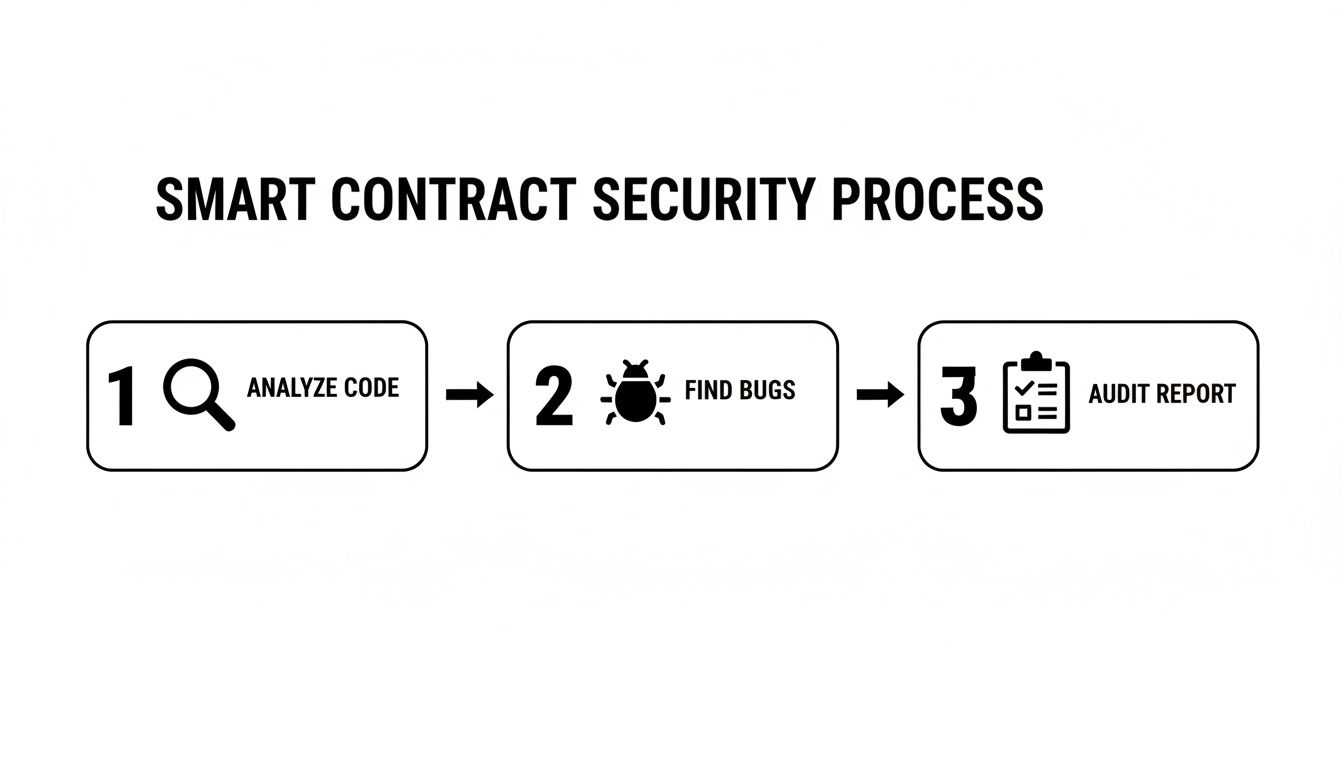
As you can see, the cycle of analysis, bug-finding, and formal reporting is what ultimately leads to a deployment that people—and potential employers—can trust.
Mastering Upgrades with Tooling
Managing proxy upgrades by hand is a recipe for disaster. Professionals don't do it manually; they use specialized tools.
The industry standard is the OpenZeppelin Upgrades Plugins for Hardhat and Foundry. These tools handle the heavy lifting:
- Deploying your implementation and proxy.
- Validating new implementations to ensure they are "upgrade safe."
- Securely executing the upgrade.
Demonstrating you can use these plugins in a technical interview proves you’ve moved beyond theory. It shows you know how to perform one of the most critical and high-stakes operations in smart contract development safely—a clear sign of a senior, production-ready engineer.
Advanced Skills That Command a Higher Salary
So you've nailed the fundamentals. What separates a good developer from a great one who commands a top-tier salary? It's tackling the high-stakes problems that unlock performance and new use cases. When you can confidently discuss these topics, you signal to employers that you are a problem-solver who can lead at the industry's frontier.
Next-Level Gas Optimization
Every operation matters. Senior engineers hunt for savings in places most don't look. This is a massive differentiator because it directly impacts a project's bottom line and user experience.
To stand out in an interview, talk about getting closer to the metal of the EVM.
- Strategic Data Packing: The EVM handles data in 32-byte slots. A savvy developer knows to manually order state variables to pack smaller types into a single slot, dramatically cutting storage costs. Mentioning this shows a deep, practical understanding of the EVM.
- Diving into Assembly (
yul): For mission-critical functions, dropping into inline assembly withyulgives you direct control over EVM opcodes for maximum efficiency. It's risky, but even mentioning your experience withyuldemonstrates an expert-level grasp of the EVM that few candidates have.
A candidate who can walk me through how they saved 20% on gas fees for a core function—either by meticulously packing storage slots or using a targeted
yulblock—is showing immense, tangible value. It proves their skills translate directly into cost savings.
Integrating Off-Chain Data with Oracles
Blockchains can't access real-world data. Oracles solve this by bringing verified information on-chain. You can't build sophisticated DeFi without them. The industry standard is Chainlink, which uses decentralized networks to prevent manipulation.
Being able to discuss oracle integration intelligently is a huge green flag for employers. Can you explain the danger of a single-source oracle? Do you know how to handle data delays? This shows you think about the full application lifecycle and its external dependencies—a key professional skill.
Architecting for a Multi-Chain World
The future is an interconnected web of blockchains. Users expect to move assets seamlessly between ecosystems. This is where cross-chain communication protocols become essential.
Understanding systems like LayerZero or CCIP puts you in an elite class of developers. These topics involve guaranteeing "atomic" transactions and managing complex security trade-offs.
Here’s what a hiring manager is listening for:
| Cross-Chain Topic | What It Signals to an Employer |
|---|---|
| Messaging Protocols | You know how to build complex dApps that span multiple chains, not just simple token bridges. |
| Atomic Transactions | You grasp the difficulty of keeping state consistent and think about failure modes—a mark of a senior architect. |
| Security Trade-offs | You can critically analyze the risks of different bridge designs, showing you're a discerning and security-conscious engineer. |
If you can confidently navigate a conversation on these subjects, you aren't just applying for a role. You're positioning yourself as a future technical leader who can guide a project through the next evolution of the internet.
Frequently Asked Questions About a Smart Contract Career
You've learned the tech and built some projects. Now, what does a real career in this space look like? Let's cut through the noise and give you the straight answers to get you hired and promoted.
Do I Need a Computer Science Degree to Become a Smart Contract Developer?
No, you absolutely do not. The Web3 world values demonstrable skill far more than traditional credentials. Your GitHub is your resume. Hiring managers want to see what you’ve built.
They’re looking for proof that you understand blockchain principles, that you’re obsessed with security, and that you can write clean code to solve hard problems.
A unique, well-documented project on your GitHub will open more doors than a diploma. Better yet, contributions to a known open-source protocol or a strong showing in an audit contest on a platform like CodeHawks are massive signals that you have the skills that matter.
Which Is Better to Learn First: Solidity or Rust?
Start with Solidity. Full stop. It's the most pragmatic path to getting a job. Solidity is the language of the EVM, which remains the dominant ecosystem by a massive margin. That dominance means more jobs, more tooling, and more learning resources.
Once you’re truly comfortable with Solidity, picking up Rust for chains like Solana will be much easier. The core logic around state, security, and immutability carries over. Mastering Solidity first gives you the foundation to become a multi-chain developer faster.
How Do I Get Hired with No Professional Web3 Experience?
This is the classic chicken-and-egg problem. You solve it by building a portfolio so strong that your lack of a "professional" title becomes irrelevant.
Here’s a career-focused roadmap:
- Build Something Real: Build 2-3 unique dApps that solve a genuine problem. Maybe it's a micro-lending protocol, a creative governance module, or an on-chain game. This is your primary talking point in interviews.
- Show Up at Hackathons: Events from groups like ETHGlobal are incredible for networking and building under pressure. A solid hackathon project is a huge credibility boost and something concrete to discuss with hiring managers.
- Contribute to Open-Source: Pick a protocol you respect and find their GitHub. Start small: fix a typo in the docs, add a test case, help sort issues. These small acts get your name in the commit history and prove you’re a proactive team player.
- Be Visible in the Community: Get active on X (formerly Twitter) and Farcaster. Share what you're learning. Write a short thread explaining a concept. Public passion and a hunger to learn will get you noticed by recruiters and hiring managers.
What Is the Expected Salary for a Smart Contract Developer?
Salaries for smart contract engineers are very competitive. Compensation varies based on experience, location, and niche, but here's what to expect.
Here's a rough breakdown of career and salary progression:
- Junior Developer (0-2 years): $90,000 to $150,000. The goal at this stage is to master Solidity and core tools, proving you can contribute to a team.
- Mid-Level Developer (2-5 years): $150,000 to $220,000. To reach this level, you must be able to work autonomously, demonstrate a deep understanding of security, and have shipped projects to production.
- Senior/Lead Developer (5+ years): $220,000 to over $350,000+, often with significant token packages. To command this salary, you must be able to lead architecture, mentor other developers, and have deep expertise in advanced topics like gas optimization or protocol design.
Keep in mind that salaries at top-tier protocols can push these ranges even higher. Many Web3 companies also offer token grants, which can add substantial long-term value to your compensation.
Ready to take the next step in your Web3 journey? At Blockchain Jobs, we connect talented developers like you with the best opportunities in the decentralized world. Find your next role in engineering, security, or protocol development. Explore the latest smart contract developer roles today.