Smart Contract Vulnerability Scanner Comparison Guide

You've just opened a pull request for a Solidity protocol. The tests pass, the contract compiles, and a scanner produces a list of warnings. During an interview, the hiring manager asks which findings matter, which are noise, and what your scanner still can't see. If your answer is “I ran the tool and fixed everything it reported,” you've demonstrated tool usage, not security judgment.
A smart contract vulnerability scanner is valuable because it gives engineers a repeatable first pass across code, bytecode, control flow, and execution paths. It's also a career signal. Auditors and protocol teams want people who can select tools against a threat model, interpret findings, validate fixes, and explain residual risk without claiming that a clean report proves safety.
Introduction Why Scanners Matter for Your Security Career
A missed scanner finding can cost more than a code review comment. It can weaken a portfolio submission, undermine an interview answer, or expose a protocol before an audit team has time to intervene. The strongest candidates don't present scanners as magic security buttons. They show how automated analysis supports architectural review, tests, manual reasoning, and remediation.
The practical standard is clear. A scanner should help you answer four questions:
- What did the tool inspect? Source code, bytecode, dependencies, execution paths, or runtime behavior.
- What did it find? A known pattern, a suspicious path, an untrusted data flow, or a property violation.
- What did it miss? Business logic, economic assumptions, authorization context, and interactions across contracts often require deeper analysis.
- What did you do next? Triage, reproduce, fix, retest, and document.
A major analysis of 246 smart contract audit findings estimated that about 78% of the most important flaws could probably be detected with automated static or dynamic analysis tools, while nearly 50% of all findings were unlikely to be found by automation, even as tooling improves. The analysis also estimated that feasible static approaches could detect 26% of the full findings set, compared with 37% for dynamic methods. These figures explain why scanners became central to first-pass workflows, but they also show why human auditors remain essential. The audit findings analysis is useful evidence to cite when you're asked whether automated tools replace review.
Hiring signal: Strong candidates describe scanner output as evidence to investigate, not as a verdict.
Scanner fluency also gives developers better interview stories. You can explain how a static finding exposed an unsafe external call, how a deeper analysis tested transaction sequences, or how a suspected issue turned out to be unreachable under the protocol's actual permissions. Those stories show prioritization and judgment, which matter more than memorizing a feature list.
For engineers moving toward auditing, scanner practice creates a bridge between implementation and adversarial thinking. A useful smart contract development career resource can help you understand the broader engineering path, but security candidates should build proof through repositories, documented findings, and reproducible test cases.
What a Smart Contract Vulnerability Scanner Does
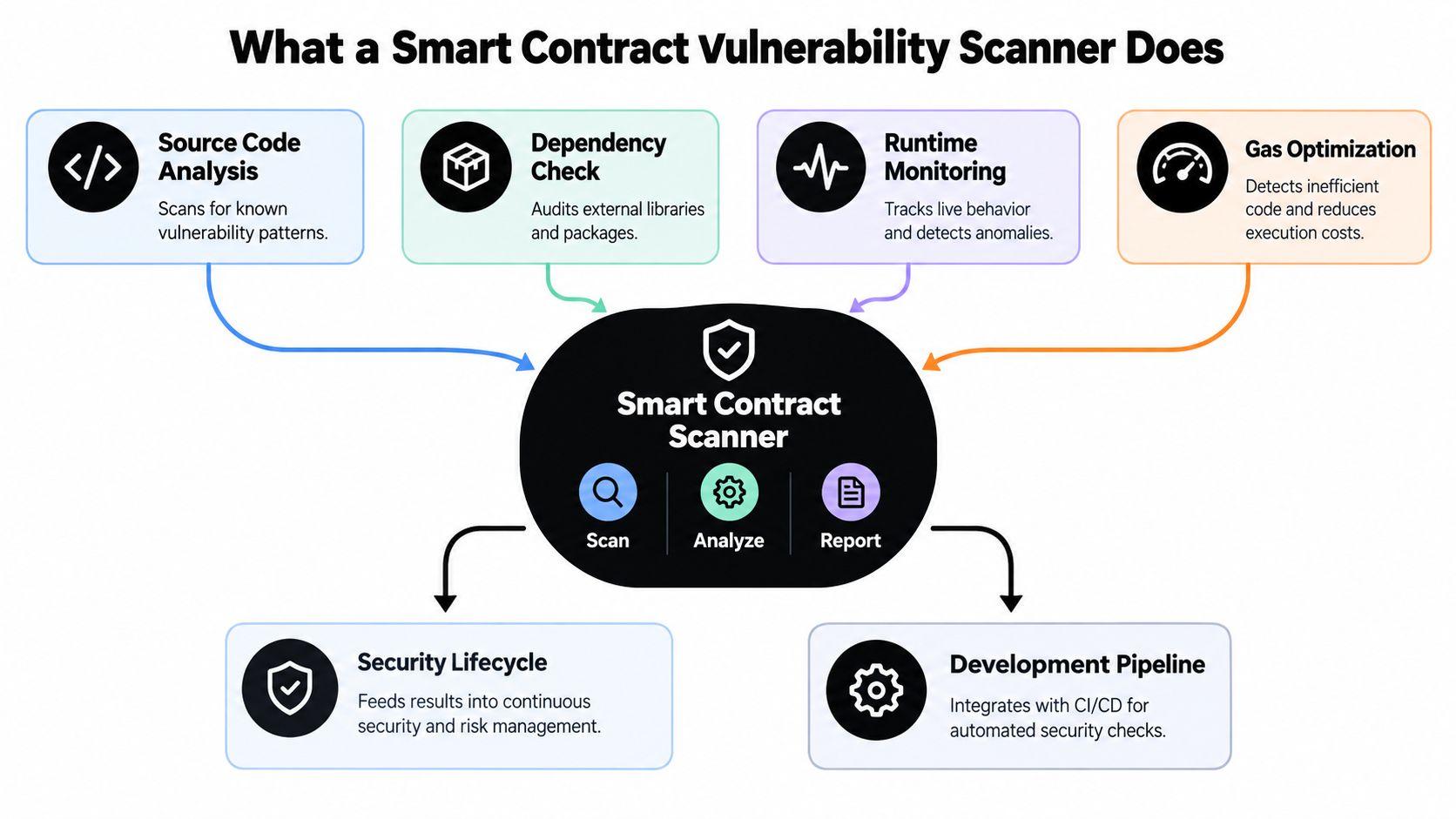
A smart contract vulnerability scanner automates security checks against the artifacts that define a contract's behavior. Depending on the product, that may include Solidity source, compiled bytecode, an intermediate representation, configuration files, dependencies, or transaction traces. The output usually contains findings, affected locations, severity labels, explanatory text, and remediation suggestions.
The scanner sits between development and full assurance. It isn't the same as a manual audit, because it doesn't reliably understand every business rule or economic assumption. It isn't formal verification, because a report of suspicious code doesn't prove or disprove a mathematically specified property. It also isn't a substitute for tests, fuzzing, deployment review, or monitoring.
Where scanning fits
Use a scanner as an automated triage layer:
- Prepare the target. Confirm the compiler version, build artifacts, contract scope, inherited code, libraries, and deployment assumptions. A scanner can't compensate for scanning the wrong commit or omitting a critical dependency.
- Run analysis. The tool searches for patterns, suspicious flows, reachable states, or other indicators of risk.
- Classify findings. Separate confirmed defects from informational warnings, unreachable paths, deliberate design choices, and environmental assumptions.
- Validate manually. Trace the affected function through callers, modifiers, state changes, external calls, and role boundaries.
- Remediate and retest. A fix isn't complete until the original finding is addressed and the change hasn't introduced a new path to failure.
This sequence gives you a credible interview answer because it explains both automation and accountability. It also creates an audit trail that another engineer can review.
What outputs mean
A finding is a lead. A high-severity label may indicate serious potential impact, but it doesn't prove exploitability in the deployed system. Conversely, an apparently minor warning can become important when it combines with an authorization flaw or a cross-contract assumption.
Teams that publish or promote Web3 products also need reliable technical distribution, not just security checks. Engineers building public portfolios can explore Web3 distribution for bootstrappers while keeping scanner reports tied to concrete code, tests, and remediation notes.
The best explanation is simple: a scanner reduces the search space. It helps humans spend review time on code paths that deserve attention, while the final security decision remains tied to architecture, threat modeling, and evidence.
How Detection Techniques Work Under the Hood
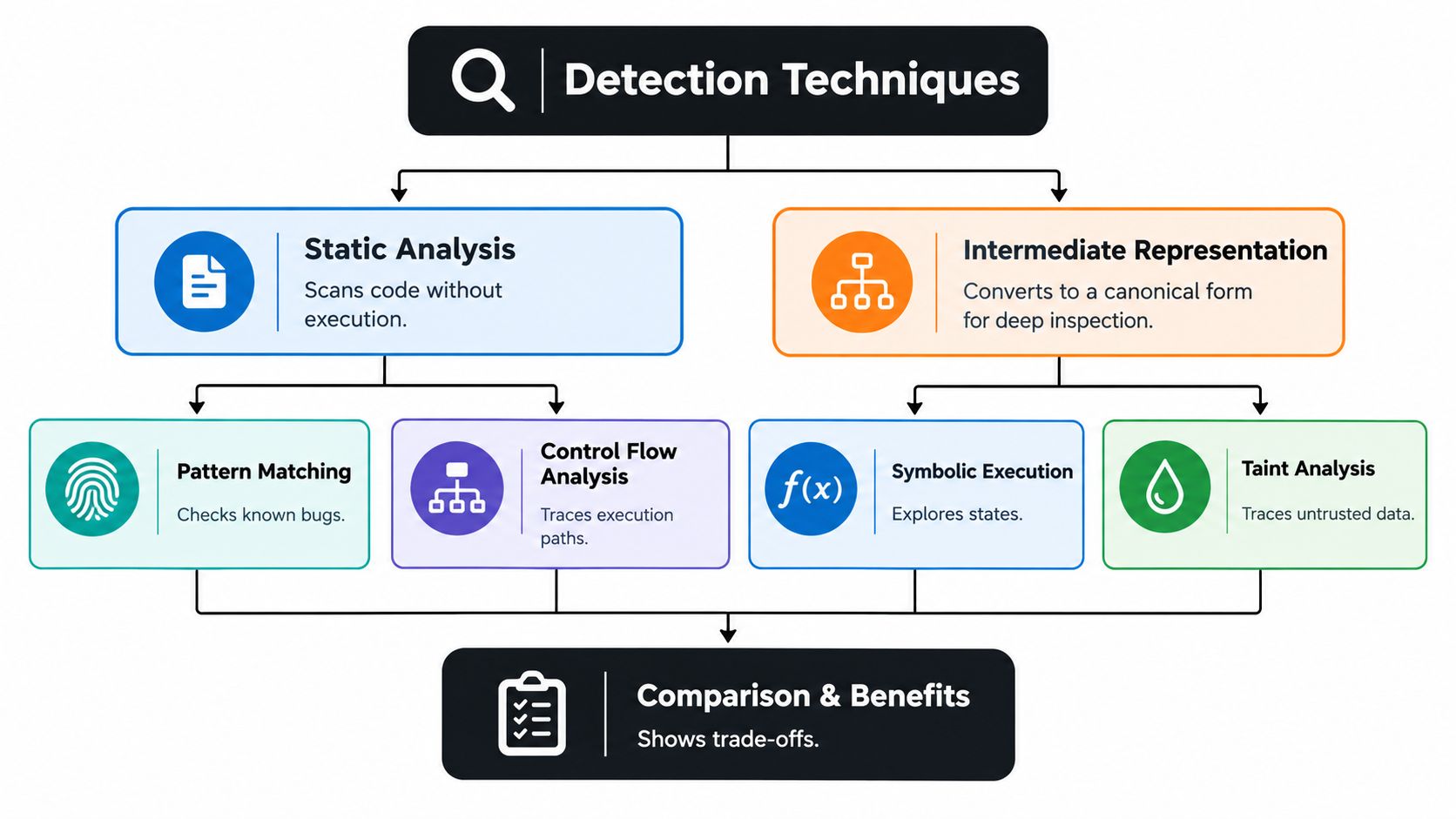
Tool selection becomes easier when you understand what each analysis method can observe. Static analysis reads code or a derived representation without executing every possible transaction. It's effective for recognizable patterns, control-flow problems, access-control signals, and coding mistakes, but it can struggle with protocol-specific meaning.
Intermediate representations translate source or bytecode into a form that makes relationships easier to inspect. That transformation can support deeper control-flow, data-flow, and state reasoning without relying only on surface syntax.
Matching patterns versus exploring behavior
Pattern matching works well for recognizable issues such as dangerous calls, unchecked results, or suspicious access patterns. It's fast and easy to integrate into pull requests. Its weakness is context. A pattern can exist in code without being exploitable because token behavior, permissions, or surrounding invariants constrain the path.
Control-flow analysis traces how execution moves through branches and functions. It can expose unreachable assumptions, risky branching, and interactions between operations. However, complex state spaces and dynamic behavior can limit what the tool proves.
Symbolic execution replaces concrete inputs with symbolic values and explores possible paths. It's useful for arithmetic constraints, transaction-order dependence, reentrancy paths, and bytecode-level behavior. Its central trade-off is path explosion. The more branches and state transitions a contract contains, the harder it becomes to explore meaningfully.
Taint analysis follows data from an untrusted source to a sensitive operation. It helps identify whether user-controlled inputs can influence privileged calls, asset transfers, or critical state changes. Taint results still require context because not every data flow creates an exploitable condition.
Dynamic, formal, and learning-based methods
Fuzzing executes contracts with varied inputs and sequences to trigger unexpected behavior. It can discover state-transition failures that a source-only scan misses, but it depends on generating useful inputs and reaching meaningful states.
Formal verification checks specified properties or invariants across modeled behavior. It can provide strong assurance for clearly defined requirements, but it demands precise specifications and can be expensive or difficult for complex systems. Engineers should understand that proving the wrong property doesn't prove the protocol is secure. The formal verification career guide provides useful context for how this discipline differs from routine scanning.
Machine-learning approaches can classify patterns across training data and assist with prioritization. They remain sensitive to data quality and novel attack patterns, so they should support, not replace, code reasoning and adversarial testing.
A recent study identified vulnerability-prediction metrics including fan-out, cyclomatic complexity, nesting depth, function calls, local variable count, coupling between contracts, average local variables, and raw lines of code. The important career lesson is that a scanner result should be read alongside code structure. Complexity and coupling don't prove a vulnerability, but they tell you where automated and manual attention may be most valuable. The Solidity metrics study documents these predictors.
Leading Scanners Compared on Accuracy Speed and Integrations
For most Solidity engineers, the practical shortlist starts with Slither and Mythril, then expands according to the protocol's chain, language, test environment, and threat model. Slither is a static-analysis scanner developed by Trail of Bits. It detects reentrancy, unchecked return values, access-control issues, unused variables, boolean-equality mistakes, dangerous delegatecalls, and more than 80 additional patterns, and it integrates with Foundry, Hardhat, and CI pipelines. Slither's documented capabilities and integrations make it a strong default for continuous feedback.
Mythril takes a deeper EVM-level approach through symbolic execution and taint analysis. It's commonly used for integer overflow and underflow, unchecked external calls, reentrancy, transaction-order dependence, and other issues that simple pattern matching may miss. Mythril's analysis profile explains why it belongs after fast triage on critical contracts.
| Scanner | Detection Approach | Coverage and Accuracy | Speed and Integrations |
|---|---|---|---|
| Slither | Static analysis and intermediate representations | Broad pattern coverage across Solidity code, with particular strength in common reentrancy and low-level-call checks | Integrates with Foundry, Hardhat, and CI. Benchmark results report strong speed, including an average scan and report time of 0.54 seconds in one evaluation. Performance evidence |
| Mythril | Symbolic execution and taint analysis on EVM bytecode | Deeper path and bytecode reasoning, useful for transaction-order and external-call analysis | Slower and more resource-intensive than a basic static pass, so use it selectively on important paths |
| Solhint | Solidity linting and static checks | Useful for coding standards and several vulnerability types, but not a complete security analysis | Fast enough for routine development feedback and pipeline enforcement |
| SmartCheck | Source-code analysis | Contributes broad triage coverage but still misses logic-heavy defects | Suitable for an additional signal rather than a single standard |
| Artemis and GNN | Source-code analysis and learning-based approaches | A 2023 Ethereum scanner study found that only five source-code-based tools, Artemis, Mythril, Slither, GNN, and SmartCheck, successfully checked at least half of the contracts in its dataset. Scanner coverage study | Coverage depends heavily on input format, supported constructs, and training or analysis assumptions |
A comparative evaluation of 10 Solidity analysis tools found that only Mythril, Slither, and Solhint detected at least six vulnerability types while maintaining an average F1-score above 80% in that benchmark. The comparative tool evaluation also compared formal verification, symbolic execution, fuzzing, intermediate representation, and machine learning. That distinction matters in interviews. You should be able to explain why a tool with broad labels may still perform poorly on ground-truth vulnerabilities.
Practical recommendation: Standardize Slither for fast feedback, add Mythril when bytecode-level depth matters, and never treat either tool as the complete audit.
Speed also varies by environment and benchmark. One large review grouped Oyente, Osiris, Slither, SmartCheck, and Solhint among fast analyzers taking roughly 5 to 30 seconds per contract on average. Another performance study reported Solmet at 28.53 seconds, Slither at 60.28 seconds, and Solhint at 77.78 seconds, while a separate benchmark reported Slither at 0.54 seconds. These differences show why candidates should name the benchmark context instead of making absolute speed claims.
Using Scanners Effectively in Your Development Workflow
A scanner earns its place when it supports a disciplined sequence. Running several tools at random creates alert fatigue. Running one tool and merging because it returned no critical findings creates false confidence.
Start with scope and architecture. Identify the contracts that hold assets, enforce permissions, manage upgrades, price positions, or call external systems. Record trust assumptions and deployment differences before scanning. If the tool analyzes only a library while the risk sits in the integration layer, the report may look polished and still be irrelevant.
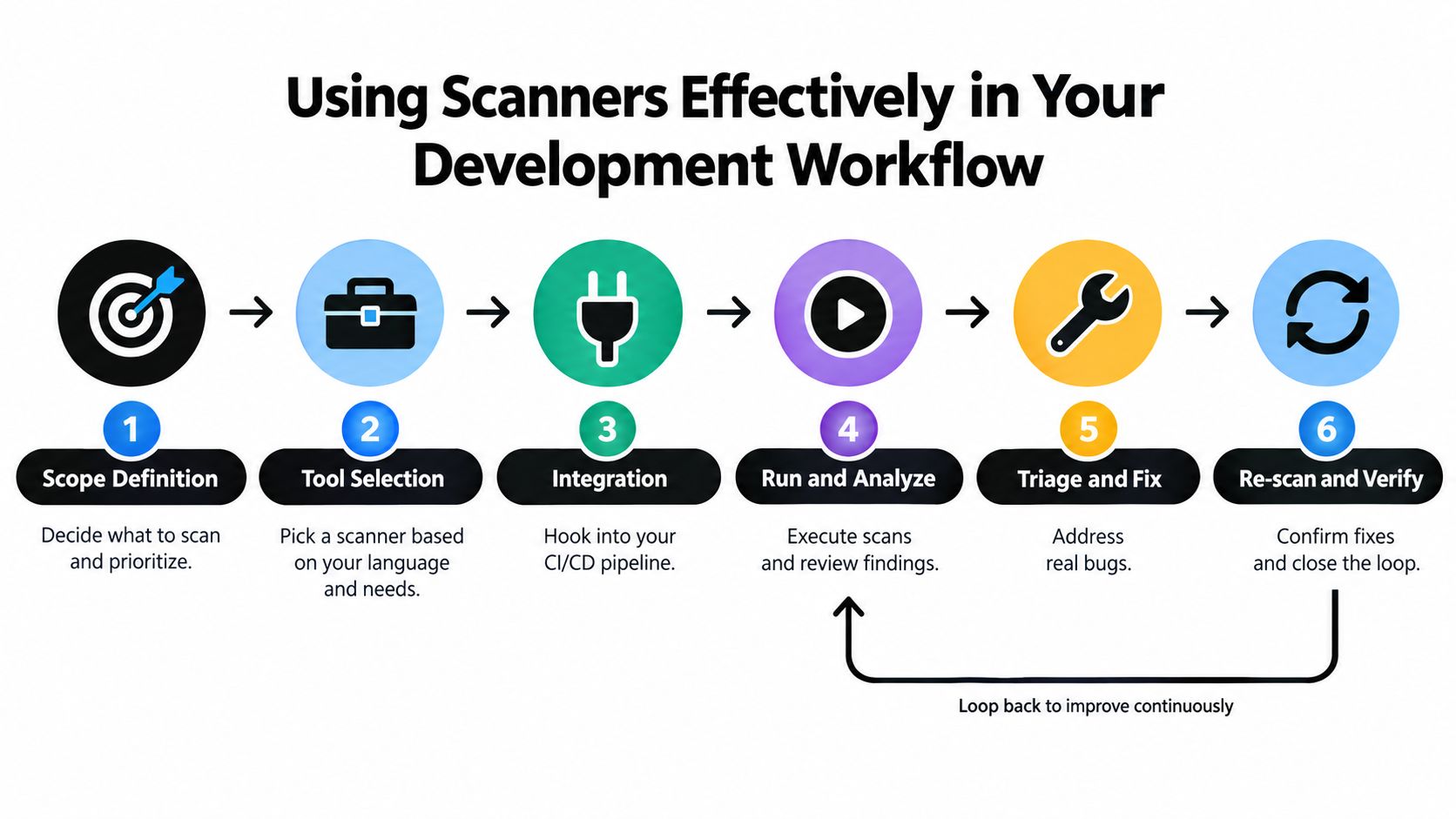
A layered operating sequence
- Define scope. Pin the commit, compiler settings, contracts, dependencies, deployment configuration, and threat model. Write down what isn't covered.
- Run Slither first. Use the fast static pass to identify High and Medium findings, suspicious external calls, permission issues, dangerous delegatecalls, and structural concerns.
- Triage every meaningful result. Trace callers, modifiers, state updates, token behavior, and reachability. Mark each result as confirmed, invalid, accepted with rationale, or requiring deeper testing.
- Use Mythril selectively. Apply symbolic execution and taint analysis to key contracts and important paths, using 2 to 3 transaction depth where the workflow calls for sequence analysis. This layered security workflow describes the sequence and triage emphasis.
- Cross-reference. Compare overlapping findings and investigate disagreements. A result reported by two tools still needs validation, while a result found by one tool may expose a capability the other lacks.
- Fix, rescan, and document. Preserve the original finding, the root cause, the patch, the test proving the fix, and the residual risk.
Audit habit: A finding without reachability analysis is an observation. A finding with a reproducer, impact explanation, and verified remediation is security work.
Integrate the fast pass into CI so developers receive feedback during review, but avoid blocking every build on low-confidence warnings. Store suppression decisions with reasons and owners. Employers notice this maturity because it shows you can operate security tooling without turning the pipeline into an unmaintainable wall of alerts.
Your portfolio should include a sanitized report with code locations, severity reasoning, reproduction steps, remediation, and a retest result. Keep the presentation readable for an auditor who didn't write the contract. Broader testing knowledge also helps when contracts depend on APIs and off-chain services, so a practical API testing guide for developers can complement your smart contract workflow.
For a formal engagement, document scope, assumptions, findings, fixes, and verification in the same way you would for a blockchain security audit. That record turns scanner familiarity into evidence of professional process.
Limitations False Positives and What Scanners Still Miss
A clean scanner report is not a security verdict. It means the configured analysis found no issue matching its rules, models, reachable paths, or assumptions. Engineers who understand that boundary earn auditor trust. Engineers who treat “no findings” as “no risk” create dangerous reassurance.
Trail of Bits' analysis of 246 audit findings shows why broad detection claims can coexist with weak defect-level coverage. A scanner may report familiar patterns across many contracts while missing the business rule, execution context, or interaction that makes a defect exploitable. The empirical scanner review supports a practical conclusion: report coverage does not equal vulnerability coverage.
Tool disagreement makes triage harder. Recent empirical work found major differences between scanners and poor performance on ground-truth datasets, even though some tools reported vulnerabilities in up to 76.78% of contracts and ran in under a minute on average. The production-trustworthiness analysis treats scanner standardization as a threat-model decision, not a popularity contest. In an interview, explain what each tool can observe, what it cannot, and how you verify the gap.
The gaps that matter most
Scanners often struggle with:
- Protocol logic. A contract can follow familiar Solidity patterns while violating its intended economic rules.
- Authorization context. A tool may flag a privileged operation without understanding governance, role separation, or deployment configuration.
- Cross-contract interactions. The vulnerability may emerge only when several contracts, tokens, or oracles behave together.
- Invariants and economic assumptions. A scanner cannot infer every property that must remain true across market conditions and transaction sequences.
- Novel attack patterns. Known-pattern detection does not guarantee recognition of an exploit that differs from its training examples.
AI-assisted scanners can improve triage for known patterns, but they do not replace expert audits. Research notes that models may generalize poorly to novel attacks and depend heavily on labeled data. Interaction-aware work has reported 93.45% F1 when ABI ground truth exists and 94.76% F1 for function-signature inference, yet those results do not remove the need for protocol-specific reasoning. The interaction-aware AI research helps demonstrate both the capability and the boundary.
Interview answer: “AI and scanners accelerate known-pattern triage. Humans still need to verify invariants, authorization, economic behavior, and cross-contract attack paths.”
Handle false positives with evidence. Record why a finding is invalid, preserve the relevant trace or code path, and improve the rule or test that would catch a real variant. That workflow shows employers you can operate security tooling without confusing alert volume with security judgment.
Choosing the Right Scanner for Your Project and Career Goals
Choose tools by risk, workflow, and the story you need to prove, not by the longest feature page.
For a solo developer preparing a pre-audit release, start with Slither in the local workflow and fix or explain every meaningful result. Add Mythril for asset-moving contracts, external-call-heavy paths, and transaction-order concerns. For a startup CI pipeline, keep the fast static pass on pull requests, enforce clear severity policies, and reserve deeper analysis for changed or high-value contracts.
Audit-firm candidates should demonstrate layered judgment. Show the scope document, the scanner configuration, the triage decisions, the manual reasoning, the patch, and the retest. Don't claim that a tool “found a vulnerability” unless you can explain reachability and impact. Hiring managers will value a candidate who rejects a false positive for the right reason more than one who lists many unverified alerts.
Your resume should name Slither, Mythril, Foundry, Hardhat, symbolic execution, static analysis, triage, and CI integration only when you can discuss how you used them. A strong interview response follows this order: threat model, tool choice, finding, validation, remediation, residual risk.
Build one compact portfolio project and make the security record public enough to inspect. That artifact will give you a sharper advantage than a generic claim that you're “familiar with smart contract auditing.”
Blockchain Jobs connects Web3 candidates with roles across security, engineering, DevOps, AI, product, and other crypto-native functions, including remote-friendly opportunities from companies building decentralized systems. Visit Blockchain Jobs to find security-focused roles where scanner judgment and audit-ready workflows can move your career forward.