Digital Assets Jobs: Your Guide to High-Paying Careers

At its core, a digital assets job is any role dedicated to creating, managing, or securing value on a blockchain. This isn't just about cryptocurrencies anymore. We're talking about a sprawling ecosystem that includes everything from NFTs to digital versions of real-world assets, and it's created a need for talent across every discipline imaginable—from engineering and finance to marketing and law.
What Are Digital Assets Jobs and Why Are They Booming?

Think of the dot-com boom. Companies were scrambling for web developers and digital marketers to build out their first websites. That’s exactly what’s happening right now in the digital assets space. A whole new financial infrastructure is being built, and companies are in a mad dash to find the talent to make it happen.
This isn't just about trading Bitcoin on an app. It's about fundamentally rewiring how we think about ownership and finance—a shift that creates massive career opportunities.
What's really lighting the fire is a perfect storm of market forces that have created a massive talent shortage. The big financial players aren't just dipping their toes in the water anymore; they're diving in. They’re actively exploring tokenization—the process of turning tangible assets like real estate into digital tokens that can live on a blockchain. As Wall Street moves into Web3, it’s creating a huge demand for people who can speak both languages: traditional finance and decentralized tech. This is your chance to get in on the ground floor.
The Forces Fueling the Hiring Surge
This hiring boom isn’t a short-lived trend. It’s built on foundational shifts in technology and finance. Understanding these drivers is critical for your job search—it helps you tailor your resume, ask intelligent questions in interviews, and position yourself as a candidate who sees the bigger picture.
Here are the key drivers you need to know:
- Mainstream Financial Adoption: Nearly every major global bank is building a digital assets division. For your career, this means roles in custody, trading, and research are opening up that require a blend of classic finance skills and new blockchain know-how.
- The Growth of DeFi: Decentralized Finance (DeFi) is building an entirely new financial system. This innovation requires brilliant engineers, product managers, and security experts. If you have these skills, you're in one of the hottest job markets available.
- Corporate Treasury Management: It's not just individuals buying crypto. As mentioned in recent congressional discussions, major corporations are now holding digital assets on their balance sheets. This forces companies to hire finance and accounting professionals who can manage this new asset class, creating entirely new career paths.
The current tax code has seriously lagged behind. Our laws are written for the traditional analog economy. It’s time to bring them into the digital era.
This urgent need for clear rules is creating a surge in demand for legal, compliance, and policy experts who can help companies navigate this new frontier—a huge opportunity if you have a background in law or regulation.
Why Your Existing Skills Are in High Demand
Here's the most important takeaway for your job search: you don't need to be a crypto-obsessed coder. That’s a total myth.
As the industry matures, it's desperate for experienced professionals from traditional fields. A great project manager, a detail-oriented financial analyst, or a savvy marketing leader brings a level of expertise that most fast-growing Web3 startups lack. Your experience is your advantage.
The real opportunity lies in learning how to apply your existing skills to this new technological landscape. This guide will show you how to frame your experience to land these roles. If you’re ready to see what’s out there, start by exploring hundreds of open roles on a dedicated platform like Blockchain Jobs.
Finding Your Place in the Digital Assets Ecosystem
Trying to navigate the world of digital assets jobs can feel intimidating. The job titles can sound abstract, making it hard to figure out where your skills fit. But the secret is that these roles are far more familiar than they seem.
The key to a successful job search is to see the digital assets world as a collection of connected sectors, each with its own specific needs. Don't get overwhelmed; focus on finding the sector that best matches your existing expertise.
The growth is staggering. As of 2025, the global digital assets market employs over 1.6 million professionals. For job seekers, the most important numbers are these: the highest demand comes from exchanges (34% of jobs), public blockchain infrastructure (28%), and DeFi platforms (21%). Focus your search on these hotspots to maximize your chances.
Mapping the Core Job Categories
To find your footing, group the endless job titles into a few core categories. This helps you translate your background into the language of Web3 hiring managers. It’s less about having years of "crypto experience" and more about demonstrating how you can apply what you already do well to solve their problems.
Let's break down the main job families:
- Engineering and Development: The architects and builders. They write the smart contracts, secure the networks, and create the foundational infrastructure. This is the most in-demand category, offering the highest leverage for skilled candidates.
- Product and Design: This group focuses on the user. They design interfaces, manage roadmaps, and work to make complex technology intuitive. If you have a knack for user experience, this is your entry point.
- Finance and Operations: The business backbone. They manage treasuries, analyze market dynamics, and navigate regulatory requirements. Your traditional finance or operations background is directly applicable here.
- Marketing and Community: In a world built on networks, community is everything. These professionals grow and engage a project's user base. If you're a storyteller and community builder, you're in high demand.
To prepare for interviews, understand where your target role fits within this structure.
Key Digital Asset Job Categories and Required Skills
| Job Category | Example Roles | Core Responsibilities | Top Skills for Your Resume |
|---|---|---|---|
| Engineering & Development | Blockchain Developer, Smart Contract Auditor, Protocol Engineer | Building and securing blockchain infrastructure, writing and testing smart contracts, maintaining network protocols. | Solidity, Rust, Go, cryptography, distributed systems, security best practices. |
| Product & Design | Web3 Product Manager, UX/UI Designer, Protocol Designer | Defining product vision, creating user-friendly interfaces, analyzing on-chain data to guide product decisions. | User research, data analysis, tokenomics understanding, wireframing, agile methodologies. |
| Finance & Operations | Digital Asset Trader, Treasury Manager, Compliance Officer | Managing corporate crypto holdings, market making, ensuring regulatory adherence, performing financial analysis. | Financial modeling, risk management, regulatory knowledge (KYC/AML), market analysis. |
| Marketing & Community | Web3 Marketing Lead, Community Manager, Developer Relations | Building and engaging user communities, creating content, managing social channels (Discord/X), running campaigns. | Content creation, community engagement, social media strategy, data analytics, storytelling. |
As you can see, the core responsibilities mirror traditional jobs. Your task is to highlight your transferable skills.
A Day in the Life: Three Key Roles
To succeed in an interview, you need to show you understand what the job actually entails. Let's look at the day-to-day reality of three high-demand roles.
1. The Blockchain Developer
A Blockchain Developer's day is a blend of deep focus and collaboration. Mornings often involve reviewing code submissions on GitHub, hunting for security flaws in smart contracts, and syncing with the team in a daily stand-up. The afternoon might be spent writing new code in Solidity or Rust, deploying contracts to a testnet, and documenting everything. To get hired, you must demonstrate both strong coding skills and the ability to work effectively in a remote, agile team.
2. The DeFi Product Manager
The DeFi Product Manager connects engineering, users, and business goals. Their day is filled with user interviews, brainstorming with marketing for a new launch, and prioritizing the product backlog with engineers. A huge part of their time is spent analyzing on-chain data to make smarter product decisions. In an interview, you must show you are data-driven and deeply empathetic to user needs in a complex technical environment.
A great Web3 product manager doesn't just manage features; they are a student of economies. Their job is to understand the intricate dance of incentives, liquidity, and human behavior that makes a decentralized protocol succeed or fail.
3. The Web3 Marketing Lead
Forget traditional ad buys. A Web3 Marketing Lead’s day revolves around community. They might start by hosting a town hall on Discord, then write a long-form thread on X (formerly Twitter) explaining a new protocol update. Later, they could be coordinating with influencers or analyzing a community incentive program. To win this role, you must prove you can build genuine engagement, not just generate clicks.
These examples show that fundamental skills are timeless. Roles like a Digital Assets Trader, for instance, blend classic financial expertise with crypto market knowledge. Map your background to these functions to find your perfect entry point.
Building the Skills That Get You Hired
Breaking into digital assets takes more than just enthusiasm. In an interview, hiring managers look for a specific mix of hard and soft skills. It’s not just what you know; it’s about proving you can thrive in an industry that moves at lightning speed. Your technical skills get you the interview; your soft skills and cultural fit get you the job offer.
Mastering the Essential Hard Skills
Your hard skills are what get your foot in the door. These are the tangible abilities that show you can do the job. To build a successful career, you must master the right technical competencies for your chosen path.
This isn't just for developers. A marketer who understands tokenomics is far more effective. A lawyer who can decipher a smart contract provides better advice. This cross-disciplinary knowledge gives you a massive advantage in interviews and on the job.
Here are the hard skills that will make your resume stand out:
- Blockchain Protocol Knowledge: You need to genuinely understand how major blockchains like Ethereum or Solana function. Be ready to discuss concepts like consensus mechanisms (Proof-of-Work vs. Proof-of-Stake) in an interview.
- Smart Contract Development: For technical roles, this is critical. Proficiency in languages like Solidity or Rust is a golden ticket. These are consistently among the highest-paid skills.
- Data Analysis and On-Chain Tools: The ability to use tools like Dune Analytics or Nansen to interpret on-chain data is crucial for roles in product, marketing, and finance. Showcasing this skill proves you are data-driven.
- Cybersecurity Fundamentals: With a history of high-profile hacks, a security-first mindset is non-negotiable for anyone involved in building a product. Mentioning this in an interview shows maturity and awareness.
This diagram helps visualize how different jobs fit into the ecosystem.
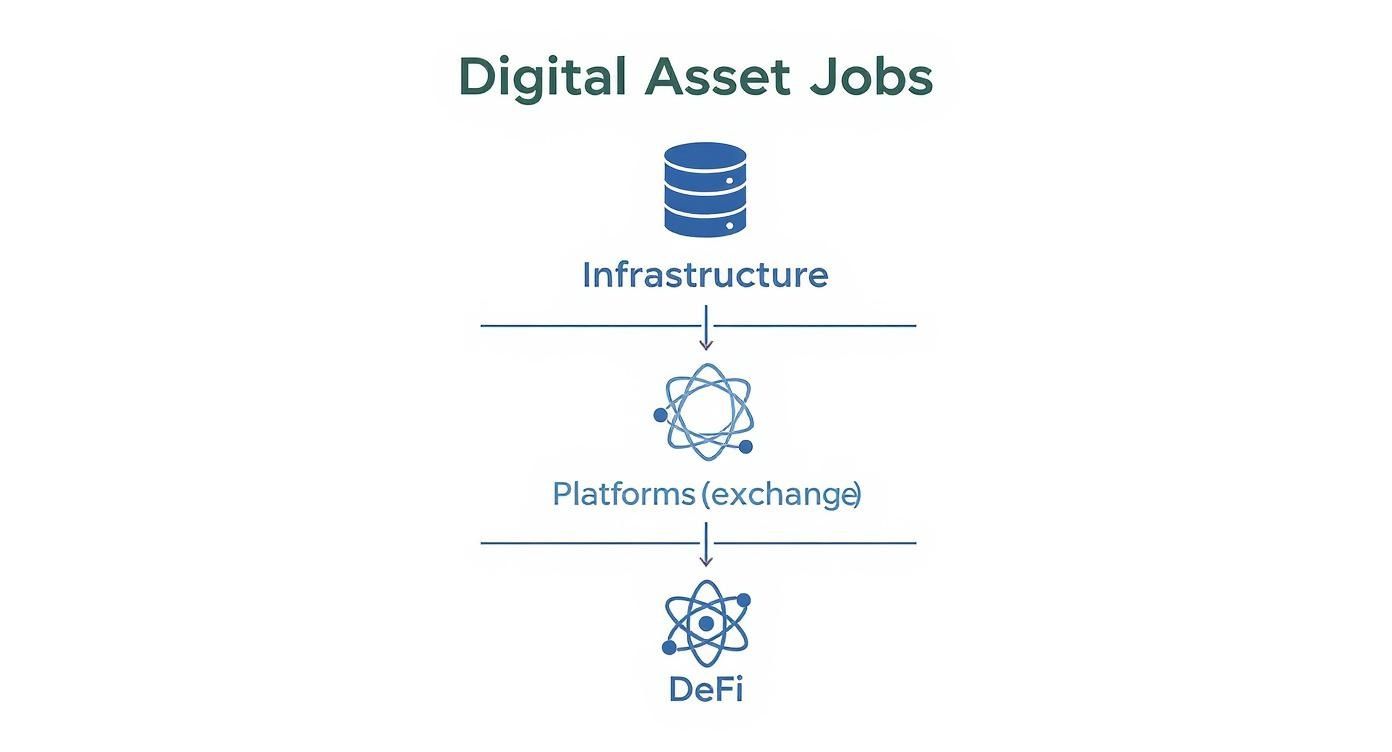
While infrastructure is the foundation, most job opportunities are at the DeFi and application layers. Target these areas in your search.
The Non-Negotiable Soft Skills
Your hard skills land you the interview. Your soft skills get you the offer and accelerate your career progression. The digital asset industry has a unique culture that values specific character traits. Demonstrating these will immediately set you apart.
The best candidates are those who show extreme ownership. In a decentralized, remote-first world, you can't wait to be told what to do. You need to identify a problem, propose a solution, and execute on it. That's the mindset that gets you hired and promoted.
Hiring managers are actively looking for these traits:
- Extreme Ownership: This is the core belief that you are accountable for your domain. In an interview, be prepared with examples of when you took responsibility for a failure, learned from it, and fixed it.
- Asynchronous Communication: Most companies are remote-first. You must be a clear, concise writer. Can you explain a complex idea in a shared document or a Slack message without needing a call? This is a vital skill for career progression.
- Adaptability and Resilience: The market is volatile, and the tech evolves constantly. Successful candidates are those who stay level-headed during market downturns and demonstrate a commitment to continuous learning.
How to Build a Winning Portfolio
Saying you have skills is one thing; proving it is another. Your portfolio is your "proof-of-work"—the concrete evidence that you can create value. This is your most powerful tool in the hiring process.
For a developer, this is your GitHub. For a marketer, it could be the Discord community you grew.
Here are actionable steps to build a portfolio that gets you hired:
- Contribute to a DAO: Find a Decentralized Autonomous Organization and start picking up small tasks or "bounties." This builds an on-chain resume that speaks for itself.
- Build a Small Project: You don't have to build the next Uniswap. A simple smart contract, a basic DeFi dashboard, or a detailed protocol analysis shows you're a builder. Aspiring developers can learn by reviewing the requirements for a Smart Contract Engineer role.
- Publish Your Analysis: Start a blog, a newsletter, or post thoughtful content on social media. Analyze protocols or market trends. This demonstrates your expertise and passion, making you a more attractive candidate.
Understanding Salaries And Hiring Trends

Let's talk compensation. Salaries in the digital assets space are extremely competitive due to a classic supply and demand imbalance: massive demand for talent and a small pool of qualified candidates.
This imbalance puts you in a strong negotiating position. The entire industry is grappling with a talent shortage, as detailed in the latest blockchain talent landscape analysis. Companies are willing to pay top dollar to attract and retain good people.
In 2025, a U.S.-based blockchain developer can expect to earn between $110,000 and $175,000 on average. This figure alone shows how much value the market places on this expertise.
Decoding The Total Compensation Package
A common mistake is fixating only on base salary. The real game-changer in many digital assets jobs is the total compensation package. To maximize your career earnings, you must understand all its components.
The true value of an offer in this industry often lies beyond the base salary. Equity and token grants are not just bonuses; they are mechanisms that align your success with the project's growth, giving you direct upside in the value you help create.
Understanding these components is crucial for negotiating your offer:
- Base Salary: Your guaranteed income. Ensure this is competitive for your experience and location before you even consider the other elements.
- Equity (Stock Options): Common at venture-backed startups, equity gives you ownership in the company. This is a long-term bet on the business's success.
- Token Grants: Unique to Web3, this gives you a stake in the project’s own digital currency. If the network you’re building succeeds, the value of these tokens could far exceed your base salary. This is a key area for negotiation.
Salary Benchmarks For Top Roles
Never enter a salary negotiation unprepared. Knowing the market rates for your role gives you the confidence to ask for what you're worth. While salaries vary, these U.S. benchmarks provide a solid starting point for your research.
Use this data to evaluate offers and frame your salary expectations.
Sample Salary Ranges for In-Demand Digital Asset Roles (US Market)
| Job Role | Entry-Level (0-2 Yrs) | Mid-Level (3-5 Yrs) | Senior (5+ Yrs) |
|---|---|---|---|
| Blockchain Engineer | $100,000 - $140,000 | $140,000 - $185,000 | $185,000+ |
| Web3 Product Manager | $90,000 - $125,000 | $125,000 - $170,000 | $170,000+ |
| Smart Contract Auditor | $110,000 - $150,000 | $150,000 - $200,000 | $200,000+ |
| Community Manager | $60,000 - $85,000 | $85,000 - $120,000 | $120,000+ |
These numbers confirm that experience is highly rewarded, but even entry-level roles offer competitive salaries that often outpace traditional sectors.
Key Hiring Trends Giving You Leverage
Several major hiring trends work in your favor. Understanding them will help you negotiate a stronger package and plan your career.
The biggest shift is remote-first work. This has erased geographic boundaries, forcing companies to compete for talent globally. This gives you access to top-tier salaries without needing to live in an expensive tech hub.
Additionally, the industry's project-based nature has created a booming market for specialized contractors. If you have niche expertise, such as security auditing, you can command high rates and enjoy greater flexibility, offering another viable career path.
Your Playbook for Finding and Winning Top Jobs
Landing a top-tier job in digital assets requires a strategic approach. It’s a game where your network and on-chain reputation often speak louder than a polished CV.
The industry was built on community, so you have to be present where the real conversations happen. The goal is to become a known, respected contributor in the right circles—often before a job is even posted.
Where the Opportunities Really Live
To find the best roles, go where founders and hiring managers spend their time. Step away from mass-market platforms and dive into the hubs of Web3 activity.
Here's a focused job-search strategy:
- Niche Job Boards: Platforms like Blockchain Jobs are purpose-built for the industry, filtering out noise and connecting you directly with relevant companies.
- X (Formerly Twitter): This is the industry’s town square. Follow founders and developers. They often signal hiring needs long before a formal job description is written. This is your intel source.
- Discord Servers: Joining the official Discord for projects you admire is non-negotiable. Most have dedicated #hiring channels where you can find openings and interact directly with the team.
Crafting Your Web3-Native Resume
In digital assets, your resume is less about corporate titles and more about your "proof-of-work." Hiring managers want to see what you’ve built and contributed to. Your GitHub profile or on-chain activity tells a more compelling story than a list of past employers.
Your on-chain resume is your most authentic professional narrative. It's a transparent, immutable record of your contributions, your interests, and your ability to navigate the ecosystem. It's the ultimate way to show, not just tell, what you can do.
A traditional resume makes a claim; a GitHub commit or a DAO voting record is hard evidence. Make these front and center in your application.
Building Connections That Get You Hired
Cold applications have a low success rate. The surest way to get an interview is to build a genuine connection with someone at the company before you apply.
Here’s a proven process:
- Identify Target Companies: Make a short list of 5-10 companies you'd be genuinely excited to work for.
- Follow and Engage: Follow key team members on X and become an active, helpful member of their Discord. Ask smart questions and offer insights.
- Add Value First: Find a small way to contribute. Spot a typo in their documentation or suggest an improvement. This simple act makes you stand out.
- Make the Ask: Once you've established a presence, reach out directly. A message like, "I've been following your work and was impressed by [specific detail]. I saw your open role for a [Job Title] and think my experience in [your skill] could help you solve [specific problem]" is incredibly powerful.
This approach transforms you from another applicant into an engaged candidate. The demand for blockchain developers is projected to grow by 22% by 2025, and this strategic effort will put you ahead. The 118% year-over-year jump in crypto job postings highlights the massive opportunity—if you know how to navigate the hiring landscape. You can explore more data on crypto hiring opportunities to refine your strategy.
How to Ace the Interview and Plan Your Career Growth

Getting an interview is a huge win, but now the real work starts. The interview process is designed to test more than just your technical skills. It’s a deep dive into how you think, solve problems, and see the future of a decentralized world. Companies are looking for candidates with a genuine passion for the industry and the grit to thrive.
Preparing for the Unique Interview Gauntlet
Interviews for digital assets jobs are different. They are more practical and forward-looking. Expect a multi-stage process that tests your real-world abilities.
Here are the formats to prepare for:
- The Technical Deep Dive: For engineers, this could be a live coding challenge on smart contracts. For other roles, it might be a case study, like being asked to map out a go-to-market plan for a new DeFi protocol.
- The Philosophical Test: Hiring managers will probe your understanding of core concepts like decentralization and tokenomics. They need to know you grasp the "why" behind the technology.
- The Visionary Conversation: Especially for senior roles, expect future-focused questions. Where do you see DeFi in five years? What are the biggest unsolved problems in crypto? They want to see if your vision aligns with the company's.
The candidates who really impress are the ones who can connect their specific role to the project's bigger picture. If you're a marketer, explain how your community strategy strengthens the network's decentralization. If you're an engineer, talk about how your code helps build a more open financial system.
Sample Questions to Rehearse
Practicing your answers to common questions is a game-changer. The goal isn't to memorize a script but to think through these topics so you can articulate your ideas clearly.
- "Explain the concept of decentralization to someone non-technical." This tests your ability to simplify a complex idea—a crucial communication skill.
- "Walk us through a time you disagreed with your team about a technical roadmap and how you handled it." This assesses your collaboration and conflict resolution skills in a remote-first culture.
- "What is your favorite dApp or protocol, and what would you do to improve it?" This is your chance to show passion, critical thinking, and product sense all at once. Be prepared with a specific, thoughtful answer.
Charting Your Long-Term Career Path
Landing the job is just step one. The real goal is building a sustainable career. Because the industry is so young, career paths are fluid, creating incredible opportunities for rapid growth if you’re proactive.
A common trajectory might see a talented Community Manager advance to a Head of Ecosystem role, managing grants and partnerships. Similarly, a skilled Blockchain Engineer could become a Lead Protocol Architect and ultimately the Chief Technology Officer.
The key to career progression is to never stop learning. By constantly picking up new skills and eagerly taking on more responsibility, you can chart your own course to a leadership position and make a real impact on the future of digital assets.
Diving into a new field brings up many questions. Let's tackle the most common ones from people looking to make the leap.
Do I Really Need a Computer Science Degree?
No, unless you're aiming for a hardcore engineering role. While a CS background is a plus for developers, the industry is starving for talent in marketing, product, legal, and finance.
What matters more is genuine passion and "proof of work." This isn't about past job titles; it's about what you've built, written, or contributed. Demonstrating an authentic understanding of the space is your key to getting noticed.
How Can I Get Experience if I Don't Have a Crypto Job Yet?
This is the classic chicken-and-egg problem, but Web3 offers a solution: just start doing the work. Hands-on experience you gain yourself is often valued more than a traditional resume because it shows genuine motivation.
Here are proven ways to build that crucial experience:
- Find an open-source project on GitHub and start contributing. Even small fixes to documentation count.
- Join a DAO and start tackling "bounties." This builds a verifiable on-chain work history that you can show to hiring managers.
- Start a blog or a thread series on X (formerly Twitter) analyzing a protocol you find interesting. This builds your personal brand and demonstrates expertise.
"The candidates who stand out are the ones who are already living and breathing this stuff. They're active in the Discords, they've actually used the products, and they can talk honestly about the real challenges and opportunities. That kind of real-world engagement is worth more than any line on a resume."
What About Job Stability? The Market Seems Crazy.
It's true, market prices are volatile. But the mission to build the underlying technology doesn't stop. Well-funded companies build on multi-year roadmaps that are not dictated by short-term price swings. The ongoing talent shortage also provides skilled professionals with significant job security.
For maximum career stability, focus on roles in core infrastructure, security, and legal/compliance. These jobs are essential regardless of market conditions, providing a solid foundation for your career.
Your journey into a digital assets career starts with finding the right opportunities. Blockchain Jobs is the go-to platform connecting top-tier talent with the best companies in Web3. You can find your next role on Blockchain Jobs.