How to Hire Rust Developers: A Complete Guide for 2024
Before you can hire great Rust developers, you have to understand why they're the bedrock of so many successful Web3 projects. It boils down to this: Rust’s core features, like memory safety and fearless concurrency, directly combat the multi-million dollar exploits and performance issues that plague the blockchain world.
Finding and hiring top-tier Rust talent isn't just a recruiting function. It's a foundational part of your business strategy, and for a developer, choosing the right Rust role is a critical career move.
Why Elite Rust Developers Are Your Web3 Moat

In Web3, a single bug isn't just an inconvenience that causes downtime. A flaw in a smart contract or a protocol can mean millions of dollars in irreversible losses. This is the reality of the space, and it’s where Rust gives your project a serious competitive advantage—a defensive "moat."
Rust was built specifically to prevent the kind of programming mistakes that open the door to security holes. Its famous borrow checker is the star of the show here. It enforces memory safety when the code is compiled, not when it's running. This single feature wipes out entire categories of common bugs, like null pointer errors and buffer overflows, all without the performance hit you’d get from a garbage collector.
For a hiring manager, this isn't just some abstract technical detail. It’s a direct line to mitigating massive financial and reputational risk. Understanding this helps you craft interview questions that probe a candidate’s grasp of these core safety principles.
Connecting Technical Features to Hiring and Career Growth
When you’re interviewing a senior Rust developer, they need to know you get why their work is so critical. You're not just looking for someone to write code; you're looking for an engineer who can architect systems that are both secure and incredibly fast. For a developer, finding a company that understands this is a sign of a strong engineering culture and a place where they can build a career.
Here’s how to translate Rust’s features into actionable insights for hiring:
Fearless Concurrency: Blockchains need to handle thousands of transactions at once. Rust’s concurrency model makes it far safer to write code that does many things simultaneously. In an interview, ask candidates to describe a time they dealt with a race condition and how Rust’s ownership model helps prevent them.
Performance Without Compromise: For networks like Solana, transaction speed is everything. Rust delivers C++-level performance. Ask candidates about performance profiling in Rust and how they would diagnose and fix a bottleneck in a high-throughput system.
A Growing, Passionate Talent Pool: The demand for Rust developers is exploding. Recent figures show a staggering 2,267,000 developers have used Rust in the last year, with 709,000 now using it as their main language. This isn't just a niche community anymore; it's a rapidly expanding talent pool for Web3. You can explore the data to see just how quickly Rust is becoming a dominant force.
For a candidate, seeing that you grasp these concepts is a powerful signal. It shows you value craftsmanship and understand that their work is mission-critical, not just another backend service. This understanding is key to attracting engineers who build careers, not just ship features.
The Strategic Imperative for Web3
There’s a reason the biggest names in the ecosystem are built on Rust. From Polkadot's Substrate framework to Solana's core infrastructure, the top projects know what they're doing. They understand that Rust's steep learning curve acts as a natural filter, attracting disciplined, systematic thinkers. Those are exactly the people you want building your platform.
When you hire Rust developers, you’re making a direct investment in the long-term security and stability of your project. For a developer, specializing in Rust offers a clear career path toward working on the most critical and challenging projects in the industry.
This playbook will walk you through the entire process, starting with how to write a job description that actually speaks to this unique group of engineers. Because before you can find them, you need to show them you speak their language.
Your Job Spec Is Your Most Important Sales Pitch

If your job description reads like a generic template, you’ll attract generic applicants. To hire rust developers who are truly exceptional, your job spec needs to speak their language and prove you understand the craft. Think of it as your first and most critical marketing document.
Too many companies fall into the trap of listing a dozen libraries and frameworks. But here’s the thing: elite engineers aren’t looking for a checklist. They’re hunting for compelling problems to solve. Your goal is to frame the role not as a set of tasks, but as an opportunity to tackle meaningful challenges and make a real impact on their career.
Nail the Job Title for Better Targeting
"Rust Developer" is far too broad. It tells a candidate almost nothing about the domain they'll be working in or the specific career path. Get specific. A precise title signals you know what you're looking for and helps attract the right kind of specialist.
- Protocol Engineer (Rust): This immediately grabs the attention of engineers who love low-level systems programming, consensus mechanisms, and core blockchain architecture. This title implies a career path towards becoming a core contributor.
- Smart Contract Developer (Rust/Anchor): This is for builders focused on on-chain logic, often within a specific ecosystem like Solana. It speaks directly to developers interested in DeFi, NFTs, and a career in application-layer work.
- Backend Systems Engineer (Rust): This targets engineers who get excited about building high-performance APIs and scalable off-chain services. This path leads to senior roles in distributed systems architecture.
When you define the role with this level of precision, you’re showing a clear vision. That clarity is a massive draw for senior talent who want to know their next job is a deliberate career step.
Sell the Problem, Not Just the Requirements
Instead of starting with a laundry list of "must-haves," describe the actual problems the candidate will get to solve. This simple shift in framing is a game-changer for attracting top talent. It elevates the conversation from "what tools do you know?" to "can you help us build this?"
A great job description is an invitation to solve an interesting problem. Top engineers are driven by challenge and impact. Show them you have both, and you'll get their attention. This is your first interview question: "Are you the person who can solve this?"
For example, don't just write, "Experience with Tokio and async Rust." That's boring.
Try this instead: "You'll own the performance of our real-time transaction engine, scaling it to handle 100,000 concurrent users and tackling complex async challenges to guarantee sub-millisecond latency." See the difference? One is a requirement; the other is a mission and a clear path to mastery.
This approach gives candidates a clear picture of what they’ll achieve and how they can grow. For a fantastic real-world example, check out this Software Engineer position at a major crypto exchange.
Show Them the Path to Career Progression
The best Rust developers are always learning. For them, a job isn't just a paycheck—it's the next step in their career. Your job spec needs to show them what that step looks like at your company.
Be explicit about the growth opportunities:
- Mentorship: Will they work alongside or learn from seasoned Rustaceans? Mention this to attract both mentors and mentees.
- Learning Budget: Do you offer a budget for conferences, courses, and books? This shows you invest in your people's career development.
- Open Source: Mention if your team contributes to open-source Rust projects. Many engineers build their reputations through public contributions, and this is a huge career plus.
- Real Ownership: Frame the role in terms of autonomy. Will they own a critical service from end to end? This signals trust and is incredibly appealing to senior engineers looking for impact.
When you articulate a clear path for professional growth, you're not just filling a seat; you're hiring for a career. In a competitive market, that’s how you hire rust developers who are truly committed.
Where to Find and Engage Elite Rust Developers
Let’s be honest: the best Rust developers aren't polishing their resumes or scrolling through job boards. They're already heads-down, building in public and solving tough problems within tight-knit communities. If you want to hire rust developers of this caliber, you have to meet them where they live—and that's rarely on LinkedIn.
A generic outreach template just won't cut it. You’re not just filling a slot; you're trying to convince a skilled engineer to join your mission. This is the pre-interview stage, where you build rapport before the first formal conversation.
Go Beyond Job Boards and Into the Code
Without a doubt, the single best place to find top-tier Rust talent is on GitHub. When developers contribute to open-source projects, they’re essentially creating a public portfolio of their skills, work ethic, and ability to collaborate. It's a pre-screened pool of candidates.
Don't just search for profiles with "Rust" in the bio. You need to dig deeper into their activity to assess their fit.
- For Web3 Infrastructure: Check out contributions to core repositories like Substrate or Solana. Also look at foundational libraries they depend on, like
tokio,hyper, orserde. - For Smart Contracts: You'll find great candidates active in repositories for Anchor (for Solana) or
ink!(for Polkadot). - For General Backend Systems: Examine contributions to popular crates that fit your needs, such as
sqlxfor database work.
When you spot a promising developer, their code is just the starting point. The real gold is in their pull requests (PRs). How do they explain the problem they’re solving? How do they handle feedback from maintainers? A thoughtful, well-documented PR is a massive signal that you’ve found a great engineer and a potential hire who collaborates well.
The most effective outreach I've ever seen starts with a genuine, specific compliment. Forget "I saw your profile." Instead, try something like, "Your recent PR in the Tokio repo that optimized the scheduler was brilliant. We're tackling similar performance challenges..." This immediately shows you've done your research and turns a cold outreach into a peer-to-peer technical discussion.
Engage Authentically in Niche Communities
Outside of GitHub, Rust developers gather in highly specialized forums and chat servers. Think of these as the modern-day workshops where they share knowledge and debug code. Becoming a value-adding member of these communities is a powerful, albeit long-term, hiring strategy.
Your goal isn't to parachute in with "we're hiring!" posts. That’s a great way to get ignored. Instead, have your engineers participate authentically to build credibility.
Key Communities to Join:
- Official Rust Discord & Forums: A great place to start. You can get a feel for the broader community and quickly see who the most knowledgeable and helpful members are.
- Ecosystem-Specific Discords: Servers for Solana, Polkadot, and Substrate are absolute goldmines. Lurk in the technical channels and see who is consistently answering questions and providing valuable insights.
- Library-Specific Communities: Many popular crates, like Tokio or Bevy, have their own dedicated Discord channels where the real experts hang out.
As you spend time in these places, you’ll start to recognize the developers who are respected by their peers. These are exactly the people you want on your team. A connection built over weeks of technical discussion is infinitely more effective than any cold email. For a clearer picture of what the market looks like, it's worth browsing dedicated engineering roles in the blockchain space to see what top companies are after.
Crafting Outreach That Actually Gets a Response
Once you've found a great potential candidate through their public work, your outreach has to be personal and respectful of their time. The best developers are bombarded with messages; yours needs to stand out by not sounding like a recruiter.
Here’s a simple, effective structure for a first message that works:
- Acknowledge Their Specific Work: Start by referencing a concrete contribution—a GitHub PR, a blog post, or an insightful comment you saw them make on Discord.
- Connect It to Your Challenge: Briefly explain the interesting problem your team is working on and why their specific skills are relevant to solving it.
- Make a Clear, Low-Friction Ask: Don’t push for a formal interview. A better approach is to ask if they’d be open to an informal chat with one of your engineers to "talk shop."
This approach shows you've invested time in understanding their work, demonstrates respect, and frames the conversation around a compelling technical challenge—the three ingredients you need to get a top-tier Rust developer to actually reply.
Designing a Vetting Process That Signals Excellence
Your technical assessment isn't just a test for the candidate—it's a test for your company. They’re evaluating you just as much as you're evaluating them. If you throw a generic puzzle at a top-tier Rust developer, you're sending a clear message: your culture values abstract brain teasers over real-world engineering.
To hire Rust developers who can actually build and ship, your vetting process needs to feel like the first day on the job, not a final exam.
The best assessments give candidates a taste of the interesting problems they'll be solving, which gets them genuinely excited about the role. This is a game-changer for experienced engineers who are looking for impact, not just another paycheck.
Before you even get to the vetting stage, you have to find these developers. The search usually starts where the code lives and moves to the communities where they talk shop.
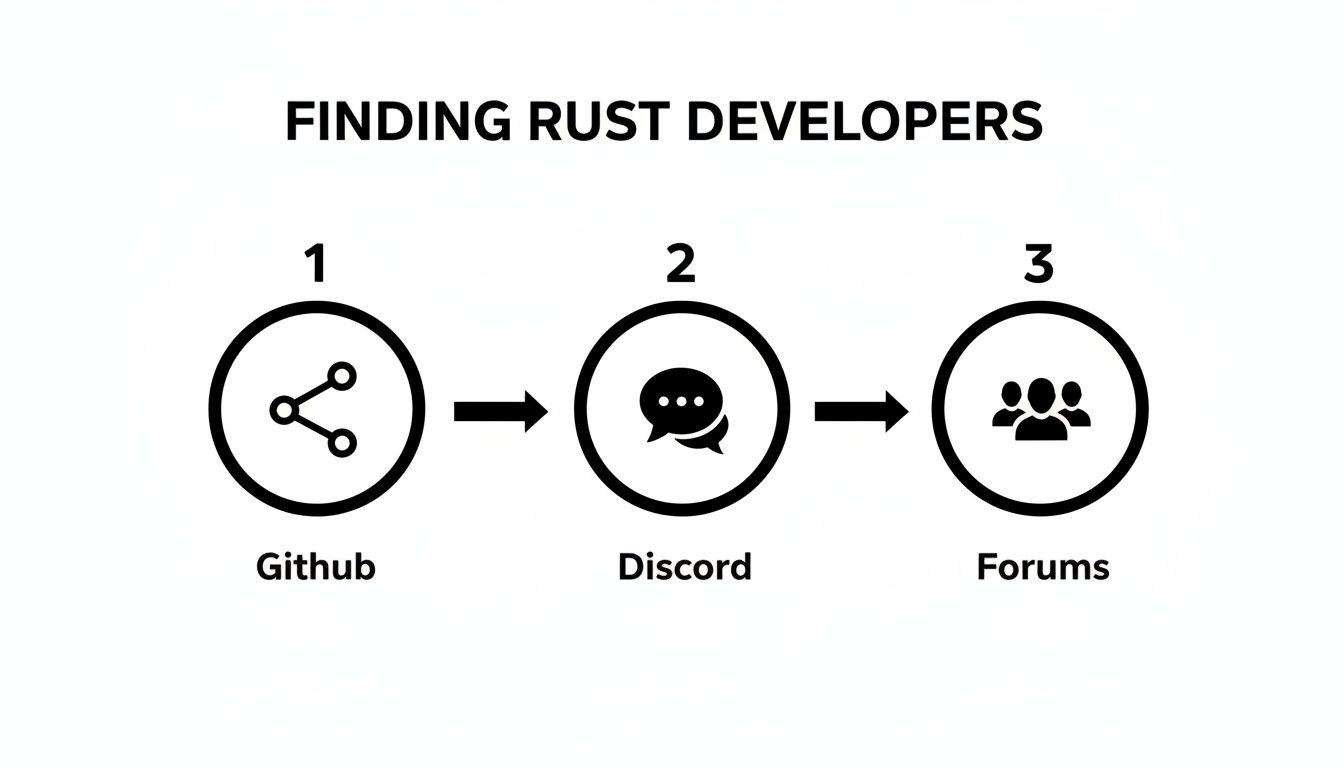
Starting on platforms like GitHub before diving into community hubs like Discord or specialized forums is a well-worn path for a reason.
Crafting a Compelling Take-Home Task
The take-home assignment is your single best chance to simulate a day on the job. Forget abstract algorithm puzzles. Instead, design a small project that directly reflects the challenges your team tackles, and which can be discussed in a subsequent interview.
For a Web3 project, this could look like:
- Build a simple CLI tool: Ask the candidate to create a command-line interface that interacts with a blockchain. This tests their ability to handle network requests, parse data, and build a clean tool.
- Create a basic Substrate pallet: For a Polkadot role, a small pallet assignment directly tests their understanding of the Substrate framework and blockchain logic.
- Implement a small piece of a protocol: Give them a simplified spec for a core component. This gets right to the heart of protocol engineering skills and provides a great basis for a technical deep-dive interview.
A good task should take no more than 3-4 hours. Anything longer signals you don't value their personal time. Always provide a crystal-clear README with setup instructions and a specific goal.
Your take-home task should be a compelling problem, not a chore. If a candidate finishes the assignment and feels like they’ve built something cool, you’ve created a powerful recruiting tool. It’s an interview question that doubles as a sales pitch for your engineering culture.
How to Evaluate Code With Precision
Once a submission lands in your inbox, your job goes way beyond checking if the code "works." You’re assessing craftsmanship. A shallow review suggests a shallow engineering culture, while a thoughtful, detailed one shows you care about quality and can provide the kind of peer review that top engineers crave.
Rust is exploding in commercial use. By 2026, 45.5% of organizations are expected to use Rust in production. Your vetting process needs to find the developers who can meet that bar. You can learn more about why Rust is a critical programming language for modern development.
To standardize your reviews and give consistent, high-quality feedback, use a checklist. It ensures every candidate is measured against the same practical standards of what makes great Rust code.
Rust Take-Home Task Evaluation Checklist
| Evaluation Criteria | What to Look For (Good Signs) | What to Avoid (Red Flags) |
|---|---|---|
| Idiomatic Rust | Uses Result and Option correctly. Leverages iterators and closures. Employs match expressions. |
Excessive .unwrap() or .expect() calls. C-style loops where an iterator is better. Overuse of .clone() hinting at a struggle with the borrow checker. |
| Error Handling | Defines custom error types (enum). Uses libraries like thiserror or anyhow wisely. Propagates errors cleanly using the ? operator. |
Panicking on recoverable errors. Returning generic String errors. Ignoring potential Result or Option failures. |
| Ownership & Lifetimes | Clear grasp of borrowing. Minimal, justified use of Rc or Arc. Lifetimes are correct and not overly complex. |
"Fighting the borrow checker" with constant .clone() calls. Arc<Mutex<T>> used everywhere without a good reason. |
| Project Structure | Code is logically split into modules. Clear separation of concerns. Tests are included and run with cargo test. |
All code dumped into main.rs. Tangled dependencies between modules. No tests, or tests that are broken. |
This checklist turns a subjective code review into an objective, fair process. It's the foundation for a productive follow-up interview, where you can ask, "Why did you choose this approach for error handling?"
The Collaborative Live Session
The final technical round should never be a whiteboard interrogation. Ditch "invert a binary tree" and run a collaborative pairing session based on their take-home project or a new, small problem. This format assesses communication, problem-solving, and teamwork—skills just as vital as coding.
Here are a couple of scenarios that work really well:
- Collaborative Debugging: Introduce a new requirement to their take-home project and work with the candidate to implement it. This shows you how they think through new problems and adapt existing code.
- Code Review Discussion: Go through the evaluation checklist together. Ask them to explain their design choices. "I see you used
Arc<Mutex>here. Can you walk me through your reasoning?" This is a great way to test their depth of understanding.
This approach completely changes the dynamic from an adversarial test to a collaborative workshop. It gives the candidate a genuine feel for your team's culture and is an incredibly effective way to close top talent when you’re ready to hire Rust developers.
Closing the Deal With a Competitive Offer

You’ve navigated the interviews, the code reviews, and the technical deep dives. You've found a fantastic candidate who gets your vision. Now for the final—and often trickiest—part: making an offer that aligns with their career ambitions.
In the hyper-competitive market to hire Rust developers, a compelling offer is so much more than a salary figure. This is your final pitch. It needs to frame the role not just as a job, but as a career-defining move. A generic offer is the fastest way to lose your top choice.
Understanding Modern Rust Salary Benchmarks
First things first: you must be grounded in market reality. Rust skills, especially with a Web3 focus, demand a premium. Trying to lowball a great candidate instantly signals that you don't value their rare expertise.
Rust consistently ranks as one of the most desired languages, and its rise in blockchain has sent salaries soaring. You can stay ahead of the curve by checking the latest insights on Rust developer salary trends and language popularity.
When you're putting together the base salary, use these benchmarks as a starting point, adjusting for location, experience, and your project's funding stage.
Mid-Level Rust Developer: An engineer with 2-4 years of experience can command $140,000 - $180,000. They are proficient in Rust but are still developing career experience in large-scale system design.
Senior Rust Developer: With 5+ years of experience, these developers bring deep knowledge of systems design, performance optimization, and mentorship. Their salary typically lands between $180,000 - $250,000+.
Principal/Lead Rust Engineer: These are your architects and technical visionaries. Compensation here often starts north of $250,000, usually supplemented with significant equity or token packages, reflecting their leadership and impact on the project's direction.
Moving Beyond Salary to Secure Top Talent
For the best Rust developers, salary is a critical piece, but it's rarely the only one. These engineers are often mission-driven, searching for roles that offer impact and career growth. This is where the rest of your offer becomes your secret weapon.
The most compelling offers are a holistic package. They combine a strong salary with incentives that align with an engineer’s desire for impact, growth, and flexibility. This shows you understand their career goals, not just your budget constraints.
Think of your offer as the complete picture of what it's like to work with you. It’s your chance to sell the unique career experience of joining your team.
Key Incentives That Drive Career Progression
When you're ready to extend that offer, these are the elements that can make all the difference. They speak directly to the career values of top-tier technical talent.
Significant Token Allocations: In Web3, this is non-negotiable. A meaningful token allocation gives developers a direct stake in its success. Frame it as co-ownership in the future you're building together.
Genuine Remote Flexibility: This isn't a perk anymore; it's the standard. Avoid saying "remote-friendly" and instead offer true flexibility. Show you trust your team and focus on output, not hours logged in a specific time zone. A quick look at other remote blockchain jobs will show you this is the norm.
Professional Growth Budget: Show them you're invested in their career. A dedicated annual budget for conferences (like RustConf), online courses, and technical books is a powerful signal that you support their growth and want them at the top of their game.
High-Impact, Open-Source Work: The chance to contribute to—or even lead—open-source projects is a huge career draw. Many top Rust developers build their reputations through public contributions. Highlighting this shows you respect their professional identity and want them to be leaders in the community.
By thoughtfully combining a strong salary with these high-impact incentives, you create an offer that’s incredibly hard to turn down. You’re not just filling a vacancy; you’re inviting a brilliant engineer to join you on a mission.
Common Questions When Hiring Rust Developers
When you decide to hire Rust developers, a few questions always pop up. Let's get straight to the answers, from a hiring and career progression perspective.
What’s More Important: Rust Experience or Blockchain Experience?
The answer depends entirely on the career path associated with the role.
For a Protocol Engineer building your core blockchain, deep Rust expertise is non-negotiable. You need someone who lives and breathes the language—someone who intuitively understands unsafe Rust, the borrow checker, and complex concurrency. This career path is about systems mastery.
But if you're hiring a Smart Contract Developer to work with a framework like Anchor on Solana, the balance shifts. These frameworks abstract away much of Rust's complexity. Here, a developer with solid blockchain fundamentals and decent Rust skills will be effective faster. This career path is about application and product building.
The unicorn candidate has both, but they're incredibly rare. For your interview process, prioritize deep systems-level Rust knowledge for infrastructure roles and blockchain domain expertise for application-layer roles.
Should We Hire Junior Rust Developers?
Hiring a junior Rust developer is a long-term investment in building your team's talent. Rust's learning curve is steep, and a junior engineer will need significant mentorship to become productive and write safe, idiomatic code.
Do not hire a junior if you do not have senior Rustaceans with dedicated time to mentor. You risk creating technical debt and burning out the junior hire.
However, if you do have that senior talent ready to mentor, hiring juniors is one of the best ways to cultivate a strong engineering culture. Pairing them with experienced pros on well-defined tasks is the fastest way to accelerate their career growth and build a loyal, homegrown team. Check for promising juniors contributing to open-source projects on GitHub—it shows genuine passion.
How Do I Assess a Candidate’s Seniority in Rust?
Seniority in Rust isn't just about years of experience; it's about the depth of understanding of the language's core trade-offs. The best way to gauge this is by asking interview questions that move from "what" to "why."
A mid-level developer can explain a concept. A senior developer can explain the trade-offs and when not to use it.
Here’s a quick breakdown of how you can frame questions in an interview to assess seniority.
Rust Interview Question Bank Examples
| Experience Level | Conceptual Question | Practical Question |
|---|---|---|
| Mid-Level | "Explain the difference between String and &str. When would you choose one over the other in a function signature?" |
"Walk me through how you would design an error handling strategy for a REST API client. What crates might you use and why?" |
| Senior | "Describe a scenario where you'd need to use Pin and Unpin. Why is this important for async code and what are the trade-offs?" |
"You've identified a performance bottleneck caused by excessive cloning. How would you approach refactoring this code to use lifetimes instead, and what potential complexities could arise?" |
| Principal | "When is it appropriate to use unsafe Rust? Discuss the trade-offs, the invariants you must manually uphold, and how you would limit its blast radius." |
"Let's architect a concurrent in-memory cache. Discuss the pros and cons of using Mutex versus a channel-based (actor) model for our specific use case." |
Ultimately, a senior Rust developer doesn't just write code that works. They write code that is idiomatic, performant, and safe. Their ability to clearly explain the why behind their architectural choices is the most telling sign of true expertise and their potential for career growth into leadership.
Finding the right talent is the single most important factor in the success of your Web3 project. At Blockchain Jobs, we focus on one thing: connecting innovative companies with the expert engineers they need to build the future of the decentralized web. Post a job today and get your role in front of a targeted audience of crypto-native professionals.