Mastering Hiring Product Designers in Web3: The 2026 Guide
Trying to hire a product designer in Web3 is a completely different beast than traditional tech recruiting. It’s not just about finding someone who can make things look good; you need someone who can translate deeply technical concepts—think gas fees, wallet signatures, and smart contract interactions—into experiences that feel intuitive and, most importantly, safe.
Get it wrong, and the consequences are brutal. A single design flaw isn't just an inconvenient bug. It can lead to irreversible financial loss for your users and shatter their trust in your project forever. This guide provides actionable insights for hiring managers to build a world-class design team.
Why Hiring Web3 Product Designers Is So Hard
Let’s be frank: finding a great product designer for a decentralized project can feel like searching for a needle in a haystack. The job demands a rare combination of skills—a deep technical grasp of blockchain mechanics married with genuine user empathy. You're not just skinning a dApp; you're designing the very foundation of trust in a trustless system.
The stakes are just fundamentally higher. In a standard Web2 app, a confusing button might cause a user to drop off or miss a feature. In Web3, that same confusing design choice could trick someone into signing a malicious transaction and seeing their wallet drained. This reality turns the hiring process into a high-stakes mission from day one.
The Scarcity of True Web3 Design Talent
Here’s the hard truth: there’s a severe shortage of designers with real, hands-on experience in this space. Plenty of people can whip up a slick Figma file, but the pool of candidates who have actually shipped a product that interacts with on-chain protocols is incredibly small.
You’re looking for someone who has wrestled with the UX of a DeFi protocol, a complex NFT marketplace, or a DAO tooling platform. This scarcity fires up a hyper-competitive market where your hiring strategy must be sharp enough to see past portfolios packed with conceptual "Web3 redesigns." For a solid baseline on the general hiring process, this hiring guide for UX Designers is a great starting point.
A designer who can actually make self-custody feel simple and safe to a complete beginner is infinitely more valuable than one who just creates a beautiful but confusing interface. The real magic is in translating the core ideas of decentralization into something anyone can approach with confidence.
Ultimately, your project's adoption lives or dies by its design. You need more than just a freelancer; you need a strategic partner who can navigate the ambiguity and chaos of building on-chain. They have to design for security, clarity, and user education all at once—a trifecta of skills you rarely find in a single person.
This is why hiring product designers in Web3 is less of a recruitment task and more of a strategic hunt for an incredibly rare kind of talent.
How to Write a Job Description That Actually Attracts Web3 Designers
If you're still copy-pasting your old Web2 job descriptions for Web3 design roles, you're fishing in the wrong pond. Hiring a product designer for a decentralized project isn’t just a slight variation of a traditional tech hire; it’s a completely different game. A generic post gets you generic applicants. What you need is a magnet for the kind of talent that already lives and breathes this ecosystem.
Think of your job description as the very first touchpoint a candidate has with your project. It's not just a list of duties—it's a window into your culture, your technical seriousness, and the mission you're on. For a candidate, this is the first test: does this company understand what it's hiring for?
Get Specific—Vague Job Titles Won’t Cut It
Let’s be honest, the title "Product Designer" is almost useless in Web3. The design challenges of a DeFi protocol handling institutional liquidity are a universe away from a DAO tooling platform trying to get more people to vote on proposals. You have to be specific right from the headline to attract candidates with relevant experience.
Instead of being generic, try titles that signal the core focus:
- DeFi Product Designer (Onboarding & Security)
- NFT Marketplace Designer (Community & Gamification)
- Lead Product Designer (DAO Governance Experience)
These titles do two things immediately: they filter for people who are genuinely passionate about that specific niche, and they show top-tier talent that you’ve actually thought through what you need. It’s a huge green flag for them and a sign of a mature hiring process.
A great Web3 job description reads less like a corporate HR template and more like a call to adventure. It outlines a mission, identifies the obstacles, and invites the right hero—your ideal designer—to join the quest.
Getting specific also forces you, the hiring manager, to define what success looks like before you even talk to a single candidate. Are you trying to boost user retention in your dApp by 20%? Or maybe your goal is to simplify the staking flow so you can cut support tickets in half. Putting these goals in the job post attracts real problem-solvers, not just people who can make pretty mockups.
Define the Right Skills and Success Metrics
Of course, they need to know their way around Figma. That's table stakes. But the real toolkit for a Web3 designer is far more specialized and mindset-driven. Your job description has to reflect this reality by describing the context where those skills are needed.
To really nail this, you need to master the art of the job post itself. For a deeper dive, this guide to writing a good job description is an excellent resource.
The core difference often comes down to a shift in focus from familiar Web2 patterns to the unique quirks of decentralization. This table shows candidates what you value.
Web2 vs Web3 Product Design Skillsets
| Skill Area | Traditional Web2 Designer Focus | Web3 Product Designer Focus |
|---|---|---|
| User Onboarding | Creating simple sign-up flows with email/social login. | Designing intuitive wallet connection and self-custody education flows. |
| Technical Fluency | Understanding front-end frameworks and API limitations. | Grasping smart contract constraints, gas fees, and Etherscan transaction analysis. |
| User Feedback | Running A/B tests and analyzing user session recordings. | Engaging with anon users in Discord/Telegram and monitoring on-chain data for behaviors. |
| Security Design | Protecting against common web vulnerabilities like XSS. | Designing against phishing, wallet drainers, and clear transaction signing intents. |
When you start outlining success metrics, tie them directly to these kinds of challenges. This elevates the role from a list of tasks to a position of genuine impact and signals a clear path for career progression.
- Weak Metric: "Create wireframes and prototypes."
- Strong Metric: "Design and validate a new onboarding flow that improves wallet connection success rate from 60% to 85% in the first 90 days."
This simple change helps a candidate see exactly how they can contribute, which is a powerful motivator for anyone who wants to do meaningful work. If you want to see how top projects are doing this in the wild, check out active listings like this Product Designer opening.
By taking this problem-first, metric-driven approach, you signal that your project is a place where a designer’s work truly matters. That’s how you attract the people who are actually ready to build the future of the web.
If you're still starting your search for a Web3 product designer on LinkedIn, you're already playing from behind. The truth is, the best crypto-native talent isn't polishing their profiles on traditional job boards. They're living, breathing, and building in the very decentralized communities you want to serve.
To find them, you have to go where they are. This isn't about cold outreach; it's about embedding yourself in their world and joining the conversation. Top designers in this space are often well-known figures in their circles, constantly sharing work, critiquing projects, and building in public.
Where the Real Designers Are (Hint: Not LinkedIn)
Let's get straight to it. A generic sourcing strategy won't work. You need to be targeted, authentic, and present in the communities where real expertise shines.
These are the hunting grounds I've seen deliver the best results, time and time again:
- Twitter (X) Circles: This is, without a doubt, the town square for Web3. Follow the influential designers, the design-focused DAOs, and the founders of major protocols. Watch for who is sharing thoughtful critiques, dropping impressive side-projects, and engaging in deep discussions about UX challenges in DeFi or NFTs. It's all happening out in the open.
- Farcaster Channels: As a truly crypto-native social platform, Farcaster is a goldmine. Jump into dedicated channels like
/design,/ux, or ecosystem-specific ones like/baseor/optimism. The signal-to-noise ratio is incredibly high, and you'll find designers sharing raw, in-progress work. - Niche Discord Communities: Yes, every project has a Discord, but the alpha is in the design-centric servers. Find the communities dedicated solely to Web3 design or specific protocols. These are the places where real peer-to-peer feedback happens. Participate, offer value, and you'll quickly spot the people who truly know their stuff.
The goal isn't to poach; it's to build genuine relationships. A thoughtful DM on Farcaster about a specific design concept they shared is infinitely more powerful than a generic "I have an opportunity for you" email.
This hands-on approach is vital because the competition is absolutely fierce. The market is white-hot, with blockchain-related job postings surging by 45% year-over-year. Product designers are at the center of this boom, driven by the frantic need for dApps that don't scare away mainstream users.
From Slick Portfolios to Meaningful Proof of Work
Once you've found some promising people, the evaluation stage begins. And in Web3, this looks different. A portfolio of beautiful, polished mockups means far less than a case study demonstrating a deep, practical understanding of the on-chain world.
You're not just hiring for visual flair. You're vetting for a very specific kind of problem-solving—one that happens in a high-stakes, technically constrained environment. Move beyond aesthetics and hunt for evidence of Web3 fluency. If you want a quick pulse check on what the market looks like, browsing current design job postings can give you a great benchmark for the roles and responsibilities top talent is pursuing.
How to Read a Web3 Case Study
When you're digging into a portfolio, it's easy to get mesmerized by slick, futuristic UIs. Don't fall for it. Your mission is to dissect their case studies for proof of real Web3 design thinking. This is your first and best chance to see how a candidate solves problems.
Here’s what I always look for to separate the true experts from the pretenders:
- Did they design around blockchain constraints? I want to see a designer who explicitly talks about challenges like gas fees, transaction latency, or the immutability of a smart contract. A great Web3 designer doesn’t just create a user flow; they architect an experience around these technical realities to make it feel effortless.
- Do they treat user security like a feature? Look for an obsession with user safety. How do they explain complex transactions to prevent users from signing something malicious? Show me designs for clear error states, transaction simulations, or stark warnings about potential scams. This is non-negotiable.
- Can they connect design to on-chain data? The best designers show how they used on-chain data from tools like Etherscan or Dune dashboards to inform their work. Did they see users dropping off at a key step in a DeFi protocol and redesign the flow for efficiency? That shows a level of sophistication that goes far beyond the surface.
Your entire evaluation rubric should be weighted heavily toward these points. A candidate who can passionately explain how they navigated a smart contract limitation to improve the user journey is infinitely more valuable than one who can only talk about typography. This is how you find the people who can truly build a bridge to the decentralized future.
Running an Interview Process That Reveals True Expertise
Once you’ve got a shortlist of promising candidates, the real work begins. You need an interview process that slices through the hype and gets to the core of a designer's Web3 capabilities. A standard interview loop borrowed from a Web2 company just won't cut it. The context is entirely different.
You're looking for someone who can navigate the wild, often-unforgiving terrain of decentralized technology. Your interview process should reflect that. It’s not just about evaluating skills; it’s a simulation of your team’s environment, testing how a candidate thinks on their feet, explains complex ideas, and tackles the unique headaches that come with building on-chain.
Staging the Interview to Uncover Depth
A great interview process is a funnel. It starts broad and gets progressively more specific, peeling back the layers to reveal a candidate's true substance. I've found a three-part structure works incredibly well for weeding out the tourists and finding the true builders.
Here's a flow that has consistently helped me identify top-tier talent:
- The Gut-Check Screen (30 minutes): This is more than an HR formality. Use this call to gauge genuine passion and "culture add." Ask about their favorite dApps and why. Probe them on the biggest UX hurdles for decentralization. You're listening for a spark and an understanding of the user's journey.
- The Portfolio Deep-Dive (60 minutes): Time to move beyond polished mockups. Ask the candidate to present one or two case studies most relevant to your project's challenges. Your role is to be the world's most curious—and slightly skeptical—user. Ask "why" relentlessly. "Why this approach?" "Why did you de-prioritize that feature?" "What would you do differently now?"
- The Live System Design Session (60-90 minutes): Drop the abstract whiteboarding puzzles. Give them a real, thorny problem your team is wrestling with right now. This session is gold. It shows you exactly how they think, collaborate, and handle ambiguity under pressure. It also gives the candidate a realistic preview of the job.
This approach ensures you’re hiring someone who can actually ship, not just someone who can talk a good game.
Asking Questions That Reveal True Web3 Fluency
Generic questions lead to generic hires. When hiring product designers for Web3, your questions need to be sharp, specific, and rooted in the real challenges of the space. You want to see if they’ve actually wrestled with the hard problems.
Here are a few questions I've found to be incredibly revealing:
- Walk me through how you would design an onboarding flow that explains self-custody to a complete beginner without scaring them off.
- Tell me about a time you had to design around a smart contract limitation. What was the constraint, and how did you solve it for the user?
- Imagine our dApp's gas fees are spiking. How would you communicate this in the UI, and what design solutions could you propose to ease user frustration?
- How do you approach designing a transaction history when some transactions might fail or remain pending for ages?
There isn't a single "correct" answer to these. You're listening for their thought process, their empathy for the user's often-stressful journey, and their practical understanding of the tech.
The Take-Home Task, Done Right
The take-home task can be a minefield. Done wrong, it’s a surefire way to alienate top talent. Done right, it’s an invaluable glimpse into their capabilities. The secret is to make it respectful, relevant, and insightful—not a request for a week of free labor.
Remember, the talent shortage is real. Product designers are among the most sought-after roles in Web3 for 2026 because great UX is the key to mainstream adoption. With an estimated 500 truly qualified experts globally for over 5,000 open roles, the best candidates won't waste their time on bloated assignments. Top positions can take 3-5 months to fill for a reason. As highlighted in these insights on the most in-demand roles from CryptoRecruit, friendly interfaces are make-or-break for dApps.
This is a good visual representation of the entire funnel, from finding candidates to assessing their work.
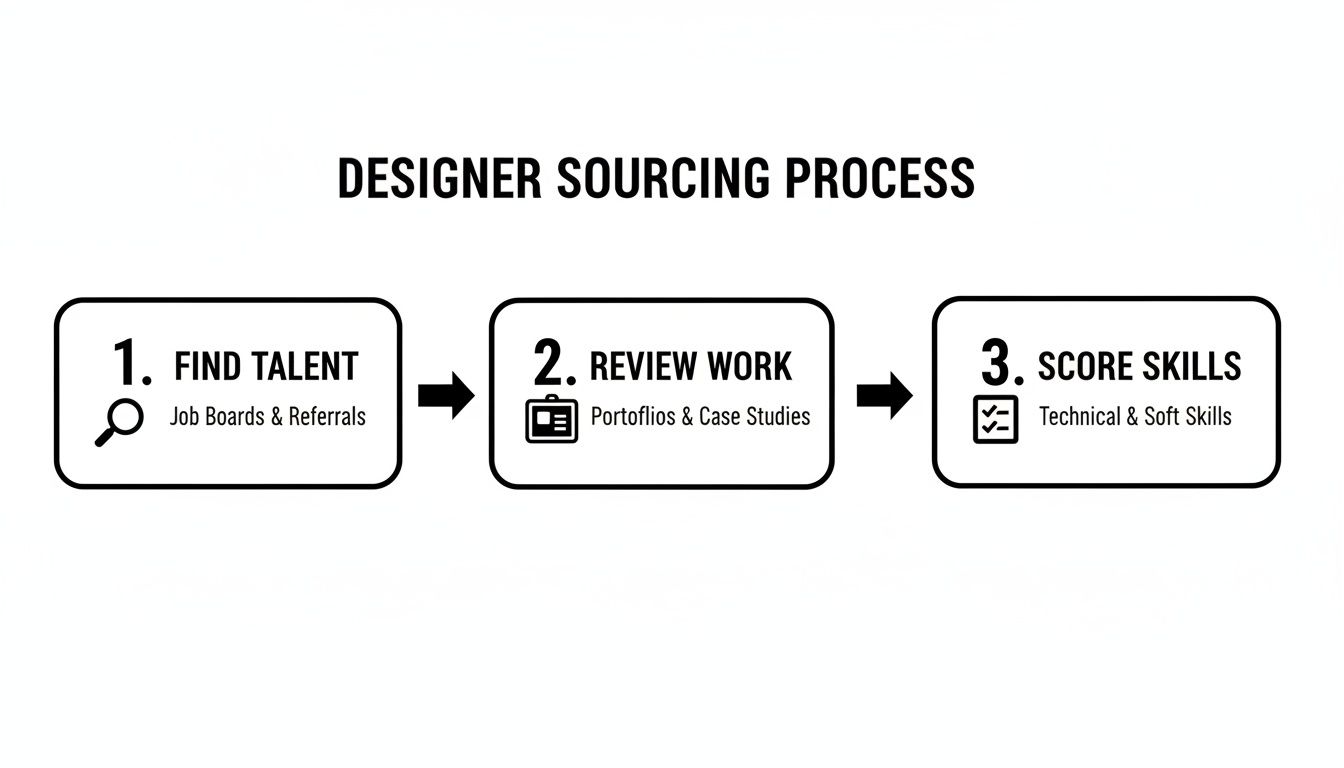
A systematic process, as shown here, is the only way to consistently make great hires.
An Effective Take-Home Task: "You have 3 hours. Our dApp currently has a confusing flow for approving a new token. Using screenshots of our current UI, create a low-fidelity prototype in Figma that simplifies this process and write a one-page document explaining your design rationale."
This prompt works perfectly. It's time-boxed, directly relevant to a real business problem, and focuses on problem-solving over pixel-perfect polish. It respects the candidate's time while giving you a crystal-clear window into how they think and communicate. And that’s exactly what you need to make a confident hire.
You’ve navigated the interviews, and you’ve found your designer. Now comes the moment of truth: the offer. In Web3, this is where you can either win the perfect candidate or lose them in a heartbeat.
Getting this right isn't just about throwing money at someone. A compelling offer shows you understand the market, respect their skills, and are offering a genuine partnership. It needs to be strong enough to pull them away from the half-dozen other exciting projects they’re likely talking to.
What a Winning Web3 Design Offer Looks Like
The compensation conversation in crypto is a different beast entirely. You’ll be talking about salary, sure, but the real needle-movers are the token incentives. If you can’t discuss both fluently, you’ll look like a tourist.
Let's talk numbers, because they tell a story. As of 2026, the average salary for a Product Designer in a crypto startup is $107,250, according to exclusive data from Wellfound. That's a full 18% higher than the $90,917 average for designers in the wider startup ecosystem. This premium is real, and it's your starting point.
Your offer isn't just a number; it's a narrative. It tells a candidate you see their value, believe in their potential, and are giving them a real stake in the future you're building together.
Of course, that's just the average. The salary spectrum is wide, starting around $50,000 for junior roles and rocketing past $264,000 for top-tier leads in places like New York. Experience is a huge multiplier—designers with a decade under their belt average $144,000, a whopping 58.4% more than their junior peers. This signals a clear career progression path based on expertise.
But salary is just the table stakes. Here’s what truly sets a Web3 offer apart:
- Tokens (Warrants or Grants): This is the game-changer. A meaningful token package is non-negotiable for most serious candidates. It aligns them directly with the protocol's success. Be completely transparent about the total grant, the vesting schedule (e.g., 4-year vest, 1-year cliff), and what that allocation represents.
- Equity: For more established companies, traditional equity can still be a powerful lure, especially when you pair it with a solid token package. It provides a different kind of stability and long-term upside.
- Performance Bonuses: These should be tied to concrete product goals. Think hitting a specific user adoption milestone or a target for on-chain activity. This makes the bonus feel earned, not arbitrary.
The Offer Is Accepted. Now What? Nailing the First 90 Days
Getting that "yes" is a huge win, but the work has just begun. A sloppy onboarding process can kill a new hire's momentum and enthusiasm, especially in a remote-first culture where so many crypto teams operate. Your mission is to get them fully embedded in your project’s culture, tech, and workflow from day one.
Since most of the best talent isn't geographically concentrated, being great at remote onboarding is a superpower. You can see how dominant this model is by browsing remote Web3 job listings. A simple 30-60-90 day plan is your best tool for this. It gives the designer a clear roadmap for success and career progression.
Your 30-60-90 Day Onboarding Framework
First 30 Days: Become a Sponge
For the first month, the designer’s only job is to absorb everything. They’re not here to ship features yet; they’re here to learn. The goal is total immersion.
- What they should be doing: Scheduling 1-on-1s with everyone—engineers, product managers, community mods. Digging through the product itself, clicking every button, and understanding its on-chain footprint. Poring over past user research, old roadmaps, and analytics dashboards.
- The goal: By day 30, they should have a solid grasp of the product, its users, and the core problems the team is trying to solve.
Days 31-60: Get a Small Win on the Board
Alright, time to get their hands dirty. Give them a small, well-defined project where they can make a tangible contribution. This could be refining a single UI component or improving a small, self-contained user flow.
- What they should be doing: Taking full ownership of that first design task. They should be presenting in design critiques and joining development sprints. Pair them with a friendly engineer to give them a direct line for understanding technical realities.
- The goal: Deliver a first small win. This builds their confidence and starts integrating them into the team’s natural rhythm of building and shipping.
Days 61-90: Start Driving a Project
By the three-month mark, the training wheels come off. Your new designer should be shifting from taking assignments to driving projects. They're ready to tackle bigger, more ambiguous challenges.
- What they should be doing: Leading the design for a more significant new feature. They should also feel comfortable enough to start proposing their own ideas based on everything they’ve learned. Look for them to start giving thoughtful feedback to other designers.
- The goal: Demonstrate clear ownership over a key part of the product. They're no longer just a new hire; they're a core part of the team, actively shaping design strategy.
Answering Your Top Questions About Hiring Web3 Designers
As you start building out your design team, some common questions always seem to pop up. Let's tackle the ones I hear most often from founders and hiring managers trying to navigate the unique challenges of finding great design talent in Web3.
How Much Should I Budget for a Senior Web3 Product Designer?
This is the big one, isn't it? Based on what we're seeing in the market for 2026, a competitive salary for a senior Web3 product designer falls somewhere between $140,000 and $250,000 a year, plus a significant token or equity package.
So, what pushes a candidate into that upper bracket? It really comes down to a proven track record. If a designer has successfully shipped dApps that people are actually using, especially in tough spaces like DeFi or blockchain gaming, they can command a premium. That deep domain expertise is incredibly valuable. This career progression from mid-level to senior is defined by the impact and complexity of the products they've shipped.
Is a Portfolio with Only Conceptual Web3 Projects a Red Flag?
Not always, but it does mean you need to dig a little deeper in the interview. A lot of sharp designers break into Web3 by creating concept projects to flex their skills and show they're serious about the space. It shows initiative.
The real acid test is the case study itself. Is it just a slick, futuristic UI layered on top of a standard Web2 idea? Or does it show a real grasp of the tech, the user's mindset, and the unique constraints of building on-chain? You have to use the interview to really probe their thinking.
Ask them why they made certain tradeoffs. Their answers will tell you everything you need to know about their problem-solving ability, which is a key indicator for any role.
What Is the Single Most Important Trait for a Web3 Designer?
If I had to pick just one, it would be adaptability—with a huge dose of user empathy. The technology, user expectations, and security protocols in Web3 are constantly shifting under our feet.
A great designer isn't just someone who's mastered today's tools; they're someone who is relentlessly curious and driven to stay ahead. Most importantly, they must be obsessed with user safety and creating clarity in a confusing, high-stakes environment. This mindset is crucial for career longevity and success in the space.
Can I Hire a Great Web2 Designer and Train Them?
You can, but it's a long and often painful road, and it depends on your team's capacity to mentor. The learning curve is incredibly steep. We're not just talking about learning Figma plugins; they need to understand everything from on-chain mechanics and technical limitations to a completely different user culture that's highly skeptical and values self-sovereignty.
For most startups, especially in the early stages, you’re much better off hiring someone who is already crypto-native. Bringing in a designer who can hit the ground running, understand the nuances, and contribute from day one is a massive advantage that will speed up your development and help you avoid common pitfalls. The investment in a crypto-native hire often has a higher immediate ROI.