
How to Build Talent Pipeline: Actionable Strategies for Web3 Hiring
Let's be honest: building a talent pipeline isn't just a "nice-to-have" in Web3. It’s your survival strategy. Forget the old model of posting a job and waiting. A pipeline means you're constantly sourcing, engaging, and building relationships with top-tier talent, even when you don't have an open req.
It’s about playing the long game. When you shift to this continuous, relationship-first mindset, you create a bench of qualified pros who are already warmed up and ready to join when the time is right. In a space where skills are this scarce and in-demand, this isn't just an advantage—it's essential for your hiring success.
Understanding the Modern Web3 Talent Landscape

Before you can even think about building a pipeline, you have to get your head around the unique world you're recruiting in. Web3 isn't just another tech niche; it’s a culture. It has its own values, its own communication channels, and its own definition of what makes a role exciting for career progression.
Throwing a job post on a mainstream board and crossing your fingers is a guaranteed way to get zero traction. Traditional recruiting tactics often completely miss the mark because they fail to connect with the core motivations of Web3 talent. These are builders, driven by a genuine passion for decentralization and a hunger to tackle massive, mission-critical problems. Your entire hiring approach, from the first contact to the final interview, has to mirror that, emphasizing your vision over a boring list of responsibilities.
The Great Skill Mismatch
Let's talk numbers, because they paint a stark picture for hiring managers. The demand for seasoned blockchain talent is absolutely crushing the available supply. The Web3 industry now counts over 460,000 professionals globally, with a staggering 100,000 of those roles added in the last year alone. Even with that growth, 60% of crypto employers report that they can't find enough senior blockchain engineers. The gap is real.
This scarcity means you're in a dogfight for talent. The best engineers, product managers, and security experts aren't scrolling through job boards; they’re fielding multiple inbound offers. They are almost always passive candidates because opportunities constantly find them.
Key Takeaway: A smart pipeline strategy starts by accepting this reality. Your job isn't to find candidates when you have a need. It's to build genuine relationships with them long before they even consider their next career move.
Where to Find Your Next Hire
So, where do you find these people? The answer might surprise you. Smart companies are looking just outside the crypto-native bubble. A massive 70% of new crypto professionals are actually migrating from adjacent fields like Web2 and traditional finance.
These are people with rock-solid skills in engineering, finance, or product who are curious and ready to apply their experience to the unique challenges of a decentralized world. This is a massive opportunity for your pipeline. By actively targeting this group, you can:
- Dramatically expand your talent pool: Look beyond the usual suspects to find world-class developers and managers who are ready for a new career challenge.
- Find highly adaptable skill sets: People from fintech, cybersecurity, and large-scale platform engineering can often get up to speed incredibly fast, making them prime candidates for career progression.
- Inject fresh thinking: Talent from outside the core crypto community brings new perspectives that can be invaluable for innovation and problem-solving during the hiring process.
Building a pipeline is more than just collecting names in a spreadsheet. It's about spotting these career transition points and creating clear, compelling pathways for skilled people to join your project. For a deeper dive on how to position your company culture to attract this talent, check out the insights on the Blockchain Jobs blog. Getting these foundational dynamics right is the first real step in learning how to build a talent pipeline that actually works for hiring.
Defining Your Ideal Candidate and Tech Stack

Before you write a single job post, you need to know exactly who you're looking for. A strong talent pipeline is built on a foundation of extreme clarity. In a market this fierce, tossing out a generic job description with a laundry list of skills is a recipe for failure. You need a detailed blueprint to guide your hiring.
This isn't just about listing qualifications; it's about crafting a true candidate persona. Think of it as a character sketch of your ideal hire. This persona becomes your north star, guiding how you source candidates, what you ask in job interviews, and how you align your entire hiring team. It’s the difference between hoping the right person applies and actively attracting them.
From Vague Job Post to Precise Candidate Persona
Stop thinking in terms of job titles. The day-to-day of a "Blockchain Engineer" at a DeFi protocol is worlds apart from one at an NFT gaming company. To get specific, pull your technical leads and hiring managers into a room and hash out the details.
Drill down with questions like these:
- What is the one critical problem this person must solve in their first 90 days to succeed?
- In one year, what does successful career progression in this role look like? What code have they shipped? What features have they launched?
- What personality traits are non-negotiable for our team? Are we looking for deep autonomy, relentless curiosity, or a passion for open-source contribution?
- What specific projects or ecosystems would a perfect candidate already be active in?
Answering these questions transforms your entire search. Suddenly, you’re not just looking for a "Solidity Developer." You're looking for an engineer who has experience optimizing gas fees for complex smart contracts and who actively follows, or even contributes to, EIPs (Ethereum Improvement Proposals). This level of detail is the first real step in learning how to build a talent pipeline that brings in top-tier talent.
By creating detailed personas, you're not just writing a job description; you're creating a magnet. It pulls in candidates who see a reflection of their own ambitions and skills while repelling those who would be a poor fit. This precision saves everyone time in the interview process.
Mapping Your Tech Stack to Reality
With your persona in hand, it's time for a reality check against your tech stack. The Web3 talent market is incredibly fragmented, and the demand for certain skills can completely outstrip the available supply. The programming languages you choose will directly impact how difficult—and expensive—it is to hire.
The numbers don't lie. While you might see 80-120 applicants for a non-technical role, it's not uncommon to get 200-400 for a technical one. The catch? The pool of proven talent for in-demand languages like Solidity, Rust, and Go is so small that demand can exceed supply by more than 2x.
This scarcity is what drives salaries through the roof. The average U.S. blockchain developer earns $146,250 annually, with experienced senior talent commanding over $200,000 plus significant equity. You can explore more about these global talent trends and what they mean for your strategy.
To give yourself a fighting chance in hiring, you have to be pragmatic. This means having an honest internal discussion about which skills are absolute must-haves versus which are simply nice to have.
- Must-Have: The non-negotiable, core language of your protocol (e.g., Solidity for an EVM-based dApp).
- Nice-to-Have: Experience with a secondary ecosystem you might explore in the future (e.g., Solana/Rust).
- Trainable: Foundational skills a great engineer can pick up quickly (e.g., a specific DevOps tool or library), offering a path for career progression.
The table below breaks down some of the most critical roles you’ll likely be hiring for, giving you a clearer picture of the responsibilities and skills involved.
Critical Web3 Roles and Skill Requirements
| Role Title | Core Responsibilities | Essential Languages & Skills |
|---|---|---|
| Blockchain Engineer | Designing, developing, and deploying smart contracts and blockchain protocols. Ensuring network security and performance. | Solidity, Rust, Go, C++, Vyper, Smart Contract Auditing, Cryptography |
| dApp (Frontend) Developer | Building user-facing interfaces for decentralized applications that interact with smart contracts on the backend. | JavaScript/TypeScript, React.js, Vue.js, Ethers.js, Web3.js, GraphQL |
| Protocol Researcher | Analyzing new cryptographic methods, consensus algorithms, and tokenomics models. Writing whitepapers and technical specs. | Deep knowledge of cryptography, game theory, distributed systems, economics |
| Smart Contract Auditor | Performing security analysis and code reviews of smart contracts to identify vulnerabilities and potential exploits. | Solidity, Formal Verification Tools (Slither, Manticore), Fuzzing, Gas Optimization |
| DevOps/Infrastructure Engineer | Managing and automating the infrastructure for nodes, testnets, and deployment pipelines in a decentralized environment. | Docker, Kubernetes, Terraform, Ansible, CI/CD, Node Operation, Cloud (AWS, GCP) |
This clarity helps focus your job interviews on what actually matters. Instead of immediately disqualifying a brilliant engineer who hasn’t used one specific library on your list, you can evaluate their core problem-solving skills and their ability to learn. In this industry, those are the two traits that truly predict long-term success and career progression.
Sourcing Talent Where Web3 Natives Actually Live
Let’s be honest: top-tier Web3 talent isn't scrolling through LinkedIn or traditional job boards. If you want to build a serious talent pipeline, you have to meet them on their home turf—the decentralized communities where they're already building, learning, and collaborating. This means you need to stop thinking like a traditional recruiter posting job ads and start acting like a genuine community member.
Your goal is to build real relationships and establish your company's credibility long before you even have an open role. You're not just hunting for candidates; you're becoming a known, trusted face in the ecosystem, making future hiring conversations much warmer.
This strategy really boils down to three core activities: getting involved in niche communities, making the most of hackathons, and establishing a presence in key developer hubs. The best sourcing strategies weave these channels together into a continuous flow.
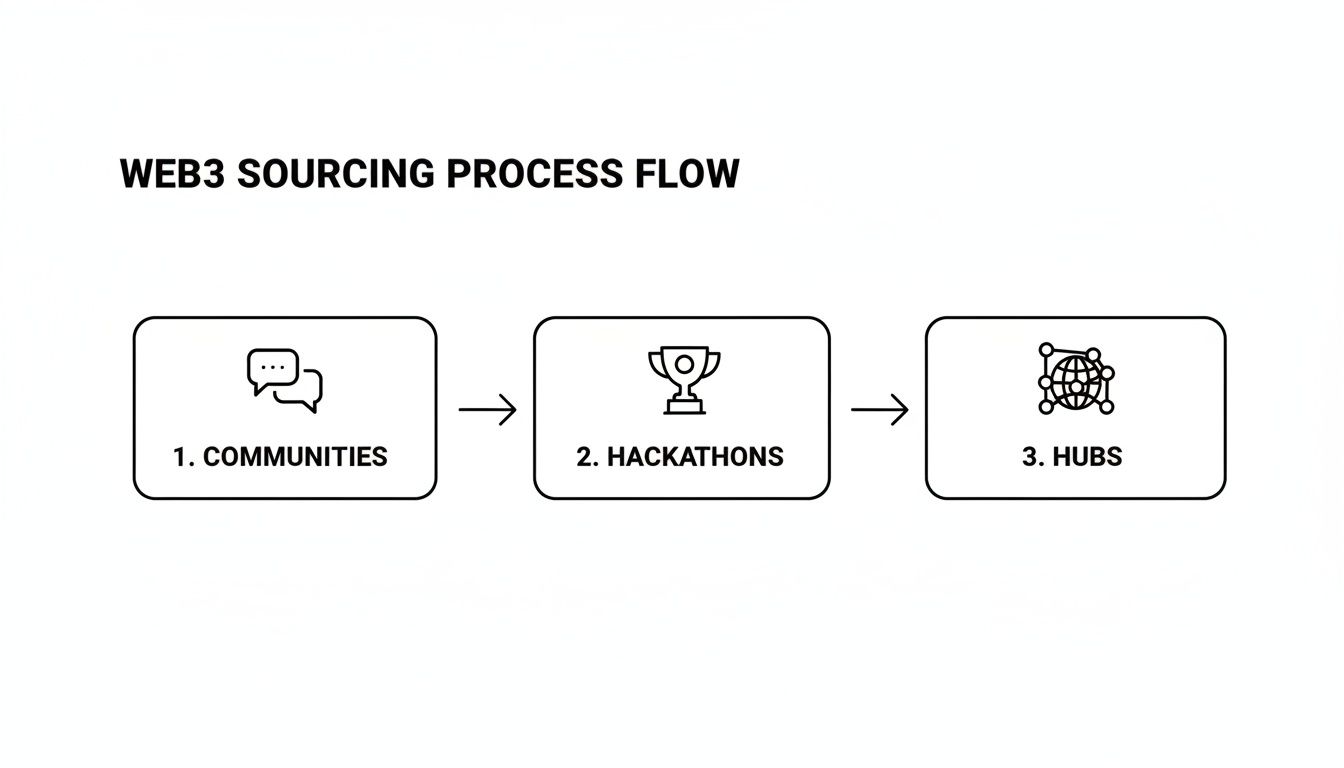
Think of it as moving from broad community engagement to pinpointing high-potential individuals through competitive events and focused developer networks.
Dive Into Niche Communities
Your first stop should be the digital town squares of Web3. I'm talking about platforms like Discord, Telegram, and Farcaster. These aren't just chat rooms; they're buzzing centers of innovation where developers are sharing alpha, collaborating on side projects, and pushing the space forward.
For example, a talent network like Superteam has become an absolute powerhouse for connecting projects with proven contributors. Getting active in groups like this gives you a direct line to people who are demonstrating their skills in real-time.
Here’s an actionable hiring approach:
- Give before you ask. Jump into conversations, answer technical questions, and share resources. Offer thoughtful feedback on projects people are sharing. Don't be the person who just lurks or, even worse, spams job links.
- Spot the top contributors. In every community, there are a handful of people who consistently provide the best answers or share the most impressive work. These are your future A-players. Keep a running list of potential candidates.
- Build your personal brand. Become known as that helpful, knowledgeable person from your company. When you build that kind of trust, it translates directly into hiring power down the road.
When you do eventually reach out about an opportunity, you're not a stranger cold-messaging them—you're a respected peer they already know.
Turn Hackathons Into a Hiring Engine
Hackathons are goldmines for talent. They're a high-pressure, high-energy environment where you can see a developer’s raw problem-solving skills, their ability to work in a team, and their grit to ship code under a deadline. These are things you just can't screen for in a typical job interview.
But don't just slap your logo on a banner and call it a day. Get involved.
- Be a Mentor or Judge: This is your chance to get a firsthand look at how developers think and collaborate. By offering your team’s expertise, you’ll see who asks the smart questions and who works well with others.
- Host a Targeted Bounty: Create a specific challenge for participants to solve using your project's tech. The quality of the submissions is an instant filter for both technical skill and genuine interest in what you're building.
- Keep an Eye on All the Standouts: Obviously, you’ll track the winners. But don’t stop there. Follow their careers and add them to your pipeline even if you don’t have an immediate opening.
My biggest piece of advice: Look beyond just the winning teams. Some of the most brilliant engineers I've met were on teams that didn't win but built something technically exceptional or incredibly creative. These are often the hidden gems for your hiring pipeline.
Become a Fixture in Key Hubs and Ecosystems
Certain blockchain ecosystems are absolute magnets for talent. The Solana ecosystem is a perfect case study. By 2026, Solana had attracted 22% of new crypto developers, a surge fueled in part by a $60 million fund for hackathons and accelerators. It's proof that investing in an ecosystem directly grows the talent pool within it.
With 87% of blockchain companies now operating with fully distributed teams, sourcing from these global hubs isn’t just a good idea—it’s essential for hiring.
You should also be looking at other valuable talent hubs:
- University Blockchain Clubs: Partner with top universities. Offer to give talks, sponsor student projects, or provide mentorship. This connects you directly with the next generation of builders before they even hit the job market.
- Angel Investor and VC Networks: These groups have early access to promising projects and their talented founders. Building relationships here can lead to warm introductions to some incredibly high-caliber people.
By embedding your company in these communities, hackathons, and hubs, you shift from passively searching for candidates to actively building a pipeline of pros who are already familiar with and excited about your work. For teams ready to scale, it's also worth looking at this list of leading companies in the blockchain space to see how others are positioning themselves to win over top talent.
Building an Engagement and Nurturing Engine

Finding brilliant developers in a late-night Discord channel or seeing a killer project at a hackathon is an incredible feeling. That's the easy part. The real work begins now: keeping those people interested in your project for the long haul. A name on a spreadsheet isn't a pipeline; it's a static list that gets stale fast. The only way to build a talent pipeline that actually works is to create a living, breathing system for nurturing those connections.
This "engine" doesn't have to be complicated. It could be a meticulously organized spreadsheet or a full-blown Applicant Tracking System (ATS) or CRM. Honestly, the specific tool is less important than the commitment to the strategy. Your goal is to shift from a passive list of names to an active community of people who are genuinely excited to get an email from you when the right job finally opens up.
From Cold List to Warm Community
At its heart, a nurturing engine is all about consistent, valuable communication. Let me be clear: this is not about spamming job alerts. It's about giving before you ask. You need to provide content and updates that prove you're a serious technical team and a fantastic place to build a career.
Think about it from the candidate's side. They meet your lead engineer at a conference, have a fantastic conversation, and connect on Farcaster. Then... radio silence. In most companies, that's where the story ends. Six months later, a job opens up, but by then, that talented person is long gone.
A nurturing engine flips that script. Instead of silence, that same developer gets a monthly email with deep dives from your engineering blog. They get an invite to a private Q&A with your CTO. They see real, tangible project updates that prove you're shipping. So when you finally do reach out about a role, it’s not a cold ask—it's the next logical step in a conversation you've been having for months.
Actionable Nurturing Strategies
Keeping your talent pool warm requires a thoughtful mix of automated touches and genuine, personal outreach. Authenticity is everything in this space.
Here are a few hiring-focused strategies that work wonders:
- Segmented Content Mailings: Never blast the same email to everyone. A frontend dev will want to read about your new dApp's UX, while a protocol researcher is looking for your whitepaper on a new consensus model. Tailor your content to their career interests.
- Exclusive Project Previews: Give your pipeline an insider’s look at what you’re building. This could be a quick Loom video walking through a new feature or a sneak peek at a tricky problem your team just solved. It makes them feel like part of the inner circle.
- "Ask Me Anything" (AMA) Sessions: Once a quarter, host an exclusive AMA with your founders or technical leads just for your talent community. This gives candidates priceless access to your company's core visionaries and culture before a formal job interview.
- Celebrate Their Work: This one is huge. If you see someone in your pipeline ship a cool side project or publish a great article, send them a personal note. A simple "Congrats, this is awesome work!" shows you see them as a peer, not just a potential hire.
Remember, the goal of nurturing is to build a relationship, not just a database. Every interaction should provide value to the candidate. If your outreach feels like a sales pitch, you're doing it wrong. People in Web3 can spot inauthentic engagement from a mile away.
Building Your Employer Brand
Every email, every technical blog post, and every social media reply shapes your employer brand. Your brand isn't a slick logo or a corporate mission statement; it’s the story people tell about you, built from every single interaction. A powerful employer brand is what convinces a top candidate to accept your offer over a competitor's, even for similar pay.
In Web3, your two most powerful brand assets are your technical vision and your company culture. Your nurturing content should hit on these two pillars again and again.
Showcase Your Technical Vision:
- Publish technical deep dives on your engineering blog. Go into the weeds and show the complexity of the problems you're tackling.
- Open-source a tool your team built. Write about the why behind it and how other developers can benefit from it.
- Share your project roadmap and the technical strategy behind your biggest milestones. This helps candidates visualize their potential career progression with you.
Highlight Your Company Culture:
- Spotlight your team members. Talk about their career journeys and the cool stuff they’re working on.
- Post behind-the-scenes content from team offsites, hack days, or even just a typical stand-up.
- Be radically transparent about your company values, especially when it comes to autonomy, ownership, and remote work policies.
When you do this right, your talent pipeline becomes more than just a recruiting list—it becomes a powerful brand-building machine. By focusing on genuine value and showing what makes your project unique, you'll attract people who aren't just looking for a job, but are looking for a role specifically with you. That’s the ultimate win for any hiring team.
Designing an Interview Process That Attracts Top Talent
Let's be blunt: your interview process is a two-way street. For every question you ask a candidate, they’re asking one about you. A slow, disorganized, or generic loop will send top-tier Web3 talent running straight to your competitors. It happens all the time.
Crafting a sharp interview process is foundational to learning how to build a talent pipeline that actually converts. In a world as small and interconnected as Web3, the candidate experience is everything. A single bad review can poison the well, while a great one can turn a rejected applicant into an advocate who sends other top people your way.
Smart Screening for a Builder's Mindset
The initial screen is your first line of defense. The goal isn’t to grill them on technicals right away, but to quickly separate the genuine builders from the tourists. You need to filter for the right mindset.
Forget the tired, generic questions. This stage is all about probing for real motivation and passion.
- Look Beyond the Resume: Ask them what they're building in their spare time. Which open-source projects have they contributed to? Who do they follow on Twitter or Farcaster and why?
- Probe for Genuine Passion: My favorite question is, "What was the last technical problem you solved that you were truly excited about?" Their answer will reveal more about their love for engineering than any scripted response about career goals.
- Check for Ecosystem Fluency: Ask which protocols they admire and why. A candidate who can passionately articulate the technical trade-offs between different Layer-2s is showing a level of deep engagement that a resume simply can’t.
This first conversation sets a crucial tone. It signals to the candidate that you care about the same things they do: building cool stuff and solving hard problems.
Designing a Web3-Native Technical Assessment
Most traditional coding challenges completely miss the mark for Web3 roles. A generic algorithm puzzle doesn't tell you if a developer truly understands the security risks of reentrancy or how to obsess over gas optimization. Your technical assessment has to reflect the unique challenges of building on-chain.
Instead of a cookie-cutter test, think about designing an assessment that mirrors the actual work they’ll be doing day-to-day.
Example Scenario: Hiring a Solidity Engineer
Don't give them a standard "solve this puzzle" challenge. Instead, provide a small, pre-written smart contract that contains a few subtle vulnerabilities. Their task isn't to code from scratch, but to perform a mini-audit.
- The Task: "Review this Solidity contract for a simple staking dApp. Identify at least three potential security flaws and one area for gas optimization. Document your findings and suggest the fixes."
- What It Tests: This approach directly evaluates their grasp of core security principles (like reentrancy or integer overflows), gas efficiency, and—just as importantly—their ability to communicate complex technical issues clearly. It’s a direct simulation of the high-stakes work they'll be performing.
A well-designed technical assessment should feel like a collaborative problem-solving session, not an academic exam. It gives the candidate a taste of the interesting challenges your team is tackling, making the role itself far more attractive.
Involving Your Team to Sell the Vision
The interview process is not just an HR function. Involving your engineering team is one of the most powerful tools you have for selling the vision and making a candidate feel like they’ve found their people. Engineers trust other engineers.
Peer interviews shouldn't be interrogations; they should be a mutual exchange of ideas.
- The "Vision Sell" Interview: Have one of your senior engineers walk the candidate through your project's technical roadmap. They should talk about the biggest challenges on the horizon and exactly where the candidate's skills could make a huge impact. This frames the role as a mission, not just another job.
- The Cross-Functional Chat: Introduce the candidate to someone from a non-technical team, like a product manager or community lead. This provides a holistic view of the company culture and shows how their code will directly contribute to the project's success in the wild.
This team-based approach gives both sides a much richer picture. The candidate gets a real feel for your culture, and your team gets to weigh in on whether the person has the collaborative spirit needed to succeed. If you need help managing this process, you might find great candidates by exploring roles in human resources specifically for the Web3 industry.
Ultimately, the goal is to make every candidate—even those you don't hire—walk away impressed. That’s how you build a reputation that consistently attracts the best.
Measuring and Optimizing Your Pipeline's Health
You’ve put in the work. You’re sourcing talent, building relationships, and running interviews. But are you just busy, or are you actually being effective? Without looking at the numbers, you’re essentially flying blind.
To truly understand how to build a talent pipeline that wins, you have to look past the surface-level wins. It’s not just about how fast you can fill a role; it’s about the health and efficiency of the entire system you've built. The data tells a story, revealing the bottlenecks holding you back and showing you exactly where your best candidates are coming from. This is how hiring becomes a strategic advantage, not just a reactive function.
Key Metrics to Track Your Pipeline's Performance
Don't get lost in a sea of data. You only need a handful of key indicators to really understand your pipeline's health and how your process impacts a candidate's journey with you.
Here are the metrics that actually matter:
- Pipeline Velocity: How long are candidates lingering in each stage? Think about it—if someone aces their first call but then sits in the "technical review" stage for two weeks, they're probably getting offers from your competitors. A slow stage is a leak in your pipeline. This metric shows you exactly where those leaks are.
- Source of Hire Quality: This is all about ROI. Where are your best people really coming from? Are the developers you meet at hackathons the ones who end up shipping major features? Do referrals consistently pass the final interview round? This data tells you where to invest your time and money.
- Offer Acceptance Rate: This is the moment of truth. In a market this competitive, if your acceptance rate dips below 80-85%, something is wrong. A low rate isn't just about money; it’s a red flag for your entire interview experience, your employer brand, or your ability to sell the vision.
A low offer acceptance rate is a blaring alarm. It’s a sign that your perception of your company's value doesn't align with what top candidates are seeing in the market. You need to dig into the "why" behind every single rejected offer.
Turning Data Into Actionable Improvements
Data is worthless if it just sits in a dashboard. The goal is to use these insights to make real, tangible changes. I recommend setting up a quarterly review with your hiring team to dissect the metrics and spot the trends.
Let's say your "Source of Hire Quality" data confirms that referrals are, by a huge margin, your best source of talent. That’s not just an interesting fact; it’s a call to action.
It means you should immediately double down on your referral program. Formalize it. Create better incentives. Publicly celebrate team members whose referrals get hired. Make it ridiculously easy for your team to submit people they know. This is how you turn a passive source into your most powerful hiring engine.
Your Top Web3 Talent Pipeline Questions, Answered
As you start mapping out your Web3 talent strategy, a few key questions almost always come up. If you're wondering about timelines, common pitfalls, or compensation, you're not alone. Let's tackle these head-on with some straight-to-the-point advice.
How Long Does This Actually Take?
Building a real talent pipeline isn't an overnight job; it’s a long-term play. You can realistically expect to see a small, engaged group of high-potential candidates emerge within 3-6 months of consistent work. This initial period is all about planting your flag and becoming a familiar face in the right communities.
But for a truly mature pipeline—one that predictably surfaces great candidates for your open roles—you're looking at a 12-18 month journey. Your success here is directly tied to how genuinely you engage. Trust is the currency in this space, and you earn it one thoughtful interaction at a time.
What are the Biggest Mistakes I Can Make?
The most common mistake I see is trying to force old-school hiring tactics into the Web3 world. If your entire strategy relies on mainstream job boards or recruiters who don't live and breathe this culture, you're going to come up empty-handed.
Another killer is a slow, clunky interview process. The best people in this market are swimming in offers. A multi-week process with too many stages will just signal that you can't move quickly. They’ll take another offer from a team that respects their time.
Finally, don't just post a boring list of responsibilities. You have to sell the mission. Top-tier talent isn't looking for a job; they're looking to solve massive, interesting problems and build the future. If you can't articulate that, they won't be interested.
Is Crypto Compensation Really That Important?
Yes. It's not just important; it's often a deal-breaker, especially for senior technical and leadership talent. A competitive base salary is the table stakes, but it's rarely the main attraction for someone who is truly crypto-native.
Offering a meaningful equity or token package does more than just sweeten the deal. It signals that you see them as a true owner in the project's success. This is what creates long-term alignment and shows you have skin in the game, just like them. For many, it's the clearest sign that you believe in your own future—and their role in it.
Ready to build your Web3 dream team? Blockchain Jobs is the premier platform for connecting with top-tier talent in the blockchain industry. Post a job today and reach the professionals who are building the future of decentralization. Find your next great hire.