How to Get a Blockchain Job: Your 2026 Career Guide

Blockchain hiring has expanded fast. The gap is no longer awareness. It is execution.
Candidates break in when they pick a lane, build relevant proof, and show they can contribute in a market that moves quickly and works in public. That applies to engineers, and it also applies to product managers, designers, marketers, analysts, operations hires, compliance professionals, and community leads.
A lot of career advice stops at industry hype. That does not help much in a real job search. Hiring in Web3 is fragmented across protocols, exchanges, infrastructure companies, DAOs, agencies, wallets, gaming studios, and fintech teams adopting on-chain products. Each one hires differently. Each one values different signals.
This guide is built for people who want a practical route into the field, not vague encouragement. It focuses on how to choose the right role, build credibility, find openings, and position yourself well enough to get hired.
Why a Blockchain Career Is Your Next Big Move
Blockchain hiring did not grow because the term became fashionable. It grew because companies kept shipping products and still could not hire fast enough for the work in front of them. Earlier reporting cited a sharp jump in blockchain job demand and high compensation for experienced builders. The useful takeaway is simpler. This field still pays for scarce skill and visible execution.
That matters beyond engineering. Once a company launches wallets, on-chain products, token programs, exchange features, analytics tools, or compliance workflows, it needs operators, product people, designers, researchers, marketers, legal hires, customer support, and community teams who understand how this market actually works. A candidate who sees blockchain as a full business category, not just a coding niche, has more ways in.
Why this market rewards prepared candidates
Hiring managers in Web3 care less about polished intent and more about evidence. Public work carries unusual weight here because teams can inspect it fast. They can read your writing, review your GitHub, check your governance comments, look at the growth experiments you ran, or ask people in a community whether you were useful.
That creates a real opening for candidates without the perfect resume.
A strong contract repo, a clean tokenomics memo, a serious user research teardown, or a documented community operations playbook can outweigh a brand-name employer if the work shows judgment. I have seen candidates from SaaS, banking, gaming, and consulting get interviews in crypto because they made their thinking easy to verify.
Practical rule: In Web3 hiring, demonstrated relevance beats claimed interest.
There is also a career structure advantage here. Traditional sectors often force candidates to wait for title progression before they touch meaningful work. Web3 teams are smaller and ship faster, so people who can handle ambiguity often get broader scope earlier. That is attractive if you want responsibility, but it also means weak candidates get exposed quickly.
Who should seriously consider this path
A blockchain career makes sense for people who fit at least one of these profiles:
- You already have technical depth and want to work in a market that still rewards strong builders at a premium.
- You come from an adjacent field such as finance, legal, product, design, operations, growth, or risk, and you can apply that experience to on-chain products.
- You are willing to publish real work through code, writing, research, audits, dashboards, community contributions, or process improvements.
- You want access to remote-first teams and a broader hiring market than your local city offers. Start by tracking active remote blockchain jobs.
The upside is real, but so is the filter. This field is good for candidates who learn fast, work in public, and can show useful output before they ask to be hired.
Charting Your Course in the Web3 Ecosystem
The biggest early mistake is picking “blockchain” as a target instead of picking a role. That's too vague for hiring managers and too vague for your own skill development. You need a lane.
While most guides stay stuck on coding, 40% of successful Web3 entrants in 2024-2025 came from traditional finance or law backgrounds, and 15% of new hiring in 2025 was for non-engineering roles like compliance and community management, according to IGM Guru's blockchain jobs analysis. That should immediately widen your field of view.
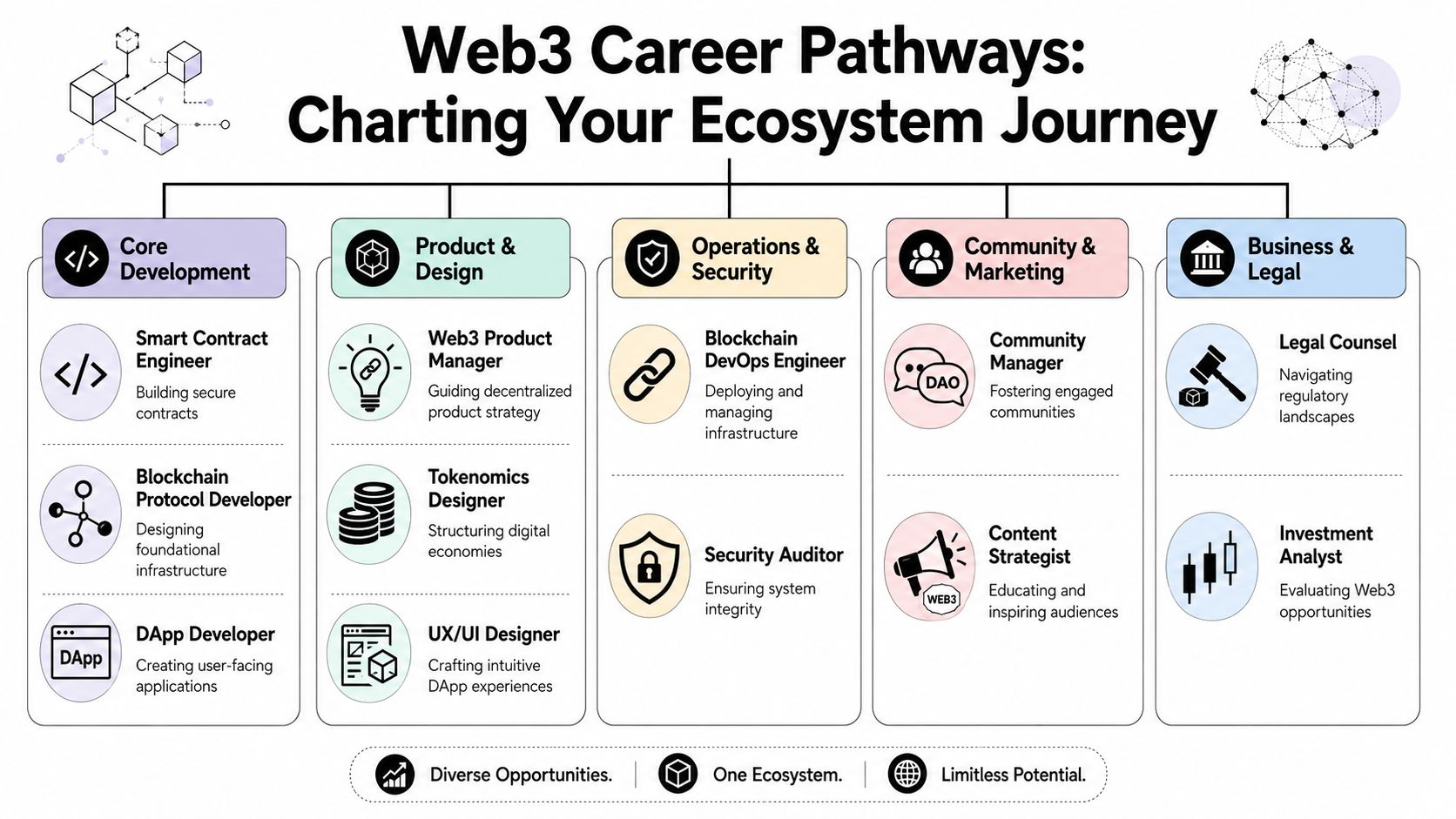
Core development roles
This is the obvious path, but not a single path.
Smart contract engineers write and maintain on-chain logic. They need security instincts, comfort with testing, and a clear understanding of how contract choices affect users and treasury risk.
Protocol developers work lower in the stack. They care more about infrastructure, performance, consensus, and system architecture. This lane suits candidates who enjoy deeper systems work.
dApp developers sit closer to the user. They connect wallets, contracts, front-end logic, and indexing layers into something people can use.
If you like writing code but hate ambiguity, protocol work may suit you. If you enjoy shipping visible user experiences, dApp work is usually the better fit.
Product, design, and operations roles
Often, many high-quality candidates under-position themselves.
Product managers in Web3 don't just write tickets. They make decisions around wallet flows, governance trade-offs, ecosystem incentives, and user trust. Designers face a different set of constraints than in traditional SaaS. Wallet permissions, transaction signing, failure states, and education all sit inside the product experience.
Operations roles also matter more than outsiders expect. Projects need people who can run launches, coordinate DAO contributors, manage support workflows, document processes, and keep distributed teams aligned.
A simple way to explore these openings is to browse remote blockchain roles across functions and look at how often skills from your current career already show up in job descriptions.
Community, growth, legal, and finance roles
A strong crypto company needs more than builders. It needs trust.
- Community managers moderate channels, shape contributor culture, and turn passive followers into active participants.
- Content strategists and marketers explain complex products clearly, support launches, and create educational material that drives conversions.
- Legal and compliance professionals help projects manage structure, disclosures, token risk, and operational boundaries.
- Finance and research talent evaluate treasury decisions, token design, market structure, and protocol sustainability.
If your background is in law, audit, accounting, growth, partnerships, or operations, don't force yourself into a junior coding track that doesn't match your strengths.
How to choose your lane
Use three filters.
| Filter | What to ask |
|---|---|
| Existing advantage | Which role lets you carry over the most from your current experience? |
| Daily work fit | Do you want to code, analyze, design, write, operate, or manage? |
| Proof of work potential | Can you create visible artifacts in this lane within a few weeks? |
Pick one primary lane and one adjacent lane. That's enough. More than that, and your learning gets scattered, your portfolio gets diluted, and recruiters can't tell where to place you.
Mastering the Essential Blockchain Skills
People overcomplicate the skills question. You don't need to know everything. You need to know the essentials well enough to operate credibly, then build depth in your chosen role.
For engineers, there's a structured route. A proven path to an engineering role involves six technical milestones, including deploying a contract to a testnet, migrating to Hardhat for testing, shipping a full-stack dApp, and conducting a security review against OpenZeppelin implementations, based on Cyfrin's in-depth hiring roadmap. That framework is useful beyond engineering too, because it shows what hiring teams respect: practical competence.
Table-stakes knowledge for everyone
You can't work in this industry if basic terminology still feels blurry. Every serious candidate should understand:
- Consensus basics like Proof of Work and Proof of Stake in plain language.
- Wallet mechanics including signing, custody, seed phrase risk, and transaction approval.
- Smart contract purpose so you can explain what's on-chain versus off-chain.
- Token behavior including utility, governance, incentives, and obvious failure modes.
- dApp flow from wallet connection to transaction confirmation and user feedback.
- Ecosystem vocabulary such as L1s, L2s, bridges, validators, DAOs, and governance proposals.
If you can't explain these cleanly to a non-technical interviewer, you're not ready. Hiring managers don't need you to sound academic. They need you to sound useful.
Skill stacks for technical candidates
Technical hiring gets stricter every year because too many applicants know the words but haven't built anything substantial.
A practical engineering progression looks like this:
- Start with fundamentals. Be able to explain PoW and PoS clearly.
- Deploy something public. Use Remix, deploy a contract on a public testnet, and verify it on Etherscan.
- Move into testing. Shift to Hardhat or Foundry and write unit tests.
- Ship a full stack app. Build a dApp with React and Ethers.js, plus an indexed data layer.
- Review security seriously. Compare against OpenZeppelin patterns, identify issues, and improve the implementation.
- Document it properly. Publish a GitHub README and a written breakdown of what you built and what you learned.
That sequence works because it mirrors hiring logic. Teams want proof that you can learn tools, build under constraints, test your work, and think about security before someone else finds the bug.
Skill stacks for non-technical candidates
Non-technical doesn't mean non-specialized. It means your proof of value looks different.
For marketing and community, learn how token-backed communities behave differently from SaaS audiences. You should be able to assess Discord structure, onboarding friction, announcement clarity, incentive alignment, and campaign sequencing.
For product and design, study wallet UX, transaction anxiety, signature requests, failed states, and governance participation. Web3 UX breaks where trust, complexity, and irreversible action collide.
For legal, compliance, and finance, focus on how on-chain activity changes monitoring, reporting, governance interpretation, and organizational structure. A candidate who can analyze a DAO process or explain an operational risk clearly is much more valuable than someone who just says they're “interested in crypto regulation.”
Learn enough technical context to speak with builders, even if you'll never write production code yourself.
What doesn't move the needle
Some activities feel productive but don't help much in interviews:
- Collecting certificates without artifacts
- Repeating market opinions from social media
- Listing tools you've never used hands-on
- Calling yourself crypto-native after passive reading
- Applying before your role story is coherent
The best candidates don't look broad. They look grounded.
Building Your Irrefutable Proof of Work Portfolio
A blockchain portfolio isn't a gallery. It's a case for employability.
That distinction matters because many candidates still build portfolios like they're applying to a traditional corporate role. They list responsibilities, summarize interests, and hope potential counts as evidence. In Web3, that approach gets ignored.
For junior positions, employers now demand verifiable proof of work like active GitHub repositories or testnet contributions, as the entry-level bar has risen to require stack-specific expertise in areas like gas limits and validator incentives, according to BlockchainJobs.uk's hiring trends guidance.

What strong proof of work looks like for developers
The most effective technical portfolios are narrow, complete, and public.
A recruiter or hiring manager should be able to open your GitHub and find a real repository with a clear README, setup instructions, architecture notes, tests, and links to public verification. If you deployed on a testnet, link the block explorer entry. If you considered security trade-offs, say what they were.
Good technical portfolio pieces include:
- A contract deployment with verified source and readable documentation.
- A tested dApp that connects wallet, contract interaction, and front-end flow.
- A security-focused review where you explain risks, remediations, and design decisions.
- An open-source contribution that proves you can work in someone else's codebase.
Weak portfolios usually share the same problems. Half-finished repos. No documentation. No testing. No explanation of why a design choice was made. Hiring teams read that as lack of depth.
What strong proof of work looks like for non-technical candidates
Many good applicants often leave jobs on the table. They assume proof of work only means code. It doesn't.
If you're a designer, publish a teardown of a wallet onboarding flow. Show where users hesitate, where trust breaks, and how you'd redesign signing screens or transaction status feedback.
If you're in marketing, build a launch plan for a hypothetical tokenized product, NFT drop, or ecosystem campaign. Include audience segmentation, education content, community activation, and risk messaging.
If you work in compliance or legal, write a concise memo on a governance proposal, treasury control issue, operational risk, or disclosure challenge. Show judgment, not just vocabulary.
If you're in product, create a mini spec for a dApp feature. Define the user problem, the wallet interaction points, the failure states, and the trade-offs.
A portfolio piece works when it lets a hiring manager picture you doing the job next month.
A simple portfolio standard
Use this checklist before you publish anything:
| Question | Why it matters |
|---|---|
| Is it public? | Private work can't help you get discovered. |
| Is it specific to a real role? | Generic crypto content rarely converts into interviews. |
| Does it show decision-making? | Employers want judgment, not just effort. |
| Can someone verify it quickly? | The easier it is to inspect, the more likely it gets reviewed. |
Build fewer, stronger artifacts
Two excellent portfolio pieces beat eight vague ones.
A good portfolio tells a hiring manager three things fast: you understand the space, you can execute in your lane, and you know how to communicate your work. That's enough to move from ignored applicant to serious candidate.
Finding Opportunities and Networking in Web3
Job seekers often waste time in the search stage because they use traditional tactics in a market that behaves differently. They apply broadly, wait passively, and assume listed jobs are the whole market. They aren't.
The blockchain market is also structurally flexible. 44% of crypto software development jobs on Indeed were remote, compared with 31% for other software roles, and major hubs included San Francisco, New York, London, and Singapore, according to Indeed Hiring Lab's analysis of crypto and blockchain postings. That means your geography matters less than your visibility and relevance.
Where strong candidates actually look
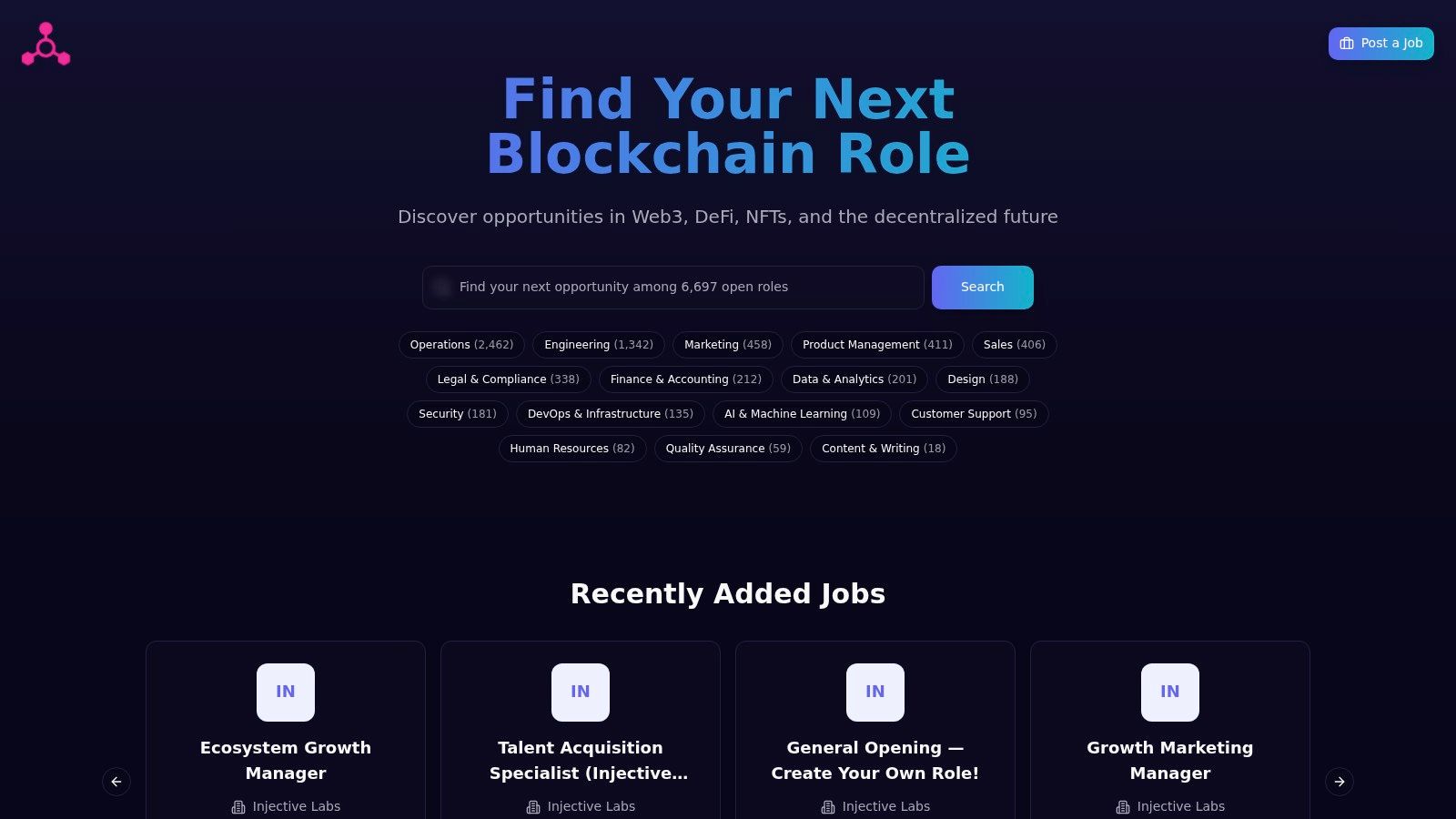
Generic job boards can still produce leads, but they're noisy. Specialized listings usually give you a much better signal because the roles are already filtered for this ecosystem.
If you're technical, reviewing blockchain engineering openings is more useful than searching broad software titles on general platforms. The job descriptions tend to reveal current tool expectations, stack language, and the difference between infrastructure, smart contract, and product-facing engineering work.
But listed openings are only one channel. You should also watch:
- Protocol Discord servers where contributors often hear about roles before they're formalized
- Project founders and team members on X or LinkedIn where hiring needs show up informally
- DAO forums and governance spaces where active contributors become obvious hiring targets
- Hackathons and ecosystem events where teams evaluate people through work, not just resumes
Networking that works in Web3
Traditional networking often feels staged. Web3 networking works better when it starts with contribution.
Commenting thoughtfully on product updates, helping in community calls, testing an early feature, answering user questions, or publishing an informed teardown all create a reputation trail. That trail is much more powerful than cold “would love to connect” messages.
Here's the practical distinction:
| Low-value networking | High-value networking |
|---|---|
| Following people silently | Responding with informed takes |
| Joining Discord and lurking | Helping answer questions or summarize issues |
| Asking for referrals immediately | Building familiarity before asking |
| Sending generic outreach | Referencing a real product, governance, or user issue |
People in Web3 remember useful contributors faster than polished self-promoters.
How to run your search each week
A disciplined search beats emotional bursts of applications.
- Audit new roles. Save the listings that match your lane and extract recurring requirements.
- Engage publicly. Post one useful observation, teardown, or build update each week.
- Contribute somewhere small. A fix, memo, thread, design critique, or community summary is enough.
- Reach out with context. Contact teams only after you have a reason to be memorable.
Candidates who treat networking as visible work usually get warmer conversations, better referrals, and fewer dead-end interviews.
Acing the Blockchain Job Interview and Negotiation
Most candidates don't lose blockchain interviews because they lack intelligence. They lose because they present themselves like generic applicants in a market that expects receipts.
That's why your resume, LinkedIn profile, and interview prep need the same operating principle. Lead with evidence.
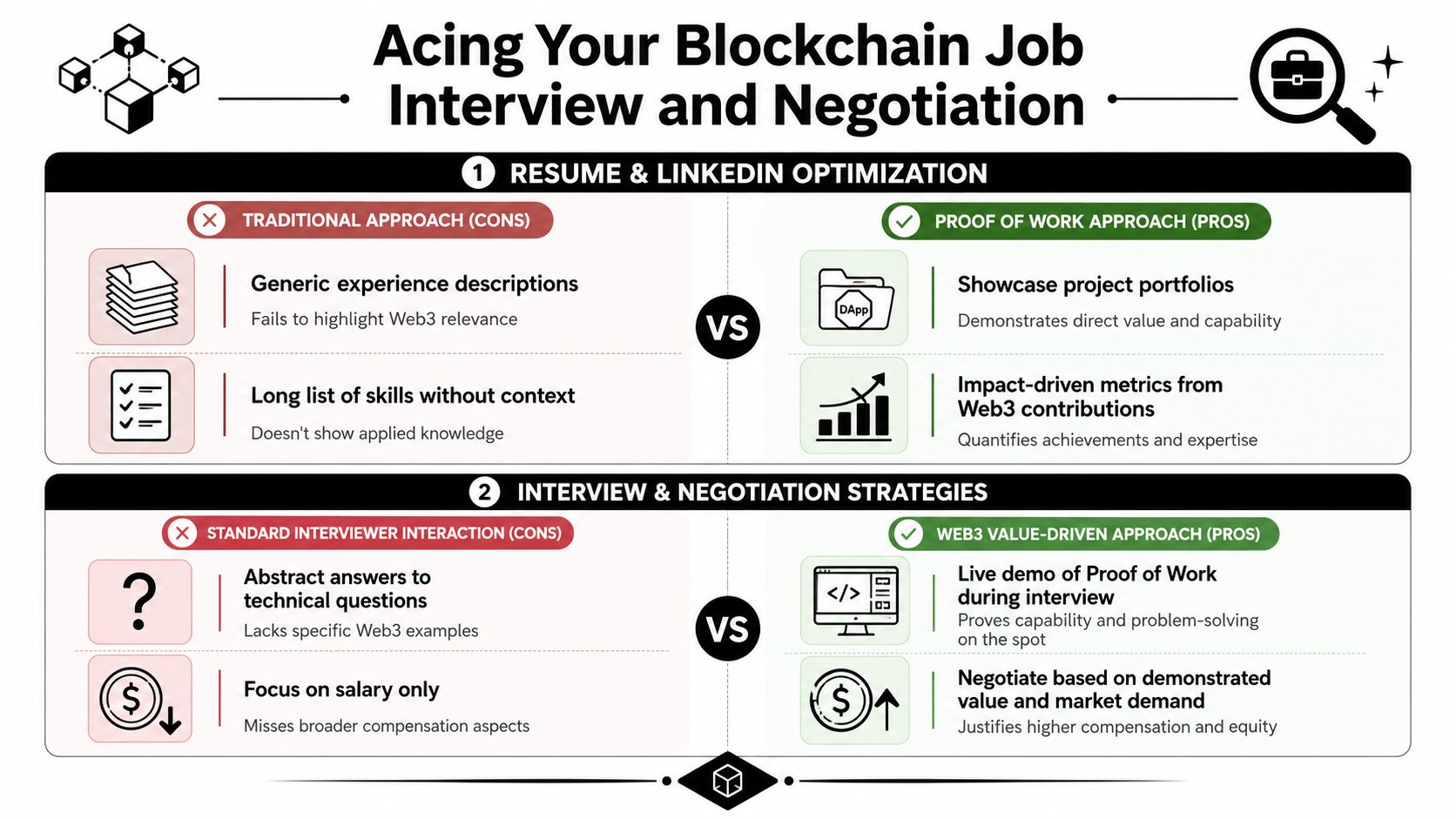
Resumes must prioritize proof of work, such as top-three hackathon finishes or DAO contributions, over chronological job titles, as 65% of Web3 startups value these verifiable outputs. The same source notes that 30% of hackathon participants secure a role according to Axiom Recruit's Web3 hiring guidance.
Rewrite your resume like a hiring manager reads it
A blockchain resume should make your relevance obvious in seconds.
Put portfolio links near the top. Add GitHub, shipped projects, governance work, hackathon output, design case studies, or published research before a recruiter has to dig for them. Your LinkedIn should do the same. If your best work is buried under an old title from a different industry, you're making the reviewer do too much translation.
Strong resume content sounds like this:
- Built and deployed a tested smart contract project with public verification
- Published a UX teardown of a wallet flow with redesign rationale
- Analyzed a DAO governance process and proposed operational improvements
- Led community onboarding content for a protocol-specific audience
Weak resume content sounds like this:
- Responsible for blockchain research
- Passionate about decentralized technologies
- Interested in smart contracts and crypto markets
Prepare for the interview you're actually going to get
Most blockchain interview loops test three things.
First, they test whether you've really done the work you claim. If you're an engineer, expect questions about your repo, test choices, security assumptions, gas awareness, and architecture. If you're in product, expect trade-off questions around wallet friction, user trust, or feature prioritization. If you're in compliance or operations, expect scenario questions, not theory.
Second, they test whether you can communicate clearly in a remote environment. Rambling kills otherwise strong candidates. You need concise answers, concrete examples, and the ability to explain technical context to mixed audiences.
Third, they test whether you care about the space itself. Not in a performative way. In a practical way. Do you understand the product, the users, and the project's constraints?
If you want a broader framework for structuring answers, practice drills, and tightening your process, these strategies to land your next role are useful because they map well to high-signal interview prep.
Bring one artifact into the interview that you can walk through live. A repo, a deck, a case study, or a governance memo changes the conversation.
Negotiate like a grown professional
Negotiation in Web3 isn't only about base salary. It can include token exposure, vesting details, contractor structure, remote expectations, and scope ambiguity.
Ask how success will be measured. Ask what part of compensation is fixed versus variable. Ask how token-based components work in practice, not just on paper. If the role is early stage, clarity matters more than hype.
Don't negotiate from excitement alone. Negotiate from demonstrated value and a precise understanding of the job you're being hired to do.
Committing to Continuous Learning in a Dynamic Industry
Getting hired is the start. This field changes too fast for static careers.
The candidates who keep progressing don't wait for formal training. They follow builders, read product updates, track governance discussions, study security incidents, and keep publishing small pieces of work that sharpen their thinking. That habit matters whether you're an engineer, recruiter, operator, designer, or legal specialist.
What to keep doing after you land the role
Use a simple maintenance loop:
- Read actively. Follow protocol blogs, ecosystem newsletters, and serious product write-ups instead of relying only on social feeds.
- Stay close to real users. Support channels, governance forums, and community calls show you where products break.
- Keep a public trail. Short analyses, code updates, design notes, or market commentary help your career compound.
- Upgrade your outreach. If you're pursuing a stretch role or a niche team, a thoughtful cold email can outperform another cold application. This guide to getting interviews through cold email is useful when you want to approach smaller teams with more intention.
A good place to keep an eye on role trends, career commentary, and market-specific advice is the Blockchain Jobs blog for Web3 career insights.
The mindset that lasts
People who last in this industry stay curious without becoming scattered. They build conviction, but they keep learning. They develop a specialty, but they understand adjacent functions well enough to collaborate. They don't wait to feel fully ready before contributing.
If you want to know how to get a blockchain job, the shortest honest answer is this: choose a lane, build visible proof, get close to real projects, and keep learning after the offer arrives.
If you're ready to turn that plan into applications, explore open roles on Blockchain Jobs. It's a focused way to find opportunities across engineering, product, design, marketing, legal, operations, and more in the Web3 ecosystem.