How to Hire Remote Developers: An Actionable Guide
Before you write a single line of a job description, let's address a common pitfall: jumping straight to a laundry list of programming languages. This is a surefire way to get buried in a mountain of irrelevant applications and miss out on top-tier talent.
The first, most critical step is to create a detailed blueprint of the exact developer you need to hire. This involves mapping your project's technical realities to a clear skills matrix and, just as importantly, defining the behavioral traits that predict success in a remote role. This isn't just about filling a seat; it's about making a strategic hire that drives career progression for them and project success for you.
Defining Your Ideal Remote Developer Profile
Rushing to post a job ad without a clear hiring strategy is like trying to build a dApp without a whitepaper. It’s a recipe for attracting a high volume of candidates who look good on paper but are completely wrong for the role, wasting everyone's time in the interview process.
The foundational work you do here will be your North Star for the entire hiring process. It dictates where you source candidates, how you structure your job interviews, and even how you'll eventually onboard them. Get this right, and you're not just hoping to find the right person; you're engineering a successful hire.

Mapping Technical Needs to a Skills Matrix
First, let's get tactical. Look at your project roadmap and translate it into a concrete list of technical skills. The key here is to fight the urge to create an intimidating "wish list" of every technology under the sun.
Instead, sort everything into two actionable buckets for your job description: must-haves and nice-to-haves. This simple act of prioritization will transform your hiring funnel.
For instance, if you're hiring a developer for a new DeFi lending protocol on Ethereum, your must-haves are probably deep expertise in Solidity, Hardhat, and Ethers.js. A "nice-to-have" might be prior experience with a Layer 2 like Arbitrum or Optimism. This clarity keeps you from immediately rejecting a brilliant Solidity dev who could pick up a new L2 framework in a week, ensuring you don't miss out on high-potential candidates.
An actionable hiring insight: By clearly separating "must-have" from "nice-to-have" skills in your job description, you can expand your qualified talent pool by as much as 40%. You start interviewing for core competency, not just checking boxes on an impossible list.
This matrix becomes your secret weapon for screening resumes and structuring the initial interview. You can instantly filter out candidates who lack the non-negotiables and focus your valuable time on those who truly meet the bar.
Defining Essential Behavioral Traits for Remote Success
Technical skills are only half the battle. A developer who was a rockstar in a bustling office might flounder without daily structure and face-to-face check-ins. A successful remote career demands a specific set of soft skills.
Your ideal candidate profile needs to be explicit about these behavioral traits. Don't be vague. These are real, observable qualities you can and should test for during the job interview process.
Focus on what really matters for your team's success:
- Proactive Communication: The best remote developers over-communicate by default. They provide updates without being asked, flag potential issues before they become emergencies, and write exceptionally clear pull request descriptions and documentation.
- Autonomous Problem-Solving: How do they behave when they get stuck? Do they immediately ask for help, or do they demonstrate resourcefulness and try to find a solution first? You are hiring for initiative.
- High Self-Discipline: A remote career is a test of intrinsic motivation. Your ideal hire is a self-starter who manages their time, prioritizes their workload, and hits deadlines without needing constant oversight.
These traits are just as critical as knowing a specific framework. When you get to the interview stage, you'll use these definitions to craft behavioral questions that probe for real evidence.
Instead of asking, "Are you a good communicator?" ask: "Tell me about a time you identified a potential risk in a project. How did you communicate that to your team, especially when you weren't in the same time zone?" This shift from hypotheticals to real-world examples is how you uncover proof of whether a candidate has the traits to succeed in a remote role.
Sourcing and Attracting Top Remote Talent
Once you've defined your ideal candidate profile, the hunt begins. Top-tier remote developers, especially in Web3, aren't just browsing mainstream job boards. To hire the best, you have to meet them where they are—deep in the communities where they’re building, learning, and collaborating.
This means you can't just post a job and wait. Sourcing great talent is an active, not a passive, process. It's about seeking out engineers in niche communities, specialized job boards, and the open-source projects they contribute to. Your goal is to start conversations, not just collect résumés.
Sourcing Channels That Attract the Best Candidates
The best remote talent is often happily employed but may be open to a compelling career move. Your sourcing strategy must be designed to reach these passive candidates. While platforms like LinkedIn have a role, the real hiring advantage comes from focusing on the places most recruiters overlook.
Here are the channels that consistently yield high-quality candidates:
- Niche Job Boards: This should be your first stop. Platforms like Blockchain Jobs are invaluable because they attract a curated audience of professionals already invested in the space. Candidates from these boards typically have the specific domain knowledge you need, saving significant screening time.
- Developer Communities: Engage authentically where developers gather. This includes Stack Overflow, specific Discord or Telegram channels for Solidity or Rust, and developer-focused forums. The key is to add value—answer questions, share insights, and build your company's reputation as a great place to work.
- GitHub Repositories: This is where you can directly assess a developer’s skills. Scout for contributors to projects relevant to your tech stack. You can analyze their code quality, collaboration style in pull requests, and commitment to their craft. It’s the most direct evidence of their abilities you can get before an interview.
The shift to remote work has fundamentally changed hiring dynamics. Recent data shows that 76% of remote jobs attract 2.5 times more applicants than on-site roles. Furthermore, 89% of those applications come from people living outside the company’s HQ city. Most importantly, 68% of companies report finding better talent by hiring remotely.
Writing Outreach That Gets a Response
Top developers receive dozens of recruiting messages a week. Most are generic, templated, and immediately deleted. To stand out and start a conversation, your outreach must be personalized, respectful, and focused on their career and interests—not just your company's needs.
A great outreach message immediately shows you’ve done your homework. It’s not about empty flattery; it’s about demonstrating a genuine interest in their work and seeing how their specific skills align with a meaningful challenge at your company.
Generic Outreach (Don't do this): "Hi [Name], I saw your profile and you seem like a great fit for our Senior Engineer role. We are a fast-growing blockchain startup. Are you open to a chat?"
Personalized Outreach (Do this instead): "Hi [Name], I was really impressed with your contributions to the [Project Name] repository on GitHub, especially your work on the new consensus module. We're tackling a similar scalability challenge for our DeFi protocol, and your expertise could be a game-changer for us. Would you be open to a brief chat about the technical problems we're trying to solve?"
The second example is specific. It proves you invested time to understand their work, connects it directly to a high-impact problem, and frames the conversation around a technical challenge—something a talented engineer will find far more engaging than a generic job pitch.
Leveraging Your Team as a Recruiting Force
One of your most powerful sourcing channels is your existing team. Employee referrals consistently bring in high-quality candidates who are more likely to be a strong cultural fit and have a longer tenure.
Your developers know other great developers. They have an innate understanding of your team's technical bar and cultural dynamics that no external recruiter can match.
To operationalize this, implement a simple, structured referral program:
- Make it Easy: Create a straightforward process for submitting referrals.
- Offer Meaningful Incentives: A significant bonus demonstrates that you value their network and effort.
- Provide Feedback: Keep referrers informed about their candidate's progress in the interview pipeline.
- Be Proactive: Regularly encourage your team to think about people in their network. This is especially useful when hiring for niche skills, mirroring the process a dedicated technical sourcer would follow.
Once your pipeline is full, it's time to assess who has the right skills and mindset. Vetting remote developers requires a different approach than in-office hiring. You're not just evaluating technical ability; you're looking for evidence of autonomy, written communication, and the discipline to succeed without direct supervision.
Your traditional interview process may favor charisma over the traits that truly matter for remote success. A robust remote vetting process acts as a series of filters, with each interview stage designed to test a different critical skill. This way, you're not just hiring a good coder—you're finding a great remote teammate whose career can flourish at your company.
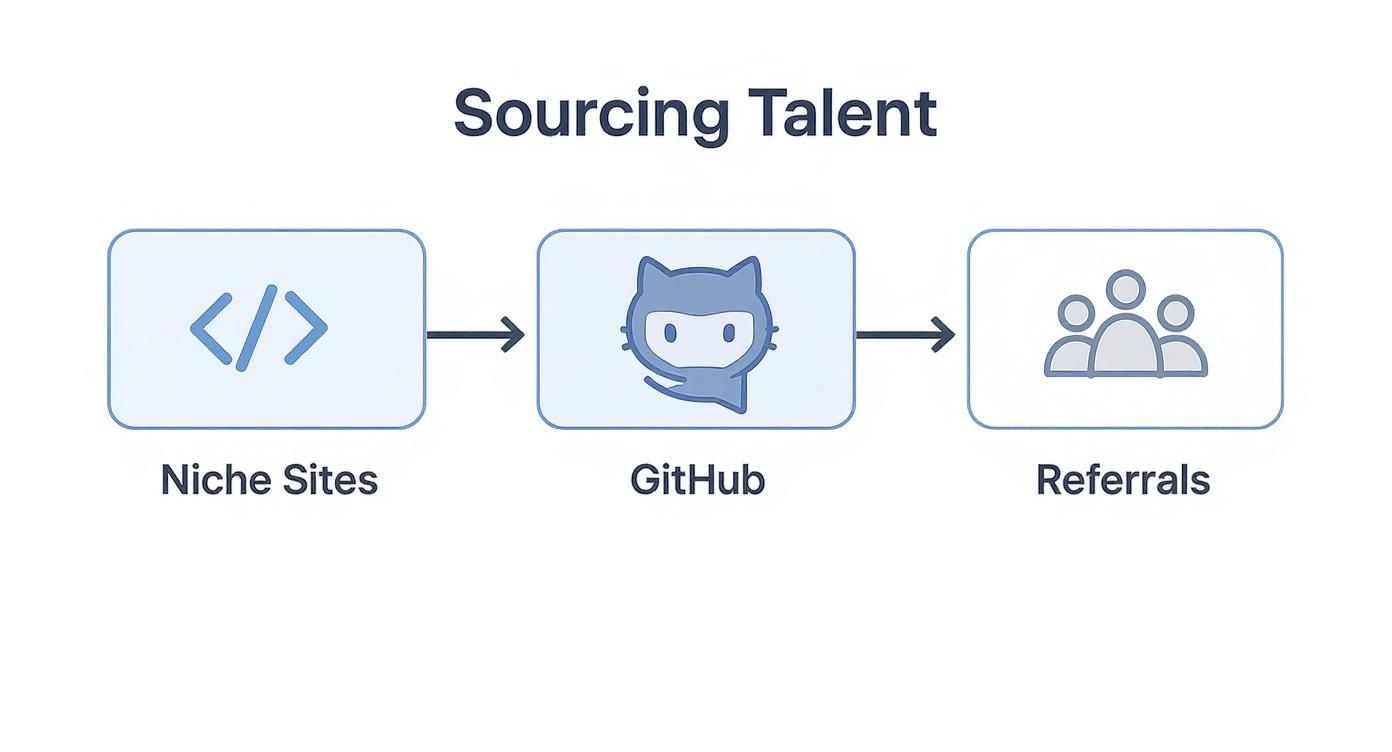
Think of your hiring process as a funnel: combining niche job boards, proactive GitHub scouting, and employee referrals creates a high-quality pipeline from the very beginning.
The Initial Screening Call: The 30-Minute Filter
The first interview is about efficiency. I keep these to 30 minutes, maximum. The goal is to confirm baseline qualifications and identify any obvious red flags before committing your engineering team's valuable time. This isn't a technical grilling; it's a gut check.
I focus on three key areas in this call:
- Confirming Core Skills: A brief discussion about their direct experience with your must-have technologies. I'll ask them to walk me through a recent project where they used your primary framework.
- Understanding Their Motivation: I always ask what specifically about our role and company stood out to them. This quickly separates candidates who are genuinely interested from those who are mass-applying.
- Assessing Remote Aptitude: I'll ask about their previous remote work experiences or how they structure their day to stay productive. I'm listening for evidence of self-discipline and proactive habits.
This call is your most important filter. If a candidate cannot clearly articulate their experience or seems uninterested in your mission, it’s a red flag, regardless of their resume.
The Technical Deep-Dive Interview
Now it's time for the technical interview with senior engineers. This is where you move beyond what a candidate says they can do and observe how they actually solve problems. A live coding session or a system design challenge is perfect for this.
The goal isn't to test for memorized algorithms. I want to see their thought process in action. How do they approach an unfamiliar problem? Do they ask clarifying questions before diving in?
A great technical interview feels less like an exam and more like a collaborative problem-solving session. You are assessing how they think and communicate under pressure, which is a powerful predictor of their on-the-job performance.
We often give candidates a simplified version of a real problem our team recently solved. As they work, we evaluate their communication as much as their code. The best candidates verbalize their logic, explain the trade-offs they're considering, and are receptive to feedback—the exact collaborative skills needed for a remote team.
This table breaks down how each job interview stage contributes to building a holistic view of the candidate.
Remote Interview Stage Comparison
| Interview Stage | Primary Goal | Key Areas to Assess | Example Question/Task |
|---|---|---|---|
| Initial Screening | Filter for baseline fit and remote readiness | Core skills, motivation, communication, self-discipline | "Tell me about your experience working in an async environment." |
| Technical Deep-Dive | Assess problem-solving and technical communication | Algorithmic thinking, system design, coding clarity, collaboration | "Let's design a basic URL shortening service together. Where would you start?" |
| Take-Home Test | Evaluate real-world code quality and attention to detail | Code structure, testing practices, documentation, async work habits | "Build a simple API endpoint based on these specs. Include tests and a brief README." |
| Final Culture Fit | Ensure alignment with team values and career goals | Teamwork, adaptability, values, passion for the project | "Describe a time you had a technical disagreement with a colleague. How did you resolve it?" |
By using each stage for a distinct purpose, you avoid repetitive interviews and gain a much clearer, multi-faceted view of every candidate.
Designing a Respectful Take-Home Assignment
The take-home assignment provides the clearest insight into a candidate's real-world coding practices. It reveals their coding style, testing philosophy, and documentation habits in a low-pressure setting. However, it's crucial to design this stage respectfully.
Here are the rules for a good take-home test:
- Be Time-Boxed: Clearly state that the task should take no more than 2-4 hours. Anything longer is disrespectful of their time and will deter top candidates.
- Be Relevant: The assignment should mirror a small slice of the actual job. If you're hiring a backend developer, have them build a single, well-scoped API endpoint.
- Provide Clear Instructions: Give them everything they need to succeed. Ambiguity doesn't test for creativity; it just causes frustration and wastes time.
When reviewing the submission, look beyond "does it work?" Is the code readable and well-structured? Are there meaningful tests? Is there a clear README.md? The care a developer puts into a small project is a strong signal of how they'll communicate asynchronously with your team.
You can often see what other companies prioritize by looking at job descriptions. For instance, in this Software Engineer in Test role, the emphasis on quality and documentation is front and center—a common theme for well-run engineering teams.
Structuring Competitive Offers and Contracts
You’ve navigated the entire hiring process and identified your top candidate. The final step—crafting a compelling offer—is where all your hard work pays off. In a global talent market, especially for sought-after Web3 roles, a successful offer is about more than just a number. It's a combination of fair compensation, clear benefits, and a solid legal framework that sets the stage for a great working relationship.
Getting this right is critical. A weak or poorly structured offer can send your top choice to a competitor, undoing weeks of effort. A thoughtful, well-crafted offer not only secures a 'yes' but also establishes a foundation of trust and respect from day one.
Benchmarking Global Salaries Fairly
A key decision in hiring remotely is how to approach compensation across different locations. There are two primary models, each with distinct implications for your hiring strategy and company culture.
The first approach is location-based pay, where salaries are adjusted based on the local cost of living and market rates. The main advantage is cost management. The downside is that it can create pay disparities for people in the same role, which can feel unfair and damage morale.
The alternative is a global salary band. In this model, everyone in the same role is paid within the same range, regardless of their location. This promotes fairness and transparency, which is a huge advantage for attracting talent. The challenge is that it can increase payroll costs, especially if your bands are benchmarked against high-cost tech hubs like San Francisco.
Your compensation philosophy is a direct reflection of your company culture. Choosing between location-based pay and global salary bands signals whether you prioritize market efficiency or internal equity. There is no single right answer, but the choice must be deliberate and align with your values.
Regardless of your chosen model, do your research. Use data from multiple reputable sources to determine a competitive offer for the role and experience level in various markets. Consider the entire package, including benefits. For highly specialized positions, you might need to consult an expert, like a Global Compensation & Benefits Specialist, to ensure your offers are competitive.
Understanding Employee vs. Contractor Status
The legal distinction between a full-time employee and an independent contractor is critical, especially when hiring internationally. Misclassifying a worker can lead to significant legal and financial penalties, including back taxes and fines.
Here’s the simple distinction:
- Employees are on your payroll. You typically dictate their hours, provide their equipment, and control how their work is done. You are also responsible for withholding taxes and providing benefits.
- Contractors operate as independent businesses. They use their own equipment, set their own schedules, and have more autonomy over how they complete tasks. They are responsible for their own taxes.
Hiring developers as contractors offers flexibility and reduces administrative burden, especially across borders. However, you must ensure the working relationship legally qualifies as a contractor arrangement under local labor laws, which vary significantly by country.
Crafting a Clear Remote Work Agreement
Whether hiring an employee or a contractor, a crystal-clear, legally sound agreement is non-negotiable. This document is the foundation of your working relationship and should eliminate ambiguity.
Ensure your remote work agreement explicitly covers these key areas:
- Scope of Work: Clearly define the role, key responsibilities, and expected deliverables to set clear expectations for career progression.
- Compensation: Detail the salary or rate, payment currency, and payment schedule.
- Confidentiality and IP: Include robust clauses to protect your company's intellectual property and sensitive data.
- Termination: Outline the conditions under which either party can end the agreement, including required notice periods.
Remember that top remote developers often expect higher compensation. Some data suggests remote software developers can earn around 22% more than their office-based peers, driven by factors like being paid in stronger currencies and possessing in-demand, specialized skills. As discussed in this Hacker News thread on remote developer pay, a competitive offer signals that you recognize and value their expertise in a fierce market.
Onboarding: From New Hire to Productive Teammate
You’ve made the hire. This is a huge win, but the work isn't over. The journey from an accepted offer to a productive team member hinges on the onboarding process. A poor first month can erode the enthusiasm of a great new hire, negating all the effort you invested in the hiring process.
Effective onboarding is more than just shipping a laptop. It's a strategic plan to integrate them into your team's culture, clarify what success looks like in their role, and provide them with the tools and support to contribute meaningfully and quickly.

Setting Up for Success Before Day One
A great first day is the result of preparation done the moment the offer was accepted. The goal is to eliminate all logistical friction so their first login is focused on meeting the team and understanding the projects, not chasing down passwords and permissions.
This pre-start checklist is your first opportunity to make a great impression. It demonstrates that you're organized, professional, and genuinely excited for them to join.
Actionable Pre-Onboarding Checklist:
- Ship equipment early. Ensure their welcome kit—laptop, monitor, swag—arrives at least a week ahead of their start date to avoid last-minute shipping delays.
- Provision all accounts. Nothing says "we weren't ready for you" like a new developer who can't access GitHub on their first day. Create and test logins for all essential tools: email, Slack, Jira, internal dashboards, and code repositories.
- Create a "First Day" digital packet. Consolidate all essential information in one place. This should include the employee handbook, a team directory (with photos), and a high-level overview of your tech stack and development workflows.
A Roadmap for the First Four Weeks
Avoid overwhelming your new hire with information. The first month should be a structured, guided experience that builds confidence and competence. A week-by-week plan provides a clear path from orientation to contribution.
This structured approach helps new hires achieve early, manageable wins, which is crucial for building momentum and morale.
Your Week-by-Week Onboarding Blueprint:
- Week 1: People and Setup. This week is about integration. Schedule 1-on-1s with every member of their immediate team. The goal is connection, not interrogation. Their first technical task should be small and low-risk, like fixing a typo in the documentation or a minor CSS bug. This allows them to navigate the full PR and deployment cycle without pressure.
- Week 2: First Real Ticket. Assign a well-scoped task from the backlog. It should be a real piece of work but small enough to complete in a few days. This is their first time contributing meaningfully to the codebase, so ensure the ticket has a clear definition of done.
- Weeks 3 & 4: Ramping Up to Autonomy. Gradually increase the complexity of their assignments. Encourage them to participate in planning meetings and discussions. By the end of the month, they should feel comfortable selecting tasks from the board and driving them to completion with minimal supervision.
The Onboarding Buddy: Your Integration Accelerator
In an office, a new hire can simply turn to a colleague for help. Remotely, this is impossible, which is why assigning an "onboarding buddy" is non-negotiable. This person is not their manager but a peer—a friendly guide for all the unwritten rules and "stupid questions" they might hesitate to ask in a public channel.
The onboarding buddy is the single most effective tool for making a new remote hire feel psychologically safe and connected. They bridge the gap between formal documentation and the reality of how your team actually works.
The buddy’s role is to proactively check in, explain internal jargon, and be a reliable point of contact. This simple human connection accelerates integration and makes a new hire feel like a true part of the team.
This kind of proactive talent strategy is becoming essential. Industry analysis projects that by 2026, over 90% of organizations will face IT skills shortages, which could lead to $5.5 trillion in losses if they fail to adapt. To get ahead, companies are hiring for specialized remote roles in fields like AI, focusing on niche skills to deliver on specific projects. You can explore more about these evolving remote hiring trends and their impact on business.
Your Top Questions About Hiring Remote Developers, Answered
Even with a solid plan, hiring remote developers presents unique challenges. Here are answers to some of the most common questions hiring managers face, providing actionable insights to help you navigate the process with confidence.
What Are the Toughest Parts of Hiring Remotely?
The biggest challenge is accurately assessing a candidate's technical skills without in-person interaction. You can't rely on the "gut feeling" from a physical whiteboard session. The second hurdle is determining if they possess the self-discipline and communication habits required to succeed in a remote, asynchronous culture.
Beyond assessment, you must navigate diverse salary expectations, time zones, and complex international labor laws. Establishing robust security protocols for a distributed team is also a critical, ongoing challenge. Addressing these issues proactively in your hiring process is key.
How Can You Really Assess Communication Skills in an Interview Process?
Evaluate communication at every touchpoint. Start with their initial application—is it clear and professional, or sloppy and generic?
During video interviews, pay close attention to how they articulate complex technical concepts. Can they make them easy to understand? Do they ask insightful questions? The take-home assignment is another critical data point—review their code comments, the clarity of their README file, and how they present their work.
A candidate's written communication during the hiring process is a direct preview of how they will communicate in pull requests, documentation, and team chats. If it's unclear or sloppy now, it will be later.
Is Hiring Remote Developers Primarily a Cost-Saving Strategy?
No, and this is a common misconception. While you save on office-related overhead, top-tier remote talent is not cheap. Elite developers command salaries competitive with major tech hubs because they know their market value.
The primary advantage of hiring remotely isn't cost savings; it's access to a global talent pool. Instead of being limited to candidates within a commuting radius, you can hire the absolute best person for the job, regardless of location. This access to exceptional talent is what drives innovation and business growth.
What Are the Must-Have Tools for a Remote Dev Team?
A successful remote engineering team relies on a well-integrated tool stack across four key categories. This forms your digital office.
- Communication: A mix of synchronous and asynchronous tools is essential. Most teams rely on Slack for daily chat and Zoom for scheduled meetings.
- Project Management: To maintain visibility and alignment, a system like Jira or Asana is crucial for tracking tasks and progress.
- Knowledge Management: A centralized wiki in Notion or Confluence is non-negotiable for documenting processes, coding standards, and project information.
- Version Control & Collaboration: A shared version control system like GitHub or GitLab is the foundation for collaborative coding.
Investing in the right tool stack is fundamental to keeping a distributed team aligned, productive, and engaged.
Ready to find your next great hire? Blockchain Jobs is the premier job board for connecting with top talent in the Web3 ecosystem. Post a job today and reach a specialized audience of crypto-native professionals ready to build the future.