Job Opportunities for Web Developers: A 2026 Career Guide

You’re probably in a familiar spot. You know how to ship production code, debug ugly frontend state, trace backend failures, and work with product teams that change priorities mid-sprint. Your web career is solid. But the work may also feel predictable, especially if you keep seeing Web3 roles that ask for skills you partly recognize and partly don’t.
That gap is smaller than it looks.
Most developers who move from Web2 into Web3 don’t start by becoming protocol researchers or cryptography specialists. They start by bringing over the habits that already make them useful: building interfaces people can trust, designing APIs and data flows, handling auth, managing state, and shipping under constraints. The hard part isn’t throwing away your experience. It’s translating it into a hiring narrative that makes sense for decentralized products.
Beyond Web2 The New Frontier for Developers
Traditional web development is still a strong career path. The U.S. Bureau of Labor Statistics projects 7% growth for web developers and digital designers from 2024 to 2034, compared with 3% across all occupations, and estimates about 14,500 to 16,500 job openings annually over the decade, according to the BLS occupational outlook for web developers and digital designers.
That matters because the best Web3 candidates usually aren’t people escaping a dead field. They’re coming from a healthy one. They already know version control, CI, frontend frameworks, database trade-offs, cloud deployment, and what happens when real users hit a product in production.
Why Web3 feels confusing at first
The noise around Web3 creates a false impression that everything is different. Wallets replace logins. Smart contracts replace some backend logic. Public chains replace private databases in selected parts of the stack. But the hiring market still rewards developers who can do normal engineering work well.
If you’ve built payment flows, marketplaces, dashboards, or collaborative apps, you already understand a lot of the problems Web3 companies face. The difference is that decentralization adds new constraints. You have to think about irreversible transactions, wallet UX, contract safety, indexing, and what belongs on-chain versus off-chain.
Practical rule: Treat Web3 as a specialization layered on top of good web development, not a separate universe.
That mindset changes how you learn. Instead of trying to absorb every chain, token model, and protocol category, focus on the parts that overlap with your background. A React developer should study wallet connection patterns and transaction states. A backend engineer should study how smart contracts interact with APIs, indexers, and data services. A full-stack developer should learn the boundaries between app code and contract code.
A more useful way to think about career progression
For many developers, the primary appeal isn’t hype. It’s scope. Web3 roles often give engineers more exposure to product decisions, security thinking, distributed systems trade-offs, and open-source collaboration. You’re not just building pages on top of business logic hidden elsewhere. In many teams, you’re much closer to how value moves through the product.
If you want a wider view of how this space is evolving, the Blockchain Jobs blog is worth browsing for market context and role patterns. Use that context carefully, though. Reading job posts is useful. Building for them is what gets you hired.
Mapping Your Skills from Web2 to Web3
The easiest way to understand Web3 is to stop treating it like magic.
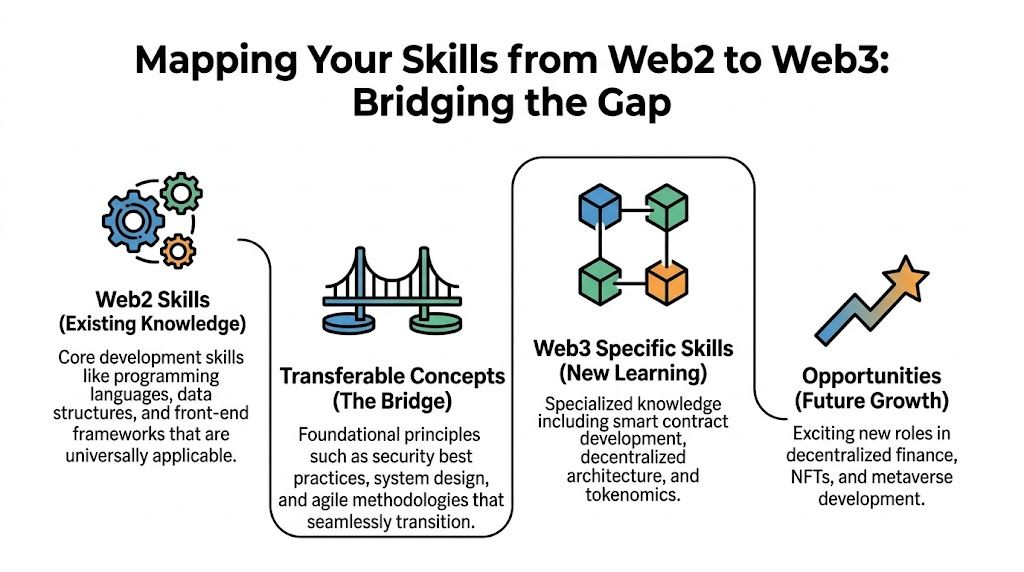
A Web2 app usually runs on infrastructure one company controls. The company owns the database, defines the rules, and exposes access through APIs. A Web3 app still has interfaces, business logic, and storage concerns, but some of those rules move into public smart contracts and some data lives in decentralized systems. The app becomes a mix of traditional web architecture and blockchain-native components.
The mental model that helps most
Think of a traditional bank app versus a decentralized finance app.
In the bank app, your balance, permissions, and transaction rules sit in systems the bank controls. In a DeFi app, the interface still looks like a web product, but the core transaction rules may live in smart contracts that anyone can inspect and interact with. That changes the engineering surface area. Frontend code has to represent transaction finality and wallet state. Backend code often shifts toward indexing, event processing, analytics, notifications, and caching rather than owning the source of truth.
That’s why experienced web developers adapt faster than they expect. The categories of work stay familiar. The trust model changes.
Web2 Skills vs. Web3 Equivalents for Developers
| Web2 Concept | Web3 Equivalent | Key Transition Point |
|---|---|---|
| Email and password auth with session or JWT flows | Wallet-based authentication and Sign-In with Ethereum | Identity shifts from app-managed credentials to user-controlled wallets |
| REST or GraphQL API consumption | Smart contract interaction through ABIs and Web3 libraries | You still call interfaces, but contract calls and transactions have different failure modes |
| PostgreSQL or another relational database as the core record system | On-chain state plus indexing layers and decentralized storage | You stop assuming your app database is the final source of truth |
| Backend business logic in Node.js, Python, or similar services | Business rules split between app services and smart contracts | Contract code must be treated as constrained, transparent, and harder to change |
| Frontend state for async requests | Frontend state for wallet connection, network switching, pending transactions, and confirmations | UX has to handle uncertainty and user action outside the browser |
| Role-based admin permissions | Contract roles, multisig operations, and governance controls | Authorization becomes partly organizational and partly protocol-level |
| CI/CD for web apps | CI/CD for web apps plus contract deployment and verification workflows | Shipping gets riskier because some mistakes become permanent |
What carries over cleanly
A lot more than people admit.
- Frontend depth still matters: React, TypeScript, component architecture, accessibility, and state management remain core skills.
- Security discipline transfers: Input validation, auth boundaries, review habits, and secure coding are still central.
- System design still wins interviews: Hiring managers want developers who know where to put logic and why.
- Developer workflow stays familiar: Git, code review, testing, staging environments, and debugging don’t disappear.
What doesn’t transfer automatically
Some Web2 instincts cause trouble in Web3.
- Assuming you can patch production instantly: Smart contracts force you to think about upgrade paths before deployment.
- Treating the frontend as purely cosmetic: In dApps, frontend choices directly affect failed transactions, user trust, and support load.
- Ignoring protocol economics: You don’t need to become a token economist, but you do need to understand incentives and user behavior around fees and governance.
- Overbuilding the backend: Many Web2 developers recreate systems that the chain already handles. Good Web3 engineers know what not to own.
The strongest transitions happen when developers keep their engineering fundamentals and only replace the parts of the stack that truly need to change.
Exploring Key Web3 Developer Roles
The phrase job opportunities for web developers gets broad fast. In Web3, the useful distinction is not “frontend versus backend” alone. It’s where trust, state, and risk live in the product.
Some teams need interface-heavy engineers who can make wallet flows understandable. Others need full-stack builders who can connect app logic to contracts and indexing systems. A smaller but critical slice needs developers who spend most of their time writing and reviewing contract code.

As reflected in job market patterns noted by Robert Half, Web3 teams show strong demand for React and TypeScript in frontend dApp work, often with Web3.js for wallet connectivity, while backend-oriented roles increasingly ask for Rust and Solidity and some benchmark systems designed for 100,000+ TPS environments.
Frontend dApp developer
This is the most natural entry point for many Web2 engineers.
You’re building the layer users directly touch: wallet connection, network selection, transaction prompts, asset views, governance screens, NFT mint pages, swap interfaces, staking flows, and activity history. The technical stack often looks familiar at first glance. React, TypeScript, component systems, and state management still matter. The difference is that state now includes chain data, wallet permissions, transaction signatures, and confirmation states.
A good frontend dApp developer does three things well:
- Handles uncertain state gracefully: Users can reject a signature, switch networks, run out of gas funds, or refresh mid-transaction.
- Makes irreversible actions understandable: If people are moving assets, the interface must explain what happens before they confirm.
- Connects product UX to protocol reality: The app can’t pretend blockchain latency or network costs don’t exist.
Hiring managers usually look for examples of careful transaction UX. They want to see whether you understand edge cases, not just whether you can style a dashboard.
Full-stack Web3 developer
This role is where a lot of experienced Web2 engineers end up.
You still work across frontend and backend, but “backend” changes shape. Instead of owning every rule in a centralized service, you often coordinate among contracts, indexers, event listeners, databases, queueing systems, analytics pipelines, and notification services. You may build APIs, but they frequently sit beside contract reads, cache layers, or chain-indexed data rather than replacing them.
A typical full-stack Web3 developer might:
- Build a React and TypeScript interface for a protocol dashboard.
- Integrate wallet login and signature-based auth.
- Pull indexed contract events into a backend service.
- Expose normalized data for portfolios, histories, or alerts.
- Add monitoring around transaction failures and chain sync issues.
This role rewards developers who can decide where logic should live. If the contract should enforce a rule, putting it in the app only is weak engineering. If the app can simplify expensive on-chain interactions with caching or batching, that’s good product sense.
Hiring signal: Full-stack Web3 candidates stand out when they can explain on-chain versus off-chain boundaries clearly.
Smart contract developer
This is the most specialized path, and it’s where many people rush too early.
Smart contract development isn’t just “backend but on blockchain.” It’s constrained programming with serious security implications. You write code that may directly control user funds, governance powers, or asset movement. That changes how you think about simplicity, testing, review, and deployment.
The two languages that come up most often are Solidity and Rust, depending on the ecosystem and protocol stack. Solidity appears frequently in Ethereum-compatible environments. Rust is common in other ecosystems and in teams that value performance and stricter systems-level control.
Smart contract developers spend time on work that looks very different from standard app engineering:
- Defining protocol rules: Asset transfer restrictions, fee logic, staking behavior, or governance execution.
- Writing defensive tests: Unit tests, integration tests, invariant thinking, and edge-case review.
- Reviewing threat models: Reentrancy, access control mistakes, upgrade risks, and assumptions about external calls.
- Coordinating with app engineers: A contract API that’s technically correct but painful to integrate still causes product problems.
For most Web2 engineers, this role should come after some hands-on dApp experience. Hiring managers rarely trust candidates who know the vocabulary but haven’t shipped anything that interacts safely with contracts.
Adjacent roles that still fit web developers
Not every move into Web3 has to end in pure engineering. Developers with product instincts often shift into technical product roles. Developers with design depth move into UX for wallets, dashboards, and protocol interfaces. Teams also need DevOps and infrastructure people who understand blockchain nodes, indexing reliability, and deployment risk.
The mistake is assuming Web3 only hires contract authors. In practice, many organizations need engineers who can make decentralized systems usable. That’s still web development. It just carries more operational and product responsibility.
Building a Web3 Portfolio That Gets You Hired
Hiring managers in Web3 say they want experience, but what they often mean is proof. They want to see that you can build, reason about trade-offs, and finish work in public.
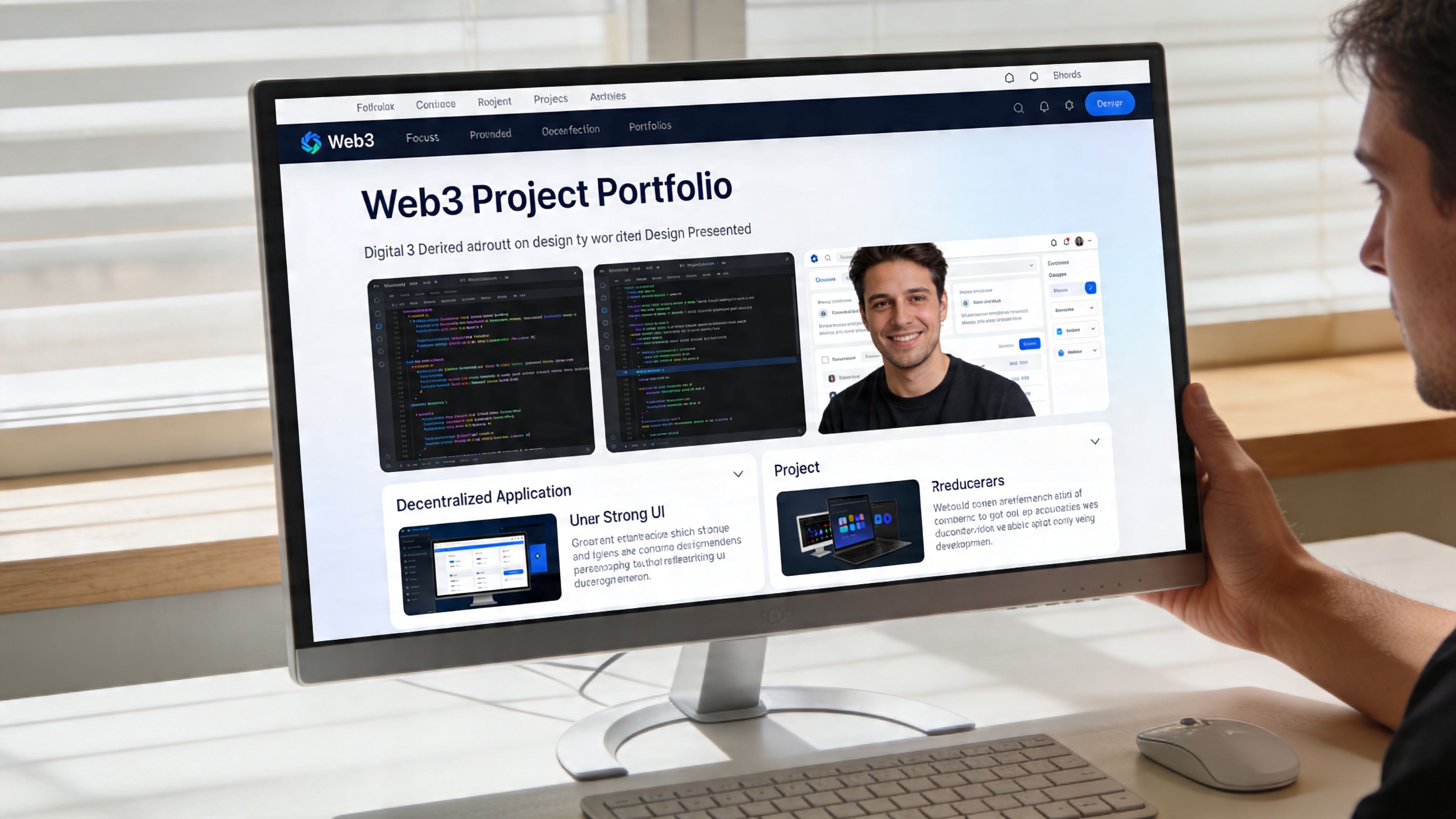
A polished resume helps. A portfolio with code, deployed apps, and clear writeups helps much more.
What a strong portfolio proves
The best Web3 portfolios don’t try to impress with jargon. They reduce doubt.
A recruiter or engineering lead should be able to answer these questions quickly after looking at your GitHub and live projects:
- Can this person ship end to end
- Do they understand wallet flows and transaction states
- Can they write readable code and explain architecture
- Do they know what belongs on-chain and off-chain
- Have they dealt with failure cases instead of only happy paths
Projects that actually help
Build fewer projects, but finish them properly.
A wallet-based app with clear auth logic
This can be a gated dashboard, a profile system, or a token-aware community app. The value isn’t novelty. It’s showing that you understand wallet connection, signature prompts, and session handling without defaulting to old email-password assumptions.
A transaction-heavy interface
An NFT mint page, a staking flow, or a governance voting app works well. The interface should handle pending, confirmed, failed, and rejected transactions cleanly. Add a short README explaining how you approached those states.
A small indexer-backed product
Take contract events and turn them into something useful: an activity feed, treasury dashboard, or portfolio tracker. This shows you understand that raw chain data usually needs normalization before users can work with it.
An open-source contribution
This is one of the fastest credibility builders. Fix a bug, improve documentation, add a test, or ship a small feature in a real crypto-native project. Public collaboration tells hiring managers you can work in the open and take review.
Don’t build a fake protocol clone with no users in mind. Build a narrow tool that solves one real workflow well.
How to present the work
Most candidates lose points here.
A strong project page should include:
- Problem statement: What user pain you were solving
- Tech decisions: Why you chose the stack
- Architecture notes: Which parts are on-chain and which are off-chain
- Risk awareness: Known limitations, especially around security and UX
- Demo instructions: So reviewers can test it quickly
A short walkthrough can help if it’s concrete. This format works well for explaining projects and thought process:
Common portfolio mistakes
- Too many unfinished repos: Three complete projects beat ten abandoned experiments.
- No explanation of trade-offs: Code alone doesn’t show judgment.
- No tests where they matter: Especially bad if you’re applying for contract-heavy roles.
- Copy-paste tutorials with minor edits: Hiring managers spot this immediately.
- No deployed version: If someone has to clone and repair your app before evaluating it, you’ve added friction.
A portfolio should feel like evidence from a working engineer, not a student archive.
Where to Find the Best Web3 Job Opportunities
Most Web3 hiring doesn’t happen through the same channels that dominate traditional tech recruiting. Roles do reach large platforms, but a lot of serious opportunities appear first in ecosystem-native spaces where teams already collaborate, ship code, and discuss roadmap decisions in public.
That changes how you should search. Don’t rely on one source. Build a pipeline.
Job boards that reflect actual crypto hiring
Specialized boards are useful because they filter out companies that mention blockchain casually but aren’t actively building in the space. If you want a cleaner view of active engineering roles, browse dedicated listings for Web3 engineering jobs. You’ll usually spot patterns faster there than on generic job sites, especially around stack requirements and remote expectations.
Still, treat job boards as discovery tools, not the whole strategy. Many good candidates stop at applying. Better candidates also show up where teams already spend time.
Discord, GitHub, and protocol communities
Protocol communities often surface opportunities before they turn into formal listings. If a team maintains an active Discord, forum, or GitHub repo, that’s a hiring signal in itself. You can learn how they communicate, what problems they care about, and whether your skills fit before you ever submit an application.
A practical approach looks like this:
- Join a few protocol communities: Pick products you’d use.
- Read support and developer channels: Repeated pain points often map directly to hiring needs.
- Watch the repos: Frequent issues, open discussions, and active maintainers tell you more than branding does.
- Contribute carefully: Start with docs, tests, or bug fixes if the codebase is large.
Hackathons and bounties
Hackathons get oversold, but they’re still useful when approached correctly. Don’t join to collect swag or stretch into an unrealistic idea. Join to build one credible thing with a team under time constraints.
Teams notice developers who can scope tightly, ship a demo, and explain decisions. That’s often closer to real startup work than a polished interview answer.
Good Web3 job hunting is rarely passive. The candidates who get traction tend to be visible in the same places the work is happening.
Direct outreach that doesn’t look desperate
Cold outreach can work if it’s specific. Don’t send “I’m interested in opportunities” messages to ten projects. Send one short note to a hiring manager or founder that shows you understand the product and have relevant work.
Mention a project you built, a repo contribution, or a sharp observation about their current UX or developer tooling. In Web3, thoughtful relevance beats volume.
Nailing the Web3 Interview and Application Process
A Web3 interview usually tests for more than coding ability. Teams want to know whether you understand why decentralization changes product design, engineering trade-offs, and user trust.
That’s why strong Web2 candidates sometimes underperform. They answer well at the framework level, but not at the trust-model level.

Rewrite your experience in Web3 language
Don’t pretend you’ve done things you haven’t. Translate what you have done.
If you built high-availability commerce systems, emphasize reliability, data integrity, and failure recovery. If you handled payments, point to transaction state, user trust, and edge-case handling. If you ran CI pipelines and staged releases, explain how that discipline would carry into contract deployment or app releases around protocol changes.
These resume shifts work well:
| Web2 Experience | Better Web3 Framing |
|---|---|
| Built a dashboard with complex filters | Built data-heavy interfaces that require state consistency and clear user feedback |
| Managed backend services and databases | Designed systems with strong integrity requirements and clear ownership boundaries |
| Worked on payments or checkout | Handled sensitive transaction flows where user trust and error prevention matter |
| Led frontend performance improvements | Improved reliability and usability in interfaces with expensive user actions |
| Maintained internal tools | Built practical tooling around developer and operator workflows |
Expect a different kind of screening question
The “why Web3” question matters more than many candidates think. Weak answers sound like speculation or ideology. Good answers are grounded in product and engineering reality.
Strong responses usually mention one or more of these:
- You care about user-controlled identity or assets
- You want to build on open protocols rather than closed platforms
- You’re interested in systems where trust assumptions are explicit
- You’ve already built something and want to deepen that work
What doesn’t work is talking only about market cycles, token prices, or broad claims about changing the world.
The technical evaluation is usually more applied
A take-home may ask you to build a small dApp, integrate a wallet, display contract state, or reason through transaction handling. Some interviews stay close to standard web engineering. Others add protocol-specific questions.
You should be ready for prompts like:
- How would you design a token staking interface so users understand pending and completed actions?
- What logic belongs in a smart contract, and what should remain in the app or backend?
- How would you handle a chain reorganization, stale indexer data, or delayed confirmations in the UI?
- What risks do users face when signing messages or transactions?
- If a contract is expensive to interact with, what product or architecture changes would you consider?
What interviewers are really checking: Can you think like an engineer in a system where transparency, immutability, and user custody change the stakes?
What usually sinks otherwise good candidates
The first failure mode is overclaiming. If you say you know Solidity well and can’t discuss testing or common attack surfaces, your credibility drops fast.
The second is ignoring UX. Many Web3 candidates obsess over contracts and forget that employers need developers who can help users complete actions safely.
The third is missing the culture fit around open work. Teams often value people who can write clearly, collaborate in public, and contribute without heavy hand-holding. If you have open-source work, bring it into the conversation. Walk through one contribution and explain the review process.
A good interview in this space feels less like reciting definitions and more like showing judgment under unusual constraints.
Understanding Web3 Salaries and Remote Work Culture
Compensation is one of the reasons many developers start looking seriously at Web3 roles, but it helps to separate broad web development pay from specialized decentralized work.
According to the 2025 web design and development industry report from Web Professionals Global, median salaries for web developers in the U.S. rose 8% to $92,000 in 2025, with international averages from $45,000 to $78,000. The same report notes that senior Web3 roles can command $120,000 to $200,000, and that remote work has expanded access beyond traditional tech hubs.
How Web3 pay packages differ
Base salary is only one part of the discussion. Some teams offer token compensation in addition to cash, and some early-stage projects may lean more heavily on tokens than established companies. That isn’t automatically good or bad. It changes risk.
When evaluating an offer, look at:
- Cash versus token split: How much of your compensation is predictable right now
- Vesting terms: When token grants become accessible
- Liquidity and lockups: Whether the tokens are usable
- Company maturity: An established infrastructure company and a brand-new protocol carry different risk profiles
If you’re comparing regional compensation or remote norms across markets, a practical benchmark resource is this salary guide for engineering roles, especially if you’re evaluating cross-border offers.
Remote culture is often a real advantage
A lot of Web3 teams were distributed early, so async communication, documentation, and global hiring are usually more accepted than in traditional companies. For developers outside major hubs, that can be a meaningful career accelerant. It also means written communication matters more.
If you want to scan live opportunities built around this model, reviewing remote blockchain roles can help you see how teams describe expectations around time zones, autonomy, and collaboration style.
The trade-off is that remote-first doesn’t mean low-pressure. Many teams are small, fast-moving, and public-facing. Good autonomy gets rewarded. Poor communication gets exposed quickly.
Frequently Asked Questions About Web Developer Jobs in Web3
Do I need a computer science degree to get hired
No. Hiring managers care far more about whether you can build and explain your work. A degree can help, but it won’t replace a credible portfolio, clean GitHub activity, and practical understanding of wallet flows, contract interaction, and product trade-offs.
How much crypto knowledge do I need before applying
You don’t need to be a trader or protocol theorist. You do need to understand the basics of wallets, transactions, signatures, gas fees, smart contracts, and why decentralization changes product behavior. The minimum bar is being able to use the kinds of products you want to help build.
Is Web3 too volatile for a stable career move
Some projects are unstable. Some aren’t. The right approach is to evaluate the company the same way you’d evaluate any startup, but with extra attention to treasury, security posture, product usage, and leadership credibility. Infrastructure companies, established exchanges, and teams with strong open-source habits tend to be easier to assess than anonymous projects with vague roadmaps.
Can I move into Web3 without becoming a smart contract engineer
Yes. Many of the best job opportunities for web developers in Web3 are in frontend and full-stack roles. Teams need people who can make decentralized products usable, connect app logic to contracts, manage indexing and data presentation, and ship interfaces that reduce user error.
Are there mission-driven paths, or is everything finance-focused
There are mission-driven paths. According to Tech Jobs for Good, examples in the broader tech ecosystem include a Full-Stack Developer at EnableYou paying $80K to $85K remote in the U.S. and a Backend Engineer at Enveritas paying $135K to $155K global remote. That pattern matters because it shows that developers who care about impact don’t have to choose only between big corporate roles and unstable startups. Similar mission-oriented paths are emerging around digital identity, public goods tooling, and transparency-focused products in Web3.
I’m coming from DevOps or platform engineering. Is that relevant
Absolutely. Blockchain teams need infrastructure thinking, deployment discipline, observability, and reliability work. If your background leans in that direction, it’s worth studying how others position themselves for adjacent roles. For example, this guide on landing high-paying SRE jobs remote is useful for understanding how reliability-focused candidates frame their value in distributed environments.
What should I do first this month
Keep it simple:
- Pick one role target: Frontend dApp, full-stack Web3, or contract-heavy path
- Build one real project: Something deployed and explainable
- Write one sharp case study: Show architecture and trade-offs
- Contribute once in public: Docs, tests, bug fix, or small feature
- Apply with evidence: Lead with projects, not buzzwords
If you’re ready to turn your existing web development skills into a serious Web3 job search, start with Blockchain Jobs. It’s a practical place to find current roles across engineering, product, design, marketing, legal, and other blockchain-focused functions without digging through generic listings that barely understand the space.