Learn Solidity Programming Language: Your Complete Career Guide
Before you write a single line of Solidity, let's talk about what hiring managers actually look for. They don't just want a coder; they want an engineer who understands the entire ecosystem. That means getting comfortable with foundational tech—specifically JavaScript and the Ethereum Virtual Machine (EVM)—before diving into smart contracts.
Getting this foundation right is what separates serious candidates from hobbyists in a technical interview. It’s the difference between just writing code and understanding why your code works the way it does on a decentralized network—a distinction that will define your career trajectory.
Building Your Foundation For A Blockchain Career
Too many aspiring developers jump straight into Solidity syntax, a shortcut that almost always leads to a dead end. To build a lasting career and pass tough technical interviews, you need to understand the ground you're building on.
That's why we start with JavaScript. Smart contracts are useless on their own; they need a front-end to interact with them, and that interaction is almost always asynchronous. A solid grasp of modern JavaScript isn't just a "nice-to-have"—it's a non-negotiable prerequisite for most Solidity roles.
- Promises and
async/await: In an interview, you might be asked how a dApp handles a pending transaction. The answer lies inasync/await. When a user submits a transaction, your app can't freeze. You must know how to handle these delayed operations gracefully. This is a core skill for building a functional dApp and a common interview topic. - API Interaction: You'll use libraries like Ethers.js or Web3.js to communicate with the blockchain. These are Promise-based. Without this knowledge, you can't connect your front-end to your back-end smart contract, making you an ineffective team member.
This flow shows how everything connects on your journey to becoming a hireable developer. You start with web development fundamentals, move to understanding the runtime environment (the EVM), and only then do you get to Solidity.
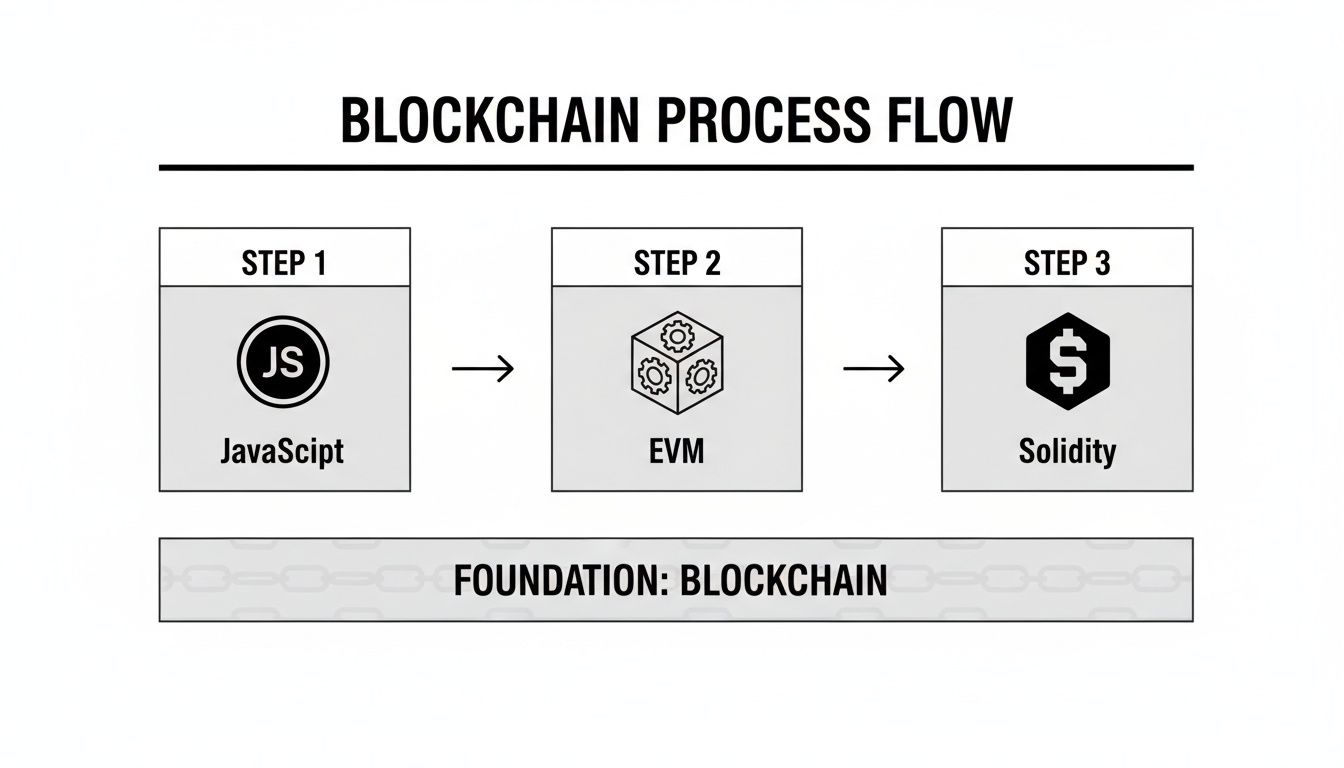
As you can see, Solidity is the final piece of the puzzle, not the starting point for a successful career.
Demystifying The Ethereum Virtual Machine
Next up is the Ethereum Virtual Machine (EVM). Think of it as a single, global computer that runs every smart contract on the network. A hiring manager won't just ask you to write a function; they'll want to know if you understand the unique, constrained environment where that function will execute. This is a key differentiator between junior and senior candidates.
The EVM is the runtime environment for smart contracts on Ethereum. Every transaction and contract deployment happens inside it. Mastering its mechanics is what elevates you from a coder to a true blockchain engineer that companies want to hire.
For your interviews, you absolutely need to nail these concepts:
- Transaction Lifecycle: What happens when someone clicks "Confirm" in their wallet? Be ready to explain the journey of a transaction from a user's device into a mined block. This demonstrates deep, practical knowledge.
- Gas and Fees: Why does every operation have a cost? More importantly, how do you write gas-efficient code? Discussing gas optimization in an interview is a huge signal that you possess a senior-level, commercially-aware mindset.
- State: The blockchain is a state machine. Every transaction triggers a state transition. You need to articulate how your smart contract modifies this global state, proving you understand the big picture.
Solidity has been around since 2014, and that maturity matters to employers. It's been battle-tested across millions of smart contracts managing billions of dollars. This long history gives companies confidence in its security and reliability. You can dive deeper into the evolution of blockchain programming languages to see how far things have come.
Getting a Handle on Core Solidity Concepts for Interviews
Alright, now that you've got the EVM basics down, it's time to get into the heart of Solidity. This is where hiring managers separate the talkers from the builders. Technical interviews aren't about reciting definitions; they're designed to see if you can write secure, gas-conscious, and functional smart contracts under pressure.
Your goal is to prove you have a deep, practical grasp of how Solidity works with the EVM's constraints. Forget memorizing syntax. You need to understand the why behind every language feature to solve real-world problems.
State Variables and Data Locations: The First Big Test
One of the first things a good interviewer will grill you on is how Solidity handles data. A mistake here in the real world can cause catastrophic bugs or burn millions in gas fees. It's a non-negotiable concept, and you will almost certainly be asked to explain the difference between storage, memory, and calldata.
Here’s what you need to know, framed for a job interview:
- Storage: The contract's permanent memory, its "hard drive" on the blockchain. It's incredibly expensive, so demonstrating that you use it sparingly is the hallmark of a professional.
- Memory: Temporary RAM for your functions. It exists only while a function is running. It's much cheaper than storage and ideal for handling data mid-calculation.
- Calldata: A special, read-only location for data passed into an external function. It’s the cheapest of the three, making it the go-to for external function parameters. Using it correctly shows you're serious about gas optimization.
Being able to fluently articulate the trade-offs between storage, memory, and calldata—especially in terms of gas costs and persistence—instantly signals to an interviewer that you think like a seasoned blockchain engineer, not a beginner.
For quick reference, here's a breakdown. Understanding this table is fundamental to writing efficient code and acing technical discussions.
Solidity Data Location Comparison
| Data Location | Persistence | Mutability | Typical Gas Cost |
|---|---|---|---|
| Storage | Permanent | Mutable | Very High |
| Memory | Temporary (per function call) | Mutable | Medium |
| Calldata | Temporary (per function call) | Immutable | Very Low |
This isn't just theory; it directly impacts every line of code you write and every wei of gas your users spend.
Mappings and Structs: Your Data-Structuring Toolkit
Simple variables only get you so far. Real applications need complex ways to organize data. Two of your most important tools will be mappings and structs, and in an interview, you'll need to know which one to reach for instinctively.
Mappings are key-value stores, like hash tables or dictionaries. They are incredibly efficient for linking one piece of data to another, like associating a user's address with their token balance.
// SPDX-License-Identifier: MIT
pragma solidity ^0.8.20;

contract UserBalances {
    // Mapping from an address to their balance (an unsigned integer)
    mapping(address => uint256) public balances;
}
Structs, on the other hand, let you create custom data types by bundling different variables together. They’re perfect for defining an "object" with multiple properties, like an NFT with an owner, an ID, and a metadata link.
// SPDX-License-Identifier: MIT
pragma solidity ^0.8.20;

contract NFT {
    struct NonFungibleToken {
        address owner;
        uint256 id;
        string metadataURI;
    }
    // You can now use 'NonFungibleToken' as a data type
}
An interviewer might ask you to design a basic system on the spot. Knowing whether a mapping, a struct, or a mix of both is the right tool is a direct measure of your practical problem-solving skills.
Function Visibility and Access Control: A Security Litmus Test
How you declare function visibility is a dead giveaway of your security mindset. One wrong specifier can create a massive vulnerability, so this is another interview essential.
Here’s the breakdown and what each choice says about you as a developer:
- public: Anyone can call it. This is for your contract's main, user-facing features.
- external: Can only be called from outside the contract. It's slightly more gas-efficient than
publicfor these calls, and choosing it shows you sweat the details. - internal: Only callable from within the contract or by inheriting contracts. Perfect for helper functions you don't want to expose.
- private: The most restrictive. It can only be called from the specific contract where it's defined.
Getting this right is crucial. Top teams live and breathe these distinctions. Job descriptions for a senior smart contract engineer at Uniswap Labs emphasize security and precision. Nailing these concepts proves you’re ready for high-stakes environments where every detail matters.
Getting to Grips with the Modern Solidity Toolchain
Writing Solidity is one thing, but knowing how to build, test, and deploy that code is what makes you a hireable engineer. In a job interview, they don't just want to see if you can write a for loop. They want to know if you understand the professional workflow—the tools that keep projects on track and prevent costly mistakes.
Mastering this toolchain is a fundamental requirement. It proves you can join a team and be a productive, safe contributor from day one. Let's walk through the essential kit for a modern Solidity developer.
Kickstart Your Ideas With Remix IDE
Every developer needs a sketchbook, and for Solidity, that’s Remix IDE. It's a browser-based environment that lets you write, compile, debug, and deploy smart contracts without any setup. For anyone starting out, Remix is your best friend.
Think of Remix as your personal lab for smart contracts. It's also a surprisingly useful interview tool. If a hiring manager asks you to prototype a simple contract on the spot, confidently firing up Remix and coding a solution live is a massive win. It shows you’re hands-on and can think on your feet.
Moving to a Professional Local Setup
While Remix is fantastic for quick tests, no serious team builds production code in a browser. For real-world development, you need a local setup managed by a development framework. This is where you’ll handle dependencies, write automated tests, and create deployment scripts—all non-negotiable skills for a professional role.
The two heavyweights are Hardhat and Foundry. Your choice often boils down to whether you prefer testing in JavaScript or Solidity. You need to be proficient in at least one; most job descriptions will explicitly mention them.
Here's a look at the Hardhat homepage, a popular choice for building, testing, and deploying smart contracts.
The screenshot highlights essentials like a local Ethereum network, debugging tools, and task runners that are central to a professional workflow.
Hardhat: The JavaScript-Powered Workhorse
For developers coming from a web background, Hardhat is often the path of least resistance. It's an Ethereum development environment that lets you manage your entire workflow using JavaScript or TypeScript.
With Hardhat, you can:
- Compile Contracts: Seamlessly turn Solidity files into EVM-ready ABI and bytecode.
- Run a Local Network: Fire up a personal blockchain for instant, free testing.
- Write Automated Tests: This is the most critical part for employers. Using standard libraries like Chai and Mocha, you write tests to prove your contract logic works. This is your first line of defense against bugs.
- Script Deployments: Create simple, repeatable scripts to deploy your contracts consistently to any network.
Knowing how to set up a Hardhat project, write comprehensive tests, and manage deployments shows you're ready for professional, team-based development.
Foundry: The Solidity-Native Speedster
Foundry is a newer toolkit written in Rust that has gained massive traction. Its killer feature? You write your tests directly in Solidity. This is a game-changer because you don't have to switch mental contexts between your contract and test code.
For many developers, testing in Solidity feels more intuitive. You're thinking in the same language and using the same patterns, which can help you spot edge cases you might miss when translating logic into JavaScript.
Foundry is also ridiculously fast. Its testing engine, Forge, can run massive test suites in a fraction of the time it takes other frameworks. As you learn solidity programming language, getting comfortable with Foundry can give you a real edge and show employers you’re up-to-date on high-performance tools.
Ultimately, whether you choose Hardhat or Foundry, mastering one proves you understand the entire development lifecycle. It’s the step that takes you from someone who knows Solidity to a capable and employable smart contract engineer. Solidity powers around 65% of all smart contracts, a dominance built on its incredible tooling. Find more data on the smart contract language market on metana.io.
Adopting A Security-First Mindset To Write Safer Code

In Web3, security isn't just a feature—it's everything. When you write a smart contract, you're engineering a digital vault. One tiny oversight can lead to irreversible, catastrophic losses, which is why security is the single most valuable skill you can bring to a team.
Hiring managers look for developers who think like auditors. They want to see that you can write code that isn't just functional, but fundamentally resilient. It’s about anticipating attack vectors and weaving defenses directly into your logic.
Dissecting Common Smart Contract Vulnerabilities
To build secure systems, you have to learn how to break them. A handful of vulnerabilities appear repeatedly in major hacks, and recognizing these patterns is a core competency for any serious Solidity developer.
Being able to discuss these intelligently in an interview—and more importantly, explain how to prevent them—is a huge green flag for employers.
- Reentrancy: The infamous vulnerability from the 2016 DAO hack. It occurs when an external call allows another contract to call back into the original function before it has finished, letting an attacker drain funds repeatedly.
- Integer Overflow/Underflow: Before Solidity 0.8.0, basic math was a landmine. Adding
1to auint256at its max value would wrap it to0. Attackers exploited this to manipulate token balances. - Front-Running: Transactions sit in the public mempool before being mined. An attacker can see your profitable trade, copy it, and submit their own with a higher gas fee to get processed first, stealing your opportunity.
Showing you understand the "why" behind these attacks, not just the "what," signals a level of maturity that companies are desperate to hire.
From Insecure Code To Bulletproof Logic
The key to impressing an interviewer isn't just listing vulnerabilities. It's demonstrating how you actively write code to shut them down. This connects theory to practice.
A crucial design pattern to internalize is Checks-Effects-Interactions. It’s a simple but powerful rule for structuring functions, especially those making external calls.
- Checks: First, validate all preconditions with
require()statements (e.g.,require(msg.sender == owner)). - Effects: Next, write changes to your contract’s state before doing anything else (e.g.,
balances[msg.sender] -= amount). - Interactions: Only after all checks pass and state is updated should you interact with other contracts (e.g.,
recipient.call{value: amount}("")).
By updating your contract's balance before sending Ether, you neutralize reentrancy attacks. Even if the recipient calls back, the internal state is already correct, so there's nothing left to exploit.
Adopting the Checks-Effects-Interactions pattern isn't just a technique; it's a mindset. It proves to an employer that your default approach is inherently defensive and security-conscious.
For integer overflows, the modern fix is simple: use Solidity 0.8.0 or newer, which has built-in protection. For more complex math, lean on battle-tested libraries like OpenZeppelin's SafeMath (or their more current math contracts). Name-dropping these tools in an interview shows you value audited, community-trusted solutions.
Mastering Access Control
Finally, strong access control is non-negotiable. Simple modifiers like onlyOwner are your first line of defense, ensuring critical functions can only be called by the right address. Writing and applying these modifiers cleanly is a baseline expectation for any Solidity role.
For advanced positions like a Smart Contract Security Engineer, you'll need to demonstrate a deep understanding of more complex, role-based access control systems. This security-first approach shows you can be trusted to build the robust applications the Web3 ecosystem depends on.
Here’s a quick reference guide to common vulnerabilities and their mitigations.
Common Smart Contract Vulnerabilities And Preventions
| Vulnerability | Description | Prevention Method |
|---|---|---|
| Reentrancy | An attacker's contract calls back into the calling contract before the initial function call is complete, allowing for repeated fund withdrawals. | Use the Checks-Effects-Interactions pattern. Update state variables before making external calls. Use a reentrancy guard modifier. |
| Integer Overflow/Underflow | Arithmetic operations result in a number that is outside the range of the data type, causing it to wrap around (e.g., uint8(255) + 1 = 0). |
Use Solidity version 0.8.0 or higher, which has built-in checks. For older versions or complex math, use OpenZeppelin's SafeMath library. |
| Front-Running | A malicious user observes a transaction in the mempool and submits their own transaction with a higher gas fee to get it processed first. | Implement commit-reveal schemes. Use off-chain solutions or private mempools for sensitive transactions. Be mindful of slippage parameters in DEXs. |
| Unchecked External Calls | A contract makes an external call but doesn't check if it was successful, potentially leading to a failed state change that goes unnoticed. | Always check the return value of low-level calls (call, delegatecall, send). Wrap them in require() statements to ensure they succeed. |
| Access Control Flaws | Critical functions lack proper authorization checks, allowing any user to perform administrative actions like withdrawing funds or changing ownership. | Implement robust access control using modifiers like onlyOwner or role-based systems (e.g., OpenZeppelin's AccessControl). |
Keeping these patterns top of mind isn't just about passing an interview; it's about being a responsible and effective Web3 developer.
Building a Job-Winning Smart Contract Portfolio

Let's be blunt: theory and a security mindset are crucial, but they won't land you a job by themselves. The single most powerful tool in your job search is a portfolio of real, well-documented smart contract projects. It’s your proof-of-work, showing recruiters you can do more than just follow tutorials—you can actually build.
This isn't about creating the next Uniswap. It's about demonstrating a clear progression of skills and a solid grasp of professional development practices. Your portfolio is your resume, technical test, and first-round interview rolled into one powerful package.
Project One: The Foundational ERC20 Token
Every Solidity developer's journey starts with a token. Building your own ERC20 token is the "Hello, World!" of smart contracts. This non-negotiable first project proves you've mastered the fundamentals.
When you build your token, focus on showcasing these core skills:
- Standard Implementation: Follow the ERC20 interface to the letter (
totalSupply,balanceOf,transfer, etc.). This shows you can read and adhere to established Ethereum Improvement Proposals (EIPs). - Access Control: Use a simple
onlyOwnermodifier to restrict functions like minting. It’s a basic pattern that signals security awareness. - Clear State Management: Use
mappingto track balances and allowances. This proves you know how to manage on-chain data efficiently.
This project is your entry ticket. Executing it cleanly and correctly is a must.
Project Two: The Creative ERC721 NFT Collection
Once you're comfortable with fungible tokens, dive into non-fungible tokens (NFTs). An ERC721 NFT collection project lets you flex your creativity and show off a more advanced, in-demand skill set.
A standout NFT project should highlight your ability to:
- Manage Unique Identifiers: Use a counter to safely mint new NFTs, each with a unique
tokenID. - Handle Metadata: Implement functions that link each
tokenIDto a metadata URI (often on IPFS). This is a cornerstone concept for any NFT project. - Ownership and Transfers: Correctly implement
safeTransferFromand manage ownership records, showing you understand the nuances of the ERC721 standard.
A well-executed NFT project proves you can handle more complex logic than a simple token. It shows you can manage unique on-chain assets, a critical skill for GameFi, digital identity, and art-focused applications that companies are hiring for.
Remember, presenting this project effectively on your GitHub is as important as building it.
Project Three: A Simple DeFi Application
With tokens and NFTs in your toolkit, the final piece of your portfolio should be a simple DeFi application. This project signals to employers that you’re ready to tackle the most valuable and complex sector in blockchain. A staking contract is the perfect place to start.
This project is where you'll showcase your most advanced skills yet:
- Contract Interoperability: Your staking contract will need to interact with your ERC20 token contract. This demonstrates you can build interconnected systems.
- Time-Based Logic: Use
block.timestampsafely to calculate staking rewards. - Financial Logic: Securely handle user deposits, withdrawals, and reward calculations, proving you can be trusted with financial primitives.
Building a project like this shows you can connect different smart contracts into a cohesive application—a core skill for any Solidity Smart Contract Developer.
Presenting Your Portfolio Like a Pro
The code itself is only half the battle. How you present your work on GitHub can make or break your chances with a hiring manager. A messy, undocumented repository is a huge red flag.
Here's how to make your portfolio shine:
- A Killer README.md: For every project, write a clear README. Explain what the project is, the problem it solves, the technologies you used, and how to run it locally.
- A Comprehensive Test Suite: Your code must have robust tests written in Hardhat or Foundry. High test coverage isn't just a number; it proves you're a disciplined and reliable engineer.
- Clean Deployment Scripts: Include commented scripts for deploying your contracts to a testnet. This shows you understand the entire development lifecycle.
Frequently Asked Career Questions
Figuring out how to go from learning Solidity to landing a job is where the real questions start. It's one thing to write a smart contract; it's another to get hired to do it.
Here's some direct, practical advice based on what hiring managers in Web3 are actually looking for.
How Long Does It Take To Get Job Ready In Solidity?
There's no single answer, but if you're coming from a background like JavaScript and stay focused, you can be job-ready in about 4-6 months. This timeline is all about active, hands-on building.
Here’s a realistic breakdown for your career plan:
- Months 1-3: Deep dive into Solidity fundamentals, the EVM, and a core developer framework like Hardhat or Foundry. This builds your foundation.
- Months 4-6: Shift entirely to building your portfolio. Your goal is to create 2-3 solid projects like an ERC20 token, a full-stack NFT minting DApp, or a simple DeFi protocol.
At the end of the day, the quality of your portfolio that screams "job-ready," not the number of months you've been studying.
Do I Need A Computer Science Degree?
Honestly, no. A CS degree isn't the golden ticket into Web3 that it might be in traditional tech. This space values what you can build far more than where you went to school. Your GitHub profile is your new resume.
A hiring manager wants to see proof that you can ship secure, efficient, and well-tested smart contracts. A self-taught developer with a clean, active GitHub—showing off well-documented code and thorough tests—is often a much stronger candidate than a recent grad with only academic knowledge.
That said, don't skip the fundamentals. A strong understanding of data structures and algorithms is still crucial for writing good code, no matter how you learned it.
Should I Learn Solidity Or Rust First?
If your goal is to land a job as quickly as possible, start with Solidity. It's the language of the Ethereum Virtual Machine (EVM), the engine behind a massive ecosystem including Avalanche, Polygon, BNB Chain, and dozens of others.
The EVM ecosystem has the largest market share, which translates directly to the most developer jobs. Rust is an incredible language with a growing community, especially for chains like Solana and Polkadot. But for now, its ecosystem is smaller and has fewer entry-level roles.
Starting with Solidity gives you a much clearer and more established path to your first blockchain engineering role.
Ready to find your place in the future of tech? At Blockchain Jobs, we connect talented professionals like you with the most exciting opportunities in the Web3 ecosystem. Explore roles in DeFi, NFTs, and beyond to kickstart your career. Find your next role at https://blockchain-jobs.com.