A Developer's Guide to Programming on the Blockchain
Programming on the blockchain is about writing code that runs across a decentralized network. The core of this work involves building smart contracts, which are self-executing programs that are critical for a career in this space.
Think of a smart contract like a digital vending machine, pre-programmed with rules: if someone inserts a dollar, dispense a soda. Once deployed, it just works. No cashier is needed, no one can change the prices, and everyone can see how it operates. This simple but powerful concept drives everything from decentralized finance (DeFi) to NFTs, and mastering it is a skill that companies are desperately looking for right now. For developers, this translates directly into high-value job opportunities.
Your Path to a Career in Blockchain Programming
Welcome to the world of blockchain development, where your code builds transparent, permanent systems that power a new digital economy. This guide is designed to cut through the hype and show you what "programming on the blockchain" actually means for your career, focusing on the practical skills that will get you hired.
Companies are investing heavily in this space for good reason. Blockchain delivers a level of security, transparency, and efficiency that is reshaping industries from finance to logistics. For a developer, this means a booming job market filled with opportunities to work on genuinely innovative problems. To land one of those roles, you must master the unique rules of this new technical landscape.
Understanding On-Chain vs. Off-Chain Logic
One of the first, and most important, concepts to master for any job interview is the difference between on-chain and off-chain logic. This isn't just a minor technical detail; it's a core architectural choice that directly impacts an application's performance and cost. Hiring managers will ask about this to test if you have practical, real-world development knowledge.
- On-Chain Logic: This is anything that happens directly on the blockchain. We're talking about the critical, trust-sensitive operations—transferring tokens, minting an NFT, or settling a trade. Because it's recorded on the distributed ledger, it's incredibly secure and transparent. The trade-off? It can be slow and expensive due to network fees (often called "gas").
- Off-Chain Logic: This covers all computations and data storage happening outside the main blockchain. Think of it as the support system that prepares data for your smart contracts or handles heavy processing without congesting the network. It's essential for building applications that are fast and user-friendly.
A common interview question might be, "How would you design a decentralized betting app?" A strong answer involves balancing both. You'd use on-chain logic for the final, trust-sensitive payout, but all odds calculations and user data management would happen off-chain to keep it fast and cheap. This shows you're thinking like a seasoned professional who can build scalable, cost-effective products.
Connecting Code to Career Opportunities
Mastering these concepts is your direct path to a career. When you browse listings for a "Smart Contract Engineer" or "DeFi Protocol Developer" on a site like Blockchain Jobs, employers are really looking for someone who can write secure and efficient on-chain code.
They need a developer who instinctively understands the trade-offs between on-chain security and off-chain performance. This guide will give you the roadmap, connecting these foundational ideas to the real-world skills and portfolio projects that turn a curious learner into a hireable expert.
Choosing Your Language and Navigating the Job Market
Every blockchain developer has a primary programming language. Think of it as your core tool. But picking which one to learn isn't just about syntax—it’s a major career decision that shapes the kinds of jobs you'll land, the teams you'll join, and the projects you'll build.
When you commit to a language, you’re buying a ticket into a specific ecosystem. You're not just learning code; you're immersing yourself in a world of specific protocols, dApps, and developer communities. That's what hiring managers are really looking for: an expert in their particular corner of the digital world.
Solidity: The Broadest Path in the EVM Ecosystem
If you want the most job opportunities, period, then learning Solidity is your best bet. It’s the original language for smart contracts on the Ethereum Virtual Machine (EVM), which powers not only Ethereum but also a huge network of other major chains like Polygon, Avalanche, and BNB Chain. This massive footprint means the demand for skilled Solidity developers is consistently high.
From a career standpoint, knowing Solidity opens doors to the most mature sectors of Web3:
- DeFi Engineering: Nearly all the big names in decentralized finance were built with Solidity. In these roles, you'll be crafting everything from sophisticated lending platforms to automated market makers.
- NFTs and Digital Collectibles: The ERC-721 and ERC-1155 standards that define the entire NFT space are written in Solidity. If you want to build the next big marketplace or minting platform, this is the language you'll need.
The EVM world is well-established, so its tools are battle-tested and robust. You'll work with frameworks like Hardhat or Foundry for development and testing, and use wallets like MetaMask to interact with contracts. Proficiency with this toolchain is a non-negotiable for most job interviews.
Rust: For High-Performance and Core Engineering
While Solidity owns the EVM space, Rust has become the gold standard for high-performance blockchains like Solana, Polkadot, and Near. These platforms prioritize speed and scalability, and Rust’s focus on memory safety and raw performance makes it the perfect tool for the job.
The job market for Rust developers often leads to more specialized, high-impact roles. A quick scan of job boards shows that Rust skills make you a top contender for:
- Protocol Engineering: This means working on a blockchain's core infrastructure—optimizing transaction processing or building foundational new features.
- High-Frequency DeFi: Think decentralized exchanges or trading bots where every millisecond of performance counts.
- On-Chain Gaming: Building game logic that needs to be fast and responsive enough for a great user experience.
Mastering Rust can be a huge advantage in your job search. It's tougher to learn than Solidity, but it sends a powerful signal to employers: you can handle deep, complex, low-level challenges. That's a trait that's always in high demand. Many senior-level blockchain jobs specifically seek this expertise. You can learn more about what a Senior Rust Engineer role in the core blockchain space entails by reviewing current job descriptions.
Move: The New Frontier of Secure Smart Contracts
There's also a newer language called Move that's gaining momentum. It was designed from scratch with an intense focus on asset security and formal verification. Originally created for Meta’s Diem project, it now powers up-and-coming chains like Aptos and Sui.
Learning Move is a strategic career bet on where the industry is heading. The ecosystem is still young, so you'll find fewer jobs than for Solidity or Rust right now, but you'll also face far less competition. Getting in early means you can quickly become a go-to expert in a rapidly growing space. The roles here often involve:
- Building the first wave of foundational dApps on these new chains.
- Working directly with core protocol teams to shape the future of the platform.
- Specializing in creating ultra-secure digital assets and token standards.
Comparing Top Blockchain Languages for Your Career
To make the choice clearer, let's put these languages head-to-head from a job-seeker's perspective. This table breaks down what matters most for your career: the ecosystem you'll join, the language's strengths, the roles you'll be qualified for, and how hard it is to get started.
| Language | Primary Ecosystems | Key Strengths | Common Job Roles | Learning Curve |
|---|---|---|---|---|
| Solidity | Ethereum, Polygon, Avalanche, BNB Chain | Massive ecosystem, abundant learning resources, huge job market | DeFi Engineer, NFT Developer, Smart Contract Auditor | Moderate |
| Rust | Solana, Polkadot, Near | High performance, memory safety, strong for core infrastructure | Protocol Engineer, High-Frequency DeFi Dev, Game Dev | Steep |
| Move | Aptos, Sui | Designed for security, formal verification, resource-oriented | Foundational dApp Developer, Core Protocol Contributor | Moderate to Steep |
Ultimately, the language you choose will set your career trajectory. Solidity offers the widest range of opportunities right now. Rust opens the door to specialized, high-performance engineering roles. And Move positions you on the cutting edge of a new, security-focused ecosystem.
My advice? Analyze job descriptions for roles that excite you. See what languages and tools they require, and let that be your guide for where to focus your learning.
Mastering the Smart Contract Development Lifecycle
Writing a smart contract is just the first step. Anyone can write a few lines of code, but what separates a junior coder from a senior engineer is a deep understanding of the entire development lifecycle. If you can walk a hiring manager through this professional workflow, you're not just showing you can code—you're showing you can ship production-ready applications.
It all starts in your code editor, likely VS Code, where you'll hash out the logic for your smart contract. This is the creative part, where you turn an idea into code using a language like Solidity or Rust. But at this stage, the code is just for you and other developers; the blockchain can't understand it yet.
From Code to Bytecode
That's where compilation comes in. This is the crucial step of turning your human-readable code into bytecode—the low-level language that a blockchain's virtual machine, like the Ethereum Virtual Machine (EVM), can actually execute. Tools like the Solidity compiler (solc) or the Rust toolchain handle this translation for you.
Once you have the bytecode, you don't just throw it onto the main blockchain. Instead, you deploy it to a testnet. Think of a testnet as a perfect replica of the real thing, but with "play money." Using a local testnet like Hardhat or Anvil, you can poke and prod your contract, simulate transactions, and find bugs in a completely safe environment. This cycle—write, compile, test, repeat—is the bedrock of building anything reliable on-chain.
The image below shows how this process works for a few of the most popular languages.
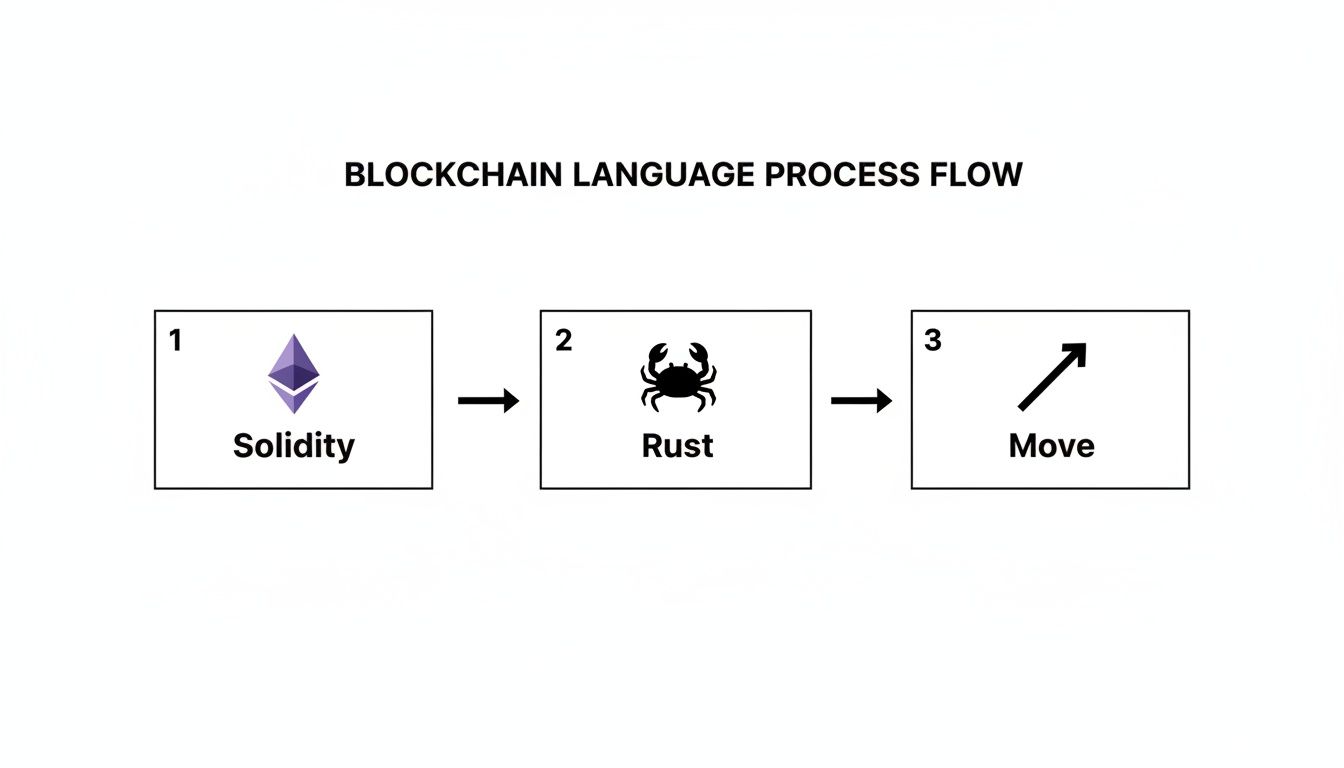
You can see that even though the languages and tools are different, the core workflow of development, testing, and deployment is a constant across all the major blockchain ecosystems.
Automating Deployment and Ensuring Quality
Senior developers don't do things by hand if they can help it. They automate. This is where Continuous Integration and Continuous Deployment (CI/CD) becomes essential. By setting up a CI/CD pipeline with a tool like GitHub Actions, you can make it so that every time you push new code, it automatically runs all your tests, compiles the contract, and even deploys it to a testnet.
In an interview, describing how you would implement a CI/CD pipeline to manage smart contract deployments proves you think about scalability and team collaboration—key traits of a senior hire. It shows you’re focused on professional-grade processes, not just hobbyist coding.
This kind of automation is the mark of a mature development process. It keeps code quality high and lets the whole team move faster without breaking things. To get a real sense of what companies are looking for, check out job descriptions like this one for a Senior Software Engineer for Blockchain Protocols.
The Paramount Importance of Security Audits
The final, and most critical, hurdle before going live is the security audit. Smart contracts are immutable and often control huge amounts of money. A single bug isn't just an inconvenience; it can lead to a catastrophic financial loss. This is why projects hire professional auditing firms to put their code under a microscope and search for any possible exploit.
Auditors are hunting for well-known and often devastating issues, such as:
- Reentrancy Attacks: The classic crypto hack where an attacker's contract can repeatedly call back into yours to drain funds before your contract's balance has a chance to update.
- Integer Overflows/Underflows: A nasty bug where a math operation goes above the maximum or below the minimum value for a variable type, causing it to "wrap around" and create completely unexpected (and dangerous) results.
- Access Control Flaws: Simple mistakes where critical functions, like one that withdraws all the money, aren't properly restricted to only the contract's owner.
Knowing these vulnerabilities exists isn't enough. You have to write defensive code from day one. When you can confidently explain in an interview how you’d prevent a reentrancy attack or structure your contract's permissions, you're sending a powerful message: you're ready for the high-stakes world of blockchain development.
Building a Portfolio That Gets You Hired

In the blockchain job market, your portfolio is everything. It's the most powerful tool you have—tangible, undeniable proof that you can actually build things. A resume can get you in the door, but it’s your GitHub that truly does the talking.
When a hiring manager looks at your work, they aren't just scanning for clean code. They are looking for signs that you can think through and solve real problems. This is why you must move beyond "Hello World" tutorials. Your portfolio should feature projects that demonstrate a solid grasp of programming on the blockchain. The real goal is to build things that become compelling stories you can tell in an interview.
Choosing Projects That Demonstrate In-Demand Skills
To make an impression, your projects should mirror the work professional Web3 teams tackle daily. Focus on building applications that force you to wrestle with core blockchain concepts—state management, security vulnerabilities, and data integration. A project that covers the full development lifecycle from coding to deployment signals you're ready for a professional role.
Here are a few project ideas designed to build the skills employers are actively seeking:
Decentralized Voting dApp: This is a fantastic way to demonstrate your understanding of access control and on-chain state management. You'll have to implement logic ensuring only authorized wallets can vote and that they can only vote once. This classic project tests fundamental smart contract security principles.
Simple NFT Marketplace: Building a basic marketplace forces you to get your hands dirty with the ERC-721 standard, a non-negotiable skill for most NFT-related roles. You’ll handle ownership transfers, listing logic, and royalty payments, proving you can work with established token standards.
DeFi Yield-Farming Dashboard: This more advanced project shows you can integrate with the existing DeFi ecosystem. You’ll write smart contracts that deposit and withdraw assets from a major protocol like Aave or Compound and then build a front-end to display the returns. This is a great way to demonstrate full-stack Web3 skills.
When presenting your portfolio, don't just show the code. Tell the story behind it. Your GitHub README should be a mini-case study. Explain the problem you aimed to solve, the technical challenges you overcame (like mitigating reentrancy attacks or optimizing gas costs), and the key design decisions you made. This narrative transforms a code repository into a powerful career asset.
Showcasing Your Work to Land Interviews
Treat your GitHub profile as your professional storefront. A clean, well-documented portfolio signals to recruiters that you're organized, thoughtful, and serious about your craft. Pin your three most impressive projects to the top of your profile—they should be the first thing anyone sees.
The demand for blockchain talent is surging. In 2025, venture capital investment in US crypto companies shot up to $7.9 billion, a 44% increase from 2024. This isn’t a small bump; it’s a sign of a strong rebound and growing confidence in blockchain skills.
What's really telling is where that money is going. For every VC dollar invested in crypto in 2025, 40 cents went to companies blending AI and blockchain—up from just 18 cents the year before. This is creating a surge in roles for AI wallets and DePIN networks. You can discover more about the 2026 crypto outlook to understand where the industry is headed. A killer portfolio is your ticket to catching this next wave.
How to Ace the Blockchain Developer Interview
You’ve built a killer portfolio and you understand the development lifecycle. Now for the final challenge: the interview. This is where you prove you can solve real problems in a high-stakes, decentralized world, going beyond just reciting technical definitions.
To succeed, you need a game plan. You must understand the different kinds of roles available, anticipate the questions you’ll face, and frame your experience as the perfect solution for the company's needs. Whether you’re interviewing for a Smart Contract Engineer, Protocol Developer, or Full-Stack Web3 position, the mission is the same: prove you think deeply about security, scale, and architecture.
Navigating Different Developer Roles
The interview you face will depend heavily on the specific role you’re targeting. Each role emphasizes a different aspect of programming on the blockchain, so a one-size-fits-all approach won't work. Always analyze the job description first to understand what skills they truly value.
Here’s a quick rundown of what to expect:
- Smart Contract Engineer: This role is all about the on-chain world. Expect deep dives into your chosen language (like Solidity’s memory layout), common security vulnerabilities (reentrancy, integer overflows), and gas optimization techniques.
- Protocol Developer: This is a core engineering role. Interviews will cover advanced topics like consensus algorithms, P2P networking, and cryptography. They need to know you can contribute to the foundational layer of a blockchain.
- Full-Stack Web3 Developer: This role connects the blockchain to the user. You’ll need to discuss building dApp front-ends, managing wallet connections, and handling on-chain events to create a seamless user experience.
Mastering the Technical Gauntlet
Once in the interview, expect a mix of theoretical questions and practical design challenges. The goal is to see your thought process in action. Hiring managers care more about how you solve a problem than whether you have the perfect answer memorized.
You'll often get questions designed to test your understanding of subtle but critical concepts. For instance, a classic Solidity question is: "Explain the difference between a call and a delegatecall." A junior answer just defines the two. A senior answer explains that delegatecall executes code from another contract within the context of the calling contract—preserving msg.sender and storage—and then immediately highlights the massive security risks this creates if not handled carefully.
System design questions take this a step further by asking you to architect an entire application. A common one is: "How would you design a decentralized exchange (DEX)?"
Your answer should be a structured, step-by-step walkthrough:
- Core Logic: Start with the smart contract architecture. You'd likely discuss using an Automated Market Maker (AMM) model with liquidity pools.
- Key Functions: Then, detail the essential functions like
swap,addLiquidity, andremoveLiquidity. - Security & Efficiency: Next, address how you'd mitigate front-running attacks and optimize gas costs.
- Oracles: Finally, mention the need for a price oracle to bring in reliable, external asset prices.
The secret weapon in your arsenal is your portfolio. When an interviewer asks about a project, don't just give a tour. Tell a story. Start with the problem you were trying to solve, explain the architectural choices you made (and why), and describe a specific technical challenge you overcame. This turns a simple project summary into a powerful narrative about your problem-solving skills.
The DeFi space, built on this kind of expert engineering, has seen staggering growth. To put it in perspective, stablecoins alone processed an estimated $46 trillion in transaction volume last year. That’s more than 20 times PayPal's volume and is catching up to nearly three times that of Visa. This incredible scale depends entirely on engineers who can manage high-throughput contracts, integrate oracles, and ensure security and compliance. It's a perfect example of why these skills are so valuable.
If you want to dig deeper into where the industry is heading, you can learn about the big ideas in crypto for 2026. By preparing for these conversations, you’re not just answering questions—you’re proving you’re ready to help build the future.
Understanding Future Trends in On-Chain Development
The world of on-chain development moves incredibly fast. To build a lasting career, knowing today's tools isn't enough—you have to anticipate what's coming next. Understanding industry trends helps you stand out in job interviews and focus your learning on the skills that will be in demand tomorrow.
When you can talk intelligently about the future of programming on the blockchain, it shows hiring managers you're a strategic thinker, not just a coder.
The Rise of Real-World Asset Tokenization
One of the biggest shifts happening is the tokenization of Real-World Assets (RWAs). This involves bringing traditional assets—like real estate, private equity, and government bonds—onto the blockchain. This innovation unlocks new liquidity and makes these assets accessible to a broader audience.
In 2024 alone, the total value of tokenized RWAs grew at a 60% annual rate, setting the stage for 2026. This boom creates huge demand for developers who understand security token standards like ERC-1400, how to integrate oracle feeds for real-world data, and how to use layer-2 scaling to manage high transaction volumes.
To succeed in the RWA space, you need to think like both a developer and a compliance officer. Your code must enforce complex legal and regulatory rules, making a deep understanding of security token standards and identity verification systems absolutely critical for landing these roles.
The Next Wave of Scalability and Interoperability
As more activity moves on-chain, networks become congested and expensive. This has pushed two other critical trends to the forefront, shaping the next generation of blockchain programming jobs.
- Layer-2 (L2) Scaling Solutions: Technologies like optimistic rollups and ZK-rollups are no longer experimental; they are becoming the default for building fast, affordable dApps. Employers are now specifically looking for developers with L2 experience, as it proves you can build products people will actually use.
- Cross-Chain Interoperability: Blockchains used to be isolated ecosystems. The future is multi-chain, and protocols like the Cross-Chain Interoperability Protocol (CCIP) are making it possible for them to communicate. Building dApps that work across different networks is a massive career advantage and a highly sought-after skill. You can see how this is creating new roles by exploring jobs focused on managing on-chain data.
Frequently Asked Questions About a Career in Blockchain
Jumping into a new field always brings up a ton of questions, and blockchain development is no different. As you start to figure out your next move, you’re probably wondering what you really need to know, what the biggest hurdles are, and how your current skills fit in.
Let’s break down some of the most common questions we see from developers looking to make the leap. These are the straight-up answers you need, framed from a hiring perspective, to help you focus on what actually gets you the job.
Do I Really Need a Computer Science Degree?
Honestly? While a CS degree gives you a great theoretical background, it's not a deal-breaker. In a field that moves this fast, what you can build speaks much louder than your diploma.
Many of the best developers in the space are self-taught or came from coding bootcamps. Hiring managers are far more interested in seeing a solid GitHub portfolio packed with relevant projects, a real grasp of blockchain fundamentals, and fluency in a language like Solidity or Rust. Your code is your best resume.
What's the Single Biggest Challenge for New Developers?
The toughest mental shift for new blockchain developers is getting used to the immutable environment. In traditional development, if you find a bug, you push a patch and fix it. On the blockchain, smart contracts are, for the most part, forever.
This concept of "code is law" changes everything. Security isn't just a best practice; it's the bedrock of your application. One small oversight can result in catastrophic and irreversible financial loss. From day one, you must think like a security expert—obsessing over testing, learning common attack vectors like reentrancy, and adopting a security-first mindset. This is a non-negotiable trait employers look for.
How Different Is Web3 Development from Web2?
The core difference is the backend. In Web2, your app communicates with a centralized server and database that you control. In Web3, your front-end interacts with a decentralized network of nodes via a smart contract.
This completely changes the development model and introduces new concepts you'll be asked about in interviews:
- Authentication: Forget email and password. You'll handle user identity and sign-in through cryptographic wallets like MetaMask.
- State Management: The "source of truth" for your application isn't a private database; it's a public, shared ledger that anyone can audit.
- User Interaction: You have to design around new factors like network congestion, waiting for users to sign transactions, and "gas fees" that can make or break the user experience.
Mastering these differences is crucial. It shows an employer you understand the unique challenges of building for a decentralized world and are ready to contribute from day one.
Ready to put your skills to work? At Blockchain Jobs, we connect top talent with the best roles in the Web3 space. Find your next role in blockchain today.