
Node.js vs PHP: Your 2026 Backend Decision Guide

A lot of backend decisions still get framed the wrong way. Someone asks whether Node.js or PHP is faster, a few people mention frameworks they like, and the team picks the stack that feels most familiar. Six months later, the actual costs show up in recruiting, onboarding, dependency maintenance, and the kinds of features the product needs next.
That's why the Node.js vs PHP question matters more than it first appears. It affects how quickly you can ship, who you can hire, how interviews should be structured, and whether your team will spend more time building product or managing operational complexity.
The Strategic Choice Beyond Code
The usual scenario is easy to recognize. A product manager wants an MVP out quickly. One engineer wants Node.js because the frontend is already in JavaScript. Another wants PHP because the product includes content workflows, admin tooling, and a marketing site that will keep growing. Everyone is arguing about code, but the actual decision is broader.
If you're leading the project, you're not only choosing a runtime. You're choosing a team shape. Node.js often pulls a company toward full-stack JavaScript hiring, shared language across frontend and backend, and faster movement on API-heavy products. PHP often pulls a company toward stable web delivery, mature content patterns, and proven workflows for server-rendered applications.
That distinction matters to individual developers too. The stack you choose influences the jobs you'll see, the interviews you'll face, and the problems you'll become known for solving. A Node.js-heavy path often leads toward APIs, real-time systems, and service-based architectures. A PHP-heavy path often builds depth in frameworks like Laravel or Symfony, business applications, and content-rich systems that companies still rely on every day.
For founders and managers, second-order effects usually outweigh benchmark talk:
| Decision factor | Node.js tends to fit when | PHP tends to fit when |
|---|---|---|
| Team composition | You want one language across frontend and backend | You already have PHP experience or a CMS-heavy roadmap |
| Product shape | APIs, real-time features, integrations, microservices | Content, admin panels, e-commerce, server-rendered pages |
| Hiring approach | You want to recruit from the broader JavaScript market | You want mature backend specialists with web delivery experience |
| Maintenance profile | You can actively manage package hygiene | You prefer a conservative, established web stack |
| Career signal | You want modern JavaScript backend depth | You want strong web application and framework depth |
A useful way to sanity-check the choice is to ask what problem will dominate your next year, not your first sprint.
If your team is actively comparing roles, stacks, and market direction in Web3, the Blockchain Jobs blog is one practical place to watch how backend requirements are described in real hiring language.
Choose the stack that reduces your next set of bottlenecks. Not the one that wins the loudest argument in kickoff.
Core Philosophy and Architectural Models
The biggest difference in Node.js vs PHP starts well before frameworks. It starts with how each runtime was born and what kind of web it was built for.
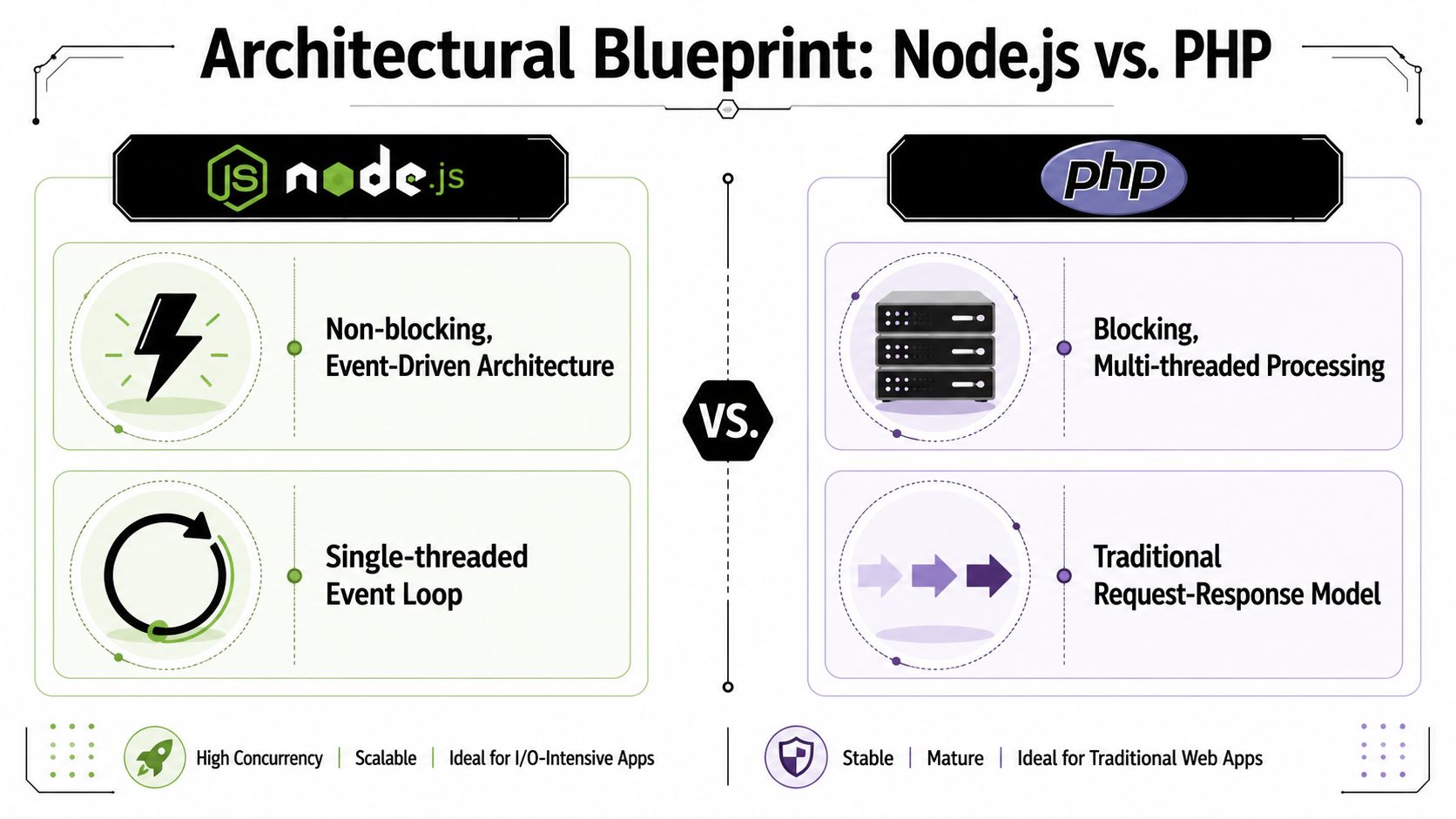
According to Zend's comparison, PHP was started in 1994 and first released in 1995, while Node.js was initially released on May 27, 2009. That gap helps explain why PHP became a default choice for traditional server-rendered publishing, while Node.js arrived later as a JavaScript runtime built around event-driven, asynchronous I/O. Zend also notes that PHP's classic model has been synchronous, while Node.js was designed to process concurrent I/O without blocking through callbacks and an event loop, which is why the choice is better understood as workload fit than old versus new (Zend on PHP vs Node.js).
How Node.js thinks about work
Node.js is strongest when the backend spends a lot of time waiting on outside systems. Database calls, message queues, payment gateways, RPC providers, websockets, and third-party APIs all fit that pattern. Instead of tying up execution while each operation waits, Node.js keeps moving and returns to tasks when the I/O is ready.
That changes the way teams design services. In a Node.js codebase, engineers naturally think in terms of handlers, async flows, queues, background jobs, and service boundaries. That's a strong fit for products with live dashboards, notifications, chat, wallet activity, event ingestion, or blockchain indexing pipelines.
A senior engineer should still be careful here. Node.js makes I/O concurrency feel natural, but it also makes it easy to hide complexity in chains of async behavior, retry logic, and package-heavy abstractions. The code can look concise while the operational behavior is not.
How PHP thinks about work
PHP grew up in the world of request, render, respond. A request comes in, the application performs its work, generates output, and the process ends cleanly. That model has shaped decades of tooling, conventions, and deployment patterns around websites, commerce flows, admin panels, and content systems.
For many teams, that simplicity is a feature, not a limitation. PHP encourages boundaries that are easier for newer backend engineers to reason about. One request maps to one unit of business logic. A bug is often easier to reproduce. A route, controller, service, and template remain legible to the next developer who joins.
Practical rule: If your application mostly fetches data, applies business rules, and renders pages or standard API responses, PHP's model stays straightforward under pressure.
Why the model affects careers and interviews
Architecture changes what companies test for in interviews. Node.js roles often probe event loops, asynchronous control flow, queue design, API throughput, and service decomposition. PHP roles often probe application design, framework conventions, database-backed business logic, validation, and maintainability in larger web apps.
That means the choice shapes developer growth:
- For Node.js developers: You'll build intuition around async systems, integration-heavy backends, and JavaScript across the stack.
- For PHP developers: You'll often gain depth in framework structure, delivery discipline, and complex application behavior over long-lived codebases.
- For managers: Interview loops should match the runtime reality. Don't hire Node.js engineers with only CRUD questions, and don't hire PHP engineers by over-indexing on distributed-systems trivia your product won't use.
Neither model is universally better. One is optimized for a modern, event-heavy backend world. The other is refined for web application delivery that businesses still need every day.
Performance Concurrency and Scalability
Performance arguments in Node.js vs PHP often go off track because teams treat all workloads as if they were the same. They aren't. The shape of the traffic matters more than runtime tribalism.
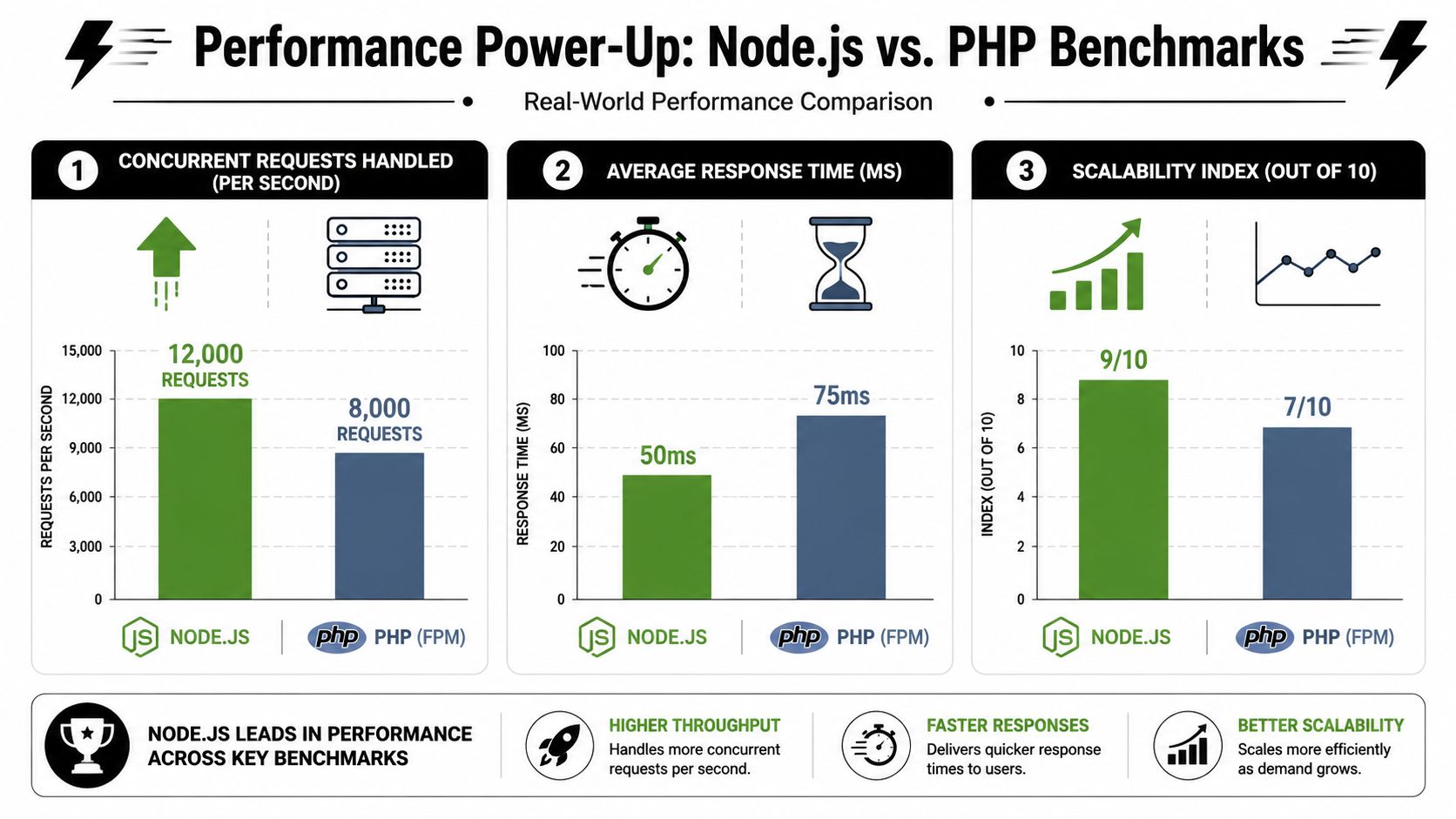
Here's the benchmark reality worth keeping. Contemporary summaries of widely recognized framework benchmarks report that Node.js often outpaces PHP in raw request handling, especially for real-time and concurrent workloads, while PHP 8.1's Just-In-Time compiler and Fibers significantly narrowed the gap for standard workloads. The practical takeaway is specific, not universal: Node.js is typically faster under concurrent request stress, while modern PHP is far stronger than its older reputation suggests (Riseup Labs on PHP vs Node.js performance).
Early in evaluation, this visual helps align the team on what kind of speed discussion you're having.
Where Node.js usually wins
Node.js tends to shine when a service has to handle many overlapping I/O-bound operations. Think websocket connections, live feeds, queue consumers, blockchain event listeners, or API gateways stitching together several downstream services.
In those environments, teams usually care about:
- Concurrent connection handling
- Responsiveness under bursty traffic
- Efficient coordination with external services
- A natural fit for real-time product behavior
That doesn't mean every Node.js service is automatically fast. Poor query design, oversized payloads, blocking CPU work, and dependency bloat still ruin performance. Node.js gives you a strong concurrency model. It doesn't rescue weak engineering decisions.
Later in the process, it also helps to hear another explanation in plain terms:
Where PHP holds up better than people assume
A lot of outdated advice still talks about PHP as if it never evolved. That's a mistake. Modern PHP is not the same thing as legacy shared-hosting PHP from years ago. If you're building content-rendered applications, business dashboards, back-office systems, or standard APIs, PHP can be a perfectly strong option.
That matters because many products don't live under constant real-time concurrency pressure. They need predictable behavior, decent performance, and code that a growing team can maintain. In that scenario, PHP's improved runtime and mature framework ecosystem often matter more than headline benchmark bragging rights.
Performance only matters in the shape your product experiences it. A CMS with admin workflows and page rendering has a different bottleneck profile than a trading dashboard with websocket updates.
What doesn't work in practice
Teams make bad stack choices when they use generic “fast” claims instead of profiling the application they're building. These patterns usually fail:
| Mistake | Why it causes trouble |
|---|---|
| Choosing Node.js for CPU-heavy work by default | The event-driven model doesn't magically solve compute-heavy tasks |
| Rejecting PHP because of old stereotypes | Modern PHP is stronger for standard workloads than many teams assume |
| Reading one benchmark as a final answer | Benchmarks measure scenarios, not your whole system |
| Ignoring infrastructure and developer behavior | Slow queries, poor caching, and oversized dependencies hurt both stacks |
If the roadmap includes live collaboration, event streaming, or many simultaneous I/O operations, Node.js deserves serious weight. If the roadmap is dominated by forms, business rules, content, and reliable page delivery, PHP often ends up being the calmer choice.
Ecosystems Frameworks and Web3 Suitability
The runtime is only part of the decision. Developers spend their time inside frameworks, package managers, testing tools, queues, ORMs, and deployment pipelines. That's where day-to-day velocity is either earned or lost.

npm versus Composer in real teams
Node.js usually means npm at the center of the workflow. That gives teams access to a huge ecosystem and fast-moving tooling. It also means engineers need discipline around dependency review, version drift, and package trust. In fast product cycles, npm is a force multiplier. In weakly governed teams, it can become a long-term maintenance trap.
PHP typically means Composer, and the experience often feels more conservative. That can sound less exciting, but many engineering leaders prefer that trade when the product needs stable delivery, less churn, and predictable upgrades.
The important distinction isn't “big ecosystem” versus “small ecosystem.” It's ecosystem velocity versus ecosystem restraint.
Framework choices shape team habits
Framework selection often matters more than the language label itself.
For Node.js, many teams gravitate toward:
- Express for minimal API layers
- NestJS for structured architecture, dependency injection, and enterprise-style organization
- Fastify when performance and plugin structure matter
For PHP, the common anchors are:
- Laravel for productive application development, strong conventions, queues, auth, and developer ergonomics
- Symfony for larger systems that value explicit structure and reusable components
A useful hiring lens is this: NestJS and Symfony tend to reward engineers who like strong architecture, while Express and Laravel often help teams move quickly with less upfront ceremony. None of those frameworks are universally superior. They produce different habits in code review, testing, onboarding, and system design.
If your team is small, framework consistency matters more than ideological purity. A mediocre framework choice used well beats a “perfect” framework used inconsistently.
Why Web3 teams often lean Node.js
In Web3 work, Node.js often feels like the default because JavaScript sits close to the rest of the product stack. Wallet integrations, contract interaction libraries, event-driven services, indexing tasks, and frontend-backend coordination all line up naturally in that environment.
That doesn't mean every blockchain company should default to Node.js. It means the fit is often strong when the backend needs to:
- react to on-chain events,
- expose APIs to web clients,
- coordinate with JavaScript-heavy frontend teams,
- or support services that behave more like event processors than classic websites.
If you're browsing roles in that space, a listing like this backend role in Web3 infrastructure at Binance Wallet is useful as a reminder that production blockchain systems often mix stacks. The primary question isn't whether Node.js or PHP can exist in Web3. It's where each one belongs in the architecture.
Where PHP still makes sense in blockchain products
PHP remains useful when the blockchain product includes content-heavy surfaces around the protocol or app. That includes community portals, publishing systems, documentation hubs, partner dashboards, campaign sites, admin tooling, support backends, and marketplace pages that behave more like traditional web apps than real-time services.
Teams sometimes get too binary. A company can run Node.js for event-heavy services and still use PHP for parts of the business that need mature content workflows and stable operational patterns. The stack doesn't have to be ideological.
A simple rule of thumb works well:
| Product area | Better default tendency |
|---|---|
| dApp APIs, event processors, websocket-heavy services | Node.js |
| Marketing sites, editorial systems, admin-heavy portals | PHP |
| Mixed product with distinct subsystems | A split stack can be sensible |
For developers planning careers, ecosystem choice also signals what kind of craftsmanship you'll build. Node.js tends to train you toward service orchestration and full-stack JavaScript collaboration. PHP tends to train you toward reliable application architecture and long-lived business systems. Both paths remain valid. The stronger move is to know which problems you want attached to your name.
Hiring Talent and Building Your Team
Organizations typically spend far more money on people than on compute. That's why the most practical Node.js vs PHP question is often this one: who can you hire, how fast can they become productive, and what risks come with that market?
The current hiring signal is clear in broad terms. The Stack Overflow 2025 Developer Survey reports JavaScript as one of the most-used languages globally, while PHP remains widely used but has smaller mindshare than JavaScript. The same market view also highlights a less discussed issue: Node.js ecosystems depend heavily on package maintenance and supply-chain hygiene, which creates a distinct long-term business risk, especially for smaller Web3 teams that need to hire quickly and still maintain secure dependencies (Simform on Node.js vs PHP hiring and risk).
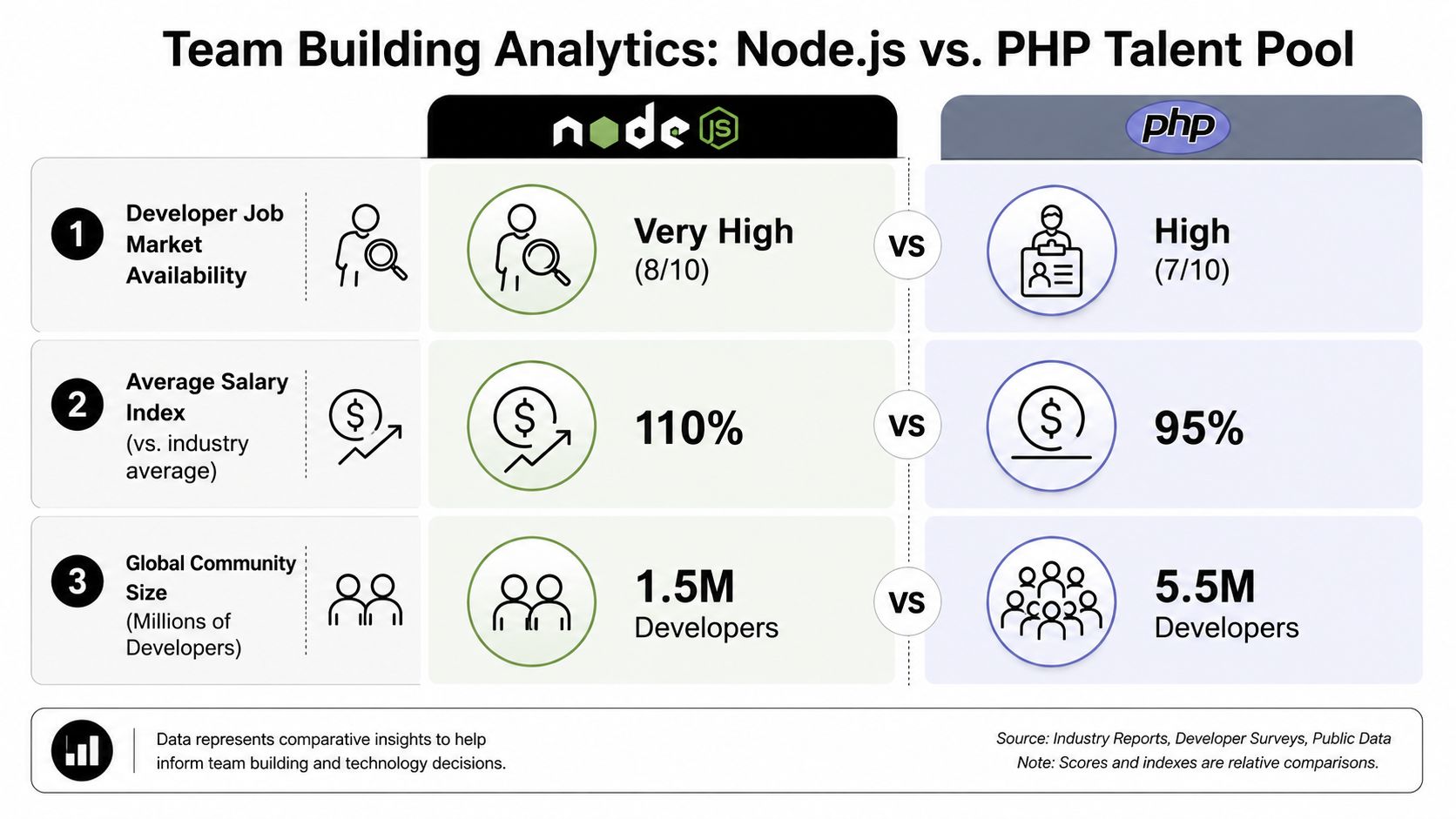
Hiring velocity is not the same as hiring quality
Node.js benefits from JavaScript's broad reach. That often means more inbound candidates, more full-stack applicants, and a larger pool of engineers who can move between frontend and backend. For a startup, that can be a major advantage. One person can contribute to React, Next.js, APIs, and integration layers without a language switch.
But broad availability creates its own filtering problem. A lot of developers can write JavaScript. Fewer can design resilient backend services, reason about asynchronous failure modes, and keep a package-heavy production system healthy over time.
PHP tends to produce a different candidate profile. The pool may feel more backend-specific and less trend-driven. In many cases, that's good. PHP candidates often come with direct experience in business applications, admin systems, e-commerce logic, or mature framework conventions. The challenge is that some hiring teams underestimate them because the market conversation is louder around JavaScript.
How to interview each stack properly
The worst hiring process treats Node.js and PHP as interchangeable. They aren't.
For Node.js backend roles, interview around:
- Async reasoning
- API design
- Queue and event handling
- Dependency judgment
- Observability and failure recovery
For PHP backend roles, interview around:
- Framework architecture
- Data modeling
- Validation and business rules
- Testing discipline
- Long-term maintainability of application code
That shift matters for candidate experience too. Good engineers notice when the interview reflects the job itself.
A hiring loop should test the production problems the team actually has. Otherwise you screen for interview performance, not job fit.
Career progression for developers
For developers choosing a path, the market signal is less about “which language wins” and more about which portfolio of problems you want to own.
Node.js is often strong if you want to become known for:
- full-stack JavaScript delivery,
- API platforms,
- integration-heavy systems,
- real-time product behavior,
- or Web3-adjacent backend work.
PHP is often strong if you want to become known for:
- application architecture,
- mature framework depth,
- commerce and CMS-style systems,
- operationally stable web delivery,
- or long-lived backend ownership.
If you're trying to map that against active openings, a broad market scan like HiredBySkill backend jobs can help you compare how companies describe backend expectations across stacks. For crypto-native roles specifically, this kind of Senior Node.js developer opening shows how often backend hiring in Web3 leans toward JavaScript-centered service work.
Team design and maintenance risk
A full-stack JavaScript team can move quickly because frontend and backend share language patterns. Shared hiring criteria, shared tooling, and easier internal mobility all help. But there's a tax: package sprawl, faster ecosystem churn, and more supply-chain attention.
A PHP team often gains steadiness. The codebase may be easier to keep coherent over time, especially in framework-driven environments with well-established patterns. That steadiness can lower onboarding friction when the product is a business application rather than a collection of event-driven services.
The key trade-off looks like this:
| Team concern | Node.js tendency | PHP tendency |
|---|---|---|
| Hiring speed | Often faster due to JavaScript reach | Often narrower but more backend-specialized |
| Full-stack alignment | Strong | Weaker if frontend is JavaScript-heavy |
| Dependency risk | Higher attention required | Usually more conservative package culture |
| Onboarding style | Good for JS-native teams | Good for application-focused backend teams |
| Long-term codebase feel | Flexible, sometimes fragmented | Structured, often steadier |
For managers, this is the part that affects budget without showing up in benchmark charts. For developers, it affects how transferable your experience will feel when you switch roles later.
The Final Verdict How to Choose Your Stack in 2026
There isn't a universal winner in Node.js vs PHP. There is only a better fit for your product, your hiring situation, and the kind of engineering organization you want to build.
If you want a deeper framework for that evaluation process, Nerdify's expert tech stack advice is a useful companion read because it pushes the decision back toward business context instead of language fandom.
The most reliable approach is to decide from constraints, not preferences.
Ask the questions that change the outcome
Start with product behavior.
- Does the system need real-time communication, many simultaneous connections, or event-heavy integrations? Node.js usually moves to the front.
- Is the product centered on content, admin workflows, e-commerce behavior, or a conventional web application model? PHP becomes easier to justify.
- Will one team own both frontend and backend in JavaScript? Node.js often simplifies collaboration.
- Do you need a calmer, more established path for a long-lived application codebase? PHP often reduces turbulence.
- Is dependency supply-chain management something your team can actively own? If not, don't underestimate the operational side of a Node.js-heavy stack.
- What kind of developers are easiest for you to recruit and retain? That answer should carry more weight than runtime ideology.
Node.js vs PHP decision matrix
| Factor | Choose Node.js if... | Choose PHP if... |
|---|---|---|
| Primary product shape | You're building APIs, real-time features, or event-driven services | You're building content-rich apps, business systems, or server-rendered products |
| Team skills | Your engineers already work comfortably in JavaScript across the stack | Your team is stronger in backend web frameworks and structured application code |
| Hiring plan | You want access to the broader JavaScript talent market | You want backend specialists with mature web application experience |
| Maintenance posture | You can manage fast-moving dependencies and package review rigorously | You prefer a steadier dependency culture and conventional delivery model |
| Web3 fit | You need wallet integrations, event processors, or dApp-facing services | You need marketing, portal, admin, or content layers around a blockchain product |
| Career value | You want experience in modern JavaScript backends and service design | You want depth in durable web architecture and framework-driven backend work |
The practical recommendation
If I were advising a new team, I'd keep it simple.
Choose Node.js when product behavior is live, integration-heavy, and concurrency-driven, and when hiring full-stack JavaScript talent is part of the plan.
Choose PHP when product behavior is application-driven, content-heavy, or operationally conservative, and when long-term maintainability in a mature web stack matters more than aligning everything around JavaScript.
Use both when the business has both kinds of workload. That isn't indecision. It's architecture.
The best backend choice is the one your team can hire for, reason about, secure, and maintain without turning every roadmap item into a systems problem.
If you're weighing Node.js or PHP in the context of Web3 hiring, Blockchain Jobs is a practical place to review live backend roles, compare stack expectations, and see how crypto teams describe the skills they need.