
Product Development Manager Salaries: A 2026 Guide
Most salary advice for product leaders is lazy. It tells you to look up a national average, compare your offer to that number, and feel good if you're above it.
That’s not how smart candidates build wealth.
A Product Development Manager can look “well paid” on paper and still be undercompensated if the package is weak, the level is mis-scoped, or the upside is capped. In Web3, that mistake gets even more expensive because base salary is only one part of the deal. Tokens, equity, bonuses, vesting, and role scope can change the true value of an offer fast.
If you want to maximize product development manager salaries over a full career, stop asking, “What’s the average?” Start asking, “What’s this role worth in this market, at this level, with this upside?”
Beyond the Average Salary Number
The clean headline number is $142,229, which is the average annual salary for a Product Development Manager in the United States as of February 2025, with a typical pay range of $123,762 to $163,634 according to Salary.com’s Product Development Manager salary benchmark.
Useful? Yes.
Enough to make a career decision? No.
That average hides the parts that matter most. It hides whether the company is paying for execution or strategy. It hides whether you're being hired to run a roadmap or clean up chaos. It hides whether your package includes meaningful upside or just a decent paycheck.
Bottom line: average salary data is a reference point, not a target.
I tell candidates the same thing every week. If you're interviewing for product roles in fast-moving tech, especially blockchain, looking at base salary alone is how you end up taking the “safe” offer that pays less over the next few years.
Why the average can mislead you
Averages flatten reality. They mix weaker markets with premium ones. They blend under-scoped roles with leadership-track roles. They also ignore whether a company rewards product with cash, equity, tokens, or some awkward combination of all three.
That’s why two Product Development Manager offers can look similar at first glance and be wildly different in actual value.
One offer gives you predictable cash and little upside. Another gives you a lower base, stronger ownership, better level alignment, and a clear path to a larger package later. The second one often wins. Most candidates miss that because they’re anchored to the headline salary number.
What serious candidates should focus on instead
When you evaluate product development manager salaries, focus on four questions:
- Role scope: Are you shipping features, owning a product line, or driving company-level strategy?
- Leveling: Is the title accurate, or are they hiring a senior leader under a mid-level title?
- Comp structure: How much of the package is cash versus long-term upside?
- Career advantage: Will this role increase your next offer, or trap you in the same band?
If you care about compensation, think like an investor. Don’t buy the number on the label. Evaluate the asset.
Deconstructing Your Total Compensation Package
A strong offer works like a portfolio. Some parts give stability. Some parts reward performance. Some parts create long-term upside. If you only compare base salary, you're ignoring most of the package.
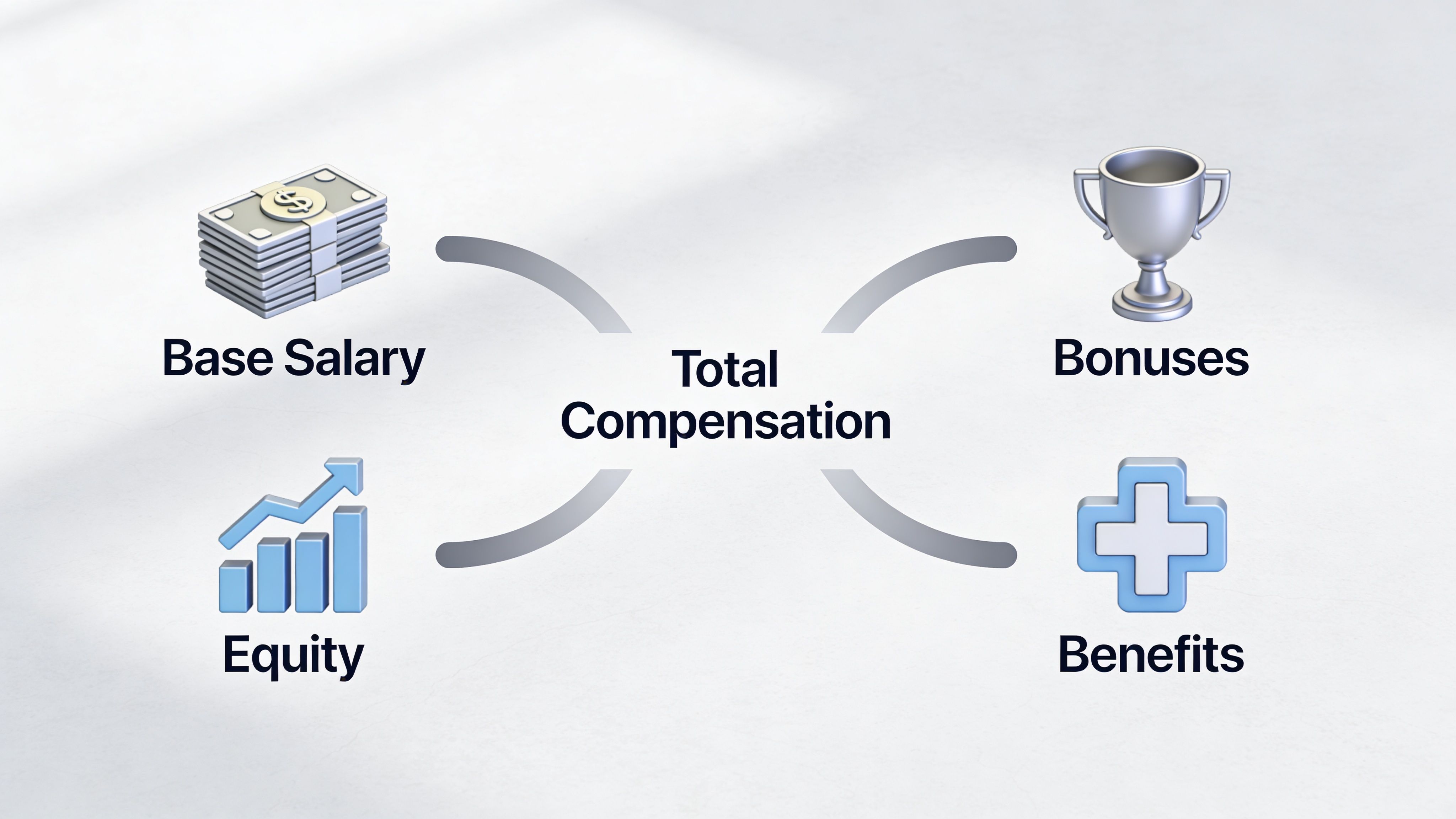
In blockchain, this matters even more. According to Indeed’s Product Development Manager salary page, lower base salaries of $80K to $137K are often paired with token grants worth 20% to 50% of total compensation, and strong market cycles can amplify that equity component 2x to 5x. That completely breaks the old rule that the higher base is always the better offer.
Base salary is your floor
Base salary pays your bills, supports your lifestyle, and gives you a negotiating advantage later. It matters.
But too many candidates obsess over base because it’s the easiest number to compare. That’s a mistake. In product hiring, companies often hold the line on base and create flexibility elsewhere. If you fixate on salary alone, you can leave real value on the table.
If you need a clean refresher on how salary fits into your overall earnings, this guide on what is annual gross income is useful because it separates headline pay from the broader compensation picture candidates often misunderstand.
Bonus, equity, and tokens are not side details
Here’s how I want you to think about the rest of the package.
- Bonus: This is your short-term upside. Ask whether it’s discretionary or formula-based. If a recruiter can’t explain how bonuses are earned, assume the payout is less reliable than it sounds.
- Equity: In traditional tech, this is often the long-term value driver. Ask about vesting, refresh grants, and how often top performers receive additional awards.
- Token grants: In Web3, this is the high-risk, high-upside component. You need to understand vesting, lockups, liquidity, and whether the token has a clear role in the ecosystem.
- Benefits: Don’t ignore them, but don’t let shiny perks distract you from a weak package. Great health coverage is nice. It doesn't compensate for under-leveling.
A weak salary with “upside” is not automatically a smart bet. The upside has to be structured clearly and tied to something real.
Questions you should ask in interviews
Most candidates ask vague questions about compensation. Strong candidates ask precise ones.
Use questions like these:
How is success measured for bonus payout?
You want specifics tied to product milestones, business outcomes, or company goals.What does the vesting schedule look like?
Monthly, quarterly, annual cliffs. Details matter.Is there a refresh policy for equity or tokens?
If there isn’t one, your upside may shrink over time.How do you level this role internally?
A low title often means a capped package.What portion of compensation is expected to come from variable components?
If too much depends on uncertain outcomes, discount the offer mentally.
My advice on offer evaluation
Don’t treat all comp components as equal.
A dollar in base salary is not the same as a dollar in bonus target. A dollar in bonus target is not the same as a dollar in startup equity. A dollar in token grants is definitely not the same as cash.
When I coach candidates, I tell them to rank each part of the package by certainty. Then look at the role itself. If the company wants high ownership, technical fluency, and visible execution under pressure, they should pay for it in more than promises.
How Experience Shapes Your Earning Potential
Experience changes your pay because it changes your value. The market doesn’t reward years alone. It rewards scope, judgment, and the ability to make hard product decisions without hand-holding.
That’s why product development manager salaries jump sharply when you move from delivery support to true ownership.
What the career ladder really pays for
The biggest jump happens when a company trusts you with broader decisions. Once you’re shaping roadmap tradeoffs, influencing engineering priorities, and carrying revenue or platform accountability, your compensation should move with that responsibility.
According to Product School’s product management salary guide, a Senior PM might earn a base of $122,000 to $190,000, a Group PM can expect $156,000 to $244,000, and a VP of Product can command $159,000 to $249,000 or more, excluding larger equity and bonus packages.
That tells you something important. Seniority isn’t a title vanity exercise. It’s where the compensation curve steepens.
Product Development Manager salary by experience level
Use the ranges below as a practical ladder, not a promise. The point is to understand where compensation expands and why.
| Experience Level | Typical Base Salary Range (USD) | Typical Total Compensation Range (USD) |
|---|---|---|
| Early career Product Development Manager | Varies by company and scope | Often more cash-heavy, with limited upside components |
| Mid-level Product Development Manager | Varies by company and ownership breadth | Usually includes broader bonus or equity participation |
| Senior PM | $122,000 to $190,000 | Typically higher than base once equity and bonuses are added |
| Group PM | $156,000 to $244,000 | Usually meaningfully above base due to larger incentive grants |
| VP of Product | $159,000 to $249,000 or more | Often substantially above base with significant equity and bonuses |
If you want to benchmark current openings against that ladder, review live product management roles and compare title, scope, and technical depth before you compare compensation.
What changes at each level
A junior or early-career product manager usually gets paid to execute. They gather requirements, coordinate teams, and keep delivery moving. Valuable work, but not yet scarce work.
A mid-level Product Development Manager starts owning outcomes. They’re expected to make prioritization calls, influence design and engineering, and communicate tradeoffs clearly to leadership. At this stage, strong operators start separating from smart note-takers.
At the senior level, companies expect judgment. Not opinions. Judgment. You’re no longer just shipping. You’re deciding what not to build, resolving conflict between functions, and protecting the roadmap from executive thrash.
By Group PM and VP level, your value shifts again. Now the company is paying for leadership's impact. You build teams, define product strategy, coach other PMs, and make the business less dependent on any one founder or executive.
Career rule: if your scope has grown but your title and compensation haven’t, you’re already behind.
How to move up faster
Candidates get stuck when they present themselves as task owners instead of business operators. If you want to increase your earning potential, your resume and interview stories need to show more than shipment.
Focus your examples on:
- Decision-making: Show where you made the call, not just joined the meeting.
- Cross-functional leadership: Name the teams you aligned and the conflicts you resolved.
- Technical fluency: In Web3 especially, explain how you worked with engineers on protocol constraints, smart contract requirements, wallets, custody, or compliance tradeoffs.
- Strategic thinking: Show why a roadmap choice mattered to the business.
The fastest way to get paid like a senior product leader is to act like one before the title arrives. Then make sure the market sees it.
The Geographic Lottery How Location Impacts Your Salary
Location still matters. A lot.
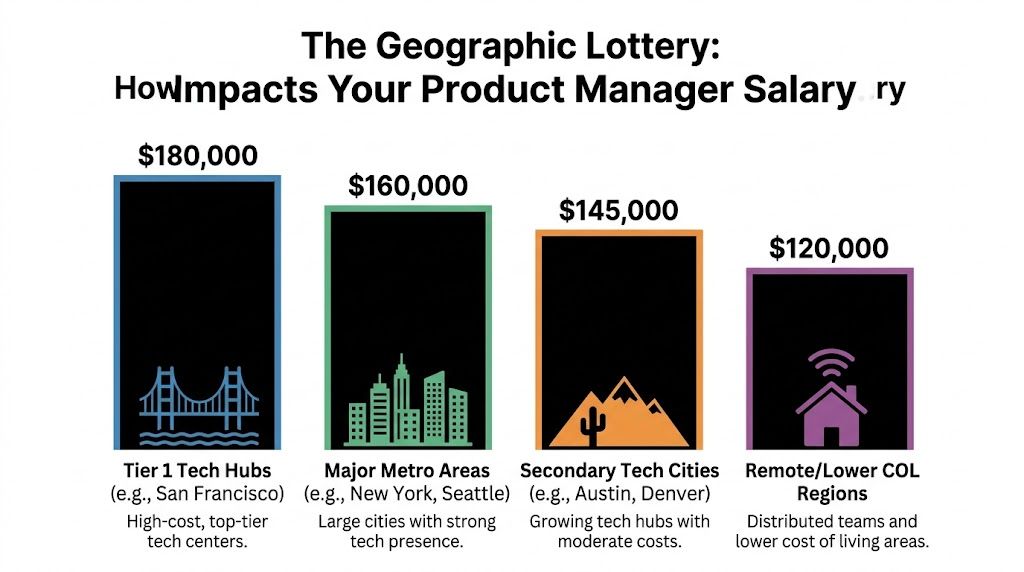
Remote work changed where people live. It didn’t erase compensation differences. Companies still price roles based on talent markets, competition, and the cost of replacing you. In product hiring, premium markets keep paying premium rates because the best companies are fighting over the same small pool of high-judgment operators.
Why San Jose keeps resetting expectations
The cleanest example is San Jose. According to Comparably’s Product Development Manager salary data, Product Development Managers there earn an average of $167,823, which is a 97% premium over the US baseline. That gap exists because tech companies, including Web3 startups, compete hard for candidates who can blend product judgment with technical depth.
That’s the key lesson. Geography isn’t just about local cost of living. It’s about concentration of opportunity and urgency. Where more high-stakes companies cluster, compensation rises.
A practical way to read location-based pay
Don’t reduce this to “California pays more.” Read it more carefully.
- Top tech hubs: These markets often pay for speed, ambiguity tolerance, and complex stakeholder management.
- Secondary markets: These can offer strong salaries with less competition and less inflated living costs.
- Remote roles: These can be excellent if the company pays by role value rather than by your zip code.
- Hybrid requirements: These often hide location-specific expectations that affect your package more than the title suggests.
If you’re targeting US roles, scanning active blockchain jobs in the USA is one of the fastest ways to see how location, remote flexibility, and specialization show up in actual hiring demand.
The Bay Area versus everyone else
The Bay Area remains the benchmark market because product is treated as a high-impact function there. Companies tend to hire PMs who can deal with technical complexity, investor pressure, and faster roadmap cycles. If you can perform in that environment, the market usually reflects it.
But don’t automatically chase the highest nominal salary. A bigger number in a premium market can still leave you with less flexibility if your living costs spike and your upside is mostly cash.
That’s why some of the strongest candidates I work with choose a different strategy. They land a company that benchmarks competitively, then live somewhere cheaper while keeping role scope high.
Remote can be the best compensation arbitrage in tech, but only if the employer doesn’t haircut the package based on your address.
How to use geography in negotiation
Most candidates treat location as fixed. Smart candidates use it to their advantage.
If the company is hiring nationally, ask how they structure location bands. If they benchmark against San Francisco or Bay Area talent while recruiting remotely, that’s good for you. If they heavily localize pay even though the role supports a national or global product scope, push back.
Use these talking points:
- Role value over residence: If the job owns a critical product area, your location doesn’t reduce the impact of the work.
- Market alternatives: If you’re interviewing across several geographies, mention that your compensation expectations reflect the broader market for your level.
- Specialized scarcity: In Web3, hybrid product-technical talent is harder to hire than generic PM talent. Location doesn’t change that scarcity.
My blunt take on relocation and remote strategy
Don’t move to an expensive market just because a recruiter says “that’s where the action is.” Move because the role gives you career acceleration that you can’t get elsewhere.
And don’t take a discounted remote package just because the company offers flexibility. Flexibility is good. It’s not a substitute for fair compensation.
The right play is simple. Target roles where your skill set is rare, your scope is clear, and the company values execution enough to pay beyond local averages. Geography matters, but only if you let the employer define the narrative.
Web3 vs Traditional Tech A Salary Showdown
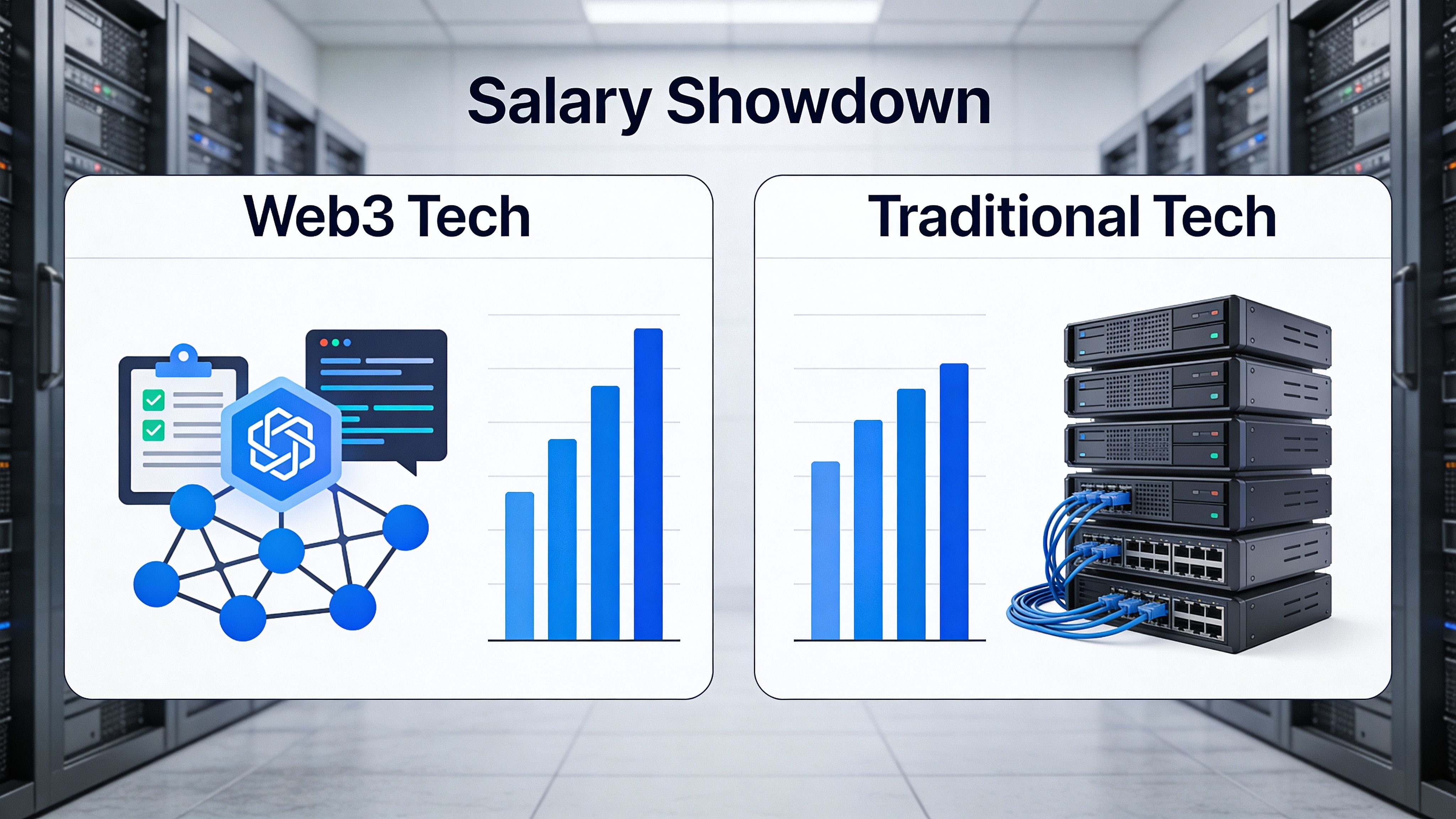
If you’re comparing a traditional tech offer with a Web3 offer, don’t ask which one pays more. Ask which one pays better for your skill set, risk tolerance, and long-term upside.
That’s a different question. It leads to better decisions.
Why Web3 can justify a premium
Web3 product roles often require more technical fluency than standard software PM roles. You may need to understand wallets, smart contracts, governance flows, custody models, token mechanics, compliance constraints, or how protocol design affects user experience.
That added complexity pays. According to 6figr’s Technical Product Development Manager salary data, Technical Product Development Managers in sectors like blockchain command an average base salary of $186,000 with total compensation reaching $231,000. The source states this is a 35% to 50% premium over general Product Development Manager roles, driven by demand for specialized expertise in decentralized systems.
If you can bridge product, engineering, and business in blockchain, you’re not a generic PM. Don’t price yourself like one.
Traditional tech offers stability
Traditional tech usually wins on predictability.
You often get cleaner salary bands, better-understood bonus structures, and equity that’s easier to model. The company may have mature leveling, experienced product leadership, and less ambiguity around role expectations. For many candidates, especially those optimizing for near-term cash flow, that matters.
Traditional tech also tends to punish less. If a quarter goes badly, your stock grant may suffer, but your compensation structure is usually still understandable.
Web3 offers asymmetry
Web3 tends to win on upside and scope.
You may get broader ownership sooner. You may work closer to founders. You may influence the product more directly. And if the token or equity component is meaningful, the upside can be materially better than a safer enterprise package.
But don’t romanticize it. Some Web3 companies use tokens to mask weak salary philosophy. Some founders hand out upside that looks impressive in a spreadsheet and vague in a legal document. If the compensation memo is confusing, that’s not innovation. That’s a risk signal.
The best Web3 offers are clear, structured, and generous. The worst ones are vague, volatile, and sold with hype.
Side-by-side comparison
| Factor | Traditional tech | Web3 |
|---|---|---|
| Base salary | Often steadier and easier to benchmark | Can be lower or higher depending on technical depth and company stage |
| Bonus structure | Usually more standardized | Often less standardized |
| Equity or tokens | Equity is often easier to value over time | Tokens can create stronger upside but carry more volatility |
| Role scope | Sometimes narrower and more specialized | Often broader, especially at smaller companies |
| Technical expectations | Product and execution focus | Product plus protocol, infrastructure, or token fluency |
| Risk profile | Lower relative uncertainty | Higher uncertainty with potentially higher upside |
Who should choose which path
Traditional tech is usually the better fit if you want structure, known processes, and compensation that’s easier to forecast.
Web3 is often the better fit if you’re technically credible, comfortable with ambiguity, and willing to trade some predictability for upside and accelerated career growth.
My advice is direct. Don’t choose Web3 because it sounds exciting. Choose it if you can evaluate product, technology, and comp mechanics with a cold eye. The candidates who do best in this market are not the most enthusiastic. They’re the most disciplined.
How to Confidently Negotiate Your Compensation
Negotiation is not about asking for more because you want more. It’s about proving the package should match the value and risk the company is buying.
Most Product Development Managers underperform here for one reason. They talk about effort instead of impact. Employers don’t pay more because you worked hard. They pay more because replacing you would be difficult, expensive, or slow.

Start with role value, not your personal needs
Don’t lead with rent, inflation, or “I was hoping for more.” None of that strengthens your position.
Lead with role scope, market fit, and the specific capabilities you bring. If the company needs someone who can align engineering, design, compliance, and GTM around a messy roadmap, say that clearly. If they need a PM who understands protocol-level constraints and can still ship user-facing value, say that clearly too.
Here’s language that works:
Based on the scope of this role, the technical depth involved, and the level of cross-functional leadership you’re expecting, I’d want the compensation package to reflect that broader ownership.
That framing is professional. It also signals that you understand how hiring managers think.
Know what you’re negotiating
Candidates lose their negotiating power when they negotiate one line item in isolation.
Break the offer into parts:
- Base salary: Your cash foundation
- Bonus: Short-term performance upside
- Equity or token grant: Long-term upside
- Level and title: Future earnings potential
- Review timing: Your next chance to reset compensation
If a company says base is capped, move to another lever. Ask for a larger grant, a sign-on bonus, a shorter review cycle, or clearer promotion criteria. Good negotiators don’t stop when they hear “no.” They redirect.
Build your case with evidence from your own work
Your strongest advantage is not generic market data. It’s your track record.
Use stories that show you can:
- Translate complexity: You turned technical constraints into roadmap decisions.
- Reduce drag: You aligned teams that weren’t moving together.
- Make tradeoffs: You chose what to cut and defended why.
- Operate under ambiguity: You shipped in markets where requirements changed fast.
Keep your examples tight. A hiring manager should be able to hear your case and immediately connect it to the pain inside their org.
Use anchors without sounding robotic
A lot of candidates are afraid to anchor high because they think they’ll sound aggressive. That fear costs money.
You don’t need to posture. You need to be clear.
Try language like this:
For a base-first negotiation
“For a role at this scope, I’d be comfortable moving forward if we can bring the base closer to the top of the range.”For total comp negotiation
“If base flexibility is limited, I’d like to look at the full package, especially equity, token participation, and review timing.”For title and level correction
“The responsibilities we’ve discussed sound closer to a senior-level product mandate, so I’d want the leveling and compensation to reflect that.”
Here’s a good reminder before you negotiate:
Questions that expose weak offers
You need to ask questions that force clarity. Especially in Web3.
Use these in late-stage interviews or offer calls:
- How do you determine token or equity refreshes for high performers?
- What happens to variable comp if company goals shift mid-cycle?
- How is this role leveled relative to others on the team?
- What are the first milestones that would support a compensation review?
- Who can explain the vesting terms in detail?
If the answers are fuzzy, the package is weaker than it looks.
Negotiation principle: if they can’t explain the compensation structure clearly, you should discount its value immediately.
What not to do
I’ve seen strong candidates hurt themselves with avoidable mistakes.
Don’t do this:
- Don’t negotiate too early: Wait until they want you.
- Don’t bluff badly: If you mention competing options, be prepared to stand behind that claim.
- Don’t apologize for negotiating: This is standard at your level.
- Don’t accept vague upside: “It could be worth a lot” is not a compensation plan.
- Don’t ignore title: A weaker title can suppress your next offer even if this package looks decent today.
My preferred negotiation sequence
This is the sequence I recommend to most Product Development Managers:
Confirm excitement about the role
You want them confident you’re serious.Restate the scope as you understand it
This anchors the discussion in business value.Share your compensation expectation as a package, not a single number
That gives you room to move components around.Pause and let them respond
Don’t negotiate against yourself.Push on the weakest part first
Often that’s equity, token terms, or level misalignment.Get the final offer in writing
Especially if any part of comp is variable or unconventional.
A solid negotiation doesn’t make you look difficult. It makes you look experienced. For product leadership tracks, that matters almost as much as the final number.
Charting Your Future Career and Compensation Path
The biggest mistake I see is short-term thinking. Candidates optimize for the next base salary bump and ignore the role that could reset their whole trajectory.
That’s backwards.
Product development manager salaries rise when three things compound together: stronger scope, scarcer expertise, and better positioning in the market. If you build all three deliberately, compensation follows. If you wait for a company to notice your potential, you’ll move slower and earn less.
The next few years should be intentional
If you’re planning the next phase of your career, focus on becoming difficult to replace.
That usually means building a combination of:
- Technical credibility: Enough fluency to work effectively with engineers on complex systems
- Business judgment: Clear prioritization under pressure
- Leadership range: The ability to align stakeholders, not just manage tickets
- Visible market presence: A profile that helps recruiters and founders understand your value fast
That last point matters more than people admit. If your network is weak, your compensation options are weak. If you need to strengthen that side of your career, this guide on how to get LinkedIn connections is a practical place to start because better access usually leads to better conversations and better offers.
Pick markets that expand your upside
The best career move isn’t always the highest immediate salary. It’s often the role that sharpens your niche and improves your next negotiation.
For some people, that means joining a mature product org and learning clean execution. For others, it means stepping into a Web3 team where product, technical, and strategic work overlap every day. The right answer depends on where your impact will grow fastest.
A useful way to assess that is by watching who’s hiring and what kinds of teams are expanding. Reviewing active blockchain companies that are hiring can help you spot patterns in demand, especially around product, infrastructure, and technical leadership.
Choose roles that increase your future pricing power, not just your current comfort.
The candidates who win over time aren’t just chasing compensation. They’re building a profile that commands stronger compensation in every future conversation.
If you're serious about landing a better role in Web3, start with a market built for crypto-native hiring. Browse open roles, compare opportunities, and track hiring teams on Blockchain Jobs.