Land High-Paying Remote Fintech Jobs: Your Career Guide
Remote fintech jobs aren't just a trend; they're your ticket to a high-paying, flexible career at the intersection of finance and technology. Roles like Blockchain Engineer or Cybersecurity Specialist let you shape the future of finance from anywhere. To land one, you need a strategy focused on what hiring managers actually want.
The Reality of Today's Remote Fintech Market
The old Wall Street model of being chained to a desk in a major financial hub is dead. Fintech operates on a global stage, and hiring remote talent is now a core business strategy, not a pandemic-era afterthought. This shift creates a massive opportunity for skilled professionals.
Companies from agile DeFi startups to legacy banks are all vying for the same talent pool, and they know the best candidates aren't always local. They need your specific expertise, and you want flexibility. This is your leverage in the hiring process.
High-Demand Roles and What They Pay
Some roles are consistently in high demand. If you have these skills, you’ll find recruiters in your inbox, and the compensation reflects that demand. To get hired, focus your resume and interview prep on these areas.
Here's what hiring managers are looking for right now:
- Blockchain Engineers: The architects building the decentralized applications of tomorrow. Your portfolio is your resume here.
- Cybersecurity Specialists: The guardians protecting sensitive financial data. Emphasize your knowledge of compliance and threat mitigation.
- AI/ML Scientists: The brains behind the algorithms that spot fraud and predict market movements. Showcase projects with quantifiable business impact.
The money is there for those who can prove their value. We’ve seen a staggering 223% year-over-year jump in available remote fintech jobs in the Americas alone. Senior remote roles, like a Big Data Architect, can command salaries up to $220,000.
To prepare for salary negotiations, research real-time market rates. Browse specialized job boards like blockchain jobs to see what developers are currently being offered. For a broader view, use the fintech talent report from Robert Walters to benchmark your expectations against global trends.
This infographic really drives home the growth and earning potential in the remote fintech world.
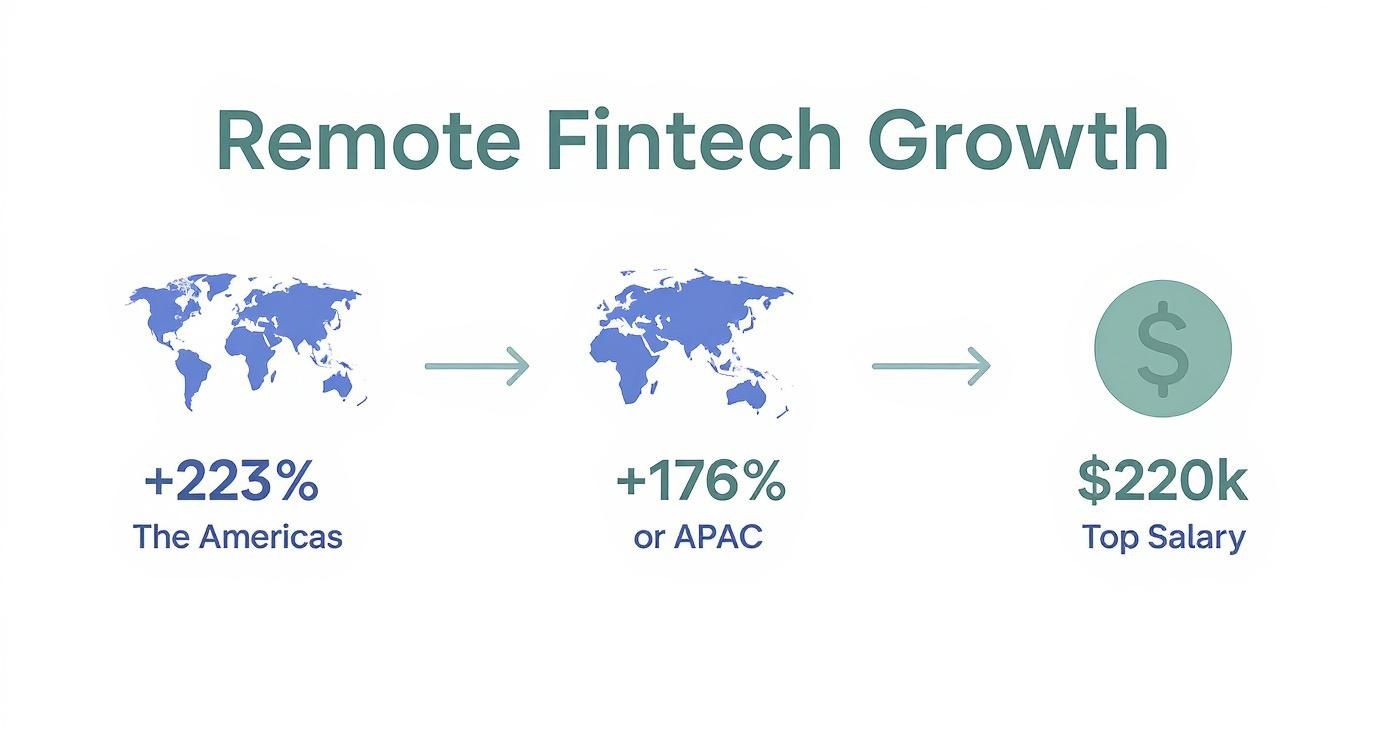
The numbers don't lie. This is a worldwide movement, creating incredible career opportunities. Understanding this landscape is the essential first step to making your next career move the right one.
Finding the Hidden Gems: Where to Actually Look for Remote Fintech Jobs

If your job search consists of scrolling through massive sites like Indeed or Monster, you’re likely missing out on 80% of the best opportunities. The top-tier remote fintech roles are often filled through niche channels long before they hit the mainstream boards.
To get an edge, you must go where fintech hiring managers and recruiters are actively sourcing talent. This means focusing on specialized platforms and building your network within relevant communities.
Ditch the Generalists for Niche Job Boards
Your most effective first step is to dive into job boards built specifically for fintech, tech startups, and remote work. Employers posting here are serious about finding candidates with your specific skill set and understand the dynamics of a distributed team.
This approach gives you a higher signal-to-noise ratio; instead of wading through irrelevant postings, every job is a potential career move.
Ready to get started? Here’s a comparison of platforms to target in your job search.
Top Platforms for Finding Remote Fintech Jobs
This table breaks down the go-to platforms that will give you the best access to high-quality remote fintech roles. Focus your time and effort here.
| Platform | Best For | Actionable Tip for Job Seekers |
|---|---|---|
| FinTech Job Board | All-around fintech roles, from entry-level to executive. | Set up alerts for specific keywords like "RegTech" or "Payments" to get relevant jobs first. |
| We Work Remotely | A broad range of high-quality remote tech and product roles. | Filter by "Fintech" category and analyze job descriptions for recurring keywords to tailor your resume. |
| Wellfound (AngelList) | Startup jobs, especially those in early-stage, high-growth companies. | Look at company funding and team size to target startups that match your risk/reward tolerance. |
| Otta | Discovering new and interesting tech companies you haven't heard of. | Use the matchmaking algorithm to find roles, but also research the suggested companies on LinkedIn to find hiring managers to connect with. |
While these boards are fantastic, don't stop there. Some of the best leads come from private Slack and Discord communities. Groups for Python developers, DeFi enthusiasts, or product managers often have dedicated #jobs channels. Join these communities and contribute before you need a job. This turns you from a job seeker into a known community member, giving you a massive advantage when a hiring manager posts a role.
Become a LinkedIn Power User
Most people barely scratch the surface of what LinkedIn can do. With a few smart search techniques, you can uncover roles that are practically invisible to everyone else.
Forget the basic filters. Use Boolean operators directly in the main search bar to build hyper-specific queries that find exactly what you want.
My Go-To Search String: Try
("Fintech" OR "RegTech") AND ("Head of Product" OR "Product Manager") AND ("Remote" OR "Anywhere") NOT "intern". This single string weeds out junior roles and hones in on senior-level, remote product jobs in your exact niche, often revealing postings that are poorly tagged by HR.
This method helps you find jobs posted directly by a hiring manager instead of through the formal jobs portal. When you find a role, connect with the recruiter or hiring manager. A generic connection request is a wasted opportunity. Personalize it. Mention the specific job posting and one key qualification you have that matches. This simple act transforms a cold outreach into a warm introduction and dramatically boosts your chances of landing an interview.
Building an Application That Beats the Bots
Think of your resume as a two-part exam. First, you have to get past the Applicant Tracking System (ATS)—the software gatekeeper. Then, you have about ten seconds to grab the attention of the hiring manager.
To win, you need to blend technical precision with a compelling story. Before you write anything, pull up three to five job descriptions for your target roles. Identify the recurring skills, technologies, and keywords. These are the keys to your application strategy.
Tailoring Your Resume with Fintech Keywords
Fintech hiring managers are looking for specific experience. A generic resume that just says "Software Developer" is going straight to the digital trash bin. You must speak their language.
Weave industry-specific terms into your experience section, but use them to frame your accomplishments, not just as a list. Show, don't just tell.
- Payment Systems: Instead of "Worked on transaction processing," write, "Engineered a payment gateway integration that supported a 20% increase in transaction volume."
- Regulatory Tech: Don’t say, "Ensured software met standards." Instead, demonstrate your impact: "Implemented new features for a RegTech platform, ensuring full compliance with KYC and AML protocols."
- Quantitative Finance: Swap "Developed financial models" for "Built and backtested algorithmic trading strategies using Python, achieving a 15% higher risk-adjusted return."
This approach does more than just get you past the ATS. It immediately signals to a hiring manager that you understand their world and have solved the kinds of problems they're facing right now. It positions you as the specialist they need to hire.
Key Takeaway: Your resume is a marketing document for your career. Every bullet point should answer the hiring manager's unasked question: "Why should we hire you for this specific remote fintech job?"
Proving You’re Built for Remote Work
For remote jobs, being technically qualified is only half the battle. Your application must also prove you can deliver high-quality work without direct supervision. You need to scream "remote-ready."
This means showing you're fluent in the tools and workflows of a distributed team. It’s not about listing software names; it's about demonstrating how you use them to drive results.
- Asynchronous Communication: Mention how you "managed project updates and documentation in Confluence, keeping the team aligned across multiple time zones."
- Project Management: Talk about how you "led a cross-functional squad using Jira and agile sprints to ship a new mobile feature two weeks ahead of schedule."
- Self-Direction: Highlight projects where you "independently identified a key performance bottleneck and prototyped a solution with minimal oversight."
These are concrete examples that show you can communicate clearly, manage your own time, and take initiative. By weaving these remote-specific skills into your story, you address a major concern for any hiring manager. It positions you as a low-risk, high-impact hire who can start contributing from day one.
Mastering the Remote Interview and Technical Challenge

The remote interview is a live audition for how you'll operate as a distributed team member. Hiring managers are assessing your technical prowess, communication style, and ability to work independently, all through a single screen.
Success comes down to preparing for both the "what" (your skills) and the "how" (your delivery). The "what" is your solid grasp of finance and tech. The "how" is your ability to build rapport and project professionalism remotely. Failing at either can cost you the job.
Answering the Tough Fintech Questions
Expect standard technical questions, but in a fintech interview, they'll push you on topics at the intersection of finance and technology to probe your commercial awareness.
Prepare to answer questions like:
- System Scalability: "How would you design a payments system to handle a sudden 10x surge in transaction volume during a market flash crash?"
- Regulatory Compliance: "Walk me through how you approach building features that have to meet strict regulations like PCI DSS or GDPR."
- Market Volatility: "Tell me about a time you had to account for extreme market swings in a project. What technical trade-offs did you make?"
Your goal isn't just to be technically correct. It's to show the interviewer that you think like a business partner who understands risk, security, and the customer journey. This level of thinking is exactly what they're hiring for in remote fintech jobs.
Pro Tip: Frame your answers using the STAR method (Situation, Task, Action, Result). For remote interviews, add a "C" for Communication—explicitly explain how you communicated your progress and results to your distributed team.
Nailing the Take-Home Technical Challenge
The take-home assignment is your chance to showcase your skills without the pressure of a live audience. Many candidates stumble here by focusing only on submitting code that works, which is just the minimum requirement.
The hiring manager wants to see how you think. A well-documented project that walks them through your problem-solving process is infinitely more impressive than a perfect but uncommented block of code.
Here’s a framework to ensure your submission stands out:
- Start with a killer README: This is your first impression. Clearly document your assumptions, any trade-offs you made, and provide dead-simple instructions for running the project.
- Show your work: Use clean, descriptive commit messages to tell the story of your development. This reveals your thought process.
- Explain your choices: Use code comments to explain why you chose a specific algorithm, library, or design pattern. What business problem were you trying to solve?
This approach proves you can work autonomously and communicate complex ideas asynchronously—two of the most vital skills for career progression in a remote role.
The global fintech market is on fire, with tech job opportunities growing a massive 182% in 2022 alone. To land one of these roles, strong async communication is non-negotiable. To dive deeper into these global hiring trends, check out the data from Financial Executives International. When you master this process, you're not just showing you can code; you're showing you're ready to contribute to a global team from day one.
Getting the Offer Right and Starting Strong

When the offer lands in your inbox, it's a huge win. But don't sign immediately. This moment is a critical pivot point for your career, and how you handle it sets the stage for your compensation and growth at the company.
Think of the initial offer as the opening bid. Most companies have room to negotiate. Before you reply, do your homework. Dig into salary benchmarks for your role, experience level, and the company's compensation location (e.g., San Francisco or New York rates).
Making Your Case for a Better Deal
Armed with solid data, you can build a compelling argument. This isn't just about asking for more money; it's about reinforcing the value you bring. Frame your counteroffer around your skills and the tangible results you've already proven you can deliver.
Tie your salary expectations directly to the accomplishments you highlighted during your interviews. For example: "Based on my experience leading the XYZ project, which drove a 15% efficiency gain, and looking at the market data for senior roles with this skillset, I believe a salary closer to [Your Target Number] would be more aligned with the value I'll bring."
And don't forget to negotiate the total package.
- Equity or Stock Options: In a startup, this can be incredibly valuable. Ask about the vesting schedule and the strike price.
- Sign-on Bonus: This is often the easiest item for a company to approve since it’s a one-time cost.
- Home Office Stipend: A must-have for a remote role. Ensure it covers essentials like an ergonomic chair and high-speed internet.
The best leverage is a competing offer. But even without one, you can significantly boost your package by confidently presenting your research and connecting it back to your unique value proposition.
Thriving from Day One
Landing the job is one thing; career progression is another. Your first 90 days are crucial for proving your worth and setting a trajectory for growth, especially when you can't rely on face-to-face interactions.
You must be proactive in building relationships. Schedule 15-minute virtual coffees with everyone on your immediate team. Ask about their roles, communication preferences, and how your work will intersect. These informal chats build rapport faster than any formal meeting.
The market for remote fintech jobs is hot. With 86% of US fintech talent considering a move, companies are working hard to retain top performers. This gives you leverage. To learn more, check out this report on the future of the global fintech workforce.
For long-term career growth, make your work visible. Post regular updates in shared Slack channels, document your processes clearly, and volunteer for projects that align with your career goals. Senior-level remote roles, like this Senior Manager of Internal Audit at Bitfinex, demand deep expertise and excellent self-management. By mastering the dynamics of remote work, you’re setting yourself up not just for this job, but for every role that follows.
A Few Common Questions About Remote Fintech Careers
As you prepare to enter the remote fintech world, some practical questions will come up. Getting clear answers will help you build a confident career strategy. Let's tackle the most common ones.
Getting clear answers on these things can help you move forward feeling a lot more confident about your next steps.
Do I Really Need a Finance Degree to Work in Fintech?
This is a common myth. While a finance degree is valuable for roles like quantitative analysis, it's not a prerequisite for the majority of remote fintech jobs in engineering, data science, or product management.
Hiring managers in these areas prioritize your technical skills and portfolio. A strong GitHub profile with relevant projects or a history of shipping successful products will always be more valuable than a finance degree. Modern fintech firms are tech companies first; they hire people who can build and execute.
Not necessarily. For most tech-centric roles, companies value proven expertise in technology over a traditional finance degree, especially in product-focused or engineering-driven fintech startups.
Are Remote Fintech Jobs Less Secure Than Office-Based Ones?
This is a mindset shift. Job security today is tied to the company's health and your individual impact, not your physical location. Remote work is now a standard operating model for many of the most stable and successful fintech firms.
Your energy is better spent vetting the companies you apply to. Are they well-funded with a clear path to profitability? As long as you join a solid company and consistently deliver high-impact work, your role is as secure as any office-based position. Your security comes from the value you create.
I've Never Worked Remotely. How Do I Prove I'm a Good Fit?
You don't need "remote work" on your resume to prove you have the right skills. The key is to reframe your existing experience through the lens of what hiring managers look for in a remote employee.
Think about any time you worked independently, managed your own projects, or collaborated with colleagues using digital tools. That’s your proof.
Here’s how to sell it in an interview:
- Highlight Autonomy: Talk about a project where you took ownership with minimal oversight. Explain how you drove it from concept to completion.
- Showcase Communication: Mention your proficiency with tools like Slack, Jira, or Asana. Crucially, provide a specific example of how you used them to resolve a miscommunication or keep a project on track.
- Demonstrate Self-Discipline: Be prepared to discuss how you manage your time and stay motivated. Explain your routine and how you maintain focus and deliver results without a manager physically present.
By framing your past work this way, you directly address the hiring manager's biggest concern: "Can this person thrive without direct supervision?" You show them you're a low-risk, high-potential candidate ready to succeed.
Ready to find your next opportunity in the world of decentralized finance? At Blockchain Jobs, we connect top talent with the most exciting roles in Web3, from engineering and product to marketing and compliance. Find your place in the future of finance today at https://blockchain-jobs.com.