Remote Front End Developer: The 2026 Web3 Career Guide
You finish a solid React take-home on Sunday, push clean components to GitHub, and feel ready to apply on Monday. Then a remote Web3 front end role asks for wallet connection flows, contract reads, event-driven UI updates, indexer fallbacks, and async communication across four time zones. The title still says front end. The job is broader than the title suggests.
From my experience on hiring teams, that gap is where many good candidates stall. A strong SaaS front-end background gets attention, but remote Web3 teams screen for something more specific. They want developers who can ship polished interfaces, reason about on-chain data moving slower than a REST API, and write updates clear enough for an async team to act on without a meeting.
That shift is also why generic remote-dev advice falls short. It tells you to polish your portfolio and apply widely. It rarely tells you which Web3 projects prove real hiring value, what protocol teams ask in interviews, or how to show that you can work without hand-holding in a distributed environment. If you want to break into this niche, start by studying remote Web3 engineering roles across blockchain teams and notice how often the same patterns show up. Wallet UX. Contract interaction. Data consistency. Clear written communication.
Remote work is common in front-end hiring, and Web3 pushes that model even further because many teams were distributed from day one. The opportunity is real. The filter is different.
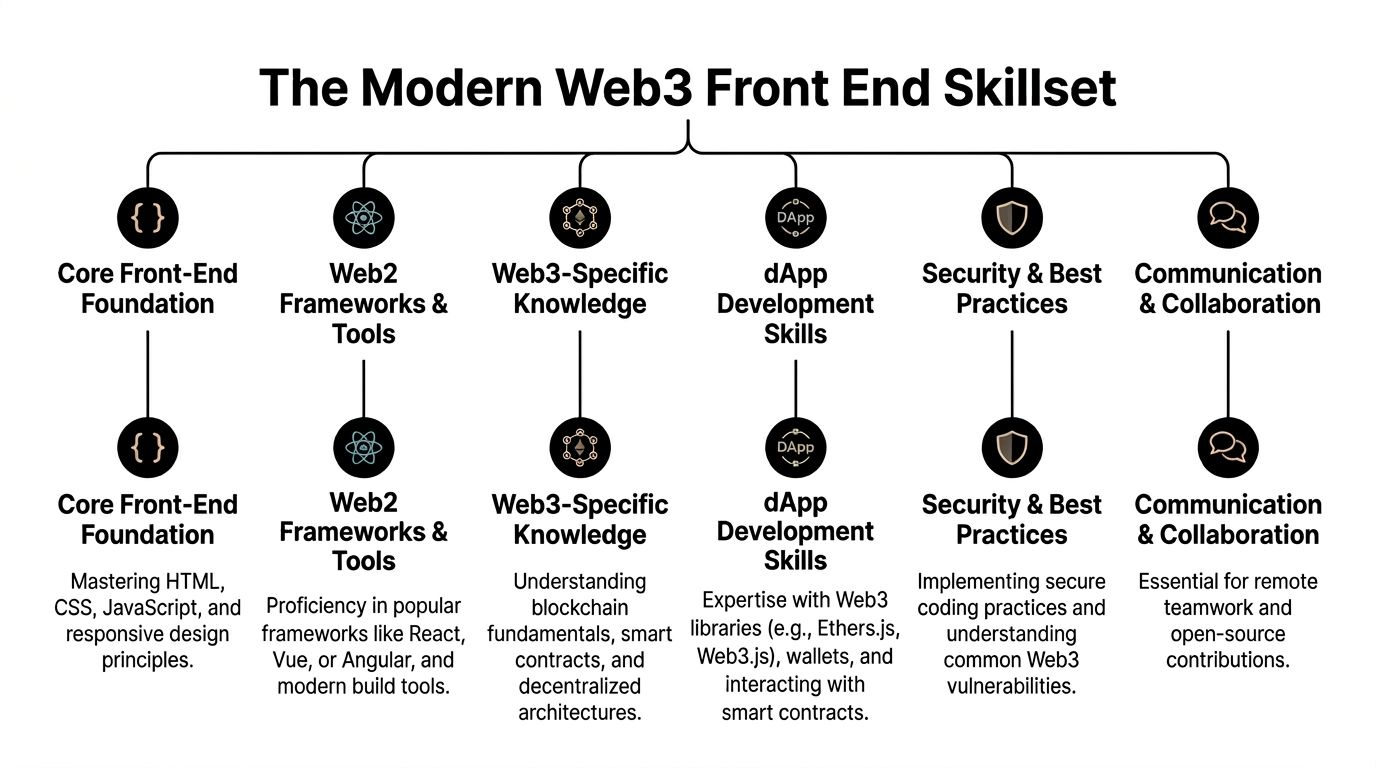
The Modern Web3 Front End Skillset
A traditional front end background gets you through the first door. It doesn't close the interview loop.
Most mid-level developers entering Web3 overestimate framework choice and underestimate systems thinking. React, Vue, or Angular still matter, but they're table stakes. The key shift is learning how a user interface behaves when the source of truth is partly on-chain, partly cached, and sometimes delayed.
What changes when you move into Web3
In a normal SaaS app, you usually control the backend contract. In a dApp, you often don't. You read from smart contracts, indexers, RPC providers, and wallet state. That means you need to think in terms of unreliable latency, transaction states, retries, chain switching, and user safety.
The skill jump usually looks like this:
- From API consumption to contract interaction: Learn
ethers.jsorweb3.js, then practice reading contract state, writing transactions, decoding events, and handling pending confirmations in the UI. - From auth flows to wallet flows: Build with MetaMask-style connectors, session persistence, disconnect states, unsupported networks, and signature prompts that users understand.
- From simple app state to distributed state: Zustand, Redux Toolkit, React Query, or TanStack Query become more important when you need to separate wallet state, server state, and on-chain state cleanly.
- From button clicks to transaction UX: The interface has to explain failure states. Gas rejection, wallet timeout, wrong network, reverted transaction, stale balance, and delayed indexing all need distinct messaging.
- From generic frontend to security-aware frontend: You won't audit contracts as a front end engineer, but you must stop dangerous UX patterns, avoid unsafe assumptions, and never hide what a wallet signature or transaction does.
Practical rule: If your UI can't explain what's happening between "Confirm in wallet" and "Transaction finalized," you're not ready for a Web3 front end interview.
The hiring lens you should use
Hiring managers don't need another developer who can clone a dashboard. They want someone who reduces execution risk on a distributed product team. That means broadening your stack enough to collaborate with protocol engineers, indexer teams, and product leads without becoming blocked.
A useful path is to start at the edge nearest your current strengths:
| Area | Start with | Then move to |
|---|---|---|
| Data | GraphQL queries, pagination, caching | indexer assumptions, event-driven updates |
| App architecture | route structure, feature folders, component boundaries | domain modeling around wallets, assets, chains |
| Backend-adjacent work | API contracts, env handling, schema awareness | server functions, background jobs, deployment pipelines |
| Infra awareness | Vercel or Netlify deploys | CI checks, secrets handling, staging discipline |
AI has changed the floor, not the ceiling. As of 2025, 84% of developers use or plan to use AI tools and 51% use them daily, while demand remains strong for experienced developers who adapt to the blur between front end and back end, based on the 2025 Stack Overflow developer survey. In practice, that means you should use AI for boilerplate, test scaffolding, and refactors, but not as a substitute for understanding contract calls, state modeling, or failure handling.
For role research, keep an eye on live engineering requirements through Web3 engineering jobs. Read them like a curriculum. The repeated tools and patterns tell you what the market rewards.
Building Your Web3-Native Portfolio
Your portfolio shouldn't say, "I can code." It should say, "I understand how decentralized products break, and I can still ship a reliable interface."
A generic weather app, task tracker, or blog won't do much for you here. Those projects prove entry-level competence. Remote Web3 teams need evidence that you can build around messy data, irreversible actions, and product trade-offs.

Replace generic projects with decision-heavy ones
The strongest portfolio shift is from toy apps to user flows with consequences.
A weak project says: I can render components and fetch data.
A strong Web3 project says: I can design for transaction states, explain risk, handle stale reads, and keep the user oriented when the chain doesn't respond the way a normal backend does.
Good project directions include:
- DAO voting interface: Show proposal state, wallet eligibility, signature flow, voting action, and post-vote feedback.
- DeFi portfolio dashboard: Aggregate balances, token metadata, wallet positions, and fallback states when one data source lags.
- NFT minting front end: Handle allowlist status, network mismatch, sold-out conditions, mint progress, and transaction confirmation UX.
- On-chain payments interface: Build around quote display, approval flow, payment execution, and transaction history that isn't misleading.
What hiring teams actually notice
The lines are blurring between frontend and full-stack in Web3, and postings increasingly ask for GraphQL, backend contributions, and blockchain payment integration, as reflected in remote front-end job trends and Web3 role requirements. That's why your portfolio can't stop at the UI layer.
Show the architecture around the interface, even if it's lightweight.
Use a README that covers:
- Product problem you're solving.
- System design in plain language.
- Data sources such as contract reads, GraphQL endpoints, or indexed data.
- Edge cases you handled.
- Trade-offs you made and why.
A hiring manager learns more from one honest trade-off note than from twenty polished screenshots.
A better way to present each project
Don't present projects as galleries. Present them as engineering stories.
A good structure looks like this:
- User problem: "Users don't understand whether a transaction failed, is pending, or hasn't indexed yet."
- Technical approach: "Wallet connection via wagmi, contract reads through ethers.js, cache strategy for balance refresh, fallback empty states."
- Tough part: "Separated pending transaction state from confirmed on-chain state to avoid false success messages."
- What you'd improve: "Would move token metadata normalization into a dedicated service layer."
That last part matters. Teams don't expect perfection. They want judgment.
What to include in the repo itself
Your GitHub repo should feel like a team-ready handoff, not a hackathon dump.
- Clear commit history: Show iterative thinking, not one giant "final commit."
- Issue list or roadmap: Even a small one helps recruiters see how you scope work.
- Environment notes: Explain what needs to be configured and what dependencies the app assumes.
- Short demo video: Walk through wallet flow, failure states, and responsive behavior.
- Tests where they matter: Focus on utility logic, state transitions, and critical UI behavior.
If you're missing contract-writing skills, that's fine. Pair with a simple existing contract, public test environment, or mock contract ABI. The important thing is proving you know how a remote Web3 front end developer thinks when the UI is connected to decentralized state.
Your Application Funnel From GitHub to Job Board
A hiring lead opens your application after dinner, scans your resume for 20 seconds, then clicks GitHub. In a remote Web3 search, that click often decides whether you get the screen.
I see candidates miss this because they apply to decentralized front end roles with the same package they used for regular SaaS jobs. A PDF and a generic LinkedIn summary rarely answer the hard questions. Can this developer ship wallet-connected UI without creating trust-breaking states? Can they explain trade-offs in public, async, and with enough clarity that a distributed team can work with them?

Treat GitHub like your primary proof of work
For remote Web3 roles, GitHub is the fastest way to verify signal. Hiring teams can inspect repo structure, readme quality, commit discipline, issue handling, and whether your code reflects production habits instead of tutorial copying.
The strongest profiles usually make three things obvious within a few minutes:
- Pinned repos that match the target role: wallet flows, on-chain reads, transaction states, indexer-backed UI, or permissioned dashboards tied to smart contract data
- Readable project setup: clear install steps, env requirements, supported chains, screenshots, and notes about known limitations
- Async collaboration evidence: issues, pull requests, review comments, or even thoughtful discussions on trade-offs and follow-up work
If your Git workflow still feels messy, this developer guide for GitHub repositories is a useful cleanup resource. Small repo mistakes can make a solid front end developer look unprepared for distributed work.
Your resume should translate your experience into Web3 terms
Your resume has a different job. It should help a recruiter or hiring manager map your existing work to a Web3 front end team without forcing them to guess.
That matters more than people think. A lot of strong candidates have relevant experience, but they describe it in a way that sounds generic. Remote Web3 teams are usually hiring for adjacent capability, not perfect background matches.
| Traditional frontend experience | How to phrase it for Web3 roles |
|---|---|
| API integration | data integration across multiple external providers |
| Auth flow work | session and identity flow experience |
| Dashboard development | complex state-heavy interface design |
| Performance fixes | user-critical rendering and loading optimization |
| Design system work | scalable component architecture across products |
Keep it honest.
If you built internal tools, say that. If your exposure to blockchain is through side projects, say that too. The goal is not to rename a SaaS feature into a dApp. The goal is to show that you already solve the same classes of front end problems Web3 products face: unreliable upstream data, sensitive user actions, difficult loading states, and UI decisions that affect trust.
Search narrower, apply sharper
Broad remote boards create volume, but they blur context. You end up in applicant pools where your wallet, state-management, and data-sync experience gets flattened into "frontend engineer."
Use targeted listings like remote blockchain jobs for front end and full-stack roles, then filter hard. Prioritize roles where two or three parts of the stack already fit your background. React plus wagmi. Next.js plus GraphQL. TypeScript plus dashboard-heavy product work. That approach produces better interviews than applying to every "Web3" posting with a token logo.
A useful interview prep video on positioning yourself for remote development roles is below.
Build a repeatable funnel
Treat applications like a weekly system, not a burst of hope.
- Pick a narrow batch of roles with similar product type, chain focus, and front end stack.
- Tune one pinned repo so it mirrors those requirements and highlights relevant decisions.
- Rewrite your summary and resume bullets to reflect real wallet, contract, indexer, or GraphQL exposure.
- Send a short custom note that connects one project you built to one problem the team is hiring for.
- Track replies, rejections, and interview feedback so the next round of applications gets stronger.
One more trade-off is worth calling out. Sending 40 generic applications feels productive. Sending 8 role-matched applications with a tuned repo, a clean GitHub profile, and a credible explanation of your Web3 transition usually gets better results. Remote teams are filtering for proof, not effort.
Decoding the Remote Web3 Interview Loop
The remote Web3 interview loop is trying to answer one question: can this person ship safely without constant supervision?
That question shapes every round. Recruiters check whether your background maps cleanly to the role. Engineers test whether you can reason through uncertain systems. Hiring managers look for product judgment and communication. In Web3, they also want confidence that you won't create trust-breaking UX around wallets, signatures, and funds.

What each round is really testing
The screening call isn't just about availability. It's often a filter for clarity. Can you explain what you built, why the architecture looked the way it did, and where your actual ownership started and ended?
The take-home usually tests production thinking more than algorithmic cleverness. Teams want to see whether you structure code cleanly, document assumptions, and handle the ugly states that real users trigger.
The live technical round often exposes weak candidates fast. They can build happy-path UI, but they freeze when asked what happens if a wallet disconnects mid-flow, a chain changes, or data resolves in the wrong order.
The questions that come up repeatedly
Expect questions like these:
- How would you handle pending, confirmed, and failed transactions in the UI?
- What should happen if contract data and indexed data disagree temporarily?
- How do you avoid misleading users during wallet signature prompts?
- Where would you keep wallet state versus server state?
- How would you make this page feel faster without sacrificing correctness?
One area interviewers won't compromise on is performance. 53% of mobile visits are abandoned if a page takes longer than three seconds to load, and that shows up directly in how teams evaluate frontend candidates, as covered in this web performance and remote front-end guide.
Performance answers need to be specific
If you're asked how you'd optimize a dApp, don't say "I'd use memoization" and stop there.
Talk concretely about:
- Lighthouse audits: identify render-blocking scripts, oversized bundles, and layout shift causes.
- Code splitting: keep wallet libraries and heavy views from bloating the initial route.
- Lazy loading: defer non-critical panels, charts, and modal-heavy flows.
- Image handling: optimize assets because heavy images subtly drag down perceived responsiveness.
- Core Web Vitals discipline: know what CLS and FCP mean in practical UI terms.
The candidate who names tools, constraints, and trade-offs usually beats the candidate who says "performance matters."
Remote readiness is part of the technical signal
Teams also pay attention to how you communicate during the interview itself. Do you narrate your assumptions. Do you ask clarifying questions. Do you explain uncertainty without collapsing into vagueness.
For more hiring context and role-specific career thinking, the Blockchain Jobs blog is a useful place to compare how different Web3 companies frame engineering expectations.
Excelling in a Distributed Development Environment
A remote front end developer doesn't earn trust by being online all day. You earn it by reducing confusion.
That matters even more in Web3 because your teammates may span protocol engineering, design, DevOps, and product, with everyone looking at a different slice of the system. If your work needs live explanation every time someone touches it, you've created drag.
Async communication is part of the job
In remote roles, asynchronous communication is as important as technical skill, and strong developers show it through detailed commit messages, strong pull request descriptions, effective use of Git and Slack, and self-contained code that supports independent review, according to this remote frontend collaboration guide.
That sounds soft. It isn't. It's operational.
A useful pull request does four things:
- States the user problem
- Explains the implementation path
- Calls out risk areas
- Tells reviewers how to test it
If your PR says "updated dashboard flow," reviewers have to reverse-engineer your thinking. If it says "separates pending transaction state from confirmed balance state to avoid false success messaging after wallet approval," they can review the actual decision.
What good remote execution looks like
Here is the pattern strong distributed engineers follow:
| Habit | Weak version | Strong version |
|---|---|---|
| Commits | vague and oversized | scoped and meaningful |
| Pull requests | code dump | guided review with context |
| Slack updates | status theater | concise blocker and decision notes |
| Documentation | written only when asked | created before confusion spreads |
| Code style | depends on tribal knowledge | readable without live narration |
You don't need perfect process. You need predictable clarity.
Make your work easy to pick up in another time zone
The practical test is simple. If someone opens your branch while you're asleep, can they continue?
That means writing code and notes that survive async handoff:
- Leave decision breadcrumbs: explain why a wallet provider fallback exists.
- Document assumptions: note whether a balance comes from contract reads or indexed data.
- Name edge cases: unsupported chain, stale token metadata, rejected signature, delayed confirmations.
- Show next actions: if work is partial, say what remains and where the risk is.
For teams reviewing their stack, this roundup of explore remote collaboration tools 2025 is a decent reference point for comparing workflow options around code review and communication.
Clear async communication makes your technical skill visible. Without it, good work stays hidden.
Negotiating Your Offer and Planning Long-Term Growth
When the offer arrives, don't switch into relief mode too early. Many good developers frequently forfeit their negotiating power at this stage.
A remote Web3 offer often has more moving parts than a standard frontend package. Base salary matters, but so do token incentives, vesting mechanics, equity, scope, on-call expectations, and what success means in the first months. If you only ask about salary, you may miss the terms that shape your upside and your day-to-day experience.
Negotiate the whole package
Start by understanding what the company is buying. Are they hiring a UI implementer, or someone expected to own wallet flows, performance, product collaboration, and backend-adjacent work. Those are different jobs, even if the title looks similar.
Use this checklist in the offer conversation:
- Role scope: Ask what you will own directly in the first quarter.
- Team topology: Find out who handles protocol work, design, data, and DevOps.
- Compensation structure: Clarify salary, equity, token exposure, and vesting terms.
- Working model: Confirm timezone expectations, meeting load, and async norms.
- Growth path: Ask what distinguishes this role from the next level up.
A strong negotiation doesn't sound combative. It sounds precise. You're not trying to win a debate. You're trying to remove ambiguity before it becomes your problem.
How to make your case
Tie your ask to business risk you can reduce.
If you've built portfolio work that handles transaction states cleanly, explain that. If your background shows performance rigor, component architecture discipline, or strong async communication, connect it to what remote teams struggle with. Specificity wins.
A simple structure works well:
- Reconfirm excitement about the role.
- Restate the value you bring in concrete terms.
- Identify the part of the package you'd like to discuss.
- Make the request clearly, then stop talking.
Plan beyond the first offer
Your first remote Web3 job shouldn't become a holding pattern. It should become a compounding role.
The developers who keep moving up usually do three things well:
- They widen their surface area carefully: enough backend, data, and infra awareness to become harder to replace.
- They build visible judgment: through docs, reviews, architecture discussions, and calm handling of production issues.
- They stay current without chasing every fad: they learn the tools that change execution, not every new token narrative.
Your long-term edge isn't just shipping faster. It's becoming the person teams trust with ambiguous, high-impact work.
If you are already a skilled frontend engineer, the path is clear. Build Web3-native evidence. Learn enough full-stack context to avoid getting stalled. Communicate like a distributed teammate rather than a solo coder. Then negotiate like someone who understands the power inherent in that combination.
If you're ready to turn that into actual applications, Blockchain Jobs is one of the better places to find remote Web3 roles without digging through generic listings. Use it to spot the stack patterns companies keep asking for, compare role scope across teams, and target openings that fit the kind of remote front end developer you want to become.