Risk Control Manager Job Description: A Web3 Guide
A lot of teams start writing a risk control manager job description only after something has already gone wrong. A regulator asks uncomfortable questions. A token listing creates exposure nobody mapped. An integration goes live before anyone checks custody concentration, sanctions flow, or incident ownership. Then the company says it needs “someone in risk.”
That's late.
In Web3, the role isn't there to slow down shipping. It's there to stop a fast-moving company from making dumb, avoidable bets while preserving the good risks that grow the business. If you're hiring, the hard part isn't writing a polished template. It's being honest about what the job really owns. If you're a candidate, the challenge is proving you can operate beyond policy language and handle messy, technical, cross-functional decisions.
Generic HR copy won't help much. Most risk control manager job description pages talk about compliance policies, audits, and escalation. Those matter. But in crypto, they're only part of the picture. This role sits where product decisions, operational controls, blockchain mechanics, and regulatory scrutiny all collide.
The Critical Need for Risk Control in Web3
A Web3 company can look healthy on Monday and be in crisis by Wednesday. The trigger might be a smart contract issue, a sanctions exposure, a custody partner problem, a bridge integration that widened attack surface, or a regulator asking for records the business never organized properly.
That's why risk control in Web3 has to be active, not ceremonial.
A Risk Control Manager protects more than compliance posture. The role protects continuity. When product, engineering, legal, finance, and operations all move at different speeds, someone has to decide which exposures are acceptable, which ones need compensating controls, and which ones should stop a launch.
Where generic teams get this wrong
Many companies hire too narrowly. They ask for someone to “manage controls” when they need someone who can challenge assumptions before losses or breaches become material. A weak setup usually looks like this:
- Risk gets involved too late: Product scopes a launch, engineering builds it, legal reviews it near the end, and risk is asked for a final sign-off.
- Controls exist only on paper: Policies look fine in a board deck but don't map to wallet operations, vendor dependencies, or incident response.
- Nobody owns trade-offs: Teams know there's exposure, but no one states the risk appetite clearly enough to decide.
Practical rule: In crypto, a control that doesn't survive a real incident isn't a control. It's documentation.
What good risk control actually changes
A strong Risk Control Manager does three things early. First, they help leadership define what the business is willing to tolerate. Second, they make teams translate that appetite into operating decisions. Third, they force uncomfortable questions while there's still time to change course.
That work can feel inconvenient in the moment. It's still cheaper than discovering your monitoring logic was too generic for on-chain behavior, or that your escalation path didn't account for a weekend exploit.
The best Web3 risk teams become growth enablers because they make launches cleaner, vendor choices sharper, and incident handling faster. That's the standard your risk control manager job description should reflect.
What Is a Blockchain Risk Control Manager
A Blockchain Risk Control Manager applies the core discipline of risk management to an environment that changes faster, breaks in stranger ways, and leaves public traces on-chain. At a base level, the role still includes policy, assessments, audits, reporting, and regulatory awareness. But that description is incomplete if it doesn't cover protocol behavior, wallet flows, vendor dependencies, and product-specific failure modes.
For crypto organizations, the role maps directly to high-frequency, high-regulatory-change environments. The operating model is straightforward: assess emerging risks, calibrate them against risk appetite, and track metrics or KRIs so leadership can act before issues become material, as described in Careervira's overview of the risk control manager role.
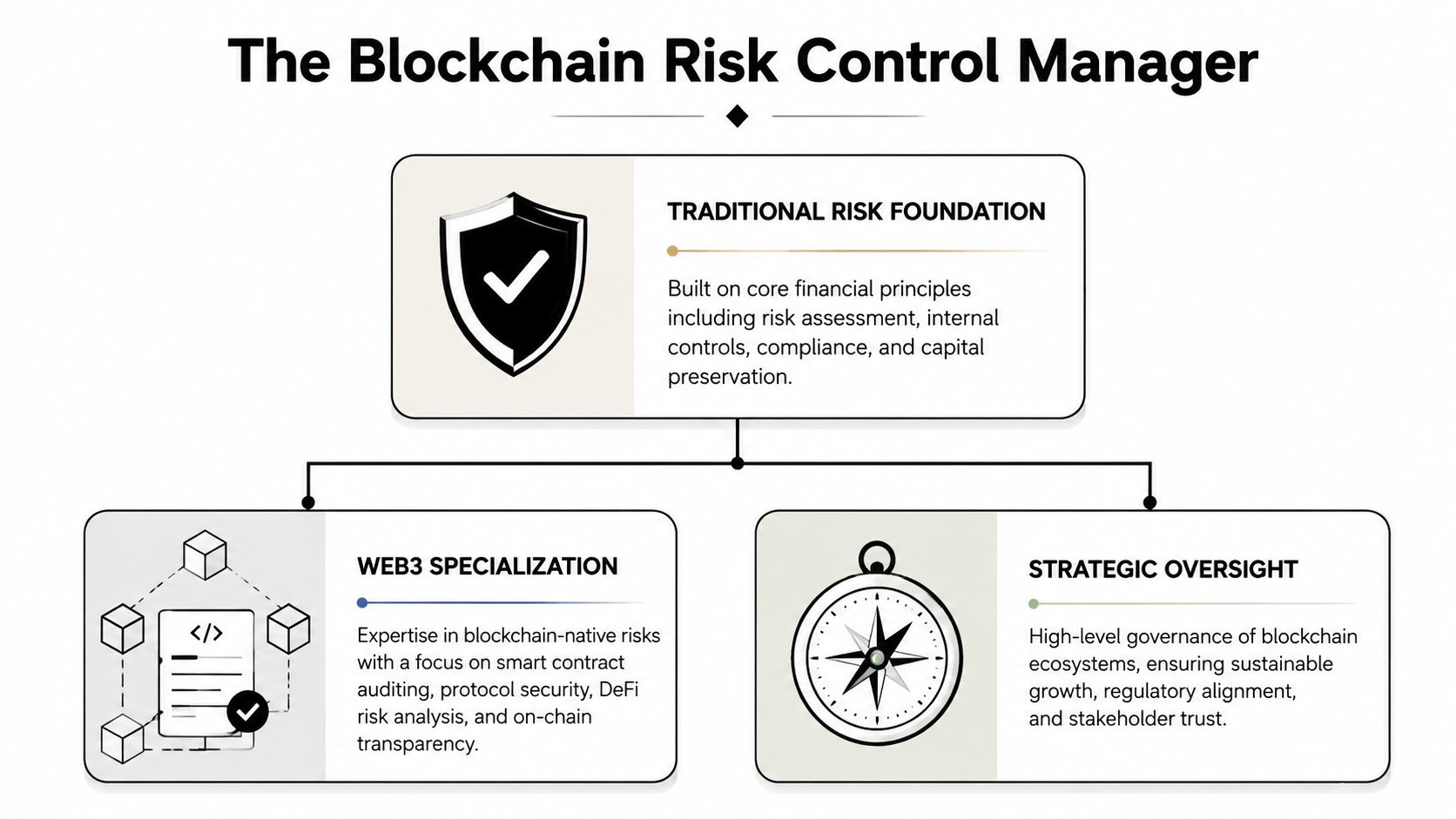
The role sits between specialized teams
In a traditional company, risk often reviews a process. In a crypto company, risk often reviews a system with legal, operational, and technical consequences all at once.
That means the manager has to translate across groups:
- For engineering: Define what is risky in an integration, contract upgrade, or custody workflow.
- For legal and compliance: Convert blockchain-specific activity into control language, monitoring logic, and reporting structure.
- For executives: Explain the exposure in business terms so leadership can decide whether to proceed, delay, or redesign.
A hiring manager who wants a pure policy writer is hiring the wrong profile.
It's broader than compliance
A lot of published job descriptions still flatten this role into compliance administration. That misses the point. In Web3, the manager often spans legal, finance, IT, and operational risk. They may not own every domain, but they must understand how the domains interact when something breaks.
That's also why candidates who want to move up should study governance structure, not just controls. A useful reference is this senior governance, risk, and compliance leadership example at Ripple, because it shows where the role can evolve when risk becomes a strategic function rather than a check-the-box one.
A good blockchain risk manager isn't the person who says no most often. It's the person who can explain which risks are real, which are manageable, and what the company must do before moving forward.
What the title should imply
When I read a risk control manager job description, I expect clarity on four things:
| What to define | What strong wording looks like |
|---|---|
| Scope | Covers product, operational, regulatory, and third-party risk in blockchain activity |
| Decision rights | States whether the role advises, approves, escalates, or owns specific controls |
| Exposure types | Names real Web3 issues such as smart contracts, custody, chain analytics, or incident response |
| Business purpose | Shows how risk supports safe growth, not just enforcement |
If your description can't answer those points, candidates will assume the role is either underpowered or confused.
Core Responsibilities in a Web3 Environment
At 2:13 a.m., a bridge connected to one of your listed assets pauses withdrawals after an exploit alert. Treasury wants exposure numbers. Operations wants a decision on customer flows. Legal asks whether any reporting duty has been triggered. Product wants to know if other features need to be disabled. A risk control manager in Web3 has to turn that noise into a clear operating decision fast.

The foundational responsibilities
The base job still looks familiar to anyone from banking, payments, or regulated fintech. Someone has to design controls, test them, track issues, document decisions, train teams, investigate incidents, and keep leadership informed. If that work is sloppy, the crypto-specific layer sits on weak foundations.
In practical terms, the manager usually owns work such as:
- Control design: Set approval flows, exception handling, access rules, reconciliations, and issue tracking that people will follow.
- Assessment work: Review higher-risk processes on a schedule, then check whether the control still works after product, vendor, or market changes.
- Regulatory change handling: Translate new rules or enforcement signals into procedure changes, monitoring updates, and retraining.
- Escalation and reporting: Give executives a usable view of exposure, decision points, and unresolved gaps instead of a long list of disconnected tickets.
This work is not glamorous. It keeps the firm out of preventable trouble.
The crypto-native responsibilities
Web3 adds failure modes that generic job descriptions barely mention. The manager has to understand how risk moves through wallets, smart contracts, bridges, validators, market structure, vendors, and on-chain customer behavior.
That means reading a smart contract audit and asking what it did not test. It means checking whether a custody setup has clear separation of duties, recovery procedures, and signing controls that hold up under stress. It means reviewing dependency risk around bridges, oracle providers, staking providers, and RPC infrastructure, because one weak external component can create customer loss, operational shutdown, or a regulatory incident.
Transaction monitoring also changes in crypto. Public ledgers create more visibility, but they also create more responsibility. If the role touches funds flow, wallet operations, token listings, or sanctions screening, the manager needs to understand how blockchain analytics, wallet clustering, mixer exposure, and cross-chain movement affect monitoring design and case handling.
What this looks like on the job
A good Web3 job description should name the actual decisions the person will support or challenge. Generic phrases like “manage enterprise risk” do not help.
Use responsibilities that reflect how the business operates:
- Review product changes: Assess whether a new token, bridge connection, staking feature, or DeFi integration creates attack paths, liquidity stress, market abuse exposure, or sanctions risk.
- Manage custody and vendor risk: Evaluate custodians, analytics providers, infrastructure vendors, and liquidity partners for concentration, resilience, control quality, and recovery readiness.
- Support on-chain investigations: Use tools such as Chainalysis or Elliptic to shape monitoring rules, investigate suspicious flows, and escalate cases with enough evidence to act.
- Build incident playbooks: Define decision owners, containment steps, communications paths, and evidence requirements when funds move unexpectedly or a protocol dependency fails.
- Work with product and engineering before launch: Push controls into design reviews, access models, wallet architecture, and launch criteria instead of documenting lessons after an avoidable incident.
- Challenge treasury and exposure assumptions: Test collateral concentration, venue exposure, stablecoin dependencies, and chain-specific operational risk before market stress makes those weaknesses obvious.
If you want a benchmark for how close this role should sit to the business, review this product and regional risk manager role at Kraken. The structure is useful because it places risk near product and regional decisions, where actual trade-offs occur.
What strong hiring managers spell out
The best descriptions make the trade-offs visible. They say whether the manager can block a launch, who owns incident response, what types of on-chain exposure sit in scope, and how far the role reaches into product, operations, and compliance.
They also acknowledge that not every risk can be reduced to zero. In crypto, the job is often to separate acceptable managed risk from hidden unmanaged risk. That is a much better test of the role than asking for someone who will “ensure full compliance” across a fast-moving product set.
What fails in practice
Three patterns cause bad hires again and again.
- Writing the role as pure compliance: You attract candidates who can maintain policies but cannot pressure-test protocol, custody, or transaction flow risk.
- Listing every risk domain without examples: Broad coverage sounds senior, but it hides whether leadership understands its own exposure.
- Avoiding technical specifics: In Web3, vague language usually signals weak decision rights or confusion about what needs protection.
Write the job around real operating risk. Good candidates notice the difference immediately.
Essential Skills and KPIs for Success
A bridge exploit hits at 2:13 a.m. Treasury movements need review, customer withdrawals are spiking, and product wants a clear answer on whether to keep a feature live. In that moment, the difference between an average risk control manager and a strong one is obvious. The strong manager can sort signal from noise, frame the decision, and tell leadership what the firm is exposed to in the next hour, not just what the policy says on paper.

Generic job descriptions usually miss that reality. They ask for risk management, analysis, auditing, finance, and project coordination, which is directionally right, as noted earlier. In Web3, the ultimate test is whether the person can apply those skills to wallets, smart contracts, transaction monitoring, vendor dependencies, and fast-changing on-chain behavior.
Skills that get hired
The best candidates are balanced across three areas. They have enough technical depth to challenge assumptions, enough operating judgment to prioritize under pressure, and enough credibility to push back on product or operations without turning every discussion into a turf fight.
Technical judgment
This role does not require a protocol developer. It does require someone who understands how failure happens in crypto systems.
Look for people who can examine questions like these without getting lost in buzzwords:
- How does value move through the product, on-chain and off-chain?
- What breaks if a wallet permission is misconfigured?
- Which controls depend on a vendor, oracle, bridge, or custodian behaving as expected?
- Where does finality risk, liquidity risk, or sanctions exposure show up in the transaction flow?
- What would they review in an audit report before treating it as meaningful assurance?
A candidate who can only say “smart contract risk” at a high level will miss real exposure. A useful candidate can trace a user action through the stack and point to the exact control points where the firm can detect, prevent, or contain loss.
Communication that holds up in a crisis
Risk control managers spend a lot of time translating. Engineers describe root cause. Compliance describes obligations. Finance describes loss exposure. Executives need a decision.
Strong communication in this job sounds like this:
- Here is what happened.
- Here is the affected asset, product, jurisdiction, or customer segment.
- Here is the control that failed, or the control that never existed.
- Here are the response options and the cost of each.
- Here is the residual risk if we keep operating.
That is the standard. Anything softer creates confusion at the worst possible time.
For hiring managers, one of the best interview tests is to give the candidate a short incident scenario and ask for a five-minute verbal escalation. If they cannot explain technical risk in clean business language, they will struggle in launch reviews, incidents, and executive meetings. A good reference point is the level of operating judgment you see in a senior manager financial risk role at Ripple, where technical context and commercial judgment have to coexist.
Control design and follow-through
A lot of candidates can identify risk. Fewer can turn that into a control that a real team will run every day.
That means they should be able to:
- write review criteria that product and operations can follow,
- define escalation thresholds,
- separate detective controls from preventive controls,
- set evidence standards for testing,
- and track remediation until the issue is closed.
I value candidates who understand the trade-off between ideal controls and usable controls. A control that looks strong in a policy doc but fails during a high-volume market event is not a strong control.
Hiring signal: Ask for an example where they accepted a managed risk instead of pushing for the maximum control. Strong candidates can explain the trade-off, the monitoring they put around it, and the trigger that would force a revisit.
Here's a useful benchmark discussion on the kind of thinking this role needs:
KPIs and KRIs that actually make sense
Bad scorecards create busywork. Good ones change decisions.
A Web3 risk control manager should be measured on whether risk is identified early, escalated clearly, and reduced in places that matter. That usually means combining delivery metrics with exposure metrics, then checking whether the numbers are tied to actions.
| Measure type | Useful example | Why it matters |
|---|---|---|
| KPI | Time to remediate audit or control findings | Shows whether issues are being fixed or simply logged |
| KPI | Percentage of material launches reviewed before release approval | Shows whether risk is involved early enough to influence decisions |
| KPI | Control testing completion for high-risk workflows | Confirms that treasury, custody, withdrawal, and access controls are actually being checked |
| KRI | Open high-severity incidents past target age | Signals weak ownership or overloaded teams |
| KRI | Volume of exceptions approved outside standard governance | Shows where commercial pressure is overriding control discipline |
| KRI | Alert precision in transaction monitoring or sanctions review | Helps the team improve detection logic instead of drowning in noise |
A practical warning. Do not overload the role with vanity metrics. Counting meetings attended, policies updated, or training sessions delivered tells you very little about whether risk is being controlled.
What success looks like after hiring
Within a few months, strong performance is visible. Launch reviews get more specific. Incident escalation gets faster. Fewer surprises reach senior leadership because weak controls are being identified earlier.
The best managers also change team behavior. Product starts bringing them in before commitments are made. Operations teams know what evidence is expected. Compliance and finance get clearer risk framing instead of fragmented updates. That is what good looks like in practice.
Candidates should ask how success will be measured before they accept the role. Hiring managers should answer with operating outcomes, decision rights, and timelines. “Be proactive” is not useful. “Reduce unresolved high-severity findings, improve pre-launch review coverage, and tighten incident escalation quality within the first two quarters” is.
Career Path Seniority and Salary Expectations
A token listing is scheduled for next month. Product wants speed, compliance wants tighter controls, and an exchange partner is asking sharper due diligence questions than your team expected. In that situation, title matters less than judgment. The person in this seat needs to know which risks can be accepted, which controls must be tightened before launch, and how to hold the line when revenue pressure shows up.
That is why Web3 career progression looks different from traditional financial services. People do not advance because they have maintained a larger issue log. They advance because they can assess smart contract exposure, challenge weak custody assumptions, work through sanctions and fraud edge cases, and brief executives without hiding behind process language.
Compensation follows that reality. According to Salary.com's Risk Control Manager salary data, as of May 2026, the average salary is $128,290 per year, with a typical range of $130,390 to $162,590. The same source shows broader variation by experience, including mid-career roles with 3 to 6 years of experience ranging from $79,000 to $141,000 annually, and notes that auditing expertise can carry a salary premium.
How seniority changes the job
The biggest shift is decision weight.
Early-career hires usually support reviews, test controls, track findings, and make sure evidence exists. In a crypto company, that work still needs context. A junior manager who cannot tell the difference between a wallet operations control gap and a market abuse surveillance gap will struggle quickly.
At the manager level, the role becomes harder and more useful. This person should be able to review a new staking product, identify the operational and financial control breaks, challenge ownership gaps across product and engineering, and push remediation without creating unnecessary friction. They are no longer just recording risk. They are shaping how the business takes it.
Senior managers and directors carry a different burden. They decide where to spend limited control capacity, which escalations need executive intervention, and when a product should slow down because the downside is not understood well enough. In Web3, that often means making calls with incomplete information. The trade-off is real. A leader who blocks everything will lose credibility. A leader who approves everything will eventually own a preventable failure.
| Seniority Level | Primary Focus | Example Responsibilities | Estimated Salary Range (2026) |
|---|---|---|---|
| Analyst or Junior Manager | Execution and control support | Maintain risk registers, support testing, track issues, prepare reports, assist with onboarding of controls | Early-career pay varies widely by company stage, jurisdiction, and how technical the role is |
| Mid-career Risk Control Manager | Control ownership and business partnership | Lead assessments, challenge product launches, manage incidents, coordinate remediation, train teams, report to leadership | Mid-career compensation often falls within the ranges published earlier for professionals with 3 to 6 years of experience |
| Senior Manager | Framework design and prioritization | Set review standards, lead cross-functional governance, define KRIs, oversee major issues, mentor junior staff | Usually priced against broader manager benchmarks, with a premium for crypto fluency and strong judgment under pressure |
| Director or Head of Risk | Strategic ownership | Define risk appetite, shape control model, resolve escalations, present to executives or board, influence product strategy | Often above manager benchmarks where the role owns firm-wide risk decisions or regulated entity exposure |
What candidates should optimize for
Good candidates look past base salary. The key question is whether the job builds judgment and scope.
Ask who owns launch approval. Ask whether engineering respects risk review or treats it as a final checkpoint. Ask whether the company expects this role to cover policy administration, fraud, financial risk, vendor risk, and security governance all at once. That last setup is common in Web3 startups, and it can be a strong learning environment or a guaranteed burnout track.
A useful benchmark is this senior manager financial risk example at Ripple. It shows how senior roles increasingly combine governance, financial judgment, and cross-functional influence rather than pure control testing.
Candidates should also read the role wording carefully. The Paradigm International Inc. guide to job descriptions is a good reminder that vague mandates create bad hiring outcomes. In practice, if a posting says “support risk activities across the business” but never names decision rights, product exposure, or accountability for outcomes, the company may not know what it needs.
What hiring managers should remember
Generic salary benchmarking creates weak hires in this function. If you need someone who can question bridge architecture dependencies, assess hot wallet control design, or manage incidents involving third-party smart contracts, you are not hiring a standard corporate risk manager.
Pay for the actual problem set. Scope, technical fluency, and judgment under pressure matter more here than polished policy writing alone. The expensive candidate is not always the one with the higher base salary. It is often the one you passed on because the job description and compensation package understated how hard the role really is.
Nailing the Hire Job Template and Interview Questions
Most companies write a risk control manager job description as if they're hiring for administrative control maintenance. Then they wonder why shortlisted candidates feel generic. If you want someone who can support growth, the posting has to make the strategic mandate visible.
Many descriptions overemphasize testing, documentation, and escalation. But the core job is to identify and assess risks against the company's risk appetite so leadership can take the right risks, a distinction emphasized in Velvet Jobs' description of the risk control manager role. That same gap is why strong candidates often ask whether the role is operational, advisory, or governance-heavy.
A practical job description template
You don't need corporate theater. You need signal.
A good draft should include:
Role summary
State the business problem plainly. Example:
This role partners with product, engineering, compliance, legal, and operations to identify, assess, and manage blockchain-specific risks across product launches, third-party relationships, transaction flows, and incident response. The manager helps the company take acceptable risks while maintaining effective controls.
Responsibilities
Use concrete language.
- Assess new initiatives: Review blockchain products, token features, integrations, and vendor dependencies before launch.
- Own control improvement: Design, test, and strengthen controls across operational, regulatory, and technology risk.
- Drive incident response: Coordinate risk assessment, escalation, and remediation after control failures or suspicious activity.
- Support leadership decisions: Present risk trade-offs in a form executives can act on.
- Maintain usable governance: Keep policies, issue tracking, KRIs, and reporting aligned to how the business operates.
Required background
Don't ask for everything.
- Experience in risk, compliance, audit, operations, or controls within crypto, fintech, or another regulated environment
- Working knowledge of blockchain transactions, wallets, custody, and smart contract-related risks
- Ability to partner with technical and non-technical teams
- Strong written judgment, especially in escalation and remediation work
If you need help tightening structure and avoiding common drafting mistakes, the Paradigm International Inc. guide to job descriptions is a useful reference because it pushes teams to write with more clarity and compliance discipline.
A strong posting doesn't just say what the role does. It tells a candidate where the role has influence.
Interview questions for hiring managers
The fastest way to separate real operators from polished generalists is to ask for decision-making, not definitions.
Try questions like these:
Walk me through how you'd assess the risk of a new cross-chain bridge integration. Look for dependency mapping, exploit paths, operational ownership, and launch conditions.
You're given a third-party smart contract audit report. What do you look for beyond the existence of the report? Good candidates talk about scope, severity handling, unresolved findings, assumptions, and compensating controls.
How would you redesign transaction monitoring if generic alert logic was flooding the team with weak signals? Strong answers show they understand tuning, segmentation, escalation thresholds, and operational burden.
Tell me about a time you had to push back on a launch. You want evidence of judgment, influence, and alternatives, not just “I escalated.”
How should risk appetite be set and communicated in a fast-moving crypto business? This reveals whether the person thinks strategically or only in terms of enforcement.
Interview questions for candidates to ask
Strong candidates should interview the company just as hard.
- How is risk appetite defined here, and who owns it?
- At what point in the product lifecycle does risk get involved?
- Does this role approve, advise, or escalate?
- Which risks have caused the most friction internally: custody, sanctions, listing, treasury, smart contracts, or vendor concentration?
- How are disagreements resolved between product speed and control requirements?
If a company can't answer those cleanly, the problem isn't your interview technique. The operating model probably isn't mature.
Onboarding Your New Manager for Maximum Impact
A new Risk Control Manager fails fast when the company gives them a title, a backlog, and no access. The first months should be structured around learning the business, exposing control gaps, and establishing credibility with the teams that ship and operate product.
A practical 30 60 90 approach
First 30 days Focus on listening. Meet engineering, product, compliance, legal, finance, security, and operations leaders. Review incidents, current policies, key vendors, monitoring workflows, and active launch pipelines. Learn where the actual friction is.
By 60 days Start mapping gaps. Identify weak ownership, stale controls, unclear escalation points, and areas where current policy doesn't match practice. Propose quick wins that lower risk without creating theater.
By 90 days Present a roadmap. Show the top exposures, the immediate fixes, the medium-term control buildout, and the decisions leadership needs to make on appetite and ownership. Keep it concise and operational.
For teams refining hiring and onboarding workflows more broadly, the AI talent recruitment guide from DataTeams is a helpful companion because it focuses on making job advertising and candidate targeting more deliberate.
The best onboarding outcome is simple. The new manager should know what matters, who owns what, and where the company is taking risk by choice versus by accident.
If you're hiring or exploring your next move in crypto risk, Blockchain Jobs is one of the best places to find Web3 roles that reflect how this work gets done across exchanges, protocols, infrastructure companies, and compliance-heavy operators.