
2026 Guide to Sales and Trading Salaries
A senior producer in US global markets took home $1,547,000 in average total compensation in 2024, according to Heidrick & Struggles data summarized by Wall Street Prep. That number gets attention, but it also hides the part that matters in hiring. Sales and trading salaries aren’t one market. They’re several compensation systems layered on top of each other: stable base pay, volatile bonus pools, product-specific economics, and firm cultures that reward very different behaviors.
That’s why candidates routinely misread offers. They compare one all-in number to another and miss the actual question: what kind of risk are you being paid to carry? A bulge bracket analyst, a Jane Street candidate, and a crypto market-making hire may all look “well paid” on paper. In practice, they’re being compensated for different mixes of client flow, desk P&L, technical depth, and commercial judgment.
From a recruiter’s seat, that’s the lens for anyone interviewing in 2026. If you’re moving within TradFi, you need to know whether your pay should be anchored to title, product, or revenue relevance. If you’re crossing into digital assets, you also need to translate your value into a desk that may borrow Wall Street compensation logic while presenting it in a very different package. If you’re also exploring independent paths before committing to a seat, this honest guide to funded trading firms is useful background because it helps separate real risk allocation from marketing spin.
The State of Sales and Trading Compensation in 2026
In a market where 39% of US sales and trading professionals report earning more than $201,000, pay still looks strong at first glance. The more useful read is underneath that headline. Only 49% received a salary increase, and among that group, 55% saw raises of just 1% to 5%, according to the Selby Jennings USA Financial Sciences & Services Talent Report 2025.

That split is the key 2026 story. Firms are still paying for revenue producers, but broad-based comp inflation has cooled. In hiring, that shows up as narrower ranges, heavier scrutiny on production quality, and a sharper distinction between candidates who benefited from strong desk conditions and candidates who clearly drove client flow, risk transfer, or P&L.
Candidates miss this point all the time. A good year on paper is no longer enough. Hiring managers want evidence that your results travel with you.
Bonus data reinforces that shift. Sales and trading professionals frequently receive bonuses, and bonuses still carry real weight in total compensation. Yet only 56% said bonuses met expectations in the same Selby Jennings report. In practice, that gap is one of the clearest warning signs recruiters see. If a desk regularly lands below expected payout, experienced candidates start discounting management credibility, franchise strength, and the odds of fair upside in year two.
A better interview question is simple: what performance moves someone from target bonus to top-bucket bonus? The answer usually exposes more than the headline range.
The other underappreciated change is how firms package certainty. Selby Jennings also found that 78% of professionals report some remote options, including 29% with three days per week and 24% with two. Trading floors still skew in-office, but flexibility now sits inside the comp discussion, not outside it.
That point is especially relevant for moves between TradFi and Web3. Crypto desks often pitch higher upside, faster title progression, and more flexible working arrangements. TradFi firms usually offer stronger guarantees, clearer bonus mechanics, and better-defined internal mobility. The compensation gap between the two is not just base versus token upside. It is a question of what kind of risk sits on your balance sheet as an employee.
For professionals comparing both worlds, the smartest approach is to price each offer in layers: guaranteed cash, variable cash, deferred or token-linked upside, platform stability, and work structure. Anyone considering alternatives outside institutional seats should also read this honest guide to funded trading firms because it helps separate real capital access from retail-style marketing.
In 2026, strong compensation still exists in sales and trading. It is concentrated in seats where impact is measurable, portable, and easy for a new employer to underwrite.
Deconstructing the S&T Paycheck
Most candidates say “comp” when they really mean one number. Recruiters don’t. We separate the package into components because each one answers a different question. What’s guaranteed? What’s earned? What’s delayed? If you don’t split an offer that way, you can’t compare two seats properly.
Base salary is the franchise signal
Base salary tells you how the firm values your seat before the year starts. It reflects scarcity, title, product complexity, and how painful it would be for the desk to replace you. In practical terms, a strong base says the firm wants stability in that role. A lighter base often means management expects performance variability and prefers to pay for outcomes after they appear.
For candidates, base matters most in three situations:
- When you're changing product: A move from a familiar flow desk into a new area often comes with uncertainty. A stronger base protects that transition.
- When the platform is still proving itself: Smaller firms and crypto-native desks may tell a compelling growth story, but a thin base shifts execution risk onto you.
- When the title is ambiguous: “Trader,” “sales trader,” and “market maker” can describe very different levels of autonomy. Base salary often reveals what the title doesn’t.
Bonus is the truth serum
Bonus is where firms reveal what they really reward. A desk may praise collaboration, platform building, and intellectual range. Bonus allocation shows whether they pay for client revenues, risk-adjusted P&L, niche product expertise, or seniority.
That’s why good candidates ask sharper questions than “is bonus discretionary?” Better questions include:
How is individual performance assessed?
Is it tied to book contribution, client wallet capture, execution quality, or broader desk support?Who controls the final number?
A direct desk head process is different from a wider divisional pool.What gets remembered at year-end?
Firms say they value long-term behavior. Some still pay heavily off recent visible wins.
If a manager can’t explain bonus logic clearly, assume the process is more political than analytical.
Deferred comp and equity change the risk profile
Deferred compensation, stock, and equity-linked awards can be valuable. They can also function as retention handcuffs. Mature banks often use deferred structures to align senior staff with the broader business. Early-stage or crypto-native firms may use equity or token exposure because cash preservation matters and upside is part of the pitch.
Here’s how I advise candidates to evaluate deferred pay:
| Component | What it can mean | What to ask |
|---|---|---|
| Deferred cash | Stability with delayed access | When does it vest, and what happens if you resign? |
| Public equity | Alignment with a listed platform | Are you comfortable with market exposure unrelated to your own desk? |
| Private equity or token-linked upside | Potentially meaningful upside, higher uncertainty | What’s liquid, what’s locked, and what’s the event that makes it realizable? |
How to compare two offers like a recruiter
Don’t compare headline totals first. Compare certainty, control, and credibility.
- Certainty: How much cash do you know you’ll receive?
- Control: How much of the upside can you influence directly?
- Credibility: Do you believe the firm can deliver the upside story it’s selling?
Candidates who get paid well over time usually aren’t the ones who chased the highest quoted number. They’re the ones who understood the pay architecture before signing.
Salary Benchmarks by Role and Seniority
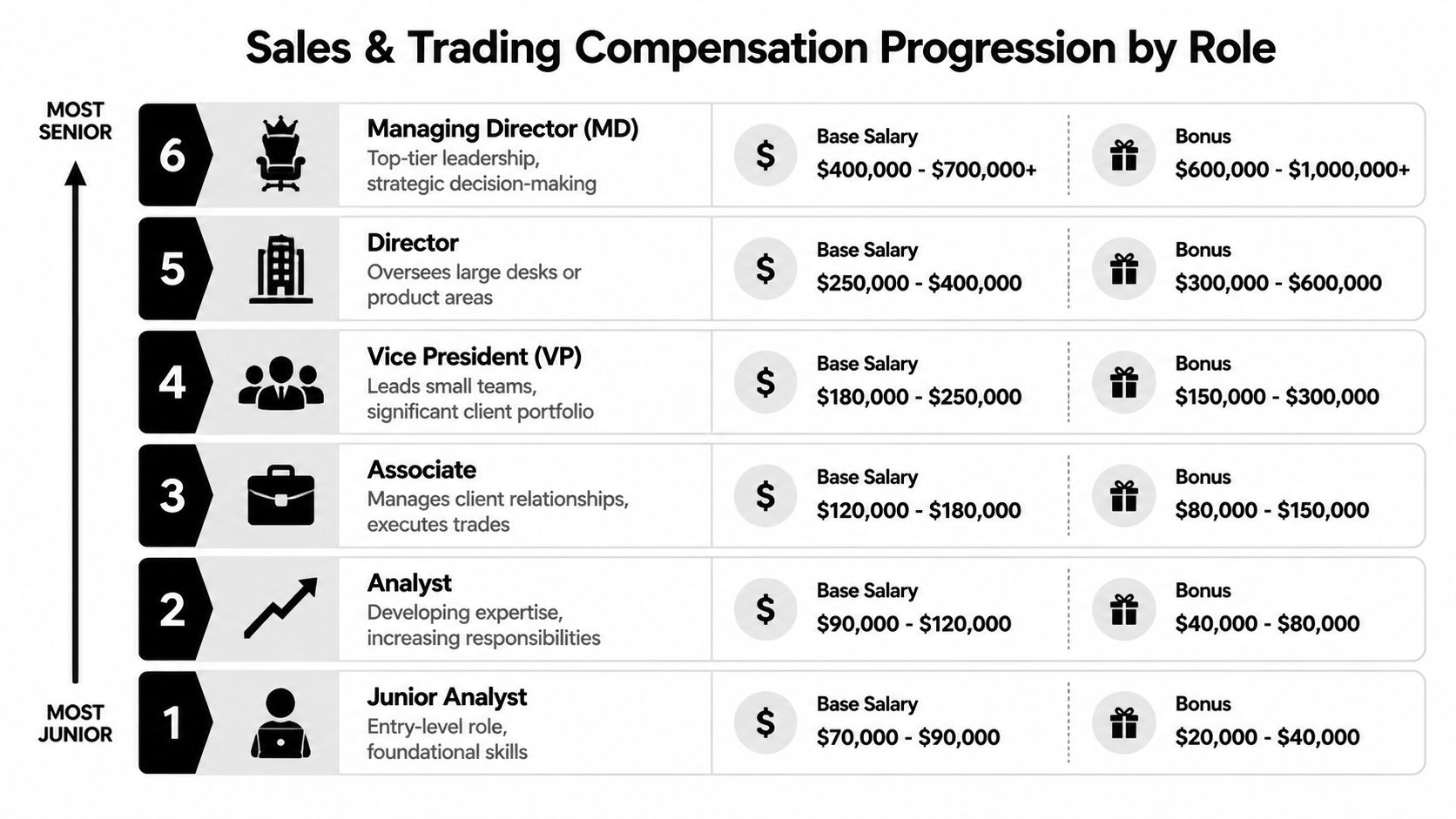
A first-year analyst on a bank trading floor can clear well into six figures all-in. By managing director, annual compensation can reach seven figures. The gap between those endpoints is not explained by tenure alone. It is explained by revenue proximity, product scarcity, and whether your skills transfer across firms, or across markets such as rates, equities, options, and now digital assets.
That distinction matters more in 2026 because pay benchmarking has become less linear. As noted earlier, junior compensation at large banks remains relatively structured. Senior compensation does not. Once you move beyond the training years, firms stop paying for potential and start paying for commercial proof.
Analyst and associate pay bands
At analyst and associate level, compensation is still the most standardized part of the ladder. As noted earlier in the article, first-year analysts at bulge bracket banks often sit around the mid-five-figure base to low-six-figure base range, with bonuses that can bring total pay comfortably above many other finance entry points. Associates move into a materially higher band, with a larger fixed salary and a bonus that starts to reflect desk performance more directly.
The practical point is not the exact number. It is what those early bands are designed to test. Firms use the analyst and associate years to identify who can process flow accurately, handle pressure, and become commercially useful fast enough to justify a more expensive seat later.
A candidate who treats those years as pure apprenticeship often gets stuck. A candidate who can show product fluency, trusted execution, and early signs of client relevance usually gets paid faster.
VP and MD economics
VP is where compensation starts to split meaningfully. As noted earlier, market guides place VP base salaries in the upper six figures or low two hundreds, with all-in outcomes that can rise sharply when the seat has direct revenue relevance. Managing directors operate in a much wider range. Base pay can be substantial, but the primary spread comes from bonus size, because firms are paying for franchise contribution, client portability, and leadership over a product or book that matters.
That creates a hiring reality candidates often miss. A VP with clean attribution on a strong desk can out-earn a more senior title sitting in a weaker product. A crypto market-making lead with direct PnL accountability can also out-earn a traditional associate or VP, even when the title looks less prestigious on paper.
Titles still matter. Seat economics matter more.
A practical benchmark table
| Role | Base salary benchmark | Bonus or total comp benchmark | Hiring read |
|---|---|---|---|
| Analyst | Structured, usually in the bank analyst range referenced earlier | Bonus meaningful, but still formulaic relative to senior ranks | Firms pay for learning speed, discipline, and technical range |
| Associate | Clear step up from analyst base | Bonus starts separating stronger desks from weaker ones | Execution quality and ownership start to matter |
| VP | Higher fixed pay, but less predictability in all-in outcomes | Total comp can vary widely by desk economics | Commercial relevance and judgment drive pay |
| MD | Senior base with broad variation by platform | Bonus dominates upside and can reach seven figures | Client franchise, leadership, and revenue portability dominate |
For crossover candidates, live hiring mandates often reveal more than title bands do. A role such as this systematic options researcher trader opening at GSR Markets shows how Web3 firms often combine research, trading, and market-making responsibilities that would sit in separate boxes at a bank. That can compress hierarchy, but it can also accelerate pay if your output is measurable.
The easiest way to underprice yourself is to benchmark against title alone. In both TradFi and crypto, compensation follows the economics of the seat.
What this means for career progression
Career progression in sales and trading is uneven by design. Compensation rises steadily at the junior end, then breaks into tiers once the market decides you are independently valuable.
Three profiles tend to move into the top half of the pay distribution:
- Professionals with client relationships another platform believes will follow
- Specialists with clear edge in a niche product, market structure, or trading style
- Operators sitting on desks management considers strategically important, including growth areas such as electronic market-making and digital assets
The non-obvious conclusion is that Web3 can either narrow or widen the gap with traditional finance depending on your role. Junior crypto hires often get less certainty and more upside-heavy packages. Senior hires who bring risk management discipline, options experience, electronic execution knowledge, or institutional client credibility can close the compensation gap quickly because those skills are still scarce on many digital asset desks.
If you are comparing paths, benchmark yourself by revenue linkage, not by business card hierarchy. That is how experienced recruiters price candidates, and it is usually how firms do it internally.
How Firm Type Dictates Your Earnings
A title tells you less about earnings than the firm's revenue model. Associate at a bulge bracket, trader at a prop shop, and execution lead at a crypto market maker can all sound comparable on paper. The pay logic behind those seats is not comparable at all.
That distinction matters because candidates often compare offers as if compensation were only a function of seniority. In practice, firm type determines three things that drive your long-term income more than title does: how much of your pay is fixed, how directly your output is measured, and how quickly the firm is willing to reprice you if you perform.
The side-by-side comparison
| Firm Type | Base Salary Range | All-In Comp Range | Key Driver |
|---|---|---|---|
| Bulge bracket bank | Structured by title and desk | More stable, with bonus tied to desk and firm results | Platform scale, client franchise, and internal pay bands |
| Proprietary trading firm | Often strong at entry level | Highest upside when performance is strong | Direct link between output and compensation |
| Boutique or specialist platform | Varies widely | Depends on product niche and business momentum | Revenue concentration and individual impact |
The useful question is not which row looks best. The useful question is which compensation system matches how you create value.
Bulge brackets reward franchise value and internal consistency
Large banks still offer the clearest pay architecture. Base salaries tend to follow established bands by title, and bonus outcomes are shaped by desk performance, division economics, and wider firm constraints. That makes pay less volatile than at a prop firm, but it also means exceptional individual performance is not always paid immediately in full.
For junior and mid-level candidates, that trade-off can be rational. Training is stronger, internal mobility is broader, and the brand still carries weight when you later move to a hedge fund, market maker, or digital asset platform. A bank seat can therefore underpay you in year one and improve your market value by year three.
That is a real economic benefit, not a soft perk.
Prop firms pay early for measurable edge
Prop shops use a different filter. They care less about platform polish and more about whether you can generate PnL, improve execution, write useful tooling, or spot inefficiencies faster than peers. As noted earlier in the article, leading firms in this category can offer junior talent unusually high bases and much larger upside than banks when performance is strong.
The catch is straightforward. Tolerance for underperformance is lower, internal politics matter less than actual output, and compensation can swing harder year to year. Candidates coming from banks often underestimate that cultural shift. A process-oriented employee who succeeds inside a layered institution does not automatically succeed in a shop where your contribution is visible every day.
Specialist firms create the widest pricing dispersion
Boutiques, niche market makers, and crypto-adjacent execution platforms are where compensation gets misread most often. Some behave like mini banks, with moderate bases and discretionary bonuses. Others behave like lean prop firms, with smaller fixed pay and a much tighter link between commercial results and upside. Two firms in the same product niche can price the same candidate very differently because one is protecting margins while the other is hiring ahead of growth.
This is also where the TradFi to Web3 compensation gap starts to narrow. Firms building digital asset liquidity, systematic DeFi strategies, or institutional OTC capabilities often pay a premium for people who bring controls, risk discipline, and market structure experience from traditional desks. They are not paying for pedigree alone. They are paying to import a process that reduces operational and market risk.
A live example is this DeFi algorithmic trader role at Wintermute. Jobs in that category often combine skills that sit in separate silos at banks: execution, automation, market microstructure, and product judgment. That skill bundle is one reason crossover candidates can sometimes close the gap with established TradFi peers faster than expected.
What experienced candidates should compare before accepting
Ask four direct questions before you compare headline numbers:
- How bonus is determined: desk pool, individual PnL, manager discretion, or formula
- What share of compensation is fixed versus variable
- How long does it take for strong performance to change your pay level
- Who owns the revenue line you are expected to influence
Those answers usually matter more than a title change or a slightly higher base.
The hiring takeaway
The highest offer is not always the best-paid path. The better choice is the firm type that prices your specific strengths correctly.
If your edge is client development, product knowledge, and execution inside a large platform, a bank may still maximize your medium-term earnings. If your edge is speed, technical judgment, risk taking, or systematic trading skill, a prop or specialist firm may pay you more accurately from day one. For professionals moving between TradFi and crypto, the best opportunities usually sit with firms that can measure your contribution clearly and are still willing to pay up for skills that remain scarce on digital asset desks.
The Crypto Desk Frontier Salaries and Structures
Crypto trading desks didn’t invent variable compensation. They imported it from market making, commodities, and high-conviction trading cultures, then added new forms of upside and new forms of ambiguity. That’s why TradFi professionals can adapt well there, but only if they know how to decode the package.

The compensation bridge is more direct than people think. The same candidate who understands spread capture, inventory risk, client flow, and execution quality on a bank desk often has relevant value on a crypto market-making desk, OTC platform, or digital asset liquidity team. What changes is how that value gets paid and how much uncertainty sits inside the upside.
The most useful benchmark for crossover candidates
The clearest crossover data point comes from Europe. A mid-level trader in Europe earns a €90,000 to €140,000 base, while variable pay can be 2x to 3x higher. The same source notes that blockchain finance professionals can target US and EU hybrid roles at firms like Galaxy Digital and negotiate for over 50% variable compensation tied to DeFi liquidity provision KPIs, pushing total compensation well over $250,000, according to 6figr.
That matters because it mirrors how many crypto desks think. They may not pay like a classic bulge bracket. But they do understand paying aggressively for measurable trading contribution, liquidity outcomes, and scarce market intuition.
What to watch in a crypto package
Crypto compensation often combines familiar and unfamiliar components:
- Cash base: This is your stability layer. In a volatile business, it matters more than founders sometimes admit.
- Variable bonus: This may be linked to desk P&L, flow quality, market share proxies, or liquidity KPIs.
- Token or equity exposure: Upside stories live here. It’s also where candidates get distracted.
A token package can be attractive. It can also mask a weak cash offer. If the token piece is meaningful, ask how it vests, what liquidity exists, and whether your upside depends on a business milestone you don’t control.
For candidates exploring direct desk moves, a posting like this senior sales trader role at Kraken is the kind of mandate worth dissecting closely. In Web3, titles often sound familiar while the commercial model behind them is quite different.
How TradFi candidates should pitch themselves
Crypto firms don’t need you to sound crypto-native on day one. They need you to show that your skills transfer.
Focus your story around:
- Market structure understanding
- Client handling under pressure
- Risk judgment in fragmented liquidity
- Execution discipline when price discovery is messy
That lands better than generic enthusiasm for digital assets.
A short explainer can help frame how these desks think about opportunity and market structure:
Crypto firms often hire TradFi talent for one reason: they trust people who’ve already been paid to make decisions in live markets.
The hidden compensation gap
The gap between TradFi and Web3 isn’t always cash. It’s governance. Bank compensation may feel bureaucratic, but candidates usually understand who decides what. In crypto, the upside can look richer while the rules are less settled.
That’s why the best crossover hires negotiate more than headline pay. They negotiate definitions, triggers, vesting, and what counts as success.
Actionable Career and Negotiation Strategy
Good candidates prepare for interviews. Strong candidates prepare for compensation conversations before the interview starts. In sales and trading, that difference shows up quickly because hiring managers are listening for whether you understand how desks make money and where you fit inside that machine.

What to say in interviews
Don’t pitch yourself as “hard-working” or “passionate about markets.” Everyone says that. Instead, explain your value in language a desk head respects.
Try framing your experience around:
- Revenue relevance: Which clients, flows, or trading situations did you influence?
- Decision quality: What did you have authority over, and how did you exercise it?
- Product specificity: Why are you stronger in rates, credit, options, OTC, or market making than a generic candidate?
- Transferability: If you’re moving into crypto, what part of your TradFi experience maps directly to fragmented liquidity or electronic execution?
That last point matters. A good crossover narrative isn’t “I want to be in Web3.” It’s “I’ve already done work that your desk needs.”
What you can negotiate
In most markets, candidates underestimate where flexibility exists. Base salary can move. Sign-on can move. Guaranteed first-year bonus treatment can move. Deferred structures can sometimes move. Scope can move too, and scope often matters as much as cash because it determines how quickly you can prove your value.
When I coach candidates, I tell them to negotiate in this order:
Role clarity
If the seat is vague, the compensation promise is weaker than it looks.Base and guaranteed elements
Secure the part of the package least exposed to politics or market swings.Variable formula
Ask how upside is earned, not just how high it can go.Review timing
An earlier review cycle can be worth real money if you expect to outperform quickly.
Hiring advice: Negotiate with evidence, not emotion. A manager will respond better to comparable roles, product fit, and desk economics than to personal need.
Red flags in offer letters
You don’t need a bad offer to turn down a role. You need enough doubt about how the firm will behave once you’re inside.
Watch for these warning signs:
- Undefined bonus language: If every answer on bonus is soft, assume downside protection is weak.
- Inflated title, thin mandate: A bigger title with limited ownership can hurt future mobility.
- Equity or token-heavy upside with little clarity: If you can’t model when or how it becomes real, treat it cautiously.
- Manager mismatch: If the direct manager talks culture but not economics, you may be reporting into someone who doesn’t allocate rewards cleanly.
Candidates also benefit from sharpening the mental side of the process. This piece on mindset for career success is useful because the strongest negotiations usually come from candidates who think clearly under uncertainty, not from those who push hardest.
The recruiter’s bottom line
Your influence is strongest when the firm believes three things at once. You can do the job. You understand the business. You have alternatives.
That’s the posture to build before you negotiate.
Frequently Asked Questions About S&T Pay
Do bonuses matter more than base salary in sales and trading
At junior levels, candidates often focus on base because it’s visible and guaranteed. Over time, bonus matters more because firms use it to distinguish between acceptable performance and real impact. In a healthy market, the gap between two professionals with the same title can come less from salary and more from variable pay.
How should I evaluate stock, deferred comp, or token-based pay
Treat each as a separate risk bucket. Cash is cash. Deferred compensation depends on vesting and retention. Equity and token-linked upside may have value, but only if you understand liquidity, timing, and what events make that value realizable. If the firm can’t explain those mechanics clearly, discount the headline figure.
Do sales and trading salaries differ by location
Yes, often materially. New York, Chicago, and major European hubs don’t compensate in identical ways because market structure, firm mix, and desk economics differ. The safest approach is to benchmark against the specific product, title, and region rather than relying on one generic market number.
When are bonuses usually paid
Timing varies by firm and structure. The important question isn’t just when bonus is paid, but whether any piece is deferred and what happens if you resign before vesting. Candidates often ask about amount and forget to ask about timing and conditions.
Is a move from TradFi to crypto worth it financially
It can be, but only if you compare the package correctly. A richer upside story doesn’t automatically beat a stronger cash offer with a clearer review process. The right move depends on your risk tolerance, your confidence in the platform, and whether the role expands your earning power.
If you’re comparing desks, testing a move into digital assets, or looking for your next front-office role, Blockchain Jobs is a practical place to track live openings across Web3 finance and trading. The best time to benchmark your market value is before you need to make a decision.