Senior Portfolio Manager Salaries: A 2026 Guide

You’re probably at one of two points in your career.
Either you’ve already moved past analyst and associate work, you’re managing real money, and you want to know whether your compensation is keeping pace with the market. Or you’re close to the senior portfolio manager level and trying to decide whether the next jump should be inside traditional finance or into digital assets, DeFi, and Web3.
That’s the right question to ask.
Senior portfolio manager salaries sit at the intersection of judgment, accountability, and revenue impact. Firms don’t pay for market commentary. They pay for asset allocation discipline, downside protection, communication with investment committees, and the ability to stay calm when a portfolio is under pressure. The title carries prestige, but hiring managers care less about prestige than proof. They want someone who can explain positioning, defend risk decisions, and make clients or internal stakeholders trust the process.
The good news is that this role still commands serious compensation. The better news is that the same skills can transfer well into newer parts of finance, especially where digital asset firms need adults in the room who understand portfolio construction, governance, and disciplined risk frameworks.
Your Path to a Top-Tier Finance Career
A lot of mid-career professionals arrive here after a strong but uneven run.
They’ve done the hard parts. They’ve built sector knowledge, sat through investment committee meetings, handled difficult quarters, and learned that performance alone doesn’t automatically translate into top compensation. Then a recruiter calls about a “senior” role, the job description looks familiar, and the first question becomes obvious. What should this role pay?

That question matters because a senior portfolio manager role isn’t just a pay bump. It’s often the point where your market value starts reflecting more than technical competence. Employers start pricing in leadership, investor-facing communication, asset allocation judgment, and your ability to make good decisions when the information is incomplete.
What employers reward
When I recruit for senior investment roles, I see candidates make the same mistake repeatedly. They talk like researchers when they need to talk like owners.
A hiring team usually wants evidence in four areas:
- Decision quality: Can you explain not only what you bought or sold, but why the decision fit the mandate?
- Risk discipline: Can you discuss drawdowns, concentration limits, liquidity constraints, and scenario planning without sounding rehearsed?
- Stakeholder trust: Can you defend a position to a CIO, client, board, or founder who doesn’t think like a PM?
- Team contribution: Can you guide analysts, sharpen research standards, and improve portfolio process?
That’s why senior portfolio manager salaries vary so widely. Two candidates may both have years in the seat, but one has true investment ownership while the other has mostly supported somebody else’s process.
The pivot many professionals are considering
There’s another layer now. Traditional firms still value these skills, but crypto-native and Web3 firms increasingly need them too. The most compelling candidates aren’t abandoning core finance skills. They’re translating them.
Someone who understands liquidity, mandate discipline, position sizing, governance, and risk reporting can become highly relevant in a digital asset environment. The labels change. The underlying work often doesn’t.
The professionals who earn the most in transition markets are usually the ones who can explain old skills in new language without pretending they invented the future.
If you’re assessing your next move, it helps to watch both markets at once. Traditional compensation gives you a baseline. Web3 tells you where adjacent upside may sit. If you want a broader view of how finance and crypto careers are evolving, the market commentary on the Blockchain Jobs blog is a useful place to track role trends and hiring language.
Senior Portfolio Manager Salary Benchmarks for 2026
Let’s start with the hard market baseline.
According to PayScale’s Senior Portfolio Manager salary data, the average base salary for a Senior Portfolio Manager in the United States is $145,572 in 2026, with total compensation ranging from $101,000 to $275,000. The same source notes that Indeed reports an average base of $119,310 in California, with Sunnyvale reaching $211,405, and that Zippia tracks a 25% rise from $92,485 in 2014 to $115,805 today.
Those numbers matter, but they don’t answer the question candidates usually ask me in private. Am I underpaid for the kind of portfolio work I do?
What the headline number hides
The market average is useful for orientation. It’s not enough for negotiation.
A senior portfolio manager at a stable institution with a narrow mandate may sit near the middle of the range. Another PM with complex cross-asset coverage, heavier stakeholder exposure, or a more technical investment environment may push toward the upper end. Compensation also changes based on how the firm values variable pay, title inflation, and strategic fit.
Here’s a practical benchmark view using only the verified data available.
| Segment | Average Low End | Average High End | Top 10% Potential |
|---|---|---|---|
| U.S. total compensation range | $101,000 | $275,000 | Qualitatively at the top of range |
| U.S. average base salary | $145,572 | Qualitatively above average with bonuses and profit sharing | Significantly higher base pay for top performers |
| California average base | $119,310 | Sunnyvale at $211,405 | Qualitatively strongest in premium local markets |
| 6figr verified top earners | Qualitatively above market average | $255,000 total compensation | Top 10% over $220,000 |
How I’d interpret these numbers as a recruiter
If your current package is centered on base pay and light bonus upside, compare yourself carefully against the total compensation range, not just the average salary number.
If you’re interviewing for a role with broad portfolio discretion, direct accountability, and exposure to a higher-volatility strategy set, a middling base can still be attractive if the incentive structure is real. The reverse is also true. A shiny base with weak bonus mechanics can leave you disappointed by year-end.
Practical rule: Benchmark the role you perform, not the title on your business card.
Candidates often benefit from checking multiple frameworks instead of relying on one salary report. If you want a broader methodology for comparing title, level, and compensation design across roles, these salary benchmarking tools give a useful overview of how employers and candidates structure market comparisons.
Geographic and market nuance
The California figures are a reminder that local market data can look strange in isolation.
People assume the highest-cost market always pays the cleanest premium. It doesn’t. Sometimes niche firms, small sample sizes, bonus design, or title differences distort the visible base salary picture. That’s why I tell candidates not to negotiate from one city datapoint alone.
Use three filters instead:
- Mandate complexity: A senior title managing a straightforward book isn’t equivalent to one overseeing a more complex strategy mix.
- Incentive depth: Base salary tells you very little if true value sits in bonus, stock, or other long-term upside.
- Replacement difficulty: Firms pay more when your skill combination is hard to find, especially if they need judgment plus communication plus sector fluency.
The longer view matters
The decade-long rise in salary levels is a good signal, but the bigger takeaway for a mid-career professional is that this is still a role that firms reward when responsibility expands.
That should shape how you job search.
Don’t ask only, “What does this title pay?” Ask, “What business problem am I solving that another candidate can’t solve as quickly?” The strongest offers usually follow that answer.
Anatomy of Your Total Compensation Package
Base salary gets attention because it’s easy to compare. It’s also the least interesting part of many senior offers.
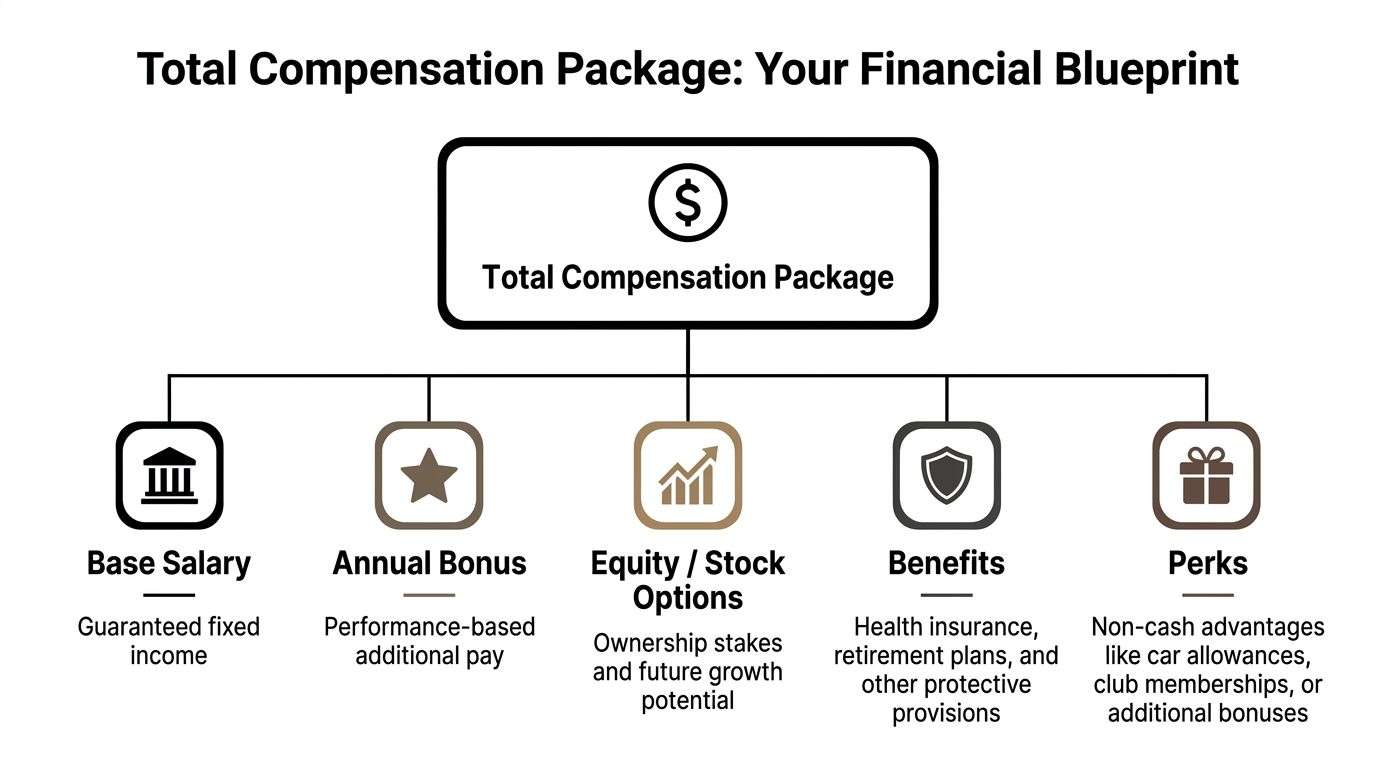
True wealth-building difference often comes from how the package is layered. Think of base pay as the foundation of a building. It matters. But the upper floors, the ones that change your long-term earnings, usually sit in bonus, stock, deferred upside, and the less glamorous terms hidden in the offer language.
Base is the anchor, not the finish line
A strong base gives you stability. It protects you from bad bonus years, strategy resets, and leadership changes that have nothing to do with your work.
But if you negotiate only the base, you may miss where top packages separate themselves. According to 6figr’s Senior Portfolio Manager compensation data, top earners reach $255,000, including a verified example with $172,000 base, $49,000 in stocks, and a $34,000 bonus. The same source reports males averaging $178,000 total compensation while females average $120,000, and notes that 46% of high earners hold Graduate degrees.
That single breakdown tells you more than a salary average ever will. Variable pay matters. Equity matters. Structure matters.
The five parts I want candidates to review
Base salary
This is your fixed cash compensation. It should reflect scope, not just tenure. If the firm wants broad portfolio responsibility but pegs your base to a narrower benchmark, that’s a warning sign.Annual bonus
Ask how it’s determined. Is it discretionary? Formula-driven? Tied to team results, fund results, or your own book? Bonus language that sounds flexible can sometimes mean opaque.Equity or stock
In public companies and many growth-stage firms, stock can become the piece that meaningfully widens your upside. The value depends on vesting, liquidity, and whether the company’s trajectory is believable.Benefits
Senior candidates sometimes dismiss benefits because they’re focused on headline cash. That’s shortsighted. Retirement support, healthcare quality, and executive-level protection benefits can change the actual value of the package.Perks and professional advantage
This category sounds minor. It isn’t. A title adjustment, investment committee visibility, conference budget, or direct report structure can improve your next comp cycle more than a small bump today.
What works in negotiation
The candidates who negotiate best don’t ask for “more.” They ask for alignment.
They say things like:
- “If the role includes direct portfolio accountability, I’d want the bonus structure to reflect that responsibility.”
- “I’m less focused on one compensation line than on how the package rewards performance over time.”
- “For a senior seat, I’d want to understand how the firm rewards portfolio judgment, not only title level.”
That language works because it signals maturity. You sound like someone evaluating a business relationship, not someone bidding for a title.
If a firm won’t explain how bonus decisions are made, assume the process may disappoint you later.
What usually doesn’t work
I’ve watched strong candidates weaken their position by focusing on the wrong things.
Avoid these traps:
- Fixating on one number: Employers notice when you care only about base.
- Negotiating too early: Wait until the firm has committed to you.
- Ignoring package mechanics: Stock without context can be meaningless.
- Accepting vague promises: “We usually take care of top performers” isn’t a compensation term.
The gender disparity in the verified data is also a reminder that compensation isn’t always allocated fairly by default. That’s why clear benchmarking, direct questions, and written terms matter.
If you’re a mid-career professional, don’t leave the package design to assumption. Read every line as if it will directly affect your next three years, because it probably will.
Key Factors That Influence Your Earning Potential
Compensation follows a pattern. Not a perfect one, but a reliable one.
Firms pay more when your value is legible. That means they can see where you’ve made money, reduced risk, improved process, or expanded the investable universe. Plenty of capable professionals stay underpaid because they’re good at the work but bad at framing the work.
What hiring managers reward
The first factor is relevance of experience.
Not all years count equally. A candidate who spent years close to decision-making, mandate design, and investment communication usually carries more weight than someone with a longer résumé built around support functions. Depth beats length when a hiring committee is deciding whether to trust you with more authority.
The second is complexity.
If you’ve managed a more demanding mandate, worked across asset classes, handled illiquid positions, or managed portfolios with sharper risk trade-offs, your profile tends to price higher. Complexity raises the stakes for judgment. Judgment is what firms pay for at senior level.
Specialization creates advantage
Generalists can do well. Specialists often negotiate better.
A PM who understands a niche sector, regulatory overlay, or fast-moving part of the market is easier to justify at a premium. In practice, that could mean technology-heavy investing, digital assets, structured products, or an area where investment process and compliance interact closely.
Here’s where I see candidates widen their earning potential:
- Credible sector ownership: You’re known for a space, not just “coverage.”
- Clear risk language: You can explain concentration, liquidity, and downside scenarios in plain English.
- Cross-functional trust: Legal, compliance, product, and investment teams all want to work with you.
- Interview fluency: You don’t bury your value under technical jargon.
Qualifications help, but only when paired with evidence
Credentials still matter. They help establish seriousness, discipline, and domain fluency.
But credentials without a strong value story won’t move compensation much. Employers rarely pay a premium because a candidate lists degrees or designations. They pay when the qualification reinforces performance, credibility, or strategic usefulness.
The best credential in any senior interview is a well-explained track record.
That also applies to professionals aiming at Web3. Hiring teams there often appreciate traditional qualifications, but they’ll still ask whether you can adapt. Can you learn quickly? Can you judge protocol risk? Can you communicate uncertainty without sounding lost?
The strongest earnings profiles usually share these traits
| Trait | Why it matters |
|---|---|
| Portfolio accountability | Firms pay more when your decisions directly shape outcomes |
| Strong communication | Senior hires must explain strategy to non-specialists |
| Process leadership | Teams value PMs who improve research and decision quality |
| Adaptability | High-growth markets reward people who can transfer skills across changing environments |
A final point from the recruiter side. Compensation often rises fastest when your profile is easiest to compare against revenue or strategic impact. If you want to maximize earnings, build a career story that makes that connection obvious.
The New Frontier Crypto and Web3 Portfolio Management
A lot of traditional finance professionals still think Web3 portfolio roles are too chaotic, too speculative, or too far removed from “real” portfolio management.
That view is outdated.
The best digital asset firms don’t need less discipline. They need more. They operate in markets that trade continuously, react quickly to liquidity shifts, and expose managers to protocol, custody, governance, and operational risk that doesn’t show up in a standard equity mandate. That raises the bar for anyone making capital allocation decisions.

Why traditional PM skills transfer well
If you already know how to think in terms of exposure, liquidity, mandate drift, and downside control, you’re not starting from zero.
What changes is the toolkit and the risk map.
You may need to get comfortable with:
- On-chain analytics: Reading wallet activity, flows, token distribution, and protocol usage signals.
- Smart contract risk: Understanding that code, audits, governance, and upgradeability can affect portfolio construction.
- Market structure differences: Crypto trades around the clock, and liquidity conditions can shift fast.
- Tax and reporting complexity: Digital asset activity can create accounting and tax wrinkles that traditional managers haven’t dealt with before.
If you’re entering this space, operational fluency matters almost as much as investment judgment. For professionals who need to understand the reporting side, this guide on how to calculate crypto taxes is a practical starting point because tax treatment can quickly become part of the hiring conversation for portfolio and trading roles.
The compensation upside is real
The pay signal in technical and blockchain-adjacent portfolio work is meaningful.
According to 6figr’s technical portfolio manager data, technical portfolio management roles in blockchain infrastructure average $166,000 to $168,000, while IT-specialized senior roles can reach $163,537 nationally and peak at $322,885 in San Francisco. The same source states that hybrid skills in on-chain analytics and regulatory compliance can result in top-decile pay exceeding $252,000.
Those numbers line up with what I see in hiring. The candidates who stand out aren’t the loudest crypto enthusiasts. They’re the ones who can blend institutional habits with digital asset adaptability.
What firms want in a crossover candidate
Many transitions fail because candidates either present as too traditional or too performatively crypto-native.
The stronger approach is balanced:
- You still speak the language of mandates, attribution, and risk.
- You can discuss protocol design, market plumbing, and operational controls without sounding like you learned it last week.
- You understand that compliance and portfolio construction now interact more closely than many candidates expect.
Web3 firms will forgive a learning curve. They won’t forgive weak judgment.
If you’re trying to visualize the kinds of opportunities where this crossover works, reviewing active role formats can help. A posting such as this Web3 trader role shows how firms increasingly combine execution, market awareness, and crypto-native operational skill in one hiring profile.
For many mid-career professionals, this is a key opportunity. You don’t have to start over. You have to translate well.
Actionable Strategies for Salary Negotiation and Career Growth
Most candidates prepare too hard for the technical interview and not hard enough for the compensation discussion.
That’s backward.
By the time a firm is talking package, your investment judgment is already under consideration. The negotiation stage is where you prove you understand your market value, the role’s economics, and the difference between attractive compensation and attractive wording.
Start with a value file
Before any interview loop reaches the offer stage, build a short internal document for yourself.
Include:
- Mandates you’ve influenced
- Risk decisions you made or shaped
- Moments where your judgment protected capital or improved process
- Examples of communicating portfolio decisions to senior stakeholders
- Any specialist angle that makes you harder to replace
Don’t turn this into a boastful script. Use it to sharpen your message.
A lot of professionals say, “I helped manage the portfolio.” That’s weak. A stronger version is, “I led allocation reviews across a changing risk environment, tightened decision discipline, and became the point person for explaining positioning to stakeholders.” Same candidate. Better framing.
Use interview language that supports senior pay
In senior searches, tone matters nearly as much as content.
These phrases tend to land well:
- “I’m most effective when the role gives clear ownership and a compensation structure that reflects that accountability.”
- “I look at total package design, especially how incentives align with long-term performance.”
- “For a senior seat, I’d want to understand how the firm rewards portfolio judgment, not only title level.”
What doesn’t land well is defensive salary talk, inflated self-comparisons, or making the process adversarial too early.
Negotiate the package in layers
Don’t ask one broad question like, “Can you do better?”
Break the offer into parts and evaluate each separately.
| Package element | Good question to ask |
|---|---|
| Base salary | How was this number benchmarked against comparable internal and external roles? |
| Bonus | What drives the payout decision, and how transparent is the process? |
| Equity or stock | What are the vesting terms, and how do refresh grants work for strong performers? |
| Scope | What authority comes with the role, and what would expand over time? |
| Title and trajectory | What would put someone on path for the next level here? |
That structure changes the conversation. You’re no longer haggling. You’re evaluating the business logic of the offer.
Career moves that usually increase earnings
The highest-earning professionals are rarely passive about progression.
They tend to make one or more of these moves:
- They move closer to decision rights: Supporting investment work is valuable. Owning decisions prices higher.
- They improve narrative clarity: They can explain exactly what they do, why it matters, and how it affects outcomes.
- They build adjacent fluency: In today’s market, that might mean digital assets, governance, regulatory overlap, or technical market structure.
- They leave when scope stalls: If the title grows but authority doesn’t, compensation often plateaus too.
Hiring reality: Firms pay up fastest when they believe another employer would understand your value immediately.
What to do after a strong year
Many PMs underuse their best advantageous moment, which is right after they’ve had a visible contribution period.
That’s when to ask for one of three things:
- A compensation review tied to expanded responsibility
- A title recalibration that matches the work already being done
- A restructured incentive package that rewards long-term contribution
Don’t wait until frustration builds. Bring the conversation while your value is recent, specific, and easy for leadership to defend internally.
If you’re targeting a move into Web3, the same rule applies. Interview with a clear portfolio story, a practical understanding of digital asset risk, and a package mindset that goes beyond base salary. That’s how senior candidates separate themselves.
Finding Your Next Senior Portfolio Manager Role on Blockchain Jobs
A smart search beats a broad search.
If you want senior portfolio manager salaries to improve, you need to apply where your background is legible and valuable. In Web3, that usually means finding roles where finance discipline is clearly part of the mandate, not an afterthought buried under hype.
How to search effectively
Start with category relevance.
The best first filter for finance-oriented candidates is the Finance & Accounting jobs section. That keeps you close to roles where portfolio thinking, treasury judgment, reporting, and capital allocation already matter.
Then narrow by keywords that match how crypto firms write jobs, not how traditional firms write them.
Useful searches include:
- Portfolio
- Treasury
- Trader
- Research
- Risk
- DeFi
- Digital assets
Remote filters matter too. Many firms in this market are open to distributed hiring, which can widen the opportunity set for candidates outside legacy finance hubs.
What good role translation looks like
A traditional senior portfolio manager won’t always apply to a role with the same title. That’s normal.
The best-fit roles may look more like:
| Role style | Why it may fit a senior PM |
|---|---|
| DeFi portfolio manager | Strong match for allocation, liquidity, and risk oversight skills |
| Senior crypto research analyst | Good bridge role for candidates with deep market judgment and communication strength |
| Treasury or digital asset strategy lead | Strong fit for professionals with portfolio discipline and governance experience |
Read the responsibilities more carefully than the title.
If the role includes position management, strategy review, market risk thinking, counterparty awareness, or communication with leadership, your background may be more relevant than the job title suggests.
How to evaluate a Web3 opportunity before applying
Use a practical screen.
Ask yourself:
- Does this role require judgment, not just activity?
- Will I be accountable for outcomes or producing research?
- Is the firm clear about risk, governance, and operating standards?
- Can I explain my traditional finance background as an advantage here?
That last point is critical. You’re not trying to hide your TradFi experience. You’re converting it into something useful for a newer market that still needs rigor.
The strongest candidates usually tailor their résumé and interview language in two directions at once. They keep the credibility of traditional finance while making it obvious they understand digital asset market structure, portfolio operations, and the pace of crypto-native environments.
If you’re ready to test your market value in traditional finance or make the jump into digital assets, Blockchain Jobs is one of the best places to find focused Web3 opportunities without wading through generic job boards. Search roles by category, scan remote-friendly openings, and look for finance, trading, research, and treasury positions where senior portfolio management skills translate directly into higher-impact work.