
Social Media Specialist Salaries: Your 2026 Pay Guide

A Social Media Specialist in San Francisco averages $98,034, while the same title in Atlanta averages $53,166 according to Coursera's salary breakdown. That gap should change how you think about pay immediately. Job title alone doesn't determine compensation. Market, industry, and specialization do.
Individuals often approach social media specialist salaries the wrong way. They ask, “What does this role pay?” The better question is, “What does this version of the role pay, in this market, with this skill set, under this compensation model?” That's how recruiters evaluate candidates, and it's how you should benchmark yourself before interviews, promotions, or a move into Web3.
What to Expect from Social Media Specialist Salaries in 2026
Online salary ranges confuse people because the title covers very different jobs. One company wants a scheduler and copywriter. Another wants a channel strategist who can own reporting, paid amplification, creator partnerships, and executive visibility. A Web3 startup may use the same title for someone who's doing community growth, token campaign coordination, and launch communications.
That's why broad averages only help at the starting line. If you stop there, you'll either underprice yourself or target jobs that were never going to pay what you want.
Why salary data feels inconsistent
Compensation shifts based on four things that show up in hiring conversations every day:
- Experience depth: Recruiters care less about years in isolation and more about what you've owned, launched, fixed, and measured.
- Business context: Regulated industries, technical products, and revenue-linked channels usually pay better than generalist brand posting roles.
- Location and work model: High-cost cities and certain remote-first roles can reset your benchmark fast.
- Role translation: In Web3, “social media specialist” often overlaps with community manager, growth marketer, or content lead.
If you're interviewing, treat salary research the same way you'd treat audience research. Segment it. Compare like with like. Build your case with evidence.
Don't negotiate from a title. Negotiate from scope, proof of impact, and market fit.
One more practical point. Social media pay increasingly ties to adjacent work, especially creator campaigns and partnership execution. If your role touches influencer sourcing, rate negotiation, whitelisting, usage rights, or deliverable management, you're more valuable than a basic content operator. That's why it helps to understand adjacent commercial skills such as these tactics for influencer deals, even if your title never includes “creator marketing.”
Breaking Down the National Salary Benchmarks
Start with a hard number. According to Payscale's 2026 salary data for Social Media Specialists, the average base salary in the United States is $54,967. That is your baseline, not your target.
The same dataset puts total compensation at $43,971 for professionals with less than one year of experience, $53,329 for specialists with 1 to 4 years, and $72,955 for professionals with 15+ years. Those figures are useful because they show how the market values proven ownership over time. They also expose a problem. Plenty of candidates spend years in the role without adding the kind of scope that moves pay.
Social Media Specialist Salary by Experience Level (2026)
| Experience Level | Average Total Compensation |
|---|---|
| Less than 1 year | $43,971 |
| 1 to 4 years | $53,329 |
| 15+ years | $72,955 |
Here's how I'd use this data in a job search.
If you have under two years of experience, treat the lower end of the benchmark as a check on what the market usually pays for execution-heavy work. If you have several years in role and your salary still sits near the early-career band, you likely have a scope problem, a title problem, or both.
That matters even more if you want to move into blockchain or crypto hiring. Web3 companies often use familiar titles for work that includes community growth, creator partnerships, token campaign support, content strategy, and real-time reputation management. Compare your current role against live Web3 marketing jobs for social and growth talent, not just traditional specialist titles, if you want a realistic view of upside.
What the benchmark means in interviews
Recruiters do not pay for posting volume. They pay for judgment, ownership, and business impact.
A candidate who scheduled posts, wrote captions, and sent basic monthly reports should not anchor to the national average as if it applies automatically. A candidate who owned campaign planning, executive social, creator coordination, cross-functional launches, or performance reporting tied to pipeline or revenue should push above that baseline, even if their title stayed flat.
Use this standard in interviews:
- Anchor with national data, then adjust for role scope. Salary benchmarks open the conversation. Your responsibilities determine where you belong inside or above the range.
- Describe decisions, not chores. “Managed Instagram” sounds junior. “Owned channel strategy, reporting, and campaign coordination” sounds like someone trusted to make calls.
- Translate title inflation carefully. In Web2, “specialist” often means channel execution. In Web3, the same title can cover growth, community, partnerships, and crisis response. Benchmark the work, not the label.
Practical rule: Average salary data reflects the market for the title. Strong offers reflect the value of the problems you can solve.
Where candidates lose money
Candidates undersell themselves when they list activity instead of authority. Hiring managers do not increase an offer because you published more content. They increase an offer when you can explain why a campaign worked, how you adjusted strategy, what stakeholders you managed, and which metrics changed because of your decisions.
That gap is where salary compression happens in traditional marketing roles. It is also where strong candidates create a Web3 premium. If you can prove you handle audience growth, fast-moving narratives, creator relationships, and performance accountability, you should benchmark yourself above a standard social media specialist range.
Key Factors That Influence Your Pay
Your salary is shaped less by your title and more by the market you sell your skills into. Two social media specialists can do similar work and still end up on very different pay tracks because geography, industry, and employer maturity change how companies value the role.
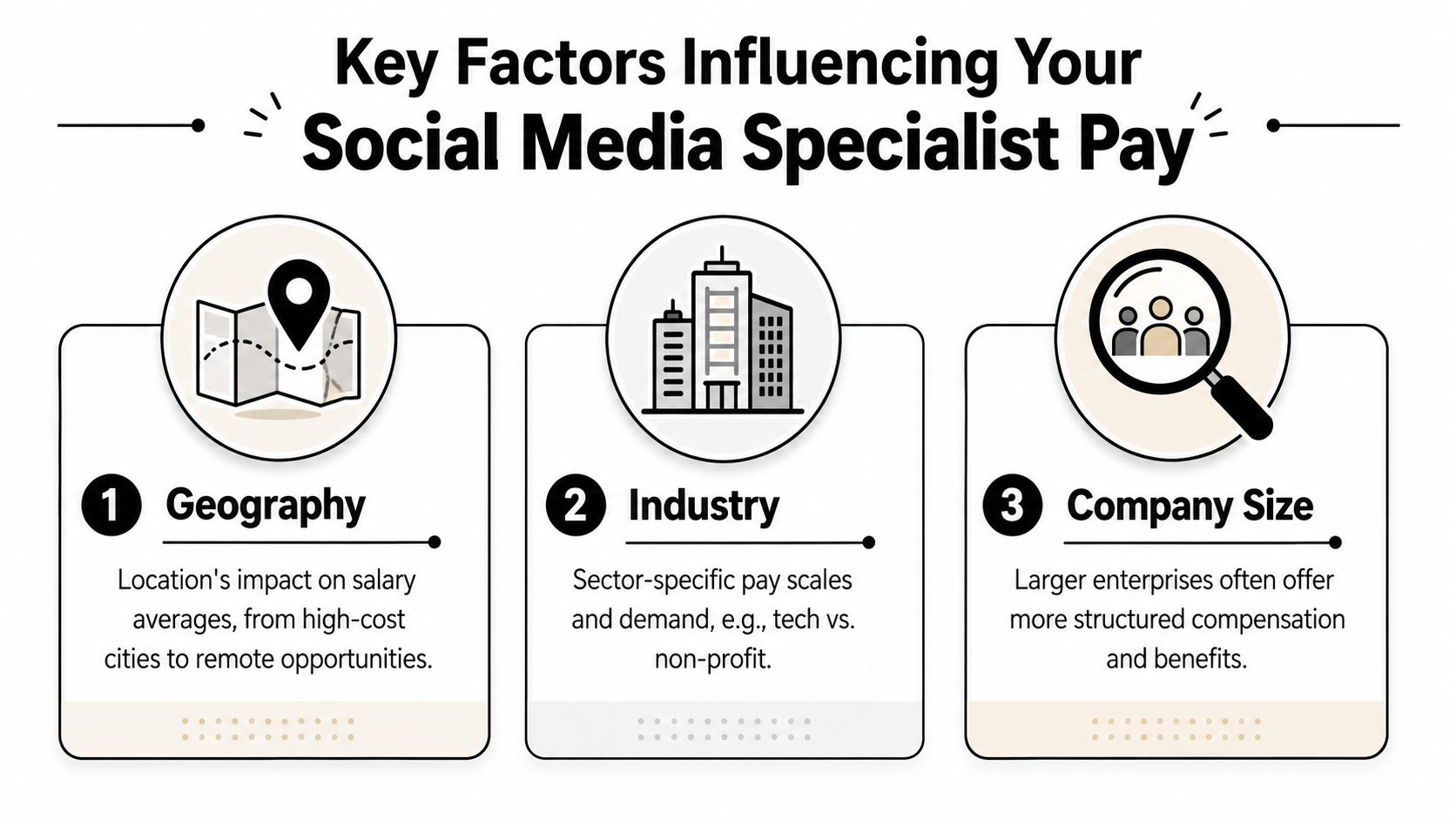
Geography changes your ceiling
Location still affects compensation, even for remote jobs. As noted earlier, the Coursera data shows a wide gap between top-paying cities and lower-paying ones.
Use that fact strategically. If you live in a lower-cost market, target remote employers that hire against national or major-metro benchmarks. If you focus only on local companies, you are often accepting a smaller salary band before the interview even starts.
This matters even more in Web3. Many blockchain companies hire globally, but the strongest offers still cluster around firms competing for talent in expensive tech hubs. If a Web3 employer expects you to cover social, community sentiment, launch support, and real-time narrative management, do not benchmark yourself against a small local brand hiring someone to schedule posts.
Industry sets the price of mistakes
Industry changes pay because it changes business risk. As mentioned earlier, the Coursera benchmarks show higher pay in sectors such as pharma and biotech than in lower-paying categories like telecommunications.
That pattern is logical. Regulated, technical, or reputation-sensitive industries pay more because weak messaging creates legal, brand, or revenue problems. If you can work with compliance reviews, product nuance, executive visibility, and crisis-sensitive content, your market value rises fast.
Web3 fits this same pattern, just with a different type of risk. Token launches, exchange listings, protocol incidents, governance disputes, and community backlash all raise the cost of getting social wrong. That is why strong Web3 social candidates often out-earn traditional specialists with similar years of experience.
Here's the useful rule. The harder your content is to approve, defend, and adapt under pressure, the higher your pay should be.
Company maturity decides whether social is treated as revenue work or admin work
A mature employer usually pays better because it understands what the role does. Companies with a real marketing structure define ownership, connect social performance to business goals, and budget for specialized talent. Less mature employers blur the role, pile on unrelated work, and underpay because they still see social as execution support.
Check for these signals in interviews:
- Clear reporting lines: Reporting into a marketing leader usually means compensation bands and promotion paths exist.
- Defined channel strategy: Employers who know why each platform matters are more likely to pay for judgment, not just output.
- Cross-functional exposure: Roles tied to product, brand, legal, partnerships, or leadership carry more internal weight.
- Real performance expectations: If they ask about pipeline influence, launches, retention, or community health, they see social as a business function.
If an employer describes the job as “just posting,” price the role accordingly and move on.
The best-paid social media specialists do not rely on title progression alone. They switch to stronger markets, target higher-stakes industries, and choose companies that treat social as a growth function. In Web3, that difference is even sharper because compensation often reflects speed, complexity, and public scrutiny, not just content volume.
Decoding Your Total Compensation Package
Base salary matters. It just isn't the whole offer.
A lot of candidates make a bad decision because they compare one base number to another and stop there. That's sloppy. You need to assess total compensation, especially when you're talking to startups, tech companies, or Web3 employers.
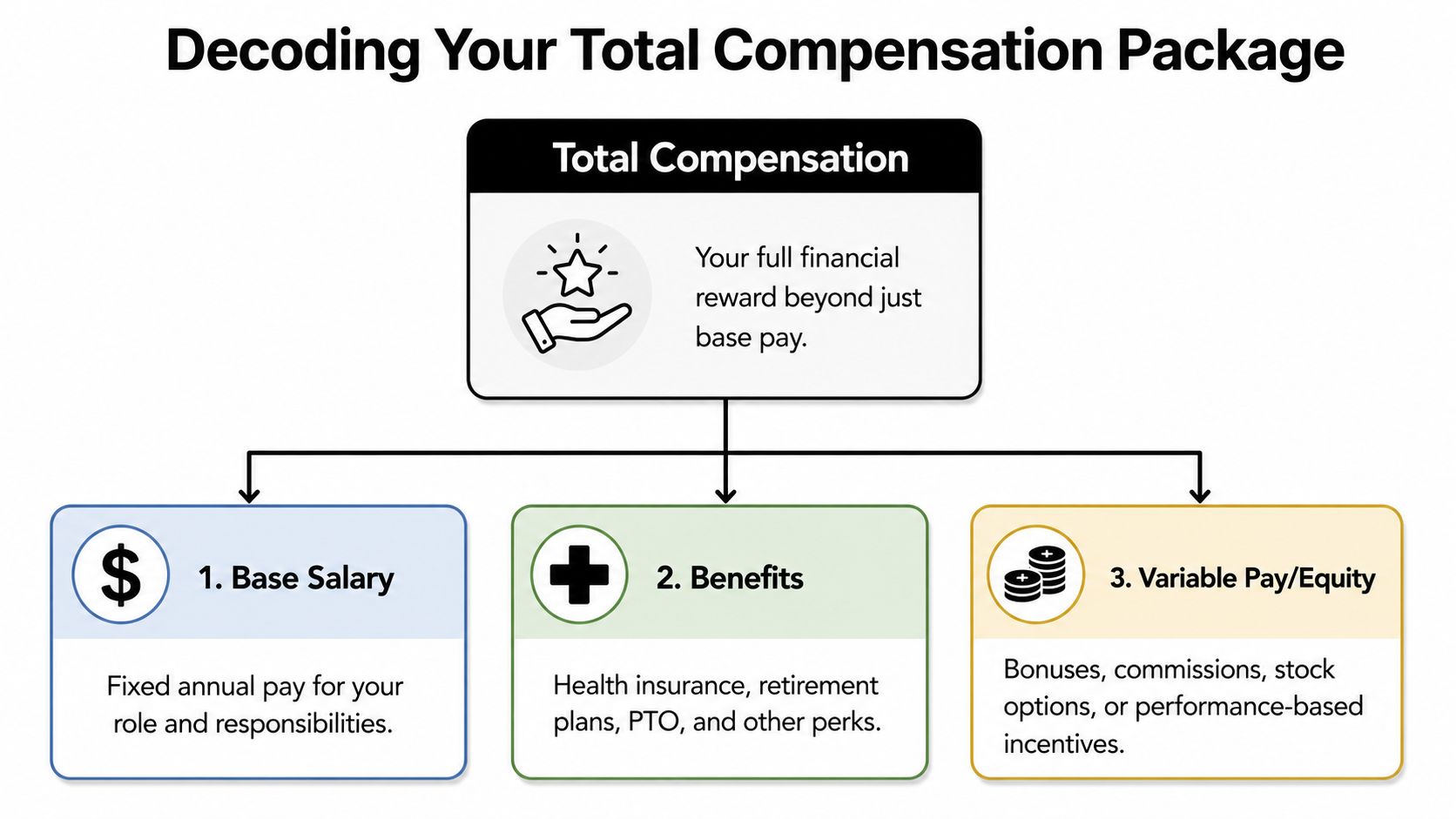
The three buckets to review
Most offers fall into three broad categories:
Base salary
This is your fixed annual cash compensation. It pays the bills and sets the tone for future raises, so don't treat it casually.Benefits Health insurance, retirement contributions, paid time off, and learning stipends can change the value of an offer fast. A lower base can still be competitive if the benefits are strong and you'd otherwise pay those costs yourself.
Variable pay and upside
Bonuses, profit sharing, stock options, RSUs, and in Web3, token incentives all live here. These can make an offer far more attractive, but only if you understand how they work.
What to ask before you accept
Don't say yes until you've asked direct questions.
- Bonus structure: Is it discretionary, company-based, or tied to your own goals?
- Equity details: If there's equity, what's the vesting schedule and what triggers vesting?
- Token incentives: If the company offers tokens, ask how they're granted, when they vest, and whether there are restrictions.
- Benefits timing: Confirm when coverage starts and what's covered.
- Professional development: Social specialists who keep up with tools, platforms, and analytics stay more valuable.
How recruiters look at competing offers
An offer with a slightly lower base but greater upside should not be automatically rejected. Instead, evaluate the company's stability, the practicality of the bonus, the value of the benefits, and the credibility of the equity or token story.
Strong candidates evaluate offers like investors. They check what's guaranteed, what's conditional, and what's speculative.
In Web3, this discipline matters even more. Token-heavy offers can be attractive, but you should still protect your cash compensation and understand what part of the package is reliable today.
The Web3 Premium for Social Media Roles
Traditional salary guides miss a big part of the market. They treat “social media specialist” like a standard marketing title. In Web3, it often isn't.
The gap is straightforward. Traditional U.S. specialists often earn $51k to $55k annually, while Web3 compensation often comes in 30% to 50% higher, with blockchain marketing roles frequently translating into Web3 Community Manager jobs in the $70k to $120k+ range, plus token incentives. That's the core compensation gap candidates need to understand when they compare mainstream marketing jobs to crypto-native opportunities.
Why Web3 roles pay differently
These companies usually aren't hiring someone to “run social” in the basic sense. They want a person who can shape narrative, manage a fast-moving online community, coordinate product announcements, and keep up with market-sensitive conversations across X, Discord, Telegram, Reddit, and founder channels.
That's not simple content scheduling. It's brand risk management, audience growth, and community operations wrapped into one function.
Here's where the premium often comes from:
- Always-on communication needs: Web3 audiences expect constant interaction and fast updates.
- Community ownership: Social and community frequently sit in the same role.
- Remote-first hiring: Companies recruit across borders and compete for specialized operators.
- Token-linked incentives: Some packages include upside that doesn't exist in standard corporate roles.
How your title translates in Web3
If you've built your career in traditional marketing, don't get stuck on job title literalism. Employers may value your background under a different title entirely.
A Social Media Specialist can map into:
- Community Manager
- Social Media Manager
- Content and Community Lead
- Growth Marketing Associate
- Brand and Social Lead
One current example of that overlap shows up in this crypto finance social media role, where the scope aligns more with high-context Web3 communication than a narrow posting job.
A useful explainer on how crypto roles and narratives evolve is below.
What candidates get wrong about the Web3 premium
They assume the premium is automatic. It isn't. Web3 pays more when you can operate in ambiguity, communicate with a technical audience, and manage community trust under pressure.
If you can't explain wallet basics, token launches, governance conversations, or ecosystem narratives in plain English, you're not yet premium talent in this market. You're a marketer trying to enter it.
Web3 doesn't pay extra for curiosity alone. It pays for fluency, speed, and credibility.
That's good news, because those are learnable. The candidates who make the jump fastest usually build niche fluency before they apply, not after they get hired.
Develop These Skills to Increase Your Earnings
If you want a better salary, stop obsessing over title inflation. Build skills that hiring managers struggle to find.
Yes, experience matters. But the most valuable social candidates aren't just older versions of junior coordinators. They've added hard-to-replace capabilities. In practical terms, that means they can connect content to growth, community health, and business outcomes.
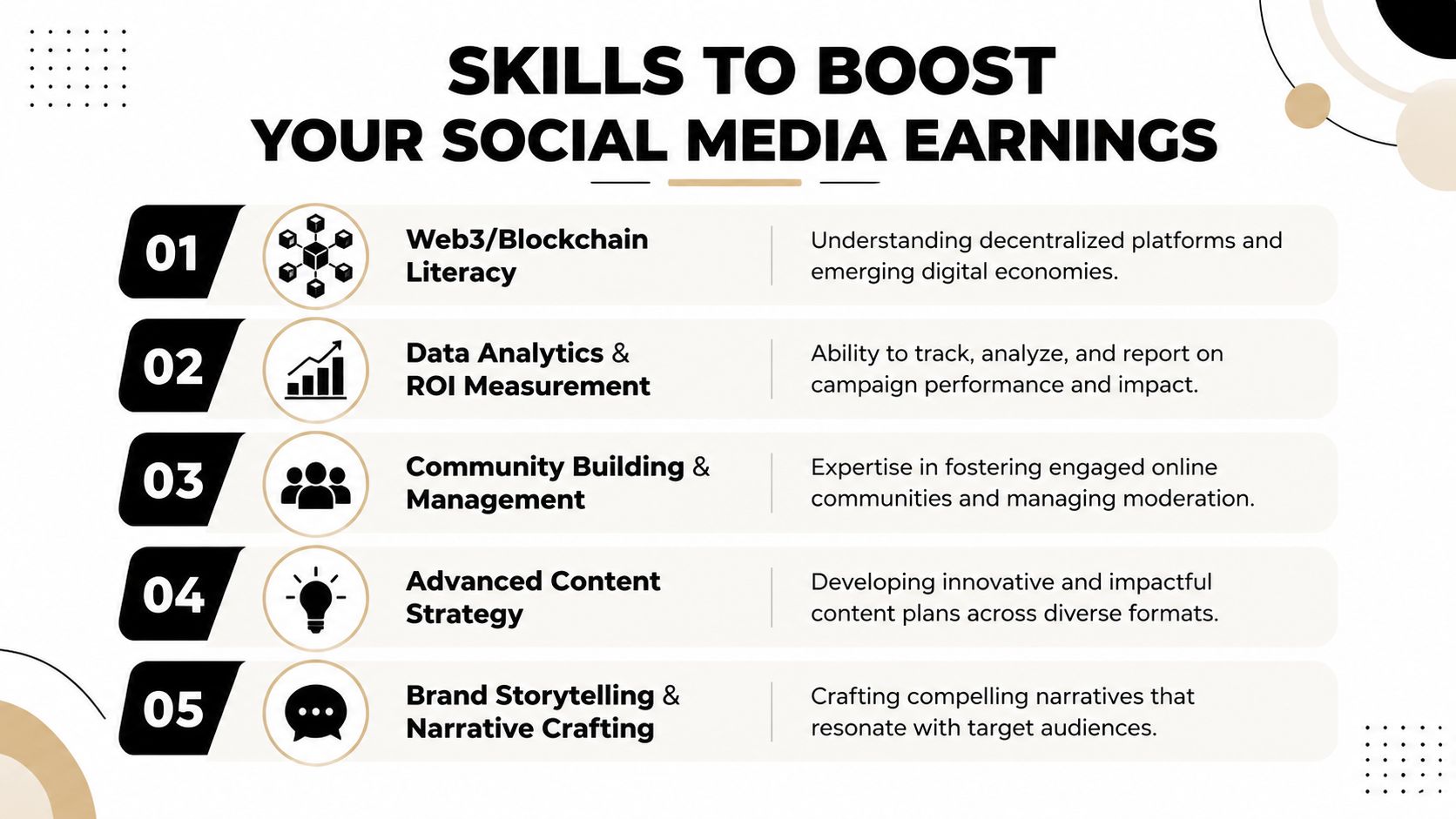
The skills that create salary leverage
Recent data indicates that specialists with AI automation tools and cross-platform token-gating strategies are scarce. Traditional salary growth from long experience exists, but Web3 and blockchain hiring increasingly rewards a skill premium for AI-integrated marketing capabilities that outpaces tenure-based growth.
That tracks with what hiring teams ask for now. They want people who can work faster, personalize better, analyze performance cleanly, and support technical communities without sounding lost.
Here are the highest-value areas to build:
- AI workflow design: Learn how to use tools like ChatGPT, Claude, Notion AI, or scheduling platforms with AI assistance to speed ideation, draft variants, and repurpose content without lowering quality.
- Data and ROI reporting: Get comfortable in native platform analytics, GA4, Looker Studio, or equivalent reporting environments. If you can't explain what happened and why, you cap your pay.
- Community management: Discord and Telegram moderation, escalation handling, and feedback loops matter a lot in Web3.
- Narrative strategy: Strong operators can turn product updates, ecosystem news, and founder viewpoints into coherent campaigns.
- Technical literacy: You don't need to code, but you do need to understand the product category you market.
Foundational skills versus premium skills
There's a difference between being employable and being expensive.
Foundational skills include content calendars, copywriting, channel publishing, and basic visual coordination in tools like Canva or Figma. You need these, but they won't separate you much.
Premium skills show up when you can:
- interpret analytics and adjust strategy,
- connect social activity to user acquisition or retention,
- coordinate across product, legal, and community teams,
- and operate comfortably in technical or fast-moving sectors.
If you work in B2B, it also helps to sharpen your understanding of workflows, publishing systems, and collaboration models. This overview with insights on B2B social media management is useful because it frames social as an operational discipline, not just a creative one.
How to prove these skills in hiring
Don't just list them on your resume. Show them.
- Bring samples: Dashboards, campaign briefs, community playbooks, reporting decks, and content systems all help.
- Tell better stories: Explain a challenge, your decision process, what changed, and how you measured it.
- Target roles that reward specialization: Openings like this social media manager role at Serotonin tend to favor candidates who can combine strategy, execution, and Web3 fluency.
The candidates who increase earnings fastest usually don't learn everything at once. They stack one premium skill on top of a solid core and make that skill visible in interviews.
How to Negotiate a Higher Social Media Salary
A spread from $12.29 to $36.12 per hour for the same job title should change how you negotiate. Indeed's social media specialist pay data shows exactly how wide the market is, and that gap gets even wider once you compare standard marketing roles with Web3 offers that mix cash, bonuses, equity, or tokens.
Start before the offer lands. Salary negotiation is a positioning exercise, not a last-call script.
Set a target range based on three things. Your local market, the actual scope of the role, and the compensation model. A social media specialist handling publishing and reporting for a traditional brand should not price the same way as a candidate expected to manage community sentiment, launch support, founder voice, and token-holder communications for a crypto startup.
Hiring managers need a reason to pay above the midpoint. Give them one they can repeat internally.
Use this structure in interviews and offer discussions:
- Define the business impact. Tie your work to outcomes like growth, retention, engagement quality, response time, creator performance, or campaign execution.
- Show the level of ownership. Be explicit about what you lead without oversight, what you build from scratch, and what cross-functional pressure you handle.
- Price the specialization. If you can manage high-volume content systems, explain analytics clearly, or communicate in fast-moving technical categories, say so directly. In Web3, that specialization often justifies a higher band.
- State your range with context. Anchor your ask to the role's scope and the full package, not the title alone.
Keep your language tight. “Based on the responsibilities we've discussed, I'm targeting X to Y in base salary.” If it is a Web3 role, add the second sentence. “I'm evaluating the total package, including cash, bonus, equity, and any token component.”
That matters because Web3 compensation can look better than it is.
A $75,000 base plus tokens may beat a traditional $68,000 offer. It may also be worse if the token portion has a long vesting schedule, weak liquidity, or unclear tax consequences. Ask direct questions. What percentage of compensation is guaranteed cash? What is the vesting schedule? Is there a lockup? How is token value calculated at offer stage? If they cannot answer clearly, discount the upside and negotiate harder on base.
Contract offers need a different approach. Anchor on hourly or monthly value first, then confirm expected hours, revision load, approval layers, and payment timing. Many social candidates underprice contract work because they compare it to salaried roles without accounting for unpaid admin time, self-employment tax, and zero benefits.
Bring proof. Bring screenshots of reporting dashboards, campaign summaries, content systems, or community wins. If you use AI to increase output without lowering quality, make that part of your case. Hiring teams pay more for efficiency they can understand. If you want a concrete example of how to present that advantage, learn PostPulse's AI content creation process.
Push back when the company wants senior ownership on a coordinator budget. Walk away when compensation is vague, scope keeps expanding, or the employer treats token upside like a substitute for cash.
Strong candidates do not ask employers to guess their value. They set the frame, justify the number, and force a clear compensation conversation.