Streamlining the Recruitment Process: A Guide to Winning Top Web3 Talent
In a fast-paced market like Web3, you don't have weeks to make a hiring decision. The best candidates are often off the market in days. If your recruitment process is slow and clunky, you're not just creating a minor inconvenience—you're actively losing the talent you need to succeed. This guide provides actionable insights for hiring managers and candidates alike, focusing on optimizing job interviews and fostering career progression from the very first touchpoint.
A Framework for a More Effective Hiring Process
Traditional recruiting methods don't cut it in this ecosystem. Elite blockchain professionals are fielding multiple offers simultaneously. A drawn-out interview cycle, vague communication, or unnecessary delays will send a top-tier Solidity developer straight to your competitor. It’s time to build a hiring engine that’s both fast and sharp, ensuring you not only attract but also secure the best people for the job.
This simple, three-stage approach—Audit, Attract, and Hire—serves as our guide to streamlining the recruitment process.
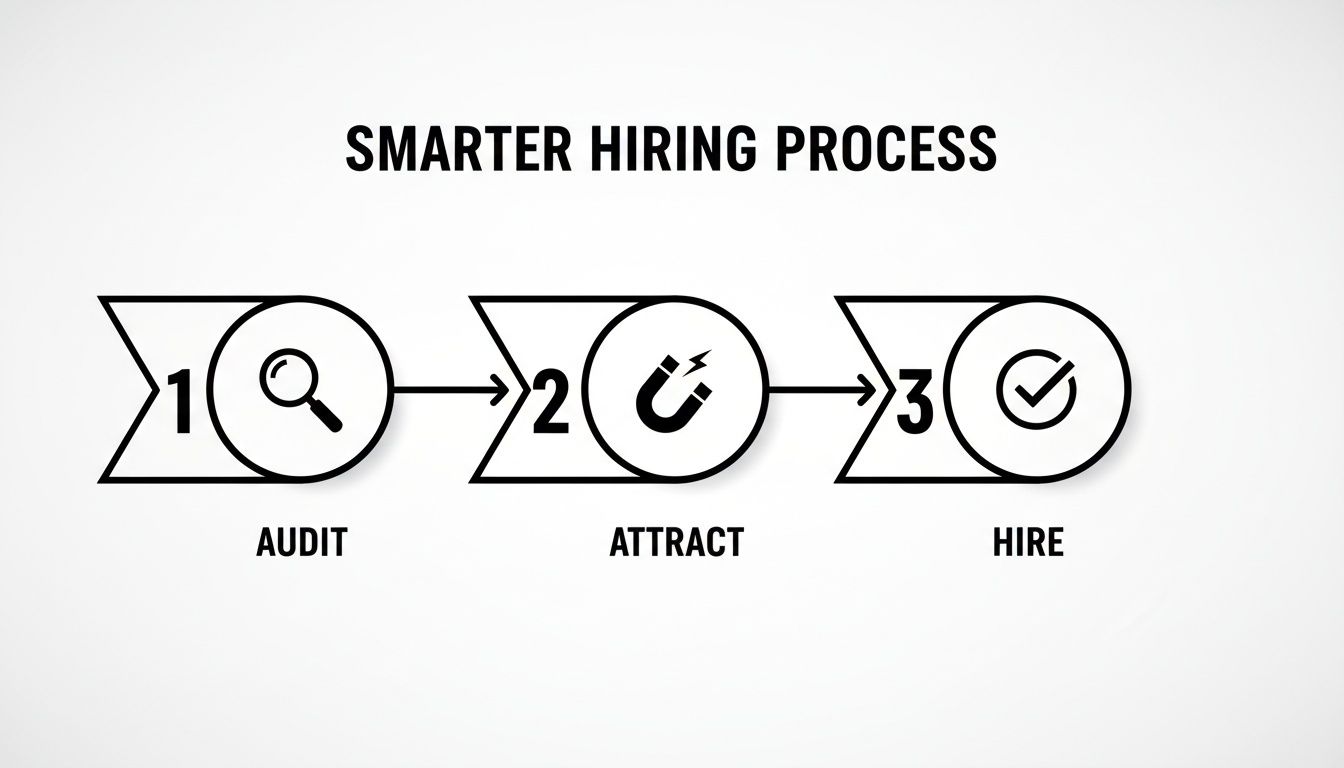
Before you can attract the right people and make a solid hire, you must first be honest about what’s broken in your current system. This audit is the first step toward creating a career-defining opportunity, not just filling a vacancy.
To give you a clearer picture, here’s a high-level look at the key stages we'll be breaking down. Each step is designed to build on the last, creating a cohesive and efficient journey from first contact to final offer.
| Key Stages of a Streamlined Web3 Recruitment Funnel | | :--- | :--- | :--- | | Stage | Primary Goal for Hiring Manager | Key Actions & Impact on Candidates | | 1. Audit & Define | Identify process bottlenecks and clarify the career path for the role. | Review time-to-hire metrics, gather team feedback, create detailed job scorecards that outline growth potential. | | 2. Attract & Source | Build a strong candidate pipeline with targeted, meaningful outreach. | Write compelling job descriptions focused on impact, engage in niche communities, leverage referrals to find passive talent. | | 3. Assess & Hire | Evaluate skills and long-term potential efficiently and fairly. | Implement structured interviews, conduct focused technical tests that reflect the job, and optimize the offer process for speed and clarity. |
This table maps out the end-to-end flow, showing how a methodical approach can transform your hiring from a chaotic scramble into a well-oiled machine that top candidates are excited to engage with.
Why Speed and Quality Aren't Mutually Exclusive
Many teams fall into the trap of thinking they have to choose: hire fast or hire well. But that's a false dilemma. The real goal is to hire smarter by cutting out the friction that frustrates everyone, from candidates to the hiring manager. A well-designed process respects a candidate’s time while ensuring every stage of the job interview is meaningful for assessing their potential career progression with your company.
When you get this right, the benefits are immediate:
- Higher Offer Acceptance Rates: Candidates are far more likely to accept an offer when they've had a professional and respectful interview experience.
- A Stronger Employer Brand: Word gets around fast in the tight-knit Web3 community. A great interview process—even for those you don't hire—builds a powerful reputation and a pipeline for future roles.
- Access to Top-Tier Talent: The best engineers and strategists are always the first to get hired. A quick, decisive process gives you the edge to sign them before your competitors do.
A candidate’s journey through your interview process is their first real glimpse into your company's culture and operational efficiency. A slow, disorganized experience signals a chaotic workplace and a lack of clear career progression paths.
This guide will walk you through diagnosing your bottlenecks, defining exactly who you need for long-term success, and running structured interviews that effectively predict job performance. By focusing on these fundamentals, you’ll build a system that doesn’t just attract the best minds in the space—it convinces them that your company is the best place for their career.
To see how other Web3 companies are tackling these challenges, you can find more real-world examples and insights on our blockchain industry blog. The strategies we're about to cover are your first step toward building a team that's built to win.
Find and Fix Your Hiring Bottlenecks
Before you can streamline your recruitment process, you need to diagnose what’s actually broken. A slow hiring cycle is rarely a single, massive problem. It's almost always a chain reaction of small friction points that grind everything to a halt. You can't just treat the symptoms; you have to find the root cause to make lasting improvements.
The first move is to gather objective data. Gut feelings and hallway chatter are one thing, but numbers don’t lie. Vague complaints like "it just takes too long" become specific problems you can solve once you see exactly where candidates are getting stuck or dropping out of your interview funnel.
Start with the Core Hiring Metrics
Your starting point should be tracking a few key performance indicators (KPIs). These numbers give you a baseline to measure whether the changes you make are actually improving your hiring outcomes.
Here are the essentials for any hiring manager:
- Time-to-Hire: Track the total number of days from posting a job to a signed offer. In Web3, anything over 30-45 days means your top candidates have likely already accepted other offers.
- Source of Hire: Where are your best hires actually coming from? This tells you which channels deliver quality candidates and which are a waste of your team's time and budget.
- Candidate Drop-off Rate: Pinpoint the exact interview stage where you lose the most candidates. If everyone is bailing after your technical assessment, it’s a huge red flag that the challenge is too long, irrelevant, or a poor candidate experience.
- Offer Acceptance Rate: This is the ultimate scorecard. A low acceptance rate signals a problem with your offers, your timeline, or the overall impression your interview process leaves on candidates.
A messy hiring process sends a powerful signal about your company. If you can't run a smooth interview loop, top-tier candidates will question your ability to manage a product, a team, or their own career progression.
Dig Deeper to Find the Sticking Points
Once you have the numbers, you can start asking the right questions. This isn’t just about staring at a spreadsheet; it’s about talking to your team to understand the stories behind the data. Are your job descriptions attracting the wrong profiles? Are your interviewers misaligned on the key competencies for the role?
More often than not, the real issue is a simple lack of clarity. Teams dive into job interviews without ever defining what a great hire for that specific role actually looks like. This inevitably leads to endless internal debates, "just one more" interview round, and candidates who feel their time is being wasted.
The fix is to get everyone aligned before the first resume is reviewed.
This is where creating a Role Success Profile is a game-changer. It's more than just a job description; it’s an internal alignment document that clearly defines the must-have skills, crucial experience, and behavioral traits needed for success and long-term career progression in the role. Forcing this conversation upfront ensures that everyone—from the recruiter to the CEO—is using the same scorecard, which eliminates ambiguity and accelerates decision-making.
Find and Attract Top Blockchain Talent

Here’s a hard truth: the best Web3 talent isn’t scrolling through mainstream job boards. If you want to hire people who truly live and breathe decentralization, you have to meet them where they are. And when you do, you need to speak their language—one focused on impact, technology, and career growth.
The most sought-after builders in this space are driven by the mission. They care deeply about the problems they're solving and the philosophy behind the project. Your job post is your first pitch, and it needs to sell the vision and the career opportunity, not just list technical skills.
Craft Job Descriptions That Attract the Right Candidates
Stop thinking of a job description as a checklist. Instead, frame it as an invitation to make a real impact and advance their career. What will this person actually build? Who will they collaborate with? How will their contributions directly shape the future of your protocol and their own professional journey?
To write a job post that stands out, make sure it includes:
- The Mission, Up Front: Start with what you're building and why it matters. Get them excited about the big picture before diving into the technical details.
- The Real Tech Stack: Be specific. Mention the protocols, languages, and tools they’ll use daily. This helps qualified people self-select and shows you're a serious engineering organization.
- Ownership and Career Progression: Talk about the autonomy they'll have and the path for growth. Top talent wants to solve hard problems and see a future for themselves, not just close tickets.
- Transparent Compensation: If possible, provide a salary range and be clear about token incentives. This honesty builds trust and signals a transparent culture, which is highly valued in the Web3 community.
This is critical for survival in a competitive market. The Web3 hiring landscape is fierce. We saw a 47% hiring rebound in 2025, and with up to 12,000 active global positions, companies must make hiring decisions in under two weeks. The best engineering roles can attract 450 applications, so your job post must do the heavy lifting of filtering for quality.
You can dive deeper into these trends in the Web3 hiring market to see just how intense the competition for talent has become.
The best Web3 job descriptions read more like a project's whitepaper—they're clear, compelling, and focused on the future. They're selling a stake in building something meaningful, which is the ultimate currency for attracting A-players looking for career-defining roles.
Look for Talent in the Right Places
Once your job description is dialed in, you need to get it in front of the right people. Posting on generic platforms is like fishing in the ocean with a tiny net—you’ll get a lot of noise and very few of the right candidates.
A streamlined recruitment process is built on targeted sourcing. Don't just wait for applicants; go out and engage with talent in their natural habitats. This does more than fill your pipeline—it builds your reputation as a serious project within the community.
Here’s where hiring managers should focus their energy:
- Niche Job Boards: Platforms like Blockchain Jobs are essential. You're tapping into a pre-vetted audience of crypto-native professionals actively seeking their next career move.
- GitHub Activity: Find developers contributing to open-source projects in your ecosystem. Their public work is a portfolio that speaks for itself and demonstrates passion.
- Real Community Engagement: Get active in relevant Discord channels, Telegram groups, and forums. Be a helpful community member first and a recruiter second. People notice authenticity.
By focusing your efforts on these high-signal channels, you cut through the static and connect directly with the builders who will drive your project forward. It’s a shift from passive posting to active, intelligent talent acquisition.
Want to see what this looks like in practice? Check out this example of a Web3 Full-Stack Developer role to see how a well-crafted post on a specialized platform can make all the difference.
Design an Efficient and Effective Interview Process
When you're flooded with hundreds of applications for a single Web3 engineering role, a slow, disorganized interview process is a guaranteed way to lose the best people. The goal here isn't to make candidates jump through more hoops. It's about designing a sharp, respectful process that accurately assesses their real-world capabilities and potential for growth within your team.
The first step is to automate the initial screening. An Applicant Tracking System (ATS) is no longer a luxury—it's a core component of a serious hiring machine. An ATS automates the first pass, filtering candidates based on the crucial competencies you defined in your role profile, freeing up your team for high-value interactions.
Move Beyond Manual Screening
A good ATS, like Greenhouse or Lever, helps your team instantly spot qualified candidates, track everyone in the pipeline, and ensure no one falls through the cracks. It’s no surprise that 98.4% of Fortune 500 companies rely on an ATS; it’s how they manage high-volume recruitment efficiently.
This automation frees up your team to do what they do best: talk to and engage with top talent. But if you're still overwhelmed, partnering with a specialized recruiting agency can be a game-changer. In the Web3 space, expert recruiters who know the talent landscape can cut time-to-hire by up to 50%. They handle the initial sourcing and screening, presenting you with a shortlist of candidates who are not just skilled but also a strong cultural fit. You can learn more about how blockchain recruitment agencies enhance hiring and provide a critical edge.
Make Technical Assessments Relevant and Respectful
It's time to ditch generic coding puzzles that feel like a college exam. The best technical assessments mirror the actual work the candidate will be doing. This approach gives you a much clearer signal of their skills and demonstrates respect for their time—a key factor in a positive candidate experience.
Here are actionable ideas for relevant assessments:
- For a Smart Contract Engineer: Provide a small, intentionally buggy smart contract. Ask them to perform a quick audit, identify vulnerabilities, and suggest fixes.
- For a Protocol Designer: Present a simplified system design problem related to your project. Then, have a collaborative whiteboarding session to discuss solutions and trade-offs.
The job interview process is a product you are selling to the candidate. A practical, engaging technical challenge demonstrates that your team is serious, thoughtful, and focused on solving real problems—exactly the kind of environment where A-players want to build their careers.
Finally, to ensure objectivity, use a structured interview scorecard. This simple tool forces every interviewer to evaluate candidates against the same criteria, from technical proficiency to problem-solving and cultural alignment.
Here’s a simple template for a hiring manager to use:
Interview Scorecard Template Example
| Assessment Area | Key Question/Task | Rating (1-5) | Interviewer Notes on Career Potential |
|---|---|---|---|
| Technical Proficiency (Solidity) | Walk me through your audit of the provided smart contract. What were the critical vulnerabilities? | Demonstrates depth of knowledge for senior-level work. | |
| Problem-Solving Ability | How would you approach scaling this protocol to handle 10x the current transaction volume? | Shows strategic thinking and future-proofing mindset. | |
| Systems Design & Architecture | Whiteboard a high-level design for a cross-chain messaging system. What trade-offs did you make? | Assesses ability to handle complexity and make sound architectural decisions. | |
| Cultural Alignment | Describe a time you strongly disagreed with your team's technical direction. How did you handle it? | Indicates collaborative spirit and potential for leadership. | |
| Communication Skills | Can they clearly articulate complex technical concepts to a non-technical stakeholder? | Crucial for cross-functional impact and career progression. |
Using a scorecard like this replaces vague "gut feelings" with data-driven insights, making your hiring decisions faster, fairer, and far more likely to be right. For those tasked with building these processes, reviewing the responsibilities of a Talent Acquisition Manager can offer a great framework.
Create an Unforgettable Candidate Experience
In the hyper-competitive world of Web3, your interview process isn't just a filter—it's your most powerful sales pitch for a long-term career. Top-tier engineers and strategists have options. A slow, disorganized, or impersonal experience won't just cost you a single hire; it can tarnish your reputation across the entire tight-knit crypto community.

The secret to a great candidate experience is simple: respect the candidate's time and intelligence. This means crystal-clear communication at every stage of the hiring process. Even a quick automated email letting someone know they're still in consideration is a world away from radio silence.
Turn Your Process into a Brand Asset
Think of every interaction as a chance to show candidates what it’s really like to work with you. Does your hiring team show up to interviews on time and prepared? Do you explain the purpose of each conversation? These details paint a picture of an organized, professional environment where people can do their best work and advance their careers.
Here are a few actionable ways to elevate the experience:
- Map Out the Journey: From the start, give candidates a clear timeline of what to expect from the job interview process. Knowing the steps, from the first call to the final offer, reduces anxiety and shows you value their time.
- Give Real Feedback: When you decide not to move forward, offer a brief, constructive reason. It’s a professional courtesy that builds incredible goodwill and makes your company stand out as a great place to interview.
- Sell the Vision and Career Path: Don't just grill candidates. Get them genuinely excited about the problems you're solving and show them exactly how their work will contribute to the bigger picture and their own career progression.
Modern tools are making a huge difference in streamlining the recruitment process. Specialized platforms are helping companies achieve 40-50% faster hiring cycles by automating tasks like scheduling and initial screenings. This speed is non-negotiable, especially since 87% of Web3 firms are remote-first and competing for talent globally. You can learn more about how technology is shaping the global blockchain talent search.
Your interview process isn't a hurdle for candidates to overcome; it's a window into your company's soul. A positive experience turns every applicant, hired or not, into a potential brand advocate.
At the end of the day, you must move fast. When you find the right person, don't hesitate. A smooth process that culminates in a decisive, competitive offer is your best closing tool. It not only boosts your offer acceptance rate but also cements your reputation as a top destination for ambitious professionals.
Frequently Asked Questions

Hiring in Web3 presents unique challenges. Here are straightforward answers to common questions from hiring managers and founders, focused on actionable insights for improving your job interviews and overall recruitment process.
These are practical tips based on what works in the real world of Web3 hiring.
What Are The Most Common Bottlenecks In A Web3 Recruitment Process?
The three most common roadblocks are ineffective sourcing, irrelevant technical assessments, and slow decision-making. Sourcing on generic job boards creates a flood of unqualified resumes, bogging down your team. Long, academic coding challenges frustrate top engineers who want to solve real-world problems. Finally, a lack of alignment among interviewers leads to endless debates and delays, by which time your top candidate has already accepted another offer.
A well-oiled process addresses these chokepoints directly. It starts with targeted sourcing on niche platforms, uses practical assessments that reflect the job, and relies on standardized scorecards to help the team reach a quick, confident consensus on the right hire.
How Can A Small Startup Compete For Top Blockchain Talent?
Small startups can win by leveraging their key strengths: speed, a superior candidate experience, and a compelling mission. Your ability to move quickly through the hiring process is your greatest advantage over larger, slower competitors.
Instead of competing on salary alone, emphasize the unique career progression opportunities, such as the chance for real impact, ownership, and direct access to the founding team. A respectful, transparent, and fast hiring process demonstrates that you are a nimble, decisive organization—an incredibly attractive quality for ambitious builders looking for their next career-defining role.
What’s The Best Way To Structure A Technical Interview?
Ditch the generic algorithm puzzles. For a senior blockchain engineer, a multi-stage process that assesses real-world skills is far more effective.
A strong structure for a technical job interview includes:
- A high-level conceptual discussion: Talk about system architecture or protocol design to evaluate strategic thinking.
- A practical, time-boxed coding exercise: Assign a task directly related to your tech stack, such as debugging a smart contract or optimizing a piece of code.
- A collaborative problem-solving session: Review their past projects and work through a problem together to assess communication, collaboration, and their approach to teamwork.
This structure provides a holistic view of their capabilities, from high-level strategy to hands-on execution.
How Important Is Employer Branding When Streamlining Recruitment?
It's everything. A strong employer brand acts as a magnet for high-quality talent, reducing your reliance on outbound sourcing. Your recruitment process is a critical part of that brand.
In the close-knit Web3 community, word travels fast. A positive, efficient, and respectful interview experience—even for candidates who aren't hired—builds a strong reputation. Conversely, a slow, disorganized process can quickly damage your brand, making it harder to attract top talent in the future.
Ready to find the specialized talent you need to build the future of the decentralized web? On Blockchain Jobs, you can connect with a pre-vetted community of crypto-native professionals who are actively looking for their next big opportunity. Post your role today and start building your team faster. Find your next hire at https://blockchain-jobs.com.