Web 2 vs Web3 A Developer's Career Transition Guide
At its core, the real difference between Web2 and Web3 boils down to one thing: control. Web2, the internet we use every day, is dominated by centralized platforms like Meta and Google. They own the servers, they control the data. In stark contrast, Web3 introduces a decentralized internet built on blockchain technology, handing ownership of digital assets and information back to the users. For a professional, this isn't just a technical shift; it's a fundamental change in the skills employers hire for and the career paths available.
Understanding The Shift From Web2 To Web3 Careers

For anyone working in tech, grasping the Web2 vs Web3 dynamic is now essential for career planning. This isn't just a simple software update; it’s a seismic shift in how applications are designed, managed, and monetized. To make a smart career move, you have to look past the buzz and really dig into the practical differences that will define your job search, interviews, and day-to-day work.
The Web2 ecosystem is mature and well-defined. You have established roles and clear career paths inside big tech companies. Web3, on the other hand, is the new frontier—an opportunity to get in on the ground floor of a field that's expanding at an incredible rate, creating high-demand, high-paying roles.
This growth is far from just speculation. The global Web3 market was valued at around USD 3.17 billion and is projected to explode to nearly USD 99.75 billion by 2034. That's a compound annual growth rate of 41.18%. If you want to dive deeper, you can discover more Web3 market insights on passivesecrets.com.
For a hiring manager, a candidate who understands these core philosophical and architectural differences is immediately more valuable. It shows you're not just chasing trends but have a genuine grasp of the underlying technology and its implications for the business and its users.
To help you get up to speed quickly, here's a simple breakdown of the most important concepts separating Web2 and Web3—think of this as your cheat sheet for job interviews.
At a Glance: Web2 vs Web3 Core Concepts
| Attribute | Web2 The Centralized Web | Web3 The Decentralized Web | Career Implication |
|---|---|---|---|
| Core Principle | Centralized control by corporations. | Decentralized ownership by users. | Web3 roles often require community management and governance skills. |
| Data Storage | Company-owned servers (e.g., AWS, Google Cloud). | Distributed on a blockchain or peer-to-peer networks. | Web3 requires knowledge of IPFS, Arweave, and blockchain data structures. |
| User Identity | Managed via accounts (e.g., email/password). | Managed via self-sovereign wallets (e.g., MetaMask). | Frontend Web3 roles demand expertise in wallet integration and security. |
| Monetization | Primarily advertising and data sales. | Token-based economies and direct user transactions. | Product and strategy roles in Web3 need a deep understanding of tokenomics. |
| Trust Model | Trust is placed in a central intermediary. | Trust is built into the protocol ("trustless"). | Web3 engineering interviews focus heavily on security and smart contract audits. |
This table gives you the high-level view, but the real impact is in the details. The shift from a client-server model where companies hoard data to a peer-to-peer network where it’s distributed and verified on-chain changes everything—from security protocols to how companies are even structured.
Throughout this guide, we'll dissect these differences from a practical, career-focused angle. We’ll cover the specific job roles, technical skills, and interview strategies unique to each ecosystem. Understanding this comparison is the key to positioning your expertise for your next big move, whether you stick with the established world of Web2 or venture into Web3.
Comparing Technical Architectures And Data Models

For any engineer, the architectural gap between Web2 and Web3 isn't just academic. It fundamentally changes how you design systems, what you build day-to-day, and how you’ll be tested in a technical interview. If you can’t articulate these differences, you won’t be able to prove you can build for either world.
Web2 runs on the classic client-server model, a pattern that has defined the internet for decades. Your app or browser (the client) makes a request to a centralized server—think Google or AWS—which then pulls information from a private database and sends it back. It's an efficient, well-understood system that works incredibly well for most applications.
The catch, of course, is that this centralization creates a single point of failure and control. When that server goes down, the service is dead in the water for everyone. This is why Web2 hiring heavily prioritizes expertise in managing, scaling, and defending these centralized infrastructures.
The Centralized Web2 Data Flow
In a typical Web2 setup, data is treated as a corporate asset. All that user information is funneled into databases—usually SQL or NoSQL—optimized for blistering-fast reads and writes. This is what powers everything from personalized ads to instant content recommendations, and engineers are tasked with building the secure APIs that manage this constant flow.
This has very clear career implications for what skills you need to land a job:
- Database Management: You absolutely need to know your way around SQL (like PostgreSQL) and NoSQL (like MongoDB) for backend or full-stack positions.
- API Development: Building and maintaining solid RESTful or GraphQL APIs isn't a "nice-to-have," it's a core competency expected in nearly every developer role.
- Cloud Infrastructure: You're expected to have deep knowledge of platforms like AWS, Azure, or Google Cloud where the applications actually live.
In a Web2 interview, expect to get grilled on optimizing database queries, architecting scalable microservices, or locking down API endpoints. The entire focus is on building efficient and reliable systems inside a company-controlled environment.
The core challenge in Web2 architecture is scaling a centralized point of trust. In Web3, the challenge shifts to coordinating a decentralized network that operates without a central trusted party, which completely changes the security and performance considerations hiring managers test for.
Web3’s Shift to Decentralized Networks
Web3 completely flips the client-server model on its head. It operates on a decentralized, peer-to-peer (P2P) network. Here, data doesn’t live on a company’s private server; it's distributed across a blockchain—a shared, unchangeable ledger run by countless computers all over the world.
Instead of hitting a private API, a decentralized app (or dApp) talks directly to the blockchain through smart contracts. These are just self-executing pieces of code that contain the app's logic and manage how the state changes on the public ledger. For developers, this is a massive paradigm shift.
The building blocks in Web3 that employers are hiring for are entirely different:
- Blockchain Interaction: You're not making HTTP requests. You're using libraries like Ethers.js to interact with blockchain nodes, a must-have skill for dApp developers.
- Data Immutability: Once data hits the blockchain, it’s permanent. It can't be changed or deleted. This forces a completely new way of thinking about data management and application logic—a key concept to discuss in interviews.
- User Sovereignty: Data ownership moves from the corporation to the individual. A user's assets and identity are controlled through their own cryptographic wallet, making wallet integration a core frontend skill.
For anyone looking for a job, this means you have to demonstrate a solid grasp of concepts that feel foreign to traditional web development. Interview questions will dig into your knowledge of smart contract security, gas optimization, and the trade-offs between consensus mechanisms. Proving you understand why immutability is both a powerful feature and a major constraint is how you'll land a Web3 engineering role on a platform like Blockchain Jobs.
Mapping Your Career Path In The Evolving Job Market
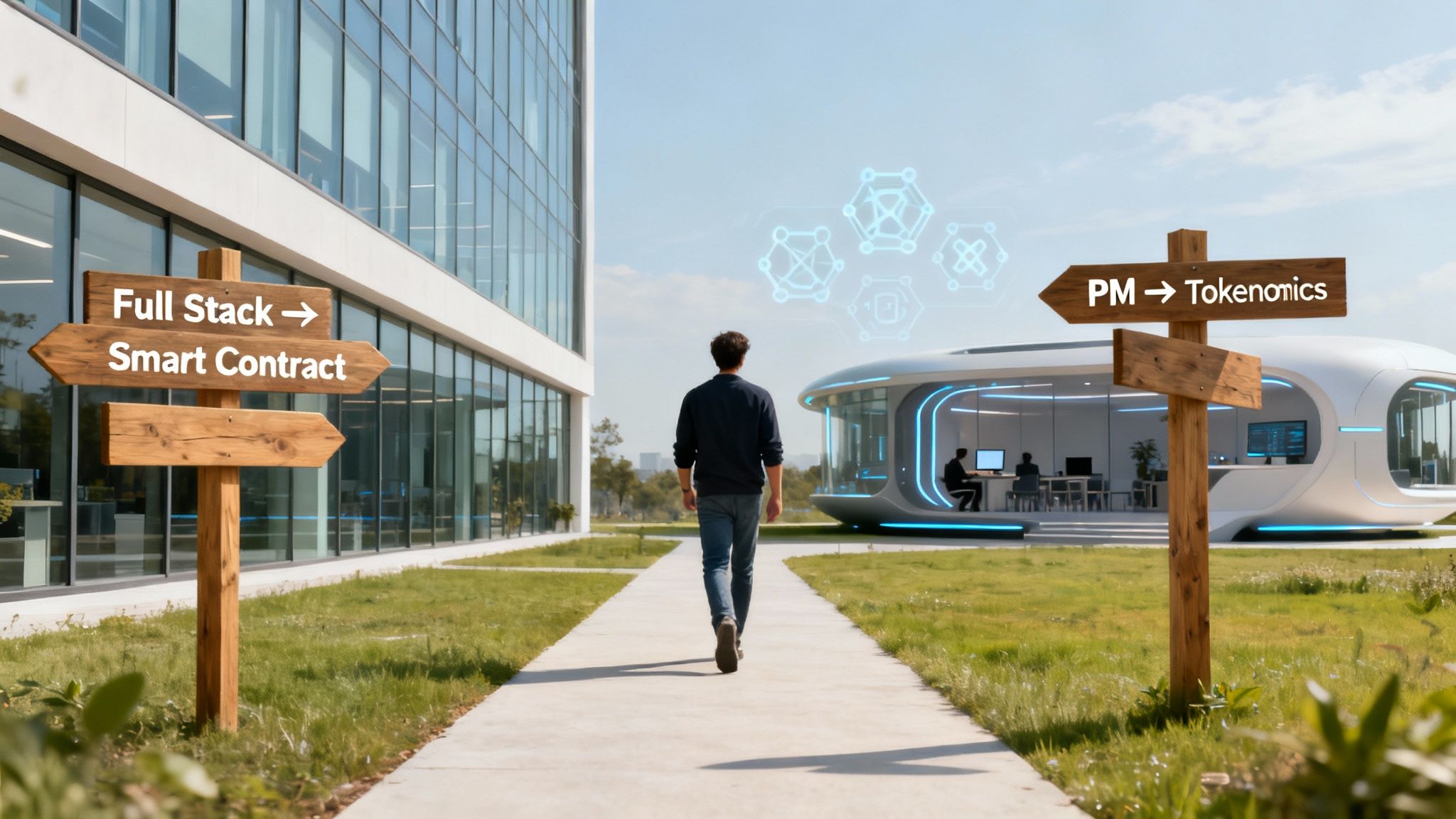
It’s one thing to grasp the technical distinctions between Web2 and Web3, but it’s another to turn that knowledge into a smart career move. The great news is your Web2 skills aren't going obsolete; they’re the launchpad for what's next. The trick is to map your current job to its Web3 counterpart and strategically upskill to target higher-paying roles.
This isn’t about hitting the reset button on your career. Think of it as adding a new, powerful layer to your existing expertise. A strong foundation in JavaScript, system architecture, or user experience is just as valuable in the decentralized world. The real opportunity is in building Web3-specific knowledge on top of that solid base to stand out to recruiters.
From Web2 Developer To Web3 Engineer
The most well-trodden path is the one for developers. If you're a Web2 full-stack dev, you have a clear runway into Web3, but that runway splits into a few exciting specializations. Knowing these paths helps you focus your learning and target your applications on platforms like Blockchain Jobs.
Here’s how that transition typically plays out in the job market:
Web2 Full Stack Developer: You’re an expert in a stack like MERN (MongoDB, Express, React, Node.js), handling everything from the user interface to the server-side logic that connects to a centralized database. Your world revolves around API performance, UX, and database management.
Web3 Full Stack Developer: You're still building frontends, likely with React, but the backend is a whole new ballgame. Instead of hitting a private API, you’re writing code that talks directly to a blockchain using libraries like Ethers.js or Web3.js. Your new obsessions are wallet integrations, fetching data from smart contracts, and making on-chain activity understandable for the user. This role is often seen as the most direct transition.
Smart Contract Engineer: This is a much deeper dive and often a higher-paid specialization. You’ll focus almost exclusively on writing, auditing, and deploying the smart contracts that act as the dApp's unchangeable backend logic. This role demands mastery of a language like Solidity or Rust and a security-first mindset that's borderline paranoid—after all, your code is managing real money and can't be patched once it's live.
In a Web2 interview, you might get grilled on scaling a database to handle a million users. In a Web3 interview, you'll be asked how you’d write a gas-efficient smart contract that’s safe from reentrancy attacks. It’s the same problem-solving muscle, just applied to a completely different set of constraints that hiring managers are testing for.
Adapting Non-Technical Roles For Web3
The talent grab in Web3 goes way beyond coding. People in product, marketing, and data are also finding incredible opportunities by reframing their skills for a decentralized world. The core job stays the same, but the tools and strategies are completely different, leading to new and exciting career avenues.
A Web2 Product Manager is focused on user acquisition, retention, and monetization on a platform the company controls. They live in tools like Google Analytics and run A/B tests to optimize funnels.
A Web3 Product Manager, on the other hand, needs to be part-community builder, part-economist. To get hired, they must demonstrate these skills:
- Understanding Tokenomics: The product’s success is often directly linked to a native token. The PM has to design token utility and incentive structures that encourage healthy network growth and user participation.
- Decentralized Governance: Instead of the product team calling all the shots, a Web3 PM often guides community governance. This means facilitating proposals and voting within a DAO (Decentralized Autonomous Organization).
- On-Chain Analytics: They’re using tools like Dune Analytics or Nansen to analyze public blockchain data, tracking smart contract interactions instead of just website clicks.
This pattern holds true for many other roles. A Web2 Data Analyst who learns to decipher complex transaction patterns on-chain becomes invaluable. A DevOps engineer who masters the art of managing decentralized node infrastructure is a hot commodity for any project that cares about uptime.
By figuring out the Web3 parallel to your current role, you give yourself a clear roadmap. You can pinpoint exactly what you need to learn—whether it’s Solidity, tokenomic modeling, or community management—and start your transition from a position of strength.
Contrasting The In-Demand Developer Stacks And Skills
Getting a job in Web2 or Web3 means you have to speak the right technical language. The difference between the two ecosystems really comes into focus when you look at their developer stacks—the specific languages, frameworks, and tools that hiring managers are actually looking for. Your career path is pretty much defined by the toolkit you choose to master.
Web2 is a mature space, dominated by well-established and incredibly efficient stacks built for centralized apps. On the flip side, the Web3 toolchain is the new kid on the block, designed to tackle the unique problems that come with decentralization, like security and blockchain interactions.
The Established Web2 Toolchain
Web2 development has been refined over decades to optimize for speed, scale, and user experience within a classic client-server model. Recruiters are hunting for proficiency in stacks that have proven they can handle the world’s biggest applications. If you want a career in Web2, these are the skills that open doors.
Two of the most common stacks you'll see on job descriptions are:
- LAMP Stack: This is one of the original open-source workhorses that powered a huge chunk of the early dynamic web. It’s made up of Linux (Operating System), Apache (Web Server), MySQL (Database), and PHP (Programming Language). It’s still a solid choice, especially for content management systems like WordPress.
- MERN Stack: This is a more modern, JavaScript-focused stack perfect for building sleek single-page applications. It includes MongoDB (NoSQL Database), Express.js (Backend Framework), React.js (Frontend Library), and Node.js (Runtime Environment). Its massive popularity means MERN developers are always in demand.
Mastering these technologies, or similar ones like MEAN or Django, tells an employer you can build and maintain the kind of scalable, data-driven applications that run the internet today.
The Emerging Web3 Developer Kit
Jumping into Web3 means picking up a whole new set of tools built for a decentralized world. While solid JavaScript knowledge is still a huge asset, the rest of the stack is completely different. The game is no longer about talking to a private database; it’s about communicating with a public, unchangeable blockchain.
A typical Web3 developer's toolkit that will get you hired looks something like this:
- Programming Languages: Solidity is the go-to language for writing smart contracts on Ethereum and other EVM-compatible chains. Rust is also gaining serious ground, especially for high-performance blockchains like Solana.
- Development Environments: You can't just push code to the blockchain. Frameworks like Hardhat or Truffle are crucial for compiling, testing, and deploying smart contracts in a safe local environment first.
- Blockchain Interaction Libraries: To get your frontend to talk to the blockchain, you need libraries like Ethers.js or Web3.js. They handle the heavy lifting of sending transactions and reading data from smart contracts.
- Decentralized Storage: For big files like images or videos that would be too expensive to store on-chain, developers turn to solutions like the InterPlanetary File System (IPFS) to keep things decentralized.
A Web2 developer’s primary concern is efficient communication with a private server. A Web3 developer’s obsession is secure, gas-efficient communication with a public, immutable ledger. This fundamental difference dictates the entire tech stack that hiring managers look for on a resume.
The financial and career upside for learning this new stack is huge. The Web3 development market was valued at USD 4.43 billion and is projected to hit USD 6.15 billion in 2025. That growth is expected to keep roaring ahead at nearly 38.4% through 2029.
This explosive expansion has created a high-demand, low-supply situation for skilled developers. You can discover more insights about these Web3 development trends. Getting a handle on these tools now puts you in a prime position to ride that wave.
To help you visualize the shift in skills, here’s a direct comparison of what’s in demand across both fields.
Web2 vs Web3 Developer Skill Matrix
| Skill Category | In-Demand Web2 Skills | In-Demand Web3 Skills | Actionable Insight for Your Career |
|---|---|---|---|
| Frontend | React, Angular, Vue.js, HTML/CSS, TypeScript | React, Ethers.js, Web3.js, WAGMI, GraphQL | Leverage your React skills as a bridge; focus on learning Ethers.js and wallet integration next. |
| Backend | Node.js, Python (Django, Flask), Java (Spring), Go | Solidity, Rust, Go, Node.js (for scripts/APIs) | Start with Solidity for EVM chains, as it has the most resources and job openings. |
| Databases | SQL (PostgreSQL, MySQL), NoSQL (MongoDB, Redis) | Decentralized Storage (IPFS, Arweave), The Graph | Learn how to index blockchain data with The Graph; this is a highly sought-after skill. |
| Frameworks | Express.js, Ruby on Rails, Next.js | Hardhat, Truffle, Foundry | Master Hardhat for a robust local development and testing environment. It's the industry standard. |
| DevOps & Infra | AWS, Google Cloud, Docker, Kubernetes, CI/CD | Infura, Alchemy, Self-hosting Nodes, Oracles (Chainlink) | Learn to use node providers like Alchemy/Infura and understand what blockchain oracles do. |
| Key Concepts | REST APIs, Client-Server Architecture, Scalability | Smart Contracts, Blockchain Trilemma, Gas Optimization | Focus interview prep on smart contract security and gas optimization—these are critical differentiators. |
As you can see, there's some overlap—especially with frontend skills like React—but the core backend, database, and infrastructure knowledge is fundamentally different. This matrix should give you a clear roadmap for where to focus your learning to maximize your hiring potential.
Navigating The Different Interview Processes
When you’re trying to land a job, the interview is the final boss. How you prepare can make or break your chances, but the interview process in Web2 versus Web3 feels like you're prepping for two completely different games. Acing one doesn’t mean you’ll succeed in the other—you need to get inside the head of each ecosystem to understand what they truly value.
Web2 interviews are a well-oiled machine, polished over decades by big tech to find engineers who can build and maintain massive, centralized systems. The process is often standardized, with a heavy emphasis on algorithmic problem-solving and large-scale system design. Recruiters are really just testing your ability to optimize for performance and reliability within a controlled corporate environment.
Web3 interviews, on the other hand, throw in entirely new layers of complexity. While solid coding fundamentals are still a must, the focus shifts dramatically toward security, blockchain principles, and even economic incentives. The problems you’ll face are less about scaling a database and more about securing user assets on an open, and often adversarial, network.
The Classic Web2 Technical Gauntlet
The typical Web2 technical interview follows a predictable, yet challenging, path. It’s built to see if you have the raw problem-solving skills to jump into complex, established codebases and contribute.
You should definitely expect a series of coding challenges that test your command of data structures and algorithms. There's a reason platforms like LeetCode and HackerRank are so popular—they're practically a mirror of the exact types of questions you’ll be asked.
Beyond pure code, the system design round is a huge deal. This is where you’ll be asked to architect a familiar application from scratch. The goal isn’t just to see if you can build it, but to understand how you think about scalability, reliability, and data management when millions of users are involved.
A classic Web2 system design question might be:
"Design the backend architecture for a high-traffic e-commerce site like Amazon."
Your answer would need to hit on topics like load balancing, database sharding, caching strategies, and how microservices talk to each other. The interviewer is looking for your ability to manage a centralized system that serves a massive audience efficiently and without falling over.
The Web3 Interview: A Test of Security and Principles
While a Web3 interview might toss in a few algorithmic questions, it will quickly pivot to topics that feel completely foreign to a Web2 developer. Hiring managers are looking for a deep, almost obsessive, understanding of the blockchain's unique properties and pitfalls. Security isn't just another feature; it's the absolute foundation of everything.
This infographic breaks down the core technology stacks that drive these different interview priorities.
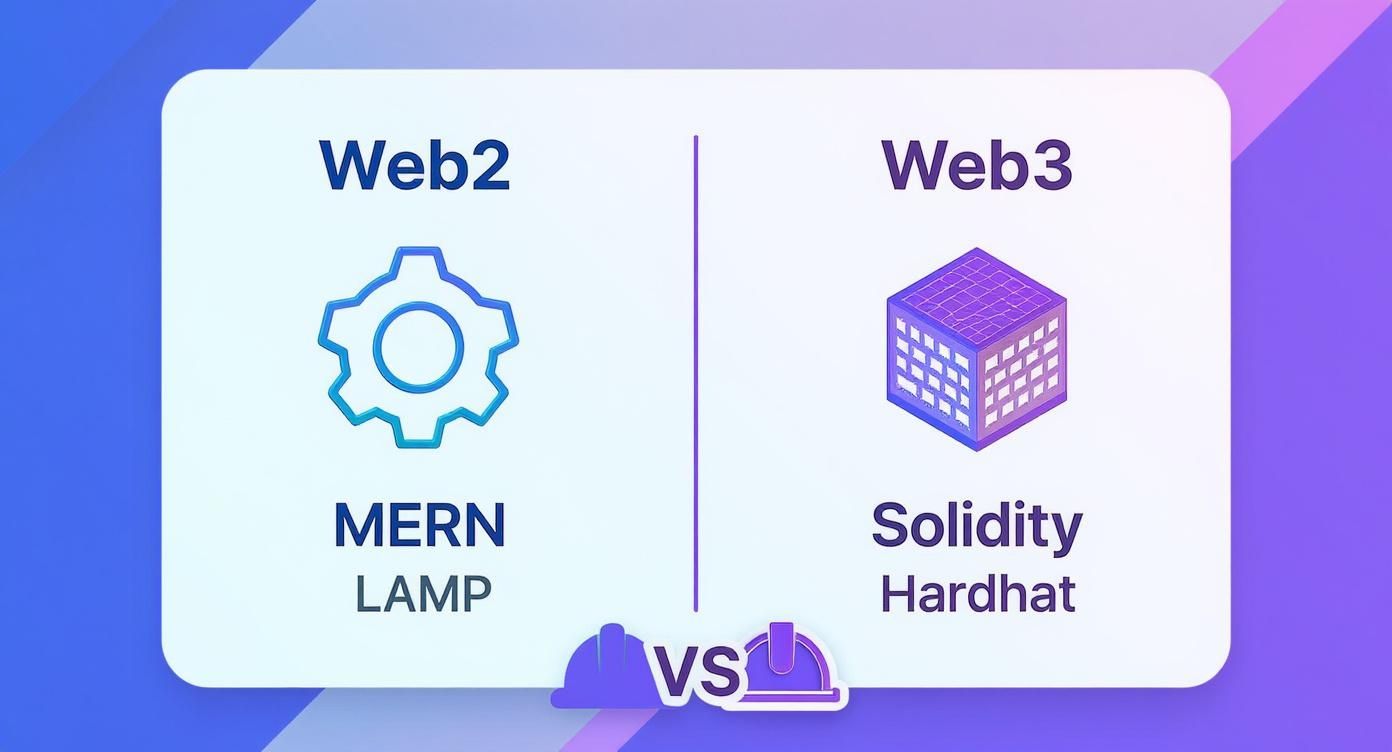
As the image shows, the shift from familiar web frameworks to specialized blockchain tools directly shapes the kinds of questions you'll get.
Instead of a generic system design prompt, a Web3 interview will present a scenario rooted in decentralization and smart contracts.
A typical Web3 design question would sound more like this:
"Design a secure and gas-efficient smart contract for an NFT minting process."
Here, the conversation has nothing to do with servers or databases. It’s all about preventing common exploits like reentrancy attacks, optimizing for low transaction costs (gas), and showing you grasp token standards like ERC-721. Demonstrating this specific knowledge is how you prove you can be trusted to write code that handles real financial value on an immutable ledger.
Ultimately, preparing for an interview in either space requires targeted practice. For Web2 roles, grind LeetCode and study system design primers. For Web3, you need to dive into smart contract security best practices and build a few small dApps to really get a feel for the core principles. By knowing what to expect, you can frame your experience effectively and show you have the right mindset for the job.
Charting Your Course from Web2 to Web3
Making the leap from Web2 to Web3 is more than just learning a new tech stack. It's a genuine mindset shift. You can't just dip your toes in; you have to dive in and show you're committed to a totally different way of building things. A good plan will get you there and make you a standout candidate in a market that's getting more competitive by the day.
The first move is simple: stop just reading and start doing. Telling a hiring manager you've read a few articles about Web3 won't cut it. You need to get your hands dirty with the core principles that make this space so different.
Get the Fundamentals Down Cold
Your first mission is to build a rock-solid, practical grasp of blockchain technology. This isn't about becoming a cryptography whiz overnight. It’s about internalizing the concepts that power every single Web3 application, a non-negotiable for any role, technical or not.
Start with the bare essentials to build your resume:
- Blockchain Fundamentals: Forget the buzzwords. You need to genuinely understand how a distributed ledger operates, what consensus mechanisms (like Proof-of-Work vs. Proof-of-Stake) actually do, and why immutability changes the entire game.
- Smart Contracts: Figure out what they are, how they work, and, crucially, what their limitations are. Think of them as permanent, public pieces of code that often control a lot of money. The stakes are high.
- Wallet Interactions: This part is non-negotiable. Set up a wallet like MetaMask, hop onto a testnet, and play around with a few dApps. Feel what it’s like to sign a transaction or manage your own assets. This firsthand experience is priceless and something you can discuss in an interview.
This foundation is what separates the curious from the serious. It proves you've put in the work and are ready to tackle the unique problems that come with building in Web3.
The Web2 pros who really succeed in Web3 are the ones who grasp the "why" behind decentralization, not just the "how." In an interview, they can clearly explain the trade-offs between a private server and a public blockchain. That skill alone puts them in a different league.
Prove You Can Build (And Participate)
Once you've got the basics down, it’s time to prove you can actually apply them. In the Web3 world, your GitHub contributions and on-chain activity often say more than your resume ever could. Recruiters are actively looking for people who are already part of the ecosystem.
Here’s how to build a portfolio that will get you on their radar:
- Contribute to Open Source: Find a Web3 project on GitHub that you find interesting and start small. Fix a typo in the docs, help out in the project's Discord, or grab a bug tagged as "good first issue." Every contribution is a public signal of your skills and drive.
- Participate in a DAO: Joining a Decentralized Autonomous Organization gives you a front-row seat to community governance, proposal voting, and collaborative work—all core tenets of the Web3 ethos. This is a powerful resume item.
- Build Something Simple: Put together a basic dApp. It doesn't have to be revolutionary. A simple NFT minter or a voting contract is more than enough to prove you can hook up a frontend to a smart contract and get it on-chain. This is a massive talking point for any interview.
When you're actively participating, you're doing more than just learning—you're networking and building a credible, Web3-native track record. It's the fastest way to close the gap between your Web2 background and the skills needed to land a great role from a platform like Blockchain Jobs.
Frequently Asked Questions
Thinking about a career move between Web2 and Web3 brings up some big questions about skills, focus, and what makes sense for the long haul. Here are some straight answers to the things I hear most often from tech pros weighing their options.
Should I Abandon My Web2 Skills To Pursue Web3?
Absolutely not. In fact, you'd be shooting yourself in the foot if you did. The strongest Web3 developers are the ones who built on their solid Web2 foundation, not the ones who started from scratch. Your existing skills are a competitive advantage.
Think about it: core skills like JavaScript, cloud architecture, and database management are the bedrock for so many Web3 applications. The real magic happens when you layer Web3 concepts on top of that existing expertise. It makes you a more versatile and valuable builder, someone who can bridge the gap between both worlds and command a higher salary.
What Is The Biggest Mindset Shift From A Web2 To A Web3 Role?
The biggest change is how you think about trust and security. In Web2, your job is to build and protect a central authority—the company's server, the database, the platform itself. Everything revolves around making that central point trustworthy.
Web3 flips that entirely. You're designing for a "trustless" environment where no single person or company is in charge. This forces you to prioritize security, immutability, and transparency above everything else. It also means you're no longer designing for "users" but for "community owners" who have a real stake and a voice in the network's future. This understanding is key to passing interviews.
The core challenge in Web2 is scaling a single point of trust. In Web3, the challenge is coordinating a network that operates without a central trusted party, completely changing security and performance considerations that you will be tested on.
How Can I Get Web3 Experience If Entry-Level Jobs Require It?
This is the classic chicken-and-egg problem, but Web3’s open, community-first nature gives you a way around it. You don't need a formal job title to build a killer track record and impress a hiring manager.
Here’s how to get your hands dirty and build your resume:
- Contribute to Open Source: Find a project on GitHub that interests you and start contributing. Many are incredibly welcoming to newcomers and will guide you through getting your first pull request merged.
- Participate in Hackathons: These are awesome for building something fast, meeting other developers and potential employers, and showing you can deliver under pressure. A hackathon win is a major resume booster.
- Build a Personal dApp: Nothing speaks louder than a working project. Create a simple decentralized app that solves a problem you care about. It’s an instant portfolio piece that proves you have practical skills.
- Join a DAO: Get involved with a Decentralized Autonomous Organization. Even small contributions to proposals or projects give you real-world experience and show you're serious about the space.
Ready to make your move into the decentralized world? At Blockchain Jobs, we connect talented professionals like you with top opportunities in the Web3 ecosystem. Find your next role in engineering, product, marketing, and more by exploring our curated job board at https://blockchain-jobs.com.