Web3 Careers: Top Roles & Skills for 2026

Blockchain-related job postings grew by approximately 45% in 2025, a clear sign that Web3 has moved past the novelty phase and into long-term company building, not just experimentation, according to Syndika's Web3 hiring trends write-up. That changes the career conversation.
Job seekers often still approach Web3 careers the wrong way. They treat it like a niche corner of tech, assume it's only for smart contract engineers, and rely on standard job application playbooks. Hiring teams don't operate like that. The strongest candidates usually show relevance before they ask for a role. They understand a protocol's product, community, and business model, then position themselves as useful.
That's why this isn't a list of trendy titles. It's a hiring-focused guide to how people get in, how they progress, and where candidates waste time. If you're serious about breaking into Web3, whether you come from engineering, product, compliance, operations, marketing, or community, start by studying the market where the roles live, such as specialized blockchain job listings.
Why a Web3 Career Is Your Next Big Move
The biggest mistake I see is treating Web3 like a speculative side market. It isn't. Hiring managers are building real teams around infrastructure, compliance, product, security, growth, and community. The professionals who move early usually gain two advantages: they build domain credibility faster, and they learn in public while the market is still defining best practices.
Web3 careers also reward people who can handle ambiguity without freezing. Teams are lean. Job descriptions are often rough drafts, not polished corporate frameworks. A product manager may need to understand governance proposals. A marketer may need to translate token utility into language users trust. A compliance lead may sit close to product decisions much earlier than they would in a large Web2 company.
Why the shift matters now
Traditional tech hiring often values pedigree first. Web3 hiring usually values proof of contribution first. That's a better market for candidates who can learn fast, communicate clearly, and show their work.
A lot of professionals also underestimate the range of viable entry points. You don't need to become a protocol engineer to build a serious career here. Teams need operators, researchers, finance talent, legal specialists, ecosystem managers, and people who can keep communities healthy when markets get noisy.
Practical rule: If you can connect an existing skill to a decentralized business model, you have a potential place in Web3.
What hiring managers actually notice
They notice whether you understand how the company works. Not just what it says on its homepage.
They notice whether your background translates cleanly. If you come from fintech compliance, can you explain how that experience applies to crypto risk and policy workflows? If you come from SaaS product, can you discuss wallet UX, governance friction, or trust issues in onboarding?
They also notice speed. The best candidates don't spend months “getting ready.” They start small and build signal.
A practical way to think about Web3 careers:
- You're not switching industries blindly. You're repositioning your current skills in a new operating environment.
- You're not waiting for permission. You're building evidence that you belong.
- You're not chasing hype. You're targeting roles tied to product delivery, user growth, risk management, or infrastructure.
The Web3 Career Landscape Explained
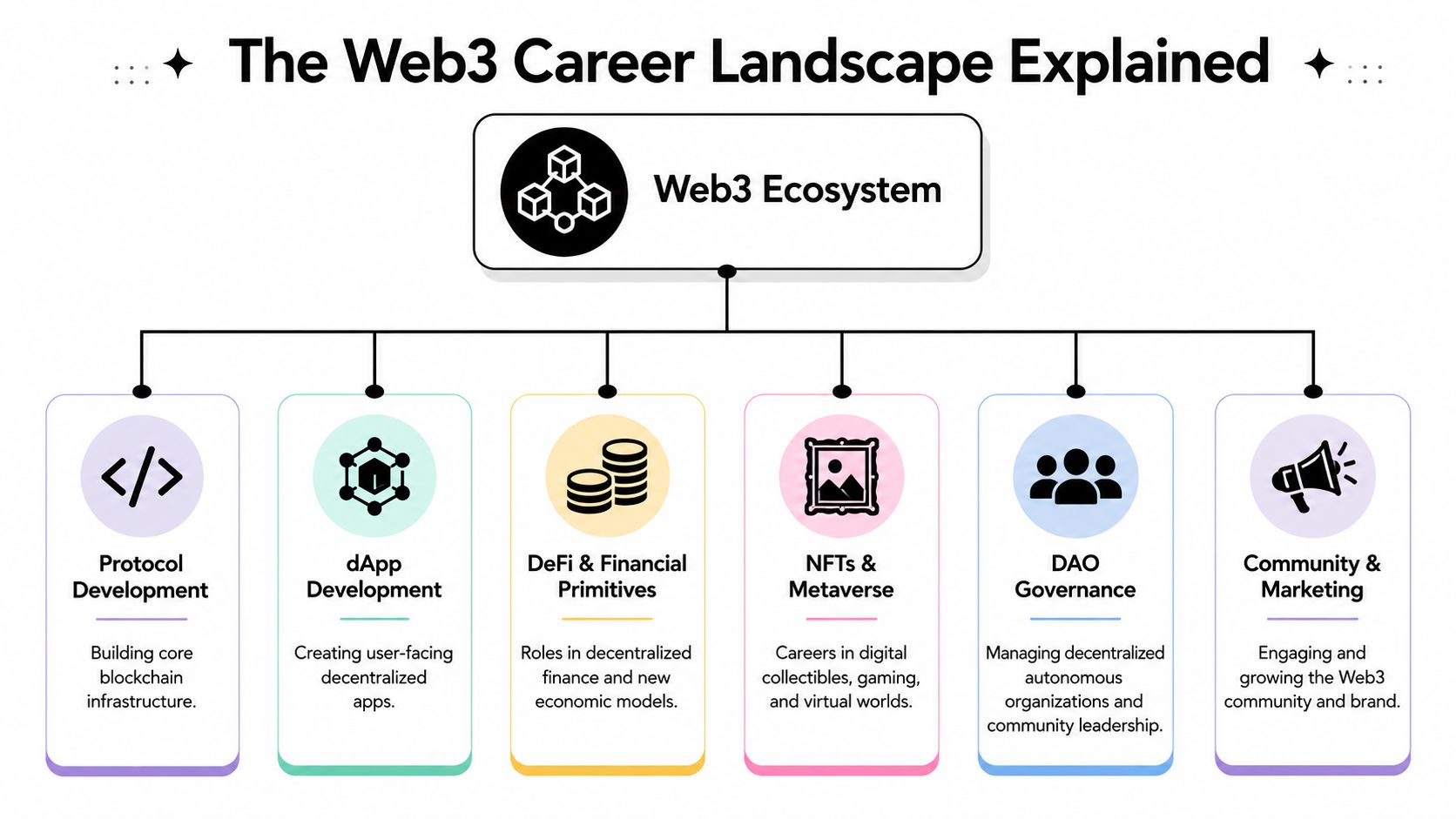
Web3 is easier to understand when you stop thinking in job titles and start thinking in operating layers. Some teams build core infrastructure. Some build products on top of it. Others manage liquidity, governance, legal risk, or user growth around those systems.
The common myth is that technical roles dominate the market and non-technical roles are the easy fallback. That's outdated. Non-technical postings now dominate hiring, accounting for 66% of 66,494 new roles, while developers are oversupplied, according to the 2025 Web3 Jobs Report coverage from Coincub. That doesn't mean non-technical roles are easier to win. It means more candidates should stop ignoring them and start preparing for them properly.
You can review the types of employers active in the space through Web3 companies hiring across categories.
The main career lanes
Protocol development sits closest to the chain. These teams work on consensus, infrastructure, smart contracts, tooling, and performance. Hiring managers here care about code quality, security thinking, and systems depth.
dApp and product teams build what users touch. That includes wallets, dashboards, consumer apps, trading interfaces, analytics products, and onboarding flows. Product, design, frontend, backend, and QA talent all fit here.
DeFi and financial operations involve roles tied to market structure, treasury, analytics, risk, and ecosystem strategy. These jobs often reward people who can connect financial reasoning with on-chain behavior.
DAO governance and community roles focus on coordination. That includes governance operations, proposal processes, contributor management, moderation, education, and communications.
Non-technical doesn't mean low-barrier
Many candidates frequently misunderstand the market. A lot of Web2 professionals assume they can slide into community, operations, or marketing just because they aren't coding. Hiring teams usually reject that quickly.
What they want is contextual fluency. A community manager in Web3 isn't just posting updates. They're reading sentiment in Discord, handling user trust during product issues, escalating governance concerns, and often acting as the earliest warning system for product confusion.
A strong non-technical candidate usually demonstrates:
- Domain understanding: They can explain a protocol, product, or ecosystem in plain English.
- Operational judgment: They know how to handle ambiguity, asynchronous work, and public-facing communication.
- Credibility with users: They don't sound like they copied Web3 language yesterday.
The candidates who stand out aren't always the most crypto-native. They're the ones who can make a decentralized company run better.
Top In-Demand Roles and Salary Benchmarks
Demand in Web3 doesn't spread evenly. Some roles stay consistently hard to fill because they sit close to revenue, risk, or core product delivery. Others look attractive on paper but attract huge applicant volume without enough signal from candidates.
The sharpest technical demand remains concentrated in Smart Contract Developers, especially those working in Solidity and Rust. Salary ranges for these roles run from $125,000 to $270,000 annually, and Rust developers command premiums averaging $152,000 in North America, based on Metana's market breakdown of in-demand Web3 jobs.
If you're benchmarking engineering opportunities, reviewing current blockchain engineering roles helps you see how employers package these expectations in live job specs. For a broader compensation lens, I also recommend these 2026 compensation salary survey insights, especially for comparing how companies think about cash versus broader package structure.
Roles worth targeting
Below are the roles I'd prioritize if I were advising candidates based on hiring friction and long-term upside.
| Job Role | Average Salary Range | Key Skills |
|---|---|---|
| Smart Contract Developer | $125,000 to $270,000 | Solidity, Rust, security mindset, protocol logic |
| Blockchain Developer in the United States | $145,000 average yearly salary | Blockchain architecture, backend development, integrations |
| Solidity Developer in North America | $138,000 median payroll | Solidity, testing, audits, EVM development |
| Project Manager | $80,000 to $150,000 | Cross-functional delivery, async operations, stakeholder management |
| Crypto Compliance Officer | $110,000 to $240,000 | Regulatory analysis, risk, policy, process building |
| AI + Web3 Engineer | $140,000 to $250,000 | AI systems, blockchain integration, applied engineering |
What these roles actually involve
Smart Contract Developer
This role isn't only about writing contracts. Teams expect candidates to think about attack surfaces, edge cases, testing discipline, upgrade patterns, and what happens when users behave unpredictably. In interviews, shallow Solidity knowledge gets exposed fast.
Project Manager
In Web3, project management often means herding contributors across time zones, clarifying ownership in loosely structured teams, and keeping execution moving when product requirements are still evolving. Strong operators do very well here.
Crypto Compliance Officer
This is one of the most underestimated lanes. Good compliance hires help teams move faster by reducing legal and operational uncertainty. Hiring managers want people who can interpret rules without turning every decision into a dead end.
AI + Web3 Engineer
This role sits at the intersection of two fast-moving areas. Candidates who can connect automation, agents, data workflows, or intelligent interfaces with blockchain products are increasingly valuable.
How to read compensation in Web3
Don't evaluate a Web3 role by base salary alone. Some employers include token equity or performance-based incentives. Those can be meaningful, but only if you understand vesting, liquidity, and how the token fits the business.
Use this filter when comparing offers:
- Base pay first: Make sure the cash compensation works without relying on upside stories.
- Token logic second: Ask what drives token value and how your package is structured.
- Scope matters: A broader role may justify a stronger package, but only if authority matches responsibility.
Essential Skills You Need to Get Hired
A strong Web3 candidate usually combines one deep skill with several context skills. Hiring managers don't expect everyone to know everything. They do expect candidates to know where they create value and where they still need support.
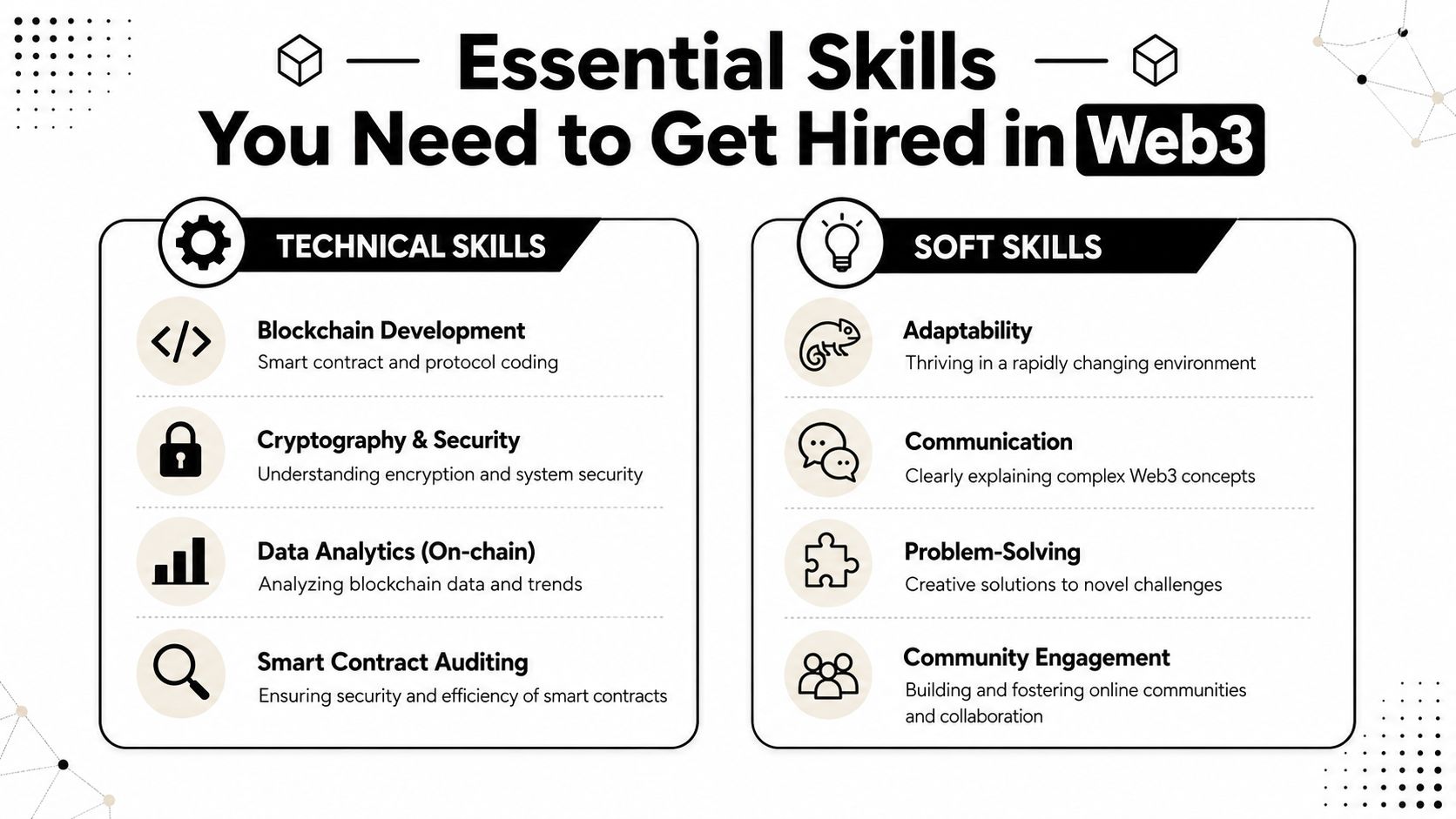
The split I use is simple. First, can you do the job? Second, can you operate in a decentralized team without creating drag?
Technical skills that carry weight
For engineering candidates, Solidity and Rust matter in different environments. Solidity is central to EVM ecosystems and smart contract-heavy product teams. Rust becomes more relevant in ecosystems and infrastructure stacks where performance and systems engineering matter.
Security awareness separates serious candidates from resume-driven ones. If you write contracts, you should understand common failure modes, testing habits, and why auditors ask the questions they ask. If you work in product or operations, you still need a basic grasp of wallet risk, transaction behavior, and user safety because those issues affect real users every day.
On-chain analytics is another differentiator. Product managers, growth leads, researchers, and ecosystem teams become much stronger when they can interpret wallet activity, usage patterns, and protocol behavior instead of relying only on surface-level dashboards.
Soft skills that hiring teams quietly rank higher
Plenty of candidates can learn tools. Fewer can work well in a Web3 environment.
Here's what gets noticed:
- Asynchronous communication: Can you write clearly in Slack, Notion, Telegram, Discord, and internal docs without constant meetings?
- Adaptability: Can you stay useful when priorities shift, ownership is fluid, and the roadmap changes?
- Community judgment: Do you understand that users, token holders, contributors, and customers may all overlap?
- Translation ability: Can you explain technical concepts to non-technical people and business trade-offs to technical teams?
A candidate who communicates clearly and ships consistently will beat a more credentialed candidate who needs heavy management.
Must-have versus nice-to-have
A quick filter helps.
| Skill type | Must-have for hiring | Nice-to-have |
|---|---|---|
| Technical candidates | Core language depth, testing habits, product understanding | Multi-chain exposure, formal audit experience |
| Product and ops candidates | Clear communication, execution, protocol fluency | Token design literacy, analytics depth |
| Community and marketing candidates | Writing, moderation judgment, ecosystem awareness | Governance operations, event leadership |
If you're early in the transition, don't collect random buzzwords. Pick a lane. Build one credible body of work around it. That's what gets interviews.
Your Roadmap for Transitioning into Web3
A Web2 background can help a lot in Web3 if you translate it properly. The transition usually fails when people either over-romanticize the industry or under-prepare for its culture. The best route is narrower and more practical.
Start with the visual map below, then treat it like a working plan rather than a one-time checklist.
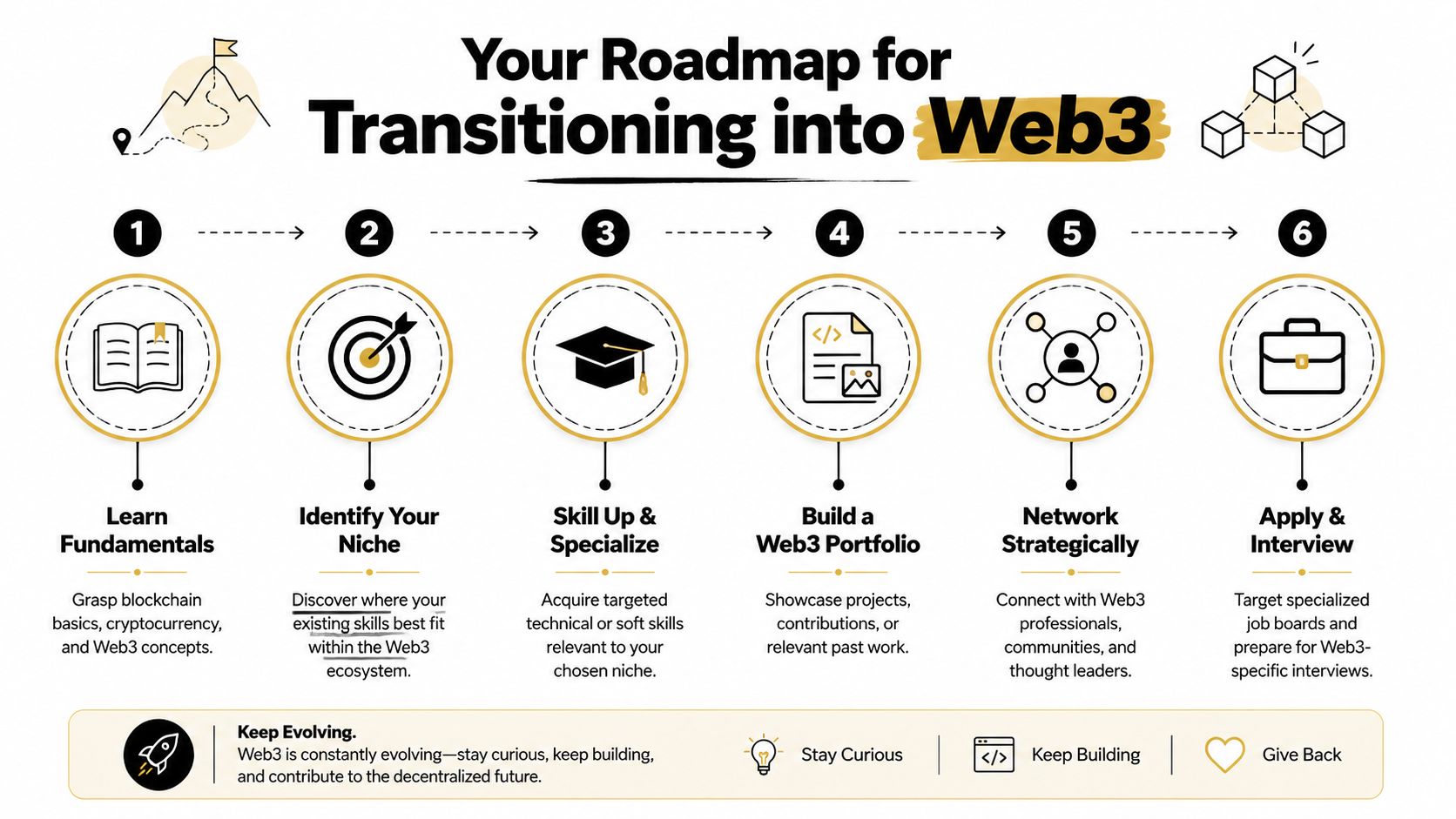
Step one is exposure, not credentials
Before you apply anywhere, spend time inside the ecosystem. Follow founders, protocol teams, researchers, and operators on X. Join Discord servers. Read docs, governance forums, product announcements, and release notes.
That immersion helps you stop sounding generic. It also helps you decide whether you belong closer to infrastructure, product, compliance, growth, research, or community.
For a broader overview of the transition mindset, this short video is a useful starting point:
Build a portfolio that matches the lane
A Web3 portfolio doesn't need to be fancy. It needs to prove relevant judgment.
If you're a developer, that may mean a contract repo, test coverage, audit notes, or a small integration with a protocol. If you're a product manager, it could be a teardown of wallet onboarding, a governance UX critique, or a proposal for improving contributor workflows. If you're from compliance, publish a short memo on risk considerations in a segment you understand.
Useful portfolio ideas:
- Protocol analysis: Break down how a project works, where users might get stuck, and what the team could improve.
- Community contribution: Help in Discord, answer user questions, moderate discussions, or summarize governance decisions.
- Open collaboration: Join a DAO, contribute to documentation, test a beta, or support ecosystem operations.
Translate your Web2 experience properly
Don't say you're “passionate about crypto” and hope that fills the gaps. Show the bridge.
A few examples:
- From SaaS product to Web3 product: Talk about onboarding friction, trust design, and user education in wallet-based flows.
- From fintech compliance to crypto compliance: Show how AML, controls, and risk workflows adapt to on-chain systems.
- From brand marketing to community growth: Show where audience building overlaps with community stewardship, and where it doesn't.
Your old title matters less than your ability to reframe your experience around a decentralized product or community.
Network with intent
Good networking in Web3 doesn't look like mass cold outreach asking for calls. It looks like being visible for the right reasons. Comment intelligently. Share useful research. Ask informed questions. Contribute before requesting attention.
That creates familiarity, which lowers hiring risk.
How to Nail the Web3 Application and Interview
Traditional application behavior underperforms in Web3. Sending resumes into generic forms and waiting rarely gives strong candidates their best shot. Teams move fast, roles evolve mid-search, and many decision-makers pay more attention to direct contact than to polished applicant funnels.
That's why one hiring pattern matters more than most candidates realize. 2026 hiring trends show direct outreach through DMs and emails is the primary gatekeeper, and messaging teams directly is described as the key move for landing roles, according to Hiro's guide to starting a career in Web3.
How to reach out without sounding desperate
Direct outreach only works when it's specific.
A bad message says you love Web3 and want to help. A strong message shows you understand what the team is building and where you fit. Mention the product, user problem, or recent launch. Then offer a reason they should talk to you.
A useful structure:
- Line one: Why this team caught your attention
- Line two: What relevant experience you bring
- Line three: One concrete way you could help
- Line four: A short ask, such as whether they're hiring or open to a conversation
Keep it tight. Nobody wants your life story in a first DM.
What proof-of-work looks like in hiring
Web3 employers trust evidence over enthusiasm.
For engineers, proof-of-work means shipped code, repos, contract reviews, bug fixes, or technical writing. For non-technical candidates, it can mean governance summaries, growth analyses, ecosystem research, community moderation, documentation improvements, or product feedback that clearly reflects domain understanding.
Here's the standard I use: if a hiring manager looked at your materials for five minutes, would they see that you've already behaved like someone in the industry?
What interviewers usually test
Web3 interviews often blend skill assessment with ecosystem judgment. Expect less polished corporate interviewing and more practical conversation.
Hiring teams tend to probe:
- Product understanding: Do you understand what the protocol, app, or infrastructure does?
- Mission fit: Are you aligned with the company's operating style and users?
- Decision quality: Can you explain trade-offs clearly?
- Security and risk awareness: Especially for product, engineering, and compliance roles
- Communication: Can you write and speak with clarity in an async environment?
If you can't explain the company's product, users, and business model in simple language, you're not ready for the interview.
Bring opinions, but keep them grounded. Interviewers don't need maximalism. They need evidence that you can think clearly in a messy market.
Finding Your Role on Specialized Job Boards
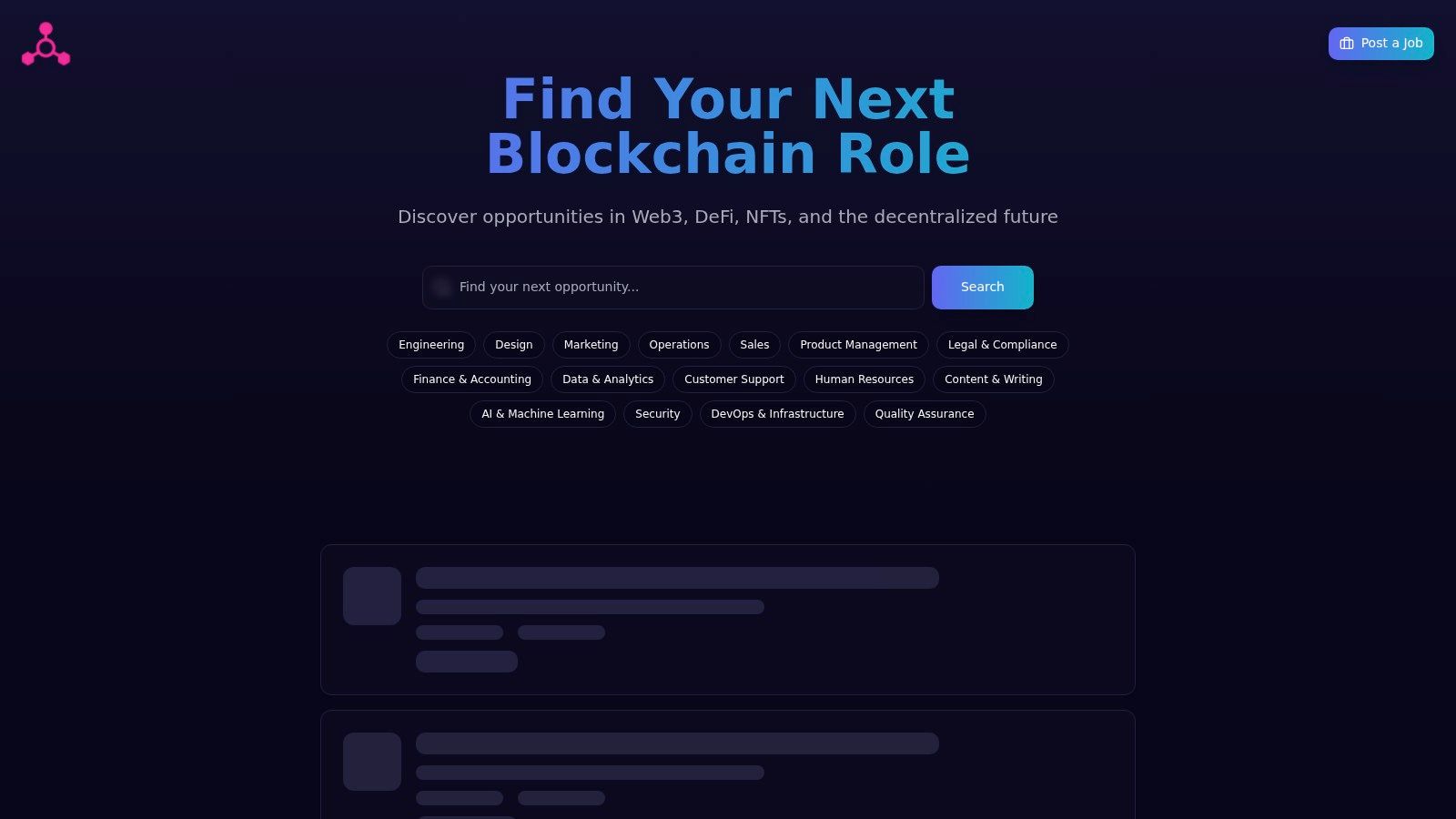
General job platforms often flatten Web3 roles into vague tags. Specialized job boards are more useful because they reflect how this market is organized: by function, crypto-native context, and category depth.
That matters because the market is active. The Web3 job market continues growing, with 3,700+ new positions added monthly across over 22,000 listings on specialized platforms, according to the Web3 jobs market summary shared in r/WebDeveloperJobs. When volume is high, filtering well becomes a career skill.
How to search like a recruiter
Start narrow. Pick one function and one context. “Product” is too broad. “Product manager, wallet, compliance-aware” is useful. “Marketing” is broad. “Community and ecosystem, DeFi” is useful.
Then filter around the practical constraints that affect your fit:
- Role category: Engineering, product, legal, compliance, community, operations, or design
- Work setup: Remote-friendly versus location-linked roles
- Keyword fit: Protocol, wallet, DeFi, infrastructure, DAO, governance, security
- Company stage: Early startup versus established team
How to judge a listing quickly
Good candidates don't apply everywhere. They screen for signal.
A listing is usually worth your time if it shows clear product context, realistic responsibilities, and a team that knows what problem it's hiring to solve. Be cautious when a role tries to combine too many unrelated functions or reads like a wishlist with no operating clarity.
Look for signs of seriousness:
| Signal | What it tells you |
|---|---|
| Clear reporting line | The team likely knows how the role fits |
| Specific product context | They understand what they need |
| Defined functional scope | You won't walk into total chaos |
| Relevant tooling or stack references | The hiring manager has practical expectations |
The best search habit is simple. Save a few tight searches, review them consistently, and apply only when you can tailor your pitch.
If you're ready to move from research to action, Blockchain Jobs is a strong place to start. It's built for Web3 hiring, covers technical and non-technical roles across the ecosystem, and makes it easier to find openings that match how this industry hires.