
What Does a Blockchain Developer Do? a 2026 Career Guide

You're probably in one of two situations right now. You're either trying to break into Web3 and the phrase blockchain developer still feels frustratingly vague, or you're hiring and realizing that candidates who all use the same title often do very different work.
That confusion matters because blockchain development isn't one job. It's a cluster of jobs with very different technical depth, interview expectations, and career ceilings. A developer writing Solidity for a DeFi app isn't solving the same problems as an engineer working on consensus rules, validator behavior, or cryptographic guarantees inside a protocol.
The practical answer to what does a blockchain developer do starts with responsibility. These engineers build and maintain systems where code often controls money, access, and irreversible state changes. That means the work is less about shipping features fast and more about shipping features that are correct, auditable, and resilient under adversarial conditions. If you need a quick grounding in how blockchains function before thinking about careers, Cascoin's crypto mining guide is a useful refresher on the mechanics underneath the development work.
Beyond the Code What Does a Blockchain Developer Actually Do
A blockchain developer writes software, but the job goes well beyond writing software that merely runs. The code has to produce deterministic outcomes across distributed nodes, handle hostile inputs, and preserve trust without relying on a central operator. That changes how you think about design, testing, deployment, and maintenance.
In practice, the work usually includes some mix of protocol logic, smart contracts, node interaction, wallet flows, off-chain services, monitoring, and security review. The exact mix depends on the role. What doesn't change is the cost of mistakes. In a traditional app, you can patch a bug after users complain. In blockchain systems, a bad contract or weak integration can lock funds, break governance, or expose users to exploits.
What the job looks like in real teams
A normal week might include reviewing Solidity code for unsafe external calls, debugging a failed transaction simulation, integrating a wallet connection, or writing back-end services that index chain events for a front end. In more infrastructure-heavy roles, it might mean working on validator logic, client performance, cryptographic implementations, or peer-to-peer networking behavior.
The strongest developers in this field think in layers:
- Protocol layer: How consensus, networking, and state transitions work
- Contract layer: How business logic executes on-chain
- Application layer: How users sign, submit, and track transactions
- Operations layer: How systems are tested, monitored, and recovered
Blockchain development is software engineering under permanent audit. Your code isn't just expected to work. It's expected to survive scrutiny.
What separates good from mediocre
Good blockchain developers don't chase complexity for its own sake. They reduce attack surface, simplify assumptions, and document trade-offs. They know when logic belongs on-chain and when it should stay off-chain. They understand that convenience features often create security liabilities.
Hiring managers should watch for this mindset. Junior candidates can grow into tools and frameworks. It's much harder to teach judgment around immutability, key management, adversarial modeling, and upgrade risk.
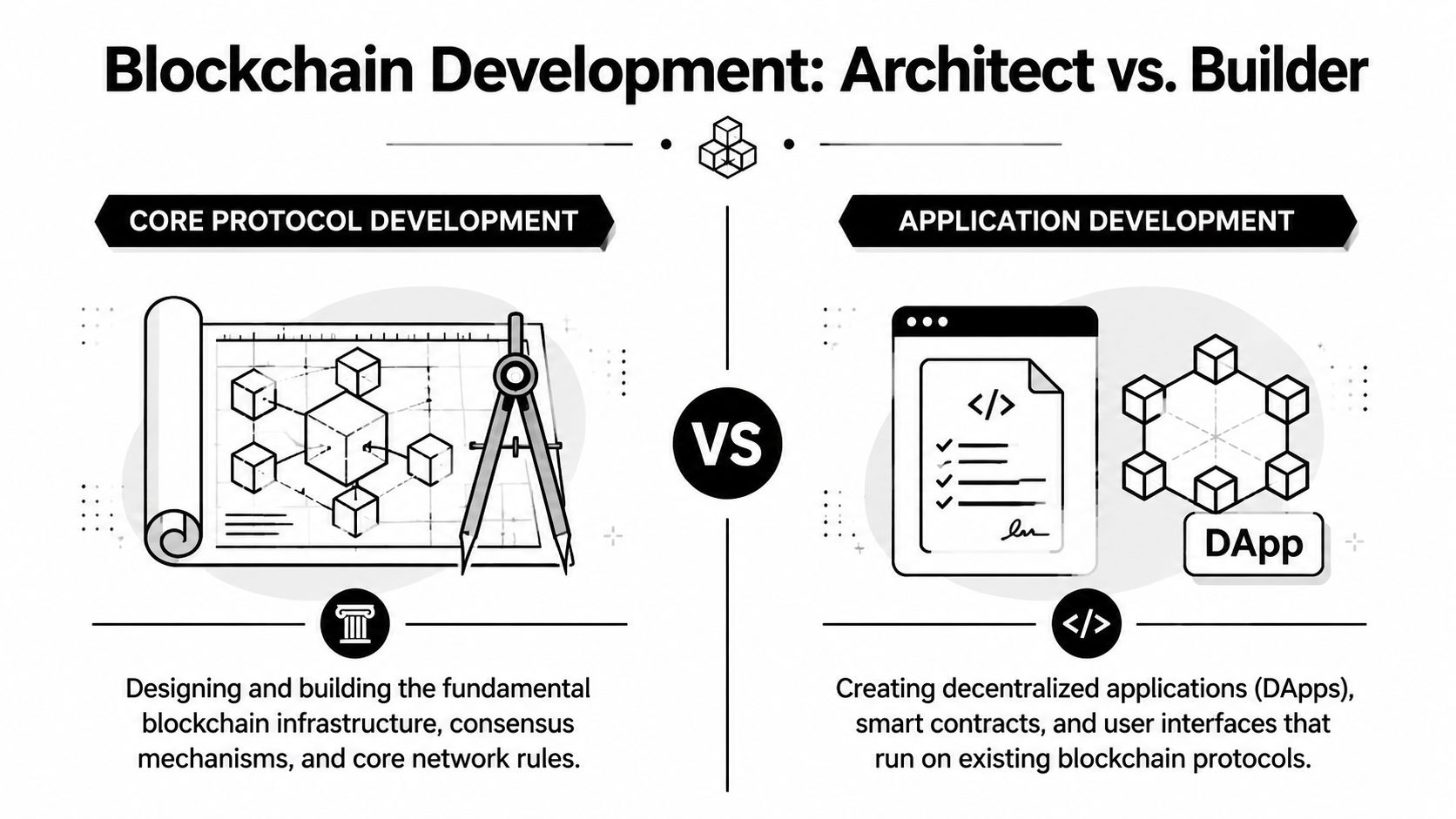
The Architect vs The Builder Core Protocol vs Application Development
The biggest career mistake in blockchain is treating blockchain developer as a single path. It isn't. The field splits into two very different tracks: Core Protocol Engineers and Blockchain Application Developers.
The easiest analogy is automotive design. One engineer designs the engine, combustion behavior, and the rules that make the machine move. Another builds the body, controls, and experience the driver uses. In blockchain, the core engineer designs the chain itself. The application developer builds on top of that chain.
What core protocol engineers do
Core protocol engineers work on the machinery that makes a blockchain credible. They design or maintain consensus mechanisms, network rules, validator behavior, cryptographic security patterns, and client architecture. They're the people who think about finality, state propagation, fork choice, and how a network behaves under stress.
This path demands stronger systems knowledge and deeper comfort with low-level performance concerns. It's also where the market pays a premium. Core Protocol Engineers in major markets earn 35-40% more than dApp developers, with median salaries exceeding $160,000 versus $115,000, according to Coursera's blockchain developer analysis. If you want to see how employers frame that role in practice, a protocol engineer opening gives a clearer picture than most generic career guides.
What application developers do
Application developers build the layer users touch. That means smart contracts, dApp back ends, front-end integrations, wallet flows, transaction handling, indexing, and business logic. They care about product behavior, usability, contract safety, and how to make on-chain systems usable without hiding the risks.
This path usually gets people hired faster because the learning loop is shorter. You can build a deployable dApp sooner than you can become useful on consensus or client internals. For many engineers, that's the right entry point.
The real trade-off
Core protocol work has a higher technical barrier and often a higher salary ceiling. Application development has a larger surface area for product work, faster portfolio creation, and more obvious paths for juniors.
Neither path is “better.” They reward different instincts.
- Choose core protocol if you enjoy cryptography, distributed systems, performance, and network architecture.
- Choose application development if you enjoy shipping user-facing products, modeling business logic, and working across front end, contracts, and APIs.
- Move from app to core only if you're willing to invest in the learning pivot called out in the salary data: advanced cryptography plus systems-heavy languages such as Rust or C++.
Hiring signal: A candidate who can clearly state which side of this boundary they belong on is already ahead of most applicants.
Four Key Specializations in Blockchain Development
Once you separate architect from builder, the work gets more specific. Organizations typically don't need a generic blockchain developer. They need a specialist who can own one hard part of the stack.
Core blockchain developer
This is the infrastructure role. A core developer architects consensus protocols such as PoS or PoW and builds the cryptographic security layers that protect data integrity. The job often involves network rules, node behavior, transaction validation, and performance decisions that affect the whole chain.
One practical example matters here. A core developer may need to optimize smart contract gas costs from O(n²) to O(n) to avoid fee spikes from $5 to over $50 during peak demand, as described in the verified technical brief on core developer responsibilities. That's not cosmetic optimization. It directly affects whether the network remains usable under load.
Smart contract developer
This role owns business logic on-chain. Smart contract developers write, test, deploy, and audit code that controls token movement, permissions, governance, staking, vaults, or marketplace rules. In many companies, this is the center of product risk.
The work looks deceptively simple from the outside. A contract can be short. The difficulty comes from edge cases, upgrade strategy, reentrancy risk, oracle assumptions, and the fact that once deployed, mistakes are expensive to fix.
The best smart contract developers write less code than juniors expect. They remove branches, reduce external dependencies, and choose boring patterns when money is at stake.
Blockchain backend and API developer
Not every important blockchain job is purely on-chain. Backend and API developers build the services that connect products to nodes, wallets, and indexed data. They often use Web3.js or Ethers.js to connect interfaces to blockchain nodes, manage transaction flows, and expose data in ways product teams can use.
They also make key architecture choices around storage. For dApps, implementing IPFS for off-chain storage is critical for reducing on-chain load while preserving accessibility, based on the verified technical description of blockchain software development.
Tooling and infrastructure developer
This role improves developer velocity. Tooling engineers build SDKs, test harnesses, deployment pipelines, local dev environments, libraries, and security workflows. If your team uses Hardhat, Truffle, custom scripts, or internal contract templates, someone usually owns that ecosystem.
In mature teams, this role is a force multiplier. One strong tooling engineer can improve quality across every contract and service repo in the company. Security-focused versions of this role are often close to dedicated audit work, which is why many teams look for profiles similar to a blockchain security engineer role.
Blockchain Developer Specializations at a Glance
| Specialization | Primary Focus | Key Technologies |
|---|---|---|
| Core Blockchain Developer | Consensus, node behavior, cryptographic security, network rules | PoS, PoW, C++, Rust, Go, ECDSA |
| Smart Contract Developer | On-chain business logic, audits, deployment, gas efficiency | Solidity, Vyper, Hardhat, Truffle |
| Blockchain Backend and API Developer | Node communication, indexing, wallet flows, off-chain services | Web3.js, Ethers.js, IPFS, React, Vue |
| Tooling and Infrastructure Developer | SDKs, frameworks, test systems, deployment and audit support | Hardhat, Truffle, internal tooling, security analyzers |
The Blockchain Developer Skillset and Tech Stack for 2026
Most hiring managers say they want blockchain experience. In reality, they want a mix of classic software engineering and blockchain-specific judgment.
Foundations that aren't optional
Start with the fundamentals. If a candidate is weak on algorithms, data structures, debugging, or back-end design, blockchain tools won't save them. Smart contracts, node software, and indexing services all punish shallow engineering habits.
Then add the blockchain layer. You need to understand consensus, transaction lifecycle, state changes, signatures, and cryptographic assumptions well enough to explain failure modes, not just definitions. Engineers who memorize terminology but can't reason through consequences usually fail interviews.
A practical stack for application-side work often includes Solidity, JavaScript or TypeScript, React, and either Web3.js or Ethers.js for node interaction. For dApps with larger content or metadata needs, IPFS is a sensible choice because it reduces on-chain load while keeping data accessible.
What strong candidates can actually do
Strong candidates can usually demonstrate these abilities:
- Write contracts safely: They can implement access control, sanity checks, and clean state transitions in Solidity.
- Integrate the user layer: They can connect wallets like MetaMask or WalletConnect and handle transaction states without confusing users.
- Design off-chain support: They know what belongs in an indexer, API, queue, or storage layer instead of forcing everything on-chain.
- Think multi-chain: They understand that modern products often need to integrate multi-blockchain payments or support assets and users across more than one network.
The hiring difference between tools and understanding
Frameworks matter, but not in the way juniors often think. Hardhat, Truffle, Embark, Docker, and Kubernetes are useful because they help you ship and operate systems consistently. They are not a substitute for knowing why a system is secure or fragile.
Practical rule: Learn one stack deeply enough to defend your choices in an interview. Breadth helps after you're employable.
If you're aiming at protocol-heavy roles, add Rust, Go, or C++ and spend more time on networking, cryptography, and performance profiling. If you're aiming at application roles, depth in Solidity, testing, wallet UX, and event-driven back ends usually pays off faster.
Landing Your First Blockchain Developer Job
Getting hired in blockchain has less to do with resume polish and more to do with proof. Teams want evidence that you can build, test, and reason about failure.

Your portfolio matters more than your title
A candidate with a modest background but a clean GitHub repository, a tested contract system, and a readable architecture decision log often beats someone with a vague “Web3 engineer” label and no artifacts.
Good portfolio pieces include:
- A deployable dApp: Show contract code, front-end integration, transaction handling, and a short write-up on trade-offs.
- A security-focused repo: Audit a contract, document the issue, patch it, and explain the exploit path.
- A protocol deep dive: If you want infrastructure work, fork a client or build a stripped-down implementation of a network component.
- A backend integration project: Index on-chain events, expose them through an API, and explain how you handle consistency and retries.
What interviews really screen for
For senior blockchain positions, hiring managers explicitly look for 2+ years of professional experience, advanced proficiency in C++, Java, and Python, deep knowledge of consensus mechanisms, and strong grounding in back-end development, algorithms, and data structures, according to Betterteam's blockchain developer job description. Even when you're applying for a junior role, that list tells you what companies respect.
That means interviews often test more than syntax. Expect live coding, contract review, debugging, architecture questions, and threat-model discussions. Many teams will also probe how you think under uncertainty. They want to know whether you notice assumptions around external calls, upgradeability, key handling, indexing delays, or bridge interactions.
A better entry strategy
Don't try to look senior before you are. It's a bad strategy in this market.
Instead:
- Pick one lane first: Smart contracts, backend integrations, or protocol internals.
- Build one polished project: Finish it. Test it. Document it.
- Contribute in public: PRs, issue triage, and technical writing create trust.
- Apply where the role matches your evidence: Browse actual blockchain engineering jobs and compare requirements against your portfolio, not your ambitions.
Candidates usually stall because they learn passively for too long. Shipping something real is what changes your interview quality.
Salary Expectations and Career Progression in Blockchain
Compensation in blockchain is strong because the work is hard to fake and expensive to get wrong. Security, distributed systems knowledge, and product judgment rarely come bundled together in one engineer.
In the United States, the median total salary for blockchain developers is $136,000 per year, and projected job growth is 35% for the 2020–2030 period, according to the verified salary and job-growth data. Those numbers explain why engineers from back-end, security, and fintech backgrounds keep moving into this field.
How careers usually progress
Most careers start with constrained ownership. A junior developer fixes bugs, writes tests, handles small integrations, and learns deployment discipline. Mid-level engineers start owning contract modules, node integrations, or internal services. Senior engineers become responsible for architecture, incident response, review quality, and mentoring.
The progression usually branches in one of two directions:
| Stage | What changes |
|---|---|
| Junior Developer | Learns stack conventions, testing, deployment, and review discipline |
| Mid-Level Developer | Owns features or services end to end, improves reliability |
| Senior Developer | Makes architecture decisions, leads reviews, handles risk trade-offs |
| Architect or Engineering Lead | Designs systems across chains, teams, and operational boundaries |
The people who progress fastest don't just accumulate tools. They get better at making trade-offs under constraints. They know when to choose Ethereum, Hyperledger, or Corda based on the job. They become fluent in languages such as Golang, Scala, and Solidity. They learn Docker and Kubernetes because operating systems matters when blockchain software has to stay reliable.
Later in the path, your decisions have to hold up under production pressure. This overview is worth watching if you're trying to understand where the field is heading at a higher level.
What salary growth really follows
Salary doesn't increase just because you stay in the field longer. It increases when you become trusted with harder problems.
Engineers get paid more when they reduce uncertainty. In blockchain, that usually means security, protocol depth, scalability judgment, or production reliability.
That's why the market separates application builders from protocol-heavy specialists. It's also why hiring managers should define the role tightly before opening a requisition. A company that needs smart contract rigor but writes a broad blockchain developer listing often attracts the wrong candidates.
Building Your Future in the Decentralized World
The practical answer to what does a blockchain developer do is this: they build systems that replace trust in institutions with trust in code, networks, and cryptographic rules. But the job title hides major differences in responsibility. Some engineers design protocol foundations. Others build the smart contracts, interfaces, and integrations that users interact with.
That distinction should shape every career decision you make. It should shape what you study, what you build, and what jobs you apply for. If you're early in your career, don't start by chasing every chain and framework. Pick a lane, build proof, and get good at explaining your trade-offs. If you're hiring, define whether you need protocol judgment, application execution, or security depth before you start screening resumes.
There's also a broader career advantage here. Blockchain teams are distributed by default, and talent is increasingly global. For anyone exploring remote opportunities outside traditional hubs, LatoJobs insights on Latam jobs offer a useful view into how international hiring patterns are evolving.
This field still rewards curiosity, but it rewards discipline more. The engineers who last are the ones who test carefully, document assumptions, and treat security as part of product quality, not a final checklist item.
If you're ready to turn that understanding into action, explore roles on Blockchain Jobs and look for the path that matches your actual strengths, whether that's protocol engineering, smart contracts, security, or Web3 product infrastructure.