
What Is Blockchain Jobs

You're probably in one of two spots right now. You work in software, finance, operations, marketing, or legal, and you keep seeing blockchain roles pop up. Or you've already decided Web3 is interesting, but the job market still feels noisy, overhyped, and hard to decode.
That confusion is normal. The phrase what are blockchain jobs sounds simple, but it covers a wide range of work. Some roles are highly technical. Others sit in product, compliance, growth, research, community, or operations. The key question isn't just what these jobs are. It's which one matches your skills, and what you need to show to get hired.
A lot of candidates lose time because they approach this market like traditional tech hiring. That usually fails. Web3 employers screen differently, interview differently, and reward proof of skill faster than polished generalist resumes. If you want to move into this space, you need a sharper map.
Beyond the Hype What Are Blockchain Jobs Really
Blockchain jobs are roles tied to building, operating, securing, explaining, and scaling decentralized systems. That includes protocol engineering, smart contract development, product management, security review, legal work, compliance, growth, customer support, and treasury or operations roles inside crypto companies.
In practice, these jobs sit at the intersection of software, finance, internet infrastructure, and regulation. A smart contract engineer doesn't just write app logic. They write rules that may control assets directly. A compliance lead isn't just handling policy. They're helping a company operate across jurisdictions where the legal environment shifts quickly. A community manager isn't just posting content. They're often the front line between a protocol and its users.
If you're still grounding yourself in how the stack works, start with a solid overview of blockchain technology fundamentals. You don't need to become an engineer to get hired in this field, but you do need enough fluency to talk clearly about wallets, smart contracts, networks, tokens, and on-chain activity.
Practical rule: In blockchain hiring, broad curiosity helps. Demonstrated relevance gets interviews.
The biggest mistake candidates make is treating blockchain as a brand-new identity they need to invent. Usually, it's a career translation problem. A backend engineer may be closer to a protocol role than they think. A financial analyst may fit an exchange, treasury, or risk function. A lawyer may have a stronger path into Web3 than a junior coder with no portfolio.
The Evolving Landscape of Blockchain Careers
Traditional tech jobs often feel like working in a built-out city. The roads exist. The job ladders are familiar. The company knows what “senior product manager” or “staff backend engineer” means.
Blockchain careers feel more like helping build the city itself. Teams are still designing the roads, the rules, the utilities, and sometimes the map.
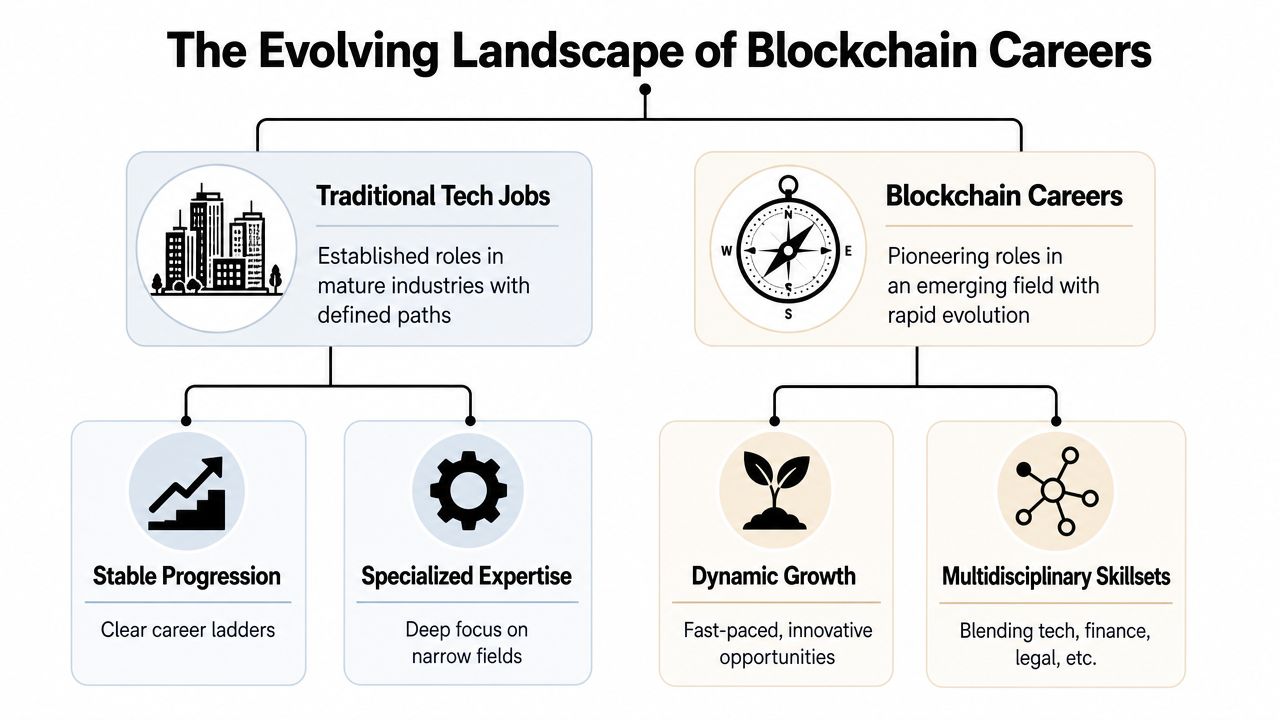
That difference matters for hiring. Employers often want people who can operate with less structure, make judgment calls earlier, and work across functions. A protocol startup may need an engineer who understands security trade-offs, a product person who can write clear specs for token flows, or an ops lead who can coordinate legal, treasury, and exchange relationships without a large support system.
Why the market no longer looks niche
The labor market data supports what recruiters have been seeing in practice. In 2025, the global Web3 labor market added 66,494 new roles, a 47% rebound from 2024. The U.S. accounted for 21,612 roles, and remote roles reached 26,925, up 40% year over year, according to Coincub's 2025 Web3 jobs report.
Those numbers matter for two reasons. First, this isn't a fringe hiring lane anymore. Second, the remote share tells you something important about how the market functions. Blockchain companies hire globally by default. You aren't only competing with local candidates, but you're also not limited by your local market.
What candidates get wrong about this environment
Many applicants still assume blockchain hiring is mostly speculative startup chaos. That's outdated. The better way to think about it is this:
- Infrastructure is maturing: More teams now hire around security, DevOps, protocol reliability, and compliance.
- Cross-border work is normal: Teams recruit across North America, Europe, Asia, and remote-first hubs.
- Generalist branding hurts: Broad “tech enthusiast” positioning gets ignored. Focused evidence gets attention.
- Career paths are less linear: You may move from community into product, from fintech compliance into exchange operations, or from backend engineering into protocol work.
The strongest Web3 candidates usually don't look the most polished on paper. They look the most credible for the exact problem a team needs solved.
That's why blockchain jobs can feel both attractive and difficult. The upside is real, but the market expects candidates to self-sort fast and present themselves with precision.
Decoding the Most In-Demand Blockchain Roles
The common version of “what is blockchain jobs” is too narrow. It usually reduces the field to developers writing smart contracts. That's only part of the picture. The actual market is broader, with meaningful hiring across engineering, product, operations, legal, compliance, and business functions, as reflected in this overview of cross-functional blockchain career paths.

Engineering roles that drive the core product
Protocol engineers work closest to the underlying network or infrastructure. They deal with consensus-adjacent systems, node performance, execution environments, APIs, and the plumbing that keeps a chain or platform usable. Interviews for these roles usually test systems thinking, code quality, and your ability to reason about reliability under edge cases.
Smart contract developers build the on-chain logic. They write and test contracts, review upgrade patterns, handle token interactions, and think hard about permissioning, failure modes, and exploit risk. Hiring managers want to see shipped code, not just course completion. If you're targeting these roles, browsing current blockchain engineering openings helps you see how employers phrase stack requirements and seniority.
Security auditors and QA specialists sit in a critical layer that many candidates underestimate. They review contract logic, test assumptions, identify attack surfaces, and validate behavior across systems. In interviews, teams often care less about flashy exploit language and more about whether you can think methodically.
A rough day in these jobs includes code reviews, architecture trade-off discussions, test writing, incident analysis, and documentation. Communication matters more than many engineers expect.
Product and design roles that translate complexity
Product managers in Web3 need stronger technical fluency than many PMs in SaaS. They often work with wallet flows, token mechanics, governance considerations, custody issues, and protocol constraints. A PM who can't explain how the system behaves won't last long.
UX and UI designers also have a distinct challenge here. They aren't just making interfaces look clean. They're reducing risk in experiences that involve irreversible actions, wallet signatures, bridging, swaps, and account confusion. A great portfolio for Web3 design shows user reasoning, not just visual polish.
This walkthrough gives a useful visual explanation of how different blockchain roles fit together:
Growth, community, and developer-facing roles
Community managers, content leads, and DevRel professionals are often misread as “soft” roles. Good teams don't hire that way. These jobs influence activation, retention, feedback loops, and developer trust.
- Community managers moderate Discord or Telegram, turn user confusion into product feedback, and help maintain credibility when launches get messy.
- Content and marketing leads need to explain technical products without sounding like hype accounts.
- Developer relations people educate builders, produce demos, answer technical questions, and represent the product publicly.
Candidates get hired here by showing signal. That can mean technical writing, community moderation history, event speaking, demo creation, or clear evidence that they understand the product thoroughly.
Legal, compliance, finance, and operations roles
Exchanges, DeFi teams, infrastructure providers, and tokenized-finance companies need people who understand policy, risk, transactions, reporting, and internal controls, allowing many experienced professionals to enter the industry fastest.
Roles include legal counsel, compliance analysts, risk specialists, finance managers, treasury operators, and program or project managers. These teams often value prior experience in fintech, payments, banking, or regulated products more than crypto-native branding alone.
If you come from a non-engineering background, don't force a coding pivot unless the role truly requires it. In many hiring cycles, the better move is to bring your existing specialty into a blockchain company.
Essential Skills and High-Value Salary Trends
A candidate with six months of crypto reading and a candidate with one strong, role-specific proof of work do not enter the market at the same level. Hiring teams pay for reduced risk. That usually means specialized skills, visible execution, and enough domain judgment to avoid expensive mistakes.
The highest salaries cluster around work that is hard to fake in an interview. Protocol engineering, smart contract development, and security work sit at the top because weak hires in those roles can ship bugs, expose funds, or slow core infrastructure. Strong compensation also shows up in legal, compliance, and risk roles when the company operates across jurisdictions or handles regulated flows.
Skills employers actually screen for
For technical candidates, the interview bar is usually narrower and deeper than applicants expect. Teams are less interested in whether you can talk about blockchain at a high level and more interested in whether you can reason through production choices.
- Smart contract fluency: Solidity is the entry point for many EVM roles, but hiring managers also look for testing habits, access control judgment, upgrade pattern awareness, and the ability to explain common exploit paths.
- Protocol and backend depth: Infrastructure and protocol teams screen for distributed systems knowledge, networking basics, state management, performance trade-offs, and reliability under load.
- Security judgment: Audit literacy matters even if you are not applying for a pure security role. Candidates who can explain reentrancy, oracle risk, key management, and failure modes interview better.
- Tooling and delivery: Clean GitHub history, test coverage, CI familiarity, readable documentation, and clear pull requests often decide who moves forward.
For non-technical and cross-functional hires, crypto companies still screen for operating competence, not just enthusiasm.
- On-chain literacy: Candidates should be able to read a wallet flow, follow a transaction, and understand what the product is doing onchain.
- Regulatory and risk awareness: Legal, compliance, finance, and ops applicants need to discuss sanctions, custody, reporting, monitoring, or jurisdictional constraints with precision.
- Commercial judgment: Product and growth hires need to understand incentives, user behavior, and where revenue or liquidity comes from.
- Communication under ambiguity: Remote teams move fast, product scopes change, and context can be incomplete. Employers notice candidates who write clearly and make decisions without drama.
One practical rule applies across all functions. If you cannot show how your skill maps to a real business problem in crypto, the market will discount it.
Where salary premiums come from
Compensation rises with downside risk and replacement difficulty. A smart contract engineer who can ship safely is scarce. A protocol engineer who understands distributed systems and crypto economics is scarcer. A compliance lead who can help a company enter a new market without creating avoidable exposure can be just as valuable.
The University of Tulsa's blockchain careers overview notes that blockchain software developers earned about $159,100 in median annual pay as of June 2024, and smart contract developers were estimated in the $120,000 to $180,000 range. In practice, the top end moves higher when candidates bring audited code, strong infrastructure experience, or a track record inside a recognized protocol, exchange, or security firm.
| Job Role | What gets you hired | Typical Salary Range (USD) |
|---|---|---|
| Blockchain Software Developer | Shipped backend or blockchain code, systems fundamentals, strong testing and documentation | About $159,100 median annual pay |
| Smart Contract Developer | Solidity, production-grade testing, contract architecture, security awareness | $120,000 to $180,000 |
| Security Auditor | Audit reports, exploit analysis, attack-surface thinking, careful written communication | Premium compensation, varies widely by firm and reputation |
| Protocol Engineer | Distributed systems depth, protocol design, performance and reliability judgment | Often among the highest-paid technical roles |
| Compliance or Risk Specialist | Transaction monitoring, policy knowledge, cross-border risk handling, operational rigor | Varies by company type, jurisdiction, and seniority |
What increases your market value fastest
Candidates usually improve pay by getting more specific, not by sounding broader.
- Ship work that another professional can evaluate. A deployed contract, audit memo, protocol contribution, analytics dashboard, treasury workflow, or sanctions-review framework carries more weight than general study notes.
- Choose a lane. “Web3 generalist” is rarely a premium category. Wallet product, DeFi risk, smart contract security, exchange operations, and developer tooling are.
- Learn the failure modes of your target niche. DeFi hires should understand exploits and incentive design. Exchange hires should understand custody, liquidity, and compliance pressure. Infrastructure hires should understand uptime and performance.
- Show proof in public. A strong GitHub, technical writing, forum posts, governance participation, or a thoughtful breakdown on the Blockchain Jobs career blog gives employers something concrete to assess.
- Tighten your positioning before you apply. Candidates who tailor their resume to one clear target role get better response rates. This guide on how to align your resume with the right jobs is a useful starting point.
Higher compensation usually follows trust. In crypto hiring, trust comes from evidence, judgment, and relevant specialization.
How to Prepare and Apply for Blockchain Jobs
Applicants typically won't break into this market by sending a polished generic resume to dozens of listings. That approach is too passive. Blockchain hiring favors visible proof, niche relevance, and community signal.
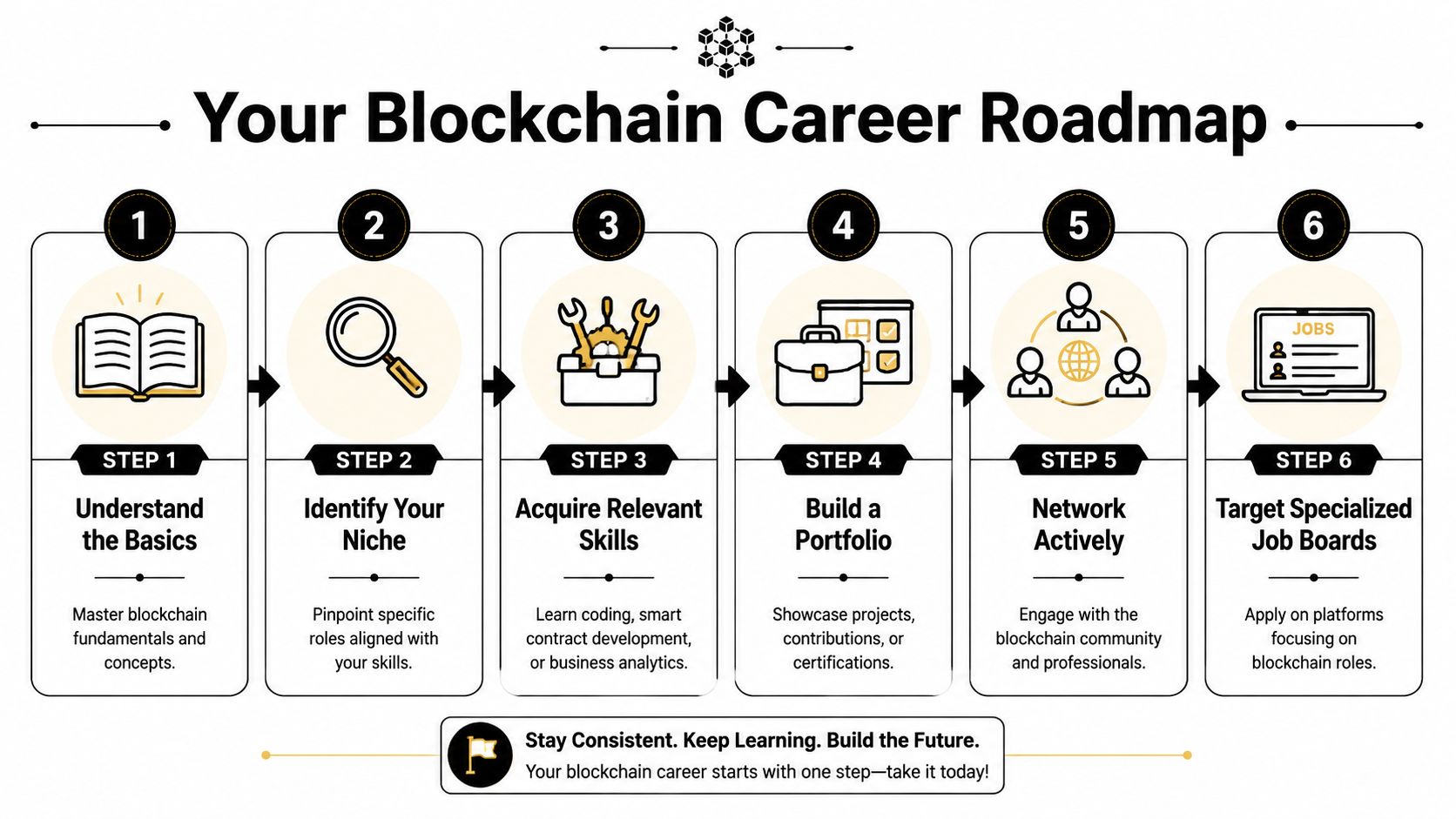
Build a portfolio that matches the role
If you're an engineer, that means GitHub repositories with readable code, tests, and documentation. A smart contract repo should show thought process, not just copied templates. Include notes on design choices, edge cases, and what you'd improve.
If you're in product, operations, legal, growth, or compliance, your portfolio can still be concrete:
- Product candidates can share specs, workflows, launch retrospectives, and user research artifacts.
- Compliance candidates can show policy thinking, transaction-monitoring logic, or anonymized examples of risk frameworks.
- Marketing and content candidates can publish explainers, ecosystem breakdowns, or campaign work tied to actual products.
- Community candidates can show moderation systems, event coordination, education threads, or contributor onboarding playbooks.
Use contribution as a credibility shortcut
DAO work, open-source contribution, hackathons, protocol forums, community moderation, and ecosystem grant participation all create evidence. They also show that you understand how crypto teams operate when there isn't much formal structure.
This matters even more for career changers. A lawyer who has contributed to governance discussions or written public analysis of token-related legal issues often looks more credible than one who says they're “interested in Web3” with no visible work.
Don't wait for permission to look qualified. Create artifacts that let a hiring manager see how you think.
Target your applications more precisely
Resume tailoring matters more here because titles vary wildly across companies. One team's “ecosystem manager” is another team's partnerships operator. One company's “protocol PM” is closer to a technical program manager.
A practical way to tighten that process is to align your resume with the right jobs before you apply. The point isn't keyword stuffing. It's making sure your past work maps cleanly to the role's actual problems.
You should also spend time reading company blogs, governance forums, docs, and team posts. That research creates better applications and sharper interviews. For ongoing context about hiring patterns, role types, and how Web3 employers describe openings, following a specialized industry resource such as the Blockchain Jobs blog can help you calibrate your search.
Don't overlook compliance and risk entry points
One of the clearest hiring shifts is toward regulatory and risk-sensitive work. RecruitBlock cites a forecast that 30% of blockchain-related jobs will require knowledge of international regulatory frameworks by 2025, highlighting legal, compliance, and financial analysis as core tracks alongside coding in its overview of crypto hiring trends and opportunities.
That creates an opening for professionals from banking, fintech, consulting, audit, law, and financial crime backgrounds. If that's you, your pitch should emphasize:
- Regulatory fluency: Cross-border awareness and policy interpretation.
- Risk handling: Monitoring, controls, escalation, and documentation.
- Operational maturity: The ability to build repeatable processes in ambiguous environments.
For many candidates, that path is faster and more defensible than trying to rebrand as an entry-level developer.
Navigating the Unique Web3 Hiring Process
You apply on Monday, get a DM from a founder that night, and by Wednesday you are in a call with an engineer, a community lead, and someone who uses a pseudonym. That kind of process is common in Web3. Candidates who get hired handle the ambiguity without getting sloppy.
The hiring flow is usually faster, less standardized, and more exposed than in a large tech company. Teams often care less about polished corporate interview behavior and more about whether you can explain a product, spot risk, ship work, and operate in public. If you want to stand out, prepare for signal-heavy conversations instead of waiting for a neat sequence of recruiter screen, panel, and offer.
What employers are really evaluating
Hiring managers are usually screening for proof, judgment, and fit with the company's operating style.
Proof means visible work. A GitHub profile helps for technical roles, but it is not limited to engineers. Product candidates should be ready to discuss launches, prioritization calls, and user research. Marketing and community candidates need examples of campaigns, writing, moderation, or ecosystem work. Operations and compliance candidates should show how they built process, handled incidents, or reduced risk.
Judgment matters just as much. Web3 teams work in environments where security, treasury management, governance, and reputation can change fast. Interviewers want to see whether you can make good decisions with incomplete information. That is one reason the broader hiring shift toward shifting from credentials to capabilities shows up so clearly in crypto. Brand-name experience helps, but evidence usually wins.
Fit is more specific here than many candidates expect. Some teams want people who are comfortable debating in public, writing in Discord, and working across time zones. Others are more structured and closer to fintech. Ask questions that reveal how the company operates:
- Security: How are upgrades reviewed, permissions managed, and external integrations checked?
- Decision-making: Who has authority over roadmap choices, and where does governance meaningfully affect execution?
- Treasury and stability: How does the team manage runway, token exposure, and hiring plans during market swings?
- First 90 days: What outcomes would make this hire clearly successful?
Strong candidates do not ask those questions to sound informed. They ask because the answers tell you whether the job is workable.
How to handle compensation discussions
Offers in this market can include base salary, token grants, vesting schedules, lockups, and milestone-based upside. Read every part carefully. A token-heavy package can be attractive on paper and still be a bad deal if liquidity is thin, vesting is long, or the company cannot explain the assumptions behind the number.
As noted earlier, strong blockchain candidates can command high pay, especially in security, protocol engineering, and other scarce specialties. But title and headline compensation are not enough. Candidates get burned when they focus on upside and ignore structure.
Ask direct questions. What is paid in cash? What is paid in tokens? What is the vesting schedule? Is there a cliff? What happens if the token is not liquid? Who sets the valuation used in the offer? If a team cannot walk you through the package clearly, treat that as a hiring signal.
A confusing offer isn't a sign of complexity. It usually means the company has not thought carefully enough about how to hire responsibly.
One more practical point. Apply through channels that make the company and role easier to verify. A focused board such as Web3 jobs platform Blockchain Jobs can help you identify teams that are actively hiring in this market, then carry that context into the interview process.
Find Your Next Role on a Specialized Job Board
General job boards are useful for broad discovery, but they often flatten blockchain roles into generic categories. That creates friction fast. You'll see weak tagging, vague titles, and very little help distinguishing between protocol engineering, exchange compliance, DevRel, treasury, or ecosystem growth work.
A specialized platform is more practical because it reflects how this market is organized. It lets you search by role family, company type, and Web3 context rather than forcing everything into traditional tech buckets.
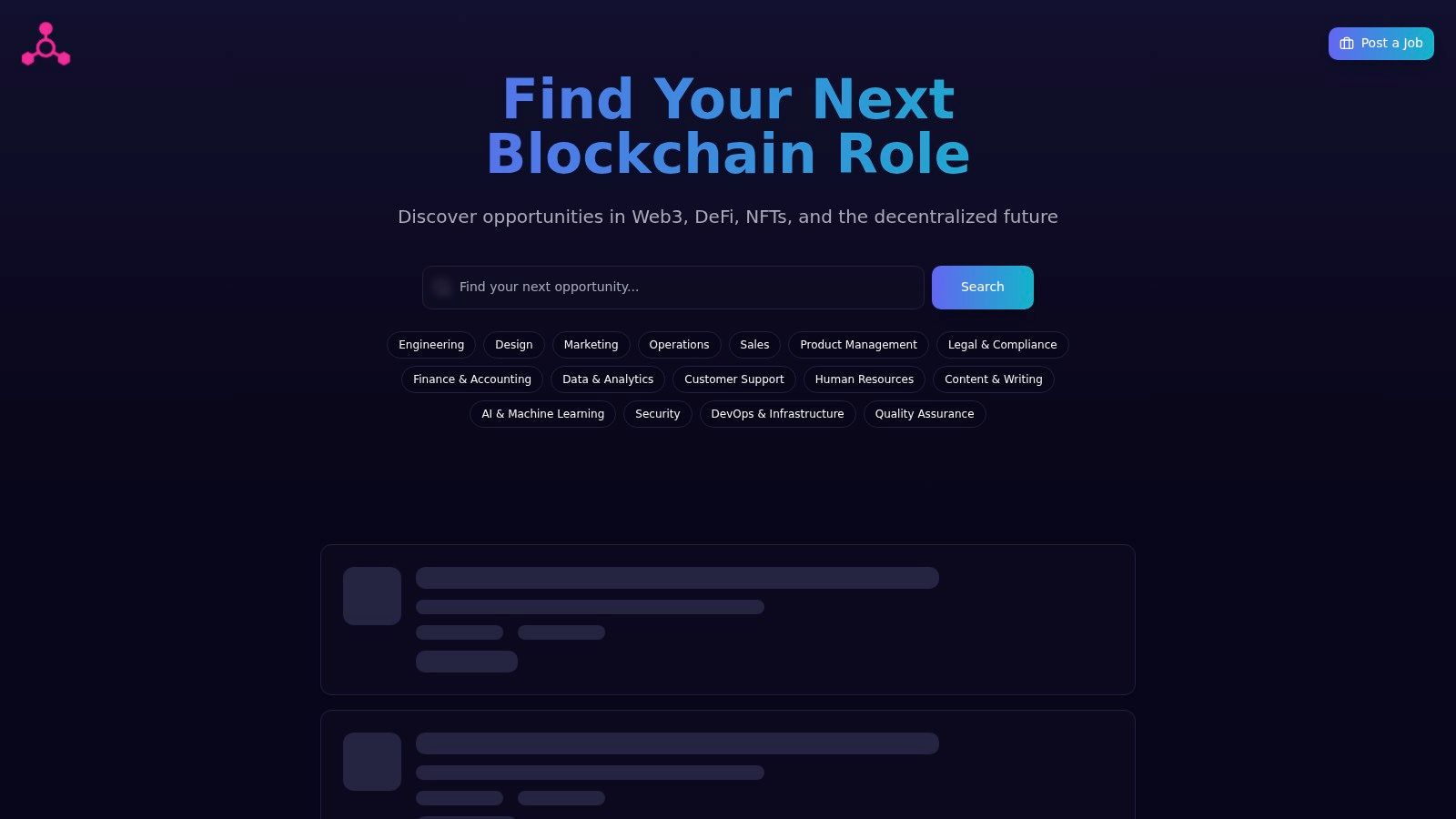
If you're serious about moving, use a focused board that surfaces current openings, role categories, and remote-friendly listings in one place. One example is Blockchain Jobs, which organizes opportunities across engineering, product, legal, compliance, marketing, operations, and other Web3 functions.
The point isn't just convenience. It's signal. Specialized boards attract employers and candidates who already understand the space, which makes it easier to assess fit quickly and spend your time on roles that match your background.
If you're ready to stop browsing vague crypto listings and start applying with focus, explore current openings on Blockchain Jobs. It's a straightforward way to find roles across engineering, product, compliance, operations, marketing, and more in the Web3 ecosystem.