
Discover Associate General Counsel Salaries: Your Guide to Nailing Your Next Offer

Pinning down Associate General Counsel compensation can feel like hitting a moving target. While total packages often land between $180,000 and $300,000+, that range is too wide to be useful for your next interview or offer negotiation. The real insights are in the details—the industry, company size, and location.
High-growth fields like tech and Web3 often shatter those averages with hefty equity and bonus packages. Understanding these nuances is your key to strategically mapping out your next career move or, if you're hiring, attracting the right legal talent.
Decoding Your Earning Potential as an AGC
Staring at an AGC job description without a salary can feel like a high-stakes puzzle. We’re here to give you the missing pieces. This guide cuts through the noise to show you what an Associate General Counsel really makes, from the base salary you can expect to the equity that could be life-changing.
Whether you're a lawyer aiming for the next rung on the ladder or a hiring manager building a world-class team, consider this your playbook. We'll break down the factors that cause compensation to swing wildly, giving you the confidence to walk into any negotiation knowing your value.
What Shapes Your Salary
Several key ingredients determine an AGC's compensation package. Mastering these is the first step toward understanding your market value or building a competitive job offer. It's not a simple formula; a small shift in one factor can have a massive impact on the final number.
Here are the big drivers you need to analyze for any role:
- Industry Focus: Your offer will look very different at a stable manufacturing company versus a crypto startup moving at lightspeed. In-demand sectors like tech and Web3 must pay a premium for sharp legal minds—a crucial point for both candidates and recruiters.
- Company Size and Stage: A massive, publicly-traded company usually offers a more structured, predictable package. Conversely, an early-stage startup might offer less cash but compensate with a significant slice of potentially valuable equity. Your risk tolerance will guide you here.
- Geographic Location: It’s no surprise that major hubs like San Francisco, New York, and Austin come with bigger paychecks. The fierce competition for talent and higher cost of living force companies to pay top dollar to attract and retain legal experts.
An AGC's salary isn't just a number; it's a story about the company's industry, maturity, and location. A candidate's ability to read that story is crucial for successful negotiation and career planning.
A Focus on High-Growth Sectors
We're going to spend extra time on the tech and Web3 worlds, where top-tier legal guidance isn't just a luxury—it's essential for survival. In these fast-moving industries, an AGC is a strategic partner, helping the business navigate a labyrinth of new and untested regulations.
That added responsibility comes with a bigger reward. So, whether you’re prepping for an interview or putting together a compelling offer, we've got the data you need to make an informed decision.
Before we get into the nitty-gritty, here’s a quick overview of what AGC compensation packages can look like across different types of companies.
Associate General Counsel Salary at a Glance
This table provides a high-level summary of typical compensation structures for an Associate General Counsel. Use these as benchmarks when evaluating an opportunity or preparing for salary discussions.
| Compensation Tier | Typical Base Salary Range | Potential Bonus and Equity | Common Company Profile |
|---|---|---|---|
| Tier 1 | $240,000 - $300,000+ | High bonus + significant equity | Large-cap public tech, late-stage private tech, Web3 |
| Tier 2 | $200,000 - $250,000 | Moderate bonus + meaningful equity | Mid-size public companies, venture-backed startups |
| Tier 3 | $180,000 - $220,000 | Smaller bonus + less equity | Traditional industries, smaller private companies |
This snapshot gives you a starting point. Now, let's dive deeper into each of these components to really understand the complete picture of associate general counsel salaries.
Evaluating the Full Compensation Package
A top-tier offer for an Associate General Counsel is rarely just about the base salary. Evaluating an offer on base pay alone is like judging a skyscraper by its lobby—you miss the incredible value built on top. The real earning potential lies in the full compensation package, where bonuses, equity, and other incentives create the complete financial picture.
For ambitious legal professionals, mastering these components is essential for making smart career moves. For hiring managers, structuring them thoughtfully is the key to landing elite talent.
Beyond the Base Salary
Think of your base salary as the foundation. It's the steady, predictable income that provides financial stability. But in many sectors, especially high-growth areas like tech and Web3, the serious wealth-building happens with the variable components layered on top.
In today's competitive legal market, total compensation for AGCs can be substantial. For instance, it's not uncommon for total pay to average around $356,000 annually in the United States. This package often breaks down into a base salary between $180,000 and $240,000, which is then boosted by stock grants averaging $74,000 and performance bonuses that can hit $48,000, particularly in major tech hubs. You can explore more salary breakdowns to see how these packages are typically put together.
The flowchart below shows the main factors that shape how these compensation packages are structured.
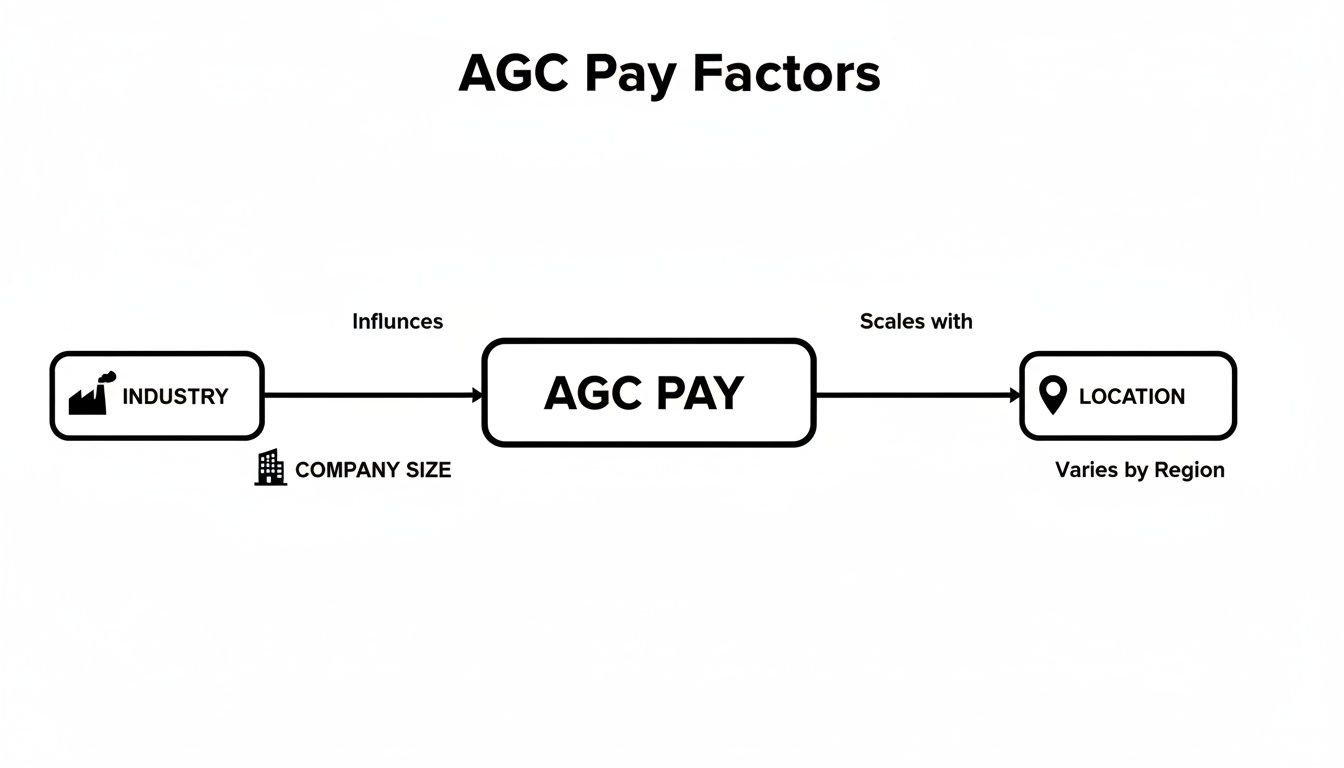
This visual really drives home how industry, company size, and location are the three core pillars that dictate both the size and the mix of an AGC's total compensation.
Demystifying Bonuses and Equity
Bonuses and equity are the accelerators in your compensation. They directly connect your performance—and the company's success—to your financial outcome. Let’s break them down from a career perspective.
- Performance Bonuses: These are usually cash payments tied to hitting specific goals. During an interview, it’s smart to ask how these are calculated. Are they purely discretionary, or is there a clear formula? What percentage of employees at your level received their target bonus last year? This helps you gauge the real value of the bonus component.
- Equity (Stock Options or RSUs): This is where long-term value is really created. Equity is a slice of ownership in the company. Think of it as being handed the deed to a small piece of the skyscraper itself. As the building's value appreciates, so does the value of your piece.
Candidate Tip: When you're looking at an equity grant, don't get fixated on the current valuation. Dig deeper in your interview process. Ask about the "strike price" for options, the vesting schedule (it's usually over four years with a one-year "cliff"), and the company's realistic growth prospects. A smaller grant in a rapidly growing startup could ultimately be worth far more than a larger one in a stagnant business.
How to Evaluate the True Value of an Offer
To properly compare job offers, you must look at the total potential value over several years, not just the first year's salary. An offer with a lower base but significant, high-growth equity could be a much better financial decision in the long run.
For employers, this is a powerful negotiating tool. When cash budgets are tight, a compelling equity story can attract candidates who are driven by the long game. Don't just present equity as another line item; frame it as an invitation to be a true owner in the business. This simple shift can change the conversation from a basic salary negotiation to a discussion about mutual investment and shared success.
Ultimately, evaluating associate general counsel salaries requires a holistic view. By understanding how base pay, bonuses, and equity all fit together, both candidates and employers can navigate the hiring process more strategically and land on an offer that aligns with their long-term goals.
How Location and Company Size Impact Your Paycheck
Ever wonder why an Associate General Counsel role in Silicon Valley can pull in a salary that completely dwarfs a similar job in a smaller city? The answer comes down to two of the biggest levers in compensation: where you work and how big the company is. These factors create unique salary ecosystems, each with its own rules and expectations.
For any lawyer mapping out their career path, understanding this landscape is non-negotiable. It’s what allows you to make smart moves, weighing the appeal of a massive paycheck in an expensive city against the lifestyle benefits of another opportunity. And for hiring managers, this data is crucial for building competitive offers that attract top talent without breaking the bank.

The Geographic Salary Premium
It’s one of the simplest truths in the legal field: location, location, location. Major hubs like San Francisco, New York City, and Austin are magnets for talent, especially in the high-stakes worlds of tech and finance. With so many venture-backed startups and public giants clustered together, the competition for elite legal minds is fierce, which inevitably pushes salaries skyward.
This creates a significant "salary premium." Companies in these hotspots have to pay more not just to outbid the competitor next door, but also to offset a much higher cost of living. You can see this play out vividly in the numbers, with tech-heavy regions commanding premiums of up to 97% over the national average. While the median AGC salary nationally might hover around $222,693, an AGC in San Jose can expect to see an average of $456,969. It's a stark difference, all driven by Big Tech's insatiable need for compliance and legal expertise. You can dive deeper into these geographic salary trends on Comparably.
Hiring Manager Insight: If you're based in a high-cost area, you can't afford to use national averages as your benchmark. You have to live and breathe local market data to set compensation that’s actually competitive. Ignore the local premium, and you'll watch top candidates walk down the street to your competitors.
Here's a closer look at how some of the major US metro areas stack up for AGC compensation.
AGC Salary Benchmarks by US Metro Area
| Metro Area | Average Total Compensation | Percentage Difference from National Average | Key Industries |
|---|---|---|---|
| San Francisco, CA | $441,754 | +98% | Tech, Venture Capital, Biotech |
| San Jose, CA | $456,969 | +105% | Big Tech, Semiconductors, SaaS |
| New York, NY | $398,550 | +79% | Finance, FinTech, Media |
| Austin, TX | $325,100 | +46% | Tech, E-commerce, Gaming |
| Boston, MA | $331,813 | +49% | Biotech, Pharma, Tech |
| National Average | $222,693 | 0% | Diversified |
As the data shows, the salary premium in top-tier markets isn't just a small bump—it's a massive leap. This reflects both the intense competition for legal talent and the higher cost of living that companies must account for to attract and retain that talent.
Company Size and Compensation Philosophy
While geography sets the stage, the company's size and maturity level write the script for your compensation package. A Fortune 500 powerhouse and a five-year-old startup think about money in fundamentally different ways, which directly shapes how they structure associate general counsel salaries.
Understanding this difference is key. For candidates, it helps you align your career goals with the right kind of company. For employers, it lets you frame your offer in a way that resonates with the talent you're trying to attract.
Large Corporations: The Stability Play
At big, established corporations, compensation is all about predictability and structure. This is the path for those who value a clear career ladder and financial stability.
- Stable Base Salaries: They lead with strong, competitive base salaries that give you a reliable financial foundation.
- Structured Bonuses: Annual bonuses are usually tied to clear, well-defined metrics for both the company's performance and your own.
- Predictable Equity: In public companies, equity typically comes as Restricted Stock Units (RSUs) with a transparent value and a set vesting schedule. No guesswork involved.
This model is a magnet for legal professionals who value stability and comprehensive benefits. It's a lower-risk path where the financial rewards are steady and foreseeable.
Startups: The High-Growth Gamble
Startups and fast-growing private companies are playing a completely different game. Their compensation model is built to conserve cash while dangling the carrot of a massive potential payday.
- Cash-Conscious Salaries: Base pay is often lower than what you'd find at a big corporation because every dollar is being poured back into growth.
- Equity as the Grand Prize: The real draw is a hefty equity grant, usually in the form of stock options. This is the high-risk, high-reward piece of the puzzle. If the company hits it big with an IPO or acquisition, that equity can be life-changing.
- Performance-Driven Culture: Bonuses might be less formal and more directly tied to hitting huge company milestones. If you're exploring this path, check out this Legal Counsel job posting to see how global opportunities can vary.
Ultimately, choosing between these paths is a personal bet on your appetite for risk versus your need for stability. For hiring managers, the key is to be radically transparent about your philosophy and sell the vision that makes your model compelling.
How Your Career Stage Shapes Your Salary
Your salary as an Associate General Counsel isn't a static number; it's a dynamic reflection of your expertise and strategic value. Think of your legal career as a building: you start with a solid foundation of core skills. As you progress, you add specialized floors and management wings, making the entire structure more valuable.
This journey isn't just about years of experience; it’s about the complexity of the problems you can solve. If you're a candidate, mapping this path is key to knowing your worth and planning your next move. For hiring managers, it's the framework for tying compensation to seniority and making a competitive offer for the right level of talent.
The Foundational Years: Junior Counsel (3-5 Years)
When you first move in-house after a law firm, your focus is on execution. You're learning the business, handling routine contracts, and supporting senior lawyers. Your value comes from being reliable, sharp, and a quick study. Your pay reflects your potential, with a solid base, a modest bonus, and likely a smaller, introductory equity grant.
To maximize your salary at this stage:
- Leverage Your Training: Coming from a top-tier law firm can give you a salary advantage right out of the gate.
- Build Your Core Toolkit: Excelling in essentials like commercial contracts or compliance makes you a more valuable hire.
- Choose Your Sector Wisely: Starting your in-house career in a hot sector like tech can set a higher salary baseline for years to come.
The Mid-Career Leap: Senior Counsel (5-10 Years)
This is where your career trajectory accelerates. You're no longer just executing—you're managing projects, advising business leaders directly, and developing a specialization like privacy, M&A, or IP. Your compensation package grows with your responsibilities, featuring a higher base salary, more meaningful bonuses, and larger equity grants. You've evolved from a legal technician to a strategic partner.
A mid-career counsel is expected to do more than just answer legal questions; they’re expected to anticipate them. In an interview, demonstrating this foresight is what will set you apart and justify higher compensation.
The Senior Strategist: Seasoned AGC (10+ Years)
With a decade or more of experience, you're operating at a different altitude. You're likely managing a team, overseeing entire legal functions, and advising the C-suite. Your work directly impacts major business decisions. This is the peak of the AGC role, and the compensation reflects it: a high base salary, a substantial bonus, and a hefty equity package that ties your success to the company's. The conversation is no longer about legal tasks; it’s about business impact.
The market data confirms this climb. Salaries can start around $78,000 for those with under a year of experience, move up to $105,000 for those with 1-4 years, and hit as high as $241,000 for the most seasoned attorneys. These numbers show how strategic career moves and deep experience directly boost your earning power. To see what a senior role looks like in practice, check out this Senior Corporate Counsel job posting. For more data, you can learn more about these salary progression findings.
Navigating the Web3 and Blockchain Salary Premium
The blockchain, crypto, and Web3 space is the legal world's new frontier, creating unique and high-paying jobs for Associate General Counsel. Companies in this arena are willing to pay a significant premium for lawyers who can confidently navigate the uncharted waters of DeFi, NFTs, and a rapidly evolving regulatory landscape. This isn't typical in-house work; it’s high-stakes risk management where technology, finance, and law collide.
The novelty of it all means you're tackling problems with no precedent. That makes a sharp legal mind one of the most valuable assets a Web3 company can hire.
Why Is There a "Web3 Premium"?
The high pay comes down to simple economics: immense demand for a very scarce supply of talent. Web3 companies aren't just hiring another lawyer; they're bringing on a strategic partner to navigate extreme uncertainty.
Several core challenges are driving this salary bump:
- Regulatory Limbo: Much of crypto exists in a legal gray area. A top-tier AGC must interpret old laws for new technologies and predict regulator actions.
- Novel IP Issues: Who owns what on a blockchain? The answers are complex and have few court-tested precedents.
- Global Complexity: Crypto is borderless. Legal teams must juggle the conflicting laws of dozens of countries simultaneously.
For a Web3 company, a top-tier legal budget isn't just an expense—it's a survival mechanism. The fallout from a single major compliance mistake can be catastrophic, making a proactive, expert AGC worth their weight in gold.
Just take a look at the variety of legal and compliance roles popping up on our job board. This screenshot shows the intense demand for specialized talent in the blockchain world.
This snapshot proves that legal expertise is critical for companies building the future of the decentralized web, creating a prime opportunity for career advancement.
How to Become a Top-Tier Web3 Legal Candidate
If you're a lawyer looking to break into this space, building the right skills is how you command a premium salary. It’s all about blending traditional legal discipline with a genuine understanding of the technology.
To position yourself for a high-paying Web3 legal role, focus on developing real expertise in these areas:
- Securities Law: Master SEC regulations like the Howey Test. This is foundational for token offerings and DeFi protocols.
- Financial Regulations: Know the ins and outs of anti-money laundering (AML) and know-your-customer (KYC) rules.
- Intellectual Property: Dive into the emerging legal theories around NFTs, DAOs, and open-source code.
- Tech Literacy: You don't need to be a developer, but you must understand how blockchains, smart contracts, and dApps function.
By building this specialized knowledge, you become the kind of candidate companies are fighting for. To see this in practice, check out this Legal Counsel job posting for a crypto-focused role. A little proactive learning goes a long way in justifying that premium salary.
Mastering Your Salary Negotiation
That final conversation before you sign an offer can be the most profitable moment of your job search. This is where your research and preparation pay off. Too many legal professionals leave money on the table because they treat it as a confrontation instead of a collaborative discussion about value.
Success here isn't about being pushy; it's about clearly articulating your value and backing up your request with market data. This advice isn't just for candidates—hiring managers can use this framework to create a transparent, fair process that starts a new working relationship on the right foot.

A Playbook for Candidates
Getting the associate general counsel salary you deserve requires building a systematic case for your worth.
Do Your Homework: Before talking numbers, know your numbers. Use guides like this one to determine a realistic salary band based on the company’s industry, location, and size. Data turns your "ask" from a wish into a well-reasoned business proposal.
Articulate Your Unique Value: List your biggest accomplishments and the specific skills that match the job description. Did you lead a complex M&A deal? Build a compliance program from scratch? Quantify your impact whenever possible to use as leverage.
Negotiate the Full Package: If a company can't move on base salary, the conversation isn't over. Ask about flexibility with a performance bonus, a sign-on bonus, or a larger equity grant.
Candidate Tip: If possible, avoid being the first to name a number. When asked for your salary expectations, pivot with something like: "My priority is finding the right fit, and I’m confident we can agree on a fair number once we've fully scoped out the role. Could you share the approved salary range for this position?"
Sample Scripts for Tricky Conversations
Handle these discussions with a calm demeanor and clear language. Here are a few lines you can adapt.
When the first offer feels low: "Thank you for the offer. I'm very excited about this opportunity. Based on my research for associate general counsel roles in this market, and given my experience in [mention a key skill or accomplishment], I was anticipating a base salary closer to the $X to $Y range. Is there any flexibility on that number?"
When you need to look beyond base pay: "I understand if the base salary is firm. Would you be open to discussing a sign-on bonus to help bridge that gap? Or perhaps we could explore the equity component to better reflect the long-term value I hope to bring."
Strategies for Hiring Managers
The negotiation process is a critical part of the candidate experience. A clunky or combative process can sour a great candidate, even if the final offer is strong. Your goal is to find the sweet spot between meeting their expectations and staying within your budget.
Be Transparent: Share the salary band for the role early on. It builds trust and ensures you're aligned from the start.
Frame the Offer Holistically: When presenting the offer, walk them through the total value—the bonus potential, the equity stake, and the benefits. Paint the full financial picture.
Know Your Levers: If you can't move on base pay, know your other options. Could you offer an extra week of vacation, a generous professional development stipend, or a guaranteed six-month review?
By demystifying the negotiation, both sides can aim for a fair deal that lays the groundwork for a successful partnership.
Common Questions About AGC Pay
When you're trying to figure out what an Associate General Counsel should earn, a few key questions always pop up. Whether you're a candidate sizing up an offer or an employer setting a budget, let's get you some straight answers.
Does an LL.M. Really Boost Your Salary?
Think of your J.D. as the price of admission. An LL.M. is a VIP pass to a specific, high-demand area. It’s not just another degree; it's a signal to employers that you have deep, ready-to-use expertise.
For roles in intricate fields like fintech or Web3, a specialized LL.M. in something like financial regulation can easily justify a salary 10-20% higher than what your peers are making. When a company is breaking new ground, they’re more than willing to pay top dollar to bring that specialized knowledge in-house and avoid costly mistakes.
Is BigLaw Experience a Must-Have for a Top AGC Job?
Starting your career in BigLaw is a proven path. The training is intense, the work is complex, and the credential carries weight, often leading to higher initial in-house offers.
But it’s not the only path. If you've climbed the ladder within a fast-growing company, you've gained a deep understanding of business operations and strategy that BigLaw attorneys often lack.
In the end, what truly matters is your track record. Can you point to complex legal challenges you’ve solved? Have you been a true strategic partner to the business? That’s what a hiring manager really cares about, not just where you got your start.
How Much More Does an AGC Make Than a Corporate Counsel?
While titles can vary, "Associate General Counsel" almost always signifies a senior role with more strategic weight and a bigger paycheck. An AGC often manages a team or an entire legal function and reports directly to the GC. A "Corporate Counsel" is typically a mid-level individual contributor focused on execution.
Because of the difference in scope, responsibility, and strategic input, an AGC can easily earn 30-50% more than a Corporate Counsel at the same company. It’s the difference between being a legal advisor and a legal leader, a crucial distinction for career progression.
Ready to find your next high-impact legal role in the most dynamic sector? At Blockchain Jobs, we connect top legal talent with leading companies in Web3, DeFi, and crypto. Explore curated opportunities and take the next step in your career. Discover your next role on blockchain-jobs.com.