Maximize Associate Product Manager Salaries 2026
Alright, let's talk numbers. You’re likely wondering what you can actually make as an Associate Product Manager (APM). It's a great question, and the answer is one of the big reasons the role is so competitive. This salary potential is a key talking point in your job search and career planning.
Across the United States in 2026, you can expect an APM base salary to land somewhere between $81,669 and $95,000 a year. But that's just the base pay. Once you factor in typical bonuses, your total cash compensation often pushes closer to $90,000, making this a seriously strong start for a career in product.
Your 2026 Associate Product Manager Salary Guide
The Associate Product Manager role isn't just another entry-level job; it's a strategic launchpad. Companies view their APM programs as a way to cultivate their next generation of product leaders. From a hiring perspective, they're not just filling a seat for today—they're investing in who you'll become in two, five, or even ten years.
This investment is why they're willing to hire talented people from diverse backgrounds, whether it's engineering, marketing, design, or finance. Your starting salary is just the first step. The real story here is the rapid financial growth that comes with proving your value, which is exactly what we'll break down in this guide to help you plan your career progression.
Setting Your Financial Baseline
So, what should you anchor your salary expectations to during interviews? Based on data from hundreds of anonymous employee submissions, the average APM base salary in the US for 2026 sits between $81,669 and $95,000. Add in an average annual bonus of around $7,592, and your total take-home cash can easily reach $89,261.
These numbers are a fantastic starting point for any negotiation. For an even deeper dive into region-specific data and offer breakdowns, this definitive entry-level product manager salary guide is an invaluable resource to have open during your job hunt.
For Your Interviews: An APM role establishes the foundation for a six-figure income. The initial salary is your starting point, but your ability to demonstrate impact and drive outcomes is what will unlock significant pay increases within your first one to two years. Frame your past experiences around this to show you're focused on future value.
To put it all together, here’s a quick look at what an average APM compensation package looks like in the United States. This is the kind of breakdown you can expect to see in a typical offer.
US Associate Product Manager Salary Snapshot 2026
| Compensation Component | Average Annual Amount |
|---|---|
| Average Base Salary | $88,000 |
| Average Annual Bonus | $7,500 |
| Typical Total Cash | $95,500 |
This gives you a solid benchmark for your job search. But remember, these are just averages. In the rest of this guide, we'll explore how factors like your location, company type, and negotiation skills—all critical parts of your interview process—can dramatically influence these numbers.
Deconstructing Your Total Compensation Offer
Getting a job offer for an Associate Product Manager role is exciting, but the number that first jumps out—the base salary—is only part of the story. To truly grasp what you're being offered and prepare for negotiation, you have to analyze the entire package.
Think of it like this: your base salary is the sticker price of a car. It's the big, obvious number. But your total compensation is the "out-the-door" price, which includes all the valuable extras that truly define the deal.
Understanding each piece of the puzzle—base salary, bonuses, and equity—is how you can accurately compare an offer from a tech giant against one from a scrappy Web3 startup. This skill is critical for making the right call for your career progression and financial future.
The Foundation: Your Base Salary
Your base salary is the most straightforward component. It’s the guaranteed, predictable cash you’ll earn, paid out in regular paychecks. For any APM, this is the bedrock of your personal finances and what you can reliably budget around.
This figure isn't pulled out of thin air. It’s a reflection of your skills, the market rate for APMs, and the company's size. When interviewing, don't underestimate your leverage, even if you're transitioning from a different field. Highlighting relevant skills, like data analysis experience from a marketing gig or project management from an engineering role, can absolutely help you negotiate a stronger base.
This chart shows how a typical APM's cash compensation breaks down.
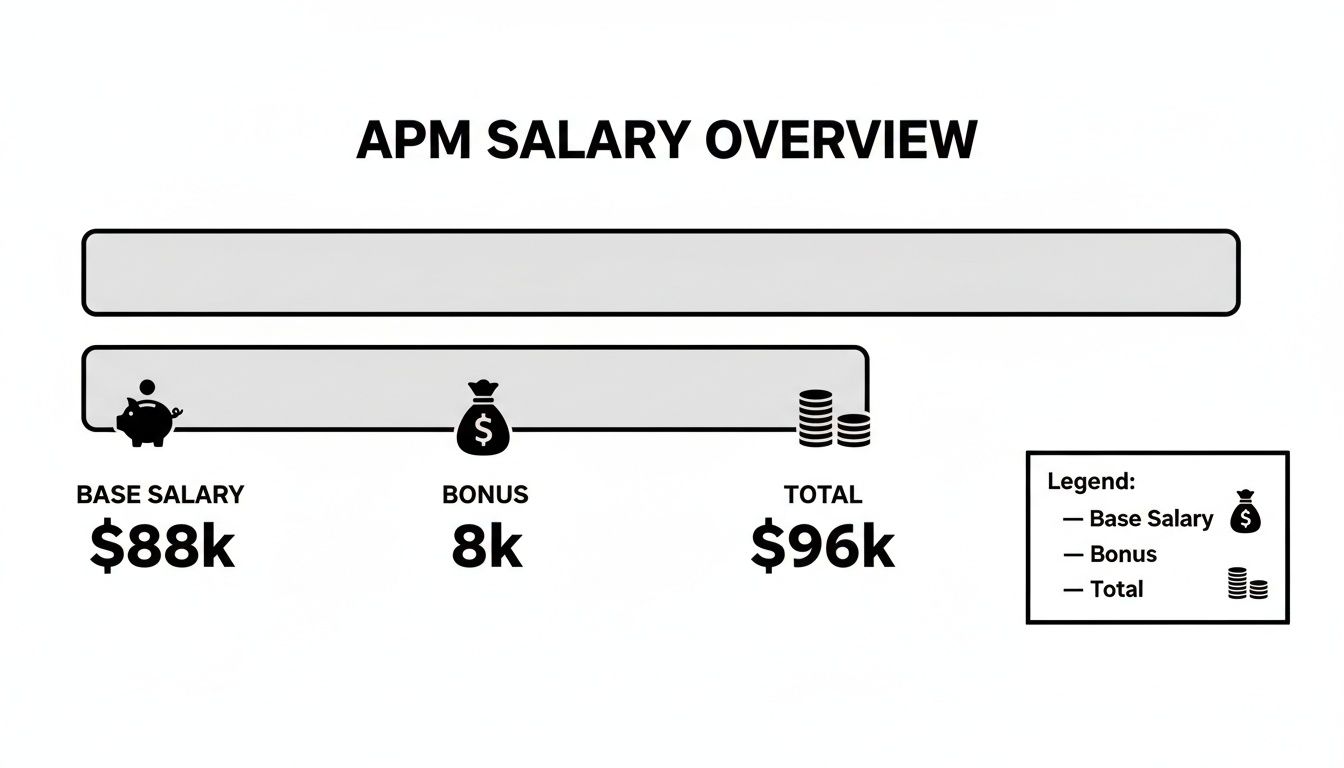
As you can see, that bonus can give your earnings a real boost, pushing your total cash well beyond just the base salary. This is a key point to clarify during the hiring process.
The Accelerator: Performance Bonuses
On top of your base pay, many companies will offer a performance bonus. This is extra cash tied directly to hitting specific goals, which means your hard work and impact on the business get rewarded. It's a great way for high-performers to accelerate their earnings and a strong signal that the company values measurable results.
These bonuses are usually discussed as a percentage of your base salary. For an APM, you’ll often see a target somewhere between 5% and 15%. So, on a $90,000 base salary with a 10% target bonus, you’re looking at an extra $9,000 if you and the company hit your targets.
For Your Interviews: Don't be shy about asking how bonuses have actually paid out. A simple question to the recruiter like, "What percentage of the target bonus has the team typically received over the last two years?" can tell you a lot about the company's performance and whether you can count on that money. It also shows you're a serious candidate thinking about long-term success.
The Multiplier: Equity and Ownership
Now, this is where compensation gets more complex, but it's also where the biggest financial upside for your career lies, especially in tech and Web3. When a company offers you equity, they're giving you a tiny piece of ownership.
For APMs, equity generally shows up in one of two ways:
- Restricted Stock Units (RSUs): These are common at big, publicly traded companies. You're granted shares of company stock that become yours over a set period of time, known as a vesting schedule. The best part is they have a clear dollar value the day you get them.
- Stock Options (ISOs): This is the standard for startups. An option gives you the right to buy company shares in the future at a locked-in "strike price." The hope is that the company grows, the share price soars, and you can buy low and eventually sell for a significant profit.
In the Web3 world, you’ll see this same idea with token packages. A crypto startup might offer you a grant of their native tokens that vest over time, just like stock. The potential upside here can be massive if the protocol takes off, but the risk is also much higher.
No matter if it's stock or tokens, always dig into the vesting schedule during the offer stage. A four-year schedule with a one-year "cliff" is common—meaning you get zero equity if you leave before your first anniversary. Understanding these details is absolutely critical when evaluating an offer and planning your career.
It's no secret that where you work has a massive impact on your paycheck. An Associate Product Manager role isn't a one-size-fits-all gig, and your salary can swing wildly depending on the company's size, its funding stage, and the industry it’s in.
Figuring this out is one of the most important parts of your job search strategy. It helps you decide whether to target a high-paying, structured role at a tech giant or a riskier, high-equity position at a scrappy startup.
Think of your career choice like this: Big Tech is a luxury tour bus on a paved highway. It’s comfortable, stable, and follows a predictable route. A startup, on the other hand, is a custom-built jeep tearing through the wilderness. The ride is bumpier and the destination isn't always clear, but the potential for an incredible journey—and payoff—is off the charts. Which ride you choose should align with your financial goals and what you’re looking for in your career progression.
Big Tech's Dominance In Associate Product Manager Salaries
If a high, predictable cash salary is your top priority for your first job, there’s no contest: Big Tech is where you want to focus your applications. Companies like Google, Meta, and Salesforce have the resources and standardized pay bands to lure in top talent. They aren't just competing on interesting problems; they're competing with serious cash, structured bonuses, and valuable stock in the form of RSUs.
The data backs this up. Across the board, the average total compensation for an APM in 2026 is around $126,000. But when you zoom in on Big Tech, those numbers jump. At a company like Salesforce, an APM with just 0-2 years of experience can pull in a total package between $199k-$201k, with a base salary alone hitting $154k-$160k.
To see just how different the pay can be, let’s look at a quick comparison.
APM Total Compensation Big Tech Vs Smaller Companies
| Company Tier | Example Company | Average Total Compensation |
|---|---|---|
| Big Tech | Salesforce | ~$200,000 |
| Smaller Firm | Carvana | ~$81,000 |
As the table shows, the difference is stark. While a smaller public company like Carvana offers a respectable salary, it simply can't compete with the cash-heavy offers from the largest players in the industry.
From a Hiring Perspective: Big Tech uses these high cash offers as a powerful magnet. They're betting that a top-tier salary will attract candidates who are already highly vetted and ready to perform in a complex, established system from day one. Your interview process will be rigorous to match.
The takeaway is clear: if maximizing your guaranteed income right out of the gate is your career goal, your job search should be laser-focused on large, public tech companies.
The Startup And Web3 Risk-Reward Tradeoff
While Big Tech offers security, startups and Web3 companies are selling a different dream. They usually can't match the hefty base salaries of their larger rivals. Instead, their pitch to candidates is about the mission, the outsized impact you’ll have, and the potential for a life-changing financial outcome through equity or tokens.
A well-funded Web3 protocol, for instance, might make an offer that looks lower on paper but could ultimately be far more lucrative. A typical package often includes:
- A Lower Base Salary: They need to conserve cash to fuel growth, so your guaranteed take-home pay will be less.
- A Significant Token Grant: This is the real lottery ticket. You might receive a large number of the project's native tokens that vest over a few years.
This is a high-risk, high-reward play. If the protocol’s token takes off, your total compensation could blow away what you’d make at a FAANG company. If the project fizzles out, that part of your compensation could become worthless. You can find exciting roles at leading Web3 and blockchain companies on specialized job boards to get a feel for the market.
Ultimately, your choice comes down to your personal risk tolerance. Do you want the security of a high salary now, or are you willing to bet on yourself and a mission for a shot at a massive payout later? Answering that question is the first step toward building a job search that truly works for you and your long-term career goals.
Mapping Your APM Career And Salary Growth

Think of the Associate Product Manager role as your launchpad, not the final destination. It's the first stage of a rocket, designed to break through the atmosphere and get you into orbit before the real journey begins. This phase is an intense learning sprint, but it’s also where you build the credibility for your next big jump in both career and compensation.
That progression isn’t just about a new title on LinkedIn. It’s a direct reflection of your growing impact on the product and the business. As you move from shadowing a senior PM to owning a small feature, and then to leading a discovery cycle, your value skyrockets. The journey from APM to a full Product Manager (PM) is one of the biggest salary accelerators in tech.
From Learning The Ropes To Owning Outcomes
Your first year as an APM is all about being a sponge. You’ll get hands-on with tools like Jira, learn to write a crystal-clear user story, and spend countless hours in meetings, just soaking it all in. After a year or two, though, the expectation shifts. You’re no longer just learning; you’re driving measurable outcomes. This is the inflection point where your salary potential truly starts to climb.
Experience is the single biggest driver of salary growth. Recent data shows a stark difference based on time in the field. Professionals with 0-1 year of experience can expect a base salary between $80,000 and $124,000. This quickly escalates to $93,000-$145,000 for those with 1-3 years under their belt. The rapid growth continues, with PMs hitting the 4-6 year mark earning between $112,000 and $170,000.
Career Progression Tip: The transition from APM to PM often comes with a salary increase of 15-30%. To make this happen, don't just wait for your annual review. Proactively meet with your manager 3-4 months beforehand to discuss your progress against PM-level competencies and align on what's needed to secure the promotion. This puts you in the driver's seat.
This proactive approach turns your achievements into tangible financial rewards and sets a strong foundation for future interviews and salary negotiations.
The Skills That Fuel Your Salary Jump
So, what actually unlocks that promotion and pay bump? It's not about just putting in the time. It’s about demonstrating tangible wins that directly impacted the product. You need to build a portfolio of successes that becomes your ammunition during performance reviews and future job interviews.
To build an undeniable case for your next career step, focus on these key achievements:
- Shipping a Major Feature: Take a feature from a messy concept all the way to launch. This proves you can manage the full development lifecycle—a core competency hiring managers look for.
- Leading a Product Discovery Cycle: Move beyond just executing the roadmap. Show you can identify real user problems, validate your assumptions with data, and propose solutions that move the needle for the business.
- Mastering Data-Driven Decisions: Get comfortable pulling your own data from tools like Amplitude or Mixpanel. Use metrics to build a case for a product decision and show that you are outcome-oriented.
- Influencing the Roadmap: Don't just be a ticket-taker. Actively bring ideas to the table and, more importantly, successfully advocate for your initiatives with solid research. This demonstrates leadership potential.
Focusing on these concrete achievements prepares you not just for a promotion, but also for interviews at your next company. Each of these accomplishments is a powerful story you can tell to demonstrate your value to a hiring manager.
Your Career As A Strategic Investment
Whether your goal is to climb the ladder in traditional tech or make your mark in the decentralized world of Web3, viewing your APM role as a strategic investment is key. Every skill you master and every feature you ship adds to your professional capital, making you a more valuable asset in the job market. You can explore more articles and insights on career growth on our product management blog.
By building a strong foundation and consistently delivering results, you're not just waiting for a promotion—you're building an undeniable case for it. This gives you the powerful talking points you need to map out your growth and make a compelling argument for a significant jump in your pay.
Negotiating Your APM Salary With Confidence

It’s the final step of the interview process. After navigating countless conversations and proving your worth, you finally have the offer in hand. This is where so many candidates get nervous and leave money on the table, but it doesn’t have to be that way.
Think of salary negotiation as the last part of your interview. It’s your final chance to demonstrate your communication skills, strategic thinking, and ability to build a case with evidence. This isn’t about being confrontational; it’s about collaborating with your future employer to land on a number that reflects your value. A good negotiation leaves both you and the hiring manager excited to get started.
Let's break down how to approach this critical career moment.
Before the Call: Do Your Homework
Winning the negotiation happens before you ever pick up the phone. Your power comes from your preparation. Walking into this discussion without data is like trying to build a product roadmap without any user research—you're just guessing. To truly negotiate your APM salary with confidence, you need to lay the groundwork.
Your prep should cover three key things:
- Know the Market: Start with the benchmarks in this guide. Then, go deeper. Use sites like Levels.fyi and Glassdoor to find company-specific salary data for APM roles at your level.
- Know Your Numbers: Decide on two figures ahead of time: your walk-away number (the absolute minimum you’ll accept) and your target number (what you’re really aiming for). This helps you stay objective.
- Build Your Case: This is crucial. You need to explain why you deserve your target number. It’s not just about what you want; it’s about the value you bring. Connect your specific skills and past wins directly to the job description and the problems you discussed during your interviews.
This preparation turns a simple "ask" into a well-reasoned business case—a language every hiring manager speaks fluently.
During the Call: Execution and Communication
This is the live conversation. Your tone is everything. You want to sound enthusiastic and collaborative, not demanding. Remember, you're starting a partnership, and this conversation sets the tone for your entire relationship. Always, always start by expressing how excited you are about the role.
After thanking them for the offer, it’s time to state your position. A simple, respectful script works wonders.
For example: "Thank you so much for the offer! I’m incredibly excited about the product vision and the chance to join the team. Based on my research for APM roles in this market and the specific skills I bring in [mention a key skill from your interview], I was hoping we could get the base salary closer to [Your Target Number]."
The Power of the Pause: After you state your number, stop talking. Seriously. Let the silence hang for a few seconds. It gives the recruiter time to process and shows them you're confident in your position. It’s a classic negotiation tactic that works.
If the hiring manager says they can't budge on base salary, don't panic. That's not the end of the road. It’s simply your cue to pivot.
After the "No": Negotiating Beyond Base Salary
Experienced negotiators know that base salary is just one piece of the puzzle. If a company has rigid pay bands, they often have much more flexibility in other areas. This is where you can get creative and add significant value to your offer.
Consider pivoting your negotiation to these other perks:
- Signing Bonus: This one-time cash payment is often the easiest thing for a company to offer. It helps bridge a salary gap without messing up their internal pay scales for the long term.
- More Equity: Especially at a startup, asking for a larger grant of stock options can have a huge long-term upside, even if the base salary feels a bit low.
- Professional Development Budget: Ask for a stipend for courses, conferences, or certifications. It’s a direct investment in your skills, which is a clear win for the company, too.
- Earlier Performance Review: Instead of waiting a full year, see if they’ll agree to a six-month performance and salary review. If you come in and crush it, this puts you on a much faster track to your next pay raise and promotion.
By knowing how to negotiate these other elements, you're demonstrating the exact kind of strategic thinking that makes a great product manager. You're not just taking an offer; you're shaping a partnership that truly reflects the value you bring to the team.
How To Land Your First APM Role
Let's be honest: breaking into your first Associate Product Manager (APM) role feels like a classic chicken-and-egg problem. Every job wants experience, but how do you get experience if no one will give you the job? The secret isn't to fake it 'til you make it. It's about showing how your past work—whether in engineering, marketing, design, or something else entirely—has already trained you to think like a product manager.
Hiring managers aren't expecting a seasoned product leader. They're hunting for potential. They want to see that you're obsessed with solving user problems, can collaborate across functions, and have a deep-seated drive to build great things. Your job in the interview process is to connect the dots for them.
Translate Your Background into a Product Story
You probably have a goldmine of relevant experience right under your nose. The trick is learning how to present your accomplishments through the lens of product management in your resume and interviews. Did you work on a project where you had to figure out what users needed, get different teams on the same page, and push it across the finish line? That’s a product story waiting to be told.
For Engineers: You didn't just write code. You made tough technical tradeoffs to hit a deadline while still meeting user needs. Talk about the times you collaborated with designers or PMs to find a practical solution instead of the "perfect" one.
For Marketers: You weren't just running ads. You were digging into user data to understand who your customers were and what they responded to. Frame this as using customer feedback or analytics to shape product direction.
For Designers: You didn't just push pixels. You ran user research to make sure your designs actually solved a real problem and felt intuitive. This is core product thinking and a powerful story for interviews.
Hiring Manager Tip: Put yourself in the hiring manager’s shoes. They’re looking for signals of user empathy, project ownership, and data-informed decisions. Your resume and interview answers need to be packed with examples of these, even if your official title was never "Product Manager."
Build What's Missing and Show It Off
If you look at your resume and see some gaps, don't just hope for the best—go out and build the experience yourself. Side projects are the single most effective way to prove you have the initiative and skills to be a fantastic APM. They give you something concrete to show in an interview, not just talk about.
And no, you don't have to launch a venture-backed startup. It can be much simpler:
Launch a No-Code App: Use a tool like Bubble or Glide to build a simple solution to a problem you face. Document your entire journey: how you spotted the problem, sketched out ideas, and what you learned. This becomes a case study for your interviews.
Write a Killer Product Teardown: Choose an app you love (or hate) and analyze it. Deconstruct its user onboarding, core features, and monetization strategy. Then, propose a new feature with mockups and a clear hypothesis about how it would improve a key business metric. Post it on a blog or LinkedIn to show your thinking.
These projects are more than just a hobby; they are your portfolio. They provide tangible proof that you can think strategically about a product, and they arm you with incredible stories to share during your interviews.
This approach is especially powerful if you're targeting the Web3 space. Building a small dApp, contributing to a DAO, or even just writing a detailed analysis of a DeFi protocol shows you’re a serious candidate. You understand the unique product challenges of a decentralized world. As more companies get serious about this tech, you'll find plenty of unique opportunities on platforms that list product management jobs in blockchain.
Ultimately, you want to walk into every interview prepared and confident. By translating your experience, building real projects, and networking smartly, you can stand out from the crowd and land that first career-defining APM role.
Frequently Asked Questions About APM Salaries
Even with all this data, you probably still have a few lingering questions. Let's tackle some of the most common ones that come up when you're preparing for interviews or planning your career path.
Does Remote Work Affect My APM Salary?
It absolutely can, but it all comes down to the company's compensation philosophy. This is a critical question to ask the recruiter early in the interview process. Many companies still use location-based pay, meaning they'll offer a higher salary to someone in a major tech hub compared to a smaller town.
On the flip side, a growing number of tech and Web3 firms are moving to location-agnostic pay scales. They offer the same salary for the same role, no matter where you live. This is their strategy for attracting the best talent globally. Getting a clear answer on their approach helps you accurately evaluate an offer.
What Is The Pay Difference Between An APM And A Product Owner?
It's easy to confuse these roles, but they are different—and so is their pay. The APM role is your classic entry point into product, designed to give you broad exposure to the entire product lifecycle as you grow into a full-fledged PM. It's a stepping stone for a long-term product career.
A Product Owner (PO) is a more specialized position within an Agile development framework. Their main job is to own and prioritize the team's backlog.
Career Path Note: Because the PO role often demands specific experience with Agile systems right from the start, you'll find their salaries are often a bit higher. A typical Product Owner in the US earns a base between $88,000–$138,000, while an APM's base salary usually falls in the $69,000–$108,000 range. The APM role, however, typically has a clearer path to the more strategic (and higher-paying) Product Manager position.
Can Certifications Increase My APM Earning Potential?
Honestly, not really. While a certification like a Certified Scrum Product Owner (CSPO) looks nice on a resume, it’s not going to be the thing that gets you a bigger salary offer. Hiring managers are far more interested in what you’ve actually done.
Think of certifications as a tool for learning, not for negotiation. When you get into an interview, your focus should be on telling compelling stories about:
- Projects where you stepped up and took ownership.
- Problems you actually solved using data.
- Times you successfully collaborated with engineers, designers, and marketers.
Your ability to demonstrate real-world impact is what gets you a top-tier offer. That’s what truly sets your earning potential in your first APM role and beyond.
Ready to find your place in the future of tech? Blockchain Jobs is the premier job board for finding roles in the Web3 ecosystem. Explore curated opportunities in product management and beyond at https://blockchain-jobs.com.