Boosting Your Back End Developer Salary

So, you're looking to understand the earning potential in back end development. The short answer? It's a lucrative career path. In the United States, you'll often see the average back end developer salary floating around the $115,000 to $120,000 mark annually.
But that's just a starting point for any salary negotiation. Your actual offer will depend heavily on your experience, the specific tech stack you've mastered, and where the job is located. An entry-level candidate might start around $91,000, but a seasoned principal engineer with a track record of success can command $160,000 and beyond. This guide breaks down how to position yourself to land on the higher end of that range.
What Is a Typical Back End Developer Salary
Understanding these salary benchmarks is critical, whether you're mapping out your career path or preparing for a high-stakes salary negotiation. While different sources may report slightly different averages, the underlying message is clear: back end development is a highly valued and in-demand skill set. Let's break down what you can expect to earn at each career stage.
As of 2025, a solid benchmark for an average salary is about $115,000 a year. But experience is the primary driver of salary growth. An entry-level developer with less than a year of professional experience can expect to start around $91,000. After building a solid foundation over 1-3 years, that figure typically rises to about $101,000. The progression continues steadily, with mid-level developers (4-6 years) earning $109,000 and senior engineers (7-9 years) reaching around $116,000. For a deeper dive into these trends, you can find more insights on back end developer salaries.
Here’s a clear breakdown of how experience directly translates to earning potential in the US job market.
US Back End Developer Salary by Experience Level
| Experience Level | Years of Experience | Average Annual Salary (USD) |
|---|---|---|
| Entry-Level | 0-1 Years | $91,000 |
| Junior Developer | 1-3 Years | $101,000 |
| Mid-Level Developer | 4-6 Years | $109,000 |
| Senior Developer | 7-9 Years | $116,000 |
| Lead/Principal | 10+ Years | $160,000+ |
As you can see, a long-term commitment to building expertise pays dividends. The salary jump from a junior to a senior or lead role is significant, reflecting the increased responsibility and impact on the business.
The "Why" Behind the Numbers
Ever wondered why back end roles often command higher salaries than other tech positions? It boils down to the complexity and mission-critical nature of the work. Back end developers are the architects and engineers designing and building the core logic and infrastructure of an application.
Think of it like building a skyscraper. The front end developer is the interior designer, responsible for the user-facing aesthetics and experience—the beautiful lobby, the welcoming decor, and the intuitive layout. The back end developer, however, is the structural engineer. They design the foundation, erect the steel framework, and install the critical plumbing, electrical, and HVAC systems. It's the unseen but essential infrastructure that ensures the building is functional, secure, and can withstand pressure.
In the world of software, the back end is the engine room. It’s where data is processed, security is enforced, and performance is determined. A failure here doesn't just look bad; it can bring the entire application to a halt, directly impacting revenue and user trust.
This level of responsibility is precisely what commands a premium salary. Companies are willing to invest heavily in engineers who can build and maintain a reliable and scalable foundation. In an interview, emphasizing your understanding of this business impact will set you apart.
Navigating Salary Data Discrepancies
When researching salaries online, you'll notice that different platforms report different numbers. One site might list an average of $115,000, while another claims it's $125,000. This is normal and expected.
These variations typically arise from:
- Data Sources: Some platforms use self-reported user data, while others analyze real-time job postings.
- Compensation Scope: Certain reports include bonuses and equity in their calculations, while others focus solely on base salary.
- Job Title Nuances: The data might group a "Back End Developer" with a "Platform Engineer," even though their pay scales can differ.
Your best strategy is to consult multiple sources to establish a realistic range. Instead of fixating on a single number, use this range to build an informed and confident case during salary negotiations. It’s your most powerful tool for demonstrating you know your market worth.
How Location Shapes Your Earning Potential

A fundamental reality in tech is that your location can influence your salary as much as your technical skills. Whether you're commuting to an office in a major tech hub or working remotely, geography plays a significant role in compensation. Understanding these nuances is key to making strategic career decisions that maximize your earnings.
From a hiring perspective, it's about competing for top talent. Companies in high-cost-of-living areas like San Francisco or New York City know they must offer premium salaries to attract and retain skilled engineers. This creates a highly competitive, yet financially rewarding, job market that draws developers from around the globe.
The Major Tech Hubs: US vs. International
For years, the United States has led the pack in tech compensation. In a city like San Francisco, a back end developer can command an average of $145,000, with senior talent often exceeding $180,000. New York City is close behind, with average salaries around $140,000. These figures are driven by the intense competition for talent among tech giants and well-funded startups.
However, high-paying opportunities are not limited to the US. Western Europe boasts its own lucrative hotspots. In Switzerland, the average back end developer salary can reach an impressive €115,659 (approximately $125,000 USD). Cities like Berlin and Munich offer strong compensation alongside a vibrant tech culture and excellent quality of life. Further afield, hubs like Singapore and Sydney in the Asia-Pacific region also present compelling, high-paying career opportunities.
For you, this means your next significant career move might involve relocating. If you're interviewing for roles in these international hubs, be prepared to discuss your reasons for targeting that specific market, demonstrating you've done your research on the local tech scene.
Salary vs. Cost of Living: The Real Bottom Line
A high salary in an expensive city doesn't automatically translate to greater wealth. It's a classic trade-off every developer must consider. A $150,000 salary in San Francisco may feel smaller than a $115,000 salary in Austin, Texas, after accounting for rent, taxes, and daily expenses.
Strategic Insight: Your true earning power isn't the number on your offer letter. It's what's left in your bank account after all the bills are paid. Always run the numbers through a cost-of-living calculator before accepting an offer that requires a move.
This is a point you can strategically raise in interviews. When a hiring manager in a high-cost city asks for your salary expectations, framing your answer with an awareness of the local market shows you’re a serious candidate who has done their homework.
The Remote Work Revolution
The rise of remote work has fundamentally altered the salary landscape. Geography is no longer the rigid constraint it once was. The global market for remote back end developers is thriving, with data on global remote salaries showing an average of $72,484 in 2025, though this figure varies widely based on the hiring company's location and policies.
This shift has resulted in two primary compensation models you'll encounter when applying for remote jobs:
- Location-Agnostic Pay: Some forward-thinking companies offer the same salary for a role regardless of the employee's location. This is the ideal scenario for developers in lower-cost-of-living areas, allowing them to earn a Silicon Valley-level salary without the associated expenses.
- Location-Adjusted Pay: This is the more common model. Companies adjust their salary offers based on the employee's geographic location. A developer in a smaller city may receive a lower offer for the same remote role as a colleague in a major metro area, even with identical skills.
When interviewing for a remote position, one of your first questions should be about their compensation philosophy. Understanding whether they adjust for location will help you set realistic expectations and negotiate effectively. Ultimately, the choice between relocating for a higher salary or pursuing a remote role depends on your personal and financial priorities.
The Skills That Actually Get You Paid More
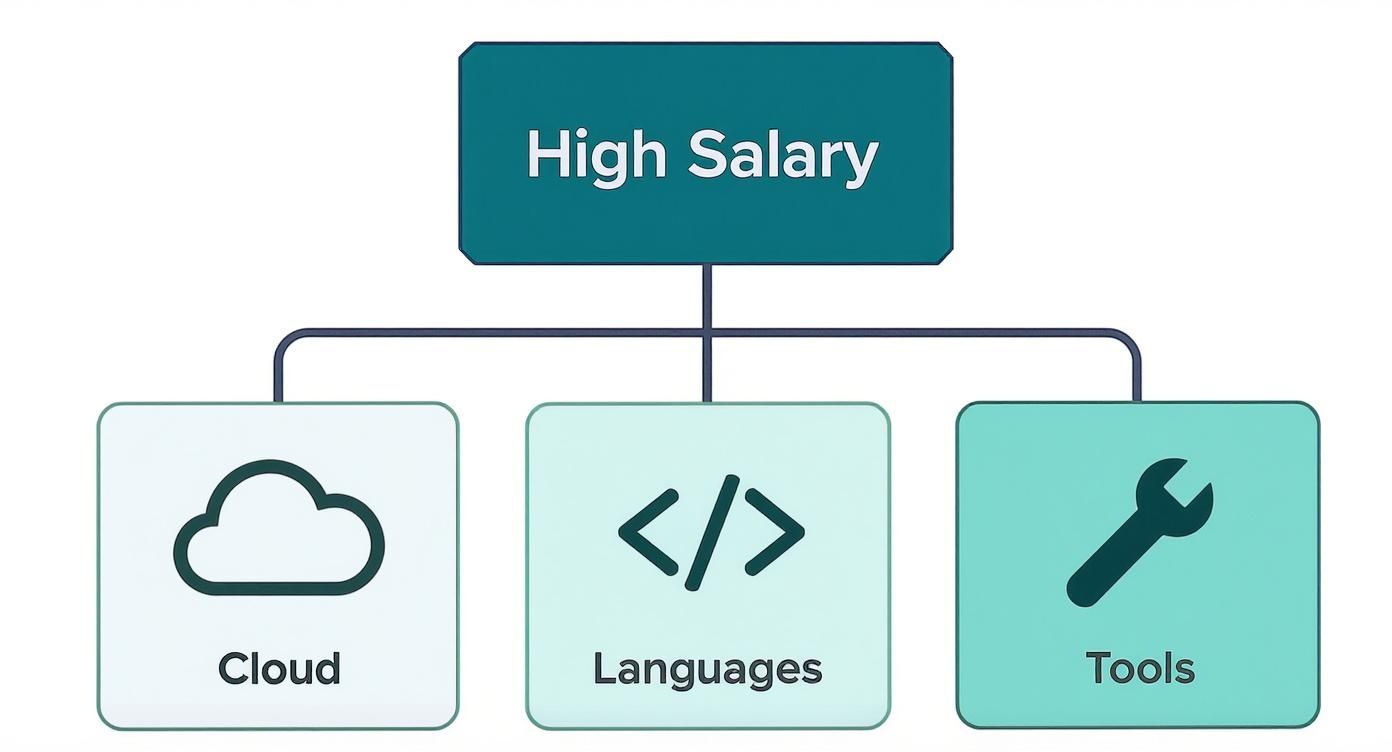
While your years of experience and location set a baseline for your salary, the specific skills in your tech stack are what truly drive your value up. Think of it this way: every mechanic owns a wrench, but the one who has mastered a specialized, high-tech diagnostic tool is the one who commands a premium rate.
Hiring managers aren't just looking to fill a position; they're searching for engineers who can architect and build systems that are fast, secure, and highly scalable. Proving you possess this expertise is how you transform a standard offer into a top-tier one.
High-Earning Programming Languages
Let's be direct—not all programming languages are valued equally in the job market. While core languages like Java and Python are widely used, a select few consistently yield higher salaries due to their specific applications and the industries that rely on them.
Data shows that specialization pays off. Developers skilled in Golang (Go), for example, often command top-tier salaries, averaging around $65,533 in some markets. Ruby follows closely at $63,616, with Rust at $62,827. These figures aren't arbitrary; they reflect strong industry demand for high-performance engineering. You can explore more about how language choice impacts software engineer salaries across the globe.
So, why do these languages carry a higher price tag?
- Go: Built by Google for speed and concurrency, it excels at handling many tasks simultaneously. This makes it a top choice for cloud-native infrastructure at companies like Google and Uber.
- Rust: Its main selling points are memory safety and performance. In fields like blockchain and FinTech, where a single bug can be catastrophic, Rust's reliability is invaluable.
- Ruby (on Rails): Startups favor Ruby on Rails for its ability to facilitate rapid development and deployment of complex web applications, making speed-to-market a key advantage.
During an interview, simply stating "I know Go" is not enough. A much more powerful statement is, "I used Go to re-architect our data pipeline, which cut server latency by 40%."
Career Tip: Don't just learn a popular language. Dig deep and understand the business problems it’s best at solving. That way, you can frame your skills as a direct solution for an employer, which makes you a much more compelling hire.
More Than Code: Your Infrastructure Superpowers
The highest-paid back end developers are not just coders; they are system architects. Your value multiplies when you can manage an application's entire lifecycle—from a line of code on your machine to a live, scalable service in the cloud. Companies are actively seeking engineers who can bridge this critical gap.
To advance to senior and principal levels, you must master these areas.
Here's a look at the technologies that can significantly boost your earning potential.
Top-Paying Back End Technologies
| Technology Category | High-Value Skills | Why It Boosts Salary |
|---|---|---|
| Programming | Go, Rust, Ruby, Scala | Used in high-performance, high-stakes environments like cloud infrastructure, finance, and Web3 where reliability and speed are critical. |
| Cloud Platforms | AWS, Google Cloud (GCP), Azure | Companies rely on the cloud for everything. Deep knowledge of services like AWS Lambda, S3, or RDS shows you can build scalable, cost-effective systems. |
| Containerization | Docker, Kubernetes (K8s) | This is the modern standard for deploying applications. Knowing how to package (Docker) and manage (Kubernetes) applications at scale is essential. |
| DevOps & CI/CD | Jenkins, GitLab CI, Terraform | Automating testing and deployment is a massive efficiency win for businesses. Skills here prove you can help the team ship better code, faster. |
Mastering these tools shows hiring managers that you think beyond writing features—you're focused on building, deploying, and maintaining robust systems that power the entire business.
These infrastructure skills are non-negotiable for senior roles. Here's what that looks like in practice:
- Cloud Platform Fluency: You must be proficient in AWS, Azure, or GCP. Hands-on experience with services like AWS Lambda for serverless computing or RDS for managed databases is a significant advantage.
- Containerization: Docker and Kubernetes are the cornerstones of modern application deployment. Docker packages your application, and Kubernetes orchestrates it at scale. Proficiency here is an industry standard.
- CI/CD Pipelines: Understanding continuous integration and continuous delivery with tools like Jenkins or GitLab CI demonstrates your ability to automate processes, helping companies innovate faster and more reliably.
In your interviews, be prepared with specific examples. Talk about the time you containerized a monolithic legacy application with Docker or how you built a CI/CD pipeline that reduced deployment time from hours to minutes. This is how you prove you don't just write code—you build resilient, efficient systems.
Understanding Your Full Compensation Package
When you receive a job offer, your eyes will naturally gravitate to the base salary. While important, that number is just one component of your total compensation. To make a career decision that builds long-term wealth, you must evaluate the entire package.
Think of your compensation like a house: the base salary is the foundation, but equity, bonuses, and benefits are the other rooms, the roof, and the plumbing. You need the entire structure to be sound. Companies use these various levers to attract and retain top talent, so understanding how to value each component gives you a significant advantage during negotiations.
Beyond the Base Salary
Your base salary is your guaranteed, predictable income, but it's rarely the full story in tech. Many roles, particularly at established companies and well-funded startups, include performance bonuses that can significantly increase your annual earnings.
These bonuses are typically tied to individual and company performance and can often range from 10-20% of your base salary. Don't hesitate to inquire about this during the interview process. A great question to ask is, "What percentage of engineers typically achieve their full target bonus?" This will give you a clearer picture of your total cash compensation potential.
Decoding Equity: RSUs and Stock Options
Equity is where compensation can become both complex and life-changing. It represents your ownership stake in the company and is often where significant wealth is generated. It typically comes in two forms:
- Restricted Stock Units (RSUs): Common at public companies, RSUs are grants of company shares that become yours once they "vest" (i.e., after you've worked for a specified period).
- Stock Options: A classic startup incentive, stock options give you the right to purchase company stock at a predetermined "strike price." The goal is for the company to grow, increasing the stock's value far beyond your locked-in price.
Key Takeaway: Equity is a long game. The most important question to ask is about the vesting schedule. The industry standard is a four-year schedule with a one-year "cliff." This cliff is crucial—if you leave before your first anniversary, you forfeit all equity. After the cliff, your shares typically begin vesting monthly or quarterly.
The Hidden Value in Benefits and Perks
Excellent benefits may not appear directly in your paycheck, but they can be worth thousands of dollars annually. A strong 401(k) matching program is essentially free money. A company that matches 100% of your contributions up to 6% of your salary provides a significant boost to your retirement savings compared to a company with no match.
The skills you possess directly influence not just your base salary, but the quality of the entire compensation package you can command. Mastering in-demand technologies gives you the leverage to negotiate for top-tier benefits.
Don't overlook other perks, either. Premium health insurance can save you a fortune in out-of-pocket medical costs. Generous stipends for professional development, flexible remote work policies, and wellness benefits all contribute to your overall career satisfaction and financial well-being. To see how companies structure these packages, it can be insightful to review job descriptions for roles that manage compensation, such as this Global Compensation & Benefits Specialist position.
How Web3 and Blockchain Skills Can Seriously Boost Your Salary
If you're a back end developer seeking the next frontier for career growth, look no further. Web3 and blockchain are more than just buzzwords; they represent a monumental opportunity to get ahead of the curve and significantly increase your earning potential.
Companies are scrambling to find engineers capable of building the infrastructure for a decentralized internet, and they are paying a premium for this talent. This isn't just about learning a new programming language—it's about mastering a fundamentally new paradigm for software development.
From Web2 to Web3: It's a Whole New Backend
The core shift from Web2 to Web3 is the move away from the traditional client-server model to a peer-to-peer, decentralized network. This transition completely redefines the day-to-day responsibilities of a back end developer and the skills required to succeed.
Hiring managers in the Web3 space are looking for a unique blend of talent—engineers with a strong foundation in traditional back end development who can also navigate the complexities of decentralization.
- Decentralized Applications (dApps): Instead of building APIs that communicate with a centralized database, you'll be creating systems that interact directly with a distributed blockchain ledger. This requires a deep understanding of how to read and write data to the chain reliably and efficiently.
- Smart Contracts: You'll work with languages like Solidity (for Ethereum) or Rust (for chains like Solana) to develop smart contracts. These self-executing pieces of code form the core logic of a dApp, handling everything from financial transactions to digital asset ownership.
- Blockchain Architecture: Much of your work will involve integrating front-end interfaces with blockchain nodes, managing user wallet interactions, and, most critically, ensuring the security and integrity of all on-chain operations.
Think of it this way: a Web2 developer builds on a private, controlled foundation. A Web3 developer builds on a public, shared foundation where trust is embedded directly into the code. This added complexity and the critical need for security are precisely why Web3 salaries are significantly higher.
Hiring Insight: When you're in a Web3 interview, frame your backend experience through a decentralized lens. Don't just talk about building APIs; talk about how you'd handle immutable data, secure private keys, or optimize calls to a smart contract. This shows you get the unique challenges of the space.
The Skills That Command a Web3 Premium
The most direct path to a higher salary in this domain is mastering blockchain-specific languages. Developers proficient in Solidity and Rust are in extremely high demand, often commanding salary premiums of 20-40% or more compared to their Web2 counterparts.
This is a classic case of supply and demand. There are far more Web3 job openings than there are engineers with the specialized skills to fill them.
Companies are specifically seeking individuals who can:
- Build APIs that integrate with decentralized exchanges (DEXs).
- Develop the back end infrastructure for NFT marketplaces.
- Create systems that power DeFi lending and borrowing protocols.
- Implement secure wallet connections for dApps.
Job postings in this space clearly outline the need for specialized talent. A role like this Backend Engineer for the MetaMask API Platform is a prime example of a position requiring a deep understanding of how to build reliable systems for millions of crypto users.
More Than a Paycheck: Getting Your Head Around Token Incentives
A unique and exciting aspect of Web3 compensation is the inclusion of token incentives. Many startups in this space offer a share of their native cryptocurrency tokens in addition to a competitive base salary and traditional equity.
This can be a powerful and potentially lucrative component of your compensation. Unlike stock options, which may only realize value upon an acquisition or IPO, tokens often have immediate liquidity on crypto exchanges. They serve as both an ownership stake and a direct performance incentive—as the project succeeds, the value of your tokens increases.
When evaluating an offer with a token component, it's essential to ask critical questions:
- What is the vesting schedule for the tokens? (Similar to stock, there is typically a cliff and a gradual vesting period.)
- Is there a lock-up period after my tokens vest? (Some companies may restrict when you can sell them.)
- What is the total token supply and the current circulating supply? (This helps you understand the potential for future dilution.)
Getting clear answers to these questions will help you assess the true potential value of an offer. For the right candidate, a well-structured token package can ultimately be far more valuable than a higher base salary alone.
Mastering Salary Negotiation and Career Growth
https://www.youtube.com/embed/5pNZw92CCAo
Knowing your market worth is one thing; successfully negotiating for it is another. Securing the compensation you deserve, whether you're interviewing for a new role or seeking a promotion, requires a clear and confident strategy.
Consider this your playbook for effective self-advocacy at every stage of your career.
The entire process hinges on one powerful principle: demonstrating your value. Companies are not just paying for lines of code; they are investing in your ability to solve complex problems, build reliable systems, and contribute to their growth. Your task is to connect your technical skills directly to that business impact.
Preparing for the Salary Conversation
Confidence in a negotiation comes from preparation, not aggression. Before your first conversation with a recruiter, arm yourself with data and a compelling narrative about the value you bring. This groundwork shifts the discussion from what you want to what the market dictates your skills are worth.
Here’s your preparation checklist:
- Do Your Homework: Use the data in this guide and other platforms to establish a realistic salary range. Factor in your experience level, tech stack, and location (or the remote market). Aim for a 10-15% window rather than a single number.
- Map Out Your Wins: Create a list of your most significant accomplishments from previous roles, quantifying them whenever possible. Did you reduce API latency by 30%? Did your CI/CD pipeline cut deployment time in half? These are your key negotiation points.
- Know Your Bottom Line: Determine the lowest salary you are willing to accept. This is your "walk-away" number. Keep it private, but use it as an anchor to prevent accepting an offer that doesn't meet your financial needs.
A well-researched salary expectation isn't a demand; it's a data-backed statement of your market value. When you frame it this way, you come across as a sharp professional, not just another candidate asking for money.
Nailing the Negotiation
Timing is critical in any interview process. Discussing salary too early can make it seem like your primary motivation is money. Waiting too long can lead to a significant mismatch in expectations. The ideal time is typically after the company has expressed strong interest in hiring you.
When asked about your salary expectations, avoid giving a single number. Instead, provide your researched range and immediately tie it back to your value.
For example, you could say: "Based on my research for a senior back end role requiring my expertise in Go and Kubernetes, I am targeting a range of $150,000 to $165,000. I'm confident I can deliver the scalable and resilient infrastructure you're looking for."
Fueling Your Career Growth
Advancing your career and securing a promotion requires the same proactive approach. Don't wait for your annual review to make your case.
Maintain a "brag document"—a running log of your accomplishments, positive feedback, and metrics that demonstrate your impact. While the name is playful, the practice is powerful.
When it's time to discuss your next career step, present this log to your manager. Frame the conversation around your growth and readiness for increased responsibility. If you're targeting a role like a Senior Software Engineer on a growth platform, you can point directly to your experience in scaling systems and leading projects. An argument backed by data is difficult to ignore.
Got Questions? We’ve Got Answers.
When you're trying to figure out backend developer salaries, a lot of questions pop up. Let's tackle some of the most common ones so you can map out your next move with confidence, whether that's landing a new job or climbing the ladder where you are.
Which Programming Language Pays the Most?
The landscape is always evolving, but currently, languages like Go, Rust, and Scala consistently command the highest salaries. This trend is driven by industry needs.
Sectors where system failure is not an option—such as finance, cloud infrastructure, and Web3—require systems that are exceptionally fast, secure, and reliable. These languages were specifically designed for such high-stakes environments. The talent pool of developers who have mastered them is smaller than for more common languages like Python or Java, creating a classic supply-and-demand dynamic that drives salaries upward.
Can I Really Earn a Top Salary as a Remote Developer?
Absolutely. The remote work revolution has fundamentally changed how tech companies approach compensation. A growing number of US-based firms now offer location-agnostic salaries, meaning they pay based on your skills and the role's value, not your physical address. This is a game-changer, enabling you to earn a Silicon Valley-level salary from anywhere.
However, this is not yet a universal standard. Many companies still adjust their offers based on the local cost of living. Your best strategy is to ask about their remote compensation policy early in the interview process to ensure alignment and avoid surprises later.
How Much More Do Senior Developers Actually Make?
The salary leap from a junior to a senior back end developer is substantial, often representing a 50% to 100% increase, and sometimes more. This significant jump reflects a change in responsibilities that goes far beyond just writing better code.
A senior developer's value comes from their judgment. They're paid to make critical architectural decisions, guide junior team members, and own complex projects from start to finish. It’s their strategic impact on the business, not just their technical output, that earns them the big bucks.
Is It Worth Specializing in a Niche like Web3?
Yes, specializing in a high-demand niche like Web3, blockchain, or AI infrastructure can significantly accelerate your earning potential. Companies in these cutting-edge fields are often well-funded and competing fiercely for a limited pool of engineers with the right expertise. This intense competition for talent naturally leads to more attractive and lucrative compensation packages.
While specializing carries slightly more risk than remaining a generalist, the rewards for developers willing to position themselves at the forefront of technology can be immense.
Ready to turn that expertise into a high-paying role in the decentralized space? Blockchain Jobs is the go-to place for opportunities in Web3, DeFi, and more. Check out thousands of roles from the best companies in the industry. Your next big thing is waiting for you at https://blockchain-jobs.com.