Best Programming Language Blockchain: Jobs & Salaries 2026
The most popular answer to the best programming language blockchain question is too narrow. People say “learn Solidity” as if blockchain engineering begins and ends with smart contracts. That advice helps if your only target is EVM contract work. It fails if you care about job volume, interview fit, and long-term career mobility.
A better question is this: which language puts you in the part of Web3 that's hiring for the kind of work you want to do? In practice, that answer changes depending on whether you want to ship DeFi apps, build validator software, write trading infrastructure, analyze on-chain data, or move from Web2 into Web3 without restarting your career.
Early on, I'd tell junior developers to stop treating “blockchain developer” as a single job title. It isn't. It's several different engineering tracks that happen to share the same industry label.
Why Most Blockchain Language Guides Are Incomplete
Most guides make a simple mistake. They focus on contract languages and ignore the rest of the system.
That sounds harmless until you look at how real teams build. About 80% of a blockchain project is built using general-purpose languages like JavaScript and Python, not only smart contract languages, as noted in this breakdown of blockchain coding languages. That gap matters because many new developers spend months learning niche syntax while skipping the backend services, indexing pipelines, APIs, automation, testing, and analytics work that companies need.
The problem with Solidity-first advice
Solidity is important. It's not the whole market.
If you only learn Solidity, you're optimizing for one slice of hiring: EVM smart contract roles. Those jobs exist, but they're also the most obvious path, which means they attract a lot of candidates with nearly identical portfolios. Recruiters then filter harder on security depth, audit awareness, protocol knowledge, and production experience.
Learn the language that matches the layer you want to work on, not the language people mention most on social media.
Junior candidates usually miss this distinction. They search “best programming language blockchain,” see Solidity repeated everywhere, and assume it's the universal answer. It isn't. It's one answer for one category of work.
Career decisions beat language hype
A practical decision framework starts with your target role:
- If you want DeFi and EVM apps, contract skills matter most.
- If you want protocol engineering, low-level systems languages matter more.
- If you want to enter Web3 from Web2, JavaScript, TypeScript, or Python may get you hired faster.
- If you're still deciding, it helps to find your best coding language by matching learning time to the kind of work you want to do.
The strongest candidates don't just ask what's popular. They ask what gets them interviews, what gives them a portfolio with real signal, and what still matters when the current narrative changes.
The Two Worlds of Blockchain Engineering
Blockchain engineering splits into two different worlds. Confusing them leads to bad learning plans.
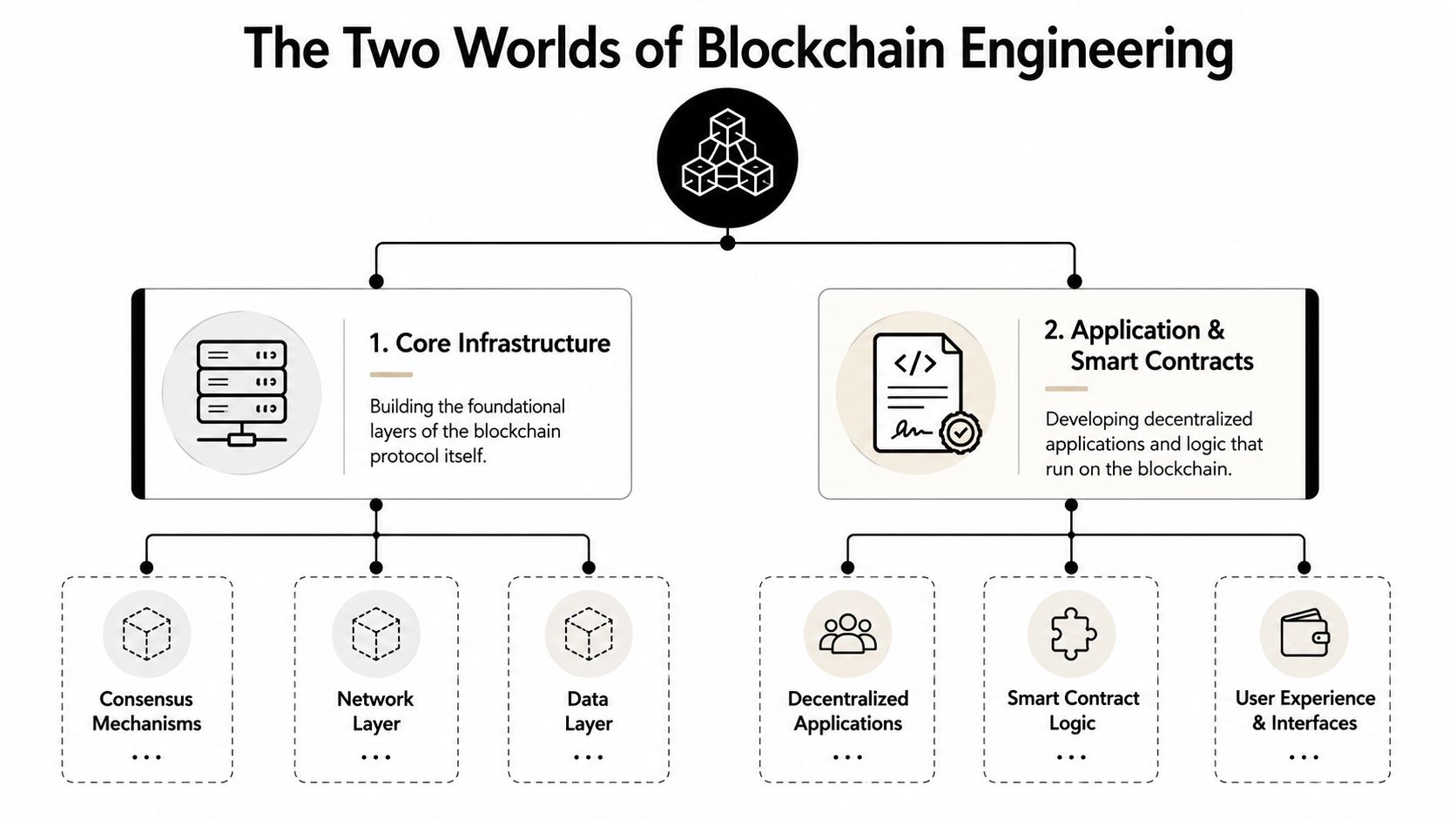
Application and smart contracts
This is the layer typically seen first. You build dApps, token logic, vaults, swaps, governance modules, NFT contracts, wallets, and the frontend that talks to them.
The work feels closer to product engineering. You care about ABI interactions, gas usage, transaction flows, testing, access control, upgrades, event indexing, and user-facing failure modes. If you've built web apps before, this path usually feels familiar faster.
Typical work here includes:
- Contract logic: ERC-20 tokens, AMMs, staking systems, lending markets.
- Frontend integration: React or Next.js apps using ethers.js, viem, wagmi, or wallet adapters.
- Tooling and tests: Hardhat, Foundry, TypeScript test suites, deployment scripts.
Core infrastructure
This is different work. You're not building on top of the chain. You're helping build the chain, its clients, or the software around nodes and data movement.
It's the difference between building a website and building the browser. Application engineers ship product features. Protocol engineers care about peer-to-peer networking, storage, execution clients, mempool behavior, validator logic, concurrency, fault tolerance, and performance under load.
If smart contract development is like designing the business logic of an app, protocol development is like designing the operating system it runs on.
That distinction changes everything about your language choice.
Why the split matters for careers
A junior developer who likes shipping user-facing features usually does better starting in the application layer. The feedback loop is quicker. You can build a portfolio faster. Interviewers can review your repos and deployed contracts easily.
A developer who enjoys compilers, memory models, distributed systems, or performance tuning should look hard at protocol work. The ramp is steeper, but the specialization is stronger and the candidate pool is usually narrower.
Hiring managers see these as separate tracks. You should too.
Smart Contract Languages The Job Market Leaders
If your goal is app-layer blockchain work, the market centers on Solidity and, in some ecosystems, Rust.
Here's the career view first.
| Criterion | Solidity | Rust |
|---|---|---|
| Primary ecosystem | EVM chains and Ethereum-compatible apps | Solana and some performance-focused ecosystems |
| Best first target role | Smart contract engineer, DeFi engineer, EVM security-focused developer | Solana smart contract engineer, systems-leaning app engineer |
| Interview focus | EVM internals, gas, security exploits, upgrade patterns, testing | Ownership model, account model specifics, performance, safety, low-level reasoning |
| Portfolio signal | DeFi contracts, audits, Foundry tests, production-style repos | On-chain programs, client integrations, state handling, performance-aware design |
| Barrier to entry | Lower if you already know JavaScript or TypeScript | Higher, but broader carryover into protocol work |
| Career trade-off | Biggest ecosystem and documentation depth | Stronger performance and future flexibility |
Solidity wins on market breadth
Solidity holds indisputable leadership in smart contract development. Over 90% of Ethereum-based dApps and smart contracts are written in Solidity, and Ethereum smart contracts reached $50 billion in total value locked in 2024, according to 4ireLabs' review of blockchain programming languages.
That matters for jobs because Ethereum and EVM-compatible networks still dominate the most visible app-layer hiring. If you want the shortest path to contract work, Solidity is still the default choice.
You also inherit the best-known toolchain. Foundry, Hardhat, OpenZeppelin, Slither, and a large body of public audit reports make it easier to learn patterns recruiters ask about.
Rust wins on engineering depth
Rust is harder. That's also why it carries signal.
For smart contract roles, Rust tends to attract teams that care about performance, stricter safety guarantees, and ecosystems where low-level thinking matters more. In interviews, Rust candidates are usually tested more heavily on ownership, memory safety, and correctness under constraints. Solidity candidates are tested more on exploit classes, token standards, upgradeability, and protocol design.
Hiring reality: Solidity gets you into the largest contract market. Rust often gets you into roles where the language itself filters for stronger systems fundamentals.
If you want EVM jobs, don't overcomplicate the decision. Start with Solidity. If you want Solana or you already enjoy systems programming, Rust can be a better long-term bet.
What recruiters look for in each path
For Solidity roles, recruiters usually want proof that you can do more than write a token.
Look for portfolio pieces like:
- A small AMM: Include swap math, tests, edge cases, and slippage handling.
- A staking or vault contract: Show role separation, pause controls, and withdrawal logic.
- Security-aware testing: Invariant tests, fuzzing, and exploit reproductions make you stand out.
A live example of the level expected for senior EVM work is a senior smart contract engineer role at Uniswap Labs. Even if you're junior, reading those requirements sharpens your learning plan.
For Rust contract roles, the strongest candidates usually show that they understand state layout, account handling, testing, and integration with off-chain clients. A toy contract isn't enough. The repo needs to look like software someone could extend.
Which one should you learn first
Start with Solidity if:
- You want speed to market: You can build visible DeFi projects quickly.
- You're coming from frontend or JavaScript work: The syntax transition is easier.
- You want the broadest set of app-layer openings: The ecosystem size still matters.
Start with Rust if:
- You already like systems work: Ownership and strictness won't feel like punishment.
- You want optionality: Rust can support both app-layer and protocol ambitions.
- You're targeting performance-first ecosystems: The interview style and engineering culture are different.
Core Infrastructure Languages The Performance Kings
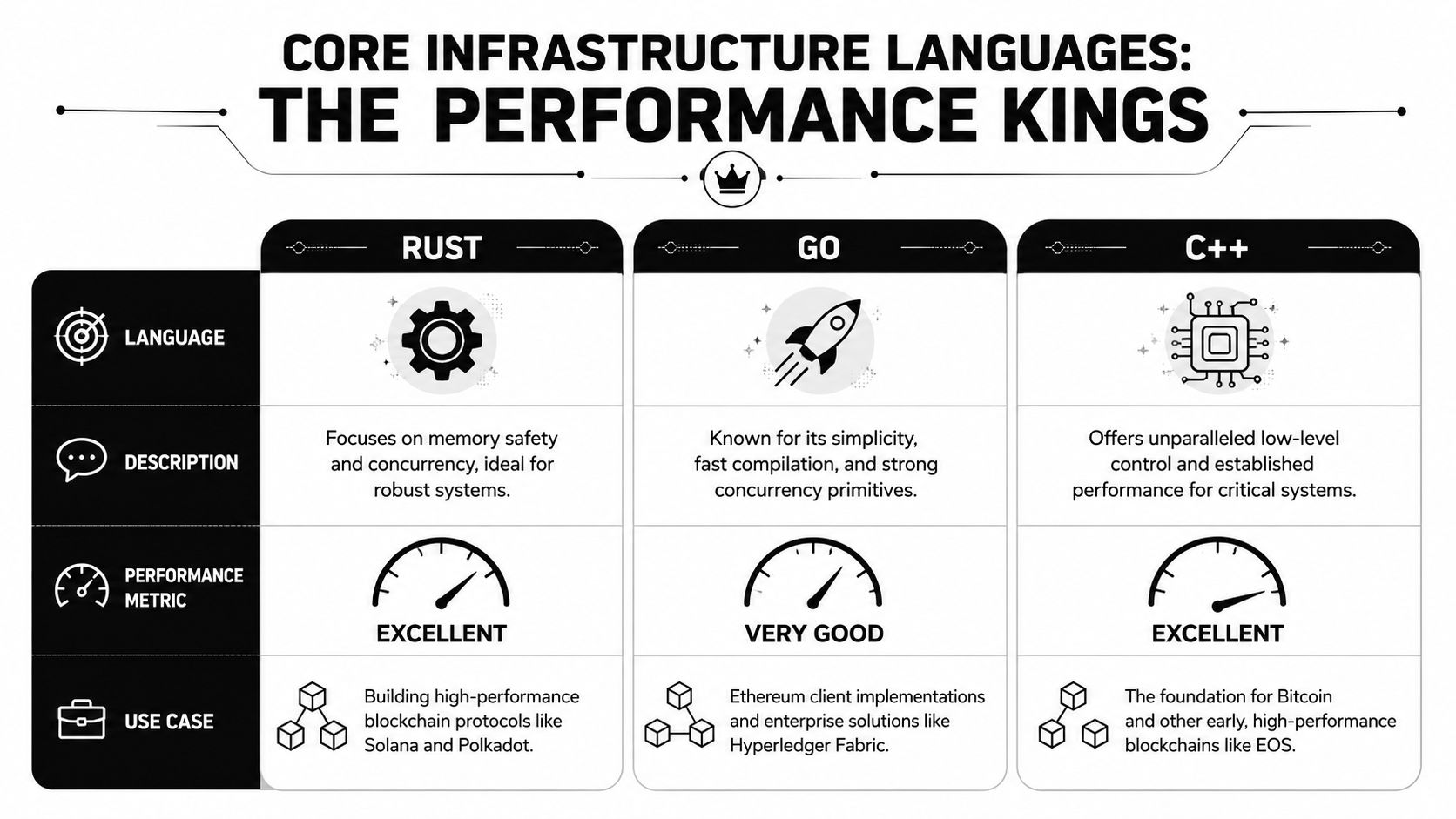
Protocol engineering has different priorities. Readability still matters, but memory safety, concurrency, determinism, and raw runtime behavior matter more.
Rust for new protocol work
Rust has become the language many teams reach for when they want high performance without accepting the same memory risk profile they'd take on in older systems languages.
Rust is the premier language for building high-performance Layer 1 blockchains, and optimized Solana environments can exceed 50,000 transactions per second, compared with Ethereum's typical 15 to 30 TPS, according to Innowise's analysis of blockchain programming languages.
That performance number is useful, but the career point is bigger than throughput. Teams hire Rust because it helps engineers encode correctness earlier. Ownership, borrowing, and compile-time checks force discipline. Junior developers hate that at first. Senior teams value it because production failures are expensive.
Go for networking and clients
Go sits in a practical middle ground. It's not as strict as Rust and not as low-level as C++, but it's excellent for networking-heavy software, APIs, services around nodes, and many forms of client tooling.
In blockchain teams, Go often appeals to engineers who need to move quickly without living in compiler battles every day. It's a solid choice for backend-heavy Web3 roles, infra services, node operations tooling, and ecosystem software that touches the chain without being the chain itself.
C++ for legacy depth and maximum control
C++ still matters where old codebases, extreme control, or specialized performance engineering dominate. If you want to work near Bitcoin-adjacent systems, matching engines, or mature infra stacks, C++ hasn't disappeared.
The trade-off is obvious. You get power and control, but you also accept more risk and complexity. For a new developer, C++ is usually not the shortest path into blockchain unless you already come from systems engineering, embedded work, game engines, or high-frequency infrastructure.
Teams building core infrastructure care less about whether you can write a token contract and more about whether you can reason about race conditions, resource use, and failure recovery.
How hiring differs at the protocol layer
Protocol interviews rarely reward surface-level knowledge. You'll get questions on:
- Concurrency: Threads, async design, message passing, and deadlock avoidance.
- Systems behavior: Memory layout, serialization, networking, and storage trade-offs.
- Distributed thinking: Faults, retries, consensus assumptions, and partial failures.
- Performance debugging: Profiling, bottleneck detection, and correctness under load.
A good benchmark for the kind of infra role this points toward is a backend software engineer opening focused on C++ and Rust in client-server systems. Even when the company isn't purely protocol-first, the interview bar often looks similar.
Choosing among the three
Use a simple rule:
| Language | Best fit |
|---|---|
| Rust | New protocol engineering, safety-critical systems, performance-heavy chain development |
| Go | Node-adjacent services, clients, networking software, backend platform work |
| C++ | Legacy protocol stacks, extreme optimization, low-level infrastructure |
If you're starting from zero and your goal is protocol work, Rust is usually the strongest first bet. If you already work in backend systems and want a smoother transition, Go is often the easiest bridge. If you're already strong in C++, blockchain can be a natural specialization rather than a reinvention.
General-Purpose Languages The Unsung Heroes of Web3
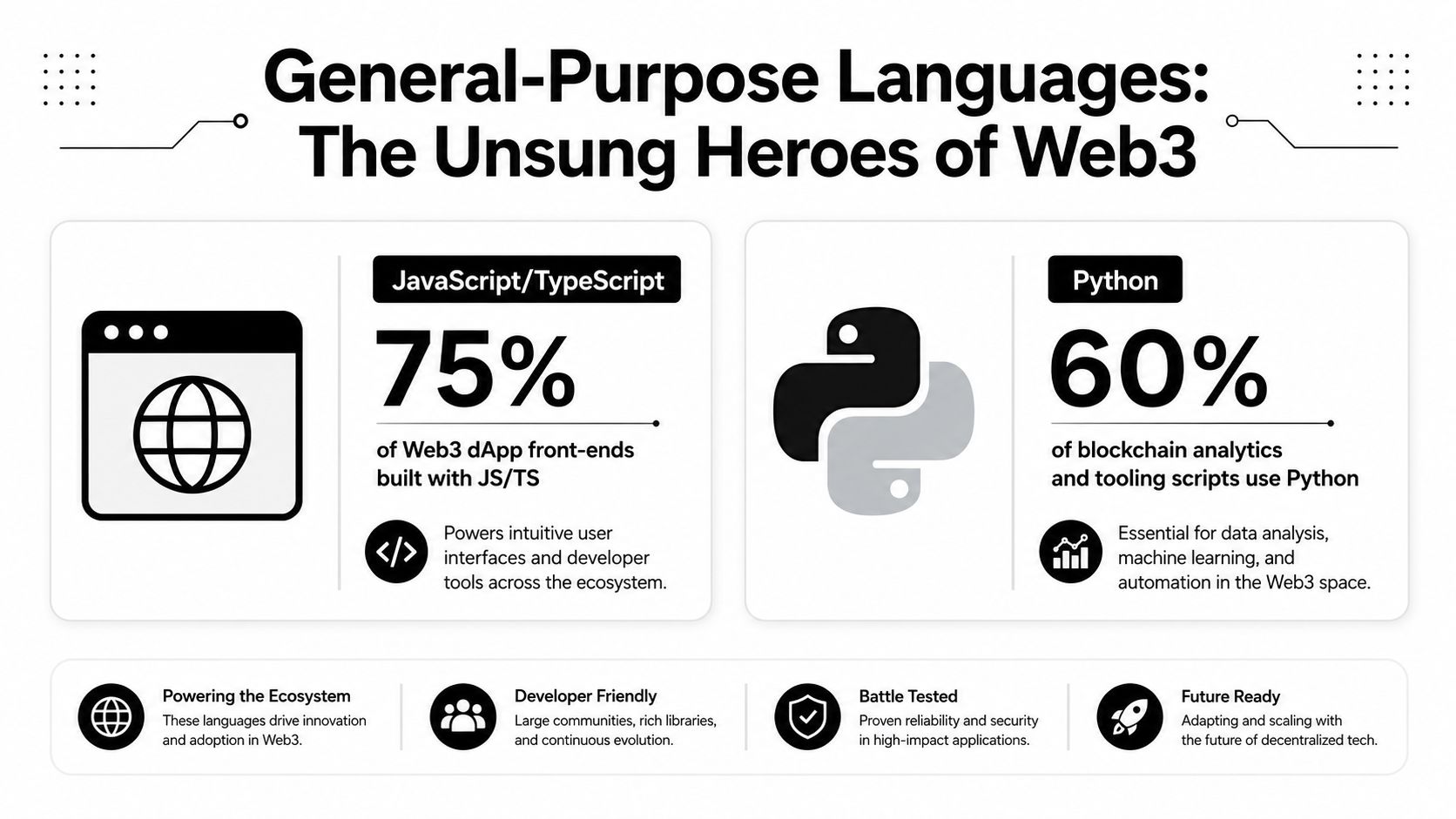
A lot of Web3 work doesn't require you to begin with a blockchain-native language at all. That's the part beginners underestimate.
JavaScript and TypeScript still open doors
Most dApps need frontend engineering, wallet integration, transaction UX, SDK work, dashboards, and testing infrastructure. That means React, Next.js, TypeScript, ethers.js, viem, and API handling still show up across real teams.
For developers moving from SaaS into Web3, this is often the lowest-friction entry point. You can contribute to interfaces, app logic, developer tooling, and internal dashboards while learning the blockchain side gradually instead of trying to become a protocol engineer overnight.
The strongest Web3 frontend candidates understand more than component styling. They know transaction states, signature flows, wallet failure handling, and how to make blockchain interactions understandable to users who don't care about block confirmations or calldata.
Python is the quiet career lever
Python doesn't dominate smart contracts, but it matters in analytics, scripting, automation, data pipelines, research workflows, and many trading-related systems.
According to 2026 hiring data, 45.7% of recruiters are actively looking to hire Python developers and 41.5% for JavaScript specialists, while Python holds a 22.61% share in the TIOBE Index, based on Itransition's summary of in-demand programming languages.
That aligns with what blockchain teams need outside contract development:
- Data analytics: On-chain dashboards, anomaly detection, token flow analysis.
- Trading and research tooling: Strategy scripts, bot orchestration, exchange integrations.
- Ops automation: Node management scripts, monitoring helpers, data extraction jobs.
- Machine learning crossover: Fraud, clustering, classification, and intelligence workflows.
A Python developer with good blockchain context is often more employable than a weak Solidity developer with no backend or data skills.
Where these languages create leverage
If your goal is career progression, JavaScript and Python are powerful because they transfer. Even if a Web3 startup changes stack or pivots product direction, those skills keep paying off.
A practical route looks like this:
- Frontend-first developers: Learn TypeScript, wallet integration, and one contract library.
- Backend developers: Add Python or Go for APIs, data handling, and service orchestration.
- Analytical developers: Use Python with on-chain data tools, notebooks, ETL jobs, and automation.
That's why the best programming language blockchain question has to include general-purpose languages. Otherwise, you're evaluating the industry through a keyhole.
Choosing Your Path Recommendations by Career Goal
Developers don't need every language. They need the right first pair.

The DeFi dApp builder
Learn Solidity first. Pair it with TypeScript.
This combination matches the actual workflow of EVM product teams. You'll write contracts, tests, deployment scripts, and frontend integrations. In interviews, you'll be more useful if you can discuss both access control and how the app calls the contract.
The protocol engineer
Learn Rust first. Pair it with Go if you want broader infrastructure versatility.
That advice is stronger now because recent 2024 to 2026 data indicates that 60% of new protocol jobs in Web3 demand Rust proficiency for work on Solana, Polkadot, and the Cosmos SDK, according to this hiring-focused Web3 discussion. If you want the segment moving hardest toward low-level interoperability and chain infrastructure, Rust is no longer optional in many roles.
The full-stack Web3 developer
Start with TypeScript. Add Solidity after you can build a complete product interface.
This path gets underestimated because it sounds less specialized. In practice, full-stack Web3 engineers are useful fast. Startups need people who can ship wallet connections, read contract events, handle transaction states, and coordinate with contract engineers.
The blockchain data analyst
Start with Python. Add enough SQL and smart contract literacy to interpret on-chain behavior accurately.
These roles are strong for people coming from data science, trading analysis, fraud analytics, or automation. You won't need to become a full contract developer on day one to be valuable.
A blunt recommendation for most juniors
If you're unsure, choose one of these:
- Solidity plus TypeScript if you want the clearest path into visible app-layer work.
- Rust plus Go if you want protocol and infrastructure credibility.
- Python plus TypeScript if you want the widest flexibility while you explore Web3.
Compensation changes by specialty, but language choice alone doesn't guarantee a better role. Skill depth, shipping history, and ecosystem fit matter more. If you're comparing broader market direction across technical careers, this roundup of highest paying jobs for 2026 is useful context for seeing where specialized engineering tracks can lead.
How to Get Hired Learning Pathways and Interview Prep
The language matters. Proof matters more.
A recruiter won't hire you because you watched a course. They hire you because your GitHub, tests, architecture choices, and explanations show that you can work on a team without creating risk.
Build projects that map to real roles
Pick projects that mirror actual responsibilities:
- For Solidity roles: Build an AMM, a staking system, or a timelock-governed vault. Include Foundry tests, edge cases, and a short audit-style readme.
- For Rust roles: Build a small stateful on-chain program or a performance-sensitive service that processes chain data. Document trade-offs and failure handling.
- For Go roles: Build a peer-to-peer module, event ingestion service, or node-facing backend API.
- For Python roles: Build an on-chain analytics pipeline, wallet labeling script, or trading research notebook with clean reproducibility.
- For TypeScript roles: Build a dApp UI with wallet connection, transaction status handling, and contract event rendering.
Prepare for the interview you actually want
The themes usually repeat.
For Solidity, expect exploit questions, upgradeability trade-offs, ERC standards, and test design. For Rust, expect ownership, concurrency, and correctness questions. For JavaScript and TypeScript, expect app architecture, async handling, and wallet UX edge cases. For Python, expect data modeling, scripting quality, and automation design.
Don't prepare only by memorizing syntax. Prepare by explaining why your implementation is safe, maintainable, and appropriate for the chain or product.
A useful way to calibrate your job search is to study GENTY's insights on Web3 hiring and compare your portfolio against live openings in blockchain engineering roles. That quickly shows whether you're training for the market you want or for an outdated idea of it.
The shortest route to getting hired is simple. Pick one path. Build two serious projects. Write clearly about your technical decisions. Apply before you feel fully ready.
If you're ready to turn your language choice into a real move, browse Blockchain Jobs for current roles across engineering, data, product, security, marketing, legal, and operations in Web3. It's a practical way to see what teams are hiring for right now, which skills repeat across listings, and where your next step fits in the market.