Your Guide to Landing High-Paying Block Chain Careers

The buzz around block chain careers is more than just hype—it’s a full-blown digital gold rush for talent. And it’s not just for hardcore developers. This boom is creating stable, high-paying, and future-proof roles for people across a huge range of technical and non-technical fields.
Think of it this way: we're building the fundamental infrastructure for the next version of the internet. This guide will show you exactly how to position yourself to get hired and advance your career within it.
Why Block Chain Careers Are Exploding Right Now

The blockchain industry has finally grown up. It's moved past the speculative frenzy and into a mature, rapidly expanding job market filled with real, sustainable opportunities. For your career, this feels like the early days of the internet—a foundational shift that’s creating entirely new paths for advancement.
Companies aren't just "experimenting" with this tech anymore. They're building core, mission-critical systems on it, and they are desperate for skilled people to help them do it. This has opened the floodgates for talent, from engineers designing secure protocols to marketers who can explain complex products in simple terms. If you're looking for a high-growth field to accelerate your career progression, the timing couldn't be better.
The Data Behind the Demand
This isn't just a feeling; the numbers tell a clear story that recruiters and hiring managers are paying close attention to. The Web3 and blockchain job market saw a staggering 300% increase in job openings between 2023 and 2025.
What’s driving this? A fresh wave of venture capital funding and serious institutional buy-in, which translates directly into new roles you can apply for. Some reports showed around 3,700 new Web3 positions being created every month.
This fierce demand has a direct impact on your career progression. Because there's a major talent shortage, professionals with the right skills can climb the ladder faster, take on more responsibility, and command much higher salaries than they would in more crowded industries.
From a hiring perspective, the current landscape is a candidate's market. Companies are competing fiercely for top talent, which means professionals with provable skills have significant leverage in salary negotiations and career choices.
What This Means for Your Career Search
Knowing this industry-wide growth is your first strategic advantage. It confirms that pursuing a block chain career isn't a risky bet—it's a smart, calculated move toward a future-proof and financially rewarding path.
As you start your job search, remember that hiring managers want more than just technical chops. They're looking for candidates who are genuinely passionate and can clearly articulate the potential of this technology during an interview.
This guide is here to help you navigate this exciting space. Whether you're a developer, a project manager, or a creative, there's a spot for you. A great first step is to browse a dedicated platform like Blockchain Jobs to see what skills and roles are currently in demand.
What Are the Most In-Demand Blockchain Jobs?
Trying to get a handle on blockchain careers can feel overwhelming. But it's simpler than it looks. The jobs really boil down to a handful of core functions. Instead of just listing titles, let's get into what these people actually do day-to-day, what hiring managers look for in interviews, and how each role contributes to career progression.
Think of this as your roadmap to getting hired. It’ll help you see where your own skills fit into the roles that crypto companies are desperately trying to fill right now. Whether you're a coder with years of experience or coming from a totally different field, there’s a path to a successful career here.
Technical Roles: The Architects of Web3
These are the builders. The engineers. The people who write the code that makes everything in Web3 work. If you're applying for a technical role, you're expected to have a solid background in software development, cryptography, and systems architecture. Your interview will be hands-on and rigorous.
Blockchain Core Developer
Think of Core Developers as the civil engineers of the blockchain world. They build the foundational network itself—the digital roads and bridges. Their job is to design consensus rules, boost performance, and roll out major upgrades that keep the network secure and efficient.
A hiring manager for this role will want to see deep expertise in low-level languages like Rust, Go, or C++. You'll face interview questions like, "What are the trade-offs between Proof-of-Work and Proof-of-Stake?" or "How would you solve for network congestion?" Your work directly impacts the security and speed of the entire ecosystem, offering significant career influence.
Smart Contract Developer
If Core Developers build the highway, Smart Contract Developers build all the applications along the side of it. They write, test, and deploy the code that powers DeFi, NFTs, and DAOs. For anyone targeting Ethereum or similar chains, Solidity is the non-negotiable language you must master.
Expect a hands-on coding interview where you'll be asked to write secure, gas-efficient code on the spot. A classic test is being given a flawed contract and told, "Find the vulnerability and explain your fix." Your GitHub is your real resume here, proving to hiring managers that you can ship production-ready code. You can see the level of expertise required in job posts like this Smart Contract Backend Engineer role.
Smart Contract Auditor / Security Researcher
These are the ethical hackers of Web3. Their job is to find and fix security holes in smart contracts before they can be exploited. This means meticulous code review, advanced testing, and thinking like an attacker to prevent multi-million dollar losses.
A strong security audit is non-negotiable for any serious project. This makes auditors some of the most sought-after and highly compensated professionals in the space. An auditor's reputation directly impacts their career progression and earning potential.
To land this job, you need an adversarial mindset. Interviewers will test your knowledge of common attack vectors like reentrancy bugs and your skill with security tools. A history of finding bugs through public audits or bug bounty programs is the ultimate credential that will get you hired.
Non-Technical Roles: The Ecosystem Builders
You absolutely do not need to be a coder to build a successful career in crypto. Non-technical roles are the glue that holds everything together. They connect the tech to the users, drive growth, and ensure the project’s vision becomes a reality.
Blockchain Product Manager
The Blockchain Product Manager (PM) is the project's chief strategist, acting as the critical link between developers, the community, and business goals. A typical day involves defining the product roadmap, writing detailed feature specs, and analyzing on-chain data to understand user behavior.
Hiring managers look for PMs who understand the unique dynamics of Web3, like tokenomics and decentralized governance. In an interview, expect questions like, "How would you design a token incentive program to drive user retention?" Your ability to think strategically about both the product and the community is what will land you the job and set you up for leadership roles.
Community Manager
In Web3, the community is the product. A Community Manager is the on-the-ground leader responsible for engaging, educating, and growing a project's user base, typically on platforms like Discord and X (formerly Twitter).
This job demands excellent communication skills and genuine empathy. A hiring manager will want to see proof that you can cultivate a vibrant, positive space. Be ready for interview questions like, "A major conflict has erupted in the Discord. How do you de-escalate it?" Your success is measured in concrete KPIs: user growth, engagement rates, and the overall health of the community.
Web3 Marketing Manager
Marketing in Web3 is a whole different ballgame. Great marketers here rely on compelling content, strategic partnerships, and community-driven storytelling. A Web3 marketer’s job is to craft a narrative that resonates with a crypto-native audience.
To succeed in this role, you need to be creative and deeply embedded in the culture. An interviewer will want to hear about your experience with guerilla marketing and how you'd launch a new project with a minimal budget. Your portfolio of successful campaigns—backed by user acquisition numbers—is the evidence that will make you stand out and get hired.
Comparing Technical and Non-Technical Blockchain Career Paths
To make things even clearer, let's break down the key differences between the most popular technical and non-technical roles. This table gives you a side-by-side look at what each job entails, the skills needed to get hired, and the typical backgrounds of successful candidates.
| Career Path | Primary Responsibilities | Essential Skills for Interviews | Typical Background |
|---|---|---|---|
| Blockchain Core Developer | Building and maintaining the foundational protocol of a blockchain network. | Rust, Go, C++, Cryptography, Distributed Systems, Consensus Algorithms | Computer Science, Systems Engineering, Backend Development |
| Smart Contract Developer | Writing, testing, and deploying secure smart contracts for dApps. | Solidity, Rust (Solana), Gas Optimization, Security Best Practices, Testing Frameworks | Software Engineering, Full-Stack Development |
| Smart Contract Auditor | Identifying security vulnerabilities and exploits in smart contract code. | Deep Solidity/EVM knowledge, Common Attack Vectors, Static/Dynamic Analysis | Cybersecurity, Software Engineering, Penetration Testing |
| Blockchain Product Manager | Defining product strategy, roadmap, and features for a Web3 project. | Tokenomics, User Experience (UX), Data Analysis, Community Engagement | Product Management, Business Analysis, Tech Entrepreneurship |
| Community Manager | Building, engaging, and moderating a project's user community (Discord, X). | Communication, Empathy, Social Media Management, Content Creation, Crisis Management | Marketing, Social Media, Customer Support, Public Relations |
| Web3 Marketing Manager | Developing and executing growth strategies through content, partnerships, and community. | Storytelling, Content Marketing, SEO, Growth Hacking, Analytics, Meme-crafting | Digital Marketing, Content Strategy, Brand Management |
Whether you're drawn to writing secure code or crafting a compelling brand story, this breakdown shows there's a clear path for various skill sets. The key to career progression is understanding where your strengths align and focusing your development efforts there.
What to Expect for Blockchain Salaries and Compensation
Let's talk money. Understanding your potential earnings is a critical part of planning your career progression. In the blockchain world, compensation often includes unique perks like tokens that you won't find in traditional tech. Knowing how hiring managers structure offers gives you a serious advantage at the negotiating table.
One of the biggest draws to a blockchain career is the incredible earning potential. The massive demand for skilled people, combined with a relatively small talent pool, has created a market where candidates are in the driver's seat. This gives you leverage to secure higher salaries and accelerate your financial goals.
Key Factors Influencing Your Salary
The final number on your offer letter is a direct reflection of the value you bring. Hiring managers will weigh a few key factors to determine your market rate.
- Area of Specialization: A smart contract auditor with a proven track record of finding critical bugs will command a higher salary than a general backend developer. Your specialization directly impacts your negotiating power.
- Proven Experience and Portfolio: Your GitHub profile, on-chain activity, or a portfolio of successful marketing campaigns is your proof-of-work. A candidate who can show tangible, high-quality projects will always secure a better offer than someone with just a resume.
- Geographic Location: While many blockchain jobs are remote, location can still factor in. Major tech hubs often have higher base salaries, but the remote work boom is leveling the playing field, allowing top talent to earn premium rates from anywhere.
The roles themselves generally fall into two main camps: technical and non-technical. Each path offers strong earning potential and is critical to a project's success.
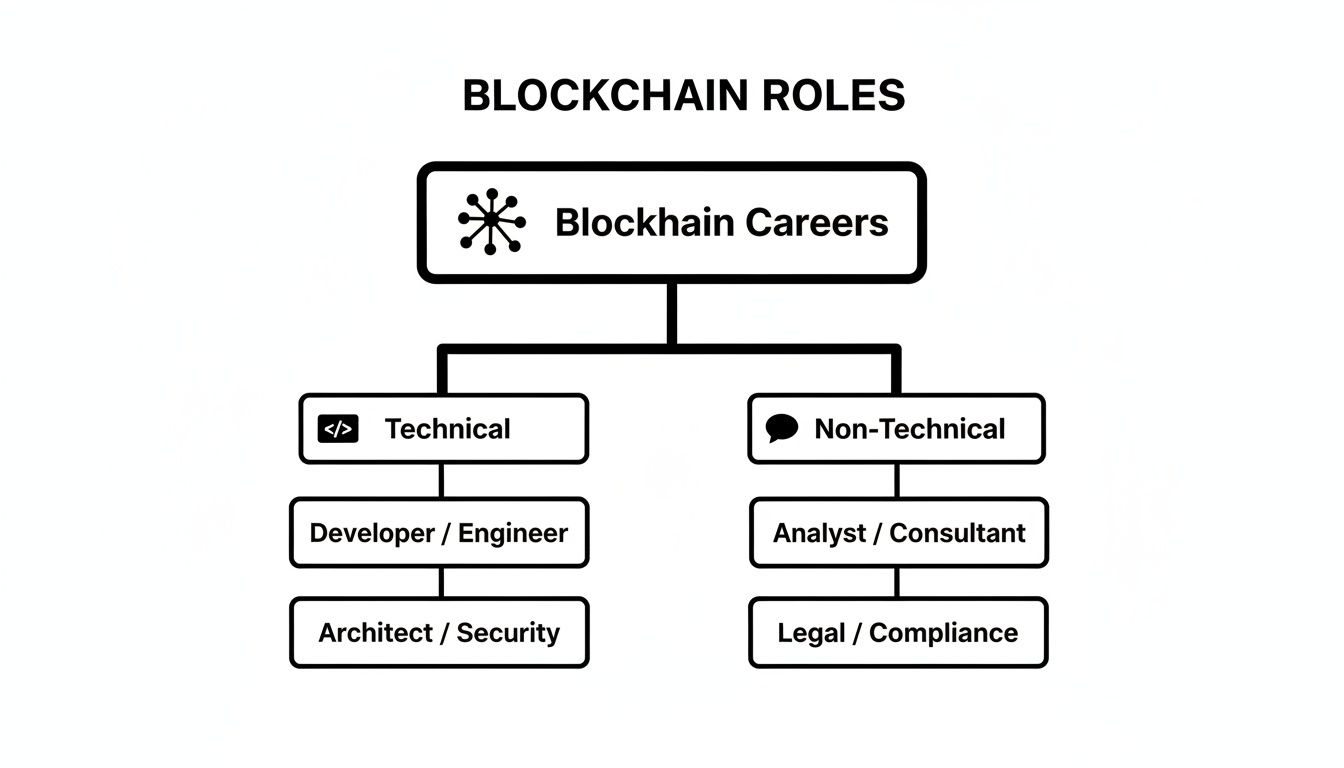
This shows that you don't have to be a hardcore coder to find a well-paying role with a clear path for career advancement. The ecosystem needs strategists and communicators just as much as it needs developers.
Understanding Token-Based Compensation
Beyond a standard salary, many Web3 companies will sweeten the deal with project tokens. This is how startups attract top-tier talent, offering a real sense of ownership and a stake in the project's future success. However, you must understand the terms to evaluate the offer properly.
When negotiating a package that includes tokens, always ask about the vesting schedule. This is the timeline that dictates when you actually gain ownership of the tokens. It's usually spread out over several years to incentivize long-term commitment.
A very common setup is a four-year vesting schedule with a one-year "cliff." This means you receive no tokens for your first year. On your one-year anniversary, 25% of your tokens vest at once. The remainder typically vests monthly or quarterly over the next three years. Understanding this structure is essential for accurately calculating the total value of a compensation offer.
Salary Benchmarks and Industry Trends
The blockchain industry is famous for its high salaries, which continue to climb as demand outpaces the supply of qualified talent. A 2025 crypto employment market report found that global salaries saw an average increase of roughly 18% in 2025.
Senior blockchain engineers and top-tier smart contract developers can command salaries from $150K to over $400K annually, often before token packages are included. It's no surprise that an estimated 75% of Web3 companies planned to use tokens to attract and retain top talent.
Ultimately, your ability to secure a top-tier offer comes down to proving your value. If you build a solid portfolio, stay informed about market rates, and know the right questions to ask about compensation structure, you'll be in a prime position to get the salary you deserve.
Building Your Action Plan to Break Into Web3

Let's get tactical. Breaking into the blockchain world requires a deliberate, focused strategy. Hiring managers aren’t looking for someone who can just talk the talk; they want people who have actively gotten their hands dirty. This is your playbook for making that happen and landing your first role.
The goal isn't just to learn about Web3; it's to become part of it. The most effective way to do this is to build your plan around three pillars: focused learning, tangible building, and strategic networking. Master these three, and you'll build the skills, portfolio, and connections that get you hired.
Charting Your Learning Path
First, you need the right knowledge. In Web3, what you can do is far more important than what a degree says you've done. Whether you're a coder or coming from a non-technical background, a structured learning plan is your foundation for building a successful career.
For aspiring developers, this means mastering a core language. Solidity is the big one, as it's the language of Ethereum and most major smart contract platforms. It is your most direct path to a job. Also, keep an eye on Rust, which is rapidly becoming the standard for high-performance chains like Solana and Near.
If you’re on the non-technical side, your job is to become an expert on the ecosystem itself. You need to get comfortable with concepts like tokenomics, decentralized governance (DAOs), and community building. You must speak the language fluently to be effective in marketing, product, or community management interviews.
Hiring managers often say they want people who are "crypto-native." This doesn't mean you needed to be mining Bitcoin in 2011. It means you've put in the work to genuinely understand the culture, the tech, and the user mindset. This is a quality they will test for in interviews.
No matter your path, learning is continuous. This industry moves incredibly fast. Staying current isn't just a good idea; it's a requirement for long-term career progression in any of the available block chain careers.
Building Your Proof-of-Work Portfolio
In Web3, your portfolio is your resume. It’s the hard evidence that you can create value. A hiring manager will always be more impressed by a clean GitHub repository or a buzzing community you helped grow than a list of bullet points on a PDF. Your portfolio is what gets you the interview.
Your portfolio projects should directly align with the job you want.
- For Developers: Contribute to open-source projects. Fixing a small bug in a well-known protocol is a massive signal to employers. Better yet, build and deploy your own simple dApp to demonstrate you can see a project through from start to finish.
- For Marketers & Writers: Start a blog on Mirror or Substack. Analyze market trends, do deep dives on interesting projects—showcase your expertise and prove you can communicate complex ideas clearly.
- For Community Managers: Don’t just join a Discord; become a valuable contributor. Answer questions, welcome new members, and offer constructive feedback. Volunteer to be a moderator or help organize an event to build a tangible track record of leadership.
- For Product Managers: Pick a few dApps and write detailed product teardowns. Analyze their strengths, weaknesses, and how you would improve them. This demonstrates the exact strategic thinking that hiring managers are desperate for.
Think of your portfolio as your personal "proof-of-work." It's the verifiable record of your contributions that will make you stand out from other applicants.
Networking Like a Web3 Native
The saying "your network is your net worth" is doubly true in the surprisingly small blockchain world. But networking here is less about collecting business cards and more about building relationships by contributing to shared goals. The best jobs often come from referrals from people who already know and respect your work.
The most effective strategy is to build in public. Share what you're learning, building, and thinking on the platforms where the Web3 community actually lives.
- Engage on X (formerly Twitter): This is the industry's digital town square. Follow founders, developers, and VCs. Don't just lurk—jump into conversations, ask smart questions, and share your work. This is how you get on recruiters' radars.
- Contribute to a DAO: Joining a Decentralized Autonomous Organization is one of the fastest ways to get real-world experience and meet key people. You can write code, help with marketing, or vote on proposals. You’ll be working alongside passionate builders who can vouch for you.
- Participate in Hackathons: Even if you're not a coder, hackathons are incredible networking opportunities. You can help with brainstorming, product strategy, or the final presentation. It's a fantastic way to collaborate under pressure and get noticed by sponsoring companies.
When you're actively participating, you're not just another applicant. You're becoming a known entity in the community. And when the perfect opportunity opens up, there's a good chance the hiring manager will already know who you are.
How to Craft a Standout Resume and Ace Your Interview
You’ve built your skills and portfolio; now it's time to translate that into a job offer. A generic resume won’t cut it. You need to craft a narrative that resonates with Web3 hiring managers and then walk into the interview prepared to prove you belong.
Your mission is to show how you fit into the unique, decentralized culture of this industry. Think of your resume and interview as the final steps in your "proof-of-work"—your chance to demonstrate the skills and passion required for a successful blockchain career.
Tailoring Your Resume for Web3 Roles
Your Web3 resume needs to speak a different language than a typical corporate one. Hiring managers scan for signs that you are an active participant in the ecosystem, not just an observer. The focus is less on past job titles and more on what you've actually built and contributed.
The single biggest change is to shift from listing responsibilities to showcasing impact.
- Showcase Project Contributions: Did you fix a bug in an open-source protocol? Highlight that GitHub pull request. Did you write and deploy a smart contract? Link to it on Etherscan. Quantify your achievements whenever possible, e.g., "Grew Discord community engagement by 40% in Q3."
- Include Your On-Chain Identity: This is critical. Add links to your GitHub and your X (formerly Twitter) profile. Consider adding your ENS name. This transparency signals confidence and gives recruiters a verifiable trail of your activity.
- Use Industry-Specific Keywords: Your resume must include terms relevant to the role, such as "DeFi," "NFTs," "Solidity," "smart contract audit," or "community building." Both automated systems and human recruiters use these to screen candidates.
A resume with a link to a clean, well-documented GitHub repository is almost always more powerful than one listing a big, fancy company name. Verifiable skill and genuine passion trump traditional credentials in a Web3 hiring process.
Your resume should tell the story of someone genuinely engaged, making it clear: "I don't just read about this stuff—I actively build and participate in it."
Deconstructing the Web3 Interview Process
The Web3 interview process is designed to filter for genuine understanding and cultural fit. It typically moves from a general screen to detailed technical or strategic challenges. Knowing the stages helps you prepare effectively.
- The Recruiter Screen: This is a culture and passion check. The recruiter wants to hear your story. Why this project? What excites you about decentralization? Your goal is to convey authentic enthusiasm and alignment with their mission.
- The Technical or Role-Specific Assessment: This is where you prove you can do the job. For developers, expect a live coding challenge or a take-home project. For non-tech roles, you might get a case study, like drafting a go-to-market plan or a community moderation strategy.
- The Team and Founder Interview: The final stage assesses team fit. You'll speak with future colleagues and often the project's founders. They are evaluating your communication style, problem-solving approach, and conviction in their vision.
Sample Questions You Will Actually Hear
Prepare for these common questions to gain a significant edge in your interviews.
For Technical Roles:
- "Walk me through a smart contract you've written or audited. What were the biggest security considerations?"
- "How would you explain the risks of
delegatecallto a non-technical product manager?" - "You've just found a critical reentrancy vulnerability in a live protocol. What is your immediate action plan?"
For Non-Technical Roles:
- "How would you launch a go-to-market strategy for our new NFT project with a limited budget?"
- "A crisis is unfolding in our Discord community. What are your first three steps?"
- "Describe the tokenomics of a project you admire. What makes their economic model effective and sustainable?"
Prepping for these questions forces you to think deeply about your experience and the industry. It positions you as an engaged candidate who is ready to contribute from day one.
Start Your Search on the Right Web3 Job Platform
Alright, your resume is polished and your portfolio is sharp. Now, where do you find the best block chain careers?
Instead of sifting through generic job boards, use a platform built specifically for the Web3 world. This is the most efficient way to get your application in front of innovative companies actively hiring for high-impact roles.
A dedicated job board like Blockchain Jobs acts as your signal booster. It cuts through the noise, connecting you directly with curated roles from legitimate, forward-thinking companies. You can stop wasting time on irrelevant listings and focus your energy where it counts.
Find Your Ideal Role with Precision
An efficient job hunt is a targeted one. Use advanced filters to zero in on the exact opportunities that match your career goals.
For example, you can instantly narrow your search by:
- Work Arrangement: Filter for remote-only positions, a cornerstone of the decentralized work culture.
- Specific Categories: Search directly for roles in Engineering, Marketing, Product Management, or Security.
- Company Stage: Choose between the fast-paced energy of an early-stage startup or the stability of an established leader.
This focused approach ensures every job you apply for is a genuine possibility, saving you time and connecting you with the right hiring managers faster. You can also monitor the recently added jobs feed to be among the first to apply for new opportunities.
A focused job search on a niche platform is a signal to hiring managers. It shows you're serious about the industry and not just casually applying everywhere—a subtle but important distinction in a close-knit community.
Leading companies like Uniswap Labs and Luxor Tech trust platforms like ours to find their next wave of talent. By using a specialized job board, you aren't just finding a job; you're finding your place in the future of the decentralized web.
For more actionable career tips and industry analysis, be sure to check out the resources on the Blockchain Jobs blog.
Got Questions About a Career in Blockchain? We've Got Answers.
Jumping into a new industry always comes with questions. If you're transitioning from a different background, it can be tough to know what hiring managers really want. Let's tackle some of the most common questions candidates have about starting a blockchain career.
Do I Really Need a Computer Science Degree?
Not always. For a core protocol developer role, a CS degree is a significant advantage. But for many other positions, it's not a deal-breaker.
Many successful developers are self-taught or transitioned from other technical fields. What truly gets a hiring manager’s attention is a strong portfolio that demonstrates your building capabilities. For non-technical roles like marketing or product management, your track record of execution and impact matters far more than a specific degree. The key is proving you can apply your skills effectively in a Web3 context.
How Much Do I Need to Know About Crypto Trading?
You don't need to be a day trader, but a foundational understanding of how crypto works is non-negotiable for any role.
Knowing your way around wallets, understanding transaction mechanics, and grasping basic market dynamics shows interviewers you are genuinely invested in the industry. It also helps you understand the user's perspective, which is invaluable. For roles in DeFi, a much deeper knowledge of financial concepts will be required.
When you get to the interview, remember this: they want to see you understand the why—the problems this technology solves—not just what the price of Bitcoin is today.
What’s the Best Programming Language to Learn for Blockchain?
The two heavy hitters are Solidity and Rust. Your choice should depend on which ecosystem you want to build in and the roles you are targeting.
Here’s a quick breakdown for your career path:
- Solidity: The language of Ethereum and EVM-compatible chains. If you want to build smart contracts for dApps, this is the most common and in-demand language to learn.
- Rust: It's fast, secure, and gaining massive traction. Major ecosystems like Solana, Polkadot, and Near are built on Rust, making it a high-growth skill for a long-term career.
- Go (Golang) & Node.js: If your goal is a backend developer role, these languages are frequently used to build the off-chain infrastructure that supports dApps, making them a solid choice.
Ready to stop wondering and start doing? Blockchain Jobs is the go-to hub for connecting top talent with the most exciting companies in Web3. Find your next role today at Blockchain Jobs.