
Top 7 Blockchain Degree Programs for Your 2026 Career
You're already doing what is common practice in Web3 before serious engagement. You read whitepapers, track ecosystem shifts, follow DeFi launches, and probably have a rough view on where infrastructure, compliance, and product are heading. The harder question is whether any of that translates into a job offer, especially now that employers expect more than enthusiasm.
A lot of people looking at blockchain degree programs are really asking a different question. Will a degree help me get hired faster, interview better, and build a career that still makes sense when the market changes again? That's the right framing. The industry is maturing, and hiring teams do value structured knowledge, but they still screen hard for applied skill, shipped work, and domain judgment. That's why skills-based hiring in tech matters here. A degree can help, but only if it sharpens the exact story you tell employers.
The timing is real. The blockchain industry is projected to generate over 40 million jobs worldwide by 2030, with an average growth rate of 59.9% from 2023 to 2030, according to Cointelegraph's reporting on crypto careers and university pathways. At the same time, the bar is getting higher. Generic credentials won't carry you on their own.
That's why this guide looks at programs the way a hiring manager would. Not just curriculum. Career fit, interview value, role alignment, and where each degree helps or falls short.
1. University of Nicosia, MSc in Blockchain and Digital Currency
If you want a program that's visibly built around blockchain rather than patched together from finance and CS electives, University of Nicosia is one of the cleanest options. The MSc in Blockchain and Digital Currency has been on employers' radar for years because it signals intent. You didn't just take one crypto class. You committed to the field.
The structure matters. It's a 90 ECTS master's with fully online delivery available, and it spans systems architecture, law and regulation, finance, and venture building. That mix is useful if you're aiming at product, ecosystem, research, or strategy roles where technical fluency needs to sit next to commercial judgment.
Best fit in hiring
This isn't the degree I'd choose for low-level protocol R&D. It is a strong fit if you want to interview for roles where employers ask whether you understand token design, regulatory pressure, market structure, and how blockchain products get adopted.
That includes jobs like:
- Product roles: Wallets, exchanges, stablecoin infrastructure, on-chain analytics products
- Business and strategy roles: Ecosystem growth, BD, research, market intelligence
- Compliance-adjacent paths: Risk, governance, digital asset policy support
The free MOOC entry point is underrated. It lets you test whether you enjoy formal study before committing to the full degree.
Practical rule: If your target interview loop includes product sense, market structure, and regulation questions, this degree gives you more usable talking points than a pure coding-heavy program.
There's also a practical credibility angle. The Global Standards Mapping Initiative lists over 130 full degree programs globally focused specifically on blockchain technology, alongside more than 1,500 related courses, which shows this field has moved well beyond the “niche elective” stage into formal academic infrastructure according to the GSMI course repository. University of Nicosia belongs in that established tier.
Trade-offs that matter
Two caveats. First, some U.S. employers won't immediately parse the European ECTS framework. That's not a deal-breaker, but you may need to explain workload and structure clearly on your resume. Second, the program leans more toward digital currency and business than deep protocol engineering.
If you choose this route, pair it with visible execution. Use Blockchain Jobs to compare role requirements while you study, then build projects that map to those listings. That's how you stop the degree from becoming a purely academic signal.
2. Nanyang Technological University, Master of Science in Blockchain
NTU is the pick for people who want the degree name to open doors before they even start talking. The Master of Science in Blockchain at NTU carries a strong university brand, and the curriculum is technical enough to matter in engineering-heavy hiring.
Here's the campus visual if you're comparing program environments:
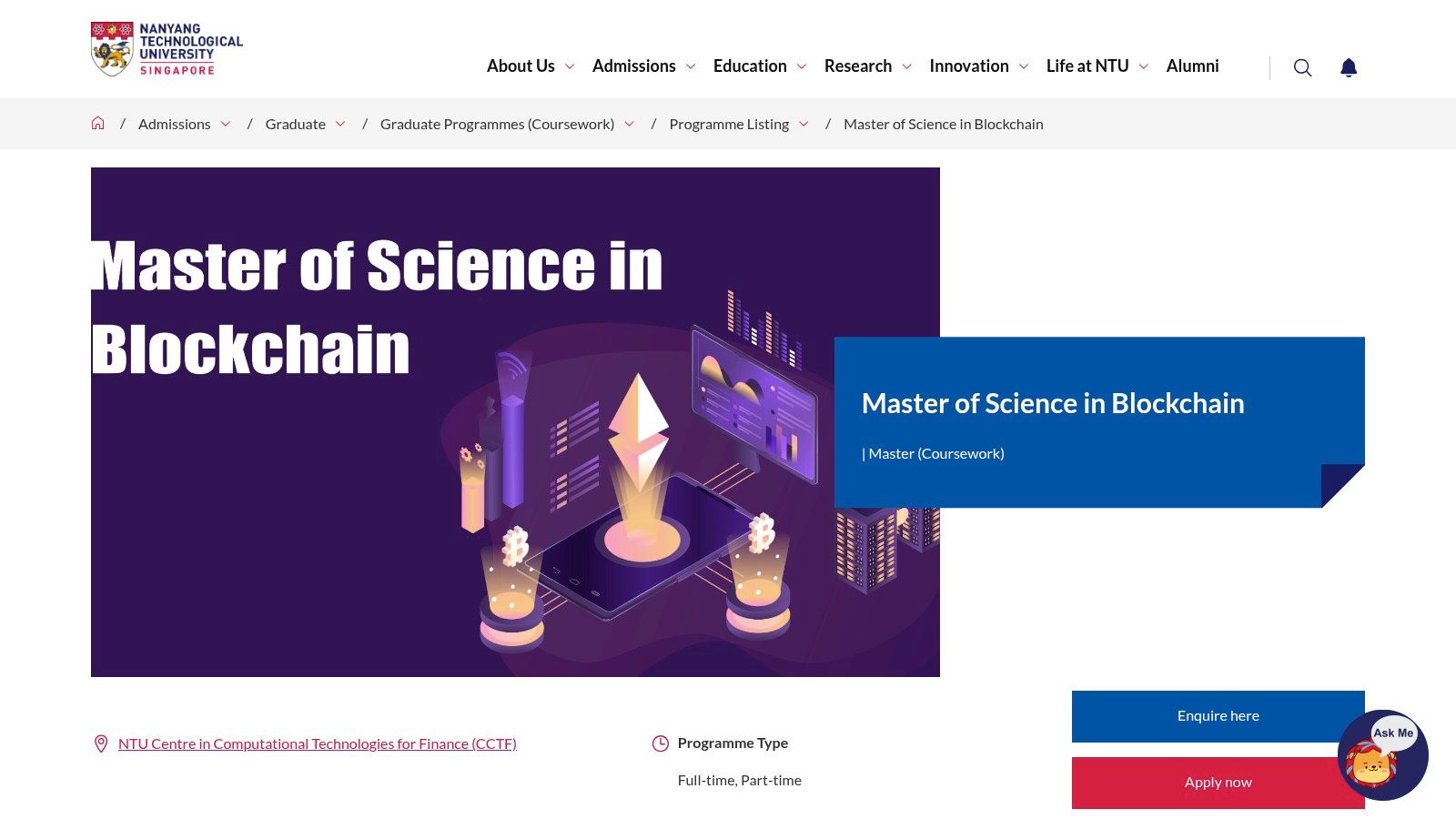
The degree offers 1-year full-time and 2-year part-time paths, includes industry project options, and sits within NTU's Centre in Computational Technologies for Finance. That last part matters because employers often read “research-backed” as “less likely to be fluff.”
Where it wins
If you're targeting engineering, infrastructure, smart contract development, or technical solution roles, NTU makes a stronger first impression than business-led programs. You're more likely to come out with credible interview material around DLT systems, application development, and technical decision-making.
That matters because hiring has become more selective. In 2026, blockchain employers are raising the bar and looking for hybrid profiles suited to roles such as DeFi Risk Engineer, On-Chain Compliance Specialist, and Tokenisation Product Manager, according to Blockchain Jobs UK's 2026 hiring trends analysis. NTU positions you well for the technical side of that shift.
Where it doesn't
If you're not sure you want to code extensively, this program may be too specialized. It's also on-campus in Singapore, so international students need to think seriously about relocation, visa logistics, and whether they'll use local network effects well enough to justify the move.
Employers tend to respect technical rigor, but they still ask for proof. A strong degree plus weak repos won't beat a decent degree plus obvious shipped work.
Use the program's industry project angle well. Don't just complete it. Turn it into a case narrative you can use in interviews with Web3 employers. Hiring teams remember candidates who can explain trade-offs in architecture, security, and user impact.
3. Hong Kong Polytechnic University, MSc in Blockchain Technology
PolyU is a strong option for candidates who want blockchain training without living entirely inside a narrow crypto silo. The MSc in Blockchain Technology at PolyU is computing-led, but it also crosses into AI and data analytics. That combination is practical because plenty of blockchain jobs now sit at the edge of analytics, fraud monitoring, infrastructure intelligence, and applied machine learning.
Here's the program atmosphere at a glance:
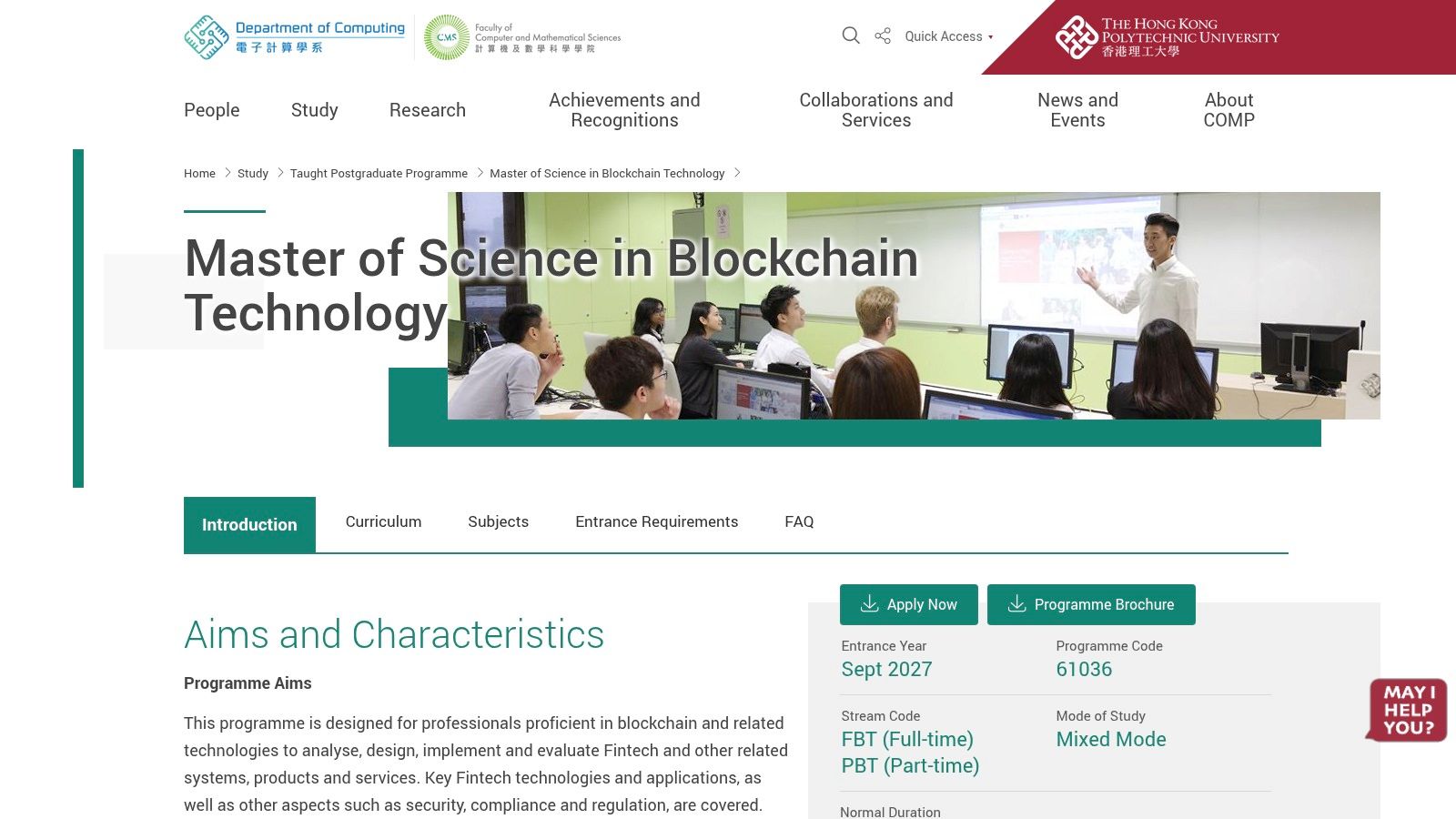
Access to PolyU's University Research Facility in Big Data is the kind of detail that can matter if you want to talk credibly about data pipelines, analytics workflows, or research-informed implementation.
Hiring lens
This program is strongest for candidates aiming at technical roles that aren't purely protocol-core. Think blockchain analytics engineer, applied data roles in Web3, infrastructure product support, or engineering paths that benefit from machine learning literacy.
There's also a location advantage. Hong Kong remains a meaningful hub for digital asset activity, which can help if you plan to build regional network effects alongside the degree.
A useful reality check comes from higher education research. A 2024 review found that many blockchain programs don't fully recognize genuine industry demands, and that curricula often lag behind the fast-evolving tooling and role requirements employers care about, as discussed in the ISCAP review of blockchain education programs. PolyU's crossover with analytics gives you more room to stay employable even if one slice of the market cools.
What you still need to add
This isn't a substitute for portfolio work. If you're interviewing for engineering jobs, you still need visible proof that you can build. That means smart contracts, backend integrations, indexer work, analytics dashboards, or security-aware code samples.
A smart way to validate your direction is to compare your coursework against live blockchain engineering roles. If your resume shows AI, data, and blockchain, make sure your project work proves you can connect those pieces in practice.
4. University of East London, MSc in Blockchain and Financial Technologies
The University of East London's MSc in Blockchain and Financial Technologies sits in a useful middle ground. It doesn't pretend everyone wants to become a protocol engineer, and it doesn't reduce blockchain to a soft business elective either. That balance makes it attractive for people headed toward fintech product, implementation, operations, or risk-aware commercial roles.
Here's the program page context:
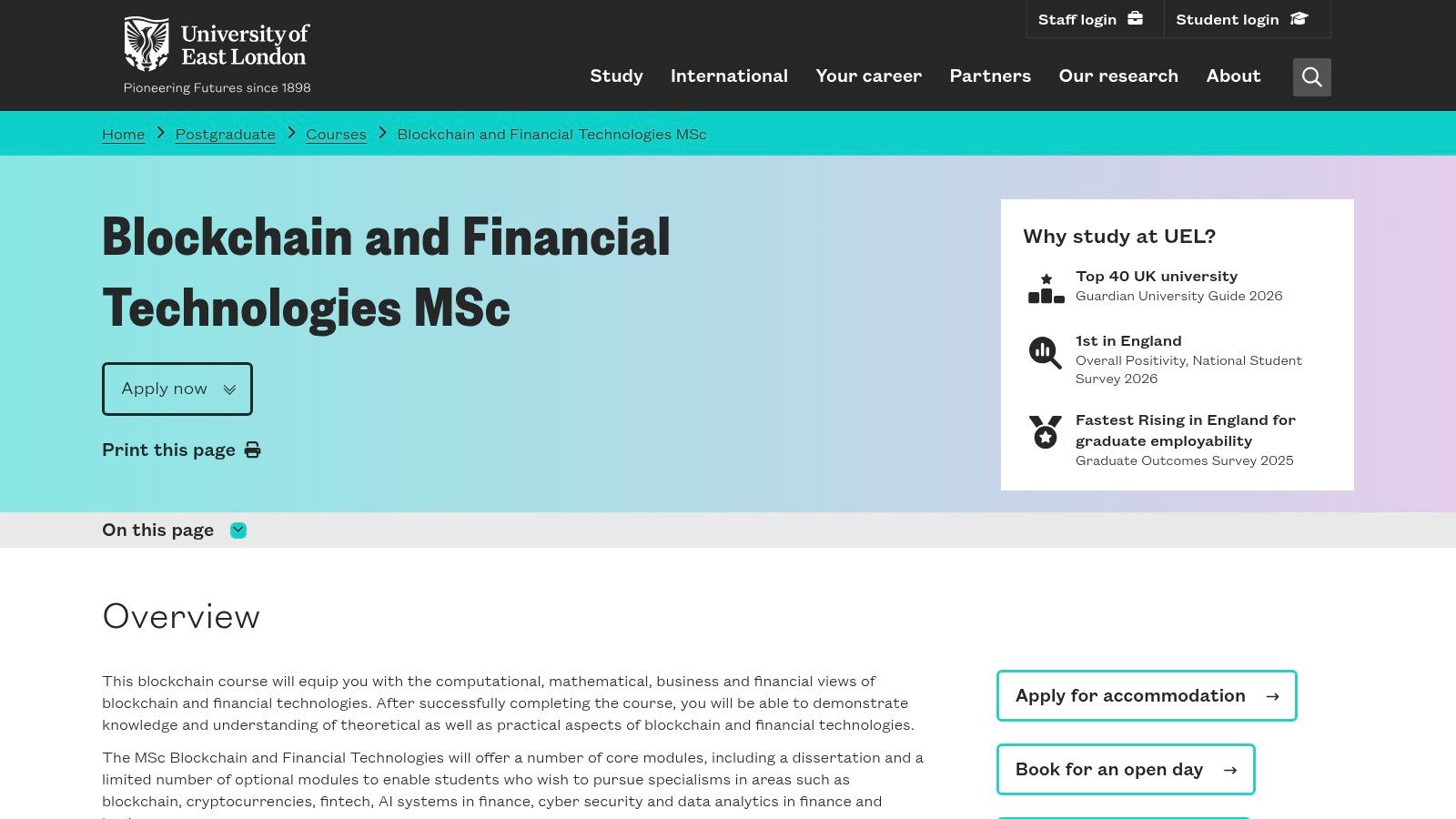
Core modules include blockchain and cryptocurrency, alongside machine learning on big data and security. That's a sensible stack for candidates who expect to work where fintech systems, digital assets, and user-facing platforms meet.
Practical career value
The biggest strength here is range. In interviews, you can talk about blockchain in the context of financial systems, data handling, and security rather than in isolation. That helps with roles like product analyst, implementation manager, fintech operations lead, or junior strategy roles at digital asset firms.
UEL also looks approachable for international applicants because the application timelines and visa guidance are clearly published. That seems administrative, but in practice it reduces friction for candidates who want momentum.
According to an education market review, approximately 28% of higher education institutions globally currently offer blockchain courses within their degree programs, and common curriculum themes include blockchain fundamentals, smart contract development, and cryptocurrency economics, as outlined in the ERIC paper on blockchain in higher education. That tells you blockchain education is spreading, but it also means a broad program like this needs to be paired with differentiation.
Where it can fall short
This isn't a pure blockchain-only degree. If you want deep protocol design or hard-core systems work, you'll likely outgrow the curriculum and need much more self-directed engineering practice.
Interview angle: Use this degree to position yourself as someone who understands how blockchain products fit into real financial workflows, not just someone who knows crypto vocabulary.
5. Queen Mary University of London, MSc Blockchain Management and Applications
Some candidates don't need another technical credential. They need a bridge into leadership-track Web3 roles. That's where Queen Mary University of London makes more sense than many engineering-first programs.
This degree is built around management, applications, employability, and transferable skills. That usually sounds soft until you look at who is hired into product, consulting, market strategy, ecosystem operations, and tokenization-adjacent business roles. Those interviews rarely hinge on whether you can optimize a low-level consensus component. They hinge on whether you can explain business value, execution risk, stakeholder alignment, and rollout logic.
Who should pick this
Choose this route if you want to work on the business side of blockchain adoption. It's especially relevant for:
- Product managers: You need to translate technical constraints into market decisions.
- Consultants and analysts: You need frameworks, communication, and applied use-case thinking.
- Operations and transformation roles: You need implementation literacy more than protocol depth.
The elective structure is helpful because it lets you tilt toward quantitative methods or adjacent business strengths. That's valuable when you're shaping a profile for tokenization, digital asset operations, or enterprise blockchain initiatives.
The hiring caveat
This isn't the best fit if your end goal is smart contract engineering or protocol research. For that path, a business-facing degree can leave you with too much explaining to do in technical interviews.
There's also a broader industry reality to keep in mind. Few resources push back hard enough on the idea that a traditional degree is necessary for blockchain work, yet practitioner-oriented guidance suggests the field is quite open to candidates who can prove skill through real projects and portfolios rather than credentials alone, as argued in this discussion on blockchain careers and practical validation. That doesn't make the degree useless. It means the degree has to support a very clear role strategy.
If you pick QMUL, make sure your side work includes product specs, token launch analyses, governance evaluations, or business cases tied to real protocols.
6. RMIT University, Bachelor of Business (Blockchain Enabled Business)
RMIT stands out because it doesn't treat blockchain as something students only encounter at postgraduate level. The Bachelor of Business with the Blockchain Enabled Business major at RMIT is useful for people who already know they want to work in digital assets but don't necessarily want to become developers.
Here's the visual context:
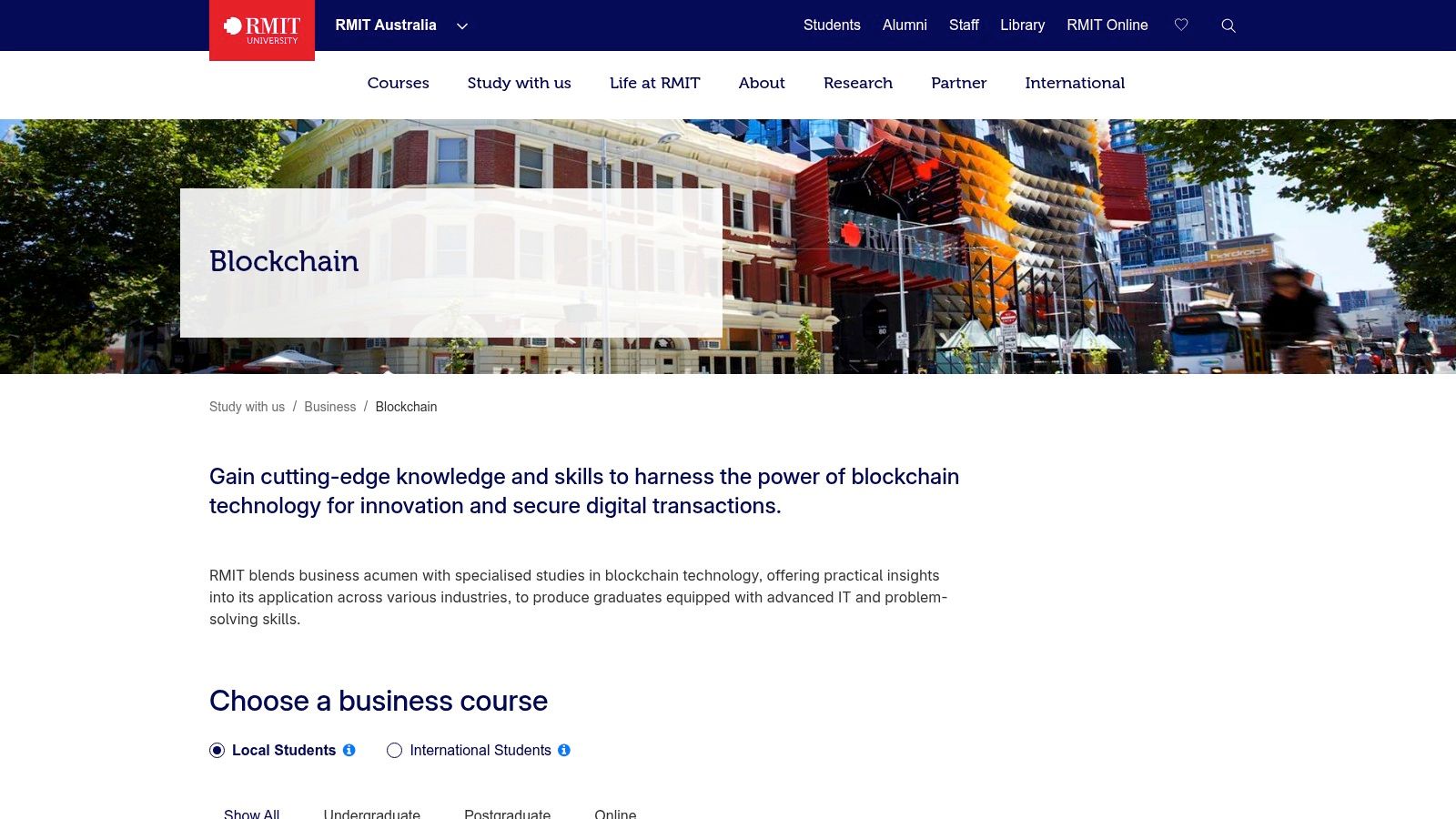
This is business-first by design. Practical labs, the RMIT Fintech-Crypto Lab, and professional practice pathways all matter because they create a route into product, operations, GTM, and partnership roles where blockchain fluency is valuable but deep engineering isn't mandatory.
Why that matters
A lot of teams need people who can work across product launches, ecosystem growth, exchange operations, wallet onboarding, or enterprise adoption. Those jobs are real, and they often get overlooked by candidates who think every blockchain career starts with Solidity.
This major can help students develop useful instincts early:
- Commercial framing: Why a blockchain product should exist
- Operational literacy: How a rollout operates
- Product communication: How to explain decentralized systems to non-technical users
That said, undergraduate business credentials need extra proof in hiring. Employers won't assume practical competence just because the major name is specialized.
The honest limitation
For mid-career professionals, this usually isn't the right reskilling path. It's better for earlier-stage candidates building a long runway. Also, because it's primarily Melbourne-focused, you need to care about the local academic and professional environment enough to make that location work for you.
There is a positive market signal behind dedicated programs like this. A 2018 Coinbase analysis found that 56% of the world's top 50 universities offered at least one course on cryptocurrency or blockchain, and about 70% of those institutions offered coursework outside computer science in areas like law, economics, and humanities, according to Cointelegraph's summary of the Coinbase report. That supports the idea that business-side blockchain education isn't fringe anymore.
7. University of the Cumberlands, MS in Global Business with Blockchain Technology
If you're U.S.-based, working full-time, and want a degree you can finish without relocating, the University of the Cumberlands MS in Global Business with Blockchain Technology is practical in a way many international programs aren't. It's fully online, uses rolling admissions, and leans into adoption, governance, and implementation across business functions.
Here's the page view:
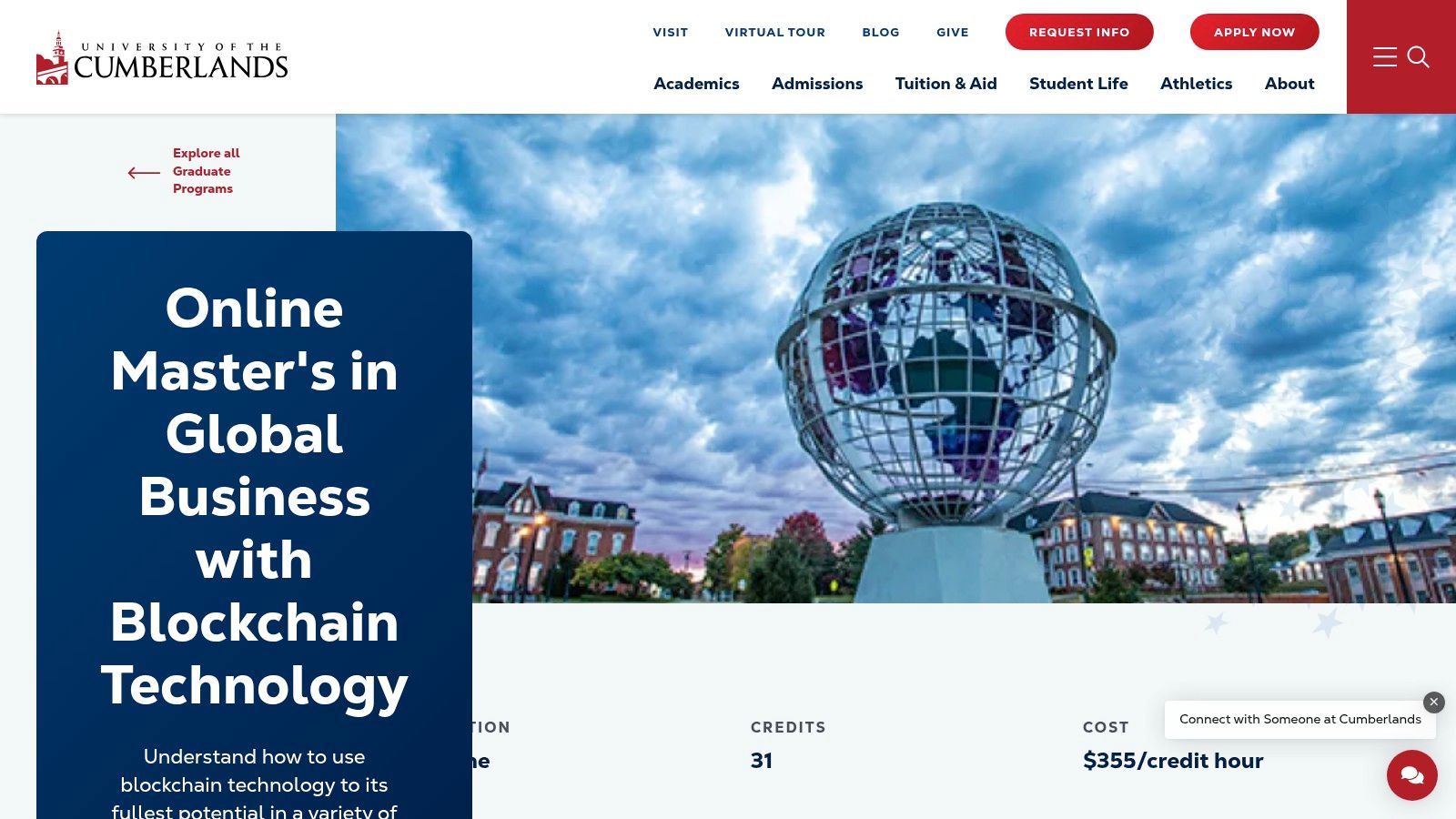
This is not the degree for someone who wants to spend their career deep in protocol engineering. It is strong for leadership-track candidates, change managers, digital transformation professionals, compliance-aware operators, and business-side specialists moving into Web3.
What employers may like
The best part of this program is convenience plus relevance. Candidates can keep working while building formal blockchain context in finance, HR, marketing, and legal-regulatory settings. That's useful if your employer is experimenting with digital assets, tokenization, or blockchain-adjacent systems and you want to become the internal subject matter lead.
There's another signal worth noting. Only a handful of blockchain credentialing solutions, including MIT's Blockcerts and the University of Nicosia's Block.co, have reached full-scale deployment, issuing thousands of blockchain-based diplomas and gaining adoption from over 100 institutions globally, while many other systems remain at pilot stage, according to Devdiscourse's review of blockchain academic credentials. In plain terms, education and blockchain still intersect unevenly. A conventional accredited online degree can feel safer to employers than more experimental credentials.
Where you must compensate
You still need tangible proof of execution. For most Web3 engineering roles, employers prioritize demonstrable skills, security-minded execution, and real project experience over generic academic diplomas, as discussed in Blockchain Council's comparison of certifications and traditional degrees. Even for business roles, I'd apply the same standard.
A business-focused blockchain degree works best when it's attached to one visible body of work: a live implementation project, a governance analysis, an internal transformation effort, or a portfolio of market-facing research.
Comparison of 7 Blockchain Degree Programs
| Program | Complexity 🔄 | Resource requirements ⚡ | Expected outcomes 📊 | Ideal use cases ⭐ | Key advantages 💡 |
|---|---|---|---|---|---|
| University of Nicosia, MSc in Blockchain and Digital Currency | Structured 90 ECTS master's; medium–high workload | Fully online or on‑campus; familiarity with ECTS helpful; scholarships and BTC payment option | Strong crypto + digital currency, regulation, and venture-building knowledge; large alumni network | Professionals seeking a dedicated blockchain master's and entrepreneurship pathways | Established program, free MOOC on‑ramp, transparent curriculum and costs |
| Nanyang Technological University (NTU), MS in Blockchain (MSBT) | Highly technical, research‑intensive; intensive 1‑year FT option | On‑campus Singapore (relocation/visa) or 2‑year part‑time; industry projects and scholarships | Rigorous engineering and R&D readiness for blockchain systems | Aspiring blockchain engineers and researchers | Top‑ranked uni with strong research backing and technical curriculum |
| Hong Kong Polytechnic University (PolyU), MSc in Blockchain Technology | Computing-led technical program with ML/data crossover; moderate–high | On‑campus Hong Kong access to Big Data research facility; multiple intake modes | Technical systems-building skills plus AI/data analytics applied to DLT | Students targeting engineering and data‑analytics roles in Web3 hubs | Technical depth with strong industry connections and big‑data resources |
| University of East London (UEL), MSc in Blockchain and Financial Technologies | Balanced tech + fintech focus; moderate complexity | On‑campus UK options (visa guidance); practical modules and professional development | Fintech-oriented competence across blockchain, ML for big data, and security | Those seeking a practical fintech-oriented master's with professional skills | Balanced curriculum, clear application process, industry‑aligned professional development |
| Queen Mary University of London (QMUL), MSc Blockchain Management and Applications | Business‑facing, lower protocol depth; moderate | On‑campus UK with electives to tailor focus; industry links | Management and applied blockchain skills for real‑economy use cases | Product managers, consultants, and non‑developer roles who need blockchain fluency | Elective customization and strong employability/transferable skills emphasis |
| RMIT University, Bachelor of Business (Blockchain Enabled Business) | Undergraduate, business‑first; lower technical complexity | Mostly on‑campus Melbourne; labs and RMIT Fintech‑Crypto Lab; double‑degree options | Business, product, operations, and go‑to‑market readiness with blockchain fluency | Undergraduates aiming for product, operations, or GTM roles in blockchain | One of few named blockchain undergraduate majors with practical industry engagement |
| University of the Cumberlands, MS in Global Business with Blockchain Technology | Executive-format online master's; moderate complexity | 100% online with rolling admissions; US accreditation, financial aid and military rates | Business/change‑management focus for blockchain adoption across functions | US‑based working professionals seeking an accredited online option | Fully online US‑accredited program convenient for practitioners with flexible admissions |
From Degree to Dream Job in Web3
Choosing among blockchain degree programs gets easier once you stop asking which one is “best” and start asking which one makes you more hireable for a specific lane. A technical MSc makes sense if you want to compete for engineering, infrastructure, smart contract, or research-heavy roles. A business-focused program makes more sense if you're heading toward product, strategy, ecosystem growth, compliance, or operations.
The financial upside is real, but only when the degree maps cleanly to a role. Median annual salaries cited for blockchain professionals remain high, with blockchain engineers earning between $150,000 and $170,000, blockchain software developers averaging $159,100, and smart contract developers ranging from $120,000 to $180,000, according to American Public University's overview of cryptocurrency job paths. Those numbers are attractive, but they don't belong to degree holders automatically. They belong to candidates who can do the work.
That's the part many academic comparisons miss. Existing content often overemphasizes credentials and underplays the skill gap between coursework and hiring reality. Some computer science departments teach blockchain in a way that leans heavily theoretical, while employers still screen for practical tooling, security awareness, and evidence of recent hands-on work. A degree helps most when it gives you structure, credibility, and a network. It hurts when it becomes an excuse to delay building.
If you're early in your career, a strong program can compress your learning curve and give you a better signal to recruiters. If you're mid-career, the right degree can reposition you into digital assets, tokenization, or on-chain product work without starting from zero. If you're already technical, it may be worth asking whether a degree adds more value than a year spent shipping open-source work, joining hackathons, and contributing to real protocols.
That's why I usually give the same advice to anyone comparing these programs. Pick the curriculum that matches the interviews you want. Then build a parallel proof layer while you study. Push code to GitHub. Write governance or tokenization analyses. Join a hackathon. Contribute to a DAO. Turn class projects into public artifacts.
Once your education is tied to visible execution, you stop looking like a student and start looking like a candidate. When you're ready to validate that against the market, review active openings and hiring patterns on platforms like Blockchain Jobs. You'll see quickly whether your degree story aligns with what companies need now.
The fastest way to test whether your education matches the market is to compare it against live roles. Blockchain Jobs makes that easy, whether you're aiming at engineering, product, legal, compliance, marketing, finance, or operations across the Web3 ecosystem.