
Blockchain Jobs Remote: Your 2026 Guide to Getting Hired

Remote work in Web3 isn't a side story anymore. In 2025, the sector added 66,494 new roles globally, and 26,925 of them were remote, a 40% year-over-year increase according to Coincub's 2025 Web3 jobs report. That matters because blockchain jobs remote aren't just for smart contract engineers in a handful of crypto hubs. Hiring is spreading across product, operations, compliance, support, and growth.
The mistake most candidates make is treating Web3 like a looser version of tech hiring. It isn't. Remote blockchain teams usually expect stronger proof, clearer writing, and more visible work than a comparable Web2 role. A polished resume helps, but it won't carry you far if your work can't be verified through GitHub, public writing, DAO activity, shipping logs, or a record of thoughtful contribution in the right communities.
From the hiring side, the strongest candidates do three things well. They pick a lane instead of applying everywhere. They show work instead of describing ambition. And they understand that remote-first Web3 companies screen for operating style just as hard as they screen for skill.
Mapping Your Path in the Web3 Job Market
A scattered search usually leads to weak interviews.
Chasing titles instead of solving for fit is a common mistake in blockchain jobs remote. Web3 hiring runs on narrower signals than many candidates expect. A product manager at a wallet company is not doing the same job as a product manager at an L2, an exchange, or a DAO tooling startup. The title may match. The operating environment, risk profile, and hiring criteria often do not.

Start by picking a lane based on the work you can already prove, not the label you want next.
Technical builders
If you write code, get specific fast. "Blockchain developer" is too broad to help a hiring team place you. Protocol engineering, Solidity app development, DevOps for validators, security research, data engineering, and wallet infrastructure each come with different evaluation standards.
The strongest applications make that distinction obvious. A candidate who can point to audited contracts, validator uptime work, subgraphs, incident writeups, or shipped tooling gives me something concrete to assess. A resume full of "Web3 experience" usually means I need to guess.
Product and business operators
This lane is deeper than many applicants realize, but the bar is different from Web2. Teams want operators who can handle ambiguity, write clearly in public or semi-public channels, and work across legal, ops, support, and product without waiting for a perfect process. In many remote crypto companies, the job involves part execution and part translation. You are turning protocol constraints, user pain, and market volatility into decisions the team can act on.
Transferable experience matters here. A fintech operator who has run onboarding workflows, worked with compliance, handled payment failures, and documented incidents often has a stronger case than a candidate with a lighter background and a lot of crypto opinions. Good Web3 hiring managers look for proof that you can operate in messy systems, especially where custody, identity, fraud, payments, or governance are involved.
DAO work can help, but only if you frame it correctly. "Contributor at X DAO" tells me very little. "Ran governance operations, wrote proposals, coordinated working group updates across time zones, and published outcomes" tells me how you work.
Practical rule: Pick 2 to 3 target roles, not 12. Your resume gets sharper, your outreach sounds more credible, and your interview answers stop drifting.
Non-technical specialists
Legal, finance, HR, support, and people ops candidates can win in Web3, but they usually need a more deliberate search. These roles are posted less consistently, and hiring teams often screen harder for context. They want to know whether you understand sanctions risk, token launches, contributor classification, treasury controls, exchange support workflows, or the practicalities of running a distributed team.
This is also where generic career advice fails. In Web3, portfolio proof is not limited to engineers. A compliance candidate can publish a short breakdown of a new rule and its hiring implications. A recruiter can show how they built a sourcing map across ecosystems. A finance operator can explain how they handled reporting across fiat and token flows. If you want compensation context while narrowing targets, review examples of remote six-figure jobs in crypto and Web3.
Use this filter before you apply:
| Question | Good sign | Bad sign |
|---|---|---|
| Does the company need your function now? | The role ties to a current business problem | The posting reads broad and recycled |
| Can you prove relevant work? | Public artifacts, shipped projects, writing, dashboards, DAO contributions | Only claims on a resume |
| Do you like the operating model? | Async communication, clear docs, real ownership | Constant meetings, fuzzy scope |
| Is the compensation structure workable for you? | Salary, token upside, vesting, and liquidity are explained clearly | Token comp is vague or used to dodge cash expectations |
The candidates who get hired fastest are usually the ones who match a specific operating need and show evidence in the format Web3 teams trust.
Where to Find High-Signal Remote Blockchain Jobs
Candidates waste hours on stale listings and roles that are not remote.
That problem is worse in Web3 because a posting can look legitimate while hiding the details that shape the job. The employer may be a foundation, a lab, a DAO-adjacent entity, or an agency hiring on behalf of a protocol. Compensation may include salary, tokens, or both. "Remote" may mean global async, or it may mean "US only, Eastern hours, contractor agreement." Read for operating reality, not branding.
Start with boards that separate Web3 functions clearly
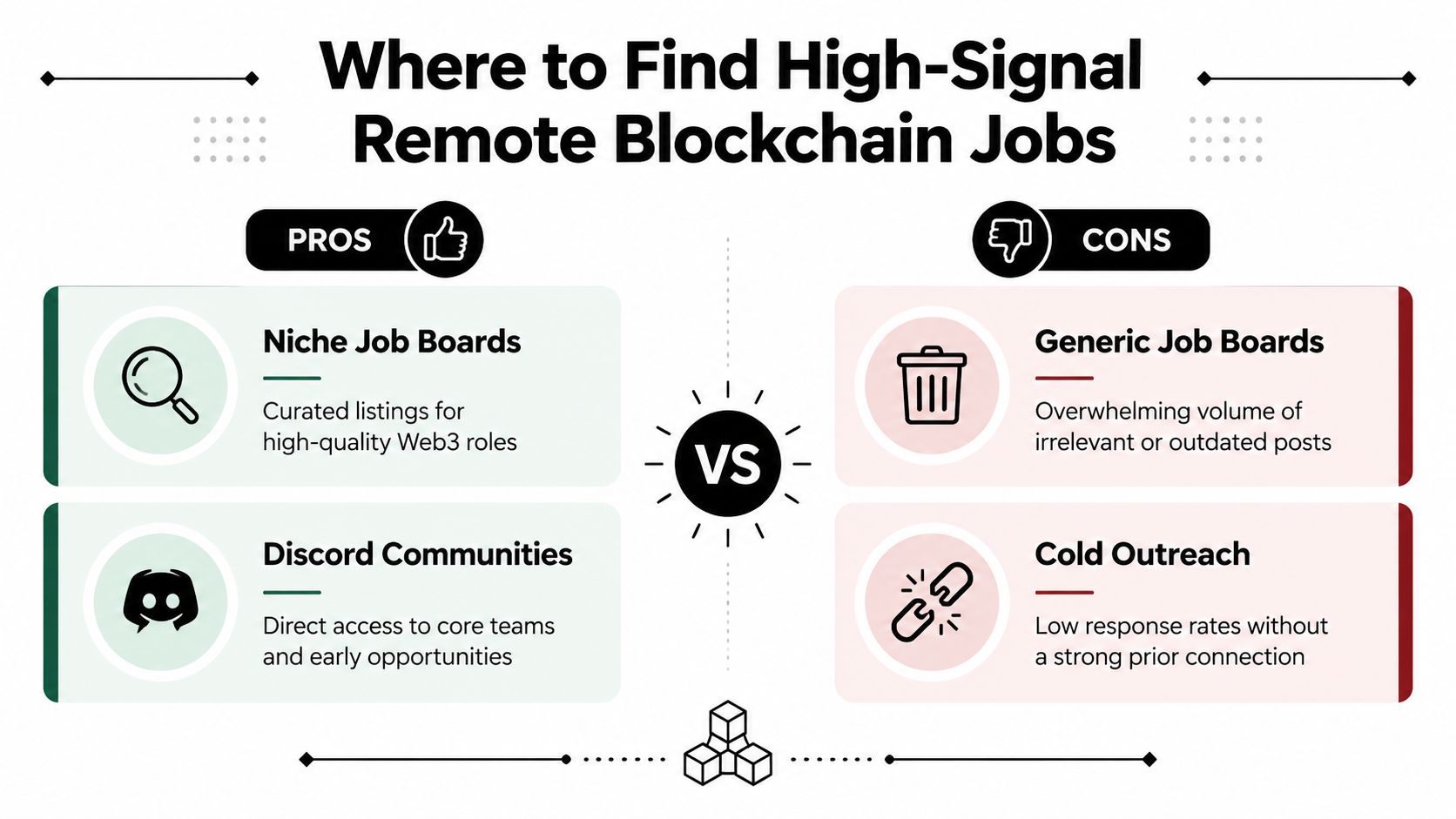
Broad job boards are useful for volume, but they mix serious openings with recycled posts and roles from companies that do not understand how to hire distributed teams. Use them to spot demand patterns, then qualify hard. For example, Indeed's remote blockchain job listings can show you which titles are active, but you still need to check whether the company names, jurisdictions, and compensation structure make sense.
A niche board usually gives better context. Remote blockchain roles filtered by location on Blockchain Jobs are easier to sort by function, which matters if you work in compliance, ecosystem, operations, support, finance, or recruiting instead of pure engineering.
I tell candidates to keep two tabs open. One for broad-market demand. One for crypto-native demand. The overlap is often where the strongest remote roles sit.
Use community signals before a role is formalized
A lot of Web3 hiring starts in public long before a recruiter posts a job description.
Watch Discords, governance forums, Farcaster, Telegram groups, and X accounts for repeated operational pain. If a protocol keeps asking for help with validator communications, grants ops, moderation coverage, exchange listing support, treasury reporting, or ecosystem onboarding, that is usually a headcount problem taking shape. Sometimes it becomes a contract role first. Sometimes it starts as a contributor bounty. Strong candidates treat those signals as early sourcing data.
DAO contributions matter here because they can function as a live portfolio piece. A governance recap, community ops dashboard, research thread, or contributor sprint can show more than a polished resume ever will. Generic career guides usually miss this. Web3 teams often trust visible work in public more than self-reported claims in a PDF.
Filter for remote operating quality
A remote blockchain role is only attractive if the team knows how to run remotely.
Look for practical signs:
- Clear timezone expectations: overlap hours, region limits, and response norms are stated directly
- Written decision-making: docs, tickets, governance records, or product specs show how work moves
- Defined employment structure: contractor vs employee status, entity location, and payment rails are explained
- Specific scope: the posting names the problems the hire will own, not just a mission statement
- Compensation transparency: cash range, token component, vesting terms, and liquidity expectations are at least introduced
If a team is vague about token compensation during hiring, expect harder conversations later. Candidates should ask whether tokens are liquid, vested, milestone-based, or a substitute for cash. That is not a finance side question. It is a job quality question.
Build a search system that matches how Web3 hiring actually moves
Crypto hiring is uneven. Teams hire fast after a raise, freeze after a market drop, then reopen the same need under a different title a month later. Browsing casually does not work well.
Track roles in Notion, Airtable, or a simple spreadsheet. Save the date posted, hiring lead, chain or ecosystem, jurisdiction limits, comp notes, and whether you have a community path into the team. Separate formal applications from contributor leads and referral leads. That one change helps candidates avoid treating every opening the same.
Good search hygiene also improves how your materials perform in screening systems. If you need a refresher on crafting ATS-friendly tech resumes, review it before you start batch applying. In Web3, the best results usually come from fewer applications, tighter targeting, and better proof.
Crafting Your Web3-Optimized Application
A generic application signals weak fit in Web3. Remote crypto teams screen for proof, speed, and judgment long before they care about polished personal branding.
Hiring managers want to verify your work quickly. They look for public artifacts, clear ownership, and signs that you can operate in an async environment with loose structure and high ambiguity. In practice, your resume, links, and intro note function like a small diligence package.

Replace broad claims with proof
Candidates often write "passionate about blockchain" or "active in Web3." Those lines carry little weight unless the application shows what that means.
Use evidence that maps to the role:
- For engineers: GitHub repos, audits, test coverage, smart contract deployments, protocol contributions, hackathon projects
- For product candidates: PRDs, token design research, roadmap docs, user interview synthesis, governance process changes
- For marketers and community hires: campaign breakdowns, dashboards, content calendars, moderation systems, growth experiments
- For legal and compliance candidates: policy memos, regulatory summaries, vendor review frameworks, risk matrices, incident workflows
- For support and ops hires: SOPs, escalation paths, handoff docs, internal wikis, service metrics
Public proof matters because Web3 hiring is unusually reference-light at the start. Many teams do not have mature recruiting operations. They make early decisions from what they can inspect themselves.
That creates an opening for candidates who lack brand-name employers but have credible work to show.
Build a portfolio that feels native to the space
A polished personal site is optional. A clean Notion page, GitHub profile, or simple portfolio doc often performs better because it gets to the point fast.
The best Web3 portfolios answer four questions immediately. What did you own? What changed because of your work? How can someone verify it? How close is this work to the team's stack, users, or operating model?
Include portfolio pieces that generic career guides miss:
- DAO or governance contributions with links to forum posts, proposal drafts, delegate notes, or research that influenced a decision
- Async work samples such as memos, specs, postmortems, and documentation that show how you think without a meeting
- On-chain or ecosystem context including chain familiarity, tooling, wallets, analytics platforms, or security constraints
- Clear role boundaries so reviewers know what you owned versus what a team shipped around you
If you contributed under a pseudonym, say so and give enough context to verify the work. That is common in crypto. Hiding the connection and hoping a recruiter figures it out is where good candidates lose momentum.
Your application is an async work sample. If it is vague, cluttered, or hard to verify, teams often assume your day-to-day work will look the same.
Keep the resume readable by both humans and systems
Some candidates make the mistake of writing for crypto insiders only. Others strip out all Web3 context to sound more corporate. Neither approach works well.
Use standard resume structure so recruiters and applicant systems can parse it. Then add the context a Web3 hiring lead needs, such as chains, protocols, governance work, security exposure, and whether your shipped work is public. If you want a practical refresher on formatting and keyword placement, review this guide to crafting ATS-friendly tech resumes before your next round of applications.
A strong format usually highlights:
| Resume element | What to include |
|---|---|
| Summary | One niche, one value proposition, one relevant Web3 angle |
| Core skills | Tools, chains, languages, workflows, analytics or governance systems |
| Experience | Scope, ownership, cross-functional coordination, verifiable outputs |
| Projects | Public proof tied to real user, protocol, or operational problems |
| Links | GitHub, LinkedIn, portfolio, writing, forum profile if relevant |
If you are applying through a job board, use the correct role page and tailor your language to that posting. For example, remote blockchain roles on Indeed often vary widely in title while asking for similar underlying skills. Match your wording to the actual responsibilities, not just the headline.
Write an intro note that shows judgment
Skip the dramatic cover letter. Send a short note with three parts: why this team, why this role, and what they should review first.
The strongest notes sound specific because they are specific. Mention a protocol decision, product constraint, governance issue, user problem, or operational gap you noticed. Then point the reader to one relevant artifact. A shipped tool, a proposal comment, a smart contract repo, a risk memo, a support workflow, or a growth dashboard is enough.
This is also the right place to show you understand how Web3 teams operate. If a role includes token compensation, contributor overlap, or odd-hour coordination across time zones, signal that you have worked in those conditions or know what they require. Candidates who acknowledge those trade-offs come across as much more prepared than candidates who only say they are excited about the mission.
Networking and Building Your On-Chain Reputation
In Web3, reputation compounds faster than credentials.
That's not because titles don't matter. It's because remote teams often hire from trust signals they can observe long before a formal interview starts. When someone has seen your GitHub activity, your forum comments, your governance reasoning, your writing, or your community conduct, they don't have to guess how you think.
Contribute where your target teams already spend time
The strongest networking in blockchain jobs remote rarely looks like networking. It looks like contribution.
If you're technical, review open issues, improve docs, test tools, answer implementation questions, or submit small pull requests. If you're non-technical, summarize governance proposals, build community resources, write explainers, organize information, or help clean up operational chaos that everyone complains about but no one owns.
The key is relevance. A random "gm" habit won't help much. A clear post that explains a protocol change in plain English might.
Build social proof without sounding performative
A lot of candidates think they need to become content creators. Most don't.
What hiring teams notice is consistency and signal:
- Thoughtful public notes on products, governance, regulation, user flows, or tooling
- Clean interaction patterns in Discord, Telegram, and Farcaster
- Small, useful contributions that reduce work for maintainers or community leads
- A visible niche so people know what to associate you with
Be the person who clarifies, documents, fixes, or organizes. Those traits travel well across almost every remote Web3 role.
DAOs can work as portfolio material
DAO participation isn't automatically impressive. Many candidates list "DAO contributor" and mean they voted twice and sat in a few calls.
What makes DAO work valuable in hiring is specificity. Did you ship a proposal? Moderate and document a process? Analyze token incentives? Coordinate contributors across time zones? Improve treasury reporting? Create member onboarding materials? Those are real work signals.
A good way to frame DAO work is the same way you'd frame paid work:
- Problem
- Scope
- What you owned
- What you shipped
- What changed because of it
Ask for conversations the right way
Cold outreach still works when it doesn't feel cold. The best messages are short, informed, and easy to answer. Reference a real part of the team's work. Show that you've done something adjacent. Ask one clear question.
Bad outreach asks for a job before trust exists. Good outreach creates a reason for dialogue.
That matters even more in Web3 because many teams hire after repeated lightweight interactions. Someone sees your contributions, remembers your name, and reaches out when the timing is right. That's a very different path from spraying applications and hoping your resume gets read.
Nailing the Remote Blockchain Interview Process
Three rounds can be enough for a Web3 team to decide whether to hire you, especially if the company is small, remote, and shipping fast. The catch is that those rounds often test more than your stated job function. They also test whether you can operate in public, work asynchronously, and make sound calls without much process around you.

A remote blockchain interview usually feels less standardized than a big tech loop. You might speak with a founder who jumps from product strategy to token design in the same call. Then a protocol engineer may ask you to reason through an exploit, write a spec, or review a pull request live. Strong candidates prepare for that shape of process instead of expecting a polished sequence.
What teams are actually filtering for
Hiring managers in Web3 look for proof that survives inspection.
For engineers, that means code quality, security judgment, and whether you can explain trade-offs in plain language. For product, ops, marketing, and community candidates, it means the same pattern in a different format. Can you make order out of messy information? Can you document decisions so a distributed team can act on them six hours later?
Public work carries extra weight here. A merged PR, a governance proposal, a careful forum post, an audit write-up, or a postmortem often says more than a resume bullet. Teams close to open-source and DAO workflows are used to evaluating visible artifacts, not just credentials.
The common stages and what each one measures
Most remote Web3 interviews include some version of these checkpoints:
| Stage | What they're testing |
|---|---|
| Recruiter or founder screen | Clarity, motivation, compensation fit, timezone overlap |
| Technical or functional interview | Depth in your lane and how you reason |
| Take-home or live task | Judgment, written communication, and async execution |
| Team interview | Collaboration, trust, and ability to handle ambiguity |
| Final conversation | Risk tolerance, role scope, and cultural fit |
The first screen gets underestimated.
In remote hiring, a short intro call often decides whether the team believes you can represent your work clearly without hand-holding. If you ramble, dodge trade-offs, or speak in vague Web3 buzzwords, that gets noticed fast.
How to approach take-homes and live rounds
Good interview tasks in this market resemble real work. Engineering candidates may review a contract, explain an attack surface, design a protocol component, or debug an integration. Product and operations candidates may get an incident scenario, a governance process problem, or a writing assignment that tests whether they can create clarity for people in different time zones.
A few habits improve your odds:
- Show your reasoning. State why you made each choice.
- Name assumptions. Interviewers care about what you noticed, not just your final answer.
- Document edge cases. Distributed teams need people who catch failure modes early.
- Write for the next person. Clean notes and readable structure matter in remote work.
- Time-box intelligently. A perfect answer delivered late is often worse than a strong answer with clear priorities.
For teams that work asynchronously, your submission is also a writing sample. If you want a stronger feel for that operating style, review these async remote job habits that teams actually rely on.
Cultural rounds test operating style
Final interviews in Web3 are often more revealing than technical screens because they expose how you behave when conditions are messy.
Expect questions about disagreement, security versus shipping speed, public criticism, and incomplete information. Teams that work with communities, token holders, or DAO contributors also want to know whether you can handle open feedback without getting defensive. That matters because a lot of Web3 work happens in public threads, shared docs, governance forums, and chat histories that everyone can see later.
Prepare examples around:
- Shipping with incomplete specs
- Resolving conflict across time zones
- Choosing safety over speed, or speed over perfection, and why
- Correcting a mistake publicly
- Creating documentation that reduced confusion for others
The strongest answers sound specific. Name the constraint, the decision, the trade-off, and the result.
A useful primer before your next round is below.
Questions serious candidates ask back
The interview is also your due diligence window. Ask questions that reveal how the team works.
- How are decisions documented after calls?
- What does strong performance look like in the first 90 days?
- Who sets priorities when engineering, community, and token-holder interests conflict?
- How much of the work is reactive versus planned?
- What has caused burnout or turnover on the team before?
That last question matters more than many candidates realize. Fast-moving remote teams can slide into unhealthy operating patterns quickly, especially across multiple time zones and always-on chat. If you want a useful framework for spotting warning signs, review these evidence-based burnout strategies for teams.
A strong interview performance in Web3 feels calm, concrete, and credible. Teams remember candidates who can think clearly, leave a usable paper trail, and handle the odd mix of autonomy, transparency, and risk that remote blockchain work brings.
Negotiating Compensation and Thriving Remotely
Compensation in Web3 can swing far wider than candidates expect because the offer often mixes cash, tokens, equity, and contractor terms. Two offers with similar headline numbers can produce very different outcomes six months later.
Treat the package like an operating agreement, not just a paycheck. Early-stage teams may need token upside to stay competitive on cash. More established companies may offer stronger base pay but less asymmetrical upside. Neither is automatically better. The right choice depends on your risk tolerance, the project's legal structure, the token's actual utility, and how much volatility you can absorb without resenting the job.
What to clarify before you accept
If tokens or equity are part of the offer, ask direct questions and keep pushing until the answers are concrete.
- Vesting terms: Start date, cliff, acceleration, and what happens if the company restructures
- Token details: Whether the token exists yet, whether grants are locked, and who controls distribution
- Liquidity reality: If there is any credible path to selling, or if the upside is paper-only for the foreseeable future
- Payment mechanics: Fiat, stablecoins, payroll provider, payout schedule, and who covers conversion fees
- Employment structure: Employee versus contractor affects taxes, benefits, IP assignment, and termination risk
- Jurisdiction: Which entity hires you, which laws govern the contract, and whether local compliance is already solved
I tell candidates to translate every token promise into three plain-English questions. What am I getting? When do I control it? What can stop that from happening?
Salary benchmarks still help, but they are only one input. As noted earlier, some remote blockchain roles post strong cash bands. In practice, the strongest negotiating position comes from scarce skills, visible proof of work, and a clean explanation of how you reduce execution risk for the team. DAO governance work, protocol contributions, public research, and shipped tooling often matter more than polished salary talk.
Negotiate the working model too
A high package does not fix a broken remote setup.
Web3 teams fail people in predictable ways. Decisions stay trapped in Telegram. Founders expect live responses across three time zones. Community fire drills keep spilling into engineering time. Token launches distort priorities for weeks. If you do not ask about operating norms during negotiation, you may inherit a role that pays well and burns you out fast.
Use this part of the conversation to get specifics:
| Topic | What to clarify |
|---|---|
| Timezone overlap | Core hours, weekend expectations, and how often urgent work is real rather than cultural |
| Async norms | Where decisions are written down, who documents them, and what happens after live calls |
| Security practices | Hardware wallet policy, access reviews, device requirements, and incident response expectations |
| Onboarding | Who owns ramp-up, what documentation exists, and when you are expected to ship independently |
| Performance | What success looks like in 30, 60, and 90 days |
| Compensation review | Whether token repricing, market moves, or scope changes trigger reassessment |
The strongest candidates negotiate for clarity, not just more money. That includes written expectations around response times, ownership boundaries, meeting load, and who has authority when token holders, founders, and users want different things.
If you are evaluating whether a team is built for distributed work, this guide to async remote jobs and how they work is a useful reference. It helps separate companies that write things down from companies that hire across time zones.
Protect your energy early
Remote Web3 work can become always-on work unless someone sets limits. Set those limits early.
Document decisions. Push for written handoffs. Mute channels that do not require your attention. Ask where emergencies are declared and who gets paged. If the answer is “everyone,” the team has an operations problem, not a culture of ownership.
Burnout usually starts as ambiguity, then turns into interruption, then turns into resentment. If you want a grounded framework for spotting and preventing that pattern, review these evidence-based burnout strategies for teams.
The people who last in remote Web3 do more than negotiate a good offer. They choose teams where the work can stay sustainable after the excitement wears off.
If you're looking for blockchain jobs remote across engineering, product, legal, compliance, operations, support, and more, Blockchain Jobs is a straightforward place to start. You can scan current openings, filter by function, and focus your search on roles that match how Web3 teams hire.