Blockchain Security Jobs: Your 2026 Career Guide

The biggest mistake people make about blockchain security jobs is thinking they're niche. They're not. They sit inside a security labor market that has been short on talent for years. Cybersecurity Ventures projected 3.5 million unfilled cybersecurity jobs globally by 2021, and market tracking cited by StationX says the gap reached 4.8 million unfilled positions in 2024 according to the Cybersecurity Ventures jobs report. That matters because Web3 companies don't hire from a separate universe. They compete for the same people who can reason about code, analyze risk, investigate incidents, and communicate under pressure.
That shortage creates an unusual opening for strong developers. If you can review contracts, understand protocol assumptions, write secure code, and explain security decisions clearly, you're not applying into a commodity market. You're entering a field where hiring teams often struggle to find people who can do more than run scanners and repeat common bug classes from memory.
Why Blockchain Security Is a Major Career Opportunity
Blockchain security attracts attention for the obvious reason. The cost of getting it wrong is immediate. A frontend bug can annoy users. A protocol bug can freeze funds, break trust, trigger emergency governance, or force a painful migration.
What makes this a serious career path is the overlap between high-stakes software and structural labor scarcity. Security talent has been in short supply across industries for years, and blockchain companies feel that pressure even more because they need engineers who understand both application security and adversarial decentralized systems. If you want a useful overview of how security teams think about enterprise protection beyond crypto, Cyber Command's perspective on business cybersecurity solutions is a helpful reminder that many core hiring signals carry over. Clear thinking, secure design, incident readiness, and practical risk reduction matter everywhere.
Why employers care so much
Hiring managers in this space usually aren't looking for someone who can only identify textbook Solidity issues. They want people who can answer harder questions:
- Can you reason about protocol invariants
- Can you explain exploitability, not just smell-test code
- Can you distinguish a low-severity issue from a release blocker
- Can you work with developers without turning every review into a lecture
Practical rule: Security people get hired faster when they can reduce uncertainty for a team.
That's the opportunity. Good blockchain security work is still rare, and teams know it.
The Full Spectrum of Blockchain Security Roles
Most public career guides flatten everything into “smart contract auditor.” That's too narrow, and it leads candidates to train for the wrong job.
Many job ads collapse smart-contract auditing and blockchain security engineering, but the roles are distinct. Security engineering often spans secure architecture, incident response, cryptography, and vulnerability research, not just Solidity review, and some postings explicitly mention forensics and key management protocols like BIP-39 and BIP-44 in this blockchain security engineer example from Selby Jennings.
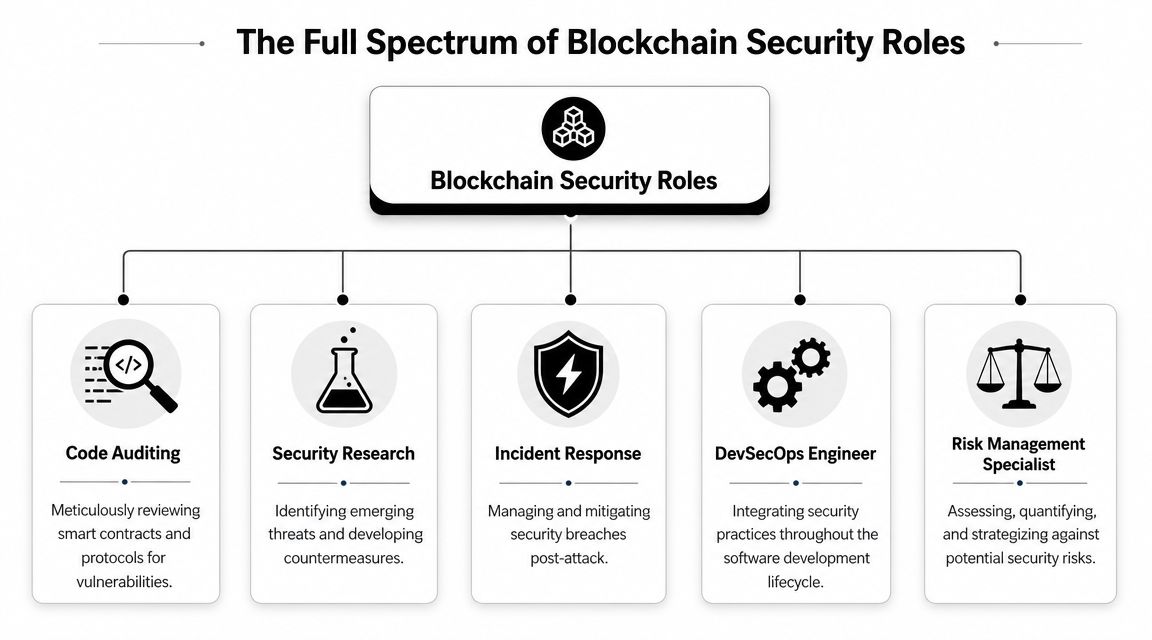
If you're browsing live openings, a dedicated list of security roles in blockchain makes the spread obvious. You'll see auditing, engineering, platform security, investigations, and security-adjacent roles that don't fit a single label.
Smart contract auditor
This is often the first role that comes to mind. The core job is reviewing Solidity, Rust, or protocol-related code for flaws before deployment or major upgrades.
A good auditor spends less time waving around automated output than most newcomers expect. Real work includes reading specs, reconstructing intended behavior, checking state transitions, tracing permission boundaries, reviewing external call patterns, and validating assumptions around pricing, oracle usage, upgradeability, and access control.
Strong fit for this role
- Detail-oriented developers who enjoy careful code reading
- People who write well because findings need to be precise
- Engineers who like invariants more than flashy exploit demos
Blockchain security engineer
This role is broader and often more valuable over time. Security engineers design protections before code reaches an audit. They build review pipelines, write internal tooling, improve wallet and key management flows, assess integration risks, support incident response, and partner with product and infrastructure teams.
A normal week might include reviewing a contract diff, threat-modeling a bridge integration, improving signing policies, reproducing an exploit reported through a bug bounty, and helping an engineering team fix root causes instead of patching symptoms.
Many candidates underestimate the breadth of this job. Security engineering rewards people who can operate across layers. Not just contracts, but CI pipelines, deployment practices, secrets handling, monitoring, and operational controls.
Protocol security researcher
Researchers sit closer to the frontier. They study new attack surfaces, explore edge cases in consensus or protocol logic, fuzz weird states, and develop proof-of-concept exploits or defenses.
This role tends to fit candidates who enjoy uncertainty and original problem-solving. You'll spend more time investigating “what happens if these assumptions collide?” than executing a standard checklist.
A researcher isn't paid for recognizing yesterday's bug pattern. They're paid for noticing tomorrow's.
Incident response and security operations
Plenty of blockchain security jobs aren't pre-deployment at all. Someone has to investigate suspicious transactions, triage alerts, assess blast radius, coordinate containment, preserve evidence, and help teams communicate clearly when things go wrong.
This work favors calm operators. The technical bar is still high, but the differentiator is judgment under stress. If you like puzzles but hate ambiguity, this may feel rough. If you like assembling evidence from chain data, logs, wallet behavior, and infrastructure clues, it can be a great fit.
Compliance, investigations, and asset recovery
This is the path many technically adjacent candidates miss. Public listings now include roles such as crypto investigators, cybersecurity investigations, asset recovery, financial-crimes leadership, and security-focused recruiting according to the crypto security jobs market snapshot.
These roles matter because not every security problem starts in code. Some start in fraud operations, sanctions exposure, insider risk, account compromise, social engineering, or recovery workflows after theft.
Good fit here
- AML and fraud professionals moving into digital assets
- Investigators who can follow on-chain and off-chain evidence
- Operations leaders who understand process control and escalation
Essential Skills That Get You Hired
Hiring teams don't want a person who knows buzzwords. They want evidence that you can reason through messy systems and find real failure modes.
ChainSecurity's blockchain security engineer posting emphasizes deep code reasoning and asks for a strong software engineering background, cryptography knowledge, Linux and Git proficiency, plus experience with penetration testing, vulnerability scanning, or threat modeling in its blockchain security engineer role description.
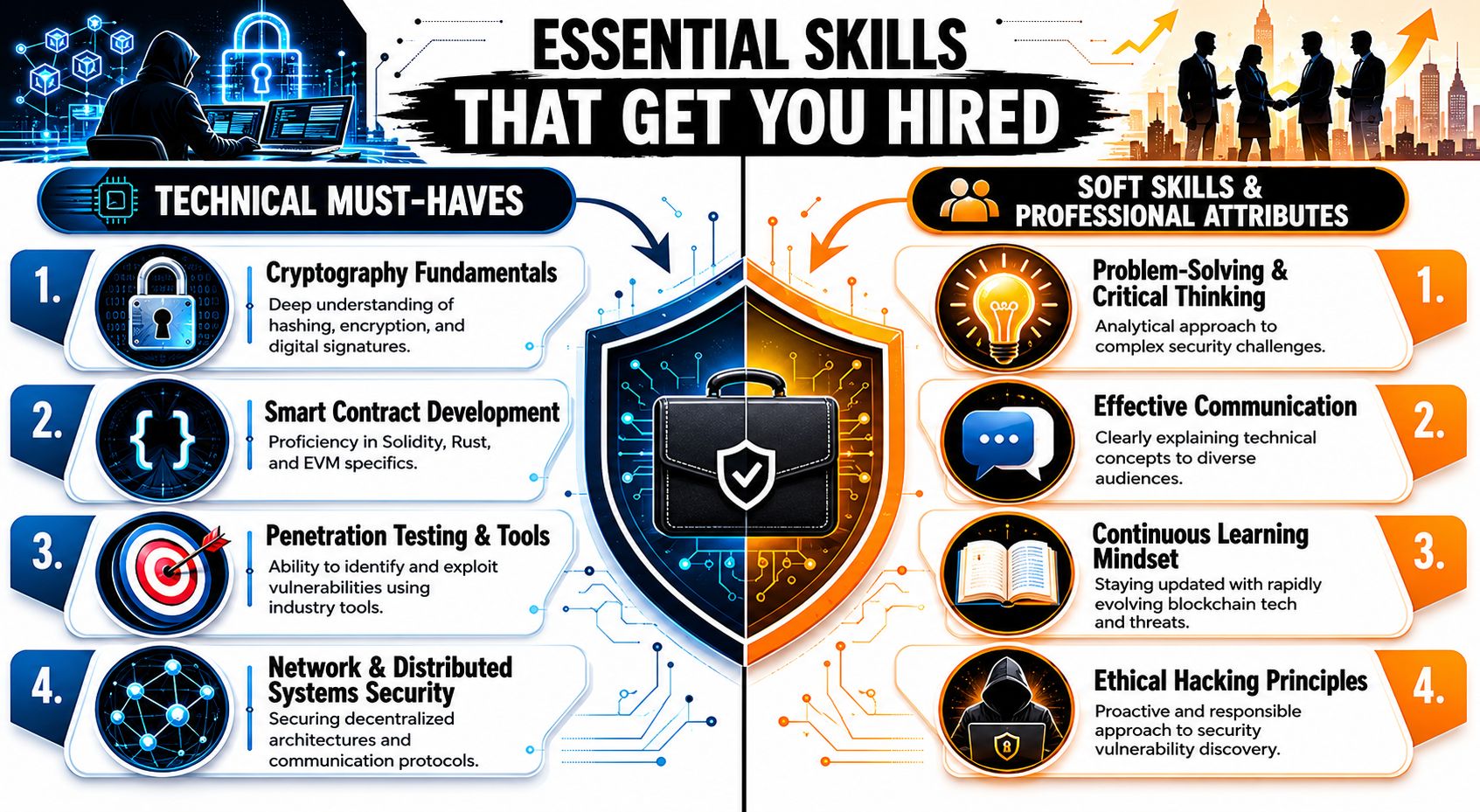
A representative opening for a senior blockchain security engineer role also shows how broad the expectation can be. Language knowledge matters, but employers are screening for judgment, architecture awareness, and the ability to communicate findings that developers can act on.
Technical must-haves
Here's what consistently moves candidates forward.
Secure software fundamentals
If you don't already write reliable production code, security specialization will be shaky. Understand testing, code review, version control, dependency risk, and failure handling. Security builds on engineering discipline.Smart contract literacy Thoroughly learn Solidity if you're targeting EVM work. Don't stop at syntax. Understand storage layout, delegatecall implications, proxy patterns, signature verification, token standard edge cases, and integration assumptions. If you want to work beyond EVM, Rust becomes more relevant.
Adversarial thinking
Read code asking “how can this break?” not “does this compile?” Practice with vulnerable contracts, exploit write-ups, and intentionally insecure exercises. The goal isn't just naming reentrancy or access control issues. It's understanding exploit chains and preconditions.Threat modeling
This is the gap in many junior candidates. They can point out local code issues but can't reason about system boundaries. Practice mapping assets, trust assumptions, privileged roles, external dependencies, economic attack surfaces, and emergency controls.Basic tooling fluency
Use Slither, Mythril, Foundry, Echidna, and static analysis tools. But don't build your identity around them. Tools help you search. They don't replace understanding.
What hiring managers actually want to see
A resume line that says “blockchain security enthusiast” means nothing. A compact portfolio means a lot.
Build proof in public with work like this:
- A practice audit repo with short reports on real open-source contracts.
- CTF write-ups that explain your reasoning, not just the flag.
- A small vulnerable project you built and then hardened.
- Issue analyses on protocol upgrades, governance risks, or design flaws.
- Tests and invariants showing you know how to validate security properties.
Don't submit ten shallow repos. Submit three that show you can think.
Soft skills that change hiring outcomes
Security is communication-heavy work. If you can't explain impact, trade-offs, or remediation clearly, you'll stall even if your raw technical ability is strong.
The soft skills that matter most are:
| Skill | Why it matters in hiring |
|---|---|
| Written clarity | Findings need to be specific, reproducible, and useful to engineers |
| Risk judgment | Teams need help prioritizing what blocks release and what can wait |
| Calm communication | Incidents and contentious reviews punish ego and reward composure |
| Collaboration | Good security people improve developer behavior instead of alienating the team |
What doesn't work is trying to sound like an elite hacker in interviews. Hiring managers usually trust candidates who are precise, humble, and evidence-based.
Understanding Salaries and Hiring Benchmarks
Salary discussions in blockchain security often go off the rails because people compare startup token-heavy packages, contractor rates, and broad cybersecurity roles as if they were the same market. They aren't. The cleaner benchmark is the underlying security profession.
The U.S. Bureau of Labor Statistics projects information security analyst jobs will grow 32% from 2022 to 2032, and the University of Tulsa reports average pay of $120,360 as of April 2024 in its overview of blockchain security and security analyst demand. That doesn't tell you what every blockchain security role pays, but it does tell you specialized security work sits on top of a strong compensation floor in a fast-growing category.
Blockchain security salary ranges
The table below is a qualitative benchmark framework, not a numeric salary claim. Compensation varies by geography, remote policy, product maturity, token exposure, and whether the role is auditing, engineering, or investigations.
| Role | Junior (0-2 Yrs) | Mid-Level (3-5 Yrs) | Senior (5+ Yrs) |
|---|---|---|---|
| Smart Contract Auditor | Often hired on proof of code review skill, strong reports, and hands-on Solidity work | Paid more when they can scope findings independently and communicate severity well | Commands top compensation when trusted on high-stakes reviews and client-facing delivery |
| Blockchain Security Engineer | Usually enters from backend, protocol, or application security backgrounds | Compensation rises when they can own threat modeling, tooling, and release risk reviews | Highest value goes to engineers who shape architecture and incident readiness |
| Protocol Security Researcher | Entry is harder without strong public research or exploit work | Mid-level researchers stand out through original findings and unusual edge-case analysis | Senior researchers are paid for novel reasoning and strategic influence |
| Investigations and Compliance Security Roles | Often accessible from fraud, compliance, or financial-crimes backgrounds | Pay improves with on-chain investigative skill and case management depth | Leadership value comes from judgment, reporting, and cross-functional trust |
What signals high value
Hiring managers usually look past titles quickly. They care about signals.
- Public work product beats self-description. Audit notes, exploit analyses, and code reviews are stronger than a generic summary.
- A disciplined GitHub profile helps when repos are clean, documented, and relevant.
- Breadth with depth wins. A candidate who understands contracts, key management, and incident handling often outranks someone who only memorized audit checklists.
One more hiring truth. Senior compensation usually follows trust, not years alone. If a team believes you can review sensitive code, flag release risk early, and stay calm during incidents, they'll treat you like a highly valuable hire.
How to Find and Apply for Blockchain Security Jobs
The search process is more tactical than most candidates realize. Good blockchain security jobs rarely go to the person with the fanciest resume. They go to the candidate who makes it easy for a hiring manager to answer three questions fast: Can this person find real issues, can they explain them, and would I trust them around production risk?
The market is broad enough to support a focused search. Coincub reported that Web3 added 66,494 new roles in 2025, a 47% rebound from 2024, and remote roles reached 26,925, up 40% year over year in an industry roundup covered by Blue Signal's 2025 tech hiring trends. For security candidates, that means you should search globally and not limit yourself to local office roles.
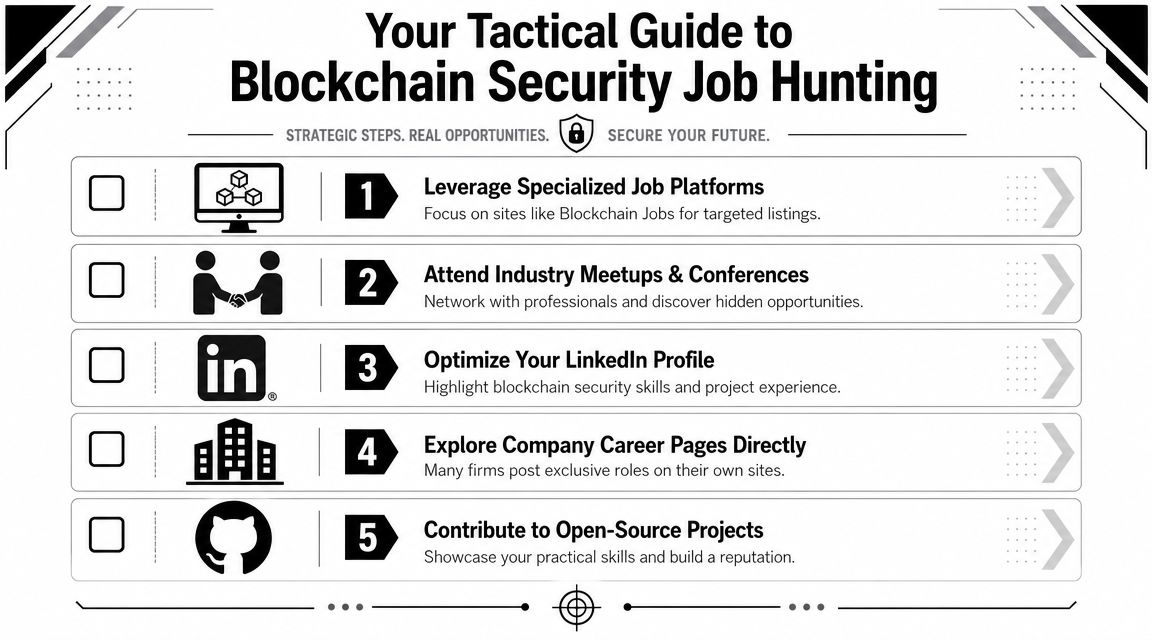
For active role discovery, use a specialized board like Blockchain Jobs alongside company career pages, security firms, exchanges, infrastructure providers, and on-chain analytics companies.
Build an application that survives first review
A blockchain security resume should feel like a threat model, not a biography. Hiring teams scan for evidence.
Include:
- Security-relevant projects with links
- Languages and frameworks tied to actual work
- Findings or reports that show clear written analysis
- Testing and tooling you used, with context
- Incident or review experience if you have it
Leave out vague lines like “passionate about blockchain” or “excellent problem solver.” Show the work.
A simple portfolio structure works well:
- One pinned repo with a small but thoughtful audit.
- One write-up explaining an exploit or design failure.
- One engineering project where you implemented security checks, tests, or monitoring.
- A concise README explaining what you want to be hired for.
Where candidates go wrong
Most weak applications fail in familiar ways.
- They submit generic resumes that could target any software role.
- They overstate expertise after a few CTFs and one tutorial project.
- They hide their thinking instead of writing down assumptions, trade-offs, and limitations.
- They treat tooling output as expertise when employers want reasoning.
For recruiters and hiring managers, this broader actionable guide for recruiting cyber talent is useful because it reflects something candidates should understand too. Teams hire for validated capability, not keyword stuffing.
The fastest way to stand out is to remove guesswork. Show code. Show findings. Show judgment.
Acing the Blockchain Security Interview
Security interviews are usually less mysterious than candidates think. They're just unforgiving if your preparation is shallow.

Most interview loops test some mix of code reasoning, exploit understanding, communication, and prioritization. The exact sequence changes, but the pattern is familiar. A recruiter screen checks background and motivation. A technical round tests contract review or system reasoning. A take-home or live exercise evaluates your process. A final round often probes judgment, collaboration, and how you handle disagreement.
What technical rounds usually look like
You may be asked to review a short contract and identify issues. Sometimes the bug is obvious. Often it isn't. The point isn't speed alone. It's whether you can form a coherent review strategy.
Expect prompts like these:
- Find the vulnerabilities in a contract with tricky state updates or role logic.
- Explain exploitability instead of only naming the bug class.
- Prioritize findings by realistic impact.
- Suggest fixes that don don't inadvertently create new risk.
- Discuss trade-offs around upgradeability, access control, pausing, and governance.
The strongest candidates narrate their reasoning clearly. They state assumptions, inspect trust boundaries, and check for edge cases. They don't panic when they miss something on the first pass.
Behavioral questions matter more than many engineers expect
Security work is full of uncomfortable conversations. You'll tell teams their launch shouldn't proceed. You'll explain uncertainty during incidents. You'll push back on weak mitigations.
That's why behavioral rounds carry weight. A practical resource on structuring answers is this guide to interview advice for LatAm professionals, especially if you're trying to tighten examples and communicate under pressure.
Useful stories to prepare:
- A time you found a serious flaw
- A time you disagreed with a developer or product lead
- A time you had incomplete information
- A time you had to explain risk to a non-specialist
- A time you changed your mind after new evidence
Here's a helpful walkthrough before you practice live.
A strong preparation routine
Don't prepare by only reading blog posts. Prepare by doing review work on a clock.
Use a routine like this:
| Practice area | What to do |
|---|---|
| Contract review drills | Review small open-source contracts and write findings in report format |
| Exploit reconstruction | Reproduce known issues in a local environment and explain root cause |
| Threat modeling | Sketch assets, trust boundaries, privileged actors, and failure paths |
| Mock communication | Practice explaining a critical issue in plain English to an engineer and to a product lead |
Good interviewers aren't looking for perfect recall. They're looking for structured thinking.
A final warning. If you don't know something, say so and reason from first principles. Pretending expertise is one of the fastest ways to lose credibility in a security interview.
Your Career Path From Junior to Security Lead
There are three primary entry points into blockchain security. Software engineering, application security, or investigations and compliance. The long-term path is less about chasing titles and more about widening the scope of risk you can own.
Early career
At the junior level, focus on execution quality. That usually means reviewing code carefully, writing reproducible findings, learning to test assumptions, and building reliability as a teammate. You don't need to know everything. You do need to be consistent.
A junior auditor or analyst becomes valuable when managers stop wondering whether the basics were missed.
Mid-career progression
Mid-level security engineers and auditors start owning slices of systems, not just isolated tasks. They can lead a review, run a threat-modeling session, improve tooling, or help coordinate remediation across teams. Their judgment gets sharper. They know which issues are urgent, which are contextual, and which are mostly noise.
This is also where careers branch. Some people go deeper into protocol research. Others move toward platform security, incident response, wallet security, or investigations.
Senior and leadership track
Senior people shape how an organization handles security before and after launch. They influence architecture, define review standards, coach engineers, help set key management practices, and lead incident decisions when pressure is high.
Security leads and heads of security spend less time finding every issue personally. They build systems, teams, and habits that prevent classes of failure from recurring.
If you want to move into leadership, keep doing technical work long enough to earn trust, then expand into planning, prioritization, and communication. The best security leaders in this space still understand the code, but they also know how to align engineering, product, legal, compliance, and operations around real risk.
If you're ready to turn preparation into actual interviews, start with Blockchain Jobs. It's one of the cleaner ways to find current Web3 openings across security, engineering, compliance, and adjacent roles without wading through generic listings.