Blockchain UX Designer Jobs: How to Land One in 2026
You've got a solid UX portfolio, years of product experience, and a growing curiosity about Web3. Then a hiring manager asks you to explain what happens between a wallet signature and a confirmed transaction, and your confidence drops. That moment separates candidates who've merely redesigned a crypto interface from designers who understand the product's actual trust, security, and financial constraints.
Blockchain UX designer jobs reward a specific kind of fluency. Figma expertise still matters, but it won't compensate for vague thinking about gas fees, token approvals, pending transactions, or wallet permissions. If you want to move into this market, treat blockchain UX as a specialization, not a new label for general product design.
What It Really Feels Like to Pivot Into Blockchain UX
A mid-career UX designer usually starts with the wrong question: “How do I make my SaaS portfolio look more Web3?” The better question is, “Can I show that I understand what users risk when they take an on-chain action?”
A conventional SaaS case study might focus on onboarding, activation, retention, and dashboard comprehension. Those skills transfer, but blockchain products add wallet ownership, signatures, network selection, transaction finality, fee visibility, and recovery from failures. A hiring manager wants to see whether you can design around those constraints without making the experience feel hostile.
The market is specialized rather than enormous. A 2026 live snapshot tracked 2,645 active Web3 roles, with 55 Design openings, and reported that 35% of all open Web3 roles were remote-friendly across the dataset (Maneki's 2026 Web3 hiring snapshot). A separate 2025 Web3 jobs report estimated 66,494 new roles, a 47% rebound from 2024, while noting the growing importance of non-technical roles such as product and go-to-market work (the same Maneki hiring report).
That data tells you two things. Design has a real place in Web3 hiring, but candidates still compete for a narrower pool than engineers and smart contract specialists. Remote work also matters because distributed product teams are common in the sector, not because every design role is automatically location-independent.
The hiring snapshot you should actually use
| Metric | Blockchain UX Roles | Broader Web3 Roles |
|---|---|---|
| Active roles in the 2026 live snapshot | 55 Design openings | 2,645 active roles |
| Remote availability | Remote-friendly work is a major pattern | 35% of all roles were remote-friendly |
| Hiring context | Wallets, DeFi, token products, infrastructure, and consumer apps | Engineering, product, GTM, operations, and other functions |
| Candidate signal | On-chain fluency plus strong UX craft | Role-specific technical or business expertise |
Don't overread the Design count as a complete census of blockchain UX designer jobs. Job titles vary widely, and a product designer at a wallet company might be listed under Product Design, UX/UI, Design Lead, or even Design Systems. Search by product problem as well as title.
Hiring reality: A generic UX résumé proves that you can design interfaces. A crypto-native portfolio proves that you understand what the interface is allowed to promise.
The strongest opportunities tend to sit around DeFi protocols, wallet providers, exchanges, bridges, layer-2 infrastructure, and consumer applications. Mature teams need designers who can translate protocol behavior into understandable decisions. They're less interested in another polished dashboard than in someone who can explain why a transaction preview needs a particular warning, what happens when an RPC endpoint fails, and how a user recovers from a replaced transaction.
Before applying, read current role language on Blockchain Jobs' Web3 design coverage. Look for repeated requirements across listings, then reshape your portfolio around those requirements. Hiring managers don't reward candidates for collecting crypto vocabulary. They reward candidates who use that vocabulary to make better product decisions.
Crypto-Native UX Skills Employers Actually Want
Blockchain UX employers don't need a designer who can recite protocol terminology. They need someone who can turn technical states into clear choices.
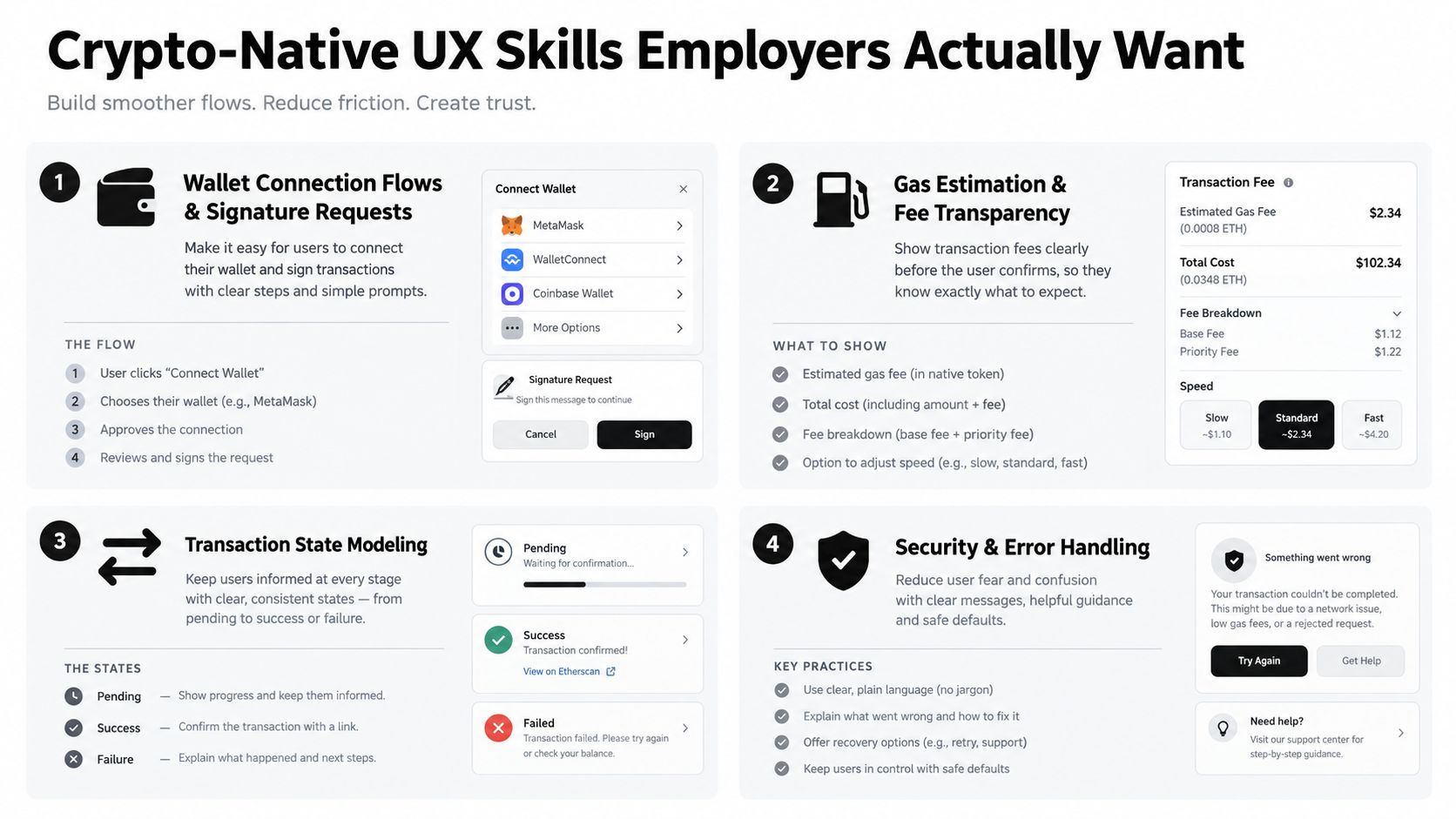
Start with wallet connection flows. Show the sequence from selecting a wallet to approving a connection, requesting a signature, rejecting the request, disconnecting, and managing permissions later. A prototype that only shows a “Connect wallet” button demonstrates almost nothing. Add a permissions panel and explain what the user is authorizing.
Gas and fee transparency is the next test. Redesign a swap confirmation so it separates the amount sent, estimated network fee, slippage tolerance, and expected amount received. You don't need to make the screen visually dense. Use progressive disclosure, plain-language microcopy, and a clear distinction between an estimate and a final charge.
Transaction state modeling is where weak portfolios usually fail. Map pending, confirmed, failed, dropped, and replaced states, then show what the user can do in each one. A loading spinner isn't a transaction strategy. Explain whether the user can retry, speed up, cancel, wait, or inspect the transaction in a block explorer.
Token UX requires equal care. Demonstrate balances, token approvals, allowance changes, revoke flows, decimals, network mismatches, and unfamiliar assets. If you can read a transaction on Etherscan and explain the user-facing consequence without pretending to be an engineer, you're already more useful than a designer who only lists “Web3” under interests.
Learn the basics of account abstraction, signature requests, and front-end integration patterns. Employers also increasingly mention tools such as v0.dev, GPT-4, and Claude, alongside front-end stack awareness (current Web3 UX/UI listings). Use AI tools to accelerate exploration, not to replace product judgment.
Audit your portfolio with four questions:
- Wallets: Can I show connection, signature, rejection, disconnection, and permissions?
- Fees: Can a user understand what they'll pay before confirming?
- States: Have I designed failure and recovery, not just success?
- Trust: Does my copy explain irreversible actions without hiding risk?
If the answer is no, you're not ready to market yourself as crypto-native yet.
Building a Blockchain UX Portfolio That Gets Interviews
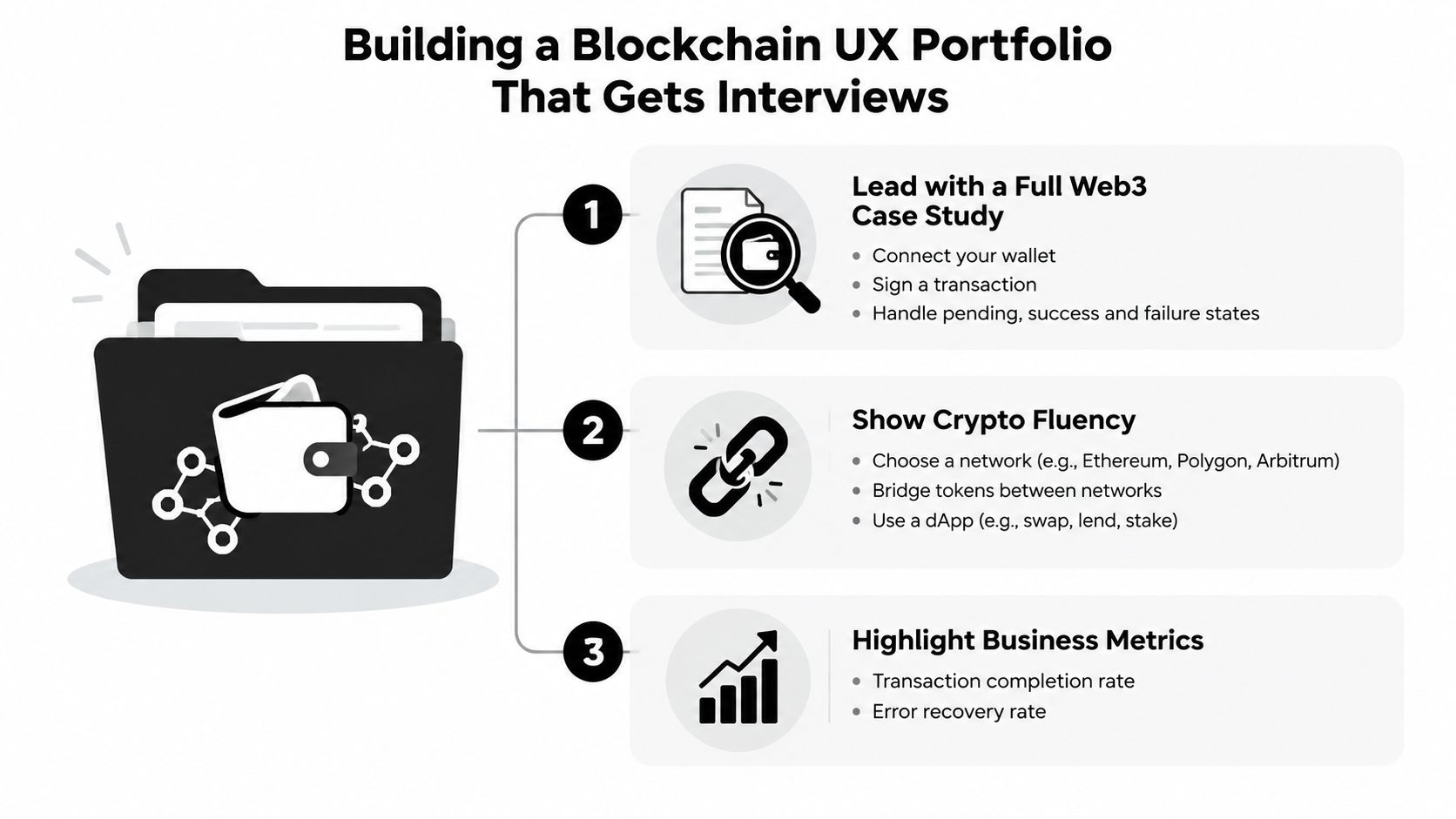
Your portfolio should make a hiring manager believe you've already worked through the uncomfortable parts of Web3 product design. Lead with one complete case study, not a gallery of attractive screens.
Build the first case study around a full flow: connect a wallet, select a network, sign a transaction, wait through confirmation, handle failure, and recover from a stuck or reverted action. Document the decision points. Explain what the user sees, what the system knows, and what the interface cannot guarantee.
Your second project should redesign a recognizable DeFi or NFT surface, such as a swap, bridge, mint page, or token approval flow. Show the trade-offs around slippage, gas warnings, approvals, network switching, and error recovery. A live Figma prototype is useful, but a coded testnet demo is stronger when it's safe and clearly labeled.
What every case study must contain
- Problem framing: Identify the user's job, the product constraint, and the risk created by confusion.
- Your role: State what you owned, what you inherited, and how you worked with product and engineering.
- Decision evidence: Connect each major design choice to research, technical constraints, or a clear hypothesis.
- Failure handling: Include rejection, timeout, insufficient funds, wrong network, and recovery paths where relevant.
- Outcome evidence: Use measurable outcomes when you have them. Never manufacture metrics for a speculative project.
Add one short spec concept, such as a clearer multisig approval experience. Keep it focused. The point is to demonstrate product thinking, not to pretend you shipped work you didn't ship.
For résumé structure and presentation, these UI UX designer resume examples can help you tighten hierarchy and make your experience easier to scan. Adapt the format to emphasize wallet flows, financial workflows, research, and collaboration rather than copying generic UX language.
Cut unrelated app screens, generic dashboards, and decorative redesigns. A hiring manager scanning this Staff UX Motion Designer role at MetaMask and Consensys will care about product context and craft, but your portfolio still has to demonstrate that you understand crypto-specific behavior.
Where to Find Blockchain UX Designer Jobs
Treat your search like sourcing, not spraying applications across every job board. Start with specialist sites where you can filter for crypto, Web3, remote work, product design, and seniority. Then move to the career pages of protocols and products you use.
Search beyond “blockchain UX designer.” Useful titles include Product Designer, Wallet, DeFi Designer, Web3 Product Designer, Design Lead, Protocol Designer, and Design Systems Designer. Companies such as Uniswap, Aave, Optimism, Phantom, and Magic Eden can reveal the vocabulary teams use, even when a role isn't open.
| Source | Best For | Typical Roles |
|---|---|---|
| Web3 specialist boards | Chain, product, seniority, and remote filtering | Product Designer, UX Designer, Design Lead |
| Protocol career pages | Targeting products you understand | Wallet, DeFi, infrastructure, and consumer design |
| Community channels | Referrals and unadvertised opportunities | Founding Designer, contributor, contract designer |
| General UX boards with crypto filters | Expanding the search without losing relevance | UI/UX Designer, interaction designer, researcher |
Remote hiring is a meaningful pattern in this field. One salary dataset lists a dedicated remote category for blockchain UI/UX designers with an average base salary of $75,000 (Cryptocurrency Jobs salary data). Treat remote work as a filter, not a promise. Teams still expect candidates to communicate clearly across time zones and work independently.
Keep a tracker with the company, role, seniority, product area, referral source, application date, stage, and last contact. Rewrite the first paragraph of your portfolio for each serious application. If the role focuses on wallet recovery, lead with wallet recovery. If it focuses on DeFi swaps, lead with transaction clarity and risk communication.
You can widen the search with find your next UX design role, but remove generic listings that don't identify a crypto product or Web3 requirement. The relevant Design jobs category is more useful when you're comparing role types and seniority in the same market.
Networking Your Way Into Web3 Design Teams
Cold applications rarely communicate crypto fluency as well as visible contribution. The fastest way to become credible is to publish useful work before you ask anyone for an introduction.
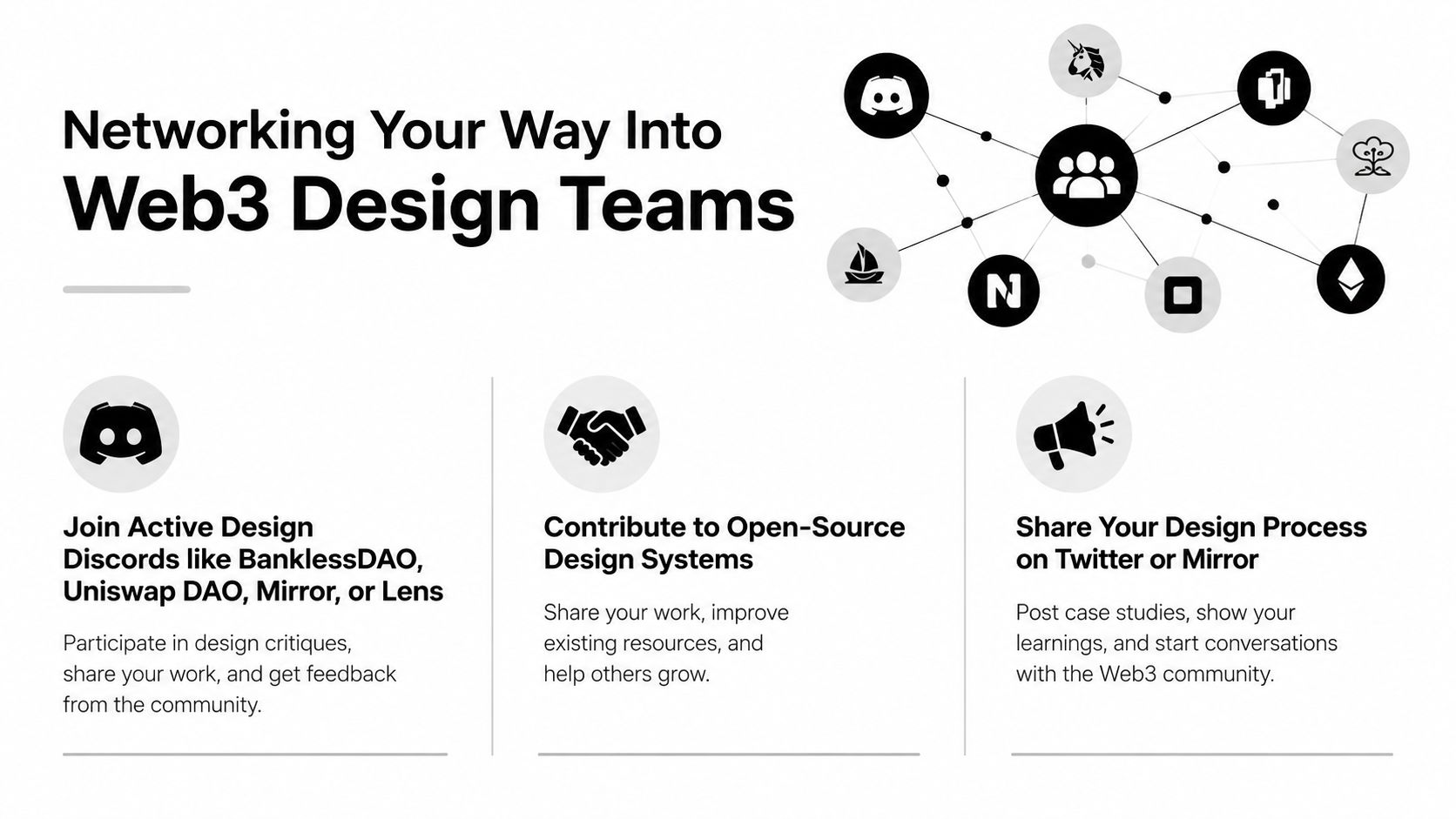
Choose two or three active communities rather than joining every server you can find. BanklessDAO design channels, Uniswap DAO, Mirror, Lens, and protocol-specific Discords can expose you to real product debates. Contribute a wallet-flow teardown, a short Figma prototype, or a thoughtful response to a design question. Don't post “open to work” and disappear.
Open-source design systems are especially valuable. Fix a confusing component state, document a pattern for transaction errors, or offer a critique that respects the protocol's constraints. Your contribution should make someone's work easier, not function as a disguised résumé.
A practical visibility rhythm
- Weekly publishing: Share one concrete observation about a crypto UX problem on Farcaster, Warpcast, Twitter, or Mirror.
- Recurring attendance: Join ETHGlobal, FWB events, or Design Buddies Web3 meetups and attend repeatedly so people recognize you.
- Targeted conversations: Identify two design managers at each target company and ask an informed question about their product work.
- Disciplined follow-up: Track DMs, introductions, and replies in a spreadsheet, then follow up at the 7-day and 21-day marks.
Ask, “How are you thinking about recovery when a bridge transaction stays pending?” Do not ask, “Are you hiring?” The first question shows that you've studied the product. The second makes the other person do all the work.
A referral should come after someone has seen your judgment. Share the relevant teardown first, ask for critique, apply the feedback, then discuss roles. That sequence produces a much stronger signal than sending a résumé to a stranger.
Acing the Blockchain UX Interview Process
Most blockchain UX interviews test three things: your design craft, your ability to reason through system behavior, and your comfort with crypto-native collaboration.
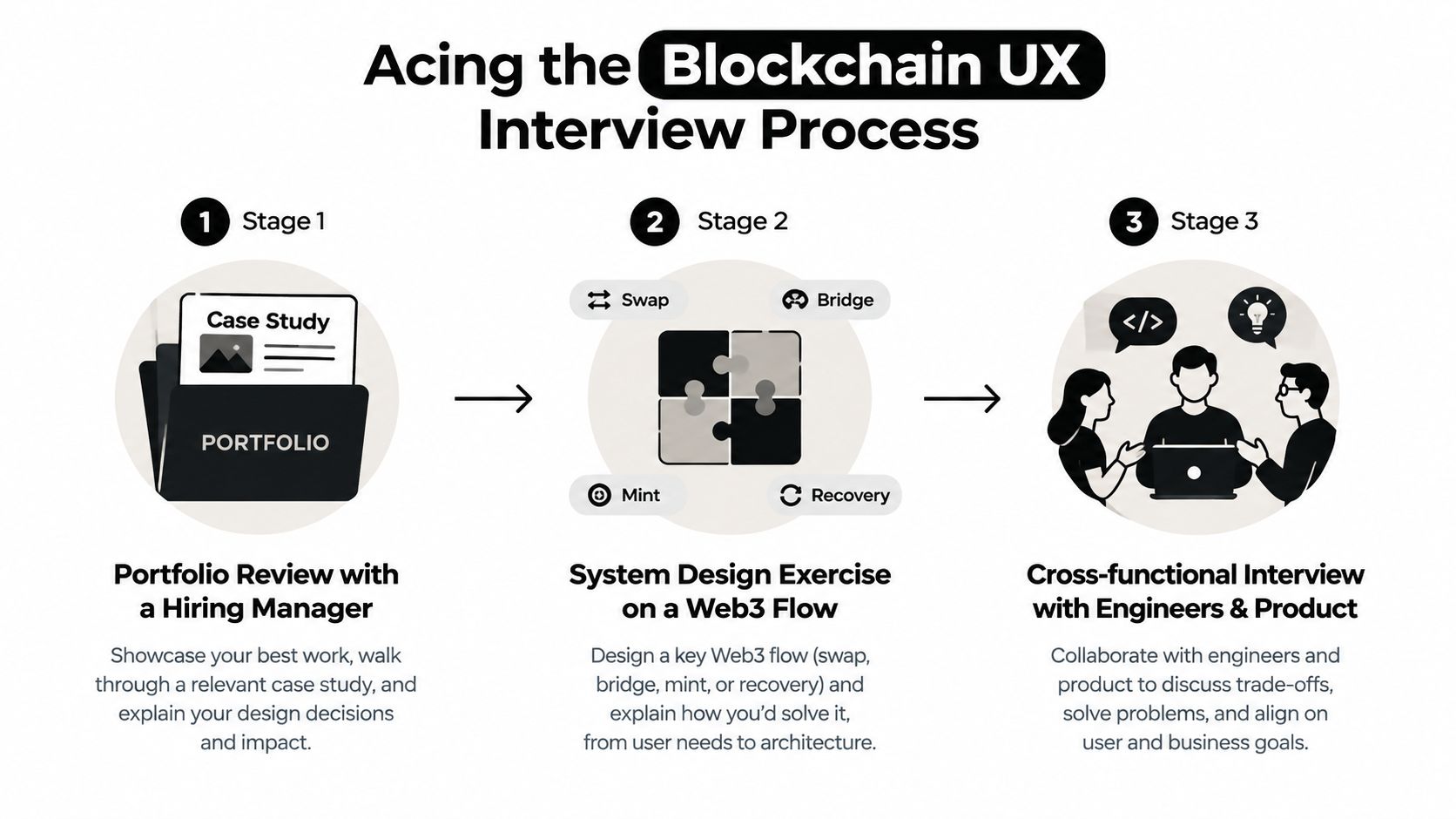
The portfolio review comes first. Defend trade-offs instead of narrating every screen. Explain why you exposed or abstracted gas settings, how research influenced the flow, and what you changed after observing users. Strong candidates can say, “We hid advanced controls by default because they confused first-time users, but kept them available for experienced users who needed control over the transaction.”
The system design exercise usually focuses on a swap, bridge, mint, send, or recovery flow. Draw the journey and label the trust boundaries: wallet signature, application state, on-chain confirmation, indexer lag, and external provider failure. Include wrong-network detection, insufficient funds, RPC outages, dropped transactions, and a clear recovery path.
Interview standard: Never present a happy path as a complete Web3 flow.
The culture conversation tests whether you can work with engineers, product managers, researchers, communities, and open-source contributors. Be ready to explain DAOs, multisigs, permission models, and how you would make decisions when the product is public and the roadmap changes quickly. Don't perform expertise. Explain what you know, identify what you'd verify, and show how you'd reduce user risk.
Bring a short checklist to every call:
- Portfolio proof: One complete Web3 case study with failure states.
- System sketch: A reusable Figma file for flows and state diagrams.
- Research evidence: Interview notes, usability findings, or clearly labeled assumptions.
- Technical questions: Network behavior, wallet support, indexer reliability, and transaction recovery.
- Collaboration examples: A moment when engineering or product constraints changed your design.
For broader interview practice and faster UX insights with Uxia, focus on explaining decisions under pressure rather than memorizing polished answers.
Your 90-Day Plan to Land a Blockchain UX Role
Use the first two weeks to expose weaknesses, not to submit applications prematurely. Audit your portfolio against wallet connections, signatures, gas, transaction states, token approvals, recovery, research, and technical collaboration. Choose two wallet-focused pieces and one token-flow piece to refine, set up a WalletConnect test app, and publish a short explanation of a transaction-state machine.
From days 15 through 45, create a visible work cadence. Publish one focused spec project each week, apply to ten targeted roles through specialist channels and three Web3-specific boards, request three informational conversations with contributors whose work you've studied, and attend at least one in-person event or X Space. Each application should point to the case study most relevant to the product's actual flow.
The final phase is about conversion. Turn useful conversations into referrals, rehearse three system-design prompts in Figma, run two mock interviews, and revise your résumé and portfolio after rejection feedback. Keep the work specific. A bridge recovery flow is more persuasive than another broad “Web3 dashboard” concept.
Judge readiness by evidence:
- You can explain a complete wallet-to-confirmation journey without hand-waving.
- You can show failure and recovery states in at least one portfolio project.
- You can discuss gas, approvals, signatures, and network behavior in plain language.
- You've published work that attracts informed feedback from Web3 practitioners.
- You're applying selectively, with a portfolio opening adapted to each product.
Salary expectations vary sharply by market and specialization. One 2026 snapshot reported an average expected salary of $74,542 for UI/UX designers at blockchain and cryptocurrency startups, with top markets around $85,000 in Los Angeles and $80,000 in Sydney and remote roles (Wellfound's blockchain UI/UX salary data). Another dataset lists U.S. average base pay at $107,500, compared with $77,000 in Europe, $55,000 in Canada, and $75,000 for remote roles (independent blockchain UX salary data). Those figures aren't a guarantee. They show why product complexity, location, seniority, and crypto-native evidence all matter when you negotiate.
If you can meet the exit criteria, start applying. If you can't, spend the next cycle strengthening the missing proof rather than changing your title.
Blockchain Jobs gives you a focused place to search for design roles across the Web3 ecosystem, including remote-friendly opportunities and fresh listings from blockchain companies. Visit Blockchain Jobs to filter for relevant design openings and put your crypto-native portfolio in front of teams hiring for the next generation of products.