
Your Career in Cryptography Starting Guide: From Learner to Hire

A career in cryptography isn't just about crunching numbers; it's about becoming a guardian of our digital world, protecting the data that fuels our lives. To get hired, you'll need a solid academic background, sharp programming skills, and a portfolio of real-world projects that prove you can apply what you know. This guide will provide actionable steps to take you from learning the concepts to landing your first job.
Why a Cryptography Career Is a Smart Move for Job Seekers
Cryptography is the invisible backbone of modern security, protecting everything from online banking credentials to national security communications. At its core, it's the science of creating and breaking secret codes. A career in cryptography places you on the front lines, designing and analyzing the systems that keep digital information private and authentic.
For job seekers, the numbers are compelling. According to the US Bureau of Labor Statistics, jobs for information security analysts—a category that includes cryptographers—are projected to grow by a staggering 33% between 2020 and 2030.
That explosion in growth translates to roughly 47,100 new job openings. It's clear this field is brimming with high-value opportunities for anyone ready to build the required skills.
The Core Appeal from a Career Progression Perspective
Beyond fantastic job security, a career in this field is intellectually thrilling. It’s a constant battle of wits, where you’re pitting your creations against some of the sharpest minds on the planet. From a hiring perspective, companies are looking for problem-solvers who can handle high-stakes puzzles that have real-world consequences.
This guide is your roadmap to navigating this profession from a career-focused angle. We'll walk through everything from the day-to-day work to the tough interview questions you'll face, helping you build a career that’s both rewarding and in high demand.
To give you a bird's-eye view, the table below summarizes what it takes to get hired in this space.
Cryptography Career Path At a Glance
| Key Roles | Essential Skills to Showcase | Common Educational Path |
|---|---|---|
| Cryptographic Engineer | Python, C++, Go, Algorithms, Data Structures | Bachelor's in Computer Science or Math |
| Cryptanalyst | Reverse Engineering, Number Theory, Protocol Analysis | Advanced degree (Master's/PhD) often preferred for top roles |
| Security Researcher | Threat Modeling, Vulnerability Analysis, Protocol Design | Varies; often requires a Master's or PhD for research positions |
This table sets the stage, but let's dive into the specifics to understand what it takes to get hired and succeed.
What a Cryptographer Actually Does: A Hiring Manager's View

The title "cryptographer" can be broad. From a hiring perspective, it's a field with distinct specializations. Companies aren't just hiring a "cryptographer"; they are hiring for a specific function.
Think of it like an elite security team. There are builders who construct impenetrable vaults, breakers who find weaknesses before criminals do, and innovators who design the security systems of the future. Understanding which role you are targeting is the first step toward building a relevant resume and acing your interviews.
Comparing Cryptography Specializations: Which Role Is Your Target?
So, are you a builder, a breaker, or an innovator? Each path requires a different mindset and skillset that you'll need to demonstrate to a hiring manager. This table breaks down the three main specializations to help you identify your target role.
| Role | Primary Focus | Day-to-Day Responsibilities | What Hiring Managers Look For |
|---|---|---|---|
| Cryptographic Engineer | Implementation | Building and integrating secure cryptographic systems, writing and reviewing code (often in Go or Rust), and deploying security protocols in software and hardware. | A practical builder with strong software engineering skills who can turn theoretical concepts into functional, secure products. Portfolio and coding skills are key. |
| Cryptanalyst | Analysis & Testing | Pressure-testing existing systems, searching for vulnerabilities, performing penetration tests, and reverse-engineering protocols to find flaws. Thinks like an attacker. | An analytical thinker with a "breaker" mentality. Looks for experience in security audits, CTFs, and a deep understanding of mathematical and logical exploits. |
| Security Researcher | Innovation & Theory | Developing new cryptographic algorithms, studying future threats (like quantum computing), and publishing theoretical work. Pushes the boundaries of the field. | A creative, forward-thinking academic with a strong background in mathematics and computer science. Academic publications and research experience are critical. |
Ultimately, choosing a specialty comes down to what drives you. Do you get satisfaction from building something that works flawlessly, or from finding the one flaw that no one else saw? Your answer will determine how you build your resume and prepare for interviews.
The Builder: Cryptographic Engineer
The Cryptographic Engineer is the master builder of the security world. Their job is to take complex cryptographic theory and turn it into rock-solid, functional code. Hiring managers for this role are looking for strong software engineers who understand security principles.
A typical day for an engineer involves designing secure systems, writing clean code in languages like Go or Rust, and ensuring cryptographic libraries are implemented correctly. They work with software developers to weave security into products from the start, a skill highly valued by employers.
The Breaker: Cryptanalyst
In direct opposition to the builder stands the Cryptanalyst. Their mission is to think like the enemy and break things. They probe, test, and attack cryptographic systems to find hidden flaws before bad actors can.
A cryptanalyst's success isn't measured by what they build, but by what they can responsibly dismantle. Finding a vulnerability before a malicious actor does is a critical victory for security.
In an interview, you'll be tested on mathematical analysis, reverse engineering, and your ability to devise novel attack vectors. Companies hire them to conduct rigorous security audits and penetration tests. For example, a cryptanalyst might be tasked with picking apart a new blockchain protocol to see if they can steal digital assets. Demonstrating this "breaker" mindset is key to landing the job.
The Innovator: Security Researcher
Finally, we have the Security Researcher, who operates on the cutting edge. They aren't just building or breaking today's systems; they're inventing the cryptographic tools of tomorrow. You'll often find them in university labs or the R&D departments of major tech and Web3 companies.
These experts focus on emerging threats, like the security challenges posed by quantum computing, and design entirely new algorithms to defend against them. Their work is highly theoretical and often gets published in academic papers—a key credential for these roles. A job like a Security Response Engineer often requires this forward-thinking ability to anticipate and neutralize future threats.
Building Your Job-Ready Skillset

Alright, let's talk about getting hired. Moving from someone who just knows about cryptography to a professional who gets paid for it takes a solid plan. A successful career in cryptography really boils down to two things you must demonstrate: deep academic knowledge and serious hands-on technical skills.
Hiring managers aren't just looking for people who can recite definitions. They need people who can build secure, efficient systems in the real world. Your goal is to prove you are that person.
Think of it this way: you could read every book on building an engine, but until you've gotten your hands dirty and built one, no race team will hire you. It’s the same here. You must master the theory and then prove you can apply it.
The Academic Foundation Employers Expect
For most cryptography roles, a strong academic background is table stakes. A bachelor's degree in either mathematics or computer science is the typical entry point. If you're targeting research or protocol design roles, many companies will require a master's degree or even a Ph.D. You can get a good feel for these educational paths over at Coursera's guide to cryptographer careers.
As you go through your degree, focus on the subjects that will come up in job interviews:
- Linear and Abstract Algebra: This is the language of modern cryptographic algorithms.
- Number Theory: This is the bedrock of public-key crypto like RSA and elliptic curves.
- Probability and Statistics: Essential for analyzing randomness and proving security properties.
A deep understanding of these mathematical principles is your entry ticket. In an interview, you won't just be asked what an algorithm does, but why it's mathematically secure. Prepare to explain the 'why'.
Core Technical Skills to Put on Your Resume
Once you've got the theory down, it's time to prove you can actually build things. This is where your technical skills come into play. Hiring managers need to see evidence that you can translate knowledge into working code.
To set yourself apart, master these key areas:
- Programming Proficiency: Get proficient with Python, C++, or Go. Python is excellent for rapid prototyping and analysis, while C++ and Go are essential for performance-critical systems.
- Cryptographic Libraries: Get hands-on experience with battle-tested libraries like OpenSSL, Libsodium, or Bouncy Castle. A huge part of the job is knowing how to correctly use existing crypto, not reinventing the wheel—a common interview red flag.
Proving Your Abilities with Practical Projects for Your Portfolio
Your portfolio is your single best asset when you're on the job hunt. It’s tangible proof you can solve real-world problems. A good project can easily be the thing that separates you from other applicants and lands you the interview.
Here are a few high-impact project ideas to get you started:
- Implement a Known Protocol: Build a simple secure messaging app from scratch, using a standard like the Signal Protocol. This demonstrates understanding of the entire lifecycle—key exchange, encryption, and data integrity.
- Participate in Capture The Flag (CTF) Competitions: Websites like CTFtime host crypto-focused challenges. Solving these and writing detailed "write-ups" of your solutions is a brilliant way to showcase your problem-solving abilities.
- Contribute to Open-Source Projects: Find a crypto library on GitHub and start contributing. Fixing bugs or improving documentation shows initiative and teamwork—skills every employer wants.
How to Land Your First Cryptography Job
Alright, you've been hitting the books and building projects. Now for the exciting part: turning all that hard work into a job offer. Landing a job requires a smart strategy focused on convincing a hiring manager you can solve their security problems.
This means your resume needs to scream "practical application," you must nail the technical interview, and you need to know where to find the best opportunities in this specialized field.
Crafting a Compelling, Project-Focused Resume
Think of your resume as your opening argument. In a field as technical as cryptography, projects speak louder than buzzwords. Anyone can list "Proficient in encryption," but showing how you've used it is what gets you noticed.
Here’s how to frame your experience to make a recruiter stop scrolling:
- Be Specific: Don't just say, "Worked on a secure messaging app." Instead, use action-oriented language: "Developed a secure messaging client implementing the Signal Protocol for end-to-end encryption, guaranteeing message confidentiality and forward secrecy."
- Highlight Impact: "Analyzed vulnerabilities" is generic. "Identified and patched a padding oracle vulnerability in a legacy web application, preventing potential data exfiltration" shows you can find and fix real-world problems.
- Quantify When Possible: If you've contributed to open-source, show it. For example: "Contributed 5 patches to the OpenSSL library, improving code clarity and fixing minor bugs in the documentation."
This level of detail proves you haven't just memorized concepts; you've wrestled with them and produced tangible results.
Acing the Cryptography Technical Interview
This is where the rubber meets the road. The technical interview is designed to test the depth of your knowledge, and it's usually a multi-stage process. Expect questions to fall into a few key categories.
First, theoretical questions on core concepts—like public-key infrastructure (PKI) or the differences between symmetric and asymmetric encryption. Then comes the practical part: live coding. You might be asked to implement a simple cipher or, more likely, demonstrate how to use a standard cryptographic library securely. For cryptanalyst roles, expect a puzzle or a "find the flaw" challenge.
A key differentiator in an interview is being able to explain why a particular algorithm is secure, not just how to implement it. When you can articulate the underlying mathematical principles, you're demonstrating a level of expertise that sets you apart.
Where to Find the Best Cryptography Roles
Knowing where to look is half the battle. While some roles appear on general job boards, you'll find higher-quality opportunities on specialized platforms, especially if you’re targeting a career in cryptography within the fast-moving Web3 world.
The salary landscape is highly attractive. This chart from Indeed provides a snapshot of earning potential.
The numbers don't lie—this is a lucrative field. The average base salary for a cryptographer in the United States hovers around $143,000 per year, with experienced professionals easily clearing $200,000. You can explore the salary data directly on Indeed.com.
For cutting-edge roles, especially in DeFi and blockchain, niche job boards are your best friend. They connect you directly with innovative companies. You can find fantastic opportunities, like this Cryptographic Engineer role, on sites that focus entirely on this ecosystem.
Mapping Your Cryptography Career Progression
Landing that first cryptography role is a massive achievement, but it's just the beginning. A long-term career in cryptography is about continuous growth, because the digital security landscape is constantly evolving. Your career path isn't just about getting better technically; it’s about growing the strategic mindset needed to lead.
The field simply never stays put. Emerging threats like quantum computing could make today's cryptographic systems obsolete. This reality makes lifelong learning a core job requirement. To stay relevant and progress, you must keep a close eye on developments like post-quantum cryptography (PQC) to ensure your skills stay ahead of the curve.
Advancing from Contributor to Leader
In your first few years, you'll likely be an individual contributor—a Cryptographic Engineer or Security Analyst—honing your technical skills. As you gain experience, you'll progress toward senior roles, like Senior Cryptographic Engineer, where you'll tackle more complex projects and begin mentoring junior team members.
This infographic gives a great high-level overview of the steps it takes to land a job in this competitive space.
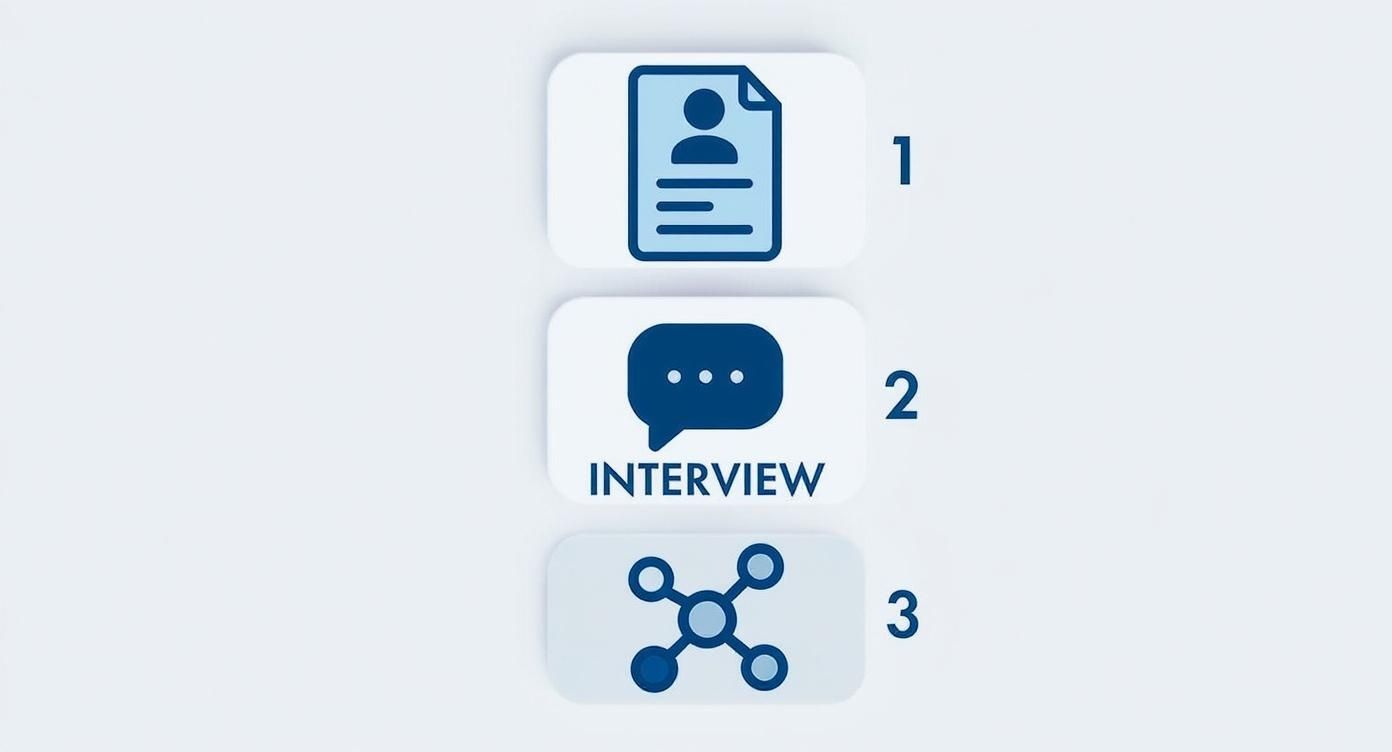
From building a killer resume to making the right connections through networking, each one of these stages is a critical building block for your career.
Making the leap from a senior technical expert to a leader requires a completely different skill set. The path to becoming a Head of Cryptography or Chief Information Security Officer (CISO) is paved with well-honed soft skills.
- Strategic Communication: You must be able to explain complex cryptographic risks to executives in terms of business impact. This skill is critical for getting a seat at the leadership table.
- Problem-Solving at Scale: Leadership means shifting from solving technical puzzles to solving organizational ones—managing resources, building effective teams, and shaping the company's long-term security strategy.
- Mentorship and Influence: The best leaders don't just do great work; they develop great teams. Your ability to guide and develop other engineers is often the deciding factor in a management promotion.
The Role of Certifications and Advanced Education in Career Growth
While nothing beats hands-on experience, formal credentials can open doors, particularly for senior and leadership positions. Certifications signal to hiring managers that you have a verified, foundational knowledge of key security principles.
A certification like the Certified Information Systems Security Professional (CISSP) does more than test your technical chops. It validates your understanding of security management, governance, and risk—all cornerstones of effective leadership and career progression.
Likewise, an advanced degree is often a prerequisite for top-tier roles. For serious research positions, a master's or Ph.D. is the standard. You can find a detailed breakdown of these requirements and learn more about how to become a cryptographer on TechTarget. These credentials prove you have the deep theoretical foundation needed to not just implement solutions, but to innovate and lead.
The Future of Cryptography and Your Role In It
Think of a career in cryptography not as a destination, but as a continuous journey into the future of security. This field is always moving, pushed forward by new threats and incredible technologies that are carving out exciting new career paths.
Right now, there's a huge push to develop quantum-resistant algorithms. This has created a real demand for specialists who can design defenses against computers that don't even exist yet. It's about future-proofing our digital world.
At the same time, privacy-focused technologies like zero-knowledge proofs are becoming a cornerstone of the Web3 space. These proofs allow you to verify something is true without revealing the secret data behind it—a concept that’s opening up roles blending deep theory with hands-on application. If that sounds interesting, you’ll find that positions like a ZK Researcher are becoming highly sought after.
Take a look at this screenshot from NIST. It gives you a sense of just how broad and forward-looking modern cryptographic research really is.
This intense focus on preparing for tomorrow’s threats shows just how dynamic the field is.
Ultimately, cryptography is the shield protecting our digital lives, securing everything from your online banking to critical national infrastructure. As technology leaps forward, so does the research, with a heavy focus on things like quantum cryptography and homomorphic encryption. To really get ahead, it's worth digging into the critical role of cryptography from NIST's research.
The future belongs to lifelong learners. The cryptographer who thrives tomorrow is the one who starts studying post-quantum threats and decentralized identity solutions today.
By adopting this mindset, you're not just keeping up; you're placing yourself at the very front of innovation. Your skills will be more than just relevant—they’ll be essential in building a more secure digital world for everyone.
Frequently Asked Questions
It's natural to have a lot of questions when you're looking at a career as complex and important as cryptography. Let's tackle a few of the most common ones that come up for aspiring cryptographers.
Do I Need A PhD To Get Hired as a Cryptographer?
Not always, but it depends on the role you're targeting. For inventing new cryptographic protocols or leading cutting-edge research, a PhD is often the standard requirement.
However, for many high-paying industry jobs—like Cryptographic Engineer or Security Analyst—practical skills and a strong project portfolio often matter more. Companies are desperate for people who can build and implement secure systems. A Bachelor's or Master's degree, combined with real-world project experience, will open many doors.
Is Cryptography Just Advanced Math?
Math is the bedrock, but the job is much more. A modern cryptography career is a blend of deep theory and practical engineering.
You can think of it as a three-legged stool: one leg is theoretical math, another is applied computer science (like algorithms and system design), and the third is practical security engineering.
To succeed in an interview and on the job, you can't just understand the equations. You need strong programming skills to implement them and a deep understanding of network protocols and system vulnerabilities to secure them. It's a truly interdisciplinary field.
How Is Web3 Cryptography Different From Traditional Roles?
The core difference is public versus private systems. Traditional cryptography often secures data for a single organization on private servers, like a bank vault.
Web3 cryptography, in contrast, secures massive, public, decentralized systems like blockchains. The rules are different when everyone can see the code and anyone can try to attack it.
This means employers are looking for a specialized skillset that's in incredibly high demand, including:
- Elliptic curve cryptography (ECC), which underpins cryptocurrency wallets.
- Zero-knowledge proofs (ZKPs), a technology used for privacy and scaling on public blockchains.
The stakes are also arguably higher in Web3. A single vulnerability can lead to millions in irreversible losses, which is why companies are willing to pay top dollar for talent and are constantly innovating.
Ready to find your place in the future of security? At Blockchain Jobs, we connect top talent with the best opportunities in the Web3 ecosystem. Explore roles in cryptography and blockchain today!