Your Guide to the Community Engagement Intern Role in Web3
You’re probably looking at “community engagement intern” postings and thinking two things at once.
First, this sounds entry-level enough to get into. Second, the Web3 version sounds vague enough to be risky.
That tension is real. In crypto, community work gets dismissed as “just Discord,” right up until a launch goes sideways, misinformation spreads, holders panic, and the team realizes nobody built trust before asking for attention. That’s why a good community engagement intern matters more in Web3 than many first-time applicants realize.
If you’re coming from campus organizing, nonprofit outreach, events, customer support, gaming communities, creator communities, or social media coordination, you’re closer to this role than you think. The trick is learning how to translate familiar skills into a crypto-native environment where ownership, transparency, speed, and public feedback loops all matter more.
What Is a Web3 Community Engagement Intern
A Web3 community engagement intern helps a blockchain company, protocol, DAO, or NFT project build trust with the people who use it, hold it, govern it, or talk about it.
That sounds broad because the role is broad. In a nonprofit, a community engagement intern might recruit volunteers, support events, gather feedback, and help the organization stay connected to local stakeholders. In Web3, the same core logic applies, but the stakes shift. Your audience isn’t just “followers.” It may include token holders, validators, governance participants, developers, creators, and skeptical users who want proof before they commit attention or capital.

Community in Web3 means participation with consequences
In traditional community roles, people usually support a mission from the outside. In Web3, they often participate from the inside. They vote, delegate, provide liquidity, join testnets, attend AMAs, report bugs, create memes, or shape the project narrative in public.
That changes the job.
A weak intern posts updates and reacts to messages. A strong one notices what the community is confused about, what language is causing friction, which questions keep repeating, and where trust is breaking down. Then they help the team fix it.
Practical rule: If your work only pushes announcements out, you’re doing social posting. If your work helps a team listen, respond, and improve, you’re doing community.
Why this role matters more than people think
Most early-career candidates underestimate how strategic this internship can be. Teams often hire their future community managers, ecosystem associates, support leads, ops coordinators, and even product marketers from people who already understand the audience.
That career value lines up with what traditional community work has shown for years. A landmark CNCS study found that volunteering through community engagement roles increased employment chances for previously unemployed individuals by 27%, according to the CNCS volunteering and employment findings. The lesson carries over well. Work that builds relationships, judgment, and communication discipline tends to open doors.
What separates Web3 from Web2 community work
A Web2 brand community often centers on retention and brand affinity. A Web3 community often centers on credibility, coordination, and ownership.
That means your internship may involve:
- Governance awareness: understanding how proposals, delegation, and community sentiment connect
- Technical translation: turning product updates into language normal users can follow
- Real-time trust management: handling rumor cycles, token chatter, launch expectations, and public criticism
- Culture building: helping a project feel like a place people want to contribute to, not just lurk in
If you want a practical definition, use this one: a Web3 community engagement intern is the person who helps the team stay legible to its own community.
That’s valuable work. It’s also one of the cleanest entry points into crypto if you’re good with people, calm under pressure, and willing to learn the product thoroughly.
The Day-to-Day of a Web3 Community Intern
What you’ll do depends on the project stage. A new protocol needs different support than an established chain or marketplace. But the weekly rhythm is more concrete than most job descriptions suggest.
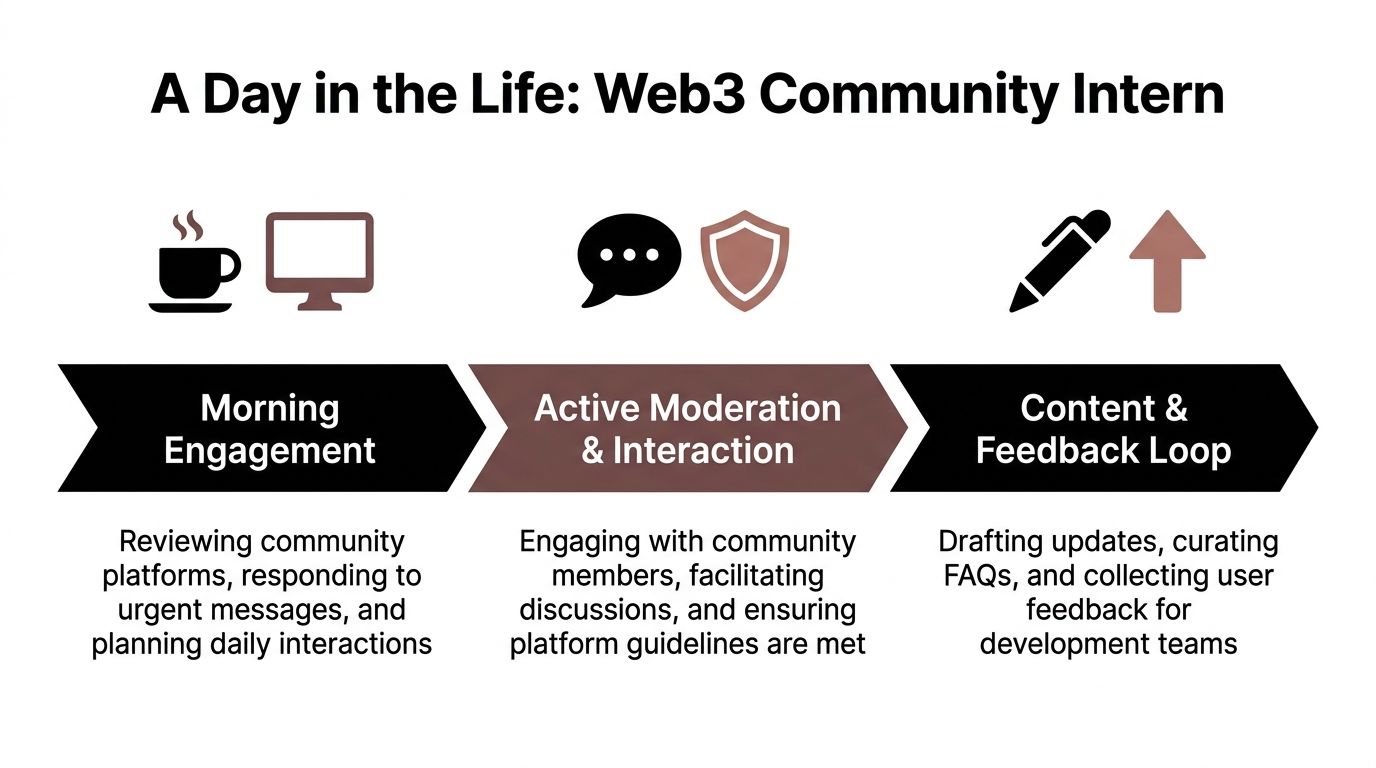
Monday starts with reading the room
You open Discord, Telegram, X, maybe Farcaster, and internal notes from the previous week. You’re looking for patterns.
Not “what was posted,” but what people are signaling. Are they confused about staking? Are support questions piling up around wallets? Did a roadmap update create frustration because the language was too vague? Is one moderator carrying too much load while another timezone is quiet?
A good intern documents this in plain English. Three repeated questions are usually more useful than one giant “sentiment report.”
Midweek is where the role gets active
On Wednesday, maybe the team is running an AMA, shipping a feature update, or trying to re-engage dormant members. In these situations, community interns stop being passive.
You might draft reminder posts, prep host notes, collect likely questions, clean up the FAQ, and message power users who can help set the tone. In traditional engagement work, interns often help with event staffing and outreach. That same muscle matters here, just in digital-native form. Interns in community roles also support multi-channel event marketing, and job-description data notes that targeted social media implementation can increase event attendance by 25% to 40%, while recruitment pipelines can grow a volunteer or contributor base by 15% to 30% in a campaign, based on the Civic Engagement Intern position description.
The Web3 version of that is familiar: Discord event reminders, X threads, short clips, partner callouts, and direct outreach to active members.
When attendance is low, the problem usually isn’t the event. It’s weak pre-event framing.
A real example of useful intern work
Say fear starts spreading after a delayed product update. New members call it a red flag. Existing holders start speculating. Someone posts an outdated screenshot and people run with it.
The wrong response is deleting everything or arguing in public.
The better response looks like this:
- Triage the confusion: collect the exact claims circulating
- Escalate internally: ask product or leadership for a clean clarification
- Publish one source of truth: pin it in the right channels
- Follow up with context: answer repeated questions without sounding defensive
- Track what changed: did confusion slow down, or did people shift to a different concern?
That’s community work. Not hype. Not damage control theater. Structured trust repair.
If you want to understand where this path can lead, study active community-facing roles such as the Community Manager role at Aptos Labs. Even if you’re applying for an internship, senior job listings reveal what teams value long term.
Friday is often feedback day
By the end of the week, the strongest interns leave behind usable insight.
That might include a cleaned-up FAQ, a short list of requested features, a spreadsheet of recurring support issues, tagged screenshots of strong community content, or notes on which event format got the best turnout. Teams remember interns who reduce noise and improve clarity.
The day-to-day isn’t glamorous every hour. Some of it is repetitive. Some of it is moderation. Some of it is copy cleanup. But the best interns become trusted because they combine judgment, consistency, and follow-through.
Essential Skills for Aspiring Community Interns
Hiring managers don’t expect an intern to know everything. They do expect signs that you can learn fast, communicate clearly, and handle public-facing work without creating extra mess for the team.
The biggest mistake I see is candidates treating this role like pure personality work. It isn’t. A strong community engagement intern brings a mix of hard skills, operational reliability, and emotional control.
The must-have skills
The baseline is simpler than people think. You need to write clearly, stay organized, and understand how communities behave online.
A core responsibility in community roles is setting goals, tracking outcomes, and reporting what happened. That’s why comfort with spreadsheets, dashboards, and reporting matters. The role often includes running data reports and tracking engagement metrics, as described in the community engagement specialist job description on Indeed Hire.
What that means in practice:
- Written communication: concise replies, announcement drafts, FAQ edits, event copy
- Platform fluency: Discord, Telegram, X, Notion, Google Docs, Airtable, or similar tools
- Basic analytics: reading engagement patterns without overreacting to every spike
- Documentation discipline: summarizing community feedback in a way product and ops teams can use
- De-escalation: knowing how to respond when people are frustrated, impatient, or baiting for attention
The skills that help you stand out
These aren’t always required, but they help.
Some teams love candidates who can make simple visuals in Canva or Figma. Others value interns who can clip video, write threads, run office hours, manage simple bots, or coordinate contributor programs. If you’ve done campus outreach, volunteer coordination, online moderation, or event logistics, you already have relevant material.
One useful way to sharpen your thinking is to review strong community engagement strategy examples and reverse-engineer what made them work. Don’t copy tactics blindly. Look at the structure behind them. Audience, incentive, channel, timing, follow-up.
Translating Your Skills to Web3
| Skill Category | Your Experience (Traditional/Web2) | How It Applies in Web3 |
|---|---|---|
| Communication | Customer support, front desk, student leadership, email outreach | Writing Discord announcements, answering user questions, clarifying roadmap updates |
| Event support | Campus events, nonprofit tabling, volunteer coordination | Running AMAs, Twitter Spaces support, community calls, onboarding sessions |
| Moderation | Forum moderation, gaming servers, comment management | Enforcing Discord or Telegram rules, reducing spam, keeping discussions productive |
| Reporting | Excel sheets, donor logs, attendance tracking, CRM updates | Tracking sentiment themes, maintaining FAQs, logging support issues, preparing weekly summaries |
| Content creation | Social posts, newsletters, flyers, student media | Creating educational threads, memes, recaps, contributor spotlights |
| Relationship building | Volunteer recruiting, peer mentoring, partnership outreach | Activating ambassadors, onboarding contributors, maintaining trust with power users |
Good candidates don’t say, “I’ve never worked in Web3.” They say, “I’ve already done the underlying work in another environment.”
Self-audit before you apply
Ask yourself four blunt questions:
- Can I explain a confusing topic clearly?
- Can I stay calm in public channels when people are upset?
- Can I turn messy feedback into clear notes?
- Can I learn a product well enough to spot recurring confusion early?
If the answer is yes to most of these, you’re already viable. If one area is weak, build evidence. Moderate a niche community. Run a small Discord server. Publish breakdowns of projects you follow. Internship hiring gets easier when your skills are visible, not just claimed.
How to Land the Internship Your Resume Portfolio and Interview
There are a lot of openings under the broader community umbrella, and volume matters. Recent job market data showed approximately 2,948 Community Engagement Intern positions available in the US alone, according to Indeed listings for community engagement intern roles. That doesn’t mean getting hired is easy. It means you don’t need a perfect background to compete.
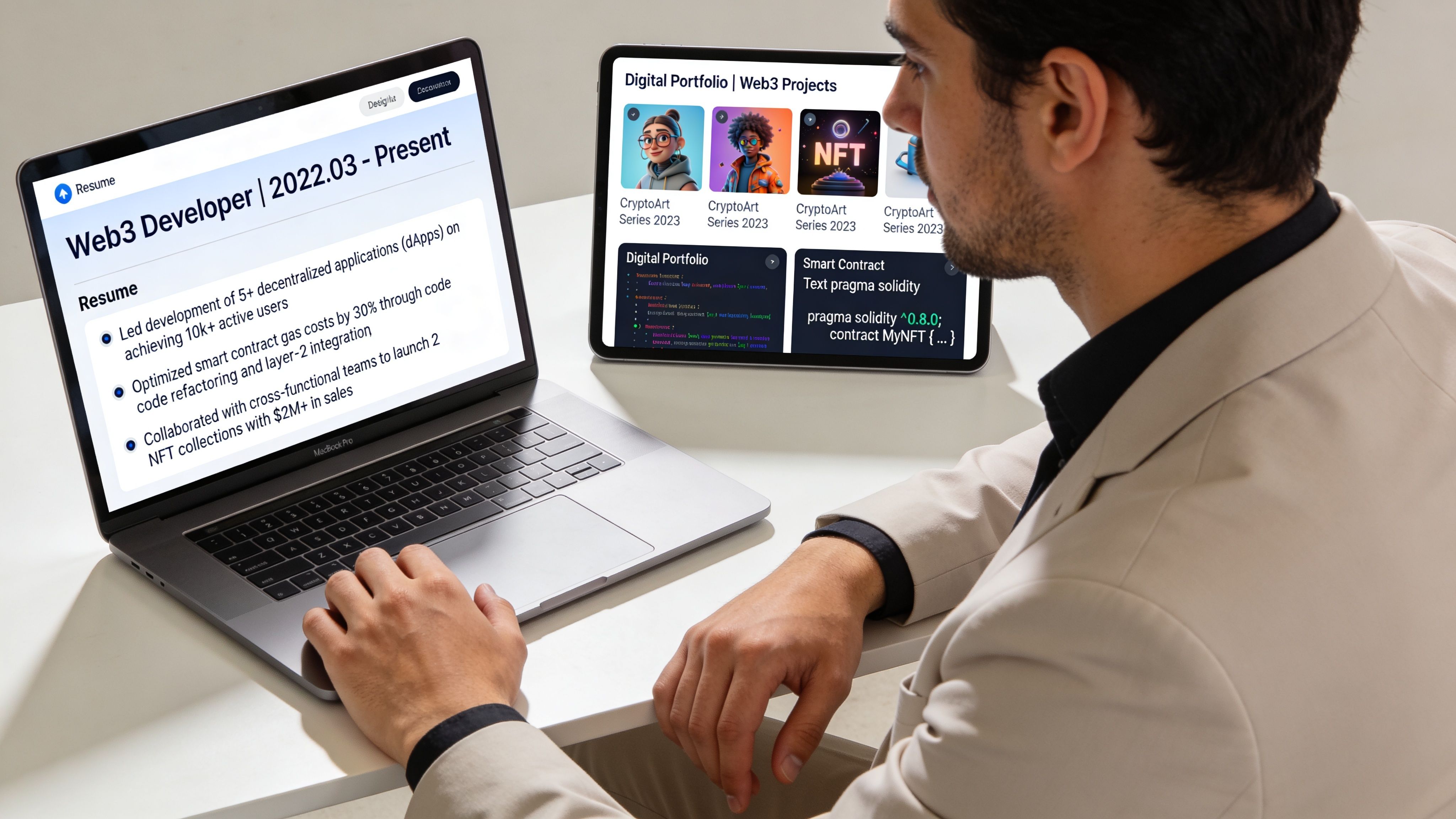
Resume bullets that sound hireable
Most applicants undersell themselves. They list tasks instead of outcomes and context.
If you’ve done adjacent work, rewrite it in terms a Web3 hiring manager respects.
Instead of:
- Helped run a student club Discord
Write:
- Moderated a digital community, answered member questions, escalated recurring issues, and helped maintain a welcoming environment during high-traffic discussions
Instead of:
- Posted on Instagram for a campus event
Write:
- Supported multi-channel event promotion through social content, reminder posts, and community outreach to increase attendance and post-event engagement
Instead of:
- Worked front desk at a nonprofit
Write:
- Served as a first point of contact for community members, resolved routine questions, documented recurring concerns, and routed issues to the right internal stakeholders
Build a proof-of-community portfolio
You do not need prior crypto employment to show fit. You need evidence that you can create or improve community experiences.
A strong starter portfolio can include:
- A small Discord server you built: choose a theme you care about, write the rules, create channels, onboard members, and document what you learned
- A speculative community plan: pick a protocol or app you admire and write a short launch or retention plan
- A content sample set: one FAQ, one announcement, one event promo, one recap post
- A feedback memo: summarize how users are reacting to a product update and what the team should do next
Make it easy to review. Use Notion, Google Drive, or a simple personal site. Hiring teams won’t dig through clutter to find your best work.
Interview answers that actually work
The interview usually turns on judgment. Not charisma.
Expect questions like:
- How would you handle FUD in Discord?
- What would you do if a user kept repeating false information?
- How would you improve engagement in a quiet server?
- What kind of community initiative would you propose for our project?
Answer with structure. Situation, action, reasoning, follow-up.
For FUD, don’t say “I’d stay positive.” Say you’d identify the source of concern, verify facts internally, respond with one clear message, avoid public arguments, and monitor whether confusion shifts or settles.
This is a good point to study how working community professionals think through the role:
A simple application plan
If you’re serious, do this over the next few weeks:
- Rewrite your resume around communication, moderation, reporting, and event support
- Create one visible portfolio page with community samples
- Join a few Web3 communities and observe what good moderation and poor moderation look like
- Practice short product explanations so you can speak clearly in interviews
- Prepare two stories about conflict, ambiguity, or public-facing communication
Hiring managers remember candidates who show receipts. Screenshots, docs, recaps, and examples beat enthusiasm every time.
You don’t need to look like a veteran. You need to look coachable, reliable, and already in motion.
Salary Rates and Remote Work Expectations
Pay in this category varies a lot. Some teams run lean and hire part-time interns for operational support. Others treat community as a serious growth and retention function and pay accordingly.
Available 2026 pay data puts the national average salary equivalent for Community Engagement Interns at around $57,202, and remote hourly rates can range from $14.42 to $22.00, according to the job-market details noted earlier. Treat those figures as a reference point, not a promise. A Web3 offer may look better or worse depending on scope, timezone expectations, and whether the team has mature operations.
What to evaluate beyond hourly pay
Web3 compensation can get messy fast if you don’t ask basic questions.
Look at these factors before saying yes:
- Schedule clarity: is the work part-time, or “part-time” with round-the-clock community expectations?
- Timezone load: are you covering one region, or expected to be available across several?
- Manager access: will someone train you, review your work, and help you improve?
- Scope creep: are they hiring an intern, or trying to get a full community manager at intern pay?
- Payment format: if any part of compensation is crypto, ask what’s fixed and what’s variable
Remote work works best with structure
Many of these roles are remote or remote-friendly, which is a big advantage if you’re trying to break into the field from outside a major crypto hub. But remote community work isn’t automatically flexible in a healthy way.
The hard part isn’t working from home. It’s staying organized while conversations never really stop.
A few habits matter a lot:
- Keep clean handoff notes if your team spans timezones
- Separate urgent issues from noisy chatter
- Use templates for incident updates, FAQ replies, and event recaps
- Protect focus time so you don’t spend your whole shift reacting
If you want to benchmark how broad the remote market is, browse remote blockchain jobs and compare community-adjacent listings with support, marketing, and ops roles. You’ll quickly see that remote-friendly teams often reward people who communicate well asynchronously.
Remote community work is a fit for people who can self-manage. If you need constant supervision to stay organized, this role gets hard.
One more trade-off. Some Web3 teams may mention token allocations, NFTs, or future upside. That can be interesting, but for interns I’d prioritize cash compensation, clarity of scope, and quality of mentorship first. Speculative upside is not a substitute for real training.
Find Your Internship on Blockchain Jobs
Searchers often restrict their queries. They type “community engagement intern,” get a short list, and assume that’s the whole market.
It isn’t.

Search titles you might miss
A lot of Web3 teams don’t use one standard title for early-career community work. You need to search by adjacent function, not just by exact phrase.
Useful terms include:
- Community intern
- Community associate
- Community coordinator
- Community moderator
- Discord moderator
- Telegram moderator
- Community operations
- Ecosystem intern
- Marketing intern
- Growth intern
- Contributor relations
If you only search one title, you’ll miss a lot of fit.
Browse by category, then inspect the actual work
Community roles often hide inside broader marketing or content buckets. That’s why it helps to browse blockchain marketing jobs and then read the descriptions carefully.
Look for responsibilities like:
- managing social channels
- supporting events or AMAs
- collecting user feedback
- maintaining Discord or Telegram
- helping with creator or ambassador programs
- writing recaps, newsletters, or onboarding content
Those are often community jobs in practice, even when the title leans marketing.
Filter for fit, not just prestige
A famous brand can look great on paper and still be a poor internship. Focus on whether the role gives you reps.
Good signs:
- clear reporting lines
- defined deliverables
- active product shipping
- evidence the team values community as an operating function
Risk signs:
- vague expectations
- no onboarding support
- constant “wear many hats” language with no boundaries
- token-heavy compensation with weak cash terms
- no explanation of who supervises you
The best early role isn’t always the flashiest project. It’s the one where you can learn product, build proof, and leave with concrete wins.
Your Launchpad into a Web3 Career
A community engagement intern role is not just a starter job for people who “like social media.” It’s one of the clearest apprenticeships in Web3 for anyone who wants to learn how products, users, incentives, and public trust fit together.
People who do this work well often move into community management, ecosystem growth, support leadership, content, operations, and product-facing roles. That happens because the internship forces you to learn the part many teams struggle with most. Staying close to users without drowning in noise.
If you’re coming from traditional community work, don’t treat that background as second tier. It’s a real advantage. Event coordination, volunteer outreach, moderation, reporting, relationship building, and public communication all transfer well. You just need to present them in crypto-native language and back them up with visible proof.
Start small if you need to. Build a portfolio. Moderate something. Write recaps. Learn how good teams communicate. Then apply with confidence.
If you’re ready to turn that groundwork into a real opportunity, start exploring roles on Blockchain Jobs. It’s one of the most direct ways to find Web3 openings across community, marketing, operations, content, and remote-friendly teams building in crypto.