Community Manager Job Description: Templates to Attract Top Talent
A solid community manager job description is your secret weapon for attracting top talent. It's the first thing a great candidate sees, and it needs to signal that you understand this isn't just a comment-moderating gig anymore. Especially in Web3, this role is strategic—it's about driving real growth, keeping people engaged, and even shaping the product itself. For candidates, understanding this description is key to acing the interview and charting your career path.
Understanding the Modern Web3 Community Manager Role
Before you can write a job description that works, you need to understand what the role really entails today. The Web3 community manager is a world away from a traditional social media moderator. They are the backbone of DAOs, DeFi protocols, and entire token ecosystems. Think of them as the crucial bridge connecting the core project team with its most important asset: the community.

This job is now a mix of strategy, data analysis, and deep user empathy. Modern community managers are expected to master digital hubs like Discord and forums, create content that drives action, and keep energy high with events and AMAs. If you want to dive deeper into this evolution, Brandwatch offers some great analysis on the subject.
The Strategic Shift from Moderator to Architect
The biggest difference for a Web3 community manager is the sheer scope of their influence. They aren't just enforcing rules; they're building digital nations from the ground up. Their work is directly tied to the project's success and demands a very specific blend of technical know-how and people skills. Aspiring managers should focus on building these specific skills to stand out.
To help illustrate just how different this role has become, let's break down the key responsibility areas. The following table contrasts the duties of a traditional community manager with the unique demands placed on their Web3 counterpart, giving hiring managers a clear view of what to look for and candidates a roadmap for upskilling.
Web3 vs Traditional Community Management at a Glance
| Responsibility Area | Traditional Community Management | Web3 Community Management |
|---|---|---|
| Community Platform | Manages social media channels like Facebook, Twitter, and Instagram. | Manages decentralized platforms like Discord, Telegram, and token-gated forums. |
| User Engagement | Focuses on likes, comments, and shares to build brand awareness. | Drives on-chain governance participation, protocol usage, and holder retention. |
| Content Strategy | Creates marketing content, blog posts, and campaign materials. | Develops educational content on governance proposals, technical updates, and tokenomics. |
| Feedback Loop | Gathers general customer feedback and bug reports for the product team. | Channels direct user insights and sentiment from token holders to influence the product roadmap. |
| Incentives & Rewards | Runs contests, giveaways, and loyalty programs. | Manages airdrops, bounties, and NFT rewards to incentivize contribution and ownership. |
| Governance | Enforces community guidelines set by the company. | Facilitates decentralized governance, educates voters, and helps guide community proposals. |
As you can see, the Web3 role is far more integrated into the core functions of the project. A great community manager is part strategist, part diplomat, and part product manager.
Key strategic functions now include:
- Facilitating Governance: They’re the ones making sure the community understands proposals, encouraging smart discussions, and generally guiding the decentralized decision-making process.
- Managing Token-Gated Access: They create and look after the exclusive spaces for token holders, which is critical for building that feeling of real ownership and belonging.
- Cultivating Culture: It's their job to set the community's tone, values, and inside jokes—turning a random group of users into a passionate, unified tribe.
- Gathering Product Insights: They are on the front lines, hearing what users love and what they hate. They funnel that invaluable feedback directly to the dev team to help steer the product's future.
A top-tier community manager job description needs to reflect this strategic depth. It tells the best candidates that you get it—you’re looking for a partner who will help you grow, not just a moderator. A good way to get a feel for this is to look at real-world examples, like this Community Manager role for Karbon, to see how other leading companies are framing their needs.
Defining Key Responsibilities and Daily Tasks
To write a job description that attracts serious talent, you must be specific. Forget vague statements. Detail the concrete, day-to-day tasks the role demands. This clarity helps candidates self-select and gives them a real picture of what success looks like on your team. It also becomes your best friend during the interview process, giving you a solid framework for your questions.
It's helpful to group these responsibilities into four key pillars. Structuring your job description this way gives it a logical flow, making it easy for candidates to connect their experience to your needs. This structure is also a great foundation for discussing career growth, as senior roles typically involve more strategic oversight of these same areas.
Community Engagement and Advocacy
This is the core of the job—building genuine relationships and nurturing an active community. The goal is to turn passive observers into true evangelists. When you're interviewing, ask candidates for specific examples of how they’ve handled these tasks to gauge their hands-on experience.
- Hosting Events: Organize and run regular community events like weekly AMAs, Q&A sessions with the dev team, or educational workshops.
- Fostering Discussion: Actively participate in conversations on platforms like Discord and Telegram to keep them lively, on-topic, and welcoming.
- Onboarding New Members: Develop a smooth onboarding process so newcomers quickly grasp the project's mission, values, and how to contribute.
- Gathering Feedback: Build a system to collect user insights, bug reports, and feature requests that can be funneled directly back to the product team.
Content and Communication
Your community manager is often the primary voice of the project. They need to be skilled at creating and sharing content that educates, informs, and excites. A crucial skill to test for in interviews is the ability to translate complex technical concepts into easily understandable content.
A great candidate won’t just post updates. They’ll craft compelling stories around technical developments that resonate with everyone, from die-hard believers to brand-new users. This single skill has a massive impact on retention and how your project is perceived.
Key duties here include writing educational threads on governance proposals, drafting clear project updates, and crafting announcements for partnerships or new features.
Moderation and Safety
Keeping the community safe and constructive is non-negotiable, especially in Web3 where scams and FUD (Fear, Uncertainty, and Doubt) are constant threats. This requires a proactive, diplomatic individual with a thick skin. A candidate’s track record in moderation reveals their ability to handle pressure and protect the community—an essential function of the role.
- Enforcing Guidelines: Clearly communicate and consistently enforce community rules to maintain a respectful and productive space.
- Implementing Safety Protocols: Set up and manage anti-scam measures, often by configuring bots and verification systems on Discord and Telegram.
- Conflict Resolution: Act as a mediator during disputes, de-escalating heated situations with both empathy and firmness.
Growth and Analytics
A top-tier community manager doesn't guess—they use data to make decisions. They track key metrics to understand community health and identify growth opportunities. Listing these duties signals that you're hiring a data-informed professional, not just a social butterfly. This involves tracking engagement metrics, analyzing community sentiment, and reporting on growth trends to leadership.
Identifying Essential Skills and Qualifications
A great community manager job description maps out the skills needed to thrive in the role. For anyone looking to get hired, this section shows you exactly where to focus your professional development. For hiring managers, it's your filter for finding talent with the right mix of technical know-how and people skills.
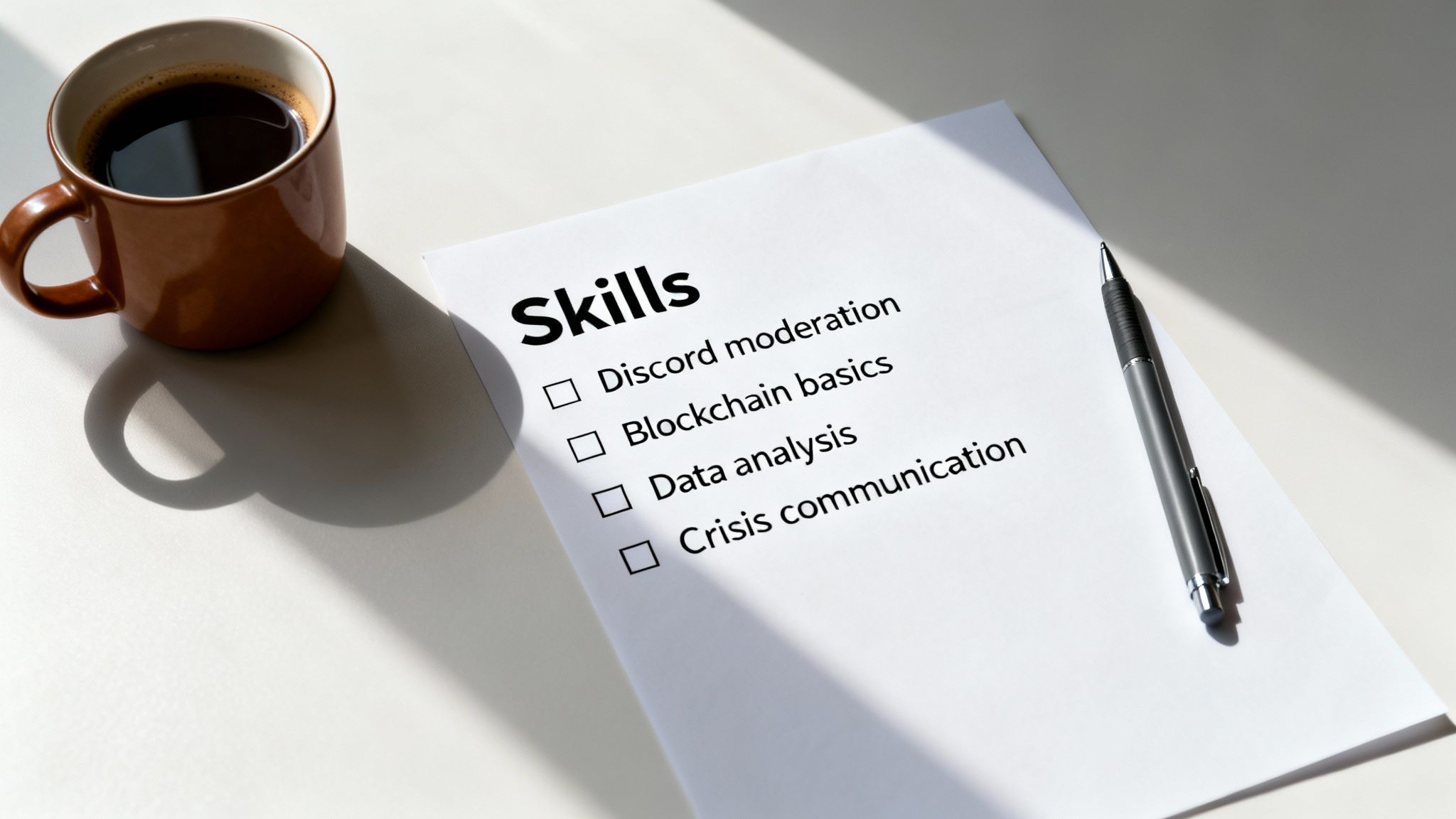
The best community pros in Web3 have a unique blend of hard and soft skills. Hard skills are the teachable, technical abilities you can easily test for. Soft skills are about personality and communication—how someone handles themselves and others. In the fast-moving world of crypto, you absolutely need both.
Required Hard Skills
These are the non-negotiables a candidate must have from day one. In an interview, probe these with practical questions or even a small, real-world test.
- Platform Mastery: Candidates must be power users of platforms like Discord and Telegram. This means knowing how to set up roles, manage permissions, configure channels, and deploy security bots to shut down raids and scams.
- Blockchain Fundamentals: Your community manager has to grasp core Web3 concepts—wallets, transactions, gas fees, and the basics of your protocol. They don't need to be a coder, but they must be able to break down complex ideas for a non-technical audience.
- Data Analysis: A good community manager runs on data. They need the ability to track, understand, and report on key community metrics using tools that measure active members, message volume, and sentiment, then turning those numbers into an actionable growth strategy.
Essential Soft Skills
Soft skills are what separate a good community manager from a truly great one. They're tougher to measure on a resume but are critical for managing the human side of a passionate and sometimes volatile Web3 community. In an interview, use behavioral questions like, "Tell me about a time when..." to see these skills in action.
Key Takeaway: Hard skills might get a candidate through the door, but it’s the soft skills that will make or break their success. Empathy and clear communication are the glue that holds a decentralized community together, especially during stressful FUD-storms or periods of insane growth.
- Empathy and Patience: Your community manager is on the front lines, dealing with users who are new, confused, or frustrated. The ability to listen, stay calm, and respond with genuine understanding builds deep trust and loyalty.
- Crisis Communication: The Web3 space is famous for FUD. A skilled manager can keep a cool head under pressure, communicate with transparency, and defuse a tense situation before it explodes.
- Strategic Thinking: The best candidates don't just put out fires; they anticipate them. They think about the long-term health of the community and align their engagement plans with the project's big-picture goals. This is what truly separates a junior CM from a senior leader.
How to Use Job Descriptions to Attract the Right Talent
A generic job description attracts generic candidates. To find a community manager who understands the unique challenges of your Web3 project, your job description must speak their language and be honest about your company's stage of growth. A well-crafted template acts as a filter, attracting people with the exact experience you need.
A seed-stage startup needs a builder. A growth-stage protocol needs an operator who can scale. An established DAO needs a seasoned facilitator. Each requires a different mindset and skillset. Below are three distinct templates designed for these scenarios.
Template 1: Seed-Stage Startup
This template is for early-stage projects that need an all-rounder—a true believer who is excited to build a community from scratch.
- Role Summary: We’re looking for our first Community Manager to build and nurture our community from day one. You'll be the voice, ears, and heart of our project, establishing our presence on key platforms, setting the cultural tone, and turning our very first users into lifelong evangelists.
- Key Responsibilities:
- Launch and manage our core community channels (likely Discord and Telegram).
- Create and execute our initial community engagement and content plan.
- Personally onboard our first 1,000 community members.
- Write and document our community guidelines and moderation policies from the ground up.
- Collect and organize user feedback to help shape our product roadmap.
- Qualifications:
- Demonstrated experience growing an online community from zero is a must.
- Exceptional writing skills with a knack for creating engaging, authentic content.
- A genuine passion for Web3 and a willingness to wear many hats in a fast-paced environment.
Template 2: Growth-Stage Protocol
This template is for projects that have found product-market fit and are now facing the challenge of scaling. The focus here is on strategic growth and building solid processes.
- Role Summary: We're hiring a Community Manager to scale our thriving community. Your mission is to build systems that deepen engagement, expand our global footprint, and create the infrastructure needed to support tens of thousands of active members.
- Key Responsibilities:
- Design and manage scalable programs, such as ambassador and contributor initiatives.
- Analyze community data to spot trends and report on key growth metrics.
- Recruit, train, and lead a team of volunteer or part-time moderators.
- Work with the marketing team on partnerships and co-branded campaigns.
- Streamline our onboarding process to effectively handle a high volume of new members.
- Qualifications:
- 3+ years of experience managing online communities, ideally in a high-growth tech or Web3 company.
- Proven ability to use analytics tools to inform community strategy.
- Experience managing other moderators or community volunteers.
Template 3: Established DAO
This template is for mature DAOs, where the community manager's role is less about broadcasting and more about facilitating governance and empowering contributors.
In a DAO, the Community Manager role shifts from a top-down director to a bottom-up facilitator. Their success isn't measured by their own voice, but by how well they amplify the voices of hundreds of contributors and guide them toward productive, decentralized consensus.
- Role Summary: We are looking for a Community Manager to facilitate governance and empower our decentralized network of contributors. You will be the operational backbone that ensures proposals are well-formed, discussions are productive, and our governance process runs smoothly and transparently. To see how this works in practice, check out this [Community Manager posting for Freelancer Monks](https://blockchain-jobs.com/jobs/community-manager-freelancer- monks) and their specific requirements.
- Key Responsibilities:
- Educate community members on governance procedures and how to submit effective proposals.
- Moderate governance forums and community calls to keep debates constructive.
- Coordinate with various working groups and delegates to push key initiatives forward.
- Summarize complex discussions and sentiment for the wider community.
- Assist in managing the DAO's treasury and grants programs.
- Qualifications:
- A deep, practical understanding of DAO structures and decentralized governance models.
- Excellent skills in facilitation, conflict resolution, and stakeholder management.
- Experience working asynchronously with a distributed, global team.
Benchmarking Salary and Mapping Career Progression
Understanding compensation and career paths is crucial for both hiring managers and candidates. For projects, a competitive offer is what secures top talent. For community managers, knowing your worth and seeing a clear path for advancement is fundamental to building a long-term career.
Community management is now a well-compensated field with significant growth potential, especially in Web3. While general salary data provides a baseline, Web3 roles typically offer higher compensation due to the specialized skills required. Recent data shows the average US community manager earns around $76,168. The broader market might show ranges between $52,750 and $75,250, but experienced Web3 professionals often command salaries well above that, especially when factoring in token packages. You can compare these figures with general compensation data from sources like Robert Half.
Web3 Community Manager Salary Ranges by Seniority
In Web3, compensation is directly tied to experience and impact. As a community manager progresses, their focus shifts from daily tasks to high-level strategy, and their pay should reflect that increased responsibility. The table below provides a solid benchmark for offers and negotiations.
| Seniority Level | Typical US Salary Range (USD) | Key Responsibilities at This Level |
|---|---|---|
| Junior Community Manager | $60,000 - $85,000 | Daily moderation, answering user questions, executing pre-planned engagement campaigns, and reporting basic metrics. |
| Mid-Level Community Manager | $85,000 - $120,000 | Designing engagement strategies, managing moderation teams, analyzing community data, and leading content creation initiatives. |
| Senior Community Manager | $120,000 - $160,000+ | Overseeing the entire community function, setting long-term strategy, managing budgets, and aligning community goals with core business objectives. |
This table is a great starting point, but remember that factors like project funding, location, and the specifics of the role can influence these numbers. Top-tier projects will often pay at the higher end of these ranges or beyond to attract the best in the business.
Charting a Path for Career Advancement
A community manager job isn't a dead end; it's a launchpad for a serious leadership role. A clear career ladder is one of the best ways to retain talent and provides ambitious professionals with a roadmap for growth.
A common mistake I see candidates make is not asking about career progression in an interview. The smart ones always want to know what the next two or three steps look like. Projects that can answer that question well show they’re serious about investing in their people.
Here’s what a typical career path looks like:
- Community Manager: This is where you master the core skills—engagement, moderation, and content.
- Senior Community Manager: You begin to own strategy, manage junior team members or moderators, and demonstrate how your work directly contributes to the project's growth.
- Head of Community: Now you're in charge of the entire department. You set the vision, manage the budget, and serve as the voice of the community in leadership meetings.
- Head of Growth / Marketing: Top performers often leverage their deep user understanding to move into broader roles, driving user acquisition and shaping the overall marketing strategy.
Structuring an Effective Hiring and Interview Process
To hire a great community manager, you need a process as well-designed as the community you aim to build. A sharp, clear process helps you vet candidates effectively and signals to them that you're a serious project that respects their time and skills. It all starts with a compelling job post that sells the strategic value of the role, using the templates we've already covered as your launchpad.
As applications roll in, your first filter should be a close look at their portfolios. You're searching for tangible results—case studies showing community growth, examples of successful engagement campaigns, or documentation of moderation systems they’ve built. A strong portfolio tells a story of impact, not just a list of vanity metrics.
Vetting for Cultural and Technical Alignment
The interview should have distinct stages, each designed to test different skills. Beyond a standard culture-fit interview, you need to dig into their understanding of your protocol. Ask pointed questions about its core values, its tokenomics, and how they would specifically shape a community strategy to hit your project's unique goals.
The best way to see what someone is truly capable of is to give them a practical test. Present a realistic community crisis—a coordinated FUD attack in your Discord or a fiery governance debate. The way they handle it will reveal more about their crisis management skills and strategic thinking than any hypothetical question ever could.
The job landscape for community managers is heavily skewed toward remote-first, global roles, a perfect fit for the decentralized nature of Web3. Around 60–70% of community manager jobs are remote or hybrid, reflecting how crypto teams operate across borders. It's worth learning more about the evolving work conditions to understand what top candidates expect.
The career path for a community pro in Web3 is pretty well-defined, moving from a junior specialist up to a head of community. This chart lays it out nicely.
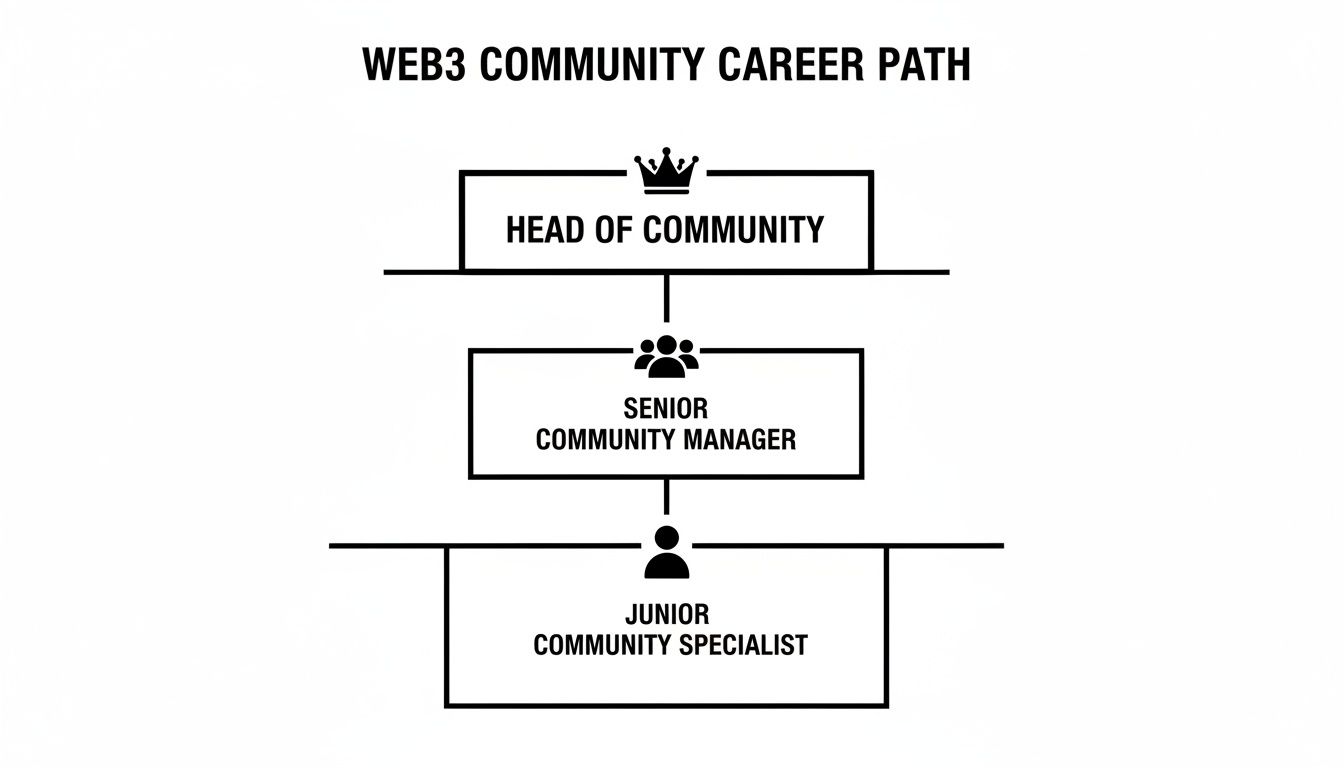
As you can see, there's a clear trajectory from being an individual contributor to becoming a strategic leader. Remember, hiring for this role isn't just filling a seat; it's an investment in your project's future leadership.
Asking the Right Interview Questions
A resume can only tell you so much. The interview is where you truly discover if a candidate has what it takes to lead your Web3 community. To find the right person, you need to ditch the generic questions and get to the heart of their real-world skills and experience.
Your community manager job description is the blueprint, but the interview is where you pressure-test the materials. By asking targeted, situational questions, you can see how a candidate thinks and solves problems. For candidates, knowing how to answer these questions is your chance to prove you’re the real deal.
Situational and Crisis Management Questions
In Web3, chaos is part of the job. These questions are designed to see how a candidate handles pressure and thinks on their feet. You're not looking for a perfect answer, but a calm, methodical thought process is non-negotiable.
- Question: “Imagine a coordinated FUD (Fear, Uncertainty, and Doubt) attack hits our Discord right as the market is tanking. What's your immediate game plan?”
- What to look for: A strong response will be a multi-step plan. They should talk about immediately isolating and shutting down the misinformation, then communicating clearly and honestly with the genuine community members. Bonus points if they mention specific moderation bots or tactics and see it as an opportunity to educate and build trust.
Behavioral and Experience-Based Questions
These questions force candidates to back up their claims with proof from past jobs. Vague, hypothetical answers are a major red flag. You want to hear specific stories with real, measurable results.
- Question: “Tell me about a time you grew a community from the ground up. What specific strategies worked, and how did you know they were working?”
- What to look for: The best answers will be packed with data. They'll talk about achieving a 30% increase in genuinely active users or a measurable lift in governance voting. They should be able to walk you through the exact campaigns or content that made it happen.
Behavioral questions are all about finding patterns. A candidate who can consistently explain how they got results in the past is someone you can count on to do it again for your project.
Strategic and Analytical Questions
This is where you separate the doers from the thinkers. A great community manager connects every community activity back to core business objectives.
- Question: “How do you prove the ROI of building a community? What metrics would you show me?”
- What to look for: A top-tier candidate will go way beyond vanity metrics like member count. They’ll discuss tracking things that actually impact the bottom line, like user retention rates, the volume of quality product feedback, or how the community contributes to new user acquisition. They understand their work has strategic value. You can see this focus on strategic impact reflected in job descriptions like this Community Success Agent at SwissBorg.
Got Questions? Let's Talk Web3 Community Management
Whether you're a founder trying to write your first community manager job description or a candidate prepping for an interview, this role can have some tricky grey areas. Let's clear up some of the most common questions I hear.
Getting these details right from the start is what separates a vague job post from one that attracts A-list talent.
What's in the Toolbox for a Web3 Community Manager?
A great community manager comes equipped with the right tools. While every project’s stack is a little different, there are a few essentials you'll find in almost any successful community pro’s kit.
- The Hubs: You have to live and breathe Discord and Telegram. This isn't just about chatting—it's about setting up roles, moderating channels, wrangling bots, and locking things down securely.
- The Data: You can't manage what you don't measure. Tools like Combot for Telegram or the built-in server insights on Discord are your best friends for tracking engagement, spotting trends, and understanding community sentiment.
- The Organizer: Chaos is the enemy. Simple tools like Trello or Notion are perfect for keeping community campaigns, content calendars, and moderator schedules from turning into a total mess.
Isn't This Just a Social Media Manager?
Not even close. It's a common misconception, but the two roles are fundamentally different. A social media manager is all about top-of-funnel brand awareness—think likes, shares, and follower counts. They're casting a wide net.
A Web3 community manager, on the other hand, is focused on deep, bottom-of-funnel engagement and user retention. Their job is to cultivate a sense of shared ownership, guide governance discussions, and empower users to become true evangelists for the project. The goals are just in a different league.
What's the Hardest Part of Managing a Crypto Community?
Hands down, the toughest part of the job is steering the ship through a full-blown crisis with complete transparency. We're talking about coordinated FUD attacks, gut-wrenching market crashes, or heated arguments during a critical governance vote.
Anyone can manage a community when the price is green. The real test is keeping your cool, communicating with clarity, and holding onto the community's trust when everything feels like it's on fire. That’s what makes a great community manager indispensable.
How Do You Actually Measure Success in This Role?
If you're just looking at the member count, you're missing the point entirely. A smart community manager knows their value is tied directly to the health and growth of the ecosystem.
We look at KPIs that tell the real story:
- Active Contributor Growth: How many people are genuinely participating in discussions, contributing to bounties, or showing up for calls?
- User Retention Rate: Are people sticking around for the long haul, or is it a revolving door?
- Sentiment Analysis: What's the general vibe? Are people optimistic and helpful, or is toxicity creeping in?
- Governance Participation: What percentage of token holders are actually showing up to vote? This is a huge health indicator.
These metrics show the tangible impact a community manager has on a project's success.
Ready to find your next Web3 role or hire the perfect community manager? Blockchain Jobs is the leading platform connecting top talent with the best projects in the ecosystem. Explore listings or post your job today.