Community Manager Social Media Jobs: Your Web3 Career Guide
You already know how to schedule posts, write captions, calm down a messy comment thread, and keep a brand voice consistent. But if you’ve spent time in traditional social roles, you’ve probably also felt the ceiling. You hit your targets, your dashboards look fine, and the work still feels shallow. A post performs. Then it disappears. The audience engages. Then it moves on.
Web3 changes the stakes. In crypto, social isn’t just distribution. It’s infrastructure for trust. Communities gather in Discord and Telegram before product-market fit is obvious, before media coverage shows up, and sometimes before the product is even stable. That makes community manager social media jobs far more operational than most Web2 candidates expect. You’re not only posting. You’re shaping belief, handling volatility, and translating chaos into retention.
That’s also why the hiring gap is real. Generic social media guides teach content planning and engagement basics. They rarely teach how to manage token-holder expectations, moderate pseudonymous users, work inside community-led governance, or keep sentiment from collapsing during a bad week. If you’re making the jump, you need a more practical map than “build your brand on X and be authentic.”
From Likes to Loyalty The Web3 Community Manager Opportunity
A lot of people enter Web3 from a familiar starting point. They’ve run Instagram, LinkedIn, TikTok, or brand X accounts. They can spot decent copy, organize a calendar, and keep stakeholders happy. Then they look at crypto roles and realize the job description sounds similar, but the actual work is not.
In Web3, your value is tied less to polished publishing and more to community durability. A DeFi protocol, NFT project, infrastructure startup, or wallet product can buy reach. It can’t buy trust once users think the team is absent, evasive, or disconnected from the community. That’s where good community managers become hard to replace.

Recent data cited in an Indeed-linked market summary says Web3 community managers earn 20-50% higher salaries, with median compensation at $120K-$180K, while also noting that 70% of Web3 projects fail because of poor community retention, which tells you exactly why this niche pays a premium for people who can build durable participation rather than surface-level engagement (Web3 community manager demand and retention gap).
Why the work feels bigger in Web3
Traditional social teams often optimize for impressions, click-throughs, and campaign support. Web3 teams care about those too, but they also care about whether members stay, contribute, defend the project, and help new people onboard without the core team hand-holding every interaction.
That changes the nature of the role:
- You moderate identity-heavy spaces: People often feel financially and ideologically invested.
- You operate in public: Product confusion, governance disagreement, and market fear all show up in community channels first.
- You become a feedback system: Founders, product leads, and growth teams rely on you to hear what users are saying.
Community management in Web3 sits closer to customer trust and product adoption than most job titles suggest.
If you need a clean grounding in the fundamentals before you specialize, this primer on how to learn community management with Zanfia is a useful reset. It covers the base layer well. The Web3 jump starts when you apply those fundamentals to crypto-native environments where attention, incentives, and sentiment move faster.
What makes this a strong career move
This niche suits people who are tired of being treated like “the person who posts.” In Web3, a strong community operator often gets pulled into product feedback loops, ambassador programs, partnerships, governance discussions, launch planning, and crisis response. That breadth can be exhausting in bad companies, but in good ones it accelerates your career faster than another generic social role ever will.
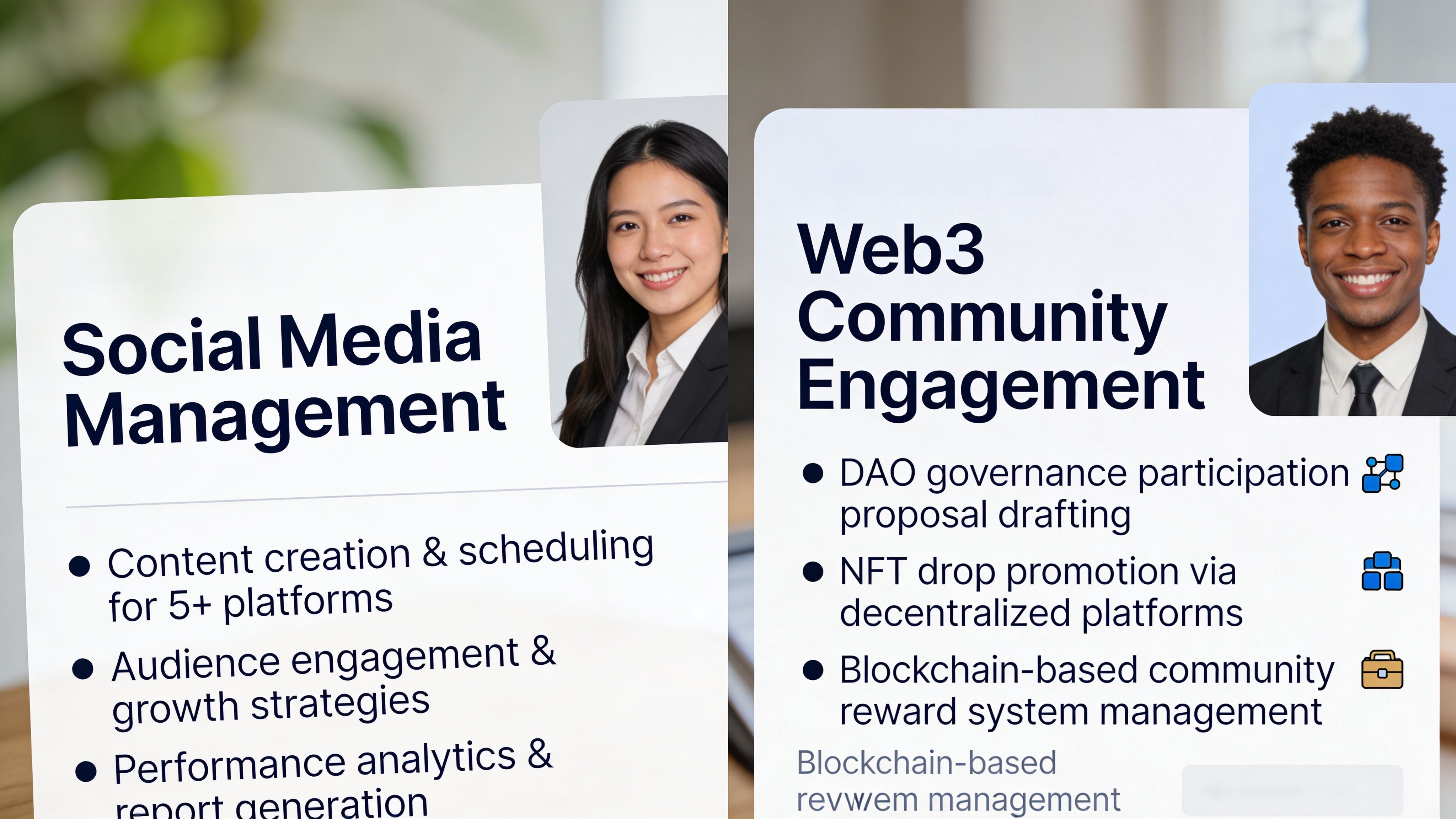
The Two Key Roles Community Manager vs Social Media Manager
Most candidates blur these roles. Most hiring managers say they don’t, then write job descriptions that do. That’s one reason interviews go sideways. You think you’re applying for a community role, then discover they want a content strategist, copywriter, analyst, support lead, and Discord moderator in one body.
That confusion costs teams. In blockchain hiring, role mix-ups can waste 20-30% of marketing budgets, and communities led by a Community Manager achieve 25% higher retention than those handled by Social Media Managers alone, according to the role comparison benchmarks published by Wow Remote Teams (CM vs SMM benchmarks for blockchain hiring).
The cleanest distinction
A Social Media Manager is responsible for outbound narrative. They decide what the market sees, when it sees it, and how the brand presents itself across public channels.
A Community Manager is responsible for relationship quality inside the audience. They manage conversation, friction, belonging, tone, and feedback loops once people are already paying attention.
In Web3, both matter. But they solve different problems.
Web3 Community Manager vs Social Media Manager
| Aspect | Community Manager (CM) | Social Media Manager (SMM) |
|---|---|---|
| Core mission | Build trust, participation, and loyalty | Build awareness, reach, and message consistency |
| Primary channels | Discord, Telegram, gated groups, community forums | X, LinkedIn, TikTok, Instagram, public brand channels |
| Daily work | Moderation, replies, onboarding, conflict handling, surfacing feedback | Content planning, publishing, campaign coordination, performance reporting |
| Success signal | Members return, contribute, and help others | Content gets seen, shared, and remembered |
| Hiring test | Can this person handle people under pressure? | Can this person shape and distribute a narrative? |
| Common background | Community ops, support, creator communities, moderation | Brand social, content marketing, campaign management |
| Failure mode | Reactive firefighting with no system | Good-looking content with weak audience depth |
| Strongest mindset | Host, operator, translator | Editor, strategist, broadcaster |
What recruiters look for in each role
If I’m hiring for a pure CM role, I don’t care first about your content calendar. I care whether you can keep a Discord usable when sentiment gets messy. I care whether you can identify recurring confusion, write escalation notes clearly, and know the difference between a frustrated real user and someone trying to derail the room.
If I’m hiring for an SMM role, I care whether you can package a launch, keep messaging aligned, work with design, and produce channel-specific content that feels native instead of recycled.
A lot of junior candidates hurt themselves by pitching “engagement” in a vague way. That word is too loose. Hiring managers want to hear operational judgment.
Signs the company actually wants a CM
Look for language around:
- Member support and onboarding: They mention Discord, Telegram, or ambassador coordination.
- Moderation and sentiment: They care about tone, conflict, and community health.
- Cross-functional feedback: They expect you to pass user insight to product, growth, or leadership.
If the role mostly talks about content production, reporting, campaign calendars, and creatives, it’s likely an SMM role dressed up with a community title.
Practical rule: If the company’s biggest pain is “nobody sees our posts,” they need a Social Media Manager. If the pain is “people join but don’t stay,” they need a Community Manager.
Which path should you choose
Choose CM if you’re strongest at conversation, emotional control, moderation, support-adjacent work, and reading subtext in messy environments.
Choose SMM if you’re stronger at narrative shaping, channel planning, content systems, and campaign execution.
Some Web3 startups will ask for both. Be careful. Combining both jobs can work for a short period, but only if the team understands the trade-off and the candidate has enough influence to define scope. If you’re reviewing live openings, a role like this founder brand and social media manager position gives you a useful contrast point. It’s much closer to narrative ownership than true community operations.
Building Your Crypto-Native Skill Stack
You don’t need to become a developer to land Web3 community manager social media jobs. You do need to become crypto-literate enough to operate without slowing everyone else down. That means understanding the language, the platforms, the incentives, and the failure modes.
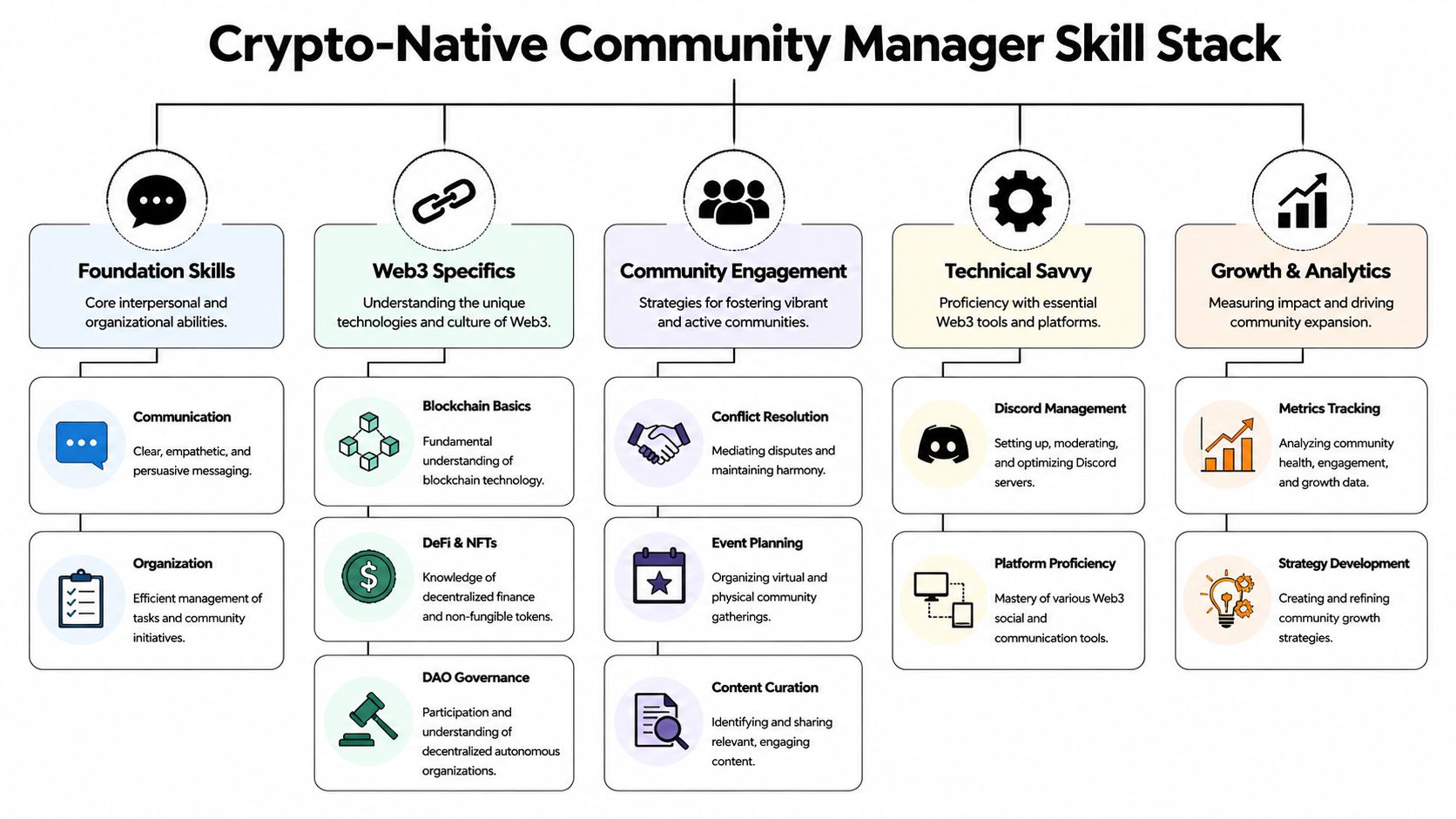
The easiest way to build that stack is to think in layers. Start with the skills you already have from Web2. Then add the pieces that make you useful in crypto-native environments.
Layer one keeps you employable anywhere
If you can’t write clearly, organize workflows, and handle people well, no Web3 knowledge will save you.
Build these first:
- Short-form writing: Discord announcements, Telegram updates, launch reminders, FAQ replies.
- Moderation judgment: Knowing when to reply, when to redirect, and when to remove.
- Documentation: Escalation logs, community notes, recurring issue tracking.
- Voice control: Switching from hype to calm explanation without sounding fake.
These are boring to talk about and decisive in hiring.
Layer two makes you crypto-native
Most transitions fail because candidates say they “love Web3” but can’t explain what a validator does, how governance proposals affect community sentiment, or why Telegram behaves differently from Discord.
Learn enough to hold your own in conversation:
- Blockchain basics: Wallets, transactions, gas, basic network differences.
- DeFi and NFTs: Not advanced trading. Just enough to understand why users care.
- DAO governance: Voting, proposals, contributor culture, community ownership language.
- Token sensitivity: Why announcements around incentives, vesting, rewards, or listings trigger emotion.
Layer three is platform fluency
Discord and Telegram aren’t interchangeable.
Discord is structured. You manage channels, permissions, onboarding paths, bots, role gating, community rituals, and support flow. Telegram is faster, noisier, and less forgiving. It’s useful for immediacy, but weakly managed Telegram groups turn into repetitive panic loops.
Tools matter here. You should know what Collab.Land does in gated access workflows, how Mee6 is used for automation, and when platform-native moderation is enough versus when a project needs more layered tooling.
For candidates exploring adjacent content work while building experience, studying listings such as this social content creator role in crypto infra and AI helps you see where content ends and community begins.
Layer four is measurement
Community work gets dismissed when candidates can’t explain how it connects to outcomes. A strong framework is the community journey map with five stages: awareness, joining, active participation, evangelism, and retention. Guidance from Christopher Penn recommends aiming for organic growth of 5-10% monthly in early stages and retention above 70% for mature communities when measuring health with analytics and platform data (community journey map and KPI benchmarks).
That framework is useful because it keeps you from treating all activity as equal.
How to connect actions to KPIs
Here’s what hiring managers want to hear in plain English.
Awareness
You know how to support reach with announcements, clips, reposts, and partnerships.Joining
You can improve the path from “saw the project” to “joined the server or channel.”Active participation
You create prompts, office hours, AMAs, or content loops that get members talking to each other, not only to staff.Evangelism
You notice who already advocates and give them structure, recognition, and reasons to keep contributing.Retention
You reduce drop-off by onboarding well, answering repeat questions clearly, and keeping the room useful.
Good community managers don’t report “we got engagement.” They explain where people entered, where they stalled, and what changed after the team fixed that point of friction.
The soft skills that matter most in crypto
This is the part generic guides miss.
- Handling FUD: You don’t argue emotionally. You separate valid concern from coordinated noise.
- Reading meme culture: Some communities communicate through jokes, irony, and references. If you miss the tone, you’ll sound corporate.
- Staying calm in volatility: Price chatter can hijack every conversation. You need to redirect without sounding evasive.
- Creating ownership: The best communities don’t feel managed from above. They feel co-built.
If you can combine operational discipline with cultural fluency, you stop looking like a marketer visiting Web3 and start looking like someone who belongs there.
Crafting a Résumé and Portfolio That Gets Noticed
Most résumés for community manager social media jobs die for one simple reason. They describe tasks, not evidence. “Managed social channels.” “Engaged with followers.” “Created content.” None of that tells a Web3 hiring lead whether you can handle a real community under pressure.
Your résumé needs to show judgment, systems, and outcomes. Your portfolio needs to prove you can operate in public-facing, high-context environments.
Rewrite your bullets like an operator
Weak bullet:
- Managed social media comments and messages across multiple channels
Better bullet:
- Moderated public conversations across brand channels, resolved recurring user issues, escalated sensitive cases to internal teams, and maintained consistent response quality during high-volume periods
Weak bullet:
- Grew an online community and increased engagement
Better bullet:
- Built repeat participation through conversation prompts, member recognition, and structured follow-up, then documented recurring feedback for marketing and product stakeholders
Weak bullet:
- Created content for social media
Better bullet:
- Wrote channel-specific updates, announcements, and educational posts aligned with audience questions and campaign priorities
Translate Web2 experience into Web3 language
You do not need prior crypto employment to make your background relevant. You need correct framing.
If you ran a Facebook Group, Slack community, subreddit, creator membership, or customer forum, emphasize the parts that overlap with Web3:
| Web2 experience | Better Web3 framing |
|---|---|
| Managed brand comments | Handled real-time public sentiment and response workflows |
| Ran a customer group | Built and moderated a recurring digital community |
| Published social content | Supported narrative distribution across audience channels |
| Answered support questions | Reduced friction for users through timely issue triage and documentation |
This is where format matters too. If your résumé still reads like an old corporate profile, clean it up. A practical guide to writing a modern resume from CV Anywhere is worth reviewing before you start tailoring for crypto roles.
Build proof of work before you get hired
The best first-time Web3 candidates rarely wait for permission. They create a body of work that shows they can think and execute in the ecosystem.
Good portfolio pieces include:
- A small Discord you built and organized: Show channel structure, onboarding logic, rules, roles, and event concepts.
- A Telegram moderation playbook: Include sample responses, escalation categories, and community guidelines.
- Community teardown posts: Analyze a protocol, wallet, NFT brand, or infra startup. Explain what the team does well and where the community flow breaks.
- DAO participation: Contribute to governance discussion, notes, or member onboarding.
- Public writing: Post threads or short essays translating complex crypto topics into clear language.
One strong artifact beats ten vague claims.
Show your thinking, not only output
Hiring managers want to know how you think when things go wrong. A portfolio should include at least one example of process:
- What signals tell you a channel is getting unhealthy
- How you’d respond to repeated confusion after a product update
- How you decide what belongs in FAQ content versus live moderation
- How you’d brief a founder before an AMA
This kind of material separates practitioners from enthusiasts.
Here’s a useful walkthrough on how recruiters and hiring teams review candidate material in social and community roles:
What to include in the portfolio package
Don’t overbuild a fancy site if the work itself is thin. A simple Notion page, PDF, or personal website is enough if the contents are strong.
Use a structure like this:
Short bio
Focus on your niche. Example: community operations, Discord growth, DeFi education, NFT culture, support-led engagement.Selected work
Use screenshots, channel examples, moderation docs, launch notes, or public writing.Operating principles
Keep this practical. Response quality, clear escalation, community safety, feedback loops.Crypto-native literacy
Show the ecosystems, tools, and project types you understand.
If your résumé says you love community and your portfolio proves you can build one, interviews get much easier.
How to Find and Win Top Web3 Community Jobs
Many job seekers hunt for jobs in Web3 the same way they did in Web2. They search titles, skim listings, apply in bulk, and wait. That approach underperforms because many strong Web3 hires happen after a candidate has already shown up in the ecosystem in some visible way.
The market is large and still expanding. The social media management market is projected to reach $171.62 billion by 2033 with a 24.8% CAGR from 2026 to 2033, and related marketing manager employment is projected to grow 6% from 2024 to 2034, adding 26,100 jobs annually, according to Grand View Research’s market outlook (social media management market growth projection). That doesn’t mean every role is good. It means there’s enough demand that targeted candidates can be selective.

Where strong candidates actually look
Generic job boards are useful for broad scanning. They’re weak for signal.
Better options usually include:
- Niche Web3 job boards: You’ll find roles with more specific expectations and less title confusion.
- Project Discords and Telegrams: Some teams hire discretely from active contributors.
- X and founder accounts: Early-stage teams often post openings through personal networks before formal listings go live.
- Ecosystem newsletters and communities: Good for infra, governance, and protocol-heavy companies.
A listing like this community manager role at SSV Labs is the kind of role worth studying closely even if you don’t apply. Read what they prioritize. Notice whether the role leans toward moderation, education, growth, or ecosystem coordination.
How to stop being a cold applicant
A recruiter can tell the difference between someone who wants a job in crypto and someone who wants this job at this project.
Do a short pre-application sprint:
- Join the community discreetly first: Read the rules, top channels, recurring questions, and tone.
- Map the pain points: Is the server dead, chaotic, repetitive, over-moderated, or founder-dependent?
- Engage like a contributor: Answer questions where appropriate, attend community calls, react thoughtfully, don’t force visibility.
- Follow the team’s public communication: Founders, PMs, and ecosystem leads reveal what they care about.
This work gives you better application material and better interview answers.
A practical outreach approach
A short message beats a grand one. Don’t send a manifesto about your passion for decentralization. Send evidence that you paid attention.
A useful outreach note usually includes:
- one sentence on why the project caught your attention
- one observation about the current community motion
- one line on the kind of work you do
- one relevant proof point or portfolio link
Example structure:
I’ve been following your community rollout and noticed most high-value conversation is happening in a few threads while onboarding questions repeat across channels. My background is in community operations and social response systems, and I’ve built moderation and onboarding workflows for digital communities. I’d love to be considered for future community openings.
Short, specific, credible.
Interview questions you should expect
Here, most candidates expose whether they understand Web3 community work or just the idea of it.
Expect questions like:
How would you handle a coordinated FUD wave in Discord or Telegram?
They want to hear triage, moderation judgment, and communication sequencing.What would you track in your first month?
They want a health model, not vanity metrics.How would you onboard new members after a launch announcement?
They want systems, not “be welcoming.”What would you do if the founder’s posts drive attention but the community doesn’t retain it?
They want your diagnosis of conversion from awareness to participation.How would you structure an ambassador or advocate program?
They want to know whether you understand incentives, recognition, and quality control.
What strong answers sound like
Strong candidates explain trade-offs. They don’t claim they’ll “increase engagement” and “build community” with generic positivity.
A strong answer to a FUD question sounds more like this:
- identify whether concern is legitimate, speculative, or malicious
- centralize official information fast
- keep moderation consistent rather than emotional
- protect useful conversation from being drowned out
- log recurring concerns for leadership and product follow-up
A weak answer says, “I’d stay transparent and engage users authentically.” That sounds nice and says nothing.
The best interview answers show operational calm. Web3 teams don’t hire community managers to sound enthusiastic. They hire them to keep the room functional.
The final round often tests judgment
You may get a take-home assignment. Common tasks include:
| Assignment type | What they’re really evaluating |
|---|---|
| Write a Discord announcement | Clarity, tone, and audience awareness |
| Build a weekly community plan | Prioritization and structure |
| Respond to a fake crisis thread | Emotional control and escalation logic |
| Review an existing server | Pattern recognition and practical recommendations |
Don’t overcomplicate these. If the prompt asks for a moderation plan, don’t turn it into a branding deck. Solve the problem in front of you.
Mistakes that cost candidates offers
- Using crypto terms incorrectly: Better to be simple and accurate than flashy and wrong.
- Over-indexing on content: Many candidates pitch posting ideas when the company’s real pain is retention.
- Ignoring user support dynamics: Community often sits close to support, especially in wallets, exchanges, or infra products.
- Talking like a fan: Admiration is fine. Critical thinking gets hired.
The people who land the best roles usually look less like applicants and more like future operators.
Decoding Salary and Career Progression in Web3
Compensation in this niche can look confusing because titles vary wildly. One company’s Community Manager is another company’s Community Lead, Ecosystem Associate, or Growth and Community Operator. You can’t read title alone. You have to read scope.
The broader salary picture in social is still useful. Milkkarten’s 2025 salary roundup reports that the combined average salary for Social Media Manager and Senior Social Media Manager roles is $91,508, with a median of $85,000, while the top 1% of Social Media Managers earn $229,000+ and Community Managers rank #3 among 2025’s most in-demand social jobs (2025 social media and community salary data).
Why Web3 often pays differently
Web3 teams often pay a premium when the role includes some combination of these factors:
- High-context product education: You need to explain technical concepts clearly.
- Always-live communities: Discord and Telegram require active stewardship.
- Global user bases: Coverage, coordination, and handoffs get harder fast.
- Reputational sensitivity: A bad response in crypto can spread quickly across tightly networked communities.
That doesn’t mean every startup pays well. Some offer inflated titles and weak structure instead of real compensation. Read carefully.
What career progression usually looks like
A realistic path often looks like this:
| Stage | Typical focus |
|---|---|
| Moderator or Junior Community Operator | Queue management, support, moderation, onboarding |
| Community Manager | Daily operations, sentiment, events, member engagement, reporting |
| Senior Community Manager | Strategy, cross-functional planning, ambassador programs, launches |
| Head of Community | Team management, budget ownership, community systems, executive communication |
| Ecosystem or Governance leadership roles | Community-led growth, contributor networks, governance participation, strategic partnerships |
How people actually get promoted
Promotion doesn’t come from answering more messages. It comes from becoming strategically useful.
That usually means you can:
- identify recurring community friction before leadership sees it
- influence product or messaging through user insight
- create repeatable systems instead of relying on personal heroics
- make launches, updates, and crisis moments easier for the rest of the team
If you want to move from operator to leader, start documenting patterns and proposing improvements. Don’t wait for someone to ask. The jump in seniority happens when people trust your judgment beyond moderation.
The fastest career growth in community comes when you stop acting like the person who manages channels and start acting like the person who understands what the community is telling the business.
Frequently Asked Questions About Web3 Community Management
Is burnout a real risk in these roles
Yes. Data cited in an Indeed-linked summary says 65% of social media managers report burnout from constant monitoring, and it also notes a 40% rise in remote Web3 community roles, which helps explain why boundaries and coverage matter so much in this field (burnout and remote Web3 role trend).
The fix isn’t “be tougher.” It’s operational:
- Set response windows: Don’t train communities to expect instant access at all hours.
- Use moderator layers: A healthy team doesn’t depend on one person watching everything.
- Create saved responses and escalation rules: Reduce decision fatigue for common issues.
Can I get hired without direct Web3 experience
Yes, if you can show adjacent experience and real proof of work. A well-run Discord, thoughtful community teardown, strong moderation examples, and clear crypto literacy can offset the lack of a formal job title.
Will AI replace community managers
Not the useful ones. AI can help with drafting, tagging, summarizing, and first-pass moderation. It can’t replace trust judgment, cultural fluency, or live de-escalation in critical situations.
What should I learn first
Start with Discord operations, Telegram dynamics, wallet and blockchain basics, and how to write clean announcements for technical products. Then practice translating community feedback into something product and marketing teams can act on.
If you’re ready to move from theory to live openings, Blockchain Jobs is one of the best places to find Web3 community, social, marketing, and ecosystem roles without wading through generic listings. Use it to study real job scopes, compare titles, and apply where your skills match the work.