Land Web3 Community Moderator Jobs in 2026
You’re probably already doing part of the job.
You’re in a Discord answering the same wallet question for the fifth time. You’re deleting fake support links in Telegram before someone clicks them. You can tell the difference between healthy skepticism and panic posting. You know when a community member needs a fast answer, and when they need a calm one.
That’s not just “being active.” That’s the start of a real career.
Community moderator jobs are often dismissed as entry-level internet work. In Web3, that’s a mistake. A strong moderator protects users, keeps conversations useful during volatility, and gives the core team clean signal from community noise. When a project is under pressure, moderators are often the first line of trust.
The role is also more durable than a lot of newcomers expect. The community moderation market has shown resilience, and professional and business services held a 3.7% unemployment rate, while nearly 70% of job seekers in Q3 2025 prioritized remote or hybrid flexibility, a preference that community moderator listings are increasingly meeting, according to Indeed job market data for community moderator roles.
That matters if you’re trying to turn crypto-native experience into paid work without waiting for a perfect title to appear.
From Enthusiast to Professional
A lot of people enter Web3 moderation sideways.
They start as the helpful member in a protocol server. Then they become the person newcomers tag for staking questions. Then the team notices they’re online at odd hours, they stay calm during FUD, and they don’t escalate every conflict into a public argument. A few months later, they’re doing shift coverage, documenting scam patterns, and helping with AMA prep.
That path is normal. It’s also one of the most reliable ways into community moderator jobs.
What hiring managers actually notice
Teams rarely hire moderators because someone says they “love community.” They hire because they need someone who can make a messy room usable. In Web3, that means you can:
- Defuse confusion: You answer repetitive questions clearly without sounding annoyed.
- Spot risk early: You catch impersonators, suspicious links, fake support accounts, and manipulated narratives.
- Translate complexity: You turn tokenomics, governance, staking, bridges, and roadmap updates into plain language.
- Stay steady in public: You don’t panic when price talk takes over the chat.
Practical rule: If you can make a chaotic server feel safe and readable, you already have the core of the profession.
The jump from enthusiast to professional happens when you start treating your activity as evidence. Keep notes on what you handled. Save examples of announcements you rewrote. Track the common questions you answered and the moderation issues you escalated. You don’t need inflated metrics to prove value. You need specific examples.
Why Web3 makes this role more important
Traditional moderators often focus on spam, abuse, and general platform rules. Web3 moderators do that too, but the job gets harder because users can lose money. A bad link isn’t just annoying. A fake admin isn’t just confusing. A rushed answer during a bridge issue can create real damage.
That’s why strong moderators often move into community management, support operations, trust and safety, growth, or ecosystem roles later. The job trains pattern recognition, communication under pressure, and operational judgment.
If you’re serious about getting hired, treat moderation as a business function, not fan activity. That shift alone changes how you apply, interview, and grow.
Understanding the Web3 Moderator Role
Web3 moderation isn’t just deleting spam and muting trolls. The essential task is keeping a community usable when money, identity, and narrative are all moving at once.

If you need a clean baseline on content moderation meaning, start there. Then layer on the Web3 part. In crypto communities, moderation includes education, scam prevention, access control, and public temperature management.
What you do day to day
Most Web3 moderator shifts include five repeating responsibilities:
Monitor user-generated content for rule violations
You watch Discord, Telegram, X replies, forum threads, and support channels for impersonation, phishing, abuse, misinformation, and coordinated disruption.
Guide conversation, not just police it
Good moderators don’t only remove bad content. They redirect repetitive questions into help channels, clarify updates, and keep discussion moving.
Escalate the right issues fast
Technical bugs, wallet issues, broken bot permissions, and suspicious account behavior need clean escalation to support, security, or leadership.
Protect trust during volatility
FUD management is part of the role. That doesn’t mean silencing criticism. It means separating real concerns from rumor loops and addressing each appropriately.
Support engagement
You help AMAs run smoothly, collect recurring concerns for the team, and surface useful member feedback.
What success looks like
Hiring managers care less about whether you were “active” and more about whether you operated with discipline. Effective moderation depends on tracking enforcement volume and resolution time, with a benchmark of keeping resolution time under 5 minutes for 90% of queries. Strong teams also use AI-assisted triage to reduce manual review by 40%, which matters when moderation activity can spike 20% to 50% during viral events, according to this moderation operations overview from Expertia.
A hiring manager may never ask you for a spreadsheet, but they will listen for operational thinking.
Here’s how that sounds in practice:
| Situation | Weak response | Strong response |
|---|---|---|
| Scam links appear in chat | “I deleted them” | “I removed the links, warned members, flagged the account pattern, and updated the team on the attack vector” |
| Users pile into a FUD thread | “I told them to calm down” | “I acknowledged the concern, linked the official update, moved support questions to the right channel, and kept the thread from spiraling” |
| AMA goes off track | “It got messy” | “I grouped duplicate questions, prioritized useful ones, and kept the session readable for new users” |
Web3-specific pressure points
Criticism isn’t the problem. Unanswered criticism mixed with uncertainty is the problem.
The hardest part of the role is judgment. Token-gated communities can create entitlement. Pseudonymous users can be cunning bad actors. Real users sometimes write like scammers because they’re panicking. You need speed, but you also need context.
That’s why the best moderators are part operator, part educator, part risk filter.
Building Your High-Demand Skill Stack
The fastest way to stay average in community moderator jobs is to build the same skill set as everyone else.
“Discord, Telegram, good communication skills” is the floor. It won’t make you stand out. In Web3, the stronger candidate knows how moderation, tooling, access control, and AI fit together.

The skills that get noticed
Start with platform fluency. You should be comfortable inside Discord, Telegram, and whatever stack a project uses for role management and onboarding, such as Collab.Land. If you’re applying to NFT, gaming, or DAO-heavy projects, token-gating and wallet-based access aren’t side knowledge. They’re operating basics.
Then build the layer most candidates still neglect:
- AI-assisted moderation tools
- Sentiment and analytics dashboards
- Scam pattern recognition
- Basic on-chain awareness
- Crisis communication
A lot of newcomers assume AI will replace moderators. In practice, it changes what human moderators spend time on. A 2025 Trust & Safety Professional Association report noted that 68% of platforms now use AI for initial content flagging, reducing manual review by 40%, and remote moderator jobs requiring AI proficiency have risen 35% since Q1 2025, according to community moderator job trend data on Indeed.
That means a modern moderator should know how to work with AI queues, not just react to chat manually.
What to learn in the right order
Don’t try to master everything at once. Learn in a sequence that mirrors the job.
First layer
Get operationally solid in the places where communities live.
- Discord competence: Roles, permissions, private channels, onboarding flows, mod logs, thread organization.
- Telegram competence: Group settings, anti-spam tools, channel vs group communication, admin workflows. If you want useful tooling ideas, this roundup of powerful Telegram bots for groups is a practical place to start.
- Written communication: Short answers, pinned updates, repetitive education without sounding robotic.
Second layer
Learn Web3-native moderation tasks.
- Token-gated access: You should understand why a user may fail verification and how to troubleshoot without exposing them to fake help.
- Wallet safety education: Teach users to avoid DMs, fake admins, malicious links, and rushed approvals.
- FUD handling: Separate legitimate concern from coordinated narrative pressure.
Third layer
Add systems thinking.
- AI triage tools: Review flags, tune escalation paths, and recognize when automation gets nuance wrong.
- Dashboards: Watch enforcement volume, queue health, recurring issues, and response patterns.
- Cross-functional escalation: Know when to loop in support, security, product, or legal.
This is also where adjacent experience becomes valuable. A lot of people who fit moderation well come from support. If that sounds like you, browsing customer support roles in Web3 can help you see how projects overlap moderator and user-facing operations skills.
What doesn’t work anymore
A weak candidate says, “I’m online a lot and understand crypto culture.”
A stronger candidate says, “I’ve handled token verification issues, cleaned up scam waves, supported announcements, and worked with bot tooling to keep channels usable.”
This video is useful if you’re trying to think more concretely about day-to-day community work and where your gaps are.
Hiring signal: Teams want moderators who can combine human judgment with tooling. If you only know manual moderation, you look behind. If you only know tools, you look risky.
The sweet spot is simple. Be the person who can use automation without surrendering judgment.
Finding and Targeting the Right Opportunities
Most applicants waste time by searching for jobs the way generalists search for jobs.
They type “community moderator” into a broad board, hit apply fifty times, and wonder why nothing sticks. That approach can work, but it’s usually noisy, slow, and full of listings that don’t understand Web3 at all.
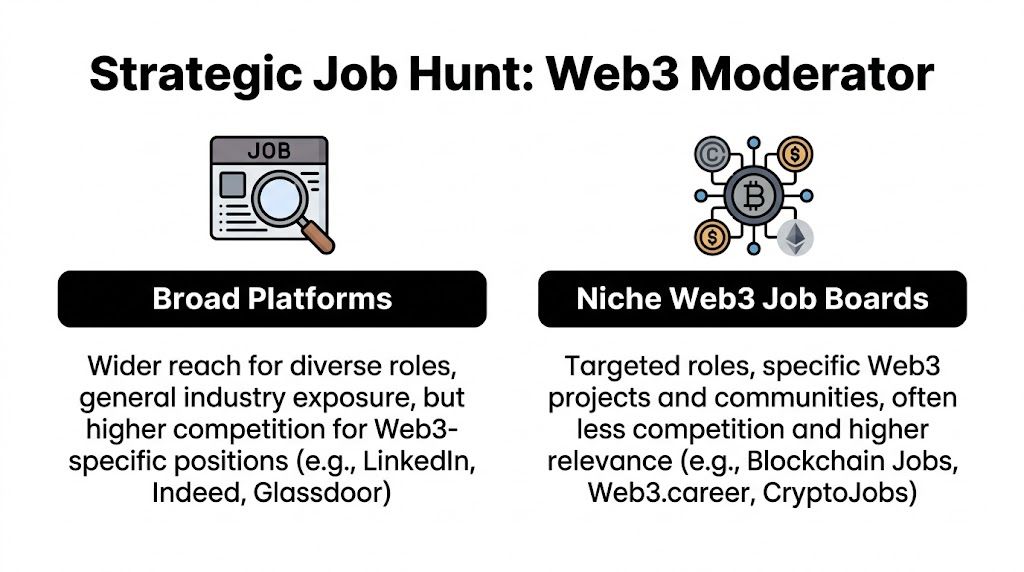
Broad boards still matter. They also come with trade-offs. Indeed shows 199 community moderator jobs, many remote, but these listings often have vague or low-end pay ranges. By contrast, specialized Web3 sources often carry a 20% to 30% compensation premium because the work involves global coverage, volatility, and crypto-specific judgment, according to online community moderator market data.
Where strong candidates actually look
Use a layered search strategy instead of a single channel.
| Channel | Best use | Main downside |
|---|---|---|
| Broad job boards | Volume and discovery | Heavy competition, weak filtering |
| Niche Web3 job boards | Better role relevance | Smaller total pool |
| Project Discords and Telegrams | Early signals, direct contact | Informal and inconsistent |
| X and Farcaster | Relationship building | Easy to look noisy or opportunistic |
| DAO contribution paths | Proof of work | Slower route to paid roles |
The hidden market matters a lot in Web3. Projects often notice moderators before they post a formal listing. If you consistently help users, write clearly, and avoid attention-seeking behavior, you become easier to trust when a role opens.
How to target, not spray
A useful application list is short and deliberate. Before applying, check these things:
- Community quality: Is the server organized, or is it unmanaged chaos?
- Team behavior: Do leads communicate clearly, or do they hide when users have problems?
- Role scope: Are they hiring a moderator, or implicitly asking for moderator, support agent, copywriter, and social lead in one package?
- Operational reality: Is the project global, always-on, and crisis-prone? If yes, can you handle that rhythm?
When you find a role you want, send value before sending a generic ask.
Weak outreach
“Hi, I’d love to work with your project. Are you hiring moderators?”
Better outreach
“Hi team, I’m active in the community and noticed recurring confusion around wallet verification and support impersonation. I’d be glad to help formalize FAQ responses or moderation coverage if you’re hiring for community ops.”
That second message shows observation, restraint, and relevance.
Framing your experience for the right jobs
You don’t need a perfect past title. You do need sharp language.
Before: “Moderated Discord chats.”
After: “Managed user questions, escalated wallet and access issues, and maintained chat hygiene during high-attention announcements.”
Before: “Helped with Telegram.”
After: “Supported Telegram moderation, answered onboarding questions, and redirected risky support requests away from private messages.”
If you want a live benchmark for how Web3 teams package related responsibilities, reviewing a role like this DeFi community manager and social media lead opening helps you see where moderation ends and broader community ownership begins.
A good search doesn’t start with “Where are the jobs?” It starts with “Which teams actually need my kind of judgment?”
That shift improves both your hit rate and the quality of offers you get.
Crafting an Application That Stands Out
Most moderation applications fail because they sound interchangeable.
They’re full of lines like “passionate about community,” “strong communication skills,” and “experienced with Discord and Telegram.” None of that is wrong. It’s just too weak to win.
Hiring managers want evidence that you can handle live environments, edge cases, and repetitive work without losing your head.
Turn activity into professional proof
A resume for community moderator jobs should sound operational. Focus on actions, environments, and outcomes you can describe accurately.
Here’s the difference.
| Weak bullet | Better bullet |
|---|---|
| Moderated a Discord server | Moderated daily Discord discussions, removed malicious links, answered recurring onboarding questions, and escalated unresolved issues to the core team |
| Helped users in Telegram | Supported Telegram users with verification and access questions while reinforcing anti-scam guidance in public channels |
| Managed community engagement | Helped keep discussions constructive during announcements, AMAs, and periods of high speculation |
If you’ve never held the title before, use adjacent work.
How to map related experience
Customer support, social media, creator moderation, live ops, and forum management all translate well if you describe them correctly.
- From customer support: “Resolved user issues under time pressure, documented recurring problems, and maintained a calm tone during frustrated interactions.”
- From social media: “Handled public-facing responses, recognized escalation risks, and adjusted messaging for different audience knowledge levels.”
- From gaming or creator communities: “Enforced rules consistently, recognized bad-faith behavior early, and balanced participation with moderation authority.”
Don’t write like you’re asking for a chance. Write like you already understand the work and are offering reliable execution.
What to put in the cover note
A strong cover note is short. It should do three things:
- Show you understand the project.
- Show you understand the risk profile of the role.
- Show how your experience fits that environment.
A useful structure:
- Opening: One sentence on why this project specifically makes sense for you.
- Middle: Two or three concrete examples of moderation, support, safety, or communication work.
- Close: One sentence on the kind of community problems you’re ready to help solve.
Good applications sound specific without pretending. If you helped a DAO proposal discussion stay readable, say that. If you handled scam attempts in a fast-moving Telegram, say that. If you built FAQ threads because the same questions kept appearing, say that.
The point isn’t to sound impressive. It’s to sound employable.
Acing the Interview and Negotiating Your Offer
Web3 moderation interviews are usually less formal than corporate interviews and more revealing.
A hiring manager may not ask polished behavioral questions. They might ask what you’d do if fake admins appear during a token launch, or how you’d answer a confused user asking why staking rewards changed. That’s good news if you’ve done the work. The role is practical, so your answers should be too.

Questions you should be ready for
Expect some version of these:
- How would you handle a coordinated FUD attack?
- How do you explain tokenomics to a newcomer without oversimplifying?
- What would you do if a user reports a scam link that several members already clicked?
- How do you balance free discussion with rule enforcement?
- How do you work across time zones and handoffs?
A strong answer usually has four parts:
- Assess the issue
- Act in public where needed
- Escalate privately where needed
- Document what happened
For FUD, don’t say you’d “shut it down.” That sounds insecure. Say you’d separate valid concerns from rumor, provide the approved source of truth, redirect support issues into the right channel, and watch for coordinated manipulation or impersonation.
For tokenomics, don’t perform expertise. Translate clearly. If the project has staking, governance, emissions, vesting, or rewards mechanics, explain them in plain language and say when you’d defer to official docs or the core team.
What interviewers are actually testing
They’re testing whether you create trust under pressure.
That means they’re listening for judgment, tone, and boundaries. Can you stay calm without sounding passive? Can you be helpful without making unsupported claims? Can you protect the project without becoming defensive?
If you answer every scenario like a security guard, you’ll sound rigid. If you answer every scenario like a hype person, you’ll sound unsafe.
The best candidates sound measured.
How to negotiate without underselling yourself
Compensation in moderation varies sharply by context. The median salary for a general Online Community Moderator is about $41,361 annually, while Lead Content Moderator roles can reach $50,000 to $54,000, and fully remote Web3 community roles often fall in the $55,000 to $85,000 USD range, according to salary data for online community moderation roles.
Use that range as orientation, not as a script.
If you’re negotiating a Web3 role, discuss more than base pay:
- Scope: Are you covering moderation only, or also support, reporting, AMAs, and documentation?
- Hours: Is the role shift-based, weekend-heavy, or effectively always on?
- Compensation mix: Is part of the package salary, contractor pay, token allocation, or another crypto-native structure?
- Authority: Can you enforce policy, or are you responsible without decision rights?
A practical negotiation line sounds like this:
“I’m aligned with the role and interested. Given the scope across moderation, user education, and scam prevention in a Web3 environment, I’d like to discuss compensation in line with specialized remote community roles.”
That’s firm without being theatrical.
If they offer low pay for broad responsibility, ask them to narrow the role or improve the package. Don’t accept a title mismatch just because the project sounds exciting.
Your Launchpad into a Web3 Career
Community moderator jobs are one of the clearest entry points into Web3 if you approach them like a profession.
Build proof, not just enthusiasm. Learn the tools people use. Get comfortable with AI-assisted workflows, token-gated communities, and scam-heavy environments. Target better opportunities instead of mass applying. Then show up to interviews like someone who already understands the operating reality of the role.
If you want a sense of where this path can lead, look at roles such as director of social and community at Ripple. That’s the long game. The first step is becoming the moderator teams can trust when the room gets noisy.
If you're ready to move from volunteering in crypto communities to getting paid for real Web3 work, explore open roles on Blockchain Jobs. It’s a focused way to find community, operations, support, and growth opportunities across the ecosystem without digging through broad job boards that barely understand the space.