Consensus Crypto Event: Your Career and Hiring Guide
You're probably looking at Consensus with two goals at once. You want the signal on where Web3 is going, and you also want to know what that signal does to your next interview, your next hire, or your recruiting pipeline. Most coverage stops at the keynote themes. The more useful question is what changes after the room clears, who gets hired, who gets introduced, and which teams suddenly have a better reason to talk.
For engineers, marketers, legal and compliance specialists, founders, and recruiters, the Consensus crypto event is less of a stage show and more of a market-matching system. The people who get the most value usually treat it like a working week compressed into three days, with meetings, demos, and candidate conversations layered on top of the programming. If you're job hunting, that means reading the agenda like a map of hiring demand. If you're hiring, it means seeing the conference as a dense, temporary talent pool.

Beyond the Hype What Consensus Means for Your Career
The usual mistake is to treat Consensus like a news cycle event. People chase headlines about market structure, AI, tokenization, or regulation, then leave without translating any of it into career moves. That's a missed opportunity, because the event's real value shows up in the hiring conversations that happen around those themes, not just on the microphones.
The clearest career signal comes from how the event has been framed publicly. Coverage of Consensus rarely answers what roles open up after the conference, but the event's own framing for 2026 emphasized that Consensus was about “infrastructure solidifying”, which points to hiring demand across protocol, infrastructure, and enterprise-facing roles rather than just headline-grabbing narratives as noted in the event framing. That shift matters because the best jobs in this market often appear where systems are becoming more durable, compliance-heavy, and productized.
Practical rule: If a session sounds exciting but doesn't change who you can meet or what job families you can target, it's probably not your highest-value hour.
That's why the career lens changes how you evaluate the conference. A founder may care about product narrative, while a recruiter cares about role clustering, and a candidate cares about where the strongest hiring conversations are likely to happen. Those are different outcomes, and Consensus rewards the people who pick one outcome and organize around it.
If you're actively job searching, focus less on being seen and more on being remembered. Bring a clear skill summary, a recent project, and a short explanation of the type of team you want to join. Then use the event to test whether the market is looking for that profile.
For a quick way to audit companies before you go, keep a shortlist of relevant employers in Blockchain Jobs company listings. That gives you a practical way to identify who's active before you start booking meetings.
Understanding Its History and Industry Significance
Consensus didn't become important because it was fashionable. It became important because it repeatedly turned into the place where the industry's working relationships were formed. In 2015 in New York City, CoinDesk reported that the event drew more than 1,000 attendees from across the Bitcoin and blockchain ecosystem, and the agenda already showed a field stretching from Bitcoin to blockchain infrastructure, regulation, and enterprise adoption Coinbase's archive of the early meetup. That mix tells you a lot about why the conference took hold so quickly.
At that stage, the event wasn't just a conference. It was a signaling mechanism for the U.S. crypto market. Product announcements found an audience, investors met founders in one place, and people looking for their next move could see where the industry was pulling talent next. The more the agenda broadened, the more the event started to look like a labor market for Web3 as much as a conference.
Why the early years still matter
The historical lesson isn't trivia. It's that Consensus has always tracked the movement from curiosity to infrastructure. When a conference becomes the place where technical, regulatory, and commercial conversations all happen in the same corridor, hiring follows that convergence. New specialties open up, and the people who understand adjacent functions usually move fastest.
That pattern helps explain why old attendees often describe the event in career terms. A founder wants partners, a candidate wants exposure, and a recruiter wants a room full of people who already speak the language of the industry. Consensus has been valuable for all three because it consistently sits near the point where ideas, capital, and jobs meet.
The practical takeaway is simple. When the agenda widens, your opportunity set widens too. If you're a smart contract engineer, a marketer, a compliance lead, or a recruiter, the conference history tells you that the event's usefulness isn't limited to the stage. It's in the density of cross-functional conversations that follow the stage.
That's also why the event has kept its reputation. It's not just that people show up. It's that people show up with reasons to hire, get hired, and move faster than they would through normal channels.
Decoding the Agenda for Career Opportunities
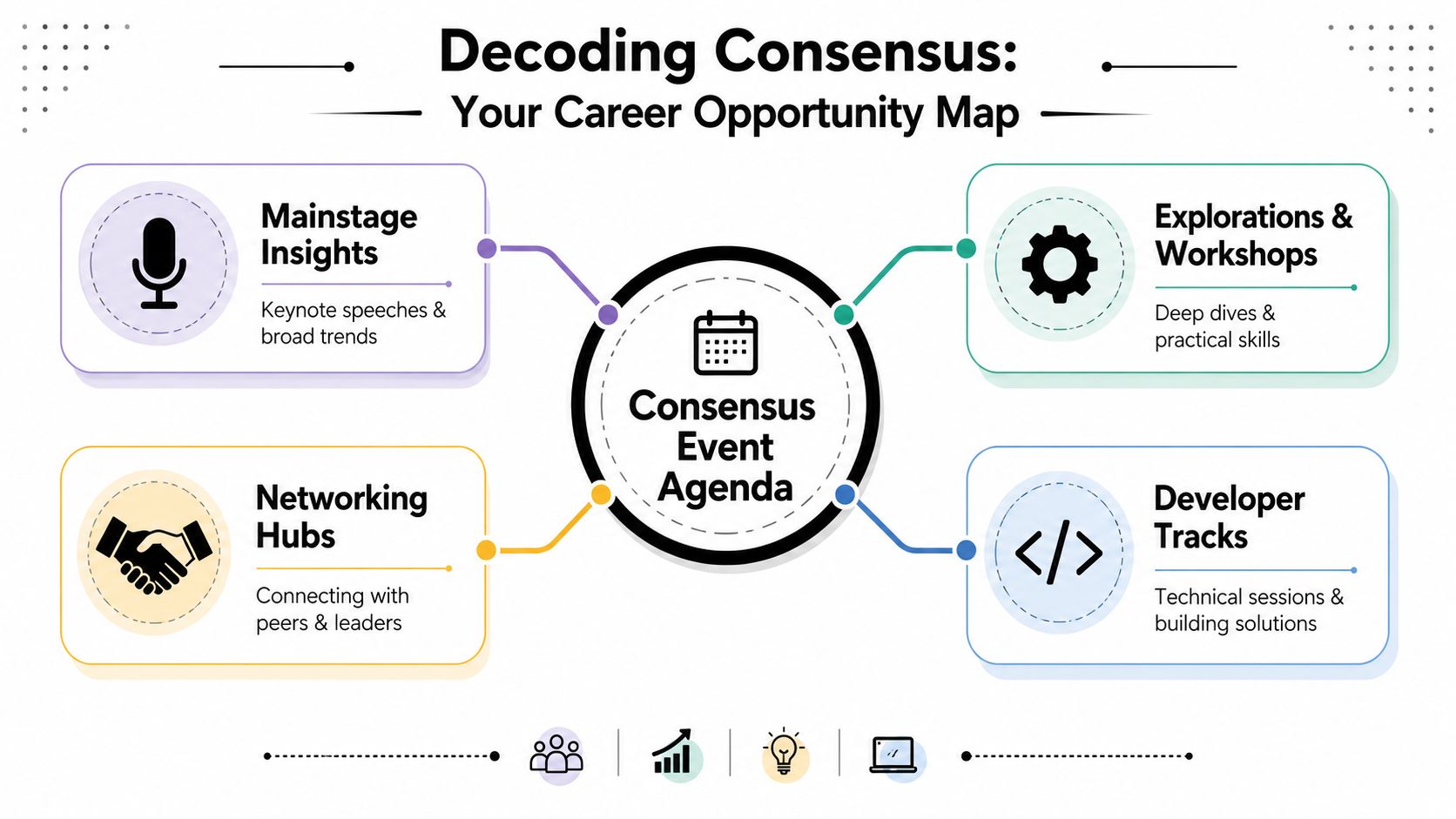
Consensus works best when you stop treating the agenda as a list of talks and start treating it as a routing system for talent conversations. The event is structured around a Mainstage, a Summit Stage, an Explorations Stage, plus Hackathon and PitchFest formats, and that mix shortens the feedback loop between protocol design, product-market fit, and funding Consensus 2026 structure overview. If you're job hunting or hiring, that structure matters more than the speaker title.
Match the stage to the role
The Mainstage is where broad market shifts get framed. That's useful for executives, product leads, and recruiters who need a macro narrative, but it's less useful if you're trying to meet the person who can review your portfolio. Use it to calibrate language, not to spend your whole day there.
The Summit Stage is more targeted. With emphasis on AI, brand integration, and finance innovations, it's the right place for candidates and hiring teams in applied product, data, and commercial strategy. Legal and compliance professionals should pay attention here too, because finance-linked AI conversations often expose the governance questions that later become job openings.
The Explorations Stage is where niche topics like tokenization, quantum innovation, and space tech surface. That's where you'll hear more specialized hiring needs before they become obvious in job postings. Engineers can listen for implementation pain points, while product managers can hear which use cases are close to market.
Then there's the practical side. Hackathon settings are still one of the cleanest ways to evaluate engineering depth because you can watch how people reason under time pressure. PitchFest is different. It's where investors and operators assess whether a team can turn a concept into something legible, fundable, and shippable. That's why founders should treat it as a talent and partner discovery channel, not just a publicity lane.
You'll often learn more about a team's hiring appetite from how they ask questions than from what they present on stage.
Use that to your advantage. If you're a candidate, ask how the team is staffing for product, engineering, or go-to-market changes tied to whatever theme they're discussing. If you're a recruiter, ask what roles they've already identified internally and what's still missing. That gives you a much better read than polite small talk.
For a broader editorial view on how conferences like this are covered, Blockchain Jobs' blog is a useful starting point when you want to compare event narratives with real hiring needs.
Who Attends Consensus and How to Connect with Them
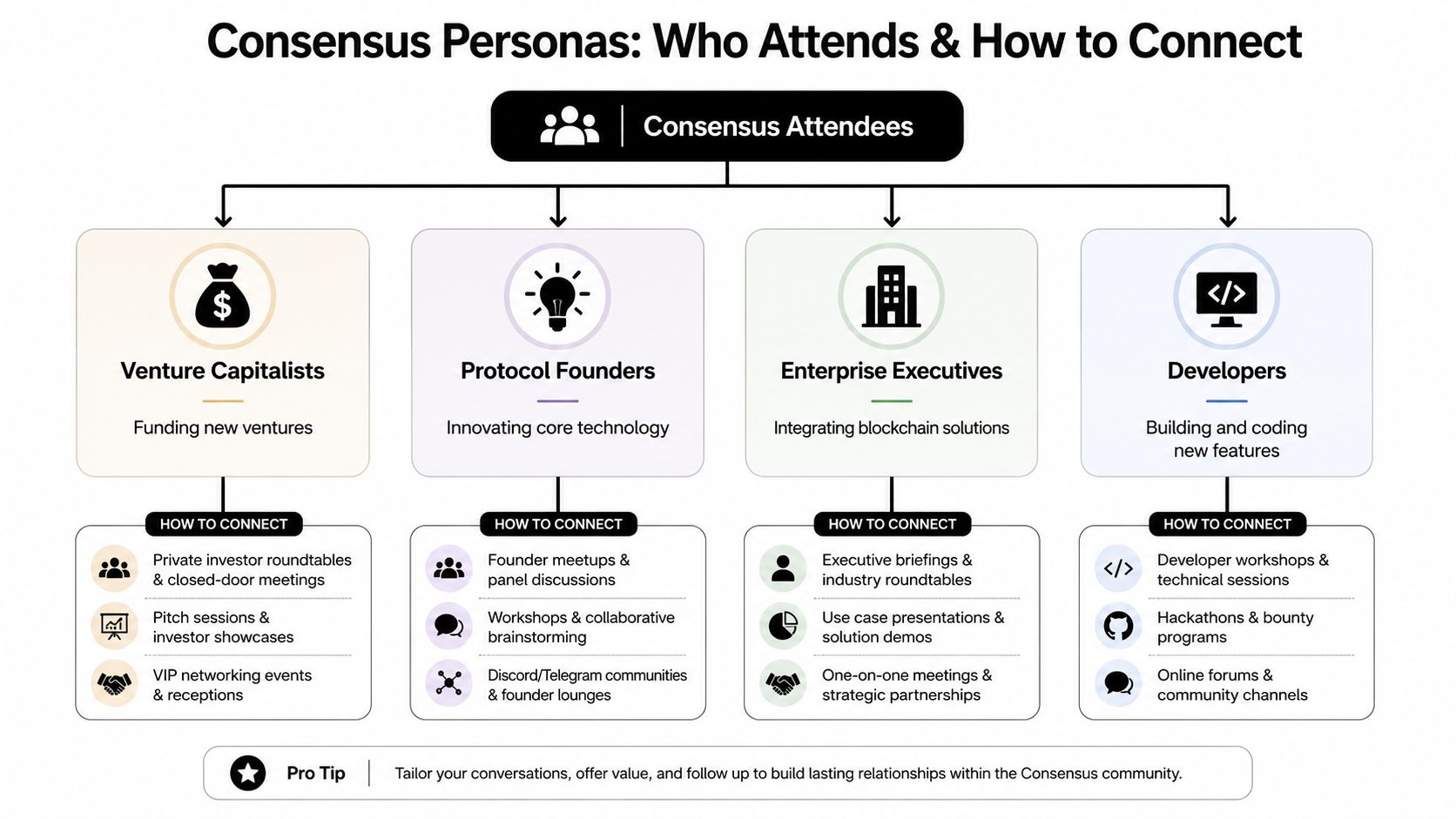
The people in the room matter as much as the agenda, and Consensus is strongest when you know who you're trying to meet. Independent coverage describes the event as hosting keynotes, panel discussions, exhibitions, startup showcases, workshops, and community side-events, with programming that repeatedly covers DeFi, NFTs, tokenization, regulation, and AI integration Conference journey guide. That mix pulls in very different attendee types, each with their own incentives.
Read the room by persona
Venture capitalists are usually there to spot momentum early. They want to hear whether a team is solving a painful problem, whether the market is already pulling, and whether the founders can explain the edge clearly. Keep your first conversation tight, and don't lead with a broad pitch. Lead with a sharp thesis and one piece of proof.
Protocol founders tend to care about technical credibility. If you're an engineer, speak in terms of trade-offs, failure modes, and what you've built that runs. If you're non-technical, ask thoughtful questions about architecture, distribution, or developer adoption instead of pretending to be the expert.
Enterprise executives are usually looking for integration paths. They respond well to examples that show security awareness, implementation discipline, and an understanding of procurement or compliance friction. If you want a follow-up, frame your message around a specific business problem they mentioned.
Developers are often the easiest people to meet and the hardest to impress. They can spot fluff instantly. Talk about tooling, debugging, deployment, or open-source work. If there's mutual interest, move quickly to a repo, a portfolio, or a direct technical conversation.
Make the first follow-up count
The best networking move is not asking for a job in the first minute. It's asking a question that makes the other person reveal what they care about. A good opener might be, “What type of role are you hiring for most urgently right now?” or “What part of your stack is still hardest to staff?” That tells you whether the conversation is worth continuing.
Then use the room to create next steps. A short hallway chat can become an informational interview if you reference one specific point they raised. A candidate introduction can become a formal application if you ask who owns the hiring process. A recruiter conversation can become a pipeline lead if you ask what profile is hardest to find.
The key is to move from generic interest to specific relevance fast. People remember the person who connected their work to a real need.
Key Themes and Speakers to Watch in 2027
Consensus 2027 is being positioned around “Internet Capital Markets”, with a focus on institutional liquidity, real-world asset tokenization, and AI integration. The event is expected to bring together over 15,000 global leaders to coordinate on standards for tokenized securities and policy regimes like MiCA and FIT21 KuCoin's preview of Consensus 2026 positioning. For career planning, that combination is a hiring signal, not just a theme list.
What those themes imply for talent
Institutional liquidity usually pulls in people who understand market structure, operations, and risk. If you work in product or strategy, that means the strongest candidates will likely have some blend of finance literacy and blockchain fluency. If you're a candidate, you should be ready to show that you can speak to both, not just one side.
RWA tokenization is especially important for hiring because it sits at the intersection of smart contracts, legal design, custody, and distribution. That means companies will value engineers who understand financial systems, but also lawyers and compliance professionals who can translate regulatory expectations into deployable product rules. It also puts a premium on operators who can coordinate across teams without slowing execution.
AI integration points to a different set of openings. Expect more interest in data-oriented roles, applied machine learning, and product people who can bridge user experience with automation. For recruiters, title matching becomes tricky, because the best-fit candidates may not have “Web3” in every role they've held, but they might have the right technical pattern for the next phase.
The policy layer matters too. Whenever MiCA or FIT21 enter the conversation, legal and compliance professionals move closer to the center of hiring. Teams need people who can help them list, launch, or scale without walking blind into avoidable risk. That's a structural need, not a temporary buzzword.
For a broader view of speaker ecosystems and event-facing operators, Discover leading corporate event speakers is worth bookmarking. It's useful context when you're comparing who tends to show up at high-signal conferences and what type of room they help create.
The practical move is to watch for job clusters around these themes. If a company is repeatedly discussed around tokenization, liquidity, or AI, that's a cue to investigate open roles in product, engineering, legal, and partnerships. The theme tells you where hiring pressure is likely to concentrate.
Actionable Networking and Preparation Tips
The people who get the most out of Consensus don't arrive hoping for luck. They arrive with a plan, a list, and a clean way to talk about themselves. Since Consensus is scheduled for May 4–6, 2027 at the Miami Beach Convention Center in Miami official event details, hiring teams and job seekers can plan travel, recruiter meetings, and interview windows around a concentrated market for crypto talent.
Pre-event setup
Start with your pitch. You need a version that says who you are, what you build, and what kind of team you want next. Keep it short enough that a busy recruiter can repeat it later without rewriting it.
Then research the people and companies you want to meet. Don't just target the loudest names. Target the teams whose current work overlaps with your skills, because those are the conversations most likely to turn into real next steps. If you want a useful external guide for refining that process, practical steps for job networking is a solid companion resource.
Before you leave, set three goals. One can be learning-focused, one can be contact-focused, and one can be outcome-focused. That keeps the trip grounded when the room gets busy.
- Research Speakers and Attendees: Identify the people who are most relevant to your target role, then build a meeting list before you arrive.
- Set Clear Networking Goals: Decide whether you want intros, interviews, partnerships, or market intelligence.
- Prepare Your Elevator Pitch: Keep it concise, concrete, and specific to the kind of work you want.
- Utilize the Event App: Use digital scheduling early so you're not trying to book meetings in the hallway.
- Map Your Targets: Review U.S.-based crypto jobs if you're open to roles that could move quickly after the event.
On-site execution
Once you're there, schedule your day around overlap, not volume. Two strong conversations are better than six forgettable ones. Use side-events for deeper conversations, because the formal schedule can be too compressed for meaningful hiring discussions.
QR code sharing helps, but only if the conversation already has substance. A contact card exchange without context is easy to forget. If you want a real follow-up, note the topic you discussed, the role they mentioned, or the project they're building.
The best event follow-up starts before the event ends. Write the key detail down while the conversation is still fresh.
Remote participants can still do well if they use the same discipline. Join discussions live, message people quickly, and send brief follow-ups while the topic is still active. The point isn't to be physically everywhere. It's to be memorable in the conversations that matter.
Turning Conference Connections into Career Momentum
The work starts after the conference, not at the badge pickup desk. Many attendees leave with a stack of contacts and then let them sit untouched. That's why so many conference conversations never become interviews, referrals, or hires. The person who follows up well usually wins the long game.
Your first message should be specific. Mention where you met, what you discussed, and why you're reaching out now. Keep it short, and make it easy for the other person to reply. If you're asking for a referral, be direct only after there's a clear fit. If the relationship is newer, ask for an informational interview first.
For recruiters, the same rule applies in reverse. Don't file candidates away after the event. Segment them by function, readiness, and relevance, then send targeted follow-ups while the conversation is still warm. A fast, relevant message is much more effective than a generic “great to meet you” note.
Practical rule: The goal after Consensus isn't to stay in touch with everyone. It's to continue the few conversations that clearly match a hiring need or a career move.
A simple rhythm works well. Send the first follow-up within a day or two. Add value in the second touch, maybe a link, a role description, or a note about a team you think fits. If there's still mutual interest, move toward a call, an application, or a referral conversation. Don't drag it out.
Consensus is strongest when you treat it as the start of a hiring cycle, not a one-off appearance. If you're a candidate, the event gives you a reason to re-enter the market with better context. If you're a recruiter, it gives you a concentrated way to build pipeline. If you're a founder, it gives you a room full of people who can help you hire the next phase of the company.
A CTA for Blockchain Jobs.