continuous improvement manager salaries: 2024 Pay Guide
When you walk into a salary negotiation or a job interview, knowing the numbers is your biggest advantage. For Continuous Improvement Managers, the average salary in the United States hovers right around $100,180 a year. The top pros in the field? They're pulling in up to $136,000.
Think of that average as your starting point. What you actually earn will come down to your track record of delivering results, where you are in your career, and how well you can articulate your value during the hiring process.
Breaking Down the CI Manager Salary Landscape
A Continuous Improvement Manager is essentially a business's efficiency coach. Their whole job is to spot the weak links in a process, cut out the waste, and get things running smoother and smarter. Because this role directly pumps up the bottom line, the pay is competitive and often reflects the results you can deliver.
Whether you're looking to land your first CI Manager role or you're a hiring manager trying to attract top talent, getting a handle on these salary benchmarks is square one for any successful negotiation.
How Experience Shapes Your Paycheck
More than anything else, experience dictates your salary. When you're just starting, you're likely focused on smaller projects and supporting senior team members. To progress, you need to show you can lead major, company-wide changes. Your compensation will naturally follow the scale of your impact.
This isn't just theory; the data backs it up. We can see a clear path for career progression as CI Managers build their skills and prove their worth with tangible results.
Here’s a quick look at how compensation tends to scale with experience, giving you a roadmap for your career:
Continuous Improvement Manager Salary by Experience Level
| Experience Level | Average Annual Salary |
|---|---|
| Entry-Level (0-1 years) | $74,574 |
| Early Career (1-4 years) | $85,000 |
| Mid-Career (5-9 years) | $102,000 |
| Experienced (10-19 years) | $115,000 |
| Senior/Veteran (20+ years) | $125,000+ |
As you can see, jumping from an entry-level position to one with just a few years of solid wins under your belt brings a significant pay bump. This is a clear return on the investment you make in your expertise and a powerful point to bring up during performance reviews or when interviewing for a more senior role.
From a hiring perspective, a well-designed compensation plan does more than just attract people—it keeps them motivated. For a deeper dive into crafting offers that resonate, you might find it useful to see how a global compensation and benefits specialist approaches this. The core idea is the same: building a package that reflects true value and career potential.
How Location and Experience Shape Your Paycheck
Think of your career as a Continuous Improvement Manager like a journey. Where you are on that path—and where you are on the map—are the two biggest factors determining what you’ll earn. For job seekers and hiring managers, these elements don't just nudge the numbers a bit; they create completely different pay brackets.
If you're charting out your next career move, getting a handle on this is essential. A manager running their first small-scale Kaizen event simply won't have the same salary expectations as a seasoned pro who has saved a company millions by rolling out complex Six Sigma projects—and you need to be ready to discuss that impact in an interview.
The Career Progression Pay Scale
As you gain more experience, your salary should naturally grow to reflect the greater impact you have on the business. An entry-level manager is still learning the ropes, but a senior manager is expected to steer the ship, making strategic calls that influence the entire organization.
This chart gives you a clear picture of the salary jumps you can expect as you move up the ladder. Use it to benchmark your own career progress.
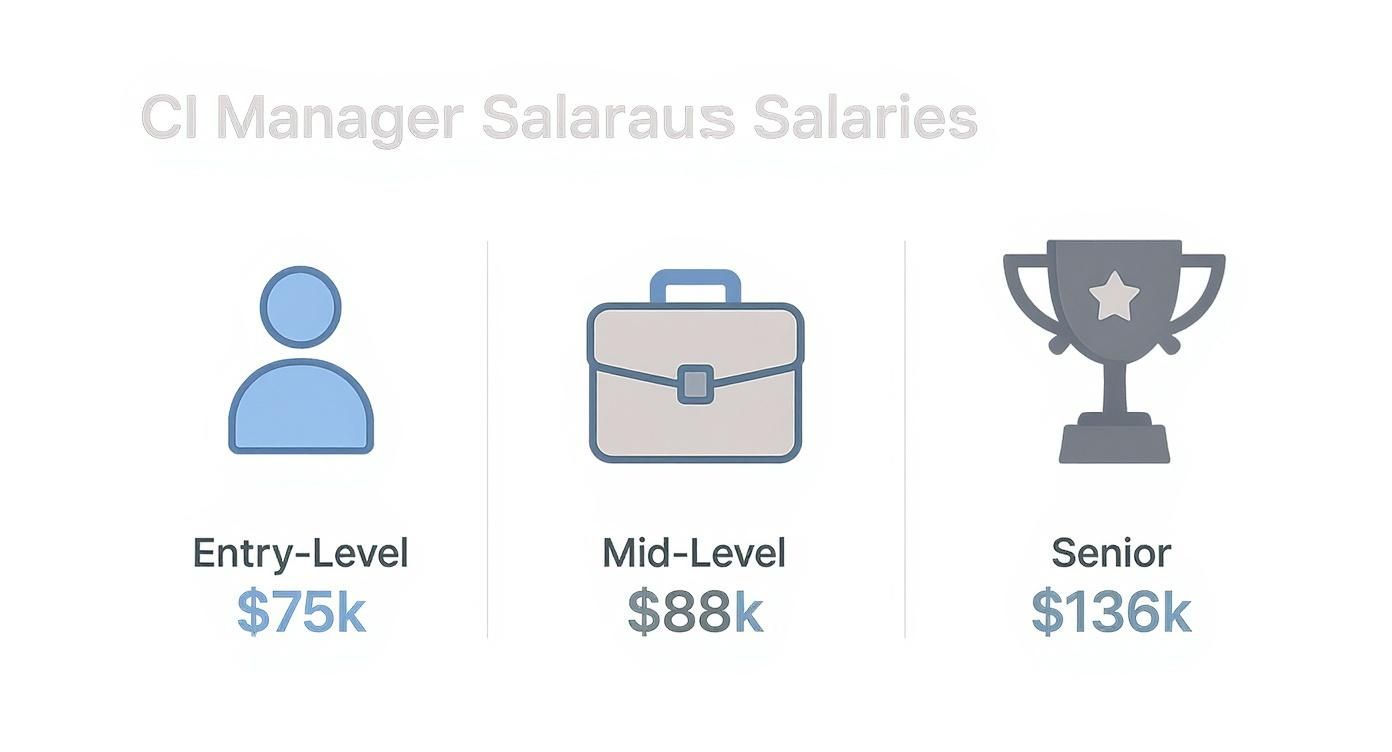
The numbers speak for themselves. Hitting a senior level can nearly double your starting salary, which is a powerful incentive to stick with it and grow in this field.
Location: The Other Side of the Coin
Where you work is just as important as how long you've been working. It's no secret that a high cost of living in a major city like San Francisco or New York means companies have to offer higher salaries to attract top talent. For job seekers, this means targeting roles in high-paying areas can be a strategic career move.
The differences can be pretty stark when you look at the global picture.
Global Salary Snapshot for CI Managers
The table below offers a glimpse into how salaries for Continuous Improvement Managers can vary significantly from one major city to another, reflecting local economic conditions and demand.
| City/Region | Country | Average Annual Salary (Local Currency) |
|---|---|---|
| United States | USA | $118,804 USD |
| London / Manchester | United Kingdom | £51,500 GBP |
| Sydney | Australia | AUD 169,251 |
| Toronto | Canada | C$101,000 CAD |
| Berlin | Germany | €78,500 EUR |
As you can see, a manager in Sydney might earn a numerically higher salary than one in London, but currency values and cost of living play a huge role. It’s a reminder that a simple currency conversion doesn’t tell the whole story. For a deeper dive into these numbers, you can explore more insights on KnowledgeHut.com.
Expert Tip: Before any interview, stop looking at national salary averages. Get granular. Research the typical pay for your role in that specific city or region. Walking in with this knowledge shows you're prepared and lets you anchor your negotiation in reality, not guesswork.
Understanding these factors isn't just about chasing a bigger paycheck—it's about ensuring you're compensated fairly for the value you deliver in a particular market. For hiring managers, this works both ways; knowing your local pay scales is crucial for writing competitive offers. Even in a remote-first world, companies often use location-based salary bands to adjust compensation, which you can see in postings like this 100% remote Talent Sourcer position.
The Skills and Certifications That Boost Your Salary

While your years of experience and location lay the groundwork for your pay, it's your specific skills and certifications that really make you stand out in an applicant pool. Think of it this way: your resume is the blueprint, but these qualifications are the high-spec materials that prove you can deliver a top-quality result. They're what justify a premium salary during a negotiation.
When a hiring manager sees a credential like a Lean Six Sigma certification on your resume, they don't just see another acronym. They see a standardized toolkit for cutting waste, optimizing workflows, and delivering tangible financial gains. That alone puts you in a different league from other candidates.
Certifications That Command Higher Pay
Not all credentials carry the same weight. Some are universally recognized as the gold standard, and they have a direct, positive impact on what you can expect to earn. If you're looking for the fastest way to boost your salary potential, investing in one of these is a smart career move.
Here are the heavy hitters that companies consistently pay more for:
- Lean Six Sigma Green Belt: This is a fantastic starting point for your career. It shows you understand the fundamentals and can be a valuable contributor to improvement projects, opening the door to better-paying opportunities.
- Lean Six Sigma Black Belt: Earning your Black Belt proves you can lead complex, high-impact projects on your own. It's a serious credential that hiring managers look for, and professionals who hold it often command a salary 15-20% higher than their peers.
- Lean Six Sigma Master Black Belt: This is the top of the mountain. It signals that you’re not just a leader, but a mentor who can train other Black Belts and shape an entire organization's improvement strategy. This credential qualifies you for the highest salary brackets and leadership roles.
- Project Management Professional (PMP): Though not strictly a continuous improvement cert, the PMP is incredibly valuable. It demonstrates mastery over scope, budget, and timelines—all non-negotiable skills for successfully rolling out major changes.
Investing in a Black Belt or PMP isn't just about what you learn; it's about building a business case for your value. It lets you walk into an interview and say, "My Black Belt training helped me lead a project that cut production defects by 30% and saved the company $250,000 a year."
How Industry and Company Size Change the Game
Of course, where you apply your skills matters. A huge manufacturing firm with a tangled global supply chain will pay top dollar for a CI manager who can find even tiny efficiencies, because those small savings quickly multiply into millions.
On the other hand, a high-growth tech startup is desperate for someone who can build scalable processes from scratch before chaos takes over. They'll also pay a premium for that expertise. The ability to implement new systems in a fast-paced environment is critical, which is why you see roles like this Implementation Manager at Coastal Community Bank pop up, where structured execution is everything.
A smaller company might not match the base salary of a giant corporation, but it could offer broader, more hands-on experience across the entire business—a great stepping stone for your career. The key is to match your best skills with the industry where they’ll make the biggest splash. That’s the most reliable path to a bigger paycheck.
Strategies for a Successful Salary Negotiation

Knowing the numbers is one thing, but walking into a negotiation and confidently asking for what you're worth? That’s the real challenge. The good news is, as a Continuous Improvement Manager, you’re already an expert at using data to drive better outcomes. It's time to apply that same skill to your own career progression.
Think of the salary benchmarks in this guide as your baseline. From here, your job is to build a rock-solid business case for yourself. The most powerful tool you have is your ability to quantify your impact. Don't just list what you did in past roles; talk about the results you delivered.
Building Your Business Case with Data
Before you ever talk numbers in an interview, get your "wins" on paper. This isn’t about being boastful; it's about presenting clear, undeniable evidence of your value. A hiring manager will always respond better to a hard number than a soft skill.
Frame your achievements around metrics the business truly cares about:
- Cost Savings: "By re-engineering the production line workflow, I cut material waste by 15%, which saved the company $200,000 a year."
- Efficiency Gains: "I led a Kaizen event that slashed order processing time from 48 to 24 hours, effectively doubling our daily capacity."
- Quality Improvement: "The new quality control checkpoint I implemented dropped product defects by 30% inside of six months."
A great negotiation isn't a fight. It's a conversation where you help the company see how your proven value aligns perfectly with what they need. You’re not just asking for money—you’re showing them that you’re a high-return investment.
Practical Scripts for Key Moments
It always helps to have a few phrases in your back pocket. Having a script ready can keep you calm and confident when the conversation gets real, whether you're in an initial interview or asking for a well-deserved raise.
During an Initial Interview
If they ask about your salary expectations early on, try to avoid being pinned down to a single number. Instead, demonstrate that you’ve done your research.
- Script: "Based on my research, a Continuous Improvement Manager role with this scope in this market typically pays between $X and $Y. With my Black Belt certification and a history of delivering six-figure savings, I'm targeting the upper end of that range."
When You Receive an Offer
First thing's first: always say thank you. It immediately sets a positive, collaborative tone for the discussion that follows.
- Script: "Thank you so much for the offer! I’m really excited about the opportunity. I was hoping for a base salary closer to $X, as I believe that better reflects my experience leading complex optimization projects. Is there any flexibility on that number?"
When you ground your negotiation in real data and proven results, you shift the dynamic. It's no longer just a request—it becomes a compelling argument that's hard to ignore. This data-driven approach gives you the leverage you need to secure the salary you’ve earned.
How Hiring Managers Can Attract Top CI Talent
In a tight market for talent, simply posting a job with a decent salary isn't going to cut it. The best Continuous Improvement professionals aren't just looking for a paycheck; they're hunting for problems to solve and an environment where they can make a real, measurable impact. To attract them, you need to frame the role around that central desire.
First, get the compensation right. Recent data shows the average continuous improvement manager salary in the US hovers between $107,000 and $111,000. But that’s just a starting point.
Geography plays a huge role. For instance, you’ll see averages jump to $143,038 in places like Goleta, California, while a city like Seattle is closer to $118,685. Knowing these numbers helps you build a competitive baseline. You can dig into a full geographical breakdown on Indeed.com's salary analysis to make sure your offer is in the right ballpark.
Crafting an Offer That Stands Out
Once you’ve nailed the base salary, the real work begins. Top-tier candidates are motivated by results, so their compensation should reflect that. A vague "annual bonus" is forgettable. A well-defined, performance-based incentive is a challenge they'll want to take on.
The trick is to directly connect their work—the efficiencies they create, the waste they eliminate—to their take-home pay. This proves you understand their value and its direct contribution to the bottom line.
Hiring Manager Tip: Ditch the generic "bonus potential" line in your job descriptions. Be specific. Try something like this: "Eligible for a performance bonus of up to 20% of base salary, tied directly to achieving predefined cost-saving and efficiency targets." This transforms a bland corporate perk into a tangible goal that attracts high-performers.
A truly compelling offer package should be built on three pillars:
- An Impact-Focused Job Description: Don't just list responsibilities. Frame the role around the strategic challenges they'll get to own and the autonomy you'll give them to solve them.
- Outcome-Based Bonuses: Tie incentives to the KPIs that matter. Think in terms of a percentage reduction in waste, measurable improvements in cycle time, or documented cost savings.
- A Clear Path for Growth: Show them what success looks like and where it leads. High achievers need to see a future with your company, not just a job for today.
When you build an offer that emphasizes impact, growth, and clear financial rewards for success, you're speaking their language. You’re not just filling a position; you’re attracting a partner who will be aligned with your company's goals from their very first day.
The Future of CI Roles in Web3 and Tech
The core ideas of Continuous Improvement—wiping out waste, cranking up efficiency, and refining workflows—are finding surprisingly fertile ground in high-growth tech. As fast-moving sectors like Web3, blockchain, and AI start to mature, they're running headfirst into the same operational snags that manufacturing giants solved decades ago. This is creating a huge career opportunity for CI experts.
Tech companies are waking up to a hard truth: a brilliant algorithm is only as strong as the processes holding it all together. This has opened a new world of high-paying career paths that mix classic CI methods with tech savvy. For any CI pro looking for their next move, this is the new frontier.
From the Factory Floor to the Blockchain Protocol
The skills that make you a great CI manager on a factory floor are the exact same ones needed in tech, but the application is entirely different. Instead of untangling a physical supply chain, you might be streamlining a decentralized governance vote or hunting down inefficiencies in a smart contract.
These new roles often fly under different banners, but at their heart, they are pure Continuous Improvement. They also command premium salaries because they solve complex problems in emerging industries.
Here’s a look at what these evolving positions look like in the wild:
Process Optimization Lead (DeFi): This person is laser-focused on making decentralized finance (DeFi) protocols work better. They might analyze transaction data to find ways to lower gas fees or redesign an onboarding flow to boost user adoption. Their work directly impacts growth and profitability.
Decentralized Operations Manager (DAO): Inside a Decentralized Autonomous Organization (DAO), community governance is everything. This manager brings CI principles to the chaos, streamlining how proposals are made, votes are cast, and treasury funds are managed, ensuring the DAO can function effectively.
AI Workflow Specialist: This role is all about the A-to-Z process of building and launching AI models. They spot bottlenecks in data pipelines, optimize resource usage for machine learning, and create playbooks to ship new models faster.
The key takeaway is this: Web3 and AI companies are desperate for people who can bring structure to their explosive growth. They have the engineering talent, but they often lack the systematic, process-driven mindset that is second nature to a CI professional. This is a gap you can fill.
Making the leap into one of these roles is a brilliant career move. It lets you take your proven CI toolkit and apply it in a world that’s not only moving at light speed but also has the venture capital backing to pay top dollar for operational mastery. If you're looking to maximize your continuous improvement manager salary, tech is where you need to be.
Answering Your Top Questions
Let's cut right to the chase. When you're considering a career as a Continuous Improvement Manager, or looking to hire one, the numbers matter. Here are some straight answers to the questions I hear most often from professionals navigating this career path.
Think of this as your cheat sheet for your next interview or hiring decision.
What’s a Realistic Starting Salary?
If you're just starting out in a CI role, a good ballpark figure is $65,000 to $80,000. At this stage, you're likely supporting smaller projects and learning the ropes from more seasoned managers.
In an interview, don't just say you have the skills. Talk about any school projects or internships where you performed process mapping or data analysis. Proving you have foundational experience, even if it's academic, will make you a much stronger candidate and help you negotiate at the higher end of the entry-level range.
How Can I Get a Pay Bump, Fast?
Want the quickest path to a higher salary? Get certified. Earning a Lean Six Sigma Black Belt is the single most effective move you can make. It's not just a piece of paper; it tells employers you're ready to lead complex, high-stakes projects on your own. This credential alone can justify a salary 15-20% higher than what your non-certified colleagues are making.
Here's a pro tip for your next interview: Don't just list your certification. Frame it around results. Instead of saying, "I'm a Black Belt," try this: "My Black Belt training gave me the tools to lead a project that slashed production defects by 30%, which saved my last company $250,000 a year." See the difference?
Do I Absolutely Need an Engineering Degree?
Nope. While an engineering background is pretty common, especially in manufacturing, it's definitely not a deal-breaker. I've seen incredibly successful CI managers come from business, operations, and supply chain backgrounds.
What really matters to a hiring manager is your mindset. Can you break down a problem logically? Do you use data to make decisions? In your interview, be prepared with examples that showcase this analytical approach, regardless of your degree. That's far more valuable than the specific title on your diploma.
Which Industries Offer the Best Pay?
If you're looking for top dollar, go where efficiency has the biggest impact on the bottom line. The highest-paying CI roles are typically found in:
- Manufacturing: A tiny tweak on a production line can translate into millions in savings.
- Healthcare: Making patient workflows more efficient directly improves care and cuts massive operational costs.
- Technology & Web3: In this space, you're not just tweaking old systems; you're building scalable processes from scratch, which is crucial for explosive growth.
In these fields, your role is not seen as a cost center but as a profit driver. That value is directly reflected in your paycheck.
Ready to put your skills to work in one of today's most dynamic sectors? Blockchain Jobs is the go-to job board for professionals aiming to make an impact in the Web3 world. You can check out hand-picked roles in operations, product, and more at https://blockchain-jobs.com.