
Why Everyone Thinks Crypto Is Dead: A 2026 Career & Hiring

11.6 million cryptocurrency projects had failed by December 31, 2025, and 86.3% of all historical token failures happened in 2025 alone, according to CoinGecko's research on failed cryptocurrencies. That sounds like an obituary for the entire sector. It isn't.
It's a sorting event.
The phrase Crypto Is Dead keeps returning because people often confuse two different layers of the market. One layer is speculative tokens, many of which were always fragile. The other is infrastructure: protocols, security tooling, compliance systems, developer platforms, custody rails, analytics, and the teams that keep those systems running. The first layer can implode while the second keeps hiring.
That distinction matters most in careers. If you're choosing whether to enter Web3, stay in it, or hire into it, the right question isn't whether crypto is dead. It's which parts are dying, which parts are consolidating, and where durable jobs sit inside that shift.
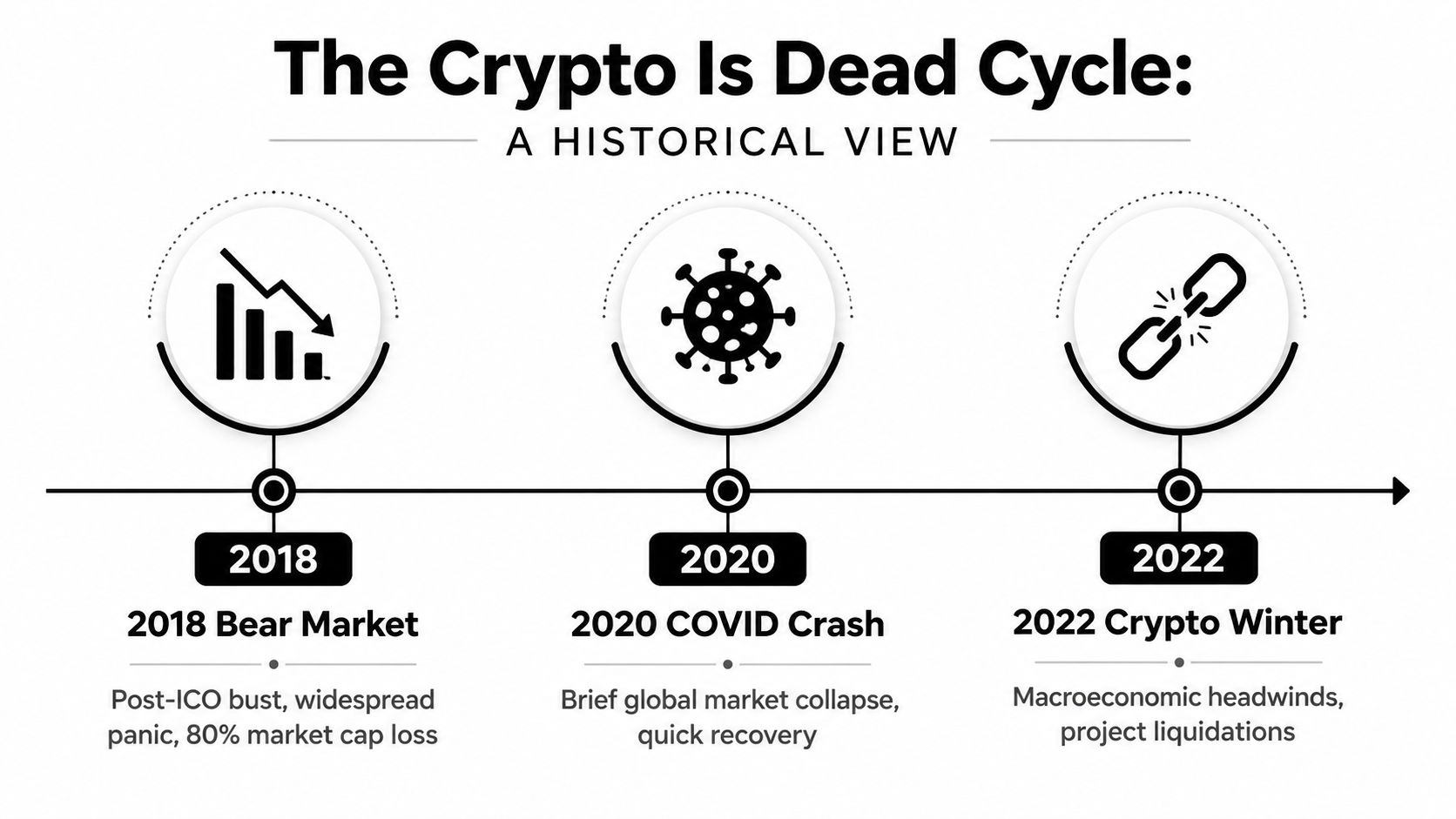
The Crypto Is Dead Cycle A Historical View
Every downturn generates the same headline. Crypto is finished. Builders are leaving. The market won't recover. Then the cycle turns, capital returns, and the teams that kept shipping during the panic suddenly look disciplined instead of early.
That pattern is why analysts should treat today's pessimism as a cycle marker, not a verdict. Market stress changes hiring behavior, budget approvals, and candidate confidence. It doesn't automatically erase long-term demand for protocol engineers, security specialists, product operators, and compliance talent.
Why the headline keeps coming back
The phrase survives because price pain is public and infrastructure progress is quiet. Retail traders see drawdowns immediately. Recruiters, engineering managers, and technical founders see a different picture: roadmaps get reprioritized, weak projects disappear, and stronger teams become more selective.
For professionals, that's a familiar labor-market pattern. Booms reward breadth. Corrections reward depth. In crypto, that usually means experience with protocol-level thinking, security reviews, smart contract testing, incident response, and systems reliability becomes more valuable than hype-driven generalism.
A useful way to track this is through technical market signals. The confirmed Death Cross pattern, where Bitcoin's 50-day moving average falls below its 200-day moving average, is bearish. But it's not a death certificate. According to this market analysis of Bitcoin's Death Cross, that signal has historically preceded consolidation, not terminal collapse, and Bitcoin has typically rebounded, with medium-term projections suggesting a 15% to 27% recovery over 2 to 3 months.
Practical rule: Hiring freezes triggered by market fear often hit speculative teams first. Infrastructure teams usually tighten standards before they stop hiring.
What that means in job markets
Candidates often make a costly mistake during downturns. They assume lower market enthusiasm means lower career value. In practice, a bear phase can improve your positioning if you use it to build scarcer skills and document real work.
Hiring managers read cycles differently. A resume from someone who shipped through ugly conditions often signals better judgment than one built entirely in euphoric markets. If you stayed close to production systems, worked through outages, handled contract upgrades, or supported users during turbulence, you've built evidence that matters in interviews.
Three implications stand out:
- Patience beats panic: If the market is in consolidation, your timeline for landing a role may stretch. Your need for technical credibility becomes more important.
- Signal quality matters more: Public GitHub work, audits, architecture writeups, and test coverage carry more weight than “Web3 native” branding.
- Cycle awareness helps in interviews: Candidates who can explain market stress without sounding ideological tend to do better with serious employers.
For professionals tracking openings and employer behavior, the best reading habit isn't doom-scrolling price feeds. It's following how teams continue to build through the noise, and watching platforms that track actual hiring activity across the ecosystem, including industry hiring analysis and commentary.
Beyond Price What On-Chain Data Really Says
Price dominates the conversation because it's easy to screenshot. It's a poor stand-in for the health of a technical ecosystem.
A better test is whether people are still using these networks for legitimate value transfer, and whether criminal usage is expanding or shrinking. On that score, the “crypto is dead” thesis weakens fast.

The signal under the volatility
In 2024, legitimate crypto transaction volume exceeded USD 10.6 trillion, up 56% from 2023, while illicit activity fell to 0.4% of total volume, according to TRM Labs' 2025 Crypto Crime Report. That combination matters more than any one-day market move.
It points to a sector that's still processing a very large amount of real activity while reducing the share tied to criminal use. For careers, that's not a minor detail. Mature usage supports stable work across compliance, payments infrastructure, custody operations, data engineering, risk systems, and enterprise product development.
Price-only narratives often fall short. A market can feel weak while networks become more operationally important. It can feel stagnant to retail traders while institutions, fintechs, and infrastructure providers push deeper into settlement, monitoring, treasury operations, and tokenized workflows.
The strongest job signal in a noisy market isn't price. It's whether companies still need engineers, analysts, and operators to support real transaction flow.
Why maturity changes the talent mix
As legitimate usage grows and illicit share drops, hiring needs shift. Early cycles rewarded evangelists and generalists. Mature cycles reward people who can reduce risk, improve throughput, and make blockchain systems usable for normal businesses.
That changes what candidates should emphasize.
- For engineers: Show that you understand production quality. Smart contract safety, indexing pipelines, wallet integrations, key management, observability, and performance tuning are more compelling than token enthusiasm.
- For product managers: Translate crypto mechanics into user outcomes. Teams need people who can simplify custody, settlement, onboarding, and compliance-heavy flows.
- For compliance and legal talent: Your role gets stronger as legitimate volume grows. Policy interpretation, transaction monitoring, sanctions workflows, and audit readiness become central capabilities.
- For recruiters and people teams: The best candidates often come from adjacent domains like fintech, cloud infrastructure, developer tools, and cybersecurity, not only from crypto-native startups.
There's also a perception gap. Crypto can “feel dead” when public attention rotates elsewhere, especially toward AI, IPOs, and large-cap tech, even while network usage remains meaningful. Serious professionals should treat that mismatch as information. It often means media attention and labor demand are moving at different speeds.
A career reading of on-chain health
If you're interviewing, don't let a falling chart define your pitch. Use the operating view instead. Explain that your interest is tied to systems with real throughput, better controls, and improving legitimacy. That tells employers you're evaluating the sector like an operator, not like a tourist.
Candidates who understand that distinction tend to sound calmer, more senior, and more useful.
The Great Misunderstanding Project Failure vs Infrastructure Survival
Crypto's mass extinction event is real. The common conclusion drawn from it is wrong.

The graveyard is real
As noted earlier, the sector has produced millions of failed tokens and an unusually large share of those failures arrived during the latest washout. That scale of failure matters. It confirms that a large portion of crypto activity was never a durable industry in the first place. It was a financing mechanism, a distribution experiment, or pure speculation wrapped in technical language.
That distinction matters for careers. A dead token and a dead capability are not the same thing. Many projects disappeared because they had weak demand, poor governance, no defensible product, or no credible path to revenue. The underlying rails often remained useful after the token around them collapsed.
This is the core misunderstanding behind the phrase “crypto is dead.” What died at scale were interchangeable projects. What remained were the systems businesses still need to run, secure, integrate, and monitor.
What tends to survive consolidation
After a speculative reset, demand usually concentrates around work that another company cannot easily replace or ignore.
| Layer | What usually remains valuable |
|---|---|
| Core protocols | Base-layer systems, scaling networks, validator operations, protocol maintenance |
| Tooling | Developer infrastructure, SDKs, indexing, analytics, wallets |
| Security | Auditing, monitoring, key management, incident response |
| Compliance and operations | Transaction screening, reporting, custody controls, treasury workflows |
That pattern changes how candidates should read the market. Counting launches or social buzz gives a poor hiring signal. A better question is whether a team supports infrastructure other firms depend on. Candidates targeting blockchain engineering roles focused on infrastructure and protocol work are generally aiming at the part of the market that survives longer than hype-driven categories.
A failed token rarely proves the underlying infrastructure had no value. It often proves the business built on top of that infrastructure could not keep users, justify fees, or survive scrutiny.
What this means for hiring and career judgment
Consolidation makes employer quality easier to assess because weak narratives lose cover. Interview loops become less about token upside and more about operating discipline.
Job seekers should press on a few specific points:
- Revenue logic: Who pays, for what service, and why now?
- Product dependence: Does the company provide infrastructure, security, compliance, or workflow software that customers rely on?
- Risk handling: Can leaders explain incident response, regulatory exposure, and reliability targets in plain terms?
- Technical judgment: Can engineering leaders discuss architecture tradeoffs without vague promises?
Candidates coming from failed projects should not treat that experience as career damage by default. In many cases, it is evidence of market exposure under hard conditions. Hiring managers often respond well when a candidate can explain exactly what failed, whether that was incentives, governance, security posture, distribution, or cost structure.
For founders, recruiters, and people teams, this phase improves talent quality. Strong operators become available after weaker ventures shut down, and many have learned lessons that are expensive to teach internally. Teams formalizing hiring during this reset may also want a practical guide for HR on recruitment software to tighten sourcing and evaluation processes while applicant volume stays uneven.
The Resilient Web3 Job Market A Hiring Analysis
21,612 new U.S. blockchain roles were posted in 2025, a 47% rebound in hiring, according to Coincub's Web3 jobs report for 2025. That figure matters because it separates market narrative from employer behavior. Capital has pulled back from weak token projects, yet companies still hire for work tied to infrastructure, security, and regulated product delivery.
That distinction has career consequences.
A weaker funding environment usually reduces broad hiring volume, but it also makes demand easier to interpret. Employers still opening roles are often hiring against operating needs, not momentum. For job seekers, that means fewer speculative openings and a clearer signal around which functions survive consolidation.
Where demand is holding up
The hiring pattern is uneven. Roles closest to system reliability and revenue retention tend to hold up best, while jobs built around attention cycles tend to disappear first.
The clearest areas of durability include:
- Engineering and infrastructure: protocol engineering, backend systems, DevOps, node operations, wallets, custody, and developer tooling
- Security and risk: smart contract review, incident response, transaction monitoring, and exchange-adjacent controls
- Execution functions tied to real customers: compliance operations, technical product management, and data roles supporting active platforms
By contrast, hiring usually gets thinner in categories attached to token promotion, short-lived ecosystem campaigns, or community growth without a durable product underneath.
That split gives candidates a practical filter. Searching broadly for “crypto jobs” is less useful than tracking firms with live products, repeat usage, and technical hiring plans. Candidates reviewing active openings in blockchain engineering roles can often identify which employers are still investing in core systems rather than waiting for sentiment to improve.
Compensation still reflects scarce expertise
Pay also cuts against the claim that blockchain careers have vanished. Employers do not maintain premium compensation for skills they no longer need. As noted earlier in this article, blockchain engineering compensation in the U.S. remains well above generalist startup averages, especially for candidates who can handle smart contracts, distributed systems reliability, wallet infrastructure, or protocol architecture.
That has two implications.
First, candidates should frame compensation around scope and technical ownership, not titles alone. A “blockchain engineer” role can range from SDK integration to low-level protocol work. Those are different jobs with different market values.
Second, hiring managers who want experienced talent need salary bands that match the risk and autonomy of the role. Teams asking one engineer to cover contract deployment, security review, backend integration, and production support will struggle if compensation assumes a generic software profile.
2026 US Blockchain Developer Salary Benchmarks
| Experience Level | Annual Salary Range |
|---|---|
| Entry-level blockchain developer | Approximately $121,000 |
| Mid-career professional | $140,000 to $165,000 |
| Senior architect or protocol engineer | Up to $187,000 |
What this means for hiring teams
Consolidation changes recruiting economics. There may be fewer open roles overall, but strong candidates often have sharper judgment because they have seen projects fail, systems break, and business models get tested under pressure. Employers that run vague interviews or slow approval chains still lose those candidates.
Recruiters and people teams should adjust for a narrower, more technical market. Good process now depends on clearer scorecards, faster coordination with engineering leaders, and compensation ranges that reflect genuine specialization. Teams formalizing that process can use this practical guide for HR on recruitment software to improve sourcing discipline and pipeline visibility.
The broader conclusion is straightforward. Millions of speculative projects are gone. The employment market around blockchain infrastructure is still active, and in some functions it is becoming more professional. For candidates, that makes this phase less about chasing hype and more about choosing the part of the stack employers still pay to maintain.
How to Position Your Crypto Career for the Next Cycle
The next hiring wave will not reward broad enthusiasm. It will reward proof that you can work on systems companies still fund after speculative demand disappears.
That changes how candidates should prepare. The strongest positioning comes from choosing parts of the stack that survive consolidation, then showing employers clear evidence that you can ship in those environments.

Build skills that survive consolidation
Move closer to infrastructure, control points, and technical bottlenecks. That does not mean every candidate needs to become a protocol engineer. It means prioritizing work that remains funded because exchanges, custodians, wallets, compliance teams, and developer platforms still need it to operate.
The pattern is consistent across cycles. Skills tied to smart contract security, custody flows, indexing, data pipelines, interoperability, transaction monitoring, developer tooling, and distributed systems reliability hold up better than skills tied only to token promotion or short-lived consumer speculation. Product and operations professionals can apply the same filter by focusing on onboarding friction, signing flows, settlement operations, and policy-heavy workflows.
A failed project can still strengthen your profile.
If your last role ended badly, treat it as operating evidence. Explain what broke, how incentives shaped user behavior, which controls were missing, and what you would design differently now. Employers in this phase often value judgment formed under pressure more than experience attached to a famous brand.
Turn experience into a hiring narrative
Weak candidates describe titles. Strong candidates describe systems, constraints, and decisions.
A simple structure works well in Web3 interviews:
- Start with the system: What were you building, and which users, counterparties, or internal teams relied on it?
- Explain the constraint: Security exposure, throughput limits, compliance requirements, wallet friction, or inconsistent data.
- Show your contribution: What you changed, which tradeoffs you accepted, what happened after the change, and what you would improve in a second version.
That approach is especially useful if your background includes failed startups, experimental products, or infrastructure migrations. Those experiences often produce better professional judgment than candidates realize, because they expose you to security failures, broken incentives, and real operating limits.
Compensation still reflects that specialization. As noted earlier, U.S. blockchain roles continue to pay well across experience levels, with the highest premiums attached to candidates who compound technical depth over time rather than chasing each new narrative.
Prepare for remote and technical interviews
Remote hiring remains one of the clearest ways to access stronger blockchain employers, especially if your local market has few technical teams. Candidates reviewing remote blockchain roles should prepare for a process that depends heavily on written communication, architecture clarity, and visible work samples.
Before your next interview, focus on four areas:
- Show artifacts: GitHub repositories, audit notes, specifications, architecture diagrams, incident reviews, or internal tools you can discuss clearly.
- Explain failure modes: Even for product, operations, or data roles, employers respond well to candidates who can describe how systems break.
- Learn adjacent tooling: Wallets, explorers, analytics platforms, contract frameworks, and node infrastructure give your answers more precision.
- Discuss market risk with discipline: Serious teams do not expect ideological certainty. They expect you to understand where business models fail and where infrastructure demand persists.
A short walkthrough can help sharpen that perspective before interviews:
What ambitious candidates should do next
Use this period to become more specific, not more generic.
Read protocol documentation. Contribute to tooling. Study security incidents and postmortems. Build a small project that forces you to handle wallets, signatures, indexing, monitoring, and production constraints. That kind of work creates better interview material, sharper instincts, and a profile that remains credible when the next cycle brings more noise than signal.
Conclusion Your Next Move in the Evolving Crypto Landscape
The claim that Crypto Is Dead collapses under closer inspection. It confuses token mortality with infrastructure viability, market fear with technical decline, and public sentiment with hiring reality.
Yes, millions of projects have failed. That's the right way to describe the speculative washout. But the deeper pattern is consolidation. Legitimate transaction activity has remained substantial, illicit share has fallen, infrastructure functions still matter, and employers are still competing for people who can build and operate durable systems.
For job seekers, the implication is clear. Don't evaluate the sector like a tourist staring at price charts. Evaluate it like an analyst. Ask which categories survive stress. Ask where compliance, security, tooling, and protocol work remain essential. Ask which skills improve your odds not just of getting hired, but of staying relevant across cycles.
For hiring teams, the lesson is just as important. Weak markets don't remove the need for talent. They raise the bar for discernment. The best candidates in this phase often come with sharper judgment, better scar tissue, and stronger signal than candidates produced in easy hiring conditions.
The phrase “crypto is dead” will keep returning because it's emotionally satisfying and often partially true. What's dying is easier to identify now: weak token economics, thin differentiation, and teams built for narrative momentum rather than operational durability.
What's still alive is where careers should focus. Infrastructure. Security. Compliance. Product execution. Reliable engineering. Measured leadership.
If you build there, the next cycle isn't something to wait for. It's something to be ready for.
If you want to act on that shift instead of just reading about it, Blockchain Jobs is a practical place to start. It's built for people looking for real roles across engineering, product, security, compliance, operations, marketing, legal, data, and other Web3 functions, with remote-friendly opportunities and fresh listings across the ecosystem.