Your Guide to Landing a DevOps Engineer Remote Job
So, you're eyeing a remote DevOps role? It's a strategic career move. More than just a job title, it's a leap into a world of automation, collaboration, and managing high-stakes infrastructure from wherever you call home. With companies increasingly building distributed teams, the competition is fierce for skilled engineers who can keep critical systems running without ever stepping into an office. This guide will give you the actionable insights you need to stand out in interviews and advance your career.
What Does a Remote DevOps Engineer Actually Do?
Think of yourself as the bridge between development and operations, but with a focus on automation and self-direction. Your core mission is to automate the software lifecycle, from a developer's first commit to a stable production environment. In a remote setup, this role's importance is amplified. You're not just a team member; you are the autonomous owner of the company's infrastructure, often collaborating with a team spread across multiple time zones.
This isn’t a job where you can tap a colleague on the shoulder for help. Succeeding remotely requires exceptional discipline and proactive ownership. Instead of waiting for tasks to be assigned, top-tier remote engineers anticipate needs, document their processes meticulously, and over-communicate in tools like Slack or Jira. This proactive mindset is exactly what hiring managers screen for.
A Look at the Day-to-Day
Your days will be a mix of deep-diving into code, writing configuration files, and analyzing monitoring dashboards. It’s a hands-on, tool-centric role. When you're interviewing, hiring managers are going to grill you on these key areas to validate your real-world experience:
- CI/CD Pipeline Management: This is your bread and butter. Be prepared to discuss how you've built, maintained, and optimized automated pipelines. You must demonstrate hands-on expertise with tools like Jenkins, GitLab CI, or GitHub Actions.
- Infrastructure as Code (IaC): Manually configuring servers is a non-starter. In any modern DevOps interview, expect to be tested on your ability to provision and manage cloud infrastructure programmatically using tools like Terraform or AWS CloudFormation.
- Containerization & Orchestration: You will be expected to live and breathe containers. A deep, practical knowledge of Docker and Kubernetes is non-negotiable. Interview questions will probe your ability to ensure these environments are resilient, scalable, and cost-effective.
- Monitoring and Observability: You can't fix what you can't see. Your ability to catch problems before they become outages is a critical skill. You’ll need to prove your proficiency with monitoring stacks like Prometheus and Grafana to demonstrate you can maintain system health proactively.
To secure and advance in a remote DevOps career, you must prove you can operate independently. It’s not just about your technical skills; it's about demonstrating to a hiring manager that you can solve complex problems without needing constant supervision.
Ultimately, thriving as a remote DevOps engineer comes down to a culture of high trust and even higher accountability. Companies aren’t just looking to fill a position; they're looking for a reliable partner who will drive the business forward, regardless of their physical location.
Building Your Remote-First DevOps Skill Set
When you're aiming for a top-tier devops engineer remote role, a simple laundry list of technologies on your resume just won't cut it. What hiring managers are really searching for is a potent mix of technical expertise and the proven ability to thrive in a remote setting. Your skill set needs to tell a compelling story—one of a self-starter who possesses deep technical knowledge and a knack for proactive problem-solving.
It’s less about just knowing the tools and more about proving how you’ve applied them in a distributed team to get real results. The fundamentals are still king, but the context of how you work is what will make you stand out and land the job.
Mastering the Technical Foundations
Some technologies are simply non-negotiable in today's DevOps world. Think of these as the table stakes for any serious remote position. A hiring manager is going to assume you're solid in these core areas, so when you get to the interview, you need to back it up with deep, hands-on experience.
- Cloud Platforms: You absolutely need deep expertise in at least one major cloud provider. While AWS still dominates with 33% of the market, strong skills in Azure or GCP are equally valuable. Be ready for interview scenarios that go beyond spinning up an instance; expect to discuss cost optimization strategies, complex security group configurations, and how you've designed resilient network architectures in past roles.
- Infrastructure as Code (IaC): Your ability to define, deploy, and manage infrastructure programmatically is critical. Terraform is the undisputed industry standard here because it’s cloud-agnostic, so make it your priority. Nothing proves your skill better than a GitHub repo showcasing a few complex, multi-environment deployments that a hiring manager can review.
- Containerization and Orchestration: You have to be fluent in Docker and Kubernetes. Interviewers will definitely dig into your practical knowledge of writing efficient Dockerfiles, managing production clusters (think EKS, AKS, GKE), and, most importantly, troubleshooting a failing pod under pressure.
Specializing for Web3 and Blockchain Roles
While the core skills will get your foot in the door, specialization is what makes you the candidate they can't afford to lose—especially in the blockchain world. These roles demand a unique grasp of decentralized infrastructure, where concepts like uptime and security carry a different weight and offer a significant career advantage.
To position yourself for these roles, build out your expertise in areas like:
- Blockchain Node Management: This is a highly sought-after skill. You need to understand the entire lifecycle of a blockchain node, whether for Ethereum, Solana, or another protocol. This means demonstrating experience in everything from initial deployment and synchronization to ongoing monitoring and guaranteeing high availability for the dApps that depend on it.
- Decentralized Network Security: Securing decentralized systems is a whole different ballgame. In an interview, be prepared to discuss how you would protect against chain-specific threats, manage validator keys without creating a single point of failure, and set up robust monitoring to catch unusual network activity before it becomes a problem.
In an interview, the game-changer is being able to explain not just what you did, but why you chose a specific tool or architectural pattern for a decentralized environment. This signals a higher level of strategic thinking that remote teams absolutely need.
General DevOps vs Web3 DevOps Skill Requirements
To really see the difference, it helps to compare the skills side-by-side. While the foundation is the same, the Web3 focus requires a distinct shift in priorities and a whole new set of specialized knowledge that can accelerate your career progression.
| Skill Area | General DevOps Focus | Web3 & Blockchain DevOps Focus |
|---|---|---|
| Infrastructure | Provisioning servers, VMs, and cloud resources. | Deploying and maintaining blockchain nodes (full, archive, validator). |
| Orchestration | Managing application containers with Kubernetes. | Orchestrating node clusters and validator infrastructure for high availability. |
| Security | Securing centralized databases, APIs, and cloud accounts. | Protecting validator keys, securing RPC endpoints, and preventing consensus attacks. |
| Monitoring | Tracking application performance, server CPU, and memory usage. | Monitoring node synchronization, peer health, block height, and transaction pools. |
| Networking | Configuring VPCs, load balancers, and firewalls. | Managing P2P network connectivity and protecting against DDoS attacks on nodes. |
This table shows how Web3 DevOps builds on top of traditional practices, adding a layer of complexity and specialization that is both challenging and incredibly rewarding.
The infographic below does a great job of visualizing how these pillars come together in a modern remote role.
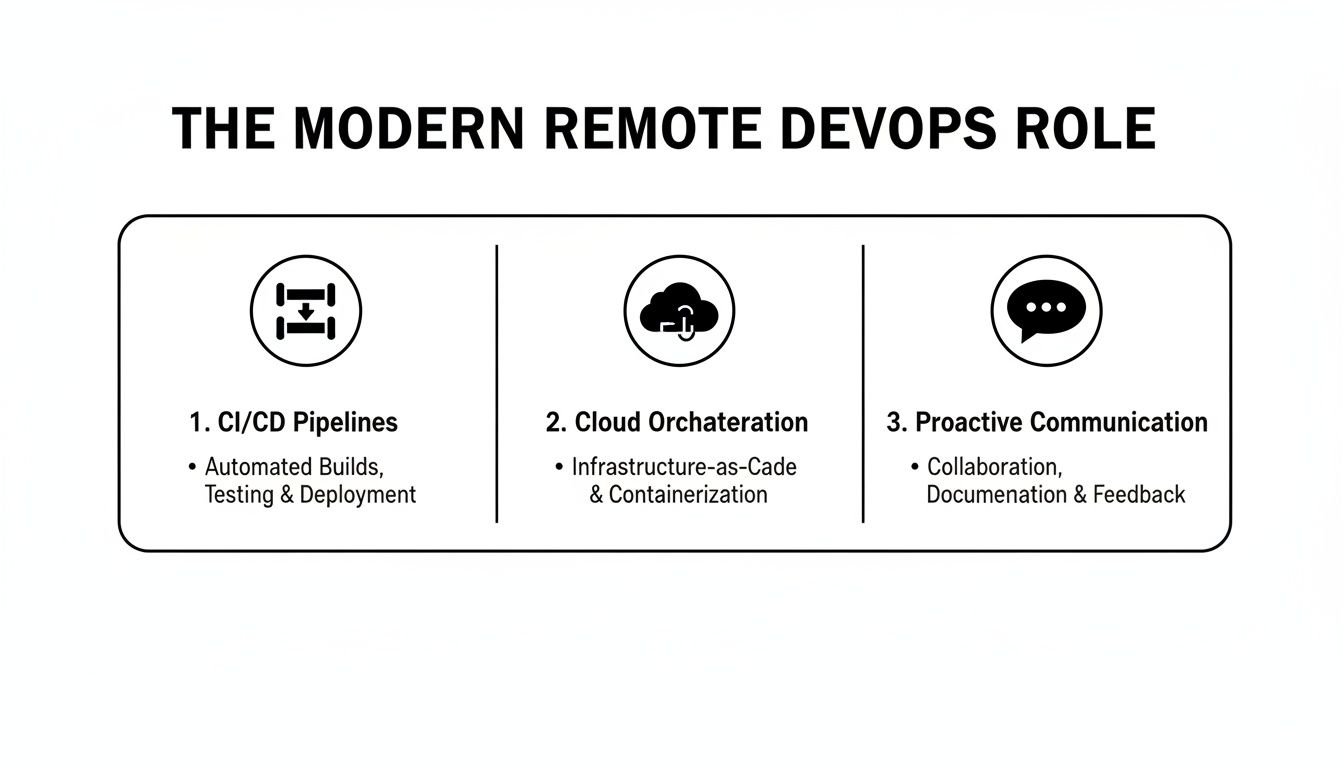
As you can see, it's not enough to be a technical wizard with CI/CD and cloud orchestration. To get hired and promoted, that expertise must be paired with excellent communication to make a real impact on a distributed team.
Cultivating Essential Remote Soft Skills
When you're working remotely, your soft skills are every bit as critical as your technical chops. Companies hiring a devops engineer remote are making a bet on your ability to deliver results with minimal hand-holding.
Ownership and Autonomy
You must demonstrate that you can take a project from concept to completion without constant check-ins. In your interviews, prepare concrete examples of times you identified a problem, designed a solution, and drove it to implementation on your own initiative. This is a key trait hiring managers look for.
Asynchronous Communication
In a remote world, real-time meetings are expensive. Mastering written communication is therefore a superpower. Your ability to clearly document a complex process, write detailed project updates in a Jira ticket, or articulate a technical issue in a Slack message is a skill that hiring managers actively screen for and is crucial for career progression.
If you want to see how employers describe these skills in the wild, check out a real job description like this Senior Cloud Infrastructure Engineer role. You'll notice how often they emphasize communication and ownership right alongside the technical requirements.
Crafting a Resume That Gets You a Remote Interview
Your resume is your first—and sometimes only—chance to make an impression. For a devops engineer remote role, it must do more than list your skills; it needs to prove you can deliver results autonomously. A generic resume gets lost in the pile, but a resume tailored for remote work tells a story of ownership, impact, and asynchronous success that gets you the interview.
The key is to shift from listing job duties to showcasing quantifiable results. Frame every bullet point around your independence and the concrete value you delivered. This means adding metrics to your achievements and using action verbs that demonstrate you already operate within a distributed work culture.
From "What I Did" to "The Impact I Made"
Hiring managers spend just seconds scanning each resume for hard evidence of performance. Vague statements like "managed pipelines" are easily ignored. Specific, metric-driven accomplishments, however, command attention and demonstrate your value.
Let's transform a few typical resume lines into remote-ready power statements.
The Old Way:
- Managed CI/CD pipelines using GitLab CI.
The Remote-First Way:
- Independently designed and implemented a CI/CD pipeline in GitLab CI for three microservices, slashing manual deployment efforts by 90% and empowering developers across multiple time zones to deploy on demand.
The second version screams autonomy ("independently designed"), names the tool, quantifies the result ("90%"), and includes a remote-friendly detail ("multiple time zones") that will catch a recruiter's eye.
Here's another example.
The Old Way:
- Responsible for cloud infrastructure on AWS.
The Remote-First Way:
- Owned the end-to-end cloud infrastructure on AWS, architecting a new Terraform configuration that cut monthly costs by $5,000 through resource optimization, all managed via asynchronous pull requests and thorough documentation.
Using a powerful verb like "owned" signals leadership. It also quantifies the financial impact ("$5,000") and highlights core remote practices like "asynchronous pull requests," showing you're a perfect fit for their culture.
Every bullet point on your resume should answer three questions for the hiring manager: What did you do? Why did it matter? And how did you do it like a self-sufficient remote pro?
Making Your GitHub a Must-See Portfolio
For a remote DevOps position, your GitHub profile is your live portfolio—the ultimate proof of your skills and independent problem-solving ability. A weak GitHub can be a deal-breaker.
To make your GitHub profile a powerful asset in your job search, focus on these actionable steps:
- Pin Your Best Work: Feature 3-5 of your most impressive, real-world projects at the top. This should be work like a complete Terraform setup for a multi-tier application or a sophisticated GitHub Actions pipeline, not simple tutorial projects.
- Write Amazing READMEs: Every pinned project needs a stellar README file. Explain the project's purpose, the problem it solves, and provide clear instructions on how to get it running. This is your chance to showcase your documentation skills, which are non-negotiable for asynchronous teams.
- Focus on Practical Projects: Build solutions to real challenges. For example, create a CI/CD pipeline that deploys a containerized app to Kubernetes, or write a set of scripts to automate cloud security policy enforcement. These projects provide excellent talking points for interviews.
When you tailor your resume and GitHub with this remote-first approach, you stop being just another applicant. You become a standout candidate who looks ready to deliver value from day one. To see how companies phrase these needs, analyze a job posting like this one for a DevOps Engineer and align your experience accordingly.
How to Pinpoint the Best Remote DevOps Jobs
Finding a great remote DevOps role isn't about carpet-bombing generic job boards with your resume. The real gems—the truly remote-first, high-impact positions—are found when you get strategic about where and how you look.
Your best bet is a two-pronged attack: get laser-focused with your searches on the big platforms, but also tap into the niche communities where the most exciting blockchain and Web3 companies are hiring. Remote work isn't a perk anymore; it's the standard for top talent, and you should approach your job search with that mindset.
The numbers don't lie. Recent stats show 33% of DevOps engineers are now fully remote, with another 58% working in a hybrid model. This gives you significant leverage in the job market.
Get Surgical With Your Search on Mainstream Sites
Typing "DevOps jobs" into LinkedIn will drown you in irrelevant, low-quality listings. To find the roles you actually want, you must use precise search queries to filter out the noise.
Boolean searches are your best friend here. Instead of a generic search, try something like this:
("DevOps Engineer" OR "SRE") AND ("fully remote" OR "distributed team") AND ("Terraform" OR "Kubernetes") -hybrid("Infrastructure Engineer" OR "Cloud Engineer") AND ("asynchronous" OR "anywhere") AND "AWS" NOT "on-site"
These aren't just keywords; they're filters. They weed out the "on-site preferred" nonsense and zero in on companies that speak the language of remote work and use the tools you're an expert in.
How to Spot a Genuinely Remote-First Company
A "remote" tag on a job post can mean anything these days. You need to become a bit of a detective and learn to spot the difference between a company that tolerates remote work and one that actually embraces it. This is crucial for your long-term career satisfaction.
Pay close attention to the language in the job description. Green flags are phrases like "asynchronous communication," "distributed teams," and "flexible hours." If you see a lot of talk about office perks or vague policies, that’s a red flag.
The tech stack is another dead giveaway. A company that lists tools like Slack, Jira, Confluence, and Miro shows they’ve invested in the infrastructure needed to make a distributed team successful.
Why You Need to Look Beyond LinkedIn
While you can't ignore the big platforms, the absolute best remote roles, especially in bleeding-edge fields like blockchain, are often hiding on specialized job boards. These niche sites are where serious employers go when they need very specific skills.
A platform like Blockchain Jobs, for example, is a goldmine. It’s curated specifically for companies building in the Web3 space—companies that were often remote from day one. You'll find highly relevant listings here, like this Backend Engineer, Wallets role, that you’d never stumble upon on a mainstream site.
Acing the Remote DevOps Interview Process
When you're interviewing for a remote DevOps role, you're being evaluated on two fronts simultaneously. They need to confirm your technical competence, but just as importantly, they are assessing if you have the discipline and communication skills to thrive autonomously. Can you solve problems independently and be a productive member of a distributed team?
Every single interaction, from the first recruiter email to the final technical deep-dive, is your opportunity to prove you’re a low-risk, high-impact hire who understands the remote work paradigm.

Your goal isn't just to pass a test; it's to leave the hiring manager completely confident that you can integrate seamlessly into their workflow from anywhere in the world.
Nailing the Early Rounds: Screening and Tech Calls
The initial interview stages are designed to filter out candidates who don't meet the baseline requirements. The HR chat is a vibe check, but the first technical call with a hiring manager or senior engineer is where you must validate the claims on your resume.
Be prepared to answer foundational questions with compelling, story-driven answers. This is your first real chance to demonstrate your value.
- If they ask about CI/CD: Don't just say, "I've used GitLab CI." A much stronger answer is, "At my last role, I built a CI/CD pipeline from scratch that cut deployment failures by 25%. I achieved this by introducing automated security scanning and integration tests, which was crucial for our fully distributed team's velocity."
- If the topic is Infrastructure as Code (IaC): Frame your experience with a remote-work angle. "I led the migration of our manual infrastructure to Terraform. I focused on creating well-documented modules, which enabled engineers across three time zones to collaborate on infrastructure changes asynchronously via pull requests."
These early conversations are your opportunity to prove you have both the technical depth and the communication skills essential for remote success.
Preparing for the System Design Gauntlet
This is often the most challenging and decisive stage. The system design interview presents a broad, open-ended problem to see how you think. It's less about a single "right" answer and more about showcasing your problem-solving process and communication skills.
They want to see you decompose a complex problem, ask intelligent questions, and articulate trade-offs.
The biggest mistake engineers make is jumping straight into a solution. The best candidates always start by asking clarifying questions. How many users? What are the latency and availability requirements? What's the budget? This shows you think like an architect, not just an implementer.
For a role in the blockchain space, expect questions tailored to decentralized infrastructure:
- "Design a highly available monitoring and alerting system for a network of Ethereum validator nodes." A strong answer would cover collecting node-specific metrics (peer count, block height) alongside standard infrastructure monitoring (CPU, disk). You must also discuss a detailed incident response plan for a downed node.
- "Architect a CI/CD pipeline for a new dApp, including deploying smart contracts to a testnet and then to mainnet." Here, they're testing your Web3-specific knowledge. Discuss security scanning for vulnerabilities, using tools like Hardhat or Truffle for automated testing, and how you'd securely manage private keys for deployments.
Proving You’re Built for Remote Work
Throughout the interview process, your setup and demeanor send powerful signals about your professionalism and readiness for remote work.
- Your Environment Matters: Choose a quiet, well-lit space with a clean, professional background. Test your camera and mic beforehand. A stable, high-speed internet connection is non-negotiable.
- Embrace the Tools: Be prepared to use a virtual whiteboard like Miro or a shared coding environment. Demonstrating fluency with these collaborative tools is a massive green flag.
- Think Out Loud: This is critical, especially during system design. Articulate your thought process clearly. Explain why you're choosing a particular database or message queue and discuss the trade-offs. This simulates the kind of transparent, asynchronous communication vital for remote teams.
Negotiating Your Offer and Succeeding Remotely
Landing an offer for a remote DevOps role is a major achievement, but your work isn't over. This is the critical moment to negotiate a package that reflects your value and sets you up for long-term success. Never accept the first offer without doing your homework.
Research the market rate for a devops engineer remote with your experience level. US-based remote roles remain highly competitive. Mid-level engineers can expect offers between $132,400 and $163,700, while senior roles often range from $145,600 to $173,000. Use resources like real-world data on remote DevOps work to arm yourself with facts before the negotiation.
Compensation is more than just base salary. Advocate for benefits that enhance your remote work life and career growth.
- Home Office Stipend: Argue for an allowance to create an ergonomic and productive workspace. This is an investment in your well-being and productivity.
- Internet & Phone Reimbursement: These are essential utilities for your job. It is reasonable for the company to cover these business expenses.
- Professional Development Budget: Push for dedicated funds for certifications, online courses, or virtual conferences. This shows you are committed to your career progression.
Your Critical First 90 Days
Once the contract is signed, the focus shifts to execution. Your first three months are your chance to prove they made the right hire, integrate with the team, and start delivering value.
The goal in your first 90 days isn't to revolutionize the company's infrastructure. It's to listen, learn the existing systems, build trust with your colleagues, and score a few small, visible wins.
Establish a productive rhythm quickly. Set clear working hours and communicate your availability to the team. In a remote setting, over-communication is key. Provide regular progress updates and highlight any roadblocks in public Slack channels. This visibility is how you build trust and demonstrate your impact when you're not physically present. Schedule virtual coffee chats to build personal rapport, which will make technical collaboration much smoother.
Your Questions Answered: Navigating a Remote DevOps Career
What does it truly take to land and thrive in a remote DevOps role? It all comes down to building and maintaining trust. As a remote engineer, you must consistently prove you can deliver high-quality work without direct supervision.
The best way to do this is to show, not just tell. During interviews, prepare specific stories about how you’ve managed projects on distributed teams. Discuss your communication strategies, how you navigated time zone differences, and the tangible outcomes you delivered. This evidence-based approach is what convinces hiring managers.
What Are the Biggest Hurdles in Remote DevOps?
The most common challenges are communication breakdowns and a lack of visibility. When you're not in the same room, misunderstandings can happen, and your contributions can go unnoticed. Furthermore, maintaining a healthy work-life balance can be difficult.
My best advice? Become an over-communicator. Document everything, post frequent updates in public team channels, and make your voice heard in virtual meetings. This isn't just about showing you're online; it's about demonstrating your impact and making sure you’re part of the team’s core, not just a satellite.
Do Certifications Actually Matter for Remote Roles?
Yes—they often matter more. When a hiring manager can't meet you in person, a certification like the AWS Certified DevOps Engineer or Certified Kubernetes Administrator (CKA) provides instant, objective validation of your skills. It’s a powerful signal that you have the expertise to back up your resume and can significantly strengthen your candidacy.
Ready to find your next opportunity? Blockchain Jobs is the go-to job board for Web3, connecting top talent with innovative companies. Discover your ideal remote DevOps role today at https://blockchain-jobs.com.