Web3 Discord Community Manager: The Career Guide
A lot of Web3 teams hit the same wall. The Discord server looks healthy from the outside, member count keeps climbing, announcements get pushed, and yet signals indicate problems. Core contributors go quiet. Questions sit unanswered. New members never make it past lurking. During a rough market week, the chat turns into a mix of rumors, support tickets, and low-grade panic.
That’s when people realize a discord community manager isn't a glorified moderator.
It’s a role that sits between growth, support, brand, operations, and risk. If you're trying to land the job, that distinction matters. If you're hiring for it, it matters even more. Strong candidates know how to shape behavior, protect trust, and give leadership a clean read on what is happening in the community. Weak candidates talk about “engagement” in abstract terms and confuse activity with health.
In Web3, the gap gets bigger. A gaming server can survive some chaos. A tokenized community, DAO, NFT project, infrastructure protocol, or wallet product often can't. Bad moderation, vague communication, or poor onboarding doesn't just create noise. It creates reputational risk.
The Modern Web3 Community Manager Beyond Moderation
Discord got too large, too complex, and too important for the role to stay tactical. By early 2025, Discord had grown to over 231 million monthly active users, added nearly 20 million new users between January 2024 and May 2025, supported more than 30 million servers, and saw 54% of users fall outside gaming, including professional communities like Web3, according to these Discord platform statistics.
That scale changes what hiring managers look for.
A moderator reacts. A community manager designs systems. A moderator removes spam and answers repeat questions. A community manager builds onboarding, event rhythm, escalation paths, contributor programs, and reporting loops that stop the same problems from repeating next month.
What the job looks like
If you want a grounded definition, this overview of what a community manager does in practice is useful because it frames the role around communication, relationship-building, and operational ownership rather than just chat policing.
In Web3, that broad scope gets sharper. The best discord community manager usually owns work across four lanes:
- Member experience: Onboarding, FAQs, channel clarity, and helping people find the right conversation fast.
- Trust and safety: Scam prevention, moderation standards, escalation, and tone-setting.
- Growth support: Community events, partnerships, ambassador programs, and launch coordination.
- Internal intelligence: Turning messy chat activity into feedback that product, marketing, and leadership can act on.
Why founders and hiring managers now value this role differently
A founder usually notices the difference when the server gets bigger but weaker. More members doesn't mean more belief. More messages doesn't mean better retention. More moderators doesn't mean the community feels well-run.
Practical rule: If a candidate only talks about “keeping the chat active,” they’re describing a junior moderation mindset, not community management.
Good community managers know which conversations need speed, which need diplomacy, and which need silence until the team has verified facts. They understand that Discord is often the public operating room of a Web3 brand. Product delays, governance friction, token volatility, exploit rumors, support confusion, and partnership speculation often show up there first.
That’s why top candidates get hired faster. They don't present themselves as chat operators. They present themselves as owners of community systems.
The strategic lens that changes your career path
If you're building a career, start thinking like someone who can influence retention, sentiment, and cross-functional execution. If you're hiring, screen for that mindset early.
The best discord community manager isn't the loudest person in the server. It's the person who can keep the room useful, credible, and worth returning to.
The Core Skillset That Gets You Hired
Hiring managers don't struggle to find people who say they love Discord. They struggle to find people who can run a Web3 server without creating hidden problems.
That’s the difference between a candidate who gets shortlisted and one who gets passed over.

Communication under pressure
Every applicant claims they’re a strong communicator. Most haven't had to answer a hostile thread when users think funds are at risk, a snapshot vote is controversial, or support tickets are piling up.
In interviews, generic claims fail. Specific communication examples work.
Bring examples like:
- Conflict handling: A moment when you de-escalated a heated discussion without sounding robotic or defensive.
- Expectation management: A time when you had incomplete information and still kept the community informed without overpromising.
- Cross-team translation: An example of taking noisy community feedback and turning it into something a product or leadership team could use.
A strong answer sounds calm and procedural. A weak one sounds performative, usually with too much focus on “keeping vibes high.”
Cultural fluency in Web3
A Web3 server has its own language, incentives, and failure modes. Candidates who don't understand that tend to misread the room.
Great candidates understand how different segments behave:
| Candidate signal | What it tells a hiring manager |
|---|---|
| Knows the difference between community hype and durable conviction | They won’t confuse noise with progress |
| Understands token-sensitive communication | They’re less likely to trigger avoidable backlash |
| Can separate FUD, valid criticism, and support confusion | They can moderate without alienating good members |
This doesn't mean sounding overly crypto-native in interviews. It means showing judgment.
Bot literacy and workflow design
A discord community manager doesn't need to be an engineer, but they do need operational fluency with bots, permissions, automations, and role flows.
Candidates stand out when they can explain how they’ve used tools like Carl-bot, Dyno, AutoMod, Collab.Land, or ticketing workflows to reduce friction. The hiring manager wants to hear why you chose the setup, what problem it solved, and what trade-off came with it.
Good candidates know tools. Great candidates know where automation stops and human judgment needs to start.
That distinction matters in Web3 because role-gating, verification, support triage, and anti-spam systems can improve order fast, but they can also make a community feel cold if badly configured.
Content and programming instincts
Servers with no programming rhythm drift. People show up for announcements, then leave.
Candidates who get hired often show they can design a lightweight content engine:
- weekly discussion prompts
- founder or contributor Q&As
- launch support threads
- office hours
- educational breakdowns for product changes
- contributor spotlights
If you don't have formal experience yet, build a mock plan. Pick a live project and create a sample monthly Discord calendar. That’s more convincing than saying you’re “creative.”
A useful benchmark for entry-level candidates is to study active role listings such as this events and community intern opening and reverse-engineer the skills the market is already asking for.
Data literacy and reporting
Many candidates fall apart here.
A hiring manager doesn't just want someone who can run the server. They want someone who can explain what changed, why it changed, and what should happen next. That means knowing how to read activity patterns, onboarding friction, channel health, and moderator workload.
You don't need a fancy deck. You do need evidence of thinking. Bring a sample report with sections like:
- What happened this week
- What members seemed confused about
- Which channels underperformed
- What action you recommend next
Security instincts and escalation discipline
Web3 communities attract impersonators, fake support accounts, phishing links, and emotionally charged accusations. A good discord community manager doesn't improvise policy in the middle of a crisis.
Hiring managers look for candidates who already think in terms of escalation paths, verification, screenshot collection, internal handoffs, and public response sequencing.
If I’m interviewing someone for a serious Web3 role, I want to hear less about “being passionate about community” and more about how they keep members safe while preserving trust.
That’s the profile that gets hired. Then promoted.
Your Daily Workflow and Strategic Growth Playbooks
The daily reality of a discord community manager is less glamorous than many candidates expect. The job isn't spending all day chatting. It’s deciding what deserves attention now, what needs a process, and what needs to be handed off.
Most days start with a scan. Check overnight issues, unanswered questions, support bottlenecks, moderator notes, suspicious links, role assignment failures, event reminders, and any messages from internal teams that need community distribution.

A practical day in the role
A solid daily workflow usually includes:
- Morning triage: Review tickets, moderation alerts, and key channels first.
- Public touchpoints: Answer open questions, post clarifications, and keep important threads from stalling.
- Internal syncs: Surface recurring feedback to product, support, or marketing.
- Program execution: Run whatever ritual the community depends on that day.
- End-of-day review: Note risks, unresolved issues, and what needs handoff coverage.
That rhythm matters because Discord punishes inconsistency. A server feels abandoned faster than many teams expect.
The onboarding playbook
A new member's first few minutes shape the odds they'll ever come back. Good onboarding isn't just a welcome message. It’s guided momentum.
A practical onboarding flow looks like this:
| Stage | What the manager does | Why it matters |
|---|---|---|
| Entry | Set up clear verification and role selection | Reduces confusion and spam exposure |
| Orientation | Keep rules, announcements, and start-here channels clean | Helps members understand where to go |
| First action | Prompt an introduction, reaction role, or beginner question | Creates a low-friction first contribution |
| First value moment | Direct them to resources, office hours, or relevant channels | Shows the server is useful, not just busy |
New members don't need ten channels screaming for attention. They need one obvious next step.
The engagement playbook
Most Web3 servers either overprogram or underprogram. Overprogrammed servers exhaust the team and train members to ignore everything. Underprogrammed servers become announcement graveyards.
The better model is a repeatable cadence. Keep it simple enough that the team can sustain it even during busy product cycles.
Use recurring formats like:
- Office hours: Product, ops, or ecosystem leads answer focused questions.
- Theme days: Governance, ecosystem tools, builder showcases, or educational prompts.
- Reaction-driven polls: Fast sentiment checks before larger discussions.
- Contributor recognition: Spotlight thoughtful members, not just loud ones.
A quiet but high-signal server often outperforms a noisy one. The useful question isn't “How active is chat?” It's “Do the right members keep returning?”
This is also where monetization and business alignment matter. If your community has revenue goals, sponsorship layers, premium access, or paid education, the structure has to support that without turning the server into a billboard. This guide to crypto group monetization strategies is a helpful reference for thinking through value exchange without damaging trust.
The growth playbook
Growth on Discord works best when it follows usefulness. Forced growth usually fills a server with the wrong people.
For Web3 teams, growth tends to come from a few reliable levers:
- Partnership activations with adjacent protocols, tools, or communities.
- Events tied to real product moments, not filler AMAs.
- Contributor pathways that give members status through work, not just presence.
- Cross-channel coordination so X, email, docs, and Discord all support one another.
If you're targeting a more senior path, study the scope of roles like this senior ecosystem growth manager position. It shows where strong Discord operators can grow once they prove they can connect community execution to broader ecosystem outcomes.
A useful walkthrough of community operations in video form can help newer managers see how these moving parts fit together in practice.
What scales
The managers who advance don't try to do everything themselves. They build repeatable systems, document rituals, and create enough structure that moderators, advocates, and internal teams can contribute without constant supervision.
That’s what turns a busy server into an operating asset.
Mastering Moderation and Safety in High-Stakes Web3
A lot of teams still treat moderation as cleanup work. That’s a mistake.
In Web3, moderation is part security, part customer trust, and part retention strategy. If your server becomes the easiest place for scams, impersonation, harassment, or rumor spirals, the best members leave first. New members notice the disorder immediately.
The strongest discord community manager doesn't moderate for optics. They moderate for stability.

Why positive-vibes-only fails
Inexperienced teams often swing between two bad extremes. One is lax moderation in the name of openness. The other is heavy-handed cleanup that kills legitimate discussion.
A more useful benchmark comes from this phased moderation guidance for Discord growth. For servers above 5K members, using Discord Server Insights and targeting less than 10% weekly moderation action rate is a practical standard. That approach can lift monthly active ratios to 40% versus 5% in unmanaged servers, while over-moderation can cut engagement by 40% in DeFi servers and under-moderation can drive 25% churn from toxicity according to the Discord moderation methodology reference.
That is the fundamental trade-off. You need enough enforcement to protect trust, but not so much that every difficult conversation gets flattened.
The phased moderation model that works
The cleanest way to train a new discord community manager is in phases.
Early setup for small communities
At the start, simple beats clever.
Set a small number of clear rules in a visible rules channel. Use AutoMod and a moderation bot for obvious spam, profanity filtering if appropriate, and suspicious link control. Keep channel structure tight so bad actors have fewer places to exploit confusion.
At this stage, you're teaching members what normal behavior looks like.
Team scaling for growing servers
Once the community gets busier, pure founder-led moderation stops working.
You need moderator coverage, report handling, escalation notes, and shared judgment standards. Carl-bot and Dyno can help with auto-roles, reporting workflows, and repeat enforcement, but the larger gain comes from consistency. Moderators should know when to warn, when to mute, when to remove content, and when to escalate internally instead of improvising in public.
A community starts to feel safe when enforcement feels predictable.
Analytics-driven governance for larger servers
At larger scale, moderation needs measurement. Discord Server Insights becomes useful because it shows where problems cluster and which channels create friction.
Watch for patterns like:
- Violation concentration: One channel creating a disproportionate share of incidents.
- Message velocity spikes: Activity jumps linked to rumors, launches, or external drama.
- Contributor drop-off: Trusted members posting less after conflict or poor moderation calls.
Governance quality isn't about deleting the most messages. It's about keeping useful participation high while keeping member risk low.
Interview signals for moderation maturity
If I'm hiring for a Web3 community role, I ask situational questions that expose judgment fast.
A few examples:
| Interview question | Good answer | Great answer |
|---|---|---|
| How would you handle a fake support scam wave? | Mentions deleting scams and warning members | Adds role restrictions, announcement language, evidence capture, and internal escalation |
| How do you respond to coordinated FUD? | Says they'd stay calm and clarify facts | Separates criticism from manipulation, creates a response cadence, and avoids feeding bad actors |
| When should a moderator stay silent? | Says when facts are unclear | Explains how premature replies can amplify rumors or create legal and reputational issues |
What separates serious operators from chat cops
The best moderation leads train the team, review edge cases, document hard calls, and adjust bot rules over time. They don't assume one setup will work forever.
They also know safety has a tone component. Members will accept tough enforcement if it feels fair and legible. They won't accept arbitrary power, public humiliation, or selective rule application.
In practice, moderation excellence looks boring from the outside. Fewer crises. Faster recoveries. Better member trust. That's exactly why it matters.
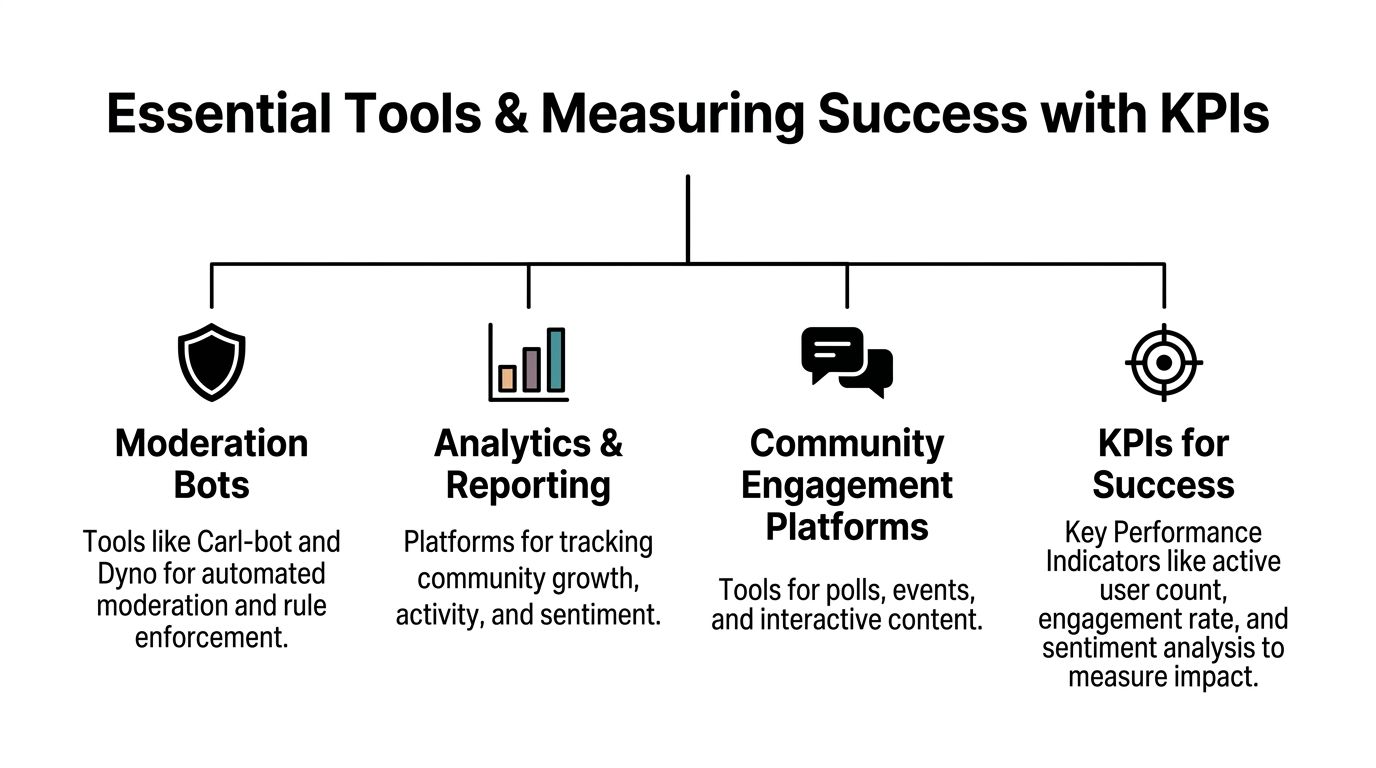
Essential Tools and Measuring Success with KPIs
Tool stacks only matter if they help a discord community manager make better decisions. Too many teams install a pile of bots, never clean up the workflow, and end up with noisy dashboards and confused moderators.
The right stack is smaller than people think. It should help you enforce rules, understand behavior, reduce repetitive labor, and prove impact to leadership.
The core stack that earns its keep
A practical setup usually includes a few categories.
Moderation bots
Carl-bot, Dyno, and Discord AutoMod handle a lot of first-line enforcement. They’re useful for role assignment, anti-spam controls, report handling, and routine rule enforcement.
The mistake is pushing them too far. Bots should catch patterns and reduce workload. They shouldn't become your substitute for human judgment on nuance, reputation, or context.
Analytics and reporting
Discord Server Insights is the first stop once a server qualifies for it. Beyond that, many teams use tools like Statbot or internal reporting sheets to track trends over time.
The point isn't to flood leadership with charts. It’s to answer basic business questions:
- Are members returning?
- Are new users getting active?
- Which channels are healthy?
- What changed after a launch, event, or policy shift?
Engagement tools
Collab.Land, poll bots, event tools, and ticketing flows help shape behavior. In token-gated or role-sensitive communities, these tools can keep the server organized and reduce manual work.
But every added tool increases complexity. If a bot adds friction to onboarding or confuses members, remove it.
The KPI language serious managers use
A lot of community reporting stays shallow. Message counts, join totals, and reaction volume can be useful, but they don't tell leadership whether the community is sticking.
A better reporting baseline comes from retention metrics. According to this community KPI reference, 57% of professionals track WAM/MAM with a target of 50% and DAM/MAM with a target of 20%, and automation with bots can cut admin workload by 45%.
Those metrics matter because they tell you whether the community has real repeat behavior.
How to interpret them
| KPI | What it means | What a manager should ask |
|---|---|---|
| WAM/MAM | How many monthly active members also show up weekly | Do members have a reason to come back during the month? |
| DAM/MAM | How many monthly active members engage daily | Does the server have enough habit-forming utility or rhythm? |
A discord community manager who understands those two ratios can move the conversation away from vanity metrics and toward retention.
A simple reporting structure
If you're presenting to leadership each week or month, keep the dashboard readable.
Use a structure like this:
Retention view Report WAM/MAM and DAM/MAM. Note whether trends improved, held steady, or weakened.
Behavior view Summarize what members did. Which channels stayed healthy? Which formats generated thoughtful participation? Where did confusion appear?
Risk view Note scam attempts, moderation pressure, and support friction. Keep this concise but visible.
Action view Recommend the next two or three operational moves. Fewer, sharper recommendations usually get acted on.
The report that gets you promoted isn't the longest one. It's the one that helps leadership decide what to do next.
How tools connect to career growth
Candidates often undersell themselves at this stage.
If you've built bots, channel systems, reporting templates, or moderator SOPs, that's not “just community work.” That's operations. That's process design. That's cross-functional communication. Those are promotion signals.
Managers move up when they can say:
- I reduced repetitive admin work so the team could spend more time on high-signal conversations.
- I tracked retention consistently and changed programming based on the pattern.
- I identified friction early and turned community noise into product or support insight.
Hiring managers trust candidates who speak in that language because it shows they understand how community work connects to business outcomes.
How to Land the Job or Hire the Right Manager
If you're trying to get hired as a discord community manager, your resume alone probably won't carry you. If you're hiring one, a vague job description will attract the wrong people.
This role sits in an awkward middle. It touches support, marketing, operations, product feedback, and trust and safety. That means both candidates and employers need to be unusually clear.
For candidates who want the job
Start by building proof, even if you haven't held the exact title before.
A useful application package includes:
A resume with operational language Focus on workflows, moderation systems, event programming, reporting, and cross-functional communication.
A lightweight portfolio Include a sample onboarding flow, moderation SOP, event calendar, or weekly reporting template.
A short case exercise Pick a live Web3 community and write a brief audit. Show what you'd change in channel structure, onboarding, and moderation.
If you need to see how the market frames the role, browse an active community manager opportunity and compare its expectations with your current experience.
How to answer interview questions well
Many candidates lose interviews by staying vague.
Here are better ways to frame common questions.
How would you handle a coordinated FUD attack
A weak answer says you'd stay calm and reassure the community.
A good answer says you'd first separate legitimate criticism from bad-faith amplification, align with internal stakeholders on verified facts, issue one clear public response, watch which channels are escalating the issue, and avoid feeding accounts that are trying to derail discussion.
A great answer adds escalation criteria. When does legal need awareness? When does support need a prepared response? When does the founder need to speak, and when should they stay out of it?
How do you increase engagement without creating spam
A weak answer says you'd run more events.
A good answer says you'd look at onboarding friction, create recurring rituals, tighten weak channels, and design prompts that lead to useful replies rather than low-effort chatter.
A great answer explains what you'd stop doing. That answer shows judgment.
What metrics would you report
A weak answer lists general engagement indicators.
A good answer focuses on retention, recurring participation, member health, moderation pressure, and notable shifts in sentiment or confusion.
A great answer explains how reporting changes decisions.
What hiring managers should put in the job description
Many job descriptions fail because they blend moderation, social media, support, growth, and partnerships into one generic blob.
A better template is more explicit.
| Section | What to include |
|---|---|
| Role purpose | Explain whether the hire is primarily for retention, support quality, growth, or ecosystem coordination |
| Core responsibilities | Include moderation systems, reporting, event cadence, internal feedback loops, and escalation ownership |
| Environment | Clarify timezone coverage, remote expectations, and whether the server is early-stage or already mature |
| Success profile | Describe the judgment, communication style, and operational rigor you want |
Be honest about the messiness of the role. Strong candidates don't mind complexity. They mind ambiguity with no support.
Interview questions that expose real ability
Use behavioral and scenario questions, not just culture fit chat.
Ask things like:
- Tell me about a time you disagreed with a founder's public messaging. What did you do?
- A moderator removed a longtime member unfairly. How would you handle it?
- The server is growing, but quality is dropping. What would you audit first?
- A product update causes confusion and backlash. How do you structure the response?
What you're screening for:
- judgment under incomplete information
- ability to protect trust without sounding defensive
- operational thinking, not just people skills
- comfort working across product, support, and marketing lines
Good versus great candidates
A good candidate has run communities.
A great candidate can explain the systems behind the outcomes. They know why a channel was merged, why a bot rule changed, why an event format failed, why a moderator needed coaching, and how they reported all of that upward.
That level of reflection is what usually predicts promotion, not charisma.
If you're the candidate, build evidence of that thinking before you apply. If you're the hiring manager, interview for it directly.
If you're ready to find your next Web3 community role or hire someone who can run one, browse open positions and post roles on Blockchain Jobs. It's one of the cleanest ways to connect community talent with teams building in crypto, DeFi, NFTs, infrastructure, and the broader decentralized ecosystem.