End to End Project Manager: A Career and Hiring Guide 2026
A lot of teams use the phrase end to end project manager when what they really mean is, “We need someone to stop this project from falling through the cracks.”
The symptoms are familiar. Product thinks engineering is handling dependencies. Engineering assumes compliance signed off. Marketing sets a launch date before release management is ready. Founders expect momentum, but nobody owns the ugly middle where priorities change, risks surface, and trade-offs get made. That's the accountability gap.
That gap matters because project leadership is a large and growing field. Industry summaries citing PMI-linked estimates say 2.2 million new project-management positions must be filled each year by 2027 across 11 countries, which is one reason execution skill has become a real differentiator rather than a generic operations label, according to this project management market summary. In practice, the market isn't short on people who can update a board in Jira. It's short on people who can carry a project from fuzzy idea to clean handoff without dropping scope, budget, risk, or stakeholder alignment.
In fast-moving tech teams, especially Web3 teams, role confusion gets expensive quickly. A protocol launch, smart contract upgrade, exchange integration, or wallet feature rollout doesn't fail because nobody cared. It fails because ownership was partial. If you want a good companion read on that broader pattern, why strategy execution fails in firms captures the organizational side of the same problem.
The End to End Project Manager Explained
A standard project manager often coordinates. A real end to end project manager owns delivery.
That distinction sounds small on paper and changes everything in the field. Coordination means collecting updates, running standups, and escalating issues. Ownership means defining success early, forcing decisions when teams stall, protecting the delivery triangle, and staying accountable after launch when everyone else has mentally moved on.
The practical definition
An end to end project manager is the person responsible for a project from initial framing through final closure. That includes not just timeline management, but the uncomfortable work around decisions, accountability, sequencing, stakeholder alignment, risk management, and post-delivery learning.
In hiring terms, this is the person who can answer all of these without hedging:
- Why this project exists
- What success looks like
- What can break delivery
- Which trade-offs are acceptable
- Who must approve what
- How handoff and closure will work
If a candidate can only speak fluently about task tracking, they're not end to end yet.
Practical rule: If nobody can tell you who owns the project after kickoff and before launch, you don't have an end to end PM. You have shared ambiguity.
Why the title gets misused
Many job descriptions say “end to end” and then describe a coordinator. That's usually a sign the company wants senior accountability without clearly defining authority.
A true end to end PM has reach across functions. They don't just report risk. They drive a decision. They don't just log a dependency. They sequence around it, negotiate resources, or force a scope cut. In Web3, that can mean balancing engineering readiness, token-related constraints, audits, exchange timelines, legal review, community communications, and operations readiness in one delivery plan.
Where this role matters most
The role becomes most valuable when projects cross multiple domains:
- Technical complexity: API integrations, release dependencies, infrastructure changes, smart contract deployment coordination
- Business sensitivity: Revenue-impacting launches, compliance-heavy work, strategic partnerships
- Distributed teams: Remote contributors, multiple time zones, external vendors, agencies, community teams
That's why the best end to end PMs tend to stand out quickly. They reduce confusion that other people normalize.
What an E2E Project Manager Truly Owns
The cleanest way to understand the role is to look at the project lifecycle and ask a harder question than most job descriptions ask: not “What do they participate in?” but “What are they accountable for if things go wrong?”
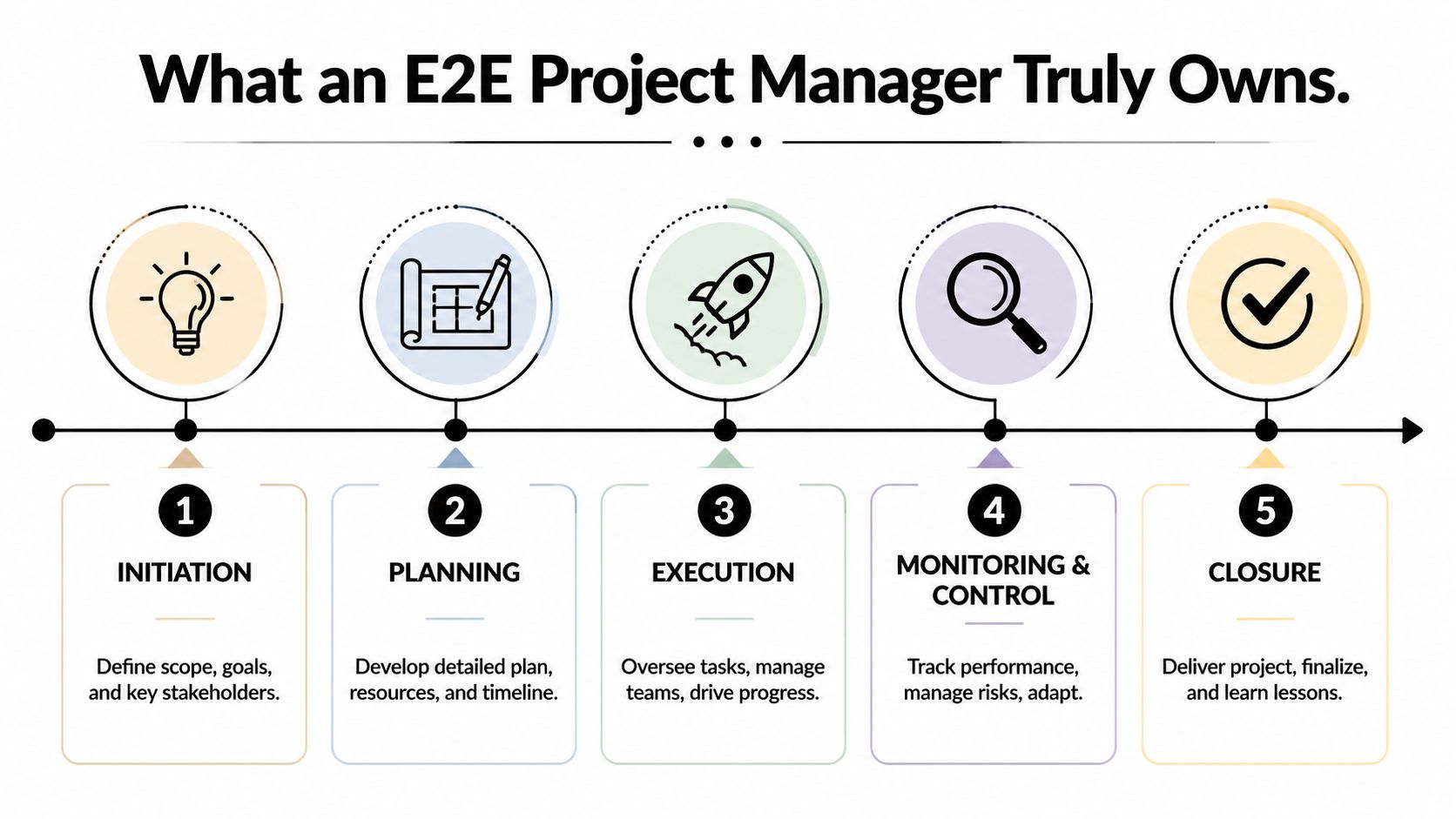
O*NET describes the role in terms that map directly to end-to-end ownership: planning, initiating, and managing IT projects, leading technical staff, acting as the liaison between business and technical sides, and monitoring progress against deadlines, standards, and cost targets in its project management specialist role summary. That's the delivery triangle in real life: scope, time, and cost under active control.
Ownership changes at every phase
| Project Phase | Standard PM Task | E2E PM Ownership |
|---|---|---|
| Initiation | Gather requirements and document kickoff notes | Pressure-test the business case, define success criteria, identify critical stakeholders, surface hidden constraints |
| Planning | Build timeline and assign tasks | Create the operating plan, lock dependencies, establish decision rights, align budget, risk, and communications |
| Execution | Run meetings and track progress | Remove blockers, enforce priorities, manage trade-offs, keep teams aligned to outcomes rather than activity |
| Monitoring and Control | Update status reports and escalate issues | Reforecast delivery, control scope drift, intervene on budget and schedule risk, drive corrective actions |
| Closure | Confirm deliverables and archive documents | Secure acceptance, coordinate handoff, review lessons learned, evaluate whether the project actually achieved its purpose |
Initiation and planning
Weak PMs become administrators. Strong ones shape the project before it hardens into a bad plan.
A generic PM receives a brief. An end to end PM challenges it. Is the scope coherent? Is the launch date political or real? Are legal, finance, security, or governance dependencies missing? In Web3, that often means identifying hidden work early, such as audit timing, wallet compatibility, validator coordination, or community rollout sequencing.
During planning, ownership expands beyond the schedule. The PM sets how the project will run. That includes the cadence of decision-making, the escalation path, the definition of done, and the rules for change requests.
Execution and control
The role earns its compensation in its active management. Projects rarely fail because the initial plan was typed poorly. They fail because nobody actively managed drift.
An end to end PM watches for three things:
- Scope drift: New asks dressed up as “small additions”
- Decision latency: Stakeholders who delay choices and still expect deadlines to hold
- Dependency blindness: Teams assuming another function has covered a critical item
The best PMs don't just ask for status. They test whether the reported status still supports the target outcome.
Closure is part of ownership
Many teams treat launch as the finish line. Senior PMs know that's usually where operational pain begins.
Closure means confirming handoff to operations, support, product, or growth teams. It means documenting unresolved items, validating what was delivered, and capturing lessons while people still remember them. If a PM disappears once the release goes live, they coordinated a launch. They didn't own the project end to end.
The Essential Skills for Total Project Ownership
The role looks broad because it is broad. But in hiring, I group the skills into three buckets. If a candidate is weak in one, the gaps show up quickly under pressure.
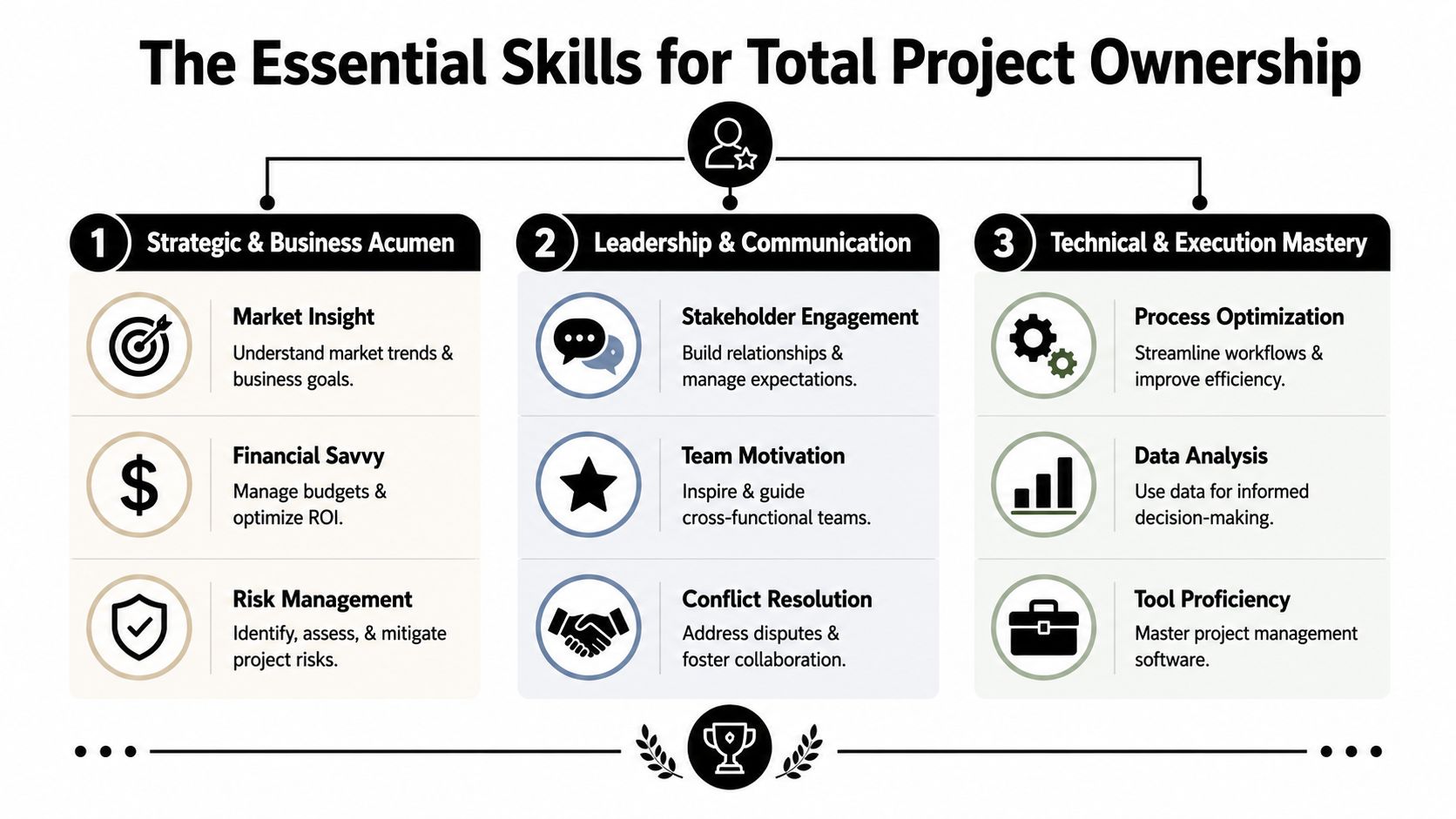
Strategic and business acumen
A project manager who can't connect delivery to business intent becomes a scheduler with better vocabulary.
Strong end to end PMs understand why the work exists. They can explain the strategic goal in plain language, identify which stakeholders care most, and tell the team what trade-offs matter. If a launch slips by two weeks, they know whether that's annoying, acceptable, or catastrophic. That judgment is what keeps teams from treating every project as equally urgent.
This also shows up in budget thinking. Even when finance owns the final numbers, a strong PM understands burn, procurement timing, staffing constraints, and the cost of rework. They know when to push for narrower scope because the business case no longer supports the original ambition.
Technical fluency and execution
In tech-heavy teams, especially Web3, PMs don't need to be the strongest engineer in the room. They do need enough technical fluency to understand what they're asking people to build and why a “small change” may not be small.
ServiceNow's overview of the technical project manager role gives a useful baseline: PMs in technical environments need fluency in areas like Agile or Scrum, version control, dev and test environments, release management, APIs, cloud services, and system architecture so they can translate technical constraints into schedule, risk, and business impact for stakeholders in its technical PM explainer.
That translation layer is where average PMs struggle.
A good PM hears “we need another sprint” and asks why. A strong PM asks whether the issue is architecture, test coverage, dependency sequencing, deployment risk, or unclear requirements. Then they turn that into a business-level decision with options.
What technical fluency looks like in Web3
Web3 raises the bar because the systems are less forgiving and the public surface area is larger.
A PM supporting a DeFi product should be comfortable discussing:
- Smart contract release flow: What must happen before deployment, what changes are immutable, and what coordination is needed across audit, engineering, and operations
- Wallet and chain dependencies: How integrations, RPC stability, network behavior, and user signing flows affect delivery risk
- Protocol mechanics: Enough understanding of staking, liquidity, bridging, governance, or settlement to spot requirement gaps early
- Operational readiness: Support documentation, incident paths, monitoring, and launch communications for a community that reacts in real time
You don't need to write Solidity to manage a smart contract rollout well. You do need to know which questions expose hidden risk.
People and communication
This is where great PMs separate themselves. Tools don't fix weak stakeholder management.
A PM with total ownership can tell an engineer what changed, tell a founder what that means, tell marketing what must move, and tell compliance what decision is required. Same project. Four different conversations. Each one accurate, calm, and adapted to the listener.
Look for these signs of maturity:
- Expectation management: They don't overpromise to keep everyone happy
- Conflict handling: They can surface tension without becoming the tension
- Executive communication: They summarize clearly, escalate cleanly, and present options, not panic
- Team trust: People give them the actual status, not the polished version
If engineers only tell the PM good news, the PM has a relationship problem, not a reporting problem.
Building Your Career as an End to End PM
Most PM resumes read like meeting notes. They list ceremonies, tools, and responsibilities. Hiring managers scan them and see coordination, not ownership.

If you want to get hired as an end to end project manager, write your experience around decisions, trade-offs, and business outcomes. That doesn't mean inventing metrics. It means showing where you held responsibility across the whole delivery motion.
Write a resume that signals ownership
Bad resume bullets usually start with “managed,” “coordinated,” or “supported.” Those words aren't wrong. They're just weak when overused.
Stronger phrasing shows what you owned:
- Defined success criteria: “Defined launch scope, stakeholder approvals, and release readiness criteria for a cross-functional product rollout”
- Drove trade-offs: “Led scope and sequencing decisions across engineering, product, and compliance during a time-sensitive release”
- Controlled risk: “Identified dependency gaps early and reworked delivery sequencing to reduce launch risk”
- Closed the loop: “Managed handoff, post-launch issue triage, and retrospective actions after release”
If you work in Web3, be specific. Mention protocol launches, exchange integrations, wallet flows, governance implementations, smart contract release coordination, or ecosystem partnerships. Concrete context beats generic PM language every time.
Use credentials carefully
Certifications matter more in some hiring environments than others. In corporate and enterprise-heavy searches, they often help with credibility and filtering. In startup and Web3 environments, they help most when paired with obvious delivery substance.
Compensation data also shows why many candidates pursue them. PMP-certified professionals were reported to earn about 22% to 23% more than non-certified peers, and 61% of project management professionals were reported to work remotely at least part-time in this project management statistics roundup. That remote reality also broadens the field. You're no longer competing only with people in your city.
If you're actively searching, it helps to review how project roles are framed in crypto hiring markets. Browsing Web3 product management jobs is useful because it shows how teams mix delivery, product, operations, and technical fluency in one role.
Prepare for interviews like a senior operator
Most PM interviews are passed or failed on storytelling quality.
Use a simple structure. State the situation, the constraint, the decision, the action, and the outcome. Keep the focus on what you owned. Don't disappear into “the team did this” language unless the question is specifically about team success.
A strong answer to failure sounds like this in substance: the project slipped because a dependency was misread, the PM recognized it late, communicated early once identified, reset scope, and changed the planning process afterward. That tells me the person learns and can handle heat.
For candidates who want a refresher on the fundamentals before interviews, this short video is a decent warm-up:
Think in career stages
Career progression is usually less about title inflation and more about the size of the mess you can handle.
- Junior PM: Handles trackers, cadences, follow-ups, and basic dependency management
- PM: Owns a contained project with moderate cross-functional exposure
- Senior PM or Technical PM: Manages higher-risk delivery with more stakeholder complexity and stronger technical context
- Program or portfolio lead: Oversees multiple related streams and resolves conflicts across them
- Head of Projects or PMO lead: Builds the system other PMs operate inside
The jump from PM to senior PM usually happens when you stop reporting issues and start shaping outcomes.
The Hiring Manager Checklist for Finding Top Talent
A lot of bad PM hires start with a bad question. Teams ask, “Do we need a PM?” when they should ask, “Where is ownership breaking down, and is that breakdown now expensive enough to justify a dedicated operator?”
Know when to hire a dedicated PM
For agencies and tech teams, a practical tipping point can show up around 8 to 12 people, with earlier need for more technical work, because an experienced PM can bring mistake-avoidance and faster value creation that outweighs the cost, based on this industry discussion on when to hire a project manager.
That's not a law. It's a useful threshold.
You probably need a dedicated end to end PM if any of these are already happening:
- Founders are project-managing by default: They're chasing updates, resolving blockers, and becoming the routing layer for decisions
- Engineering leads are overloaded: They're spending too much time on coordination and not enough on architecture, hiring, or technical quality
- Projects cross too many functions: Product, engineering, compliance, partnerships, marketing, and support all need tight sequencing
- Launches are painful: Dates move, ownership blurs, and nobody can explain the critical path without opening six different tools
Write for accountability, not activity
Most PM job descriptions attract generalists because they list duties instead of ownership.
Don't write “manage timelines, run meetings, communicate with stakeholders.” Every PM candidate on the market can mirror that language. Write the actual challenge:
- Own launch readiness across engineering, product, legal, and go-to-market
- Drive trade-offs across scope, timing, and delivery risk
- Establish project operating cadence and executive reporting
- Lead post-launch review and handoff into operations
That language filters for candidates who've carried responsibility, not just administered workflows.
A useful hiring discipline is building a structured scorecard before interviews begin. Teams that want a tighter process can borrow ideas from this guide on how to make confident hiring decisions, especially around consistent evaluation.
Screen resumes for signs of real scope
The best PM resumes show complexity. Not fluff. Complexity.
Look for evidence of:
- Cross-functional range: Did they work across engineering, compliance, operations, product, and external stakeholders?
- Decision ownership: Did they shape scope, budget, or risk decisions?
- Closure discipline: Did they mention launch, handoff, lessons learned, or post-release stabilization?
- Technical context: Can they speak credibly about systems, releases, integrations, or infrastructure?
If you're benchmarking role expectations against live market examples, reviewing a listing like the principal technical program manager role at Ripple can help clarify the difference between broad coordination and high-accountability delivery leadership.
Interview for judgment under pressure
Resume review should narrow the pool. Interviews should test operating maturity.
Use scenario questions. Ask what they'd cut first if scope expands late. Ask how they'd handle a founder who commits to a date before engineering estimates are complete. Ask how they'd manage a release where legal approval is slipping but community comms are already scheduled.
Hire the PM who can simplify a messy situation without pretending the trade-offs disappeared.
Top Interview Questions to Ask and Answer
PM interviews are often too abstract. “How do you manage stakeholders?” doesn't reveal much. Put the candidate in a recognizable situation and listen for structure, judgment, and ownership.
If you interview PMs regularly, it also helps to study adjacent customer-facing and operational roles, because they reveal similar strengths around communication and process clarity. This guide to help center roles in 2026 is useful for that reason. Different function, similar signals.
Question one on bad news
A launch dependency slips late. A senior stakeholder still expects the original date. What do you do?
For the interviewer, a strong answer reveals whether the candidate escalates early, frames options clearly, and protects trust without becoming defensive. Weak candidates hide behind process. Strong ones explain the issue, impact, options, and recommendation.
For the candidate, answer in a simple arc:
- Situation: What slipped and why it mattered
- Task: What you were accountable for
- Action: How you verified facts, aligned the team, and communicated upward
- Result: What happened, including any reset to scope or timeline
Question two on scope pressure
A founder asks for “one more feature” days before release. How do you respond?
The interviewer is testing whether the candidate can hold the line without acting territorial. Good answers include trade-off language. “Yes, if we move this.” “Yes, in a later release.” “No, not without increasing risk in these specific areas.”
Candidates should avoid sounding rigid. The goal isn't to say no. The goal is to show controlled decision-making.
Question three on technical ambiguity
Engineering says a task is blocked by an integration issue. Product doesn't understand the delay. How do you handle it?
A strong PM translates. They don't parrot technical language they barely understand, and they don't oversimplify to the point of distortion. They ask enough questions to isolate the actual constraint, then explain the schedule and business impact in plain English.
That answer tells you whether the PM can operate in technical environments without creating more confusion.
Question four on project failure
Tell me about a project that didn't go well.
This is still one of the best filters in hiring. Good candidates don't dodge it. They explain the failure directly, own their part, and show what changed afterward.
A strong response usually includes:
- Clear accountability: No blaming vague stakeholders
- Specific mistake: Poor dependency mapping, weak kickoff, delayed escalation, bad scoping
- Behavior change: What they now do differently
- Mature tone: Honest, calm, not theatrical
Question five on closure
How do you know a project is done?
This question catches people who think delivery ends at launch. Better candidates talk about acceptance, handoff, unresolved items, support readiness, documentation, and lessons learned. That's the mindset you want in an end to end PM.
For candidates, the best interview strategy is simple. Pick examples where your decisions mattered. If your story could be told by any coordinator, choose a different story.
Sample E2E Project Manager Job Descriptions for Web3
Most Web3 PM job descriptions are too vague. They ask for “strong organization” and “excellent communication” though the role requires operational control across technical, business, and launch workstreams.
DeFi protocol project manager
Role summary: Own end-to-end delivery for protocol initiatives, including feature releases, governance implementation, partner coordination, and launch readiness.
Responsibilities
- Own project delivery from scoping through post-launch review
- Coordinate engineering, product, audit, legal, operations, and community workstreams
- Manage timelines, risks, dependencies, and release readiness
- Run stakeholder updates and decision forums
- Drive handoff into support and operations after release
Preferred background
- Experience with DeFi products, smart contract release coordination, or on-chain governance
- Strong technical fluency with APIs, release management, and cross-functional delivery
- Ability to translate protocol and engineering constraints into business decisions
NFT platform launch manager
Role summary: Lead launch execution for NFT marketplace, creator tooling, or consumer-facing collection initiatives.
Responsibilities
- Define launch plan, milestone ownership, and go-live criteria
- Align design, product, engineering, marketing, partnerships, and support teams
- Manage asset readiness, partner dependencies, and launch communications
- Track issues during launch window and coordinate rapid response
Preferred background
- Experience shipping digital products with public launches
- Comfort working with remote teams and fast-moving stakeholder groups
- Strong judgment around sequencing, escalation, and launch risk
Technical project manager for Web3 infrastructure
Role summary: Manage infrastructure and integration projects across node services, wallets, tooling, or data platforms.
Responsibilities
- Own planning, execution, monitoring, and closure for technical initiatives
- Coordinate engineering teams, external vendors, and internal stakeholders
- Maintain project controls across scope, timing, and risk
- Lead implementation reviews and post-project retrospectives
A live reference point for how technical PM roles appear in crypto hiring markets is this technical project manager opening at Polymarket.
The strongest end to end PMs don't just “keep projects on track.” They close the accountability gap that causes good teams to miss obvious things. That's why this role is worth defining carefully, hiring carefully, and building deliberately as a career.
If you're hiring or job hunting in crypto, Blockchain Jobs is a practical place to find current Web3 roles across product, operations, engineering, and project delivery.