Kickstart your career with entry level crypto jobs and Web3 roles

Trying to break into the crypto world can feel a bit like you've been handed a puzzle with no picture on the box. But landing that first entry-level crypto job is more than possible—you just need the right strategy. Think of this guide as your map. We're here to cut through the noise and give you a real, practical playbook for getting your foot in the Web3 door.
From a hiring manager's perspective, success here isn't about a polished, traditional resume. It's about demonstrating genuine passion and skills that you can put to use from day one.
Decoding the Modern Crypto Job Market
To get your first job in crypto, you have to understand what hiring looks like right now. The market has matured, and with that maturity comes more competition. The industry is still expanding, but the kinds of roles available have shifted. Passion is still your entry ticket, but you have to back it up with tangible proof of what you know and can do—what hiring managers in the space call your "proof-of-work."
This guide will walk you through everything, step-by-step. We’ll identify the most accessible entry-level roles, show you how to build a portfolio that gets you noticed in interviews, break down the specific skills hiring managers are really looking for, and teach you how to nail the unique Web3 interview process to secure an offer.
The New Reality for Newcomers
Let's start with a clear-eyed look at the landscape today. In 2025, we've seen a pretty big drop in junior positions, which now make up only about 10% of all crypto roles. Why? A lot of failed projects have unfortunately flooded the market with experienced talent, which means senior and principal-level roles now dominate the scene, making up 37% of all available jobs.
This doesn't mean the door is closed for newcomers. It just means you have to be smarter about your approach. Companies are searching for candidates who are deeply engaged, proactive, and can show they'll add value from day one—even without a long list of previous jobs.
This shift means the focus is much more on what you can do versus what you've done. Throughout this guide, we’re going to zero in on actionable steps you can take to build that all-important proof-of-work. If you want to get a better feel for the companies shaping this industry, you can read more about our mission and the teams we partner with.
Our goal is to help you turn your curiosity into a compelling career narrative that connects with the people building the future of the decentralized web.
Finding Your Fit in the Crypto Ecosystem
So, you want to get into crypto, but you're not a coding wizard or a Wall Street quant? Good. Breaking into this industry isn't just for the deeply technical. In fact, many of the most critical roles that keep Web3 companies alive and growing are non-technical.
These jobs are the connective tissue of a project—they build the community, explain the vision, and support the users. Think of it like this: developers build the engine, but it's the non-technical team that builds the car around it, markets it, and teaches people how to drive. Your existing skills probably map directly to one of these foundational needs, giving you a clear path for career progression.
While the crypto job market does lean heavily towards senior talent, there's a clear and growing space for newcomers. This snapshot of the industry shows you exactly where the entry points are.
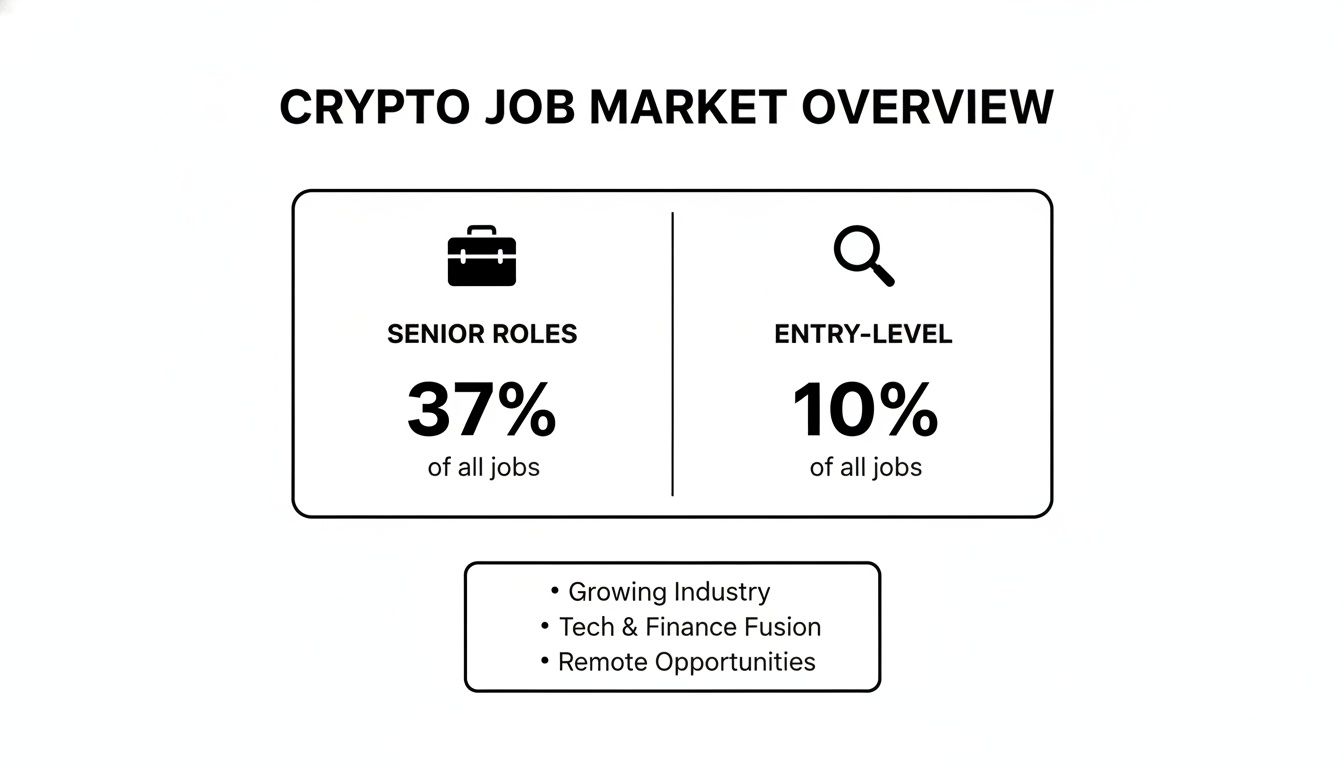
That data tells a clear story. While senior roles make up a hefty 37% of the market, that dedicated 10% of entry-level positions is your sweet spot. It just means you need to be smart and focused in your job search.
To help you get started, here's a look at some of the most common entry-level crypto roles. This table breaks down what they do and what you'll need to succeed to get hired.
Top Entry Level Crypto Roles and Key Responsibilities
| Job Title | Primary Function | Essential Skills to Get Hired |
|---|---|---|
| Community Manager | Cultivating and moderating the project's online community (Discord, Telegram). | Communication, empathy, social media savvy, conflict resolution. |
| Content Writer | Translating complex crypto concepts into easy-to-understand articles, guides, and posts. | Strong writing, research skills, ability to simplify technical topics. |
| Support Specialist | Assisting users with technical issues, answering questions, and building trust. | Problem-solving, patience, clear communication, technical aptitude. |
These roles are often the front door to a long-term career in the space, offering a direct line of sight into how a project operates and what its users truly need. Let's dive a little deeper into what each one actually involves from a hiring and career perspective.
The Community Manager: The Digital Town Square Mayor
At its heart, every crypto project is a community. The Community Manager is the person who nurtures that community, turning a quiet Discord server into a bustling, helpful, and exciting hub. This is one of the most popular entry level crypto jobs for a reason—it puts you right at the center of the action.
Your day-to-day work is being the first point of contact on platforms like Discord and Telegram.
- Moderating Conversations: You’ll be answering questions, steering discussions in a productive direction, and making sure the community remains a safe and welcoming place for everyone.
- Gathering Feedback: You are the project's eyes and ears. You'll collect user feedback, bug reports, and bright ideas, then package that intel for the product and dev teams.
- Organizing Events: This could mean running AMAs (Ask Me Anything) with the founders, coordinating contests, or hosting community calls to keep engagement high.
From a hiring manager’s point of view, a great Community Manager proves they can communicate effectively under pressure and genuinely understand the user base. Starting here can lead to roles like Head of Community, Marketing Manager, or even Product Manager, where your deep user insights become a massive asset.
The Content Writer: The Blockchain Storyteller
Let’s be honest—crypto can be mind-numbingly complex. A Content Writer or Content Strategist has the crucial job of translating that complexity into clear, engaging, and accessible content. If you're a natural teacher who loves to write, this is an amazing way to get your foot in the door.
This isn't just about blogging. It's about building an entire educational world for your users, from the absolute beginner to the seasoned degen.
A project can have the most groundbreaking technology in the world, but if no one can understand what it does or why it matters, it will fail. Content is the bridge between the code and the user.
As a writer, your work has a direct line to user growth and retention. One day you might be writing a step-by-step guide on using a new DeFi protocol; the next, you're scripting a short video to explain tokenomics. Hiring managers want to see that you can truly grasp the subject, not just rephrase what's already out there. This role is a natural stepping stone to becoming a Content Marketing Manager or a specialized technical writer.
The Support Specialist: The On-Chain First Responder
When real money is on the line, user anxiety can shoot through the roof. A Customer Support Specialist is the calm, guiding voice that helps people solve their problems and builds crucial trust in the project. This role is a fantastic starting point because it forces you to learn the product inside and out.
You’ll quickly become an expert on every common user headache, from wallet connection problems to confusion over transaction fees. Your main tasks will be responding to support tickets, building out a helpful knowledge base, and flagging recurring issues for the tech team to fix for good.
In an interview, the key is to show empathy and a structured approach to problem-solving. If you excel in this role, you prove you're reliable and user-obsessed, which can open up future opportunities in Quality Assurance (QA), Operations, or Product Testing, where that deep knowledge of user pain points is pure gold.
The Skills That Get You Hired in Web3
In the crypto world, what you can do often carries more weight than a fancy job title from your last gig. When hiring managers are sifting through applications for entry-level crypto jobs, they’re looking for a specific mix of skills that prove you’re here to build, not just to spectate.
Simply slapping "passion for Web3" on your resume isn't going to cut it. You have to show your value with real, tangible skills. It’s time to move past the buzzwords and demonstrate that you get the culture, the tech, and the community-first vibe that powers the best projects. We can split these skills into two main camps that, when you have both, make you a truly compelling candidate.
Soft Skills: The Unspoken Requirements
Think of these as the foundational traits that show you can thrive in an environment that’s fast-paced, sometimes chaotic, and always collaborative. It’s less about what you know and more about how you operate. A hiring manager will be looking for signals of these traits in your portfolio and interview.
Demonstrable Curiosity: This is, without a doubt, the most important one. Don't just say you're curious—prove it. A hiring manager will be far more impressed by someone who has written a detailed breakdown of a project's tokenomics or actively participates in its governance forums than by another "crypto enthusiast" bio. Show your work.
Clear Communication: Can you explain a concept like liquidity pools or zero-knowledge proofs to a friend who’s never heard of them? Your ability to take complicated ideas and make them simple is a superpower in this industry, especially for roles in content, community management, and customer support. This is a skill you'll be tested on during the interview.
Community-First Mindset: Web3 is built by and for communities. Proving you're an active, helpful member of a project's Discord or Telegram is a huge green flag. It tells a hiring manager you understand the culture and can connect with users authentically, which is essential for almost every non-technical role.
From a hiring perspective, a candidate who can clearly explain why a certain protocol’s design is interesting and has a history of thoughtful community participation is already halfway to getting the job. It proves they are engaged beyond a surface level.
These skills are your way of getting noticed. They signal that you aren't just looking for any paycheck but are genuinely invested in helping the ecosystem grow.
Foundational Hard Skills: Proving You Belong
While you don't need to be a coding genius, you absolutely need a baseline of practical, hands-on knowledge. These hard skills show you’re serious and have put in the time to understand how this technology actually works. Without them, it’s tough to contribute in a meaningful way.
The crypto job market is growing, but it's also shifting toward more specialized positions. In fact, technical jobs now make up over 50% of total crypto roles, ranging from smart contract engineering to security auditing. And while you might not be gunning for a top blockchain developer role with a $200,000+ salary, getting the basics down is non-negotiable for any position. You can discover more insights about these employment market shifts and see how demand for regulatory expertise is also on the rise.
Here are the essential hard skills you need to nail down before you apply:
Blockchain Literacy: You have to be able to explain, at a high level, how a blockchain works. What's a block? What’s a consensus mechanism? Why does decentralization even matter? You don’t need a computer science degree, but you need to understand the core ideas. Expect to be asked about these concepts in an interview.
Wallet Proficiency: You should be completely comfortable using different crypto wallets like MetaMask, Phantom, or a hardware wallet like Ledger. This means understanding seed phrases, managing different networks (like Ethereum and Solana), and signing transactions. This is the Web3 equivalent of knowing how to use a web browser—it’s that fundamental.
On-Chain Navigation: Do you know your way around a block explorer like Etherscan or Solscan? Being able to look up a transaction, check a wallet's history, or peek at a smart contract's details is a crucial skill. It proves you can find information on your own and truly understand what’s happening on-chain.
Mastering these skills gives you instant credibility. In an interview, being able to talk fluently about your own on-chain activities or analyze a recent transaction shows you're a native user, not just an observer. This hands-on experience is the "proof-of-work" that will set you apart from the rest.
Building Your "Proof of Work" Portfolio
Your resume tells a story about your past, but your portfolio shows what you're capable of in the future. For entry level crypto jobs, a resume might get you past the first automated filter, but it’s your "proof-of-work" portfolio that really grabs a hiring manager's attention. This is your golden opportunity to prove your skills and passion, even if you don't have a single day of professional crypto experience.
Think about it this way: anyone can say they're "passionate about Web3" on a CV. A portfolio is your tangible, verifiable proof that you actually walk the walk. It’s a curated collection of projects and contributions that shows you’re an active participant in this space, not just a spectator. In a competitive field, this is how you stand out.

From Consumer to Creator
The big idea here is to shift your mindset from passively consuming crypto content to actively creating it. This doesn't mean you need to code the next Uniswap. It’s about making small, consistent, and high-quality contributions that put your skills on display for potential employers.
Here are a few practical ideas you can start working on today to build a portfolio from scratch:
Write Insightful X Threads: Pick a protocol that genuinely interests you. Go deep—read the whitepaper, dig through the docs, and see what the community is talking about. Then, distill what you’ve learned into a clear, insightful thread on X (formerly Twitter). Don't forget to tag the project and its founders. A well-researched thread that gets a nod from the core team is a huge signal to employers.
Contribute to a Project's Discord: Don't just be a lurker. Jump in and help new users, answer questions, and offer thoughtful feedback in the right channels. This shows you're a community-builder and a problem-solver—skills that are essential for community and support roles.
Create a Dune Analytics Dashboard: Tools like Dune let anyone query and visualize on-chain data with just a little SQL knowledge. Build a simple dashboard tracking a key metric for a project you follow, like daily active users or transaction volume. This immediately showcases your analytical mind, which is a massive plus for almost any role.
Showcasing Your Skills
Once you have a few projects under your belt, you need to present them in a way that tells a compelling story to a hiring manager. A portfolio isn't just a junk drawer of links; it should be a curated narrative about your abilities and where you want to go. A simple website or a clean Notion page works perfectly.
Your portfolio should answer one critical question for a hiring manager: "Can this person add value from day one?" Each project needs to be a clear "yes" to that question.
Try to structure your portfolio to highlight different skills. For instance, you could group your X threads under "Analysis & Communication," your Discord activity under "Community Engagement," and your Dune dashboard under "Data Insights." For each item, add a short blurb explaining what you did, why you did it, and what you learned. This context is what separates a good portfolio from a great one. For more tips on career growth, many successful people in the space share their journeys on the Blockchain Jobs blog.
A Checklist for a Winning Portfolio
As you put your proof-of-work together, keep this checklist in mind. It's not about having the most projects; it’s about quality and smart presentation designed to impress an employer.
- Lead with Your Best Stuff: Put your 2-3 most impressive projects front and center. This could be the X thread that got the most engagement or the dashboard that uncovered a cool insight.
- Demonstrate Your Range: Show you're not a one-trick pony. If you're targeting a marketing role, maybe include a writing sample, a community moderation example, and a simple graphic you made. Versatility is a huge asset.
- Provide Clear Context: For every project, write a mini-case study. What was the problem or goal? What tools did you use? What was the outcome? This shows you think strategically.
- Keep It Polished: Check for broken links, typos, and sloppy formatting. Your portfolio is a reflection of your work ethic, so make sure it's clean and professional.
Your portfolio is a living, breathing document. Keep adding to it and tweaking it for the specific entry level crypto jobs you’re applying for. It is, without a doubt, the most powerful tool you have to bridge the gap between "no experience" and "you're hired."
Acing the Web3 Job Interview Process
Forget everything you know about traditional job interviews. A crypto interview is a different beast entirely. It's less about reciting your resume and more about proving you're genuinely part of the culture. Think of it as a conversation designed to test your conviction in a decentralized future, not just your hard skills.
The process often kicks off informally, maybe with a chat on Telegram or Discord, before you ever see a formal video call on the calendar. At every step, they're gauging your passion and whether you have a builder's mindset. They need to see that you've done more than just read the headlines—they want proof you’ve actually used the tech.

Preparing for Common Crypto Interview Questions
While every conversation is different, a few questions pop up time and again because they cut straight to what matters: your depth of knowledge and genuine interest. Nailing these is your chance to really shine and land the job.
"Which protocol or project are you most excited about right now, and why?" This is a test of your curiosity. Don't just name-drop a big project. Get specific. Talk about a protocol's unique tokenomics, a clever governance model, or a problem it solves in a novel way. Showing you understand the risks is a huge plus, too.
"Explain a complex crypto concept to a beginner." Your ability to break down something like "zero-knowledge proofs" or "impermanent loss" without making someone's eyes glaze over is a superpower. Practice on a friend. If they get it, you're ready. This proves you understand things on a fundamental level.
"What are your thoughts on the latest industry trend (e.g., restaking, DePIN)?" This is how they find out if you're actually paying attention. Have a real opinion, back it up with a few key points, and show that you see both the hype and the potential roadblocks.
Showing Your Value Beyond the Answers
The best candidates don't just answer questions; they guide the conversation. The interview is a two-way street, and how you engage shows them what kind of team member you'll be.
From a hiring manager's perspective, the ideal candidate is one who not only understands the "what" but also has a strong opinion on the "why." They aren't just looking for knowledge; they're looking for conviction and a builder's mindset.
Frame your experiences in the context of their company. Connect the dots for them. Explain how the community you moderated on Discord or the deep-dive you did on a competitor’s protocol makes you the perfect person to help them solve their problems.
Asking Insightful Questions
When the interviewer finally says, "So, do you have any questions for us?"—this isn't just a courtesy. It’s your final test. Your questions reveal your priorities and just how much homework you've actually done.
Skip the generic questions about company culture. Instead, ask sharp, strategic questions that prove you're already thinking about their challenges:
- "I noticed your protocol's daily active users have been flat for the last quarter. What's the team's main strategy for reigniting user growth in the next six months?"
- "How does the team balance the need for rapid shipping with maintaining robust security, especially given the recent exploit on [competitor's name]?"
- "I read your latest governance proposal on tokenomics. Could you walk me through the team's thinking behind that change and what you hope to achieve?"
Questions like these show you aren't just looking for any of the entry level crypto jobs out there. They prove you're thinking like a partner who is already invested in their success. That's what gets you hired.
Where to Find Your First Crypto Job
To land that first crypto job, you have to go where the builders and founders actually hang out. Spoiler alert: it's rarely on LinkedIn. The best entry-level crypto jobs pop up in the community-driven, crypto-native spaces where the work really happens.
Being active in these circles signals to hiring managers that you're not just a tourist passing through; you're genuinely part of the ecosystem. Think of your job search less like scrolling through listings and more like a proactive mission to become a visible, helpful member of the community.
Crypto-Native Job Boards
While generic platforms are often a dead end, specialized crypto job boards are a fantastic place to start. These sites are built specifically for the Web3 industry, so you can skip the noise and find listings from companies that get it.
A great first stop is a dedicated platform like Blockchain Jobs, where you can get a real-time pulse on which teams are actively looking for talent.
Other solid options include:
- CryptoJobsList: This one is known for having a high volume of listings, covering everything from intern to senior-level roles.
- Web3.career: Features a really clean interface and tends to highlight jobs at fast-moving startups.
- Bankless Talent: A community-focused board that often features opportunities from projects in the popular Bankless ecosystem.
The Unlisted Path to Your First Role
Here’s the thing: some of the best opportunities are never formally posted on a job board. They're discovered through real engagement and networking. This is how you get on a team's radar long before a job description is even written.
In Web3, your reputation is your resume. Consistently adding value to a community is the most powerful way to show a potential employer you’re committed and have the right skills.
Put yourself in a hiring manager’s shoes. Would you rather take a chance on a random applicant from the internet, or hire a trusted community member who already knows and loves the project? It's a no-brainer. This community-first approach is your secret weapon.
You can start doing this today. Pick two or three projects you genuinely admire and dive into their Discord or Telegram. Don't just lurk—become an active, positive presence. Answer questions from new users, offer thoughtful feedback on proposals, and get involved in governance discussions. Over time, you’ll build real relationships that can directly lead to your first role. It's all about being in the right place, at the right time, with the right reputation.
Answering Your Big Questions About Starting a Crypto Career
Jumping into any new field brings up a ton of questions. Let's tackle some of the most common ones I hear from people looking to land their first crypto job. My goal here is to give you straight, practical answers so you can move forward with a clear head.
Do I Really Need a Computer Science Degree?
Nope, definitely not. Let’s get that out of the way right now.
While a CS degree is pretty much a must-have for hardcore technical roles like protocol engineering, the Web3 space is starving for non-technical talent. For every developer building the tech, companies need people to handle marketing, build communities, design great user experiences, and keep the whole operation running smoothly.
Honestly, for most non-dev roles, hiring managers care way more about what you can do than what your diploma says. A portfolio that proves you can write killer content or grow an active online community is worth its weight in gold—far more than a specific degree.
What’s a Realistic Salary for My First Crypto Job?
This is a big one, and the answer is… it depends. Entry-level salaries can swing pretty wildly based on how well-funded the company is, where you're located, and what you’ll actually be doing.
For non-technical gigs like a Community Moderator or a Content Associate, you can realistically expect to start somewhere in the $50,000 to $75,000 USD range.
But don't just fixate on the base salary. You've got to look at the entire compensation package. A lot of startups will offer tokens or equity as part of the deal, which could be incredibly valuable down the line. Make sure you ask about the vesting schedule during your interviews to get a full picture of the long-term potential.
A quick tip on negotiating: your portfolio—your "proof of work"—is your best friend. A solid portfolio that shows what you're capable of can easily justify a salary on the higher end of that range because it proves you're a safe bet.
How Do I Get Experience if I Don't Have Any?
Ah, the classic chicken-and-egg problem. The great thing about Web3 is that you don't need anyone's permission to start building experience. The whole culture values proactive contribution, so you can literally create your own track record.
Here are a few ways to start building that experience today:
- Join a DAO: Dive into a Decentralized Autonomous Organization. Many of them have open bounties or need help with tasks like writing, moderating their community, or design work. This is real experience you can put straight onto your resume.
- Create Your Own Content: Start a blog, a newsletter, or even just a thread series on X where you break down projects you find interesting. This is a fantastic way to show off your research skills and your ability to make complex ideas easy to understand.
- Become a Community Power-User: Find a project you love and become a fixture in their Discord. Spend time answering questions, welcoming new members, and offering thoughtful feedback. The core team will notice, and this is a common path that leads directly to a job offer.
Ready to find your spot in the decentralized world? Blockchain Jobs is the go-to place for discovering roles in Web3. Start browsing curated listings from the best crypto companies and find your next big opportunity at https://blockchain-jobs.com.