entry level front end developer: Land Your First Job in Tech
So you’re aiming for your first front-end developer role. You’re probably focused on mastering HTML, CSS, and JavaScript, which is exactly where you should be. But before you dive too deep into the code, let's take a step back and look at the bigger picture from a hiring manager's perspective. Understanding what they're looking for is the first step to a successful job search.
What Hiring Managers Really Expect
When a company posts a job for an entry-level front-end developer, they aren't just looking for someone who can write code. They’re looking for a new team member. They want someone who can slot into their workflow, contribute from the get-go, and demonstrate a clear potential for growth.
More than anything, they’re trying to answer a few key questions about you during the interview process. Can you take a design and bring it to life on a screen? Will you be able to jump into an existing project without breaking everything? They’re betting on your potential just as much as your current skill set.
From Design to Deployment
Working as a developer is rarely a solo sport. You're part of a larger process, and showing you understand your role within it is crucial for an interview. A typical day isn't just about coding in isolation; it's about collaboration and fitting into an established workflow.
Here's what that workflow often looks like, and what you need to prove you can do:
- Translating Designs: A UI/UX designer will hand you a file from a tool like Figma. Your job is to take that static design and turn it into a living, breathing, interactive webpage using HTML, CSS, and JavaScript. This is the core technical skill hiring managers test for.
- Collaborating with Git: You’ll use a version control system like Git to manage your code. This means creating your own "branch" to work on a new feature, submitting your changes as a "pull request" for a senior developer to review, and eventually merging it into the main project. Proficiency here is non-negotiable.
- Debugging and Problem-Solving: Things will break. That’s a guarantee. Hiring managers need to see that you have a solid process for figuring out why something isn't working. In an interview, be prepared to talk through how you'd troubleshoot a tricky CSS layout bug or a frustrating JavaScript error.
A strong junior developer isn't someone who knows everything. They're someone who knows how to find the answers and isn't afraid to ask for help when they get stuck. Showing that you try to solve problems on your own first, but know when to ask for guidance, is a huge plus for any hiring manager.
The Soft Skills That Seal the Deal
Your portfolio and technical skills might get you the interview, but your soft skills are what will land you the job and help you advance your career. You'll be getting feedback on your code every single day. Being able to take constructive criticism on a pull request without getting defensive is a non-negotiable skill.
Clear communication, both written and verbal, is just as important. Can you explain a technical roadblock to a non-technical project manager? Can you give a clear update on your progress in a daily stand-up? Companies are building teams, not just codebases. Being curious, collaborative, and receptive to feedback is often the deciding factor that will make a hiring manager choose you over another candidate with a similar skill set. This is especially true in fast-moving fields like Web3, as you can see in the requirements for front end developer jobs in the Arbitrum ecosystem.
Building the Technical Skills That Actually Get You Hired
If you want to land your first job as a front-end developer, your technical foundation is everything. Forget about just finishing a few tutorials. Hiring managers are looking for concrete proof that you can step in and handle the real-world tasks of a professional developer.
At its core, the job is about turning designs into clean, functional code and doing it as part of a team. This simple workflow is a great snapshot of what companies actually expect.
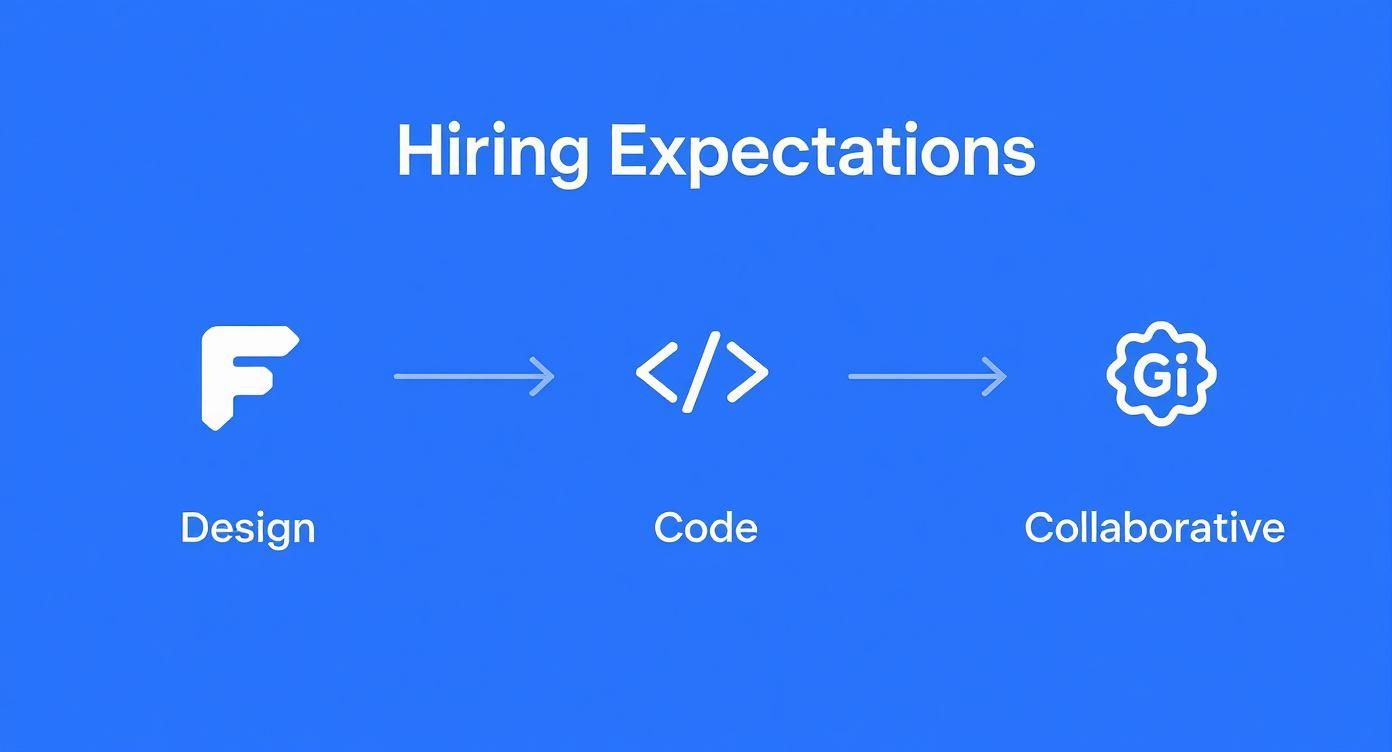
As you can see, writing code is just one piece of the puzzle. It’s about how your work fits into a bigger picture that starts with design and relies heavily on collaboration—all things you will be evaluated on in a job interview.
Your Essential Toolkit for an Entry Level Front End Developer
To get your foot in the door, you need to be fluent in the foundational languages of the web. But more than that, you need to demonstrate the modern way of using them in your portfolio and technical interviews. Below is a breakdown of the absolute must-haves.
| Technology | What It Is | Why It's Essential for a Job |
|---|---|---|
| HTML5 | The standard markup language for creating web pages and web applications. | Go beyond basic tags. Focus on semantic HTML (<main>, <article>, <nav>) to prove you understand accessibility and SEO. A page full of <div> tags is a red flag for hiring managers. |
| CSS3 | The language used to style and lay out web pages. | You absolutely must be comfortable with Flexbox and CSS Grid. These are non-negotiable skills for building the kind of complex, responsive layouts modern companies demand. Expect to be tested on this. |
| JavaScript (ES6+) | The programming language that enables interactive web pages. | This is where you really prove your worth. Mastering modern features like let/const, arrow functions, Promises, and async/await is critical for writing clean, professional-grade code that interviewers look for. |
This isn't just a checklist; it’s the core of what you'll be doing day-to-day. Mastering these fundamentals is the first and most important step to becoming a competitive candidate.
Your ability to write clean, modern JavaScript is a direct signal to interviewers that you can contribute to a professional codebase. They're not just looking for code that works; they're looking for code that their team can understand and build upon.
Picking Your First Framework
Once you’re truly comfortable with vanilla JavaScript, it’s time to pick up a framework. Frameworks give you the structure and efficiency to build complex applications much faster, and they are a staple in almost every modern development shop.
The data doesn't lie: technologies like JavaScript, React, and CSS are essential in over 80% of front-end job listings. For an entry-level developer, the choice usually boils down to the big three:
- React: The undisputed king in terms of popularity. Learning React opens up the largest number of job opportunities, period.
- Vue: Often praised for its gentle learning curve and fantastic documentation. It’s a favorite in the startup world and has a very dedicated community.
- Angular: A full-blown, comprehensive framework backed by Google. You'll often find it powering large-scale enterprise applications.
So, which one should you pick for your career? For most beginners, React is the safest and most strategic bet. Its massive market share means more jobs, more tutorials, and a bigger community to help when you get stuck.
The Tools of the Trade
Being a developer is about more than just writing code. You have to know how to use the tools that make teamwork possible—and these will be listed on every job description.
Mastering version control with Git is absolutely mandatory. There's no way around it. You need to be comfortable with the entire basic workflow: cloning a repository, creating branches, committing your changes, and opening pull requests. This is a day-one skill.
You'll also need a solid understanding of how to work with APIs. This means using JavaScript’s fetch API to request data from a server and then display it on your site—a task you’ll perform constantly in almost any front-end role. Job descriptions, like this one for a web app developer using HTML, JavaScript, and CSS, frequently list these as non-negotiable requirements.
Creating a Portfolio That Opens Doors
So, you've started to build up your technical skills. That's fantastic, but a hiring manager needs to see those skills in action. This is where your portfolio becomes your most valuable asset. It is the single most powerful tool you have to prove you can do the job and secure an interview. It offers tangible, interactive proof of what you can build.
A well-crafted collection of projects is your chance to cut through the noise and stand out from a sea of other applicants.
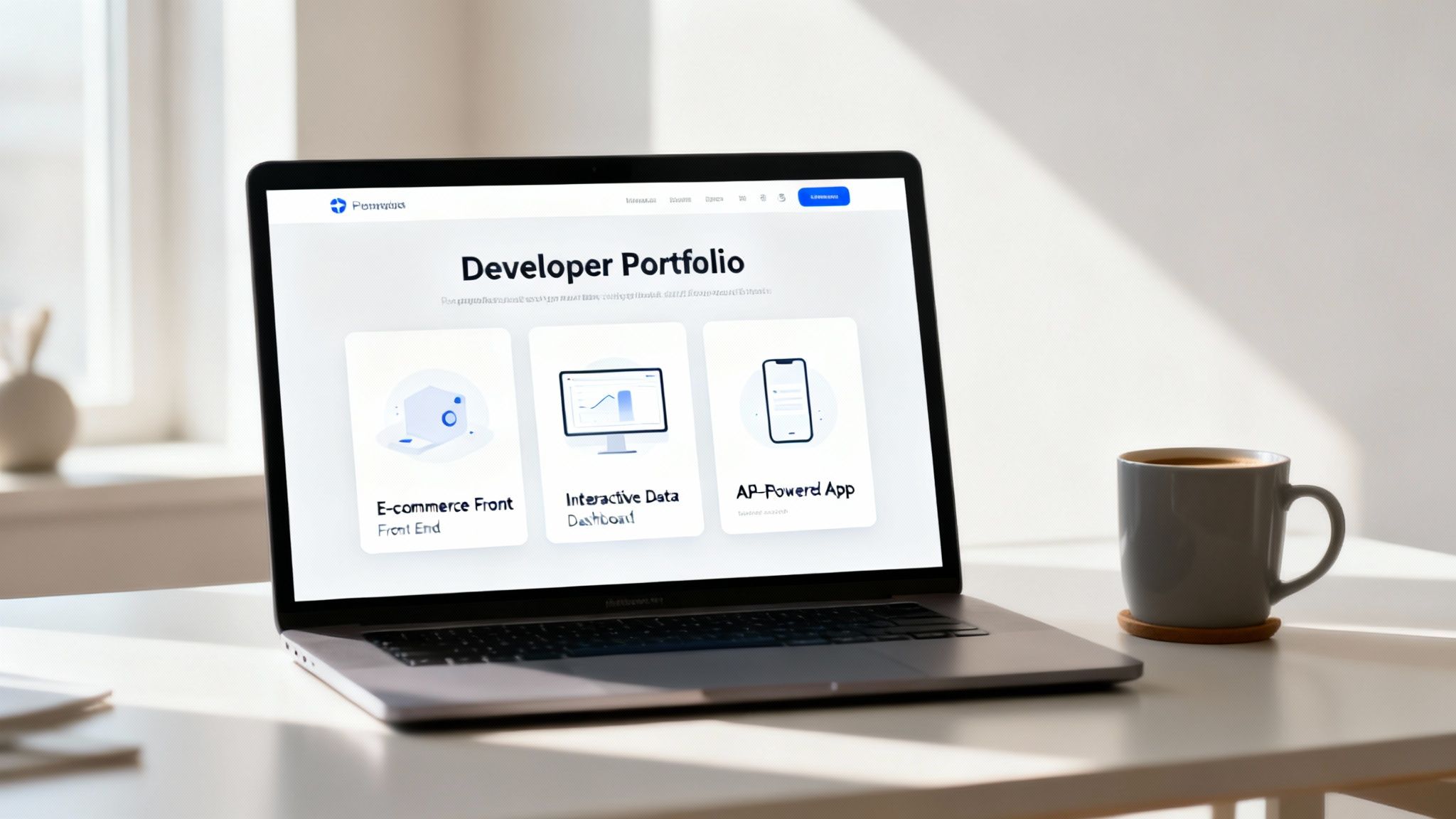
It's really tempting to just load up your portfolio with projects you built following a tutorial—you know the ones, the classic to-do list or the basic weather app. While those are great for learning the ropes, they won't impress a recruiter who has already seen a hundred of them this week. Your goal should be to build projects that show you can think like an engineer and solve real-world problems.
Beyond the Basic Projects
To create a portfolio that actually gets you interviews, you need to showcase projects that demonstrate a deeper level of thinking and technical ability. The key is to prove you can handle complexity, work with external data, and build something with a clear purpose—all things you’ll do on the job.
Here are a couple of ideas to get you thinking beyond the tutorials:
- A functional e-commerce front end: Build the user-facing side of an online store using a public API like FakeStoreAPI. Focus on building out a shopping cart, managing its state, and creating a multi-step checkout flow. This project is perfect for demonstrating your ability to handle complex application state and user interactions—key skills for any web application.
- An interactive data visualization dashboard: Find an interesting public API from a source like NASA or a government open data portal. Fetch that data and display it using a charting library like Chart.js. This shows interviewers you can work with data, handle asynchronous requests, and present information in a clean, compelling way.
A great portfolio tells a story. It's not just a gallery of what you've built; it’s a narrative of how you solve problems, pick up new technologies, and apply your skills to create something genuinely useful. Frame it this way in your interviews.
Documenting Your Work Like a Pro
The code itself is only half the story. How you present your projects is just as important. A sparse GitHub repository with zero context is a huge red flag for hiring managers because it suggests poor communication. This is where a well-written README file becomes your best friend.
Think of your project's README as a mini case study that sells your work to a recruiter. It needs to clearly explain what the project is, why you decided to build it, and the technical hurdles you overcame along the way. It's your chance to walk a recruiter through your thought process before you even speak to them.
A compelling README should always include these things:
- A Clear Project Title and Description: In just a sentence or two, explain what the application does.
- Live Demo Link: Don't make them work for it! Deploy your projects using services like Netlify, Vercel, or GitHub Pages and link to the live version right at the top. A non-working link is an instant rejection.
- Technologies Used: List the key languages, frameworks, and libraries you used to build it.
- Key Features: Use a simple bulleted list to highlight the main functionalities of your app.
- Challenges and Lessons Learned: This is crucial. Briefly talk about a problem you ran into and how you solved it. It shows self-awareness and a real commitment to growth, which is a major green flag for hiring managers.
This level of documentation and polish shows you’re a professional with strong communication skills—exactly the kind of qualities that hiring managers for roles like this full-stack developer with a front-end focus are looking for.
How to Craft a Standout Developer Resume
Before a hiring manager ever reads your name, your resume has to get past the digital gatekeeper. Most companies rely on an Applicant Tracking System (ATS) to do the first round of cuts, meaning your application won't even reach a human unless it’s optimized with the right keywords.
This means you absolutely have to tailor your resume for every single job you apply to. Seriously, don't skip this step. Comb through the job description for the entry level front end developer role you're targeting. Look for specific skills they mention, like “React,” “API integration,” or “responsive design,” and then weave those exact phrases into your skills list and project descriptions. It might feel tedious, but it’s the single best way to beat the bots and get your resume seen.
Showcasing Impact Over Tasks
Okay, so your resume made it past the ATS. Now, a real person is looking at it, and you've got maybe six seconds to grab their attention. This is where you need to stop listing what you did and start showing the impact you made.
"Built a website using React" is forgettable. It tells them nothing. Instead, think like a storyteller and use the STAR method to frame your accomplishments. It’s a simple framework that helps you build a compelling narrative around your work, which you can also use in interviews.
Here’s how it breaks down:
- Situation: What was the project? What was the problem you were trying to solve?
- Task: What was your specific goal? What were you responsible for?
- Action: What did you actually do? What technologies did you use to get it done?
- Result: What happened in the end? This is where you bring in the numbers and quantify your success.
Let’s reframe that boring example. Instead of "built an e-commerce site," try this: "Developed a responsive e-commerce front-end (Situation) to improve the mobile user checkout process (Task). I used React and Redux Toolkit to build reusable UI components and manage the shopping cart's state (Action), leading to a 40% faster page load time and a seamless experience on all devices (Result)."
See the difference? One is a passive statement; the other is a powerful story that showcases your skills and your ability to deliver results.
Your LinkedIn Profile is Your Digital Handshake
Think of your LinkedIn profile as your professional landing page. After a recruiter glances at your resume, it's the very next place they'll go to learn more about you. It needs to be sharp, professional, and aligned with your career goals.
Start with your headline. "Software Developer" is too generic. Get specific. Something like "Front End Developer | React, TypeScript & CSS | Seeking Entry-Level Roles" immediately tells recruiters who you are, what you do, and that you're actively looking for a job.
Don't just list your projects—show them off. Use LinkedIn's "Featured" section to link directly to your live project demos and their GitHub repositories. This turns your profile into a mini-portfolio, letting recruiters see your work in action with just one click and increasing your chances of getting an interview.
The number of developers is climbing fast—it's expected to hit 28.7 million by 2025. A huge chunk of that growth is from new talent just entering the field. A polished, professional online presence isn't just nice to have; it's essential for getting noticed in such a crowded market. If you're curious, you can dig into more frontend development statistics that show just how competitive things are getting.
Acing the Front End Developer Interview

This is it—the final stage where your resume and portfolio get their moment in the spotlight. Nailing the interview process is about more than just knowing your stuff; it’s about sharp preparation, clear communication, and having a game plan for each step. Getting this right is what turns a strong candidate into the team's newest hire.
Most companies use a multi-stage process, and it usually kicks off with a non-technical phone screen. Think of this initial chat, typically with a recruiter, as a high-level filter. They want to hear your story in your own words—your passion for coding and what drew you to their company. Get a concise "elevator pitch" ready and be prepared to talk about your best projects with genuine excitement.
Navigating the Technical Challenge
Once you're past the initial screen, it's time for the technical assessment. This usually comes in one of two flavors: a live coding session or a take-home project. While they test different skills, the one thing that matters in both is how well you communicate.
During a live coding challenge, remember they're watching your thought process just as much as your final code. Talk out loud. Explain what you’re thinking, the approach you’re about to take, and why you believe it's the right move. If you hit a wall, don't just go silent. Articulate the problem you've run into and what you might try next. This shows you can collaborate and problem-solve under pressure.
A take-home project is different. It’s a test of your ability to build a small, functional app on your own.
- Scrutinize the requirements: Don't just skim the prompt—read every single detail and deliver on it.
- Write clean, understandable code: A logical project structure, clear variable names, and helpful comments go a long way.
- Document everything: A simple
README.mdfile that explains your technical choices and how to run the project is a huge sign of professionalism. It shows you respect the reviewer's time.
The point of the technical interview isn't to find a flawless coder. It's to find a problem-solver who can collaborate. Hiring managers want to see how you think, how you handle pressure, and how you communicate when you're stuck.
Answering Behavioral Questions
The final round is often a behavioral interview, designed to see if you’ll mesh with the team culture. Interviewers use questions about your past to get a feel for how you’ll perform in the future. Be ready for prompts like, “Tell me about a time you had to learn a new technology on a tight deadline,” or “Walk me through a difficult bug you squashed and how you did it.”
This is another great place to use the STAR method (Situation, Task, Action, Result) to frame your answers. It helps you tell a clear, compelling story that grounds your skills in a real-world context. Above all, be honest, be yourself, and let your enthusiasm for learning and teamwork shine through.
Knowing your value is also a crucial part of this last step. For an entry level front end developer, compensation can vary, but Glassdoor data shows an average salary hovering around $82,693 per year in the United States. With the field expected to see about 15,000 new openings annually, you're stepping into a high-demand market. Do some digging on front-end developer salary trends to walk into any salary discussion with confidence.
Common Questions on Becoming a Front End Developer
Stepping into a new career path always brings up a ton of questions. If you're aiming to become an entry level front end developer, getting straight answers is the best way to move forward with confidence. Let's dig into some of the most common questions and concerns I hear from people just starting out.
Do I Need a Computer Science Degree
Honestly? No. While a CS degree certainly doesn't hurt, it is absolutely not a prerequisite for landing a great front-end job. These days, hiring managers are far more interested in what you can do, not just what you've studied.
A strong portfolio is your best asset. When you can show off real, working projects that you've built from the ground up, it speaks volumes. A collection of well-designed applications using modern HTML, CSS, JavaScript, and a framework like React is concrete proof you have the skills to contribute from day one. That’s what gets you hired.
How Long Does It Take to Get a Job
This one really depends on you—your background, how much time you can dedicate, and how you approach learning. For someone starting from zero and staying focused, it typically takes anywhere from 6 to 18 months to become job-ready. After that, the actual hunt for a job can take another 3 to 6 months.
The key isn't cramming; it's consistency. Think of it as a marathon, not a sprint. A steady, disciplined routine of coding, building, and networking will get you much further than sporadic, intense study sessions. This long-term commitment is what builds a career.
Everyone struggles with imposter syndrome, especially at the beginning. Just remember, every senior developer you admire was once exactly where you are now. See challenges as learning opportunities, not as proof you don't belong. This growth mindset is a key trait that hiring managers look for.
Should I Learn a Framework Before Mastering JavaScript
This is a big one, and the answer is always the same: master vanilla JavaScript first. It's non-negotiable for long-term career success.
Frameworks like React, Vue, and Angular are just tools built on top of JavaScript. If you don't have a rock-solid grasp of core JS concepts, you'll constantly hit walls. You won't understand why the framework behaves the way it does, and debugging will feel like guesswork.
A deep understanding of JavaScript fundamentals—things like asynchronous code, manipulating the DOM, and modern ES6+ features—makes you a much stronger developer. It also makes picking up any new framework down the line infinitely easier, which is critical for career progression in an ever-changing industry.
Ready to find your first role in the exciting world of Web3? At Blockchain Jobs, we connect talented developers like you with top companies in the decentralized space. Explore entry-level and junior front-end developer positions today!