High-Impact Resumes For Web Developers That Land Interviews
Your web developer resume isn't just a list of your skills—it's your ticket to the interview. The only goal is to prove you can solve a company's problems and deliver value. To do that, you must stop thinking like a developer listing tasks and start thinking like a hiring manager hunting for impact and results. Adopting this mindset is the single most important change you can make to write a resume that gets you hired.
Thinking Like A Hiring Manager

Let's be direct: your resume is a sales pitch, and your career is the product. The hiring manager is your target customer, and they are overwhelmed, often sorting through hundreds of applications for one role. You have a tiny window to make your pitch. Studies show they spend an average of just six to seven seconds on the first scan.
In those few seconds, they are not reading your life story. They are pattern-matching, scanning for keywords to answer one critical question: "Will this person make my team stronger and solve our business problems?"
The Six-Second Resume Scan
To get through that initial scan and land in the "interview" pile, you must anticipate what the hiring manager needs to see. They are looking for clear, unmistakable evidence that you can deliver results. This is where showcasing your impact is non-negotiable.
Here’s what a hiring manager is trained to find in that six-second window:
- Your Role & Specialty: Are you a Front-End, Back-End, or Full-Stack developer? Are your core technologies (e.g., React, Node.js, Solidity) immediately visible?
- Hard Numbers: Do any metrics jump out? Percentages, dollar amounts, or performance data that prove your work had a tangible effect.
- Proof of Problem-Solving: Do your bullet points describe how you used your skills to improve something?
Your resume's job is to make these three things impossible to miss. If a recruiter has to hunt for your accomplishments, they won't. They will simply move on to the next candidate.
From Tasks To Tangible Impact
The most common mistake on developer resumes is listing job duties instead of achievements. A resume filled with lines like "Wrote code for the user dashboard" or "Responsible for maintaining the API" signals a junior, task-oriented mindset. It explains what you were assigned, not what you accomplished.
The secret to a killer developer resume is translating technical tasks into business value. Your code doesn't exist in a vacuum—it drives revenue, improves user experience, or boosts efficiency. That is the story your resume must tell to get you the interview.
To understand what hiring teams value, let's break down the key elements they scan for.
Key Elements Of An Impactful Developer Resume
This table outlines the core components that will catch a hiring manager's eye and advance your application to the next stage.
| Resume Component | What Hiring Managers Want To See | Example Focus |
|---|---|---|
| Headline/Summary | A clear, concise title and specialization. | "Senior Full-Stack Engineer (React & Node.js)" or "Web3 Developer (Solidity & Rust)" |
| Technical Skills | A well-organized, scannable list of relevant technologies. | Grouping skills by category (Languages, Frameworks, Databases, Tools). |
| Experience Bullets | Quantifiable achievements showing the results of your work. | "Increased page load speed by 40% by..." not "Worked on performance." |
| Projects & Portfolio | Links to live projects and clean, well-documented code on GitHub. | Highlighting a specific feature and the problem it solved. |
| Keyword Alignment | Terms and technologies that match the job description. | If the JD mentions "REST APIs," make sure that phrase is in your resume. |
By focusing on these areas, you shift the narrative from what you've done to what you can do for your next employer.
Hiring managers are looking for specific, data-backed claims. Instead of a passive "Fixed bugs," a high-impact bullet point is, "Slashed user-reported defects by 50% by implementing root cause analysis for the top four recurring issues."
This shift from describing activity to showcasing outcomes is precisely what separates an average resume from an interview-winning one. This principle applies whether you're a junior dev describing a bootcamp project or a senior architect explaining a system redesign. If you're targeting roles that value this results-oriented mindset, check out positions like this ReactJS/Next.js Developer opening.
Translating Code Into Business Impact
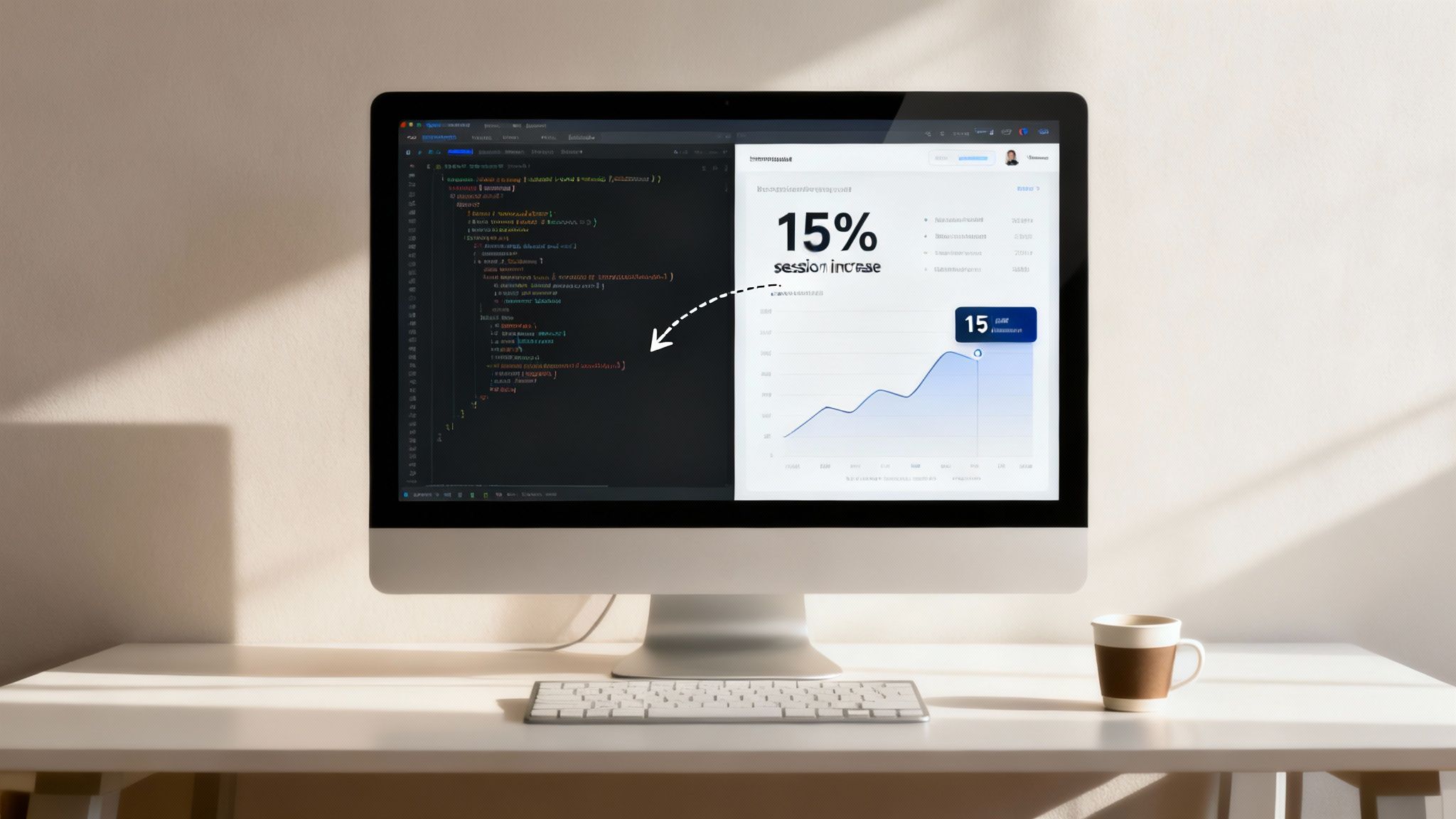
Your code is the engine, but your resume is the key that starts the conversation. Many developers mistakenly list every language and framework they've ever touched in a single, unreadable paragraph. Hiring managers—and the screening software they use—will skip right over that wall of text.
The art is showing how your technical skills drove business outcomes. Companies don't hire you because you know JavaScript; they hire you because you can use JavaScript to solve their problems, ship a great product, or make a process more efficient. This is the mindset shift that gets you interviews.
How to Strategically Showcase Your Skills
The easiest way to improve clarity is to group your skills into logical categories. This isn't just about aesthetics; it shows a recruiter in seconds that you understand the entire development ecosystem and where your expertise lies.
Break up your skills section with clear subheadings for an instant readability upgrade.
- Languages: JavaScript (ES6+), TypeScript, Python, Solidity, Rust
- Front-End: React, Next.js, Vue.js, Svelte, Redux, HTML5, CSS3/Sass
- Back-End: Node.js, Express, Django, Ruby on Rails, Go
- Databases: PostgreSQL, MongoDB, Redis, MySQL
- Cloud & DevOps: AWS (EC2, S3, Lambda), Docker, Kubernetes, Jenkins, Terraform
- Testing: Jest, Cypress, React Testing Library, Mocha
This structure signals that you are organized and have a professional understanding of the stack. If you're applying for a Web3 role, ensure that Solidity, Rust, and Ethers.js are prominently featured.
The Real Power Is in Quantified Achievements
After organizing your skills, the real work begins in your experience section. Here, you must connect your technical abilities to tangible business results. The most common mistake is listing job duties instead of accomplishments.
A task-based bullet says what you did. An achievement-based bullet says what happened because of what you did. That small change is everything.
For every bullet point, ask yourself, "So what?" You built a new feature… so what? You refactored legacy code… so what? The answer must be a measurable outcome that a non-technical manager can understand.
Think in terms of performance boosts, revenue growth, cost savings, or user engagement. For senior roles that demand a high degree of ownership, like this Senior Software Engineer for Consumer Growth position, proving your impact with metrics isn't just a good idea—it's a requirement.
From Vague Tasks to High-Impact Bullets
Let's make this actionable. Here’s how to transform generic, task-based descriptions into bullet points that prove your value and will be talking points in an interview.
Front-End Developer Example
- Before: Wrote React components for the new user dashboard.
- After: Engineered a dynamic, component-based user dashboard with React and Redux, resulting in a 30% reduction in customer support tickets related to data navigation.
The "after" version is powerful. It names the tech (React, Redux), the project (dynamic dashboard), and the direct business impact (fewer support tickets). It proves you solve problems, not just write code.
Back-End Developer Example
- Before: Responsible for the company's main REST API.
- After: Optimized database queries and introduced a caching layer with Redis for the primary REST API, decreasing average response times by 60% and supporting a 2x increase in user traffic.
The "before" is passive. The "after" is active and outcome-driven. You didn't just "manage" the API; you made it drastically better. By explaining how (query optimization, Redis) and quantifying the results, you demonstrate a level of expertise that commands attention.
Full-Stack Developer Example
- Before: Built a new checkout feature for an e-commerce platform.
- After: Architected and deployed a full-stack checkout process using Next.js and Stripe, which streamlined the user journey and directly contributed to a 15% increase in successful transactions.
This is the goal—connecting your technical work directly to the company's bottom line. It shows you’re not just a coder, but a product-minded engineer who understands what matters to the business.
Highlighting Web3 And Blockchain Projects
Quantifying impact in the Web3 space follows the same principle, but the metrics change. Focus on what matters in a decentralized ecosystem: efficiency, security, cost savings, and user adoption.
- Before: Wrote a smart contract for an NFT marketplace.
- After: Developed and deployed a gas-optimized ERC-721 smart contract in Solidity, reducing minting costs for users by an average of 40% and leading to a 25% increase in platform adoption within the first month.
This example is perfect. It highlights your technical skills (Solidity, gas optimization) and shows how those skills directly improved the user experience and grew the platform. When you consistently frame your experience this way, your resume stops being a history of jobs and becomes a portfolio of your career wins.
Getting Past The Robots and Impressing Humans
Before a hiring manager sees your resume, it must pass the first gatekeeper: the Applicant Tracking System (ATS). This software scans your application for specific keywords and a parsable format. If it can't read your resume or doesn't find the terms it's looking for, your application is rejected. No human will ever know you applied.
Your first objective is to create a resume that is machine-readable. This means function over form. Avoid complex layouts with columns, unusual fonts, or images. The ATS is a simple parser, and creative designs will confuse it. Given that over 98% of Fortune 500 companies use an ATS, you cannot afford to skip this step.
Use a clean, single-column layout with standard fonts like Arial, Calibri, or Helvetica. Pro tip: avoid putting critical information like your contact details in the header or footer, as some older systems may ignore those sections.
Speaking The Language of The Job Description
The single most effective strategy to beat the ATS is to tailor your resume with the exact keywords from the job description. The system is programmed to find specific terms, and if you don't include them, you won't rank as a match.
For example, if a job ad lists "experience with RESTful APIs," your resume must contain the phrase "RESTful APIs," not just "API development." If they want someone who understands "CI/CD pipelines," ensure that exact phrase appears in your experience or skills section.
Actionable Tip: Print the job description and highlight every technical skill, tool, framework, and responsibility. Then, strategically incorporate those exact keywords into your resume's bullet points and skills section. This isn't about "stuffing" keywords; it's about clearly demonstrating you are a direct match for the role's requirements.
This one habit will dramatically increase your interview rate.
Designing For The Human Eye
Once you're past the ATS, your resume is on a hiring manager's screen. You have about six seconds to make an impression. Now, scannability and visual clarity are paramount.
A clean, easy-to-read layout is your greatest advantage. Here's how to achieve it:
- Create a Clear Hierarchy: Use bold, distinct headings for major sections like "Experience," "Skills," and "Projects." This helps the reader quickly navigate your career story.
- Embrace White Space: Do not cram information onto the page. Generous margins and spacing make your resume feel professional and easy to digest, rather than dense and intimidating.
- Use Bold Text Strategically: Make your key achievements impossible to miss. Bolding metrics like a "40% reduction in load time" or a specific technology like "React" guides the reader’s eye directly to your most impressive qualifications.
Treat your resume like a user interface. The goal is to make it incredibly easy for the user (the hiring manager) to find the information that proves you are the right person for the job. This is especially true for specialized roles; a recruiter hiring a Web3 Frontend Engineer needs to see terms like Solidity, Ethers.js, or Hardhat in a split second.
A cluttered resume buries your wins. A well-organized one puts them in the spotlight.
Tailoring Your Resume for Every Career Stage
The resume that lands a junior developer their first interview will get a senior developer's application rejected. Your resume is not a static document; it's a dynamic story of your career progression, and it must evolve as you gain experience.
Hiring managers have different expectations at each level. For a junior, they seek potential and a passion for coding. For a mid-level dev, they need proof of execution and increasing responsibility. For a senior, they demand leadership, architectural vision, and a direct link between your work and business success. Here's how to position yourself at each stage.
For The Junior Developer: Prove Your Potential
As a new developer, your primary challenge is the "no professional experience" paradox. Your resume's job is to prove you can do the work, even if you haven't been paid for it yet. This makes your projects section the most critical part of your resume.
Your GitHub profile is your most valuable asset. It is the tangible proof of your skills, and hiring managers will click that link. They are looking for more than just forked tutorial repos; they want to see clean, well-documented code and original projects that demonstrate your problem-solving abilities.
Here’s how to frame your entry-level resume for an interview:
- Treat Your Best Project Like a Job: Give your top project its own entry in your experience section. Use bullet points to showcase what you accomplished. Instead of "Built a MERN stack app," write "Developed a full-stack e-commerce PWA using the MERN stack, implementing JWT for secure user authentication and a responsive, mobile-first design."
- Showcase Your GitHub: Don't just list the link. Call out 1-2 of your best repositories in your projects section. Briefly explain the project's purpose and the tech stack. A clean commit history and a detailed README are massive signals of professionalism.
- Lead with Any Real-World Experience: Even a short internship or a small open-source contribution is gold. Place it at the top of your experience section to show you understand professional development workflows and teamwork.
For The Mid-Level Developer: Show Your Growth
After a few years in the field, the hiring conversation shifts from potential to proven performance. Recruiters are no longer just wondering what you can do; they're evaluating what you have done. Your resume must show that you are more than a ticket-closer; you are a reliable engineer who takes ownership of features from conception to deployment.
This is where you must highlight your increasing responsibilities and the direct impact of your code. You are moving beyond simply implementing assigned tasks.
A mid-level developer's resume should tell a story of increasing autonomy. It needs to show how you've used your skills to make a real difference for your team and the product, justifying your next career step.
No matter your level, some fundamentals always apply.
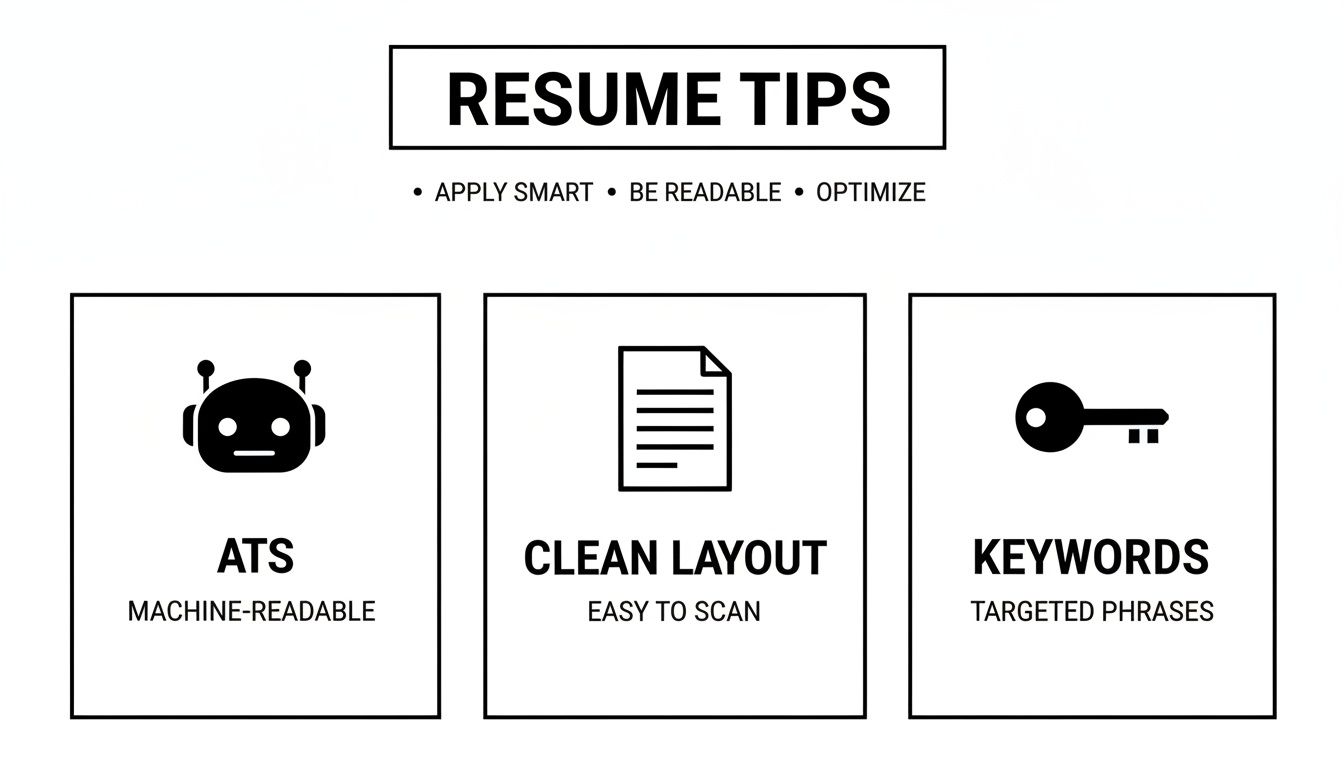
This graphic is a great reminder that optimizing for ATS, keeping your layout clean, and targeting keywords are non-negotiable from your first job to your last.
For The Senior Developer: Demonstrate Leadership and Ownership
At the senior level, your technical skills are assumed. A list of programming languages is not impressive. Hiring managers are now evaluating your ability to lead, mentor, and make high-level decisions that drive business outcomes. Your resume must pivot from a "doer" to a "force multiplier."
The focus must be on architectural decisions, team leadership, and the strategic impact of your work. You are no longer just building features; you are designing systems and elevating the engineers around you.
Here’s what to highlight to land a senior role:
- Technical Leadership: Did you design a new microservices architecture? Explain how it improved scalability or developer velocity.
- Mentorship: Did you onboard junior engineers or establish a code review process that improved code quality across the team? Frame this as a leadership achievement.
- Architectural Impact: "Wrote an API" is a junior bullet point. A senior one is: "Architected and led the development of a new RESTful API gateway, consolidating five legacy services and reducing server costs by 20%."
- Cross-Functional Work: Describe how you collaborated with product managers and designers to define project roadmaps or deliver complex features ahead of schedule.
Don't Forget to Specialize
Beyond your career stage, the specific role you are targeting requires further customization. A front-end resume for a UX-focused team should differ from a Web3 resume for a DeFi protocol.
For a front-end role, emphasize experience with modern frameworks like React or Vue, a deep understanding of accessibility (a11y), and performance optimization metrics. For a Web3 developer role, your skills in Solidity, Rust, and Ethers.js are paramount. Always mirror the language and priorities from the job description to show you are not just a good developer, but the right developer for that specific job.
Your Pre-Submission Resume Checklist

You've done the hard work of translating your accomplishments into compelling bullet points. Now, before you hit "submit," it's time for a final quality check.
This last step is where many developers fail. A single broken link or a typo can undermine an otherwise strong application. Think of this checklist as your final code review—a crucial step to catch small mistakes that make a big negative impression and can cost you an interview.
The Non-Negotiable Proofread
First, proofreading is not optional. Typos are the number one signal of a lack of attention to detail—a fatal flaw for a developer. An effective technique is to read your entire resume out loud, slowly. This forces your brain to process each word individually, helping you catch awkward phrasing and errors you might otherwise miss.
For best results, use a tool like Grammarly and then have a friend review it. After staring at a document for hours, you develop blind spots. A fresh pair of eyes will see what you no longer can.
Final Checkpoint: Is every word spelled correctly? Is the grammar perfect? Does it read clearly and concisely? A "good enough" proofread is not good enough. It must be flawless.
Click Every Single Link
Imagine a hiring manager is impressed by your projects. They click your GitHub link... and get a 404 error. The opportunity is lost. It signals carelessness.
Before sending your resume, you must personally verify every external link. Use an incognito browser window to ensure they work for someone who isn't logged into your accounts.
- GitHub: Does the link go to your profile page with your best work pinned?
- Portfolio Site: Is the site live? Check the load time and open the developer console for errors.
- LinkedIn: Is the custom URL correct and public?
- Project Demos: Do all live demo links open the correct, functioning application?
This five-minute check can be the difference between getting an interview and being ignored.
The Final Red Flag Review
Now, it's time to be ruthless. Read your resume as if you were a skeptical hiring manager with 50 other applications waiting. Your goal is to eliminate anything that wastes their time or appears unprofessional.
For junior developers, if your resume exceeds one page, you are signaling an inability to prioritize information. Cut it down without mercy.
Hunt for these common deal-breakers:
- Irrelevant Hobbies: No one cares that you enjoy hiking unless you built a geo-tracking PWA for your favorite trails. Keep it strictly professional.
- Generic Profile Summary: If your summary says you're a "motivated team player passionate about technology," you have said nothing of value. Replace it with specific skills and accomplishments.
- Unprofessional Email: Your
sk8rboi2005@email.comaddress must be retired. Use a clean, professional format likeFirstName.LastName@email.com. - File Format & Naming: Always submit a PDF. It preserves your formatting across all devices. Name the file professionally, such as
Jane-Doe-Web-Developer-Resume.pdf, notResume_final_v3_final.pdf.
This final review isn't just about cleaning up; it's about ensuring every detail presents you as a polished, competent, and high-value developer ready to make an impact.
You're at the finish line. Run through this table to ensure every component of your resume is optimized to get you an interview.
The Final Resume Sanity Check
| Check Item | Why It's A Non-Negotiable | Status (Ready/Needs Work) |
|---|---|---|
| Flawless Proofreading | Typos suggest a lack of attention to detail—a fatal flaw for a developer. | |
| Working Links | Broken links to your GitHub or portfolio are an instant sign of carelessness. | |
| ATS-Friendly Format | If the system can't parse it, a human will likely never see it. | |
| Tailored Keywords | Your resume must reflect the language and skills in the job description. | |
| Quantifiable Metrics | Numbers show impact. "Increased performance by 30%" beats "Improved performance." | |
| Consistent Formatting | Clean, consistent design makes it easy for recruiters to scan and read. | |
| Professional File Name | John-Smith-Resume.pdf looks professional. MyResume.pdf does not. |
Once you've gone through this checklist and everything is marked "Ready," you can finally submit your application with confidence. Good luck
Answering Your Top Resume Questions
Even experienced developers can get tripped up by the details of resume writing. Let's address the most common questions to ensure your resume gets a second look and not discarded.
Is the One-Page Resume Rule for Real?
Yes, for anyone with less than 10 years of experience, the one-page resume is a firm rule. You must remember that recruiters are scanning, not reading.
A two-page resume from a junior or mid-level developer is a major red flag. It signals that you cannot prioritize and distill information—a critical skill for any engineer. Sticking to one page forces you to be concise and highlight only your most relevant and impressive achievements.
If you are a principal engineer or senior architect with a long, distinguished career, a second page may be acceptable. However, even then, the first page must stand on its own as a compelling summary of your value. Assume page two will never be read.
How Do I Actually List Personal Projects?
Personal projects are your secret weapon, especially early in your career. They provide tangible proof of your passion and skills outside of a professional setting. Do not just bury a GitHub link in your contact info. Create a dedicated "Projects" section and treat your best project as if it were a real job.
For each key project, include:
- The Project Name and a live demo link: Make it easy for them to see your work in action.
- A link to your GitHub repo: This is your opportunity to showcase clean, well-documented code.
- Two or three powerful bullet points: Describe what you built using the same action-verb, metric-driven formula from your professional experience. Instead of "Built a to-do app," write, "Engineered a task management PWA with offline capabilities using IndexedDB, achieving a 90% faster load time on repeat visits."
A well-documented project with clear outcomes is often more impressive than a vague bullet point from an old internship. It shows initiative and a genuine love for your craft.
Do I Still Need a Summary Statement?
The old-fashioned "Objective" statement is obsolete. It wastes valuable space. Replace it with a powerful, 2-3 line professional summary located directly under your name and contact information.
Think of this as your resume's headline—it immediately tells the reader who you are and what value you provide, setting the tone for the rest of the document.
For example: "Senior Full-Stack Engineer with 7+ years of experience building scalable, high-traffic applications with React, Node.js, and AWS. Specializing in performance optimization and API design." In one sentence, the reader knows exactly what you offer.
Ready to put these insights into action and land your next role in the decentralized world? Blockchain Jobs is the number one job board for opportunities in Web3, DeFi, and more. You can explore thousands of curated positions and get in front of the top companies building the future. Find your next blockchain job today!