ERC20 vs ERC721: Which Token Standard Wins You the Job?
You're probably in one of two spots right now. You're either preparing for a smart contract interview and keep seeing the same shallow ERC-20 versus ERC-721 question, or you're choosing what to build next and you know the answer affects your portfolio, your resume, and the kind of jobs you'll qualify for.
My advice is blunt. Stop treating ERC-20 vs ERC-721 as a beginner topic. Hiring managers don't. They use it to test whether you understand asset modeling, contract design, gas tradeoffs, and product architecture. Your answer tells them what kind of engineer you are.
Here's the fast comparison before we go deeper:
| Dimension | ERC-20 | ERC-721 |
|---|---|---|
| Asset type | Fungible | Non-fungible |
| Core mental model | Currency, points, voting units | Ownership of unique items |
| Best fit | DeFi, payments, governance, staking | Art, collectibles, game items, ticketing, unique RWAs |
| Balance model | Quantity per address | Ownership by token ID |
| Key interview signal | Can you model interchangeable value? | Can you model unique ownership and metadata? |
| Transfer logic | Simpler | Safer but more complex |
| Gas profile | Lower | Higher |
| Career path | Protocols, DeFi, tokenomics, infrastructure | NFT platforms, gaming, creator tools, digital identity |
The Interview Question That Defines Your Web3 Career
The final interview often comes down to one deceptively simple prompt: explain the difference between ERC-20 and ERC-721, then justify when you'd use each.
That question isn't checking whether you memorized token definitions. It's checking whether you can make architectural decisions under product constraints. In smart contract interviews, candidates are expected to explicitly choose ERC-20 for fungible utility tokens like currencies and ERC-721 for unique, non-divisible assets like digital art, and that distinction is a primary screening criterion for Blockchain Developer and Web3 Backend Engineer roles, as noted in this interview-focused breakdown of ERC-20 vs ERC-721.
If you answer with “ERC-20 is fungible and ERC-721 is for NFTs,” you're still at the surface. A strong candidate goes further:
- Product reasoning: “I'd use ERC-20 when every unit must be interchangeable and divisible.”
- Data model reasoning: “I'd use ERC-721 when each asset needs identity, ownership history, and unique metadata.”
- System reasoning: “The standard changes wallet behavior, marketplace logic, indexing, gas costs, and audit scope.”
- Career reasoning: “My specialization follows from the systems I want to build.”
Practical rule: In interviews, don't define the standards first. Start with the asset model and user behavior. Then map that to the standard.
That structure makes you sound like a senior engineer, not a tutorial repeater.
You should also treat this answer as a communication test. If you're polishing how you present your background, these expert tips to impress in interviews are useful because they help you frame technical depth around business value instead of dumping raw jargon.
What interviewers are really screening for
They want to know whether you can answer four questions quickly and clearly:
- What is the asset? Interchangeable or unique.
- How is ownership tracked? By balance or by token ID.
- How will users interact with it? Trading, staking, voting, collecting, listing, redeeming.
- What systems need to support it? Wallets, marketplaces, indexers, frontends, auditors.
Miss any of those and you sound incomplete. Hit all four and you sound employable.
Fungibility vs Scarcity The Philosophical Divide
Most developers learn ERC-20 and ERC-721 as a taxonomy problem. That's too shallow. The fundamental divide is economic.
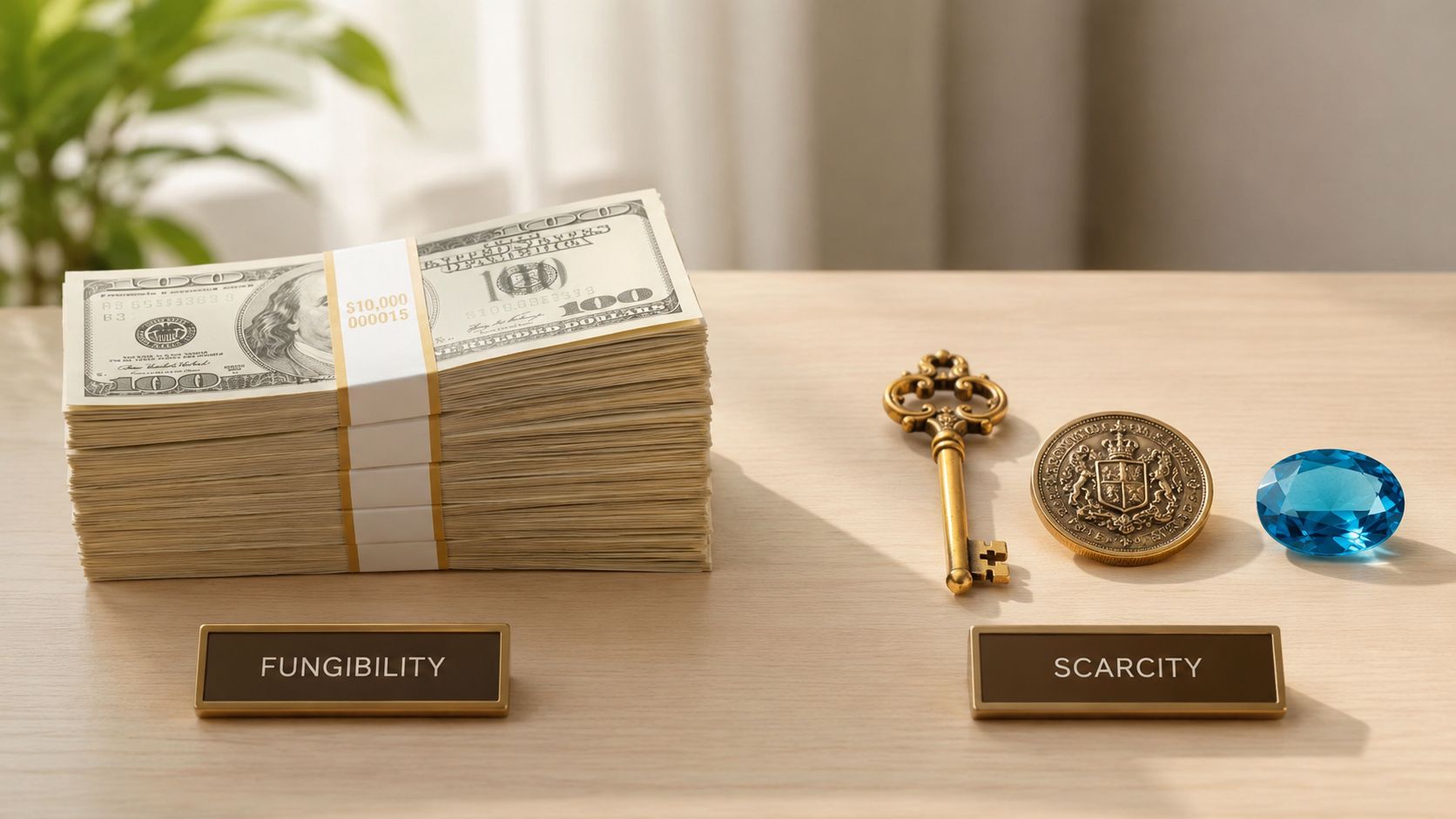
ERC-20 models sameness. One token unit can substitute for another token unit. That's why it fits payments, governance, staking, liquidity pools, and any system where equality between units matters more than identity.
ERC-721 models individuality. Each token is its own record. It isn't just “one token.” It's token ID 184, with its own owner, transfer history, and often its own metadata.
Why ERC-20 became the DeFi default
ERC-20 won because finance needs interchangeable units. You can't build efficient swaps, lending markets, or voting systems if every unit behaves like a snowflake. ERC-20 remains the dominant token standard for ICO launches, powering over 80% of all token sales on Ethereum since 2017, which reflects its foundational role in DeFi according to this ERC token standards analysis.
That dominance wasn't accidental. ERC-20 gave developers a common interface with six core functions: balanceOf, transfer, transferFrom, allowance, approve, and totalSupply. Standardization made tokens easy to integrate across dApps and exchanges.
Why ERC-721 changed digital ownership
ERC-721 matters because uniqueness needs first-class support. If you're building event tickets, in-game items, domain-like assets, membership collectibles, or tokenized claims on singular objects, you need identity at the token level.
A useful shortcut:
- ERC-20 asks: how much does this address own?
- ERC-721 asks: who owns this exact item?
That difference sounds small. It changes everything.
Scarcity only works when the system can prove that one item is not interchangeable with another.
The career implication most developers miss
This philosophical split maps directly to two engineering mindsets.
A developer who prefers ERC-20 work usually likes systems with liquidity logic, economic incentives, and capital efficiency. A developer who prefers ERC-721 work usually likes ownership systems, metadata models, distribution mechanics, and user-facing asset experiences.
Neither path is better by default. But pretending they're the same path is a mistake. If you enjoy protocol mechanics, master ERC-20 first. If you enjoy consumer products, marketplaces, gaming, or identity, ERC-721 is the stronger bet.
Technical Deep Dive Contract Interfaces and Gas Costs
An interviewer asks you to compare ERC-20 and ERC-721 at the contract level. Your answer signals your career track within two minutes. If you explain interfaces, state layout, and gas tradeoffs with precision, you sound ready for protocol work, product engineering, or audits. If you stay at the level of “fungible vs non-fungible,” you sound junior.
ABI differences that change how you code
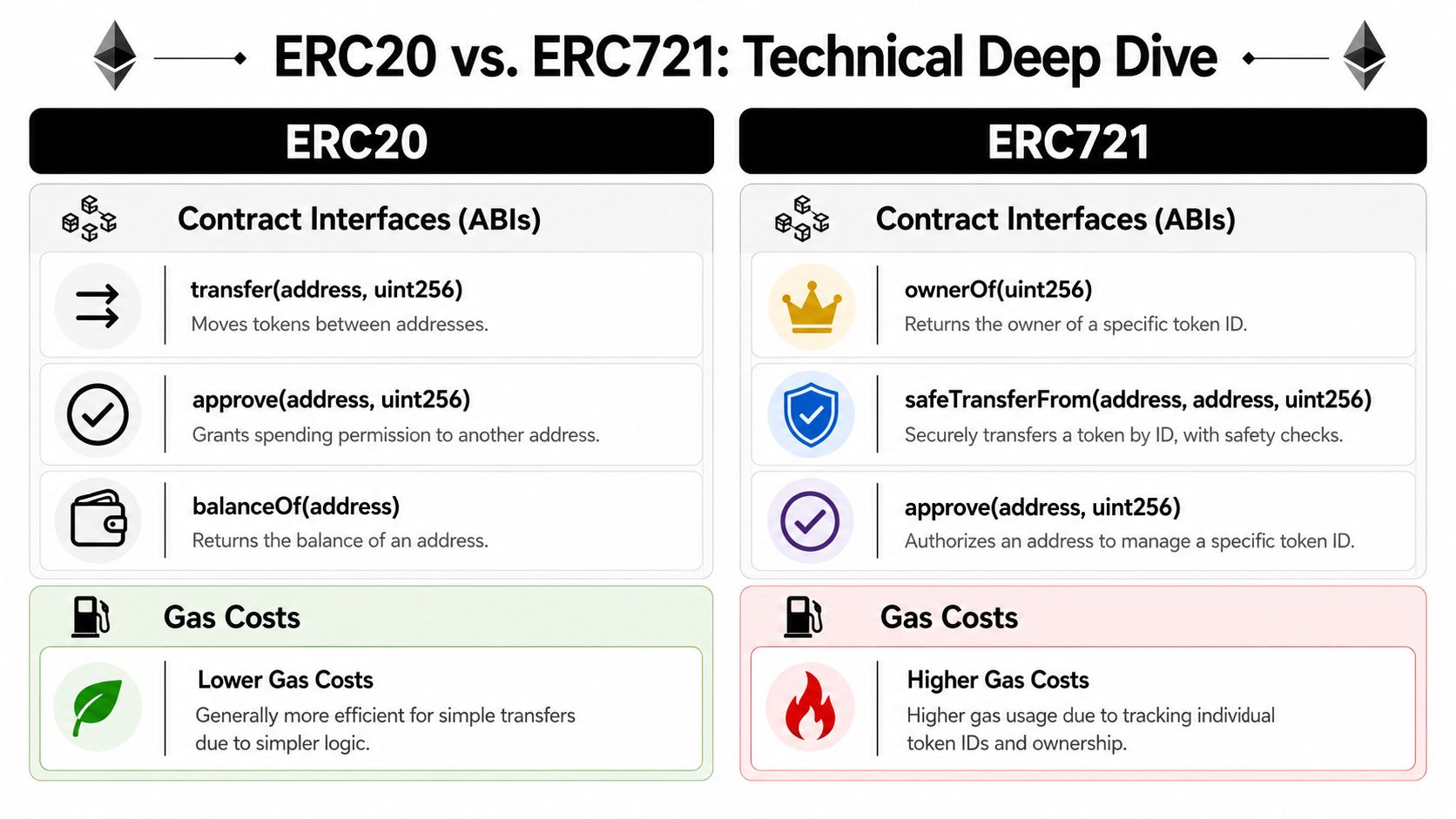
The overlap in method names confuses early-career developers. Hiring managers use that confusion to test whether you understand semantics or just memorize signatures.
| Concern | ERC-20 pattern | ERC-721 pattern | Why it matters |
|---|---|---|---|
| Ownership query | balanceOf(address) |
ownerOf(uint256) |
ERC-20 tracks quantities. ERC-721 tracks a specific asset. |
| Transfer | transfer(address,uint256) |
safeTransferFrom(address,address,uint256) |
ERC-721 adds receiver checks because the token can get stuck in contracts. |
| Approval | approve(address,uint256) |
approve(address,uint256) |
Same name. Different meaning. |
| Delegated movement | transferFrom(address,address,uint256) |
transferFrom(address,address,uint256) |
ERC-20 moves an amount. ERC-721 moves one token ID. |
That difference matters in code review and in interviews.
In ERC-20, approve and transferFrom usually exist to let another contract spend a user's balance within an allowance. Routers, vaults, staking contracts, and payment flows depend on that pattern. In ERC-721, approval is permission over a specific token ID or all assets owned by an address through operator approval. That is a custody and ownership model, not a spending model.
A good engineer says that plainly.
State layout tells you the attack surface
balanceOf(address) implies aggregated balances. The contract cares about arithmetic, allowances, supply changes, and event correctness.
ownerOf(uint256) implies per-token state. Now you care about token existence, ownership transitions, approval invalidation, mint sequencing, burn behavior, metadata consistency, and receiver compatibility. The code surface expands fast, and so does the number of ways a product team can introduce bugs.
That is why ERC-20 mastery often leads toward DeFi protocol engineering, treasury systems, and execution paths where gas efficiency and accounting correctness decide whether the product works. ERC-721 mastery often leads toward consumer apps, gaming, marketplaces, and identity systems where transfer safety, metadata design, and asset lifecycle rules dominate.
If you want to work in audits, this distinction is career-defining. Roles in smart contract auditing and blockchain security engineering reward engineers who can look at an interface and immediately infer failure modes.
Audit lens: ERC-20 interviews often probe allowance abuse, fee-on-transfer edge cases, rebasing assumptions, and access control around minting. ERC-721 interviews often probe approval scope, unsafe receiver flows, reentrancy around hooks, duplicate mint paths, and broken ownership bookkeeping.
Gas costs are architecture, not trivia
ERC-20 transfers are usually cheaper because the contract updates balances for interchangeable units. ERC-721 transfers often cost more because the contract handles token-specific ownership and, in safe transfers, checks whether the recipient contract implements the required receiver interface. OpenZeppelin's ERC-721 API documents that safeTransferFrom calls IERC721Receiver.onERC721Received on contract recipients, which adds execution and failure paths that ERC-20 does not have by default.
That difference shapes products. It also shapes hiring.
Protocol teams want engineers who understand why fungible balance accounting supports high-frequency transfers, reward distribution, and liquidity movement with less overhead. NFT and consumer product teams want engineers who understand why identity-rich assets cost more to mint, move, and index, and how to design around that cost instead of fighting it.
What this means in real engineering decisions
Choose ERC-20 if the system optimizes for throughput, pooling, accounting, or repeated transfers:
- Staking and reward distribution
- Governance balances
- Liquidity pools and routing
- In-app credits or usage units
- Payment-like flows
Choose ERC-721 if the product depends on token-level identity and lifecycle rules:
- Tickets with seat-level uniqueness
- Game items with distinct attributes
- Membership passes with individual history
- Claims on singular assets
- Collectibles where provenance matters
Trying to use ERC-721 as a payment rail usually creates unnecessary gas cost, indexing complexity, and bad UX. Trying to use ERC-20 where users care about the exact asset usually destroys provenance and weakens the product.
What interviewers actually screen for
The strongest answer does not stop at “ERC-20 is fungible and ERC-721 is non-fungible.” It connects contract mechanics to product constraints and job value.
A senior candidate says:
“ERC-20 is balance-based accounting. ERC-721 is identity-based ownership. ERC-20 fits systems that need repeated movement of interchangeable units and tight integration with DeFi contracts. ERC-721 fits systems where each asset needs its own ownership record, approval path, metadata, and transfer safety checks. That means different gas profiles, different failure modes, and different engineering specialties.”
That answer gets attention because it sounds like someone who has built these systems, reviewed them, and can explain why the standard choice changes the whole stack.
Use Cases and Product Design Implications
Token standards are product decisions disguised as smart contract choices.
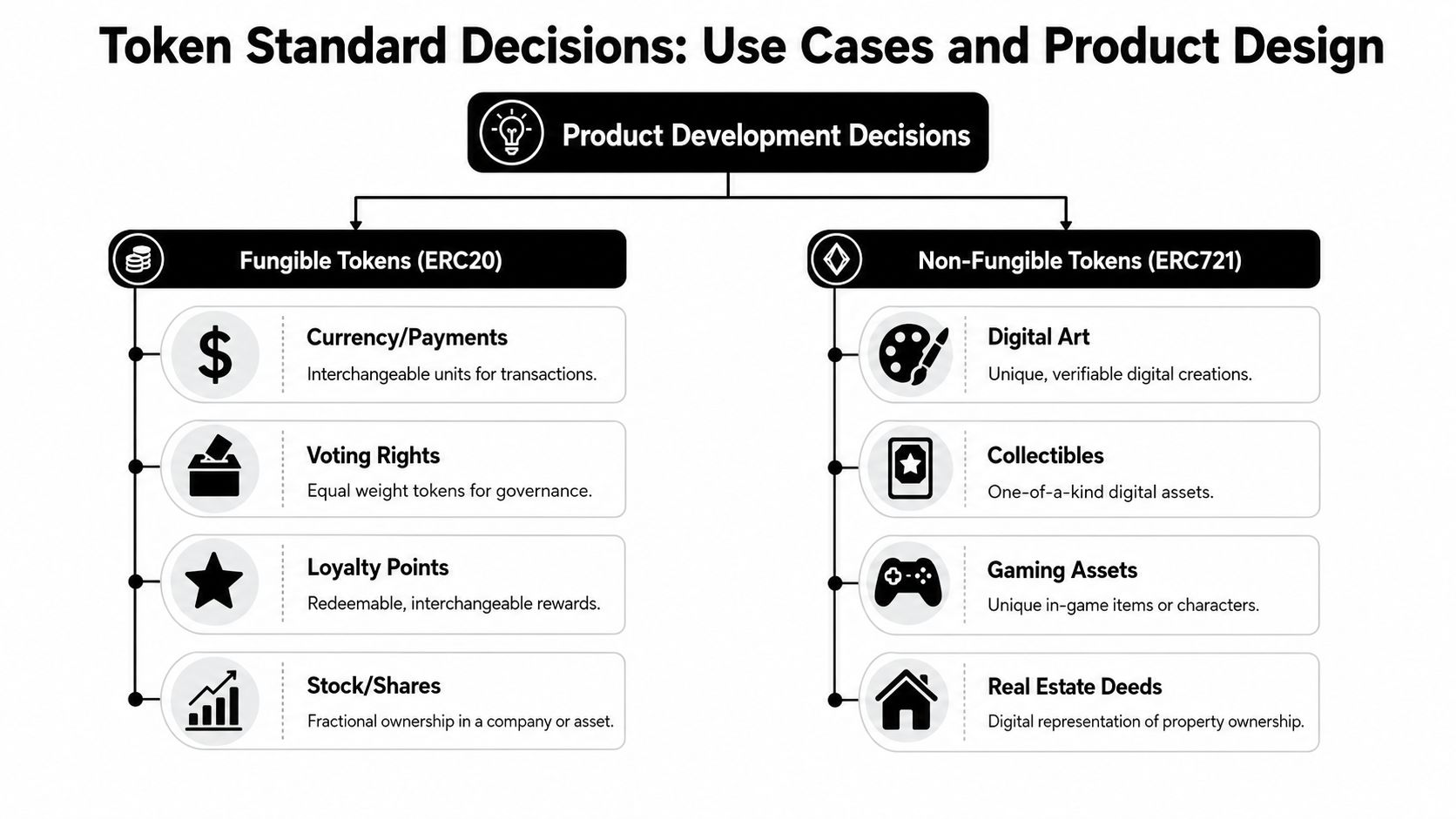
The wrong choice won't just make your contract awkward. It will force ugly frontend workarounds, break user expectations, and create operational pain across trading, analytics, and support.
Products that should almost always use ERC-20
A DAO governance token is the cleanest example. If voting power depends on interchangeable units, use ERC-20. One token represents one voting unit. Treasury systems, staking modules, and exchange integrations all become easier.
The same logic applies to:
- Utility tokens for access or usage credits
- Loyalty systems where points should be redeemable and interchangeable
- Protocol incentives distributed to users or liquidity providers
- Fractionalized economic rights where divisibility matters
If users ask “how many do I have?” more than “which one do I own?”, ERC-20 is usually correct.
Products that break without ERC-721
Ticketing is a strong example. A concert seat in row A, seat 12 isn't interchangeable with general admission or with row B, seat 3. The asset needs unique identity.
Gaming is even clearer. If your game has player-owned swords, skins, land plots, or characters with distinct traits, ERC-721 gives you ownership per item and metadata hooks for rendering and market display.
A few practical examples:
| Product | Better fit | Reason |
|---|---|---|
| DAO governance token | ERC-20 | Interchangeable voting units |
| In-game gold | ERC-20 | Currency behavior |
| Legendary sword | ERC-721 | Unique identity and ownership |
| Event seat ticket | ERC-721 | One seat, one token |
| App reward points | ERC-20 | Redeemable and divisible units |
| Property deed tokenization | ERC-721 | Unique claim record |
Product managers and engineers need the same framing
This isn't just a Solidity choice. It's a user model choice.
If you choose ERC-20, you're designing around liquidity, divisibility, and predictable balances. Users expect wallet balances, easy swapping, and staking compatibility.
If you choose ERC-721, you're designing around identity, rarity, and object-level interaction. Users expect galleries, item pages, provenance, and listing flows.
A token standard is a UX decision before it becomes a contract decision.
That's why strong engineers can talk to product managers without getting lost in EIP trivia.
The RWA and hybrid design wrinkle
Real-world asset tokenization often exposes the limits of simplistic thinking. A fractionalized real estate pool may use fungible logic for shares. A deed-like representation of a specific property unit fits unique-asset logic better.
The key isn't to memorize categories. It's to map the legal and product reality to the on-chain representation. If the object itself is singular, ERC-721 often fits. If users need interchangeable slices of exposure, ERC-20 often fits.
Developers who can explain that tradeoff clearly tend to stand out because they're not just coding contracts. They're modeling ownership correctly.
Ecosystem Integration Wallets Marketplaces and Indexers
Most developers underestimate this section until they have to ship.
Your token standard determines how wallets display assets, how marketplaces list them, and how indexers reconstruct your product state. That's why ERC-20 vs ERC-721 affects far more than the contract ABI.
Wallet behavior changes with the standard
MetaMask and similar wallets usually present ERC-20 assets as balances. The user sees a token symbol, a quantity, and maybe a fiat estimate. That works because fungible assets compress well into a number.
ERC-721 assets need a different interface. Wallets and portfolio apps usually place them into NFT-specific views with thumbnails, collection grouping, and token-level detail. A user isn't just holding “12 units.” They're holding specific assets with identity.
That distinction matters if you want to work on wallet platforms or asset interfaces. Product and mobile engineers building wallet experiences need to thoroughly understand both standards, especially when ownership, media rendering, and transaction signing all behave differently. Roles in this category include wallet platform engineering positions like this MetaMask-related opening.
Marketplace architecture isn't interchangeable
A DEX such as Uniswap handles ERC-20 assets through liquidity pools. The system prices interchangeable units and routes swaps through pooled liquidity.
An NFT marketplace behaves differently. It usually deals with individual listings, collection-level metadata, trait-based browsing, and token-specific ownership history. The backend logic, indexing strategy, and caching layers all reflect that object-level uniqueness.
That has direct implications for engineers:
- ERC-20-heavy systems favor expertise in router interactions, approvals, slippage handling, and pooled asset math.
- ERC-721-heavy systems favor expertise in listing state, collection contracts, metadata refreshes, rarity filters, and ownership sync.
Indexing and analytics are fundamentally different
If you use The Graph or build your own event indexing pipeline, you'll write different data models for each standard.
For ERC-20, you usually care about:
- balances by address
- total supply logic
- transfer history by amount
- allowances and spend behavior
For ERC-721, you usually care about:
- token ID ownership
- metadata references
- collection relationships
- approval events on unique assets
- transfer history per object
Developers who can decode Transfer and Approval event logs cleanly become much more useful in interviews because they can bridge on-chain data and product behavior. That's one reason engineers who understand token standards often transition well into analytics, infra, and backend roles.
Why cross-ecosystem thinking matters
Good engineers also look beyond Ethereum-native assumptions. If you're studying how blockchain ecosystems expand, user experience and infrastructure support become just as important as token design. This piece on analyzing Ton blockchain expansion is useful because it highlights how ecosystem growth changes the demands on wallets, apps, and developer tooling.
The contract is only half the product. Wallet support, market structure, and indexing determine whether users can actually use what you built.
If you want to stand out in interviews, say that plainly. It shows systems thinking.
Choosing Your Specialty For Your Web3 Career
You shouldn't ask only which standard is “better.” You should ask which one builds the career you want.
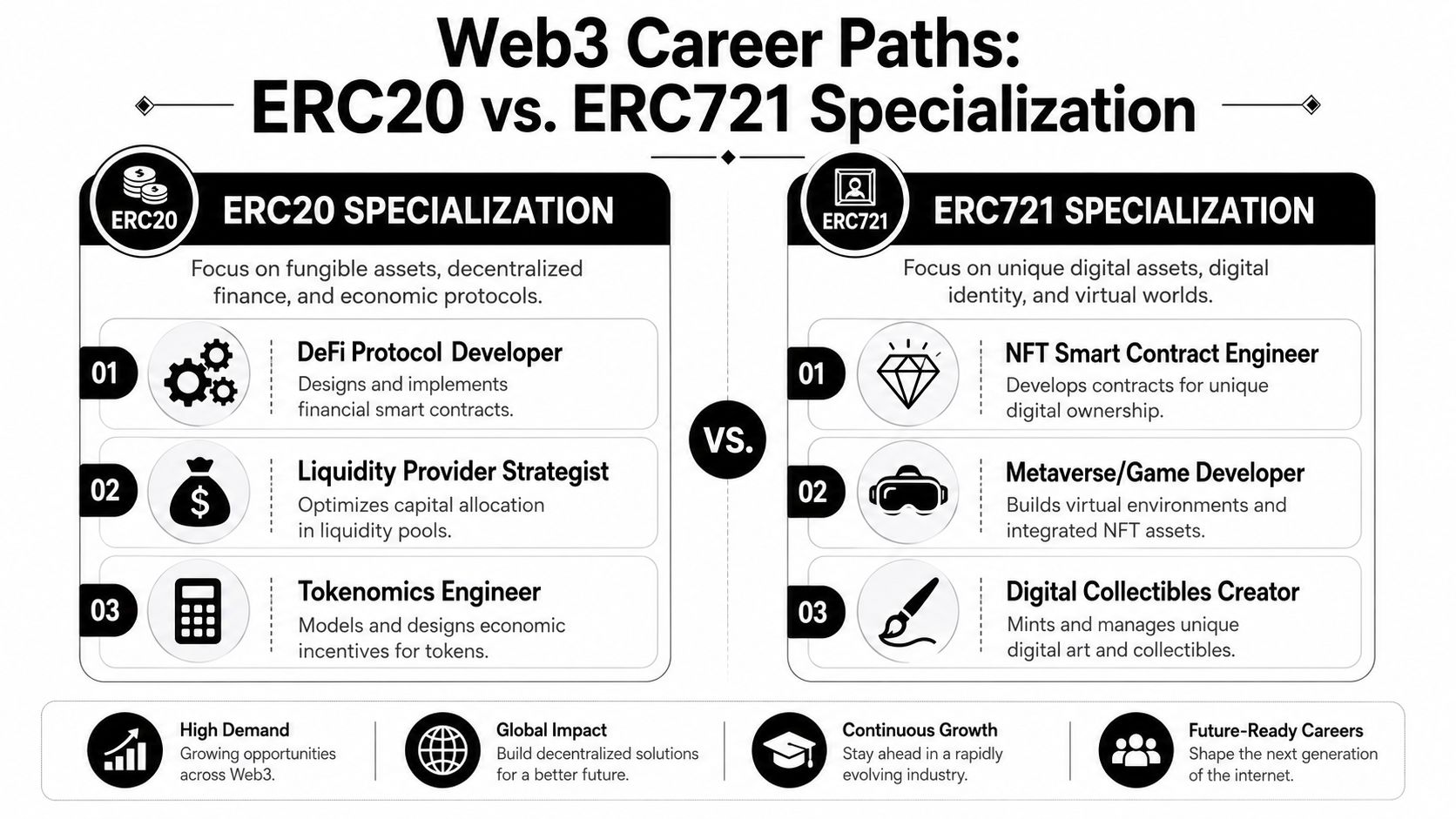
The ERC-20 specialization path
If you specialize in ERC-20, you're signaling fit for DeFi protocol engineering, tokenomics work, and capital-efficient system design.
You'll spend more time on:
- allowance flows
- staking and vesting contracts
- governance mechanics
- treasury movement rules
- liquidity and economic design
- audit-heavy infrastructure
This path fits engineers who like precision, protocol safety, and financial abstractions. If you enjoy reading router contracts and tracing asset movement through multi-step transactions, ERC-20 is probably your lane.
The ERC-721 specialization path
If you specialize in ERC-721, you're signaling fit for NFT infrastructure, gaming, creator tools, digital identity, and ownership-centric product design.
You'll spend more time on:
- minting mechanics
- collection architecture
- token metadata
- gas-conscious drops
- marketplace compatibility
- asset display pipelines
- ownership analytics
Recent job market data shows a 45% surge in postings for “ERC721 Smart Contract Engineers,” with senior roles commanding $150,000 to over $250,000, and “Ethereum-based token standards” functions as a mandatory resume keyword tied to stronger compensation outcomes, according to this Web3 hiring analysis focused on ERC-20 vs ERC-721 careers.
That tells you something important. ERC-721 expertise is no longer niche hobby knowledge. It's monetizable specialization.
Resume positioning that actually works
Don't write “familiar with ERC standards.” That says nothing.
Write your profile around the systems you can build.
A stronger ERC-20 framing:
- Fungible asset systems
- DeFi protocol development
- Allowance and transfer flow security
- Governance and staking contract design
A stronger ERC-721 framing:
- Non-fungible asset architecture
- Metadata-aware contract systems
- Marketplace and collection integration
- Gas optimization for ownership-heavy applications
If you're actively looking for EVM work, roles such as this smart contract engineer opening in the EVM ecosystem often reward candidates who can explain where they sit on that spectrum instead of pretending they're equally deep in everything.
What hiring managers usually believe
Here's the blunt version.
If you say you know ERC-20, interviewers assume you can probably build token transfers and basic utility logic. That's table stakes.
If you say you know ERC-721 well, many interviewers expect more. They expect contract-level nuance around ownership, metadata, approvals, mint flows, and gas-sensitive design. That's partly why this specialization can command a premium.
“I build fungible systems” and “I build non-fungible ownership systems” are not interchangeable claims. They point to different teams, products, and compensation bands.
My recommendation
If you're early-career, start with ERC-20 because it teaches the cleanest foundations of token standards, approvals, and DeFi integration.
If you already know ERC-20 and want to increase your market value, go hard on ERC-721 next. Learn collection architecture, metadata patterns, and gas-conscious minting. That combination makes you far more versatile than staying in fungible-only territory.
If you want senior roles, don't stop at either one.
Beyond the Binary ERC1155 and Future-Proofing Your Skills
You are in a senior-level interview. The team asks a simple question: would you ship ERC-20, ERC-721, or ERC-1155 for an in-game economy with currencies, skins, crafting parts, and limited drops? Your answer tells them whether you memorize standards or design systems.
ERC-1155 matters because it lets one contract manage both fungible and non-fungible assets under a single model. That reduces contract sprawl, simplifies batch transfers, and usually gives product teams more room to build mixed economies without stitching together separate token systems. If you want to work on gaming, loyalty infrastructure, ticketing, or marketplace backends, this standard should already be on your roadmap.
Hiring managers read ERC-1155 skill as architectural judgment. They are screening for developers who can explain why a multi-token design beats deploying separate ERC-20 and ERC-721 contracts, where batch operations save gas, and what tradeoffs appear in metadata, indexing, and client support. That is a stronger signal than claiming broad familiarity with token standards in general.
Learn it for the right reason.
ERC-1155 is not a replacement for ERC-20 or ERC-721. It is the standard that proves you know when specialization hurts the product. In interviews, strong candidates explain contract structure, transfer semantics, URI patterns, operator approvals, and how downstream systems such as wallets, marketplaces, and indexers react to mixed asset inventories.
Use this sequence:
- Master ERC-20 fundamentals so you can explain fungible balances, allowances, and DeFi integrations clearly.
- Add ERC-721 depth so you can handle unique ownership, metadata design, approvals, and marketplace flows.
- Learn ERC-1155 so you can design multi-asset systems, defend the gas tradeoffs, and answer senior-level architecture questions with confidence.
That progression gets attention because it maps to how teams hire. ERC-20 gets you in the conversation. ERC-721 raises your ceiling. ERC-1155 helps you win roles where the company needs someone who can choose the right token model instead of forcing every product into a single standard.
If you're ready to turn token-standard knowledge into a better role, start searching on Blockchain Jobs. It's one of the cleanest ways to find Web3 openings across engineering, security, product, design, marketing, legal, and operations, including remote-friendly roles that reward actual protocol knowledge instead of buzzword stuffing.