Find Contracting Jobs: A Career Guide to Landing Your First Web3 Contract
Finding contract work in the ever-expanding Web3 world boils down to two things: knowing where hiring managers look and having a portfolio that gets you through the interview. The demand for skilled contractors in blockchain is immense, creating a massive opportunity for career progression. We've moved beyond traditional job boards into a space where your on-chain activity and project contributions are your new resume, and your proof-of-work is your interview.
Understanding the Web3 Contracting Gold Rush
Let's be clear: the need for skilled Web3 contractors is through the roof. This isn't a passing fad; it's a fundamental shift in how innovative companies build teams, prioritizing flexibility and specialized knowledge. For you, this means a direct path to high-impact roles that accelerate your career.
This entire contract-based economy is getting a massive boost from the growth in blockchain, DeFi, and AI. The result? Unprecedented flexibility and earning potential for professionals ready to seize the opportunity. Companies, from agile startups to giants like Uniswap, rely on contractors for essential roles in engineering, marketing, and operations. To stand out to these hiring teams, you need a solid game plan to navigate this world, build a reputation that precedes you, and land the contracts that will define your career trajectory.
Why the Contractor Model Thrives
The traditional 9-to-5 model can't keep pace with the speed of Web3. One month a project needs to staff up for a major launch; the next, they need a top-tier security auditor for a two-week sprint. Contracting gives them that agility. For your career progression, it's a ticket to work on a variety of cutting-edge projects, rapidly gaining experience without being locked into a single company's long-term vision.
The real magic of Web3 contracting is the mutual flexibility. Companies get the talent they need, exactly when they need it. Professionals get to build a career based on high-impact work, not just punching a clock. In an industry that changes by the day, it's a perfect match.
The market data confirms this trend. Finding contract gigs is becoming a goldmine, especially with a projected net gain of 78 million jobs by 2030. This isn't just a job market; it's a career launchpad.
This creates a huge opening for contractors, particularly in areas like cybersecurity and machine learning, where over 90% of organizations report IT skill shortages. Your specialized skills are the solution to a hiring manager's biggest problem.
This guide will give you the actionable playbook you need to get hired. For more career tips, check out our other articles on the Blockchain Jobs Blog.
Where The Best Web3 Teams Actually Find Talent
To land a contract role in Web3, you need to be where the builders and hiring managers are. Forget generic job boards. The real opportunities are found in niche communities where your contributions speak louder than a polished resume and serve as your preliminary interview.
The key is to switch your mindset from being a passive applicant to an active contributor. Don't just apply for jobs—become a known, trusted face in the ecosystem. By showing up in the right places, you’ll put yourself directly in the path of incredible opportunities, often before they're ever publicly listed. This proactive approach is what gets you noticed by decision-makers.
The infographic below paints a clear picture of why contracting is booming. It's not just hype; there's a serious skills gap that companies are scrambling to fill, creating a perfect entry point for skilled professionals.
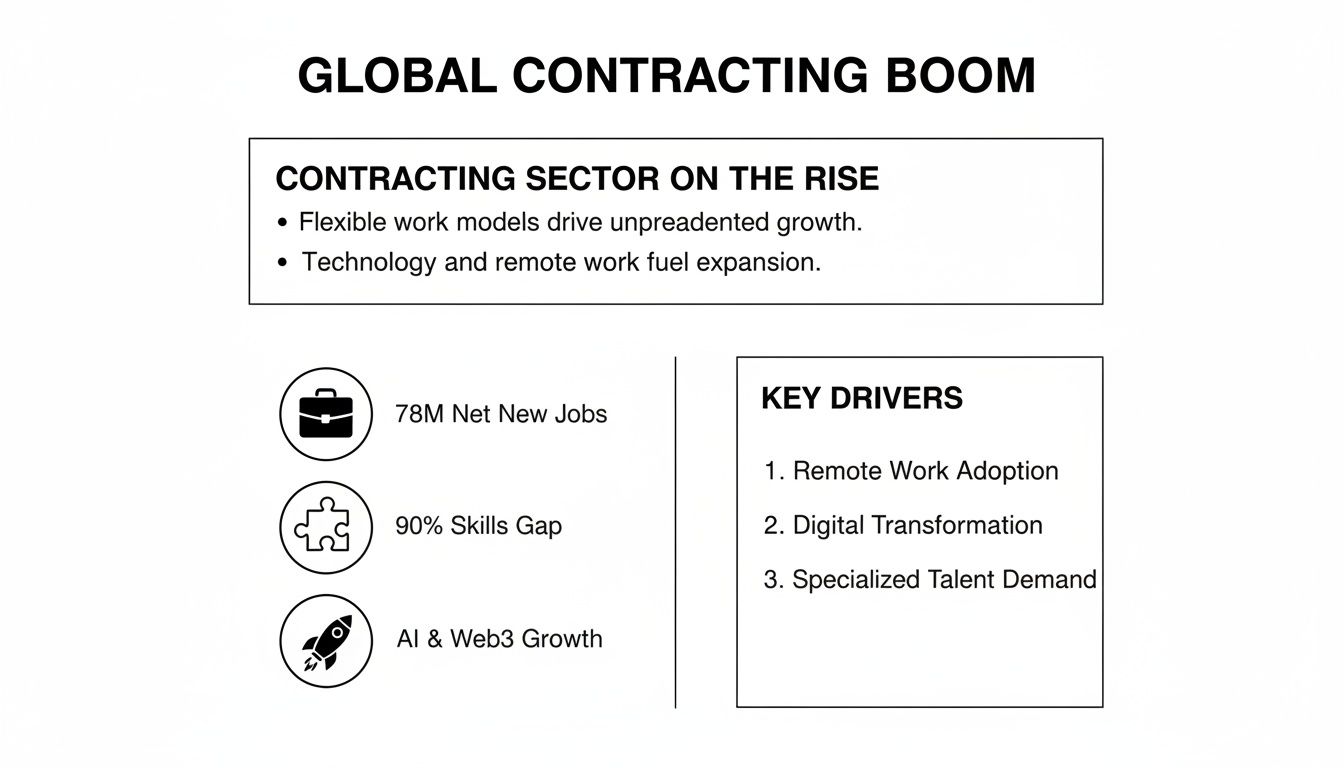
What this data screams is that a huge increase in jobs paired with a staggering 90% skills gap has created the perfect storm for skilled contractors. For anyone looking to advance their career, this is a clear signal of high demand and significant leverage.
To help you get hired, I've put together a comparison of the top platforms where you'll find the best contract gigs.
Top Platforms for Blockchain Contracting Jobs
| Platform Type | Best For | Example Roles | Key Advantage |
|---|---|---|---|
| Niche Job Boards | Quickly finding vetted, full-time & contract roles at serious projects. | Smart Contract Engineer, Blockchain Developer, Head of Growth, Community Manager. | High signal-to-noise ratio; every listing is a direct line to a relevant hiring manager. |
| DAOs | Hands-on contributors who prefer project-based work and community involvement. | Bounties for specific code fixes, grant-funded research, content creation, treasury management. | Proof-of-work model; your contributions often lead directly to paid work without a formal interview. |
| Freelance Marketplaces | Short-term, specific tasks for those building a portfolio or earning side income. | NFT art creation, tokenomics modeling, technical writing, Discord bot development. | Direct access to clients with immediate needs; great for building initial experience. |
| GitHub / Dev Communities | Developers who want to prove their skills through open-source contributions. | Protocol development, bug fixes, building new features for core infrastructure. | Your public contributions act as a live portfolio, attracting inbound interview requests from top teams. |
Each of these channels offers a different path to your next role. The best strategy for career progression is to pick one or two that align with your skills and go deep, building a strong reputation.
Specialized Web3 Job Platforms
While most big job sites are a waste of time, specialized Web3 boards are pure gold. A platform like Blockchain Jobs is built by and for people in the industry, which means you're not sifting through hundreds of irrelevant corporate postings.
Hiring managers here get it. They're looking for real blockchain expertise and understand the lingo. It’s the fastest, most direct route to finding roles posted by well-funded, serious projects. A great starting point is to browse their list of Web3 companies actively hiring to see who’s building cool stuff and might be a good fit for your career goals.
Dive Headfirst into DAOs and Ecosystems
Decentralized Autonomous Organizations (DAOs) are more than just novel corporate structures; they are living communities constantly looking for skilled people. Many have dedicated Discord channels or forums for "bounties" or "grants"—these are paid contract tasks waiting to be claimed, and they are your entry point.
Here’s an actionable plan to get involved and get noticed:
- Start by just showing up. Join the Discord, jump into conversations, and offer helpful advice. This makes you a known entity.
- Grab a small bounty. The quickest way to prove your reliability and skill is to complete a small, paid task. This is your first "work trial."
- Build real relationships. Stick around. Consistent, quality contributions almost always lead to bigger, ongoing contract offers, often without any formal interview.
The fastest way to land a Web3 contract is to stop asking for a job and start doing the work. Contribute to a DAO, solve a problem in a Discord channel, or submit a pull request on GitHub. Your proof-of-work is your interview.
The Unconventional Path: Contribution and Community
Let’s be honest: some of the best-paying, most interesting contract gigs are never posted publicly. They are filled through reputation and direct messages within tight-knit developer circles. This is where career progression truly happens.
Think of your activity on platforms like GitHub and technical Discord servers as your public portfolio. When you submit a thoughtful pull request to an open-source protocol or help another dev work through a tough bug in a community channel, you're marketing yourself in the most authentic way possible.
Hiring managers and lead engineers notice this initiative. It often leads to a DM about a project they're working on. This approach shows you're not just looking for a paycheck; you're genuinely invested in building a better ecosystem. That’s a quality they can’t find on a resume and a massive advantage in any hiring process.
Build a Portfolio That Gets You Hired
When you're chasing Web3 contract gigs, a traditional resume doesn't carry the same weight. What really matters to hiring managers is cold, hard proof that you can do the work. Your portfolio—your GitHub, your project contributions, your social media presence—is your single most powerful asset in the hiring process.
Think of your GitHub profile as your living, breathing resume. A clean profile with key projects pinned, clear README files, and a consistent commit history tells a hiring manager more about your skills and work ethic than any resume ever could. This is often the first place a potential employer looks before even considering an interview.
Your professional social media, especially on platforms like X (formerly Twitter) and LinkedIn, needs to be optimized for inbound opportunities. Pack your bio and headline with relevant keywords like "Smart Contract Developer," "DeFi Strategist," or "Web3 Community Manager." Share your insights on the industry, interact with projects you admire, and showcase what you’re building. This signals to recruiters that you're an active, clued-in member of the community.

Showcase Tangible Proof of Work
A great portfolio is all about showing, not just telling. Build a collection of work that speaks directly to the kinds of problems potential employers are trying to solve. This is your evidence in the interview process.
Here are a few high-impact project ideas that get hiring managers' attention:
- Contribute to an Open-Source Protocol: Find a project you admire and dive in. Submitting a pull request to fix a bug or add a small feature is a massive green flag. It proves you can navigate a real-world codebase and collaborate with a team.
- Publish a Smart Contract Security Audit: Pick a smaller, open-source smart contract and do a basic security review. Write up your findings in a professional report. This demonstrates meticulous attention to detail and a grasp of security principles—a skill that is always in demand.
- Build and Deploy a Simple dApp: Create a small decentralized app that solves a specific problem. The goal isn't to build the next unicorn; it's to prove you can ship a product from concept to deployment, a key competency for any development role.
Your portfolio needs to tell a story. Don't just list your projects. Frame each one with a short narrative: what was the problem, what tech did you use to solve it, and what was the result? This context is what turns a simple list into a compelling argument for hiring you.
This narrative is everything. For example, instead of just saying "dApp for event ticketing," frame it with purpose: "Built an ERC-721 based ticketing dApp to eliminate counterfeit tickets, using Hardhat for development and deploying on the Sepolia testnet to demonstrate core functionality."
Suddenly, you're not just a coder; you're a problem-solver. Curating these tangible examples makes the hiring process less about them guessing your abilities and more about confirming what they can already see.
Mastering Proposals and Nailing Your Rate
Getting your portfolio in front of the right people is half the battle. Closing the deal comes down to a killer proposal and knowing your worth. This is where you pivot from showing what you’ve done to proving what you can do for them, turning a job application into a strategic partnership.
A generic proposal is a one-way ticket to the "no" pile. A great proposal shows you've already started thinking about their specific problem and have a plan. This makes the hiring manager's job easier and immediately puts you ahead of other candidates.
The trick is to stop talking about yourself and start talking about their pain points. When you show you understand why they need help, not just what they need done, you change the dynamic. It’s no longer a job application—it’s a strategic conversation that positions you as a valuable consultant.
Crafting a Proposal That Actually Wins
Think of your proposal not as a resume, but as the first page of your project plan. Its job is to build massive confidence in your abilities before you even get on an interview call. You want them to read it and think, "This person gets it."
A proposal that consistently gets replies follows this simple structure:
- Echo Their Problem: Start by summarizing their challenge in your own words. This immediately proves you've listened and aren't just spamming applications.
- Outline Your Solution: Give them the high-level strategy. What's your game plan? This shows you are a strategic thinker.
- Define the Deliverables: Break it down into concrete milestones. This shows you're organized and helps manage their expectations from day one.
- Connect the Dots (Why You): This is where you tie your past projects directly to their problem. Frame your skills as the exact solution they've been looking for.
Your proposal should be less about your history and more about their future. When a hiring manager reads it, they should feel like you’ve already joined the team and are laying out the roadmap to success.
A Real-World Proposal Scenario
Let's say a DeFi protocol is looking for someone to integrate their lending platform with a new Layer 2 network.
A generic proposal: "I am a smart contract developer with five years of experience in Solidity and Hardhat. I have worked on several DeFi projects and am confident I can handle this integration."
A winning proposal: "I see you're aiming to expand to Arbitrum to slash gas fees and tap into a new user base. I'd tackle this in three phases: first, an L2-compatibility audit of your current contracts; second, a full deployment on the Arbitrum testnet; and finally, a managed mainnet rollout. When I migrated a similar protocol last year, we saw their transaction volume jump by 40%."
The second proposal isn't just applying; it's presenting a business case and demonstrating immediate value, making the hiring decision easy.
Setting Your Rate with Confidence
Pricing your work can feel like a guessing game, but it all comes down to the value you deliver. This is a key part of your career progression and financial independence. Most Web3 contracts fall into two buckets: hourly or project-based.
| Rate Model | Best For | Key Consideration |
|---|---|---|
| Hourly Rate | Open-ended roles, projects with a fuzzy scope, or ongoing consulting. | Simple to track, but you have to be disciplined. It can also unintentionally penalize efficiency. |
| Project-Based Rate | Gigs with crystal-clear deliverables and a defined timeline (e.g., "build this dApp feature"). | Rewards you for working smart and fast, but you carry the risk if you underestimate the work involved. |
As you find contracting jobs, remember to factor in hidden costs. This includes time spent on research, specialized software, and security tools. Your expertise is a high-demand commodity. State your rate with confidence—it signals your professionalism and value to potential employers.
Navigating Contracts and Remote Work in a Decentralized World
Landing the contract is a milestone, but your long-term career success depends on what happens next. The fine print in your agreement, your communication habits, and your invoicing process—these are the details that build a sustainable career and turn one-off jobs into long-term partnerships.
This is where you set professional standards that protect you and make you the kind of contractor teams are eager to re-hire for future projects, fueling your career progression.

Think of your service agreement as your professional shield. Before signing, ensure it clearly covers a few non-negotiables to prevent future headaches.
- Scope of Work: What does "done" actually look like? Get this defined with crystal clarity. Vague terms lead to scope creep and turn a straightforward project into endless revisions.
- Payment Terms: Be specific. Name the currency (USDC, ETH, etc.), the payment schedule (e.g., upon milestone completion, bi-weekly), and how invoicing works. This is non-negotiable.
- IP Ownership: Who owns the code or content you create? Typically, the client owns the final work product once you've been paid in full. Ensure you retain the rights to your own pre-existing tools and methods.
- Termination Clause: This is your professional exit strategy. Make sure the contract outlines exactly how either party can end the agreement if things aren't working out.
Thriving in a Remote-First Culture
Web3 operates in a global, asynchronous world. Mastering remote collaboration is a core competency, not a soft skill. The entire culture inside DAOs and distributed teams is built on trust, transparency, and top-notch communication—qualities that hiring managers actively seek.
This new way of working is driving a huge shift in hiring. Companies are desperate for specialized talent, and contracting is exploding. Consider that 97 million new jobs influenced by AI are expected by 2026, yet 77% of companies already struggle to find the right people. This creates a massive opportunity for skilled remote contractors. In fact, remote work now makes up 40% of all new positions.
The most successful remote contractors are masters of asynchronous communication. They don't wait for a weekly sync-up to give an update. They over-communicate through clear documentation, detailed pull requests on GitHub, and regular status reports that keep everyone aligned across a dozen different time zones.
To stand out in any hiring process, get comfortable with the tools of the trade: Notion for documentation, Discord for community chatter, and GitHub for development. Your ability to get things done independently while keeping everyone in the loop builds a rock-solid reputation. This is exactly how you land great remote opportunities, like this Cosmos Hub Community Manager contract.
Ultimately, being a great Web3 contractor is about more than your technical chops. It’s about being a reliable partner who makes remote work feel effortless. Nail your contracts and master decentralized collaboration, and you’ll become indispensable—the ultimate goal for career growth.
Answering Your Top Questions About Web3 Contracting
As you look for contract roles in Web3, a few questions always come up. Getting clear answers is the best way to move forward with a confident career strategy. Let's tackle the most common questions aspiring contractors ask.
How Do I Get Hired with No Professional Web3 Experience?
This is the classic career-starter's dilemma. The good news: in this space, what you can do matters more than what your resume says. Hiring managers want to see your skills in action. Your goal is to build a public portfolio that serves as your proof-of-work, showing them you’re not just interested—you're already building.
Start by contributing to open-source projects on GitHub. Even small bug fixes or documentation improvements show you can navigate a real-world codebase. Hackathons are another fantastic way to build something fast and network with potential teammates or hiring managers. Ultimately, one of the most powerful things you can do is build a small dApp that solves a real problem. It showcases your end-to-end skills and gives you a tangible project to discuss in an interview.
Should I Accept Payment in Cryptocurrency?
This comes down to your personal financial strategy and risk tolerance. Many Web3 contracts offer payment in stablecoins like USDC, which provides the benefits of crypto rails without the price volatility. It's a reliable way to get paid and manage your finances.
Getting paid in a project’s native token can have a massive upside if the project succeeds, but it's a high-risk, high-reward bet. You must be prepared for the value to fluctuate significantly. A balanced approach often works best for career stability: negotiate a split, perhaps 70% in stablecoins to cover your expenses and 30% in the project's token as a long-term investment in its success. Always consult a tax professional who understands crypto.
How Do I Stand Out in a Global Talent Pool?
When competing globally, being a generalist is tough. The key to career progression is to specialize. Find a high-demand niche and become the go-to expert. Instead of being just another "blockchain developer," you can become a specialist in a high-value area.
Consider diving deep into fields where talent is scarce:
- Zero-Knowledge (ZK) Proofs: Highly technical and in-demand for building privacy and scaling solutions.
- NFT Smart Contract Optimization: Projects need developers who can reduce gas fees and tighten security on their NFT contracts.
- DeFi Security Audits: A critical and very well-compensated specialty for those with a knack for finding vulnerabilities.
Beyond technical skills, your communication is your secret weapon. In a remote-first industry, your ability to clearly document your work, provide regular updates, and collaborate smoothly across time zones is what makes you someone hiring managers want to work with again and again.
In a global, remote talent pool, your reputation for clear communication and reliability is just as important as your code. The best contractors are not just great at what they do; they make the entire team better and the project run smoother.
What Are Red Flags in a Web3 Contract Posting?
Knowing what to avoid is as critical as knowing what to look for. As you hunt for contracting jobs, be wary of any posting with vague deliverables or an undefined scope. This is a classic sign of a disorganized project and a recipe for frustration.
A huge red flag is an anonymous team. If you can't find public history or verifiable info on the founders, be cautious. Legitimate projects are proud of their people. Also, steer clear of any "opportunity" that pressures you to invest your own money or makes unrealistic promises.
Look for a professional interview process, clear goals, and a transparent team. Due diligence is the most important step in protecting your career and reputation.
Ready to put this playbook into action? At Blockchain Jobs, we cut through the noise to connect you directly with the best opportunities in the Web3 ecosystem. Find your next contract role today at https://blockchain-jobs.com.