Hire a Blockchain Developer A Practical Guide for Modern Teams
Before you can even think about hiring a blockchain developer, you have to get crystal clear on what you actually need. What are you building? Is it a brand-new layer-1 protocol? A complex DeFi application? Or maybe a slick, user-friendly NFT marketplace?
Each of these projects demands a wildly different skillset. Getting this first step wrong is easily the most common—and most expensive—mistake a hiring manager can make. It leads to mismatched candidates, frustrating interview loops, and ultimately, hiring someone who isn't equipped for the job.
Pinpointing Your Ideal Blockchain Developer Profile
So, before you jump into writing a job post, you need to translate your product roadmap into a specific developer profile. The term "blockchain developer" is just too vague. This space has matured, and now we have specialized roles, each with its own responsibilities and career trajectory. If you don't grasp these distinctions, you'll end up hiring someone who is incredibly talented but completely wrong for your project.
Differentiating Key Web3 Roles
The best way to start is by figuring out the main technical problem you're trying to solve. Your needs will almost certainly fall into one of three core categories, each with its own career path:
- Protocol Engineer: Think of this person as a systems-level architect. They work deep in the guts of the blockchain's core infrastructure, designing consensus mechanisms, boosting network performance, and building the very foundation you stand on. You need a protocol engineer if your ambition is to create a new blockchain or make significant changes to an existing one. Their career progression leads to roles like Chief Architect or Head of Protocol.
- Smart Contract Developer: This is the most sought-after role in the space. These developers write, test, and deploy the on-chain logic that makes decentralized applications (dApps) tick. They spend their days immersed in languages like Solidity or Rust, obsessing over security vulnerabilities and gas optimization. If you're building a DeFi protocol, a DAO, or an NFT collection, this is who you’re looking for. Senior smart contract developers often become team leads or security auditors.
- Full-Stack Web3 Developer: This engineer is the bridge between the blockchain and the user. They build the front-end interfaces people click on, manage the back-end services, and integrate wallets using libraries like Ethers.js or Web3.js. Their job is to make sure all that complex on-chain logic is actually accessible and usable. This role can progress into a Head of Engineering or Product-focused engineering lead.
Knowing these roles is crucial because it completely shapes your interview process. For a protocol engineer, you'll dive deep into their understanding of cryptography and distributed systems. For a smart contract developer, you'll grill them on security patterns and famous exploits. And for a full-stack Web3 developer, you’ll want to see a portfolio brimming with dApps that people have actually used.
Hiring Insight: Don't hire a protocol guru to build your dApp front-end. It's like asking an F1 engine designer to work on a car's infotainment system—both are brilliant automotive experts, but their skills are not interchangeable. Clarifying the role upfront saves a world of frustration for everyone involved.
Matching Tech Stack to Talent
Your choice of technology has a direct line to the talent pool you'll be fishing in. It’s that simple. If your dApp lives on an EVM-compatible chain like Ethereum or Polygon, you absolutely need a Solidity expert. But if you’re building on Solana or Aptos, proficiency in Rust is completely non-negotiable.
This decision goes way beyond just programming languages. It dictates your entire development environment, from the testing frameworks you use (like Hardhat versus Anchor) to your security tooling.
When you're defining the role, be explicit. Map your exact tech stack to the skills required. For instance, a well-written job description for a Smart Contract Engineer will list the specific tools and frameworks a candidate must know. This level of precision does two things: it attracts developers who can hit the ground running, and it sets a clear standard for your technical assessments during interviews.
Writing a Job Description That Attracts Real Talent

In the hyper-competitive world of Web3, a generic job description is a surefire way to get overlooked. The best developers are mission-driven. They aren't just looking for a paycheck; they want to tackle tough problems and build something that matters. Your job post is your first pitch—your one shot to convince them your vision is worth their time and talent.
Stop thinking of it as a boring list of duties and start treating it like a compelling story. What are the unique technical challenges your project is trying to solve? Don't just say, "Write and deploy smart contracts." Instead, frame it around the impact: "Help us design and implement a novel gas-efficient staking mechanism that will secure millions in user assets." See the difference? One is a task, the other is a challenge.
The most ambitious builders are also thinking about their careers. Your description needs to show them a clear path forward. Spell out how joining your team will help them level up their skills, gain ownership, and make a name for themselves in the space.
More Than Just Bullet Points
To really cut through the noise, you have to offer the transparency developers are starved for. Be upfront about your entire tech stack, your engineering philosophy, and what a typical day or sprint actually looks like. This isn't just extra detail; it helps the right candidates self-select, saving you from interviews that go nowhere.
A standout job description is more than a list of "must-haves." It's a window into your company's soul. This table breaks down the key components that will get your open role noticed by the right people.
Anatomy of a Standout Web3 Job Description
| Component | What to Include | Why It Matters to Developers |
|---|---|---|
| The Mission | A powerful one-paragraph summary of your project's "why." | Top talent wants to contribute to something meaningful, not just another project. |
| The Impact | What this specific developer will own. e.g., "You will lead the architecture for our cross-chain messaging protocol." | Developers crave ownership. It shows you trust them and signals career growth. |
| The Challenges | The 2-3 most interesting technical problems they'll tackle in their first 6 months. | This is the exciting part! It proves the work is engaging and a chance to level up. |
| Career Path | How does this role evolve? Mention opportunities for mentorship, leadership, and skill development. | The best candidates are ambitious. Show them a future, not just a job. |
| Tech Stack | A specific list of languages, frameworks, chains, and tools. | This immediately tells them if their skills are a match and shows you know what you're doing. |
| Compensation | A clear salary range, plus details on equity and/or token incentives. | Transparency builds trust from day one and filters out mismatched expectations. |
By structuring your post this way, you're not just listing requirements; you're starting a conversation and showing candidates that you're a serious, well-organized team that invests in its people.
Hiring Insight: Top developers judge a company by the quality of its job description. A sloppy, vague post signals a chaotic internal culture. A thoughtful, detailed one suggests a team that values clarity, excellence, and its people.
Be Radically Transparent About Pay
Finally, let's talk about money. You have to address it head-on. The days of "competitive salary" are over, especially in Web3 where talent expects radical transparency.
Post a clear salary range. If you offer tokens, explain how the incentives are structured. What’s the vesting schedule? What’s the token’s utility and potential upside? This honesty does more than just build trust—it saves everyone an incredible amount of time by filtering for candidates whose expectations actually align with your budget. When you want to hire a blockchain developer, this level of candor isn't just a nice-to-have; it's a critical first step.
Where to Find and Vet Top Blockchain Candidates
If you want to hire a great blockchain developer, you need to think like one. That means looking for talent where they actually spend their time—and it's rarely on traditional platforms like LinkedIn. The best people are already deep in the trenches, building, collaborating in niche communities, and putting their work on-chain for the world to see.
To find developers who are truly part of the ecosystem, you have to meet them on their turf. A multi-channel strategy is non-negotiable. This starts with moving your search to the places where Web3 culture is alive and well, especially specialized job boards that attract a crypto-native crowd.
Go Beyond Conventional Job Boards
Casting a wide net on general tech sites will just leave you sifting through a sea of irrelevant resumes. Niche Web3 boards, on the other hand, offer a highly concentrated pool of talent. These are the platforms where developers who are serious about a career in blockchain go first.
- Web3-Specific Job Sites: Platforms like CryptoJobsList and Web3.career are absolute goldmines. They cut through the noise, connecting you directly with professionals who have relevant, verifiable experience.
- Community Channels: Never underestimate the power of Discord and Telegram. I've found incredible talent by becoming an active member of servers for major protocols like Ethereum or Solana, or even for developer tools like Hardhat. Participate authentically, and you’ll find people through insightful conversations and the projects they share.
For a curated list of opportunities designed to reach this specialized audience, you can find active blockchain jobs on our platform, which connects companies directly with proven Web3 professionals.
Vet Candidates by Their Public Contributions
In the world of blockchain, a developer’s real resume is their public activity. You can learn a massive amount about a candidate’s skills and passion before ever hopping on a call, just by looking at their digital footprint. This is a crucial pre-screening step that helps you separate the tourists from the true builders.
The first stop should always be their GitHub profile. Are they working on personal projects? Making meaningful contributions to open-source protocols? Is their code clean and well-commented? A strong commit history tells a powerful story about their consistency, work ethic, and ability to collaborate—all key indicators for a successful hire.
From there, dive into their on-chain activity. Grab a block explorer and see what they've been up to. Have they deployed smart contracts, participated in DAOs, minted NFTs, or experimented with DeFi protocols? This kind of activity is hard evidence of hands-on experience and a genuine curiosity for the space—qualities you simply can't fake on a resume.
Hiring Insight: I'd much rather see a candidate with a modest but active GitHub and a history of on-chain experimentation than someone with a polished resume but no public proof of work. Look for the passion projects and genuine engagement; that’s where you find the hidden gems.
Running Technical Interviews That Reveal True Skill
Alright, you’ve got a pipeline of promising candidates. Now for the hard part: figuring out who can actually build secure, efficient systems on the blockchain. This is where you need to move beyond standard coding puzzles and into an interview process that simulates the real-world pressures of Web3 development.
Think of your interview process as a multi-stage gauntlet. Each stage should be designed to test a specific skill, from foundational knowledge to complex architectural thinking. The goal isn't to stump them with abstract brain teasers, but to see how they solve problems—the kinds of problems they'll face on day one. A great process feels less like a test and more like a collaborative work session, giving both you and the candidate a feel for what it's like to work together.
This chart breaks down the high-level flow, showing how interviews are the critical filter after you've done the hard work of sourcing.
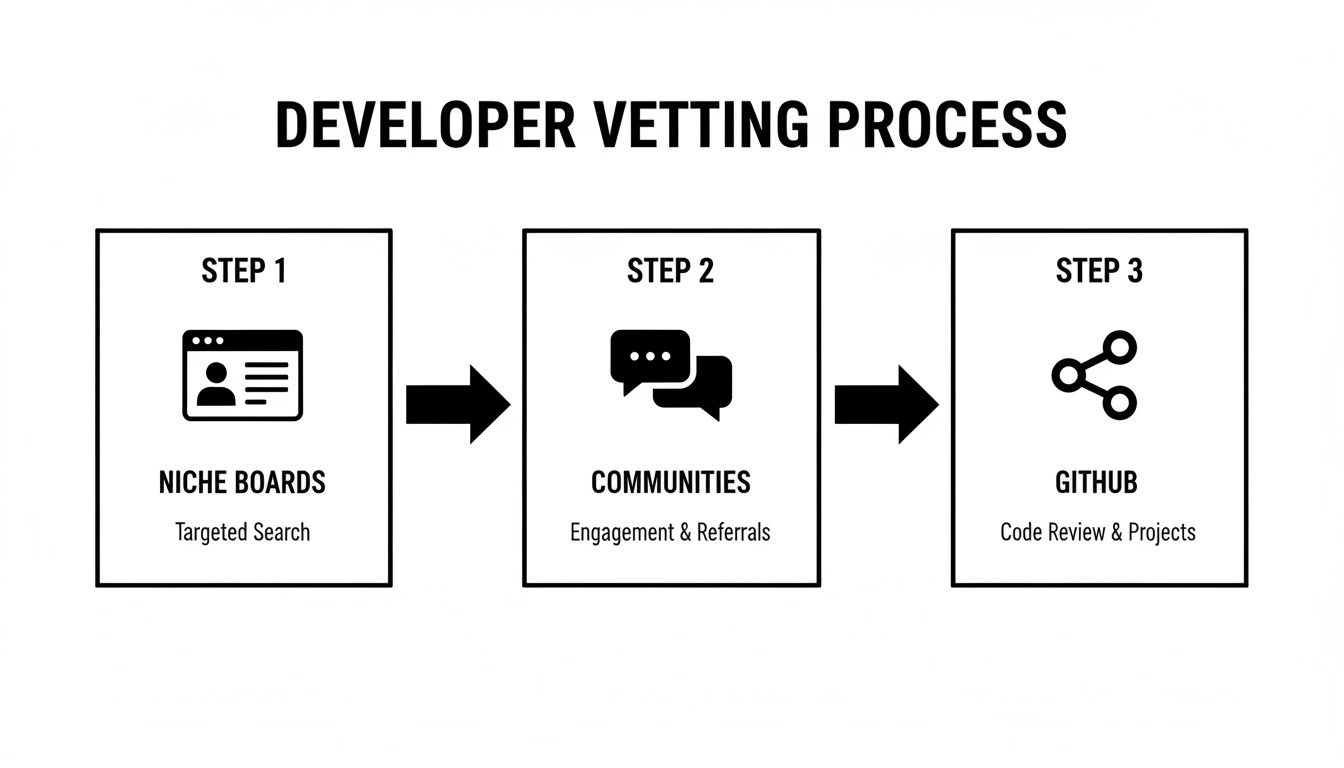
As you can see, the interview is the final crucible where you validate the skills of the talent you've found through specialized channels.
The Multi-Stage Interview Framework
A rock-solid process usually has three main parts. Each one gives you a different lens through which to evaluate a candidate's potential for career growth on your team.
- The Quick Technical Screen: Start with a 30-45 minute chat led by one of your senior engineers. This is your first-pass filter. You’re checking for core, non-negotiable knowledge. Ask them to explain the difference between
call,delegatecall, andstaticcall. Or have them walk you through a consensus mechanism like Proof-of-Stake. If they can’t handle the basics here, they won’t survive the next stages. - The Hands-On Coding Challenge: This is where you separate the talkers from the doers. Give them a take-home assignment that mirrors a real task. Think small and well-defined: write a simple ERC-20 token with one unique twist, debug a snippet of code with a known vulnerability, or refactor a function to make it more gas-efficient. Their solution tells you everything about their coding style, how they approach testing, and their eye for detail.
- The Systems Design Deep Dive: This is the final boss, where you gauge their senior-level potential. Present a high-level, open-ended problem. “Design a decentralized voting system” or “Architect a simple lending protocol.” Then, you sit back and watch how they think. Are they considering trade-offs? Security? Scalability? This is where you find out if you’re talking to a junior coder or a future architect.
Hiring Insight: The best candidates don't just start coding. They ask a ton of clarifying questions about the systems design problem. If someone dives right in without thinking through the architecture and edge cases, that’s a major red flag for their problem-solving ability.
Probing for Deeper Understanding
The quality of your questions matters just as much as the structure of your interviews. You want to understand how they think, not just what they can recite from a textbook.
- Security Scenarios: Don’t just ask, “What is a reentrancy attack?” That’s a trivia question. Instead, frame it as a problem: "You're reviewing a contract that allows users to withdraw funds. Walk me through the code, point out any reentrancy vulnerabilities, and tell me exactly how you’d fix them."
- Gas Optimization Trade-offs: Pose a real-world dilemma. For instance, "We need to store user data on-chain. What are the gas implications of using a
mappingversus anarray? Can you think of a scenario where you'd deliberately choose the more expensive option?" This reveals their ability to make pragmatic engineering decisions. - Protocol-Level Thinking: If you’re hiring for a core protocol role, like a Staff Software Engineer working on Blockchain Protocols, test their strategic thinking. Ask something like, "How would you design our network to handle a potential 51% attack scenario? What are the long-term implications for the protocol's reputation?"
To keep your evaluations consistent and fair, it helps to use a standardized rubric. This removes bias and forces your interview team to score candidates based on the same criteria.
Blockchain Developer Interview Scorecard
Use this rubric to objectively assess candidates across crucial technical and collaborative skills during the interview process.
| Skill Category | Evaluation Criteria | Rating (1-5) |
|---|---|---|
| Solidity & EVM | Demonstrates deep knowledge of smart contract patterns, gas optimization techniques, and EVM-specific nuances. | |
| Security Mindset | Proactively identifies common vulnerabilities (reentrancy, integer overflows) and designs defensive code. | |
| System Architecture | Ability to design scalable, decentralized systems, considering trade-offs between on-chain and off-chain logic. | |
| Problem-Solving | Breaks down complex, ambiguous problems into clear, actionable steps. Asks clarifying questions. | |
| Testing & Debugging | Explains their approach to testing smart contracts (unit, integration) and demonstrates methodical debugging skills. | |
| Collaboration & Communication | Clearly articulates technical concepts and thought processes to both technical and non-technical stakeholders. |
By using a scorecard like this, you can make a data-driven hiring decision, ensuring you're bringing on developers with proven, relevant skills.
This methodical approach ensures you hire a blockchain developer who can truly deliver. With the demand for Web3 talent pushing salaries up by 15-20% in just the last three years, a rigorous interview process isn't just a good idea—it's essential for protecting your investment.
Crafting a Competitive Offer and Onboarding for Success
You’ve made it through the entire hiring gauntlet and found a fantastic candidate. Now for the final, critical step: crafting an offer they can't refuse. In the Web3 space, a compelling package goes far beyond a simple salary number. The best developers aren't just looking for a paycheck; they want a genuine stake in the project's future, a way to tie their own success directly to yours.
This means you have to think differently about compensation. Move past traditional models and consider incorporating equity, token warrants, or performance bonuses that are directly linked to key product milestones. These kinds of incentives do more than just sweeten the deal—they signal that you see your developer as a true partner, not just another employee. It shows you’re in it for the long haul and gives them a powerful reason to pour their best work into your vision.
Building a Modern Web3 Compensation Package
To put together an offer that actually lands, you have to know the market. Let’s be clear: hiring a blockchain developer is a significant investment. Globally, average salaries are sitting around $150,000 per year, with the full range spanning from $78,000 all the way up to $262,000. This spread reflects the intense demand for highly specialized skills in areas like DeFi, NFTs, and smart contract security. You can dig into more of these salary benchmarks over on Web3.career.
A truly competitive offer will almost always blend several components:
- Base Salary: The foundation. This is the reliable cash component that covers living expenses and provides essential stability. Don’t skimp here.
- Equity/Stock Options: For more established companies, this is a familiar way to offer a share in the company’s growth and success.
- Token Warrants/Grants: The crypto-native incentive. This gives developers a direct, tangible stake in the protocol itself. Just be completely transparent about vesting schedules and the token's real utility.
- Performance Bonuses: These can be paid in fiat or tokens for hitting specific, measurable goals—think a successful mainnet launch or passing a security audit with zero critical vulnerabilities.
Your offer is the final piece of your pitch. It’s a reflection of your company's values, your belief in the candidate, and your vision for the future. Don’t lose a top-tier developer at the last minute because of a one-dimensional offer.
A Structured Onboarding for Long-Term Retention
Getting that "yes" on your offer feels like the finish line, but it’s really just the beginning. The real work of retaining great talent starts on day one, and it all comes down to a seamless onboarding experience that sets them up for career progression. A chaotic or confusing first few weeks can kill a new hire's excitement and set a negative tone.
Your best bet is to implement a structured 30-60-90 day plan. This isn't corporate fluff; it's a practical roadmap that clearly outlines expectations, provides all the necessary resources, and assigns a dedicated mentor to help them succeed.
- First 30 Days: Integration. The focus here is getting them acclimated. They should be learning the tech stack, digging into the existing codebase, meeting the team, and maybe tackling a small, low-risk coding task to build some early confidence.
- Next 30 Days: Contribution. Now, it's time to shift gears. The developer should start taking ownership of a small feature, actively participating in code reviews, and beginning to contribute to architectural discussions. This is their first step toward real impact.
- Final 30 Days: Autonomy. By the 90-day mark, they should be a fully integrated member of the team. The goal is for them to feel empowered to tackle larger tasks independently and contribute meaningfully to the product roadmap, demonstrating their readiness for future challenges.
This methodical approach ensures your new hire feels supported and can start making a real impact quickly. It’s the difference between a new employee who thrives and one who flounders, and it sets the stage for a long and productive career with your company.
Got Questions About Hiring Blockchain Developers? We've Got Answers.
Hiring your first blockchain developer can feel like navigating a minefield, especially if you're coming from a non-technical background. The questions that pop up aren't always simple, but getting them right can be the difference between a game-changing hire and a very expensive misstep. Let’s walk through some of the most common ones I hear from hiring managers.
What’s This Going to Cost Me?
Let's get straight to it: money. The demand for skilled blockchain developers has absolutely exploded, and that means they command a premium over most traditional software engineering roles. It's a simple case of supply and demand.
In the US, for example, you’re looking at an average base salary of $140,477, and that's before you factor in another $17,347 in typical cash bonuses. If you want to dive deeper into the numbers, the full salary data from Built In is a great resource. Knowing these figures from the get-go is crucial for setting a realistic budget and making sure your offers are competitive enough to even get a conversation started.
How Can I Spot Real Expertise If I'm Not Technical?
This is the big one. I see it trip up founders and product managers all the time. How do you really know if a candidate has the technical chops if you can’t read a line of Solidity yourself?
The trick is to shift your focus from the code itself to their thought process and communication.
When you’re in the interview, ask them to walk you through a complex project they've worked on, but with one condition: they have to explain it like you're a non-technical manager. A truly skilled developer can break down their architectural decisions and security trade-offs in a way anyone can understand. This isn't just a test of their knowledge; it's a test of their communication skills, which are vital for career progression.
Another great tactic is to use a structured, practical assessment. Give them a take-home coding challenge and then have a trusted senior engineer—or even a third-party consultant—review it. They'll know exactly what to look for:
- Security: Did they protect against common vulnerabilities like reentrancy attacks? This is non-negotiable.
- Efficiency: Is the code gas-optimized? Inefficient code can cost users a fortune.
- Readability: Is it clean, commented, and easy for another developer to pick up? This shows they can work in a team.
This gives you hard data to base your decision on, taking the guesswork out of the equation.
Where Are All the Best Developers Hiding?
Sure, the Web3-specific job boards are a good place to start, but the most passionate and proactive developers? They're usually not just sitting around waiting for a job post. They're already building and progressing in their careers.
You have to go where the talent lives. Look in these often-overlooked spots:
- Hackathon Winners: Check out platforms like ETHGlobal. The people winning or even just participating in these high-pressure events are the real innovators, proving their skills under pressure.
- Open-Source Contributors: Spend some time on the GitHub repos for major protocols. Who’s consistently submitting pull requests, squashing bugs, and improving the documentation? That’s pure gold for identifying collaborative and skilled engineers.
- DAO Members: Anyone actively contributing to a DAO has already proven they can collaborate in a crypto-native environment and are deeply committed to the space.
Hiring Insight: Remember, you're not just hiring a coder. You're hiring a future leader and community member. When you source from these channels, you find people who are already living and breathing the culture and technology you're building on.
Finding the right Web3 talent is tough, but you don’t have to go it alone. At Blockchain Jobs, we specialize in connecting forward-thinking companies with the crypto-native professionals who are ready to build the future.
Ready to find the developers you’ve been looking for? Post a Job on Blockchain Jobs today.